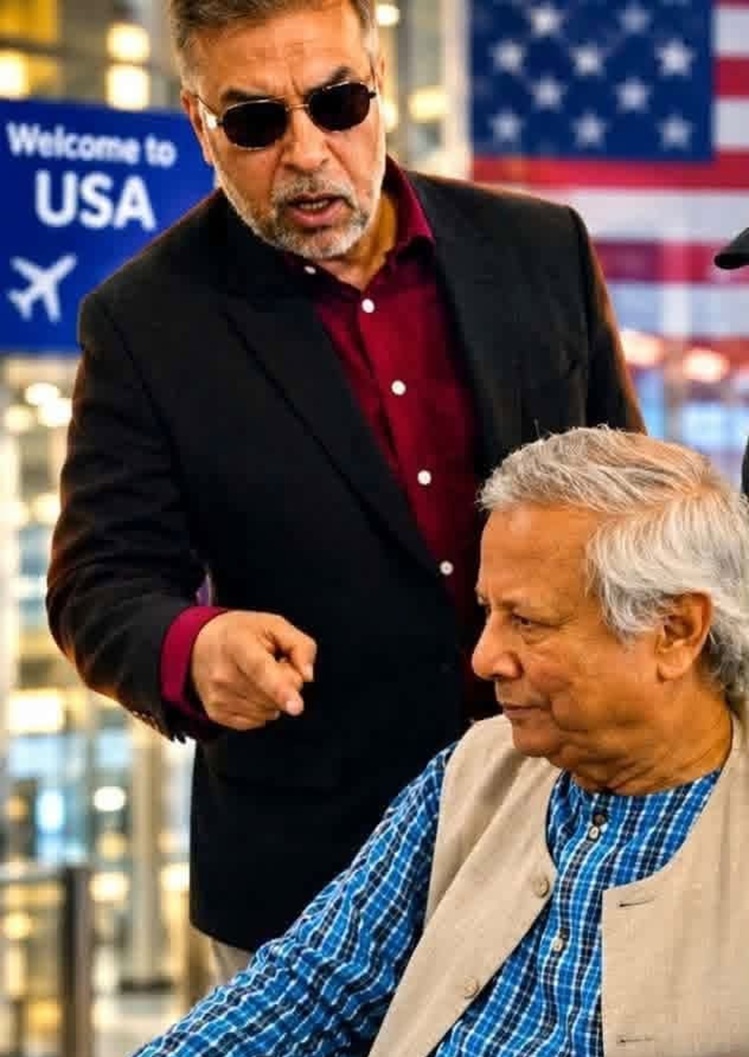
NEW YORK: Activists affiliated with the Awami League have claimed that they staged a protest against Dr. Muhammad Yunus at John F. Kennedy International Airport in New York on October 12, expressing anger over Bangladesh’s political situation and the restrictions imposed on their party’s political activities. In a social media post accompanying a video, the activists claimed that a group led by Imdad Chowdhury, general secretary of the New York Metropolitan Awami League, confronted Yunus at the airport.
According to the post, other participants included Mizan Chowdhury, general secretary of the US Jubo League; Sakhawat Hossain Chanchal, vice president of the New York Metropolitan Awami League; Tanvir Kaisar, general secretary of the Jackson Heights Awami League; and Jubo League leader Sagor.
The post raised several allegations concerning Bangladesh’s political environment, including claims of political repression, mob violence, police killings, attacks on opposition activists, arrests, assaults, killings, torture, and vandalism and looting of homes and businesses. These allegations reflect the protesters’ claims and have not been independently verified in connection with the airport incident.
The activists also expressed anger over the ban on the Awami League’s political activities and questioned the purpose of Yunus’s visit to the United States. According to the social media account, they sought answers from him about Bangladesh’s political situation. The post further claimed that Yunus left the area quickly with his associates without responding to their questions. The circumstances of the encounter could not be independently established from the account provided.
Dr. Muhammad Yunus assumed leadership of Bangladesh’s interim government after Sheikh Hasina’s government fell in August 2024 following a student-led mass uprising. The political transition prompted discussions about democratic reform, accountability, judicial independence, and investigations into alleged human rights violations committed under the previous administration.
At the same time, the interim government faced criticism over political violence, retaliatory attacks, arrests, and law enforcement practices. Following the change of government, cases were filed against numerous Awami League leaders and activists, and several were arrested. Concerns were also raised about alleged politically motivated harassment, arbitrary detention, and the need to uphold due process.
These developments have placed political accountability and human rights protection at the center of Bangladesh’s ongoing political debate. Ensuring justice for past abuses while protecting the legal rights and security of citizens regardless of political affiliation remains a significant challenge.
On May 11, 2025, Yunus’s interim government announced a decision to prohibit all activities of the Awami League under the Anti-Terrorism Act. The government said the measure was taken in the interest of national security while legal proceedings concerning serious allegations against the party were underway. Allegations of involvement in deaths during the 2024 uprising were among the issues cited in the context of the decision.
The Awami League rejected the ban, calling it unacceptable. The decision triggered debate over the party’s ability to conduct public political activities, maintain its organizational structure, and participate in the country’s political process.
The restrictions also raised broader questions about political pluralism, freedom of association, and the distinction between prosecuting individuals accused of crimes and restricting the activities of an entire political organization.
Human Rights Watch’s World Report 2026 raised concerns about arrests under the interim government, including the detention of thousands of people described as political opponents. The report discussed the detention of Awami League leaders, members, and supporters, difficulties in obtaining bail, and the importance of ensuring due process. The broader human rights debate has focused on whether arrests are based on credible evidence and whether detainees receive fair treatment under the law. Human rights advocates have emphasized that allegations of criminal conduct should be investigated individually and adjudicated through independent legal proceedings.
Concerns have also persisted over mob attacks, harassment of political opponents, and obstruction of political meetings and demonstrations. Public humiliation, physical assaults, and organized pressure intended to silence political activity pose challenges to the rule of law and the protection of civil liberties.
In a July 2025 assessment, Human Rights Watch said retaliatory violence and human rights violations had continued following the fall of Sheikh Hasina’s government. The organization cited attacks on Hindu homes in Rangpur and clashes in Gopalganj in which five people were killed. It also expressed concern over the detention of people considered supporters of the Awami League following the Gopalganj violence.
These incidents underscored the risks of political retaliation during periods of transition. Human rights advocates have stressed that allegations against individuals or groups should be addressed through impartial investigations, credible evidence, and fair judicial proceedings rather than collective punishment.
Bangladesh’s political landscape has continued to evolve following the February 2026 national election. As a result, scrutiny of the interim government’s decisions has increasingly intersected with questions about political rights, arrests, and freedom of expression under the current administration.
In an October 5, 2026, report, Human Rights Watch said police took approximately 290 people into custody from a meeting of a left-wing political party in Dhaka. According to the report, authorities alleged that those detained had attended a clandestine meeting of the banned Awami League. The organization also reported that 27 of the detainees were subsequently sent to court custody.
The reported incident renewed concerns about the use of mass detention in cases involving alleged political affiliation or participation in gatherings associated with a banned party. Human rights advocates argue that accountability for abuses committed under previous administrations must go hand in hand with protections against arbitrary detention and politically motivated restrictions under the current government. Political affiliation alone should not determine a person’s right to freedom, a fair hearing, or peaceful political participation.
Bangladesh’s political divisions have also become increasingly visible among expatriate communities in the United States. Political rallies, competing slogans, and allegations of confrontations involving supporters of rival parties have highlighted tensions within the Bangladeshi diaspora, particularly in New York.
The claimed October 12 protest against Yunus at JFK Airport is another example of how developments in Bangladesh continue to shape political activism among expatriate Awami League supporters.
The airport incident also highlights the competing narratives surrounding Bangladesh’s political transition. Supporters of the former ruling party have raised concerns about political exclusion and alleged repression, while the authorities have cited accountability for serious alleged crimes as a justification for restrictions and legal proceedings.
The claims surrounding the airport encounter, however, should be distinguished from independently established facts about the incident and the broader political allegations.
Bangladesh’s political future will depend in part on whether the country can pursue accountability for past human rights violations while safeguarding political freedoms, public safety, and the rule of law. Allegations of crimes should be investigated impartially, with individuals held accountable on the basis of evidence and through fair legal proceedings. At the same time, political identity should not be grounds for collective punishment, arbitrary detention, or violence.
As Bangladesh continues to navigate the consequences of the 2024 political upheaval and the subsequent transition of power, ensuring equal protection under the law and meaningful political participation remains essential to restoring public confidence in democratic institutions.

