Cuba Condemns US Pressure, Warns of ‘Law of the Jungle’ at UN

Shibbir Ahmed, New York — Cuba’s Foreign Minister Bruno Eduardo Rodríguez Parrilla has warned that growing military and economic pressure in Latin America and the Caribbean is threatening international law, while accusing the United States of intensifying its longstanding campaign to isolate and weaken Cuba.

Addressing the General Debate of the 81st session of the United Nations General Assembly on Saturday, Rodríguez Parrilla said the international system was facing a rise in what he described as “expansionism, usurpation, plunder” and military and economic aggression.

He argued that fundamental principles of the UN Charter, including the sovereign equality of states, were under increasing pressure. The Cuban foreign minister called for the United Nations to be strengthened and made “more democratic and effective,” with a closer connection to the people it serves.

Cuba accuses US of economic pressure

A major part of Rodríguez Parrilla’s address focused on Cuba’s decades-long confrontation with Washington. He accused the United States of escalating economic pressure on Cuba since January, including what he called an “energy blockade” and efforts to discourage other countries from exporting fuel to the island. According to the Cuban minister, more than 7,000 containers were stranded in ports, including shipments containing food, medicines and medical equipment. He said some of the shipments had already been paid for by Cuban private companies.

Rodríguez Parrilla also accused Washington of putting pressure on foreign investors, restricting tourism and limiting Cuba’s access to financing, technology and international markets. He further criticized US efforts to discourage governments from maintaining arrangements under which Cuban medical professionals provide healthcare overseas.

“The economic warfare is aimed against the people,” Rodríguez Parrilla said, characterizing the alleged impact on Cuban families as deliberate “collective punishment.” He rejected claims that Cuba poses a threat to US national security.

“Cuba is not a threat; the blockade is!” he declared.

Havana says it remains open to dialogue

Despite his criticism of US policy, Rodríguez Parrilla said Cuba remained willing to engage in dialogue with Washington. He said any negotiations should be based on sovereign equality, respect for international law, non-interference in domestic affairs and the absence of preconditions. The Cuban government has maintained for decades that the US economic embargo has imposed significant costs on the country’s economy, while Washington has defended its policies on various political and security grounds.

Cuba outlines changes at home

The foreign minister also highlighted changes Cuba is pursuing in response to its economic and social difficulties. He pointed to a new program adopted by the National People’s Power Assembly that introduces new economic practices, actors and concepts while maintaining Cuba’s constitutional framework and socialist system.

According to Rodríguez Parrilla, the process is intended to address the needs of the Cuban population while pursuing what he described as greater social justice and protecting the country’s sovereignty and right to self-determination.

Warning over militarization in Latin America

Turning to the wider region, Rodríguez Parrilla criticized what he described as attempts at militarization, intervention and domination in Latin America and the Caribbean. He rejected the Monroe Doctrine and referred to the region’s 2014 declaration as a Zone of Peace.

The Cuban foreign minister also expressed solidarity with Small Island Developing States facing the effects of climate change, reiterated Cuba’s support for Nicaragua, backed Puerto Rico’s right to self-determination, and supported calls for reparations to African and Caribbean nations over colonialism and the transatlantic slave trade.

Concluding his address, Rodríguez Parrilla warned that allowing powerful states to impose their will through intimidation and coercion would create an unstable international order. “The law of the jungle cannot be the future of humanity,” he told the General Assembly, urging countries to strengthen the United Nations and preserve its role in international affairs.


Iran Proposes Seven-Day Plan to Reopen Strait of Hormuz

Shibbir Ahmed, New York — Iran has proposed a plan that could reopen the strategically important Strait of Hormuz within seven days and pause fighting across the region, Iranian officials said during the United Nations General Assembly in New York.

Iranian Foreign Minister Abbas Araqchi said the proposal was transmitted to the United States through Qatari mediators. Under the proposal, a seven-day countdown would begin once Washington agrees to the terms, potentially leading to the reopening of the strategic waterway and a halt to hostilities. The Strait of Hormuz is one of the world’s most important energy-shipping routes, making its continued disruption a major concern for global oil markets and international trade.

Iran’s proposal reportedly calls for the United States to lift its blockade on Iranian ports, release frozen Iranian funds and waive oil sanctions. Tehran has also indicated that broader negotiations could follow once fighting is halted.

Iranian officials have said they are not prepared to make concessions on their nuclear program as part of the proposal. Tehran maintains that it retains rights related to uranium enrichment and has rejected demands that it surrender highly enriched uranium.

The initiative comes amid continuing military tensions across the Middle East. The disruption of oil shipments through the Strait of Hormuz has added pressure to global energy markets and raised concerns about alternative shipping routes.

Iran has also discussed safe shipping arrangements in the strait with Saudi Arabia, according to Iranian officials. The United States has not formally accepted Iran’s proposal, leaving the status of the initiative uncertain.


Bangladesh Sramik League Holds Protest Outside UN Headquarters in New York

NEW YORK: A protest rally was held outside the United Nations headquarters in New York on Wednesday, with the Bangladesh Sramik League USA chapter calling for the withdrawal of the ban imposed on the Bangladesh Awami League and the Sramik League. The protest was organized at 2 p.m. during the ongoing United Nations General Assembly session. Organizers said the demonstration was aimed at drawing international attention to their demands, including the withdrawal of restrictions on the Sramik League in accordance with the principles of International Labour Organization (ILO) conventions.

Nazmul Alam Romen, an executive member of the central committee of the Bangladesh Sramik League, addressed the rally as the chief guest. The event was chaired by Kazi Azizul Haque Khokon, president of the Sramik League USA, and moderated by Jewel Ahmed, general secretary of the organization. Speakers alleged that following August 5, 2024, the activities of the Bangladesh Awami League and its affiliated and associated organizations were banned through an executive order. They further claimed that the activities of the Bangladesh Sramik League, which they described as affiliated with the International Labour Organization (ILO) and the International Trade Union Confederation (ITUC), were also prohibited in violation of labour laws.

The speakers said the right to form and join trade unions is recognized by the ILO as a fundamental labour right. They said protecting trade union rights is important for ensuring democratic conditions in the workplace and allowing workers to pursue their legitimate demands.

Referring to ILO conventions, the speakers said Convention No. 87 protects freedom of association and the right to organize, while Convention No. 98 provides protection against anti-union discrimination. They alleged that the ban on the Sramik League’s activities through an executive order violates these principles.

The speakers also alleged that the headquarters of the Bangladesh Awami League and the Sramik League at 23 Bangabandhu Avenue in Dhaka had been burned and destroyed, while offices of various trade unions affiliated with the Sramik League had been closed.

They further claimed that thousands of Sramik League activists had lost their jobs and that workers had been killed or injured in attacks, while others were being harassed through what they described as false cases.

The rally called for the withdrawal of the restrictions on the Bangladesh Awami League and the immediate lifting of the ban on the Sramik League’s activities, which the speakers said should be done in accordance with ILO conventions. The speakers also called on the ILO, ITUC, international human rights organizations and the broader international community to take notice of their concerns.

Among those attending the rally were Sramik League USA leaders M.A. Alam Biplob, Laskar Moyzur Rahman Jewel, Abdur Razzak Anwar, Md. Motaleb Hossain and Saidul Islam, among others.


US, Bangladesh Reaffirm Strong Defense Ties

DHAKA — U.S. Ambassador to Bangladesh Christensen and Chief of Army Staff General Waqar-Uz-Zaman have reaffirmed the enduring strength of the defense relationship between the United States and Bangladesh. In a statement following the meeting, Ambassador Christensen said he and General Waqar-Uz-Zaman reaffirmed their commitment to the longstanding defense partnership between the two countries.

The ambassador also expressed appreciation for Bangladesh’s substantial contribution to the Haiti Gang Suppression Force, highlighting the country’s role in international security efforts.

“Chief of Army Staff General Waqar-Uz-Zaman and I reaffirmed the enduring strength of the U.S.-Bangladesh defense relationship,” Christensen said.

“I also expressed my appreciation for Bangladesh’s substantial contribution to the Haiti Gang Suppression Force—an example of Bangladesh’s important role as a global security partner,” he added.

Bangladesh has a long-standing record of participation in international peace and security operations. Its contribution to the Haiti mission underscores the country’s continued engagement in multinational efforts to address security challenges. The meeting comes as Washington and Dhaka continue to strengthen cooperation in defense and security, alongside broader bilateral engagement between the two countries.


Trump Announces Greenland Security Deal

Shibbir Ahmed, Washington DC — President Donald Trump has announced a new security agreement involving the United States, Denmark and Greenland that would expand the U.S. military presence on the strategically important Arctic island and give Washington long-term security access. Trump announced the agreement on September 18, describing it as providing the United States with “permanent control” over Greenland’s security and saying it would address Washington’s national security concerns. He also said the United States would begin developing plans for a larger military presence on the island.

The agreement does not transfer Greenland’s sovereignty to the United States. Denmark and Greenland said the arrangement recognizes the sovereignty and territorial integrity of the Kingdom of Denmark as well as the Greenlandic people’s right to self-determination. The governments have also indicated that the agreement must go through the necessary parliamentary procedures before it can take effect.

The precise terms of the agreement have not yet been made public. According to reporting by Reuters, the deal would allow the United States to expand its military presence in Greenland while preventing U.S. adversaries from establishing military bases on the island or making sensitive investments there.

A U.S. State Department official said the agreement guarantees Washington permanent access, basing and overflight rights and is designed to remain in place even if Greenland eventually becomes independent. The official also said the agreement would prevent non-NATO countries from establishing military bases in Greenland.

Trump said the United States would work with Greenland’s population on the development and construction of additional military facilities. The United States already maintains a significant military installation at Pituffik Space Base in northwestern Greenland, formerly known as Thule Air Base. The U.S. has maintained military facilities on the island for decades under a 1951 defense agreement with Denmark.

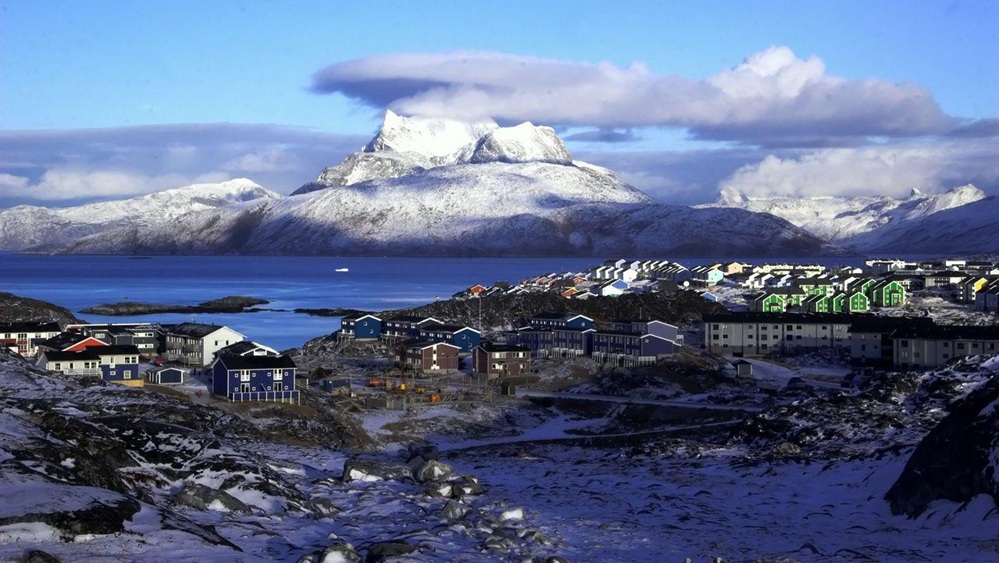
Greenland’s Arctic landscape highlights the island’s strategic importance in the region.

The announcement follows months of tension over Greenland. Trump has repeatedly argued that the island is strategically important to U.S. national security because of its location between North America, Europe and the Arctic region. His earlier push to acquire Greenland generated strong opposition in Denmark and Greenland and created tensions with other NATO allies.

Danish Prime Minister Mette Frederiksen said the agreement would strengthen security in the Arctic and North Atlantic and would be beneficial to NATO and Europe. She also emphasized that the arrangement recognizes Denmark’s sovereignty and Greenland’s right to self-determination.

Greenland’s Prime Minister Jens-Frederik Nielsen also welcomed the agreement, saying it recognizes Greenland’s interests and its role in international cooperation. Greenland is an autonomous territory within the Kingdom of Denmark and has its own government and parliament.

U.S. Secretary of State Marco Rubio said the agreement addresses Washington’s national security concerns and ensures that Greenland remains part of the strategic defense area of North America. NATO also welcomed the announcement, saying greater security and cooperation in the Arctic and North Atlantic would benefit the alliance.

The planned agreement is expected to be signed in New York during the United Nations General Assembly next week, according to the governments involved. It will then face the required parliamentary procedures in Denmark and Greenland.

The agreement represents a shift from Trump’s earlier proposal to acquire Greenland toward a security-focused arrangement that leaves the territory under Danish sovereignty while giving the United States expanded and potentially permanent military access. The full text of the agreement will be important in determining the precise scope of Washington’s rights and obligations under the arrangement.


U.S. Extends Visa Sanctions on Palestinian Officials

Shibbir Ahmed, WASHINGTON DC — The United States has extended visa sanctions against members of the Palestine Liberation Organization (PLO) and officials of the Palestinian Authority (PA), citing what the State Department described as continued failures to meet commitments made to Washington.

In a September 16 media note, the State Department said it had notified Congress that the PLO and PA had again failed to comply with commitments outlined under the PLO Commitments Compliance Act of 1989 and the Middle East Peace Commitments Act of 2002.

The department accused the two organizations of pursuing actions at international institutions that Washington says contradict previous commitments related to UN Security Council Resolutions 242 and 338. It also cited efforts to pursue the Israeli-Palestinian conflict through international legal institutions, including the International Criminal Court (ICC) and International Court of Justice (ICJ), as well as efforts to obtain unilateral international recognition.

The State Department also cited what it described as continued payments to individuals convicted of terrorism and the glorification of terrorism and terrorists in public statements and educational materials. These are U.S. government allegations and were presented as the basis for the policy.

As a consequence, Washington said it would extend visa restrictions denying entry visas to PLO members and PA officials under Section 604(a)(1) of the Middle East Peace Commitments Act. The State Department said it would continue a standing waiver for personnel notified to the PLO Observer Mission to the United Nations, as in previous determinations.

The announcement comes ahead of the 81st UN General Assembly, when Palestinian representatives are expected to participate in high-level diplomatic meetings in New York. Reuters reported that the restrictions continue measures imposed previously, including the denial of a U.S. visa to Palestinian President Mahmoud Abbas, preventing him from attending the General Assembly in person.

The Palestinian Authority holds observer status at the United Nations rather than full UN membership. The latest U.S. action adds another point of tension to Washington-Palestinian relations as international attention remains focused on the Gaza conflict and efforts toward a broader Israeli-Palestinian political settlement.


DFC Approves $8 Billion in Global Investments

Shibbir Ahmed, WASHINGTON, D.C. — The U.S. International Development Finance Corporation (DFC) Board of Directors has approved more than $8 billion in new investments aimed at expanding U.S. exports, strengthening critical infrastructure and energy security, and supporting American technology and businesses in international markets.

The DFC said the investments include projects in Ukraine, Jordan, Sub-Saharan Africa and emerging markets, with additional support for critical minerals in West Africa. The agency described the package as part of its effort to advance U.S. economic and national security interests.

One major component will support U.S. exports to emerging markets through a counter-guarantee for the International Finance Corporation’s Global Trade Finance Program. The arrangement is designed to help foreign banks expand trade-finance capacity and facilitate purchases of American goods.

In Ukraine, DFC will provide financing to Vodafone Ukraine to strengthen telecommunications infrastructure, including the development of secure and reliable 5G networks. The agency also approved financing for a 200-megawatt/400-megawatt-hour battery energy storage portfolio across six Ukrainian sites. The project, developed by DTEK with technology from U.S.-based Fluence, is designed to improve the stability and resilience of Ukraine’s electricity grid. DFC said the storage system could provide enough power for approximately 600,000 homes for two hours.

In Jordan, DFC approved a loan for the National Carrier Project Company to support construction, operation and maintenance of a seawater desalination plant and water-conveyance system. Political-risk insurance will also be provided for equity investors Meridiam and Suez.

In Sub-Saharan Africa, DFC will make an equity investment in WIOCC Group to expand digital infrastructure across the continent. WIOCC operates telecommunications, data-center and fiber-network infrastructure spanning 30 African countries, according to DFC.

DFC is also supporting a critical-minerals project in West Africa. The agency said some additional transactions remain confidential because of commercial sensitivities and may require further steps, including congressional notification, before they can be formally committed and closed.


China Warns U.S. Space Weapons Could Fuel Arms Race

BEIJING — China has urged the United States to halt its military buildup in outer space, warning that the deployment of weapons in orbit could trigger a global arms race and increase strategic tensions.

The warning followed comments from U.S. officials acknowledging that the United States has weapons deployed in orbit. U.S. Air Force Secretary Troy Meink said the weapons are intended to help defend against hostile actions involving space. Chinese Foreign Ministry spokesperson Guo Jiakun said Beijing opposes the weaponization of outer space and called on Washington to stop expanding its military capabilities there.

“China stands for peaceful use of outer space and keeping it safe, and opposes any arms race in outer space,” Guo said at a Foreign Ministry briefing on September 15. He urged the United States to maintain global strategic stability through concrete actions.

Chinese state media and military analysts have also warned that the expansion of U.S. military capabilities in orbit could encourage other countries to develop counter-space weapons, potentially creating a cycle of competition and increasing the risk of conflict in space.

The issue highlights growing international concerns over the military use of space. Russia has separately called for efforts to prevent an arms race in outer space, arguing that a legally binding agreement could help restrict offensive weapons in orbit.

The United States and China are already competing across several strategic areas, including advanced technology, artificial intelligence and military capabilities. The latest dispute adds space security to the growing list of issues affecting relations between the two powers.


U.S. Pays $725 Million to UN, Keeps Voting Rights

Shibbir Ahmed, New York — The United States has paid $725 million to the United Nations, reducing its outstanding financial obligations to the world body and ensuring that Washington retains its voting rights in the UN General Assembly. The payment comes just days before world leaders are due to gather in New York for the annual General Assembly session.

The United Nations said the United States transferred $725 million for the organization’s regular budget on Tuesday. Washington also paid an additional $102 million toward UN peacekeeping operations on Friday. Despite the latest payments, the United States still owes approximately $1.312 billion to the UN regular budget, according to UN spokesperson Farhan Haq.

The payment also removes the immediate risk that the United States could lose its voting rights under Article 19 of the UN Charter. The provision says a member state can lose its vote in the General Assembly when its arrears reach or exceed the amount of contributions due for the preceding two full years, although the General Assembly can grant an exception in certain circumstances.

The United States is the largest contributor to the UN budget, but the Trump administration has criticized the organization and reduced or delayed funding to various UN agencies. Washington has also pushed for reforms and cost reductions across the UN system.

The latest payment comes as the United Nations faces continuing financial pressure and implements its “UN80” reform and cost-cutting initiative. China, the UN’s second-largest contributor, paid $641.4 million toward its regular budget contribution earlier this month, according to UN figures cited by Reuters. The U.S. payment means Washington will retain its vote as the 2026 UN General Assembly prepares to convene in New York next week, while the broader dispute over U.S. funding and UN reforms remains unresolved.


Judge blocks Trump name from Kennedy Center

Shibbir Ahmed, WASHINGTON DC: A US federal judge on Tuesday blocked the Kennedy Center board from adding President Donald Trump’s name to the building or its grounds, ruling that such a move would require approval from Congress. US District Judge Christopher Cooper said the board could not circumvent his earlier order by using alternative wording to honor Trump. The ruling came after the Kennedy Center board proposed adding an inscription reading that the building had been “Restored and Renovated By President Donald J. Trump.”

“Simply put,” Cooper wrote, the defendants cannot install memorials for Trump or anyone or anything else at the Kennedy Center without congressional approval. The decision follows Cooper’s May ruling that the Kennedy Center’s name could not be changed without action by Congress. Trump’s name, which had been added to the building’s exterior, was subsequently removed in June.

The Kennedy Center board, which Trump chairs, had voted in August to pursue new signage recognizing his role in the institution’s renovation. The board also considered naming the center’s grounds the “President Donald J. Trump Plaza.” The latest court ruling blocks those efforts.

The legal dispute comes as the Kennedy Center faces financial difficulties and questions over the condition of its aging building. Trump and his allies have argued that extensive repairs are urgently needed, while the administration has warned in court filings that the building could eventually face demolition if major renovations are not carried out.

Trump has pointed to recent damage at the center following severe weather as evidence of safety concerns. In a post on Truth Social on Tuesday, he argued that the building required immediate attention and criticized the court proceedings over its future.

Meanwhile, the Kennedy Center board voted Tuesday to temporarily close the performing arts complex for renovations. The decision followed the court ruling and came amid reports of severe financial pressures facing the institution. The Kennedy Center, officially established as a memorial to former President John F. Kennedy, was created by Congress and opened in 1971. Cooper’s rulings have emphasized that Congress has the authority to determine its name.

The dispute has also affected programming at the venue. A number of artists have canceled or reconsidered appearances following Trump’s takeover of the institution, while reports have pointed to declines in ticket sales and fundraising.

Trump has said his involvement is intended to help secure the center’s finances and fund necessary renovations. The legal battle over the institution’s name and future is expected to continue as the administration considers its options following Cooper’s ruling.