Sam Altman to Brief UN Security Council on AI

Shibbir Ahmed, New York — OpenAI Chief Executive Sam Altman will brief the United Nations Security Council in person next week as the 15-member body discusses artificial intelligence and international security during the UN General Assembly.

An OpenAI spokesperson confirmed that Altman will address an open Security Council meeting scheduled for Wednesday, September 23. His remarks are expected to focus on international coordination, shared safety standards and measures OpenAI is taking to ensure that artificial intelligence is safe and benefits people globally.

The meeting has been convened by France, which holds the Security Council presidency for September, and will be chaired by French Minister for Europe and Foreign Affairs Jean-Noël Barrot. A French concept note circulated among council members highlights concerns about the misuse of AI and calls for urgent action to promote its safe and responsible development.

The council is expected to examine risks associated with the loss of control over increasingly advanced AI models, including their potential use in activities that could affect international peace and security. Diplomats have also indicated that senior representatives from Anthropic could attend, although their participation had not been confirmed.

The Security Council first held a dedicated discussion on the risks of artificial intelligence in 2023. Since then, concerns over AI’s potential impact on security, warfare and global stability have become a growing issue at the United Nations.

Altman has previously warned about the potential risks of advanced AI. In a 2015 essay, he described the development of superhuman machine intelligence as a major threat to humanity’s continued existence.


UN Chief Deeply Regrets US Visa Denial to Mahmoud Abbas

Shibbir Ahmed, New York: United Nations Secretary-General António Guterres has expressed “deep regret” over the United States’ decision to deny a visa to Palestinian Authority President Mahmoud Abbas for the second consecutive year, preventing him from attending the upcoming UN General Assembly in person. UN spokesperson Stéphane Dujarric said Friday that Guterres was concerned about the impact of the decision on the ability of the State of Palestine to participate fully in the work of the United Nations.

“The full participation of all delegations in the work of the Organization is essential to its proper functioning,” Dujarric said in a statement. The U.S. State Department announced that visas would not be issued to Abbas and other Palestinian officials seeking to attend the high-level UN General Assembly session, which begins in New York on Tuesday. Members of the Palestinian mission to the United Nations will continue to participate.

Guterres has urged the United States, as the host country, to ensure that visas are issued to members of all delegations in accordance with its obligations. Dujarric said the secretary-general would continue engaging with U.S. authorities on the issue.

Abbas to Address UNGA Virtually

The U.S. decision marks the second consecutive year that Abbas has been unable to attend the General Assembly in person. Last year, he addressed the gathering by video after the Trump administration denied visas to members of the Palestinian delegation. On Thursday, the UN General Assembly voted 152-3 to allow Abbas to address this year’s high-level debate virtually. The United States, Israel and Paraguay voted against the measure, while four countries abstained.

US Cites Palestinian Policies

Washington has defended the visa restrictions by citing what it describes as the Palestinian Authority’s failure to meet commitments related to peace efforts and reforms. The U.S. State Department has also cited Palestinian efforts to pursue the Israeli-Palestinian conflict through international institutions, including the International Criminal Court (ICC) and the International Court of Justice (ICJ). Washington has argued that such moves seek to bypass negotiations through international legal and diplomatic mechanisms.

The United States and Israel have also criticized the Palestinian Authority’s former policy of providing payments to families of imprisoned or killed Palestinians, including individuals accused of carrying out attacks against Israelis. The Palestinian Authority has since reformed the system, saying assistance would be based on families’ financial needs rather than political affiliation or prisoner status.

Continuing Tensions Over Palestinian Representation

The visa dispute comes amid continuing tensions over Palestinian representation at the United Nations and the broader Israeli-Palestinian conflict. The United States has opposed efforts to internationalize the conflict through international courts and has also disagreed with the position of the majority of UN member states that recognized Palestine at the United Nations last year. According to AFP, 142 UN member states recognized a Palestinian state in 2025.

Despite the visa restrictions, Palestinian diplomats accredited to the United Nations will continue to represent the State of Palestine at UN meetings, while Abbas is expected to address the General Assembly remotely. Guterres has maintained that the participation of all delegations is important to the functioning of the United Nations and said he would continue discussions with Washington over the issue.


Global Financial Architecture Must Support Sustainable Development: Titumir

Shibbir Ahmed, New York — Dr. Rashed Al Mahmud Titumir, Adviser to the Prime Minister on the Ministries of Finance and Planning, has called for comprehensive reform of the global financial architecture to ensure affordable, predictable and vulnerability-sensitive financing for developing countries.

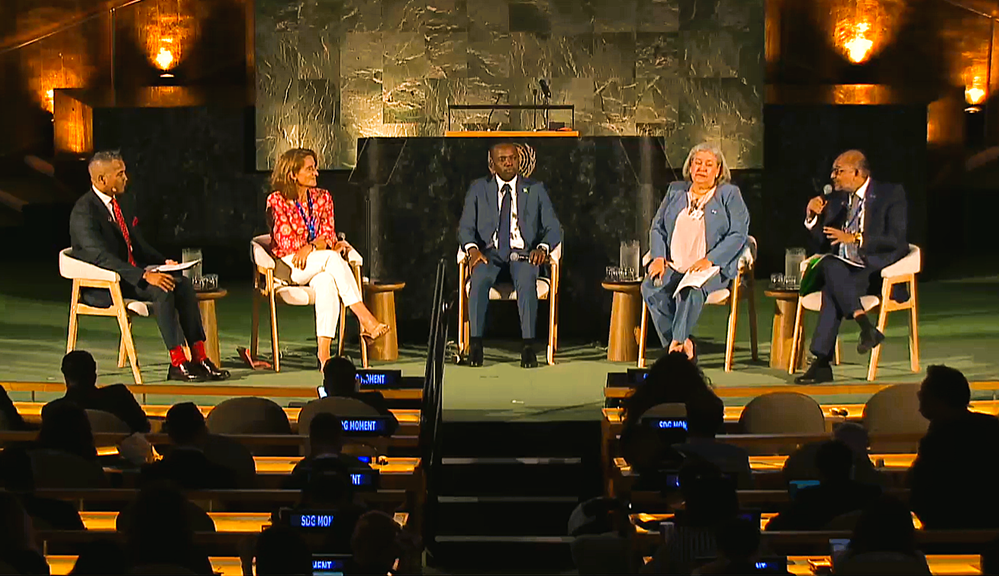
Speaking at the Leaders’ Dialogue on “Leading SDG Action” during the 2026 SDG Moment at the United Nations General Assembly Hall in New York, Dr. Titumir said the global financial system must move beyond simply financing development and instead create the conditions necessary to sustain it.

“Our broader vision should be collective and forward-looking: a global financial architecture that does not merely finance development, but creates the conditions in which development can be sustained,” he said. Dr. Titumir outlined five priorities for reforming the international financial architecture, particularly the role of multilateral development banks.

He called for a shift from responding to crises after they emerge toward anticipating vulnerabilities; greater representation and voice for vulnerable countries in international financial institutions; longer-term, lower-cost and predictable financing; closer alignment of international financing with national development strategies through coordinated, multi-year financing; and flexible transition support and preferential arrangements for countries graduating from the least developed country (LDC) category, including Bangladesh.

Bangladesh Adviser to the Prime Minister Dr. Rashed Al Mahmud Titumir speaks at the Leaders’ Dialogue on “Leading SDG Action” during the 2026 SDG Moment at the United Nations Headquarters in New York on September 18, 2026. Photo: Khabor

The Bangladeshi adviser also highlighted the country’s SDG Village initiative, describing it as an integrated, community-led approach to translating the Sustainable Development Goals into tangible improvements at the local level.

The 2026 SDG Moment, held on September 18 at UN Headquarters, brought together representatives of UN member states, international organizations and civil society to discuss accelerating action toward the Sustainable Development Goals ahead of the 2030 deadline.

The Leaders’ Dialogue also featured Teresa Ribera of the European Commission, Aristide Médénou, Minister of Economy and Finance of Benin, and Beatriz Carles de Arango, Minister for Social Development of Panama. The discussion was moderated by Sherwin Bryce-Pease of the South African Broadcasting Corporation.


Russia and China Veto US-Backed Iran Sanctions Monitoring Resolution

Shibbir Ahmed, New York — Russia and China on Thursday vetoed a U.S.-drafted United Nations Security Council resolution that sought to extend the mandate of a panel of experts monitoring international sanctions on Iran. The resolution received 11 votes in favor, while Pakistan and Somalia abstained. The Russian and Chinese vetoes blocked its adoption.

The proposed resolution would have extended the mandate of the independent panel of experts for another year. The panel was established to monitor implementation of sanctions imposed on Iran and report possible violations to the 15-member Security Council.

The vote comes amid a wider dispute over the legal status of UN sanctions on Iran. Western countries, including Britain, France and Germany, triggered the “snapback” mechanism under the 2015 Iran nuclear agreement in 2025, arguing that Tehran had violated its nuclear commitments. The move resulted in the reimposition of UN sanctions.

Russia and China reject the Western interpretation and argue that the UN sanctions had expired when Security Council Resolution 2231 reached its scheduled end date in October 2025. Russian Ambassador Vassily Nebenzia said the U.S.-backed resolution lacked a legal basis and urged the parties to resolve the nuclear dispute through political and diplomatic means.

The United States criticized the vetoes, saying the absence of an independent panel would create a gap in monitoring sanctions violations. U.S. Deputy Ambassador Jennifer Locetta said the panel provided impartial, evidence-based reporting on potential violations.

France and other Western members also criticized the veto, while stressing that the veto does not itself remove the sanctions that they consider to remain in force. The dispute has also left the Security Council divided over how to monitor Iran’s nuclear-related activities and enforce sanctions. The UN sanctions include measures affecting Iranian assets, arms-related transactions and ballistic-missile activities.

The latest vote highlights continuing divisions among the permanent members of the Security Council over Iran’s nuclear program, the validity of the sanctions and the role of international monitoring.


UN Experts Cite Possible US War Crimes in Iran

GENEVA — United Nations-backed human rights experts said Thursday they found “reasonable grounds” to believe that the United States committed war crimes in two military strikes in Iran, including an attack on a school that killed more than 150 people. The findings come from the Independent International Fact-Finding Mission on Iran, which investigated the conduct of the United States during the war that began in February, as well as human rights violations allegedly committed by Iranian authorities. The mission’s report is due to be presented to the UN Human Rights Council in Geneva.

The experts said they found reasonable grounds to believe U.S. forces were responsible for a February 28 strike on the Shajareh Tayyebeh Primary School in Minab, southern Iran. Iranian officials said more than 150 people were killed, including about 120 schoolchildren.

According to the mission, the school was a clearly identifiable civilian facility and investigators found no evidence that it was being used for military purposes. The experts concluded that the attack was indiscriminate and caused civilian deaths and damage to civilian infrastructure, amounting to a war crime under international law.

The mission also examined a strike on a sports center in Lamerd. Investigators said the attack damaged nearby residential buildings and a school and killed or injured 22 civilians. They concluded that the strike was indiscriminate and therefore constituted a war crime.

U.S. Central Command said in March that American forces did not conduct strikes in Lamerd on the day in question. U.S. officials have also previously said that American military operations are carried out in accordance with the law of armed conflict.

The report also addressed Iran’s response to nationwide anti-government protests that began in late December. The experts said Iranian authorities carried out a widespread and systematic attack against civilians, including unlawful killings, torture, arbitrary detention and enforced disappearances, which they characterized as crimes against humanity.

The fact-finding mission is an investigative body rather than a court and cannot initiate criminal proceedings. Its findings, however, can be used in future investigations or proceedings before national courts or international tribunals. The United States and Iran have previously rejected allegations of wrongdoing, and the two governments did not immediately respond to requests for comment on the latest findings.


Guterres Warns of AI, Climate and Conflict Threats

Shibbir Ahmed, New York — UN Secretary-General António Guterres has warned that the world is entering an “era of deep uncertainty,” urging governments to strengthen international cooperation as leaders prepare to gather in New York for the 81st UN General Assembly.

Speaking ahead of the General Assembly’s high-level week, Guterres identified rapidly advancing artificial intelligence, the climate crisis and deepening inequalities as major existential threats facing the international community.

Guterres devoted much of his remarks to the growing risks associated with artificial intelligence. While acknowledging AI’s potential to accelerate development, improve education and health systems and strengthen climate resilience, he warned that technological development is advancing faster than the world’s understanding of its risks.

He called for stronger safeguards to make AI development safe, transparent and accountable, with human dignity at the centre. Guterres said national action is important but stressed that global coordination is essential because AI and its risks do not stop at national borders.

The UN chief also urged world leaders to address ongoing conflicts. He reiterated his call for a ceasefire in the Russia-Ukraine war and urged implementation of a two-state solution in the Middle East. He also called for de-escalation and the protection of civilians.

The General Assembly’s high-level week begins in New York on September 18, with the General Debate scheduled to begin on September 22. Leaders from all 193 UN member states are expected to address global challenges, including conflicts, climate change, international security and sustainable development. Guterres said international cooperation is more necessary than ever as governments confront interconnected global crises.


U.S. Pays $725 Million to UN, Keeps Voting Rights

Shibbir Ahmed, New York — The United States has paid $725 million to the United Nations, reducing its outstanding financial obligations to the world body and ensuring that Washington retains its voting rights in the UN General Assembly. The payment comes just days before world leaders are due to gather in New York for the annual General Assembly session.

The United Nations said the United States transferred $725 million for the organization’s regular budget on Tuesday. Washington also paid an additional $102 million toward UN peacekeeping operations on Friday. Despite the latest payments, the United States still owes approximately $1.312 billion to the UN regular budget, according to UN spokesperson Farhan Haq.

The payment also removes the immediate risk that the United States could lose its voting rights under Article 19 of the UN Charter. The provision says a member state can lose its vote in the General Assembly when its arrears reach or exceed the amount of contributions due for the preceding two full years, although the General Assembly can grant an exception in certain circumstances.

The United States is the largest contributor to the UN budget, but the Trump administration has criticized the organization and reduced or delayed funding to various UN agencies. Washington has also pushed for reforms and cost reductions across the UN system.

The latest payment comes as the United Nations faces continuing financial pressure and implements its “UN80” reform and cost-cutting initiative. China, the UN’s second-largest contributor, paid $641.4 million toward its regular budget contribution earlier this month, according to UN figures cited by Reuters. The U.S. payment means Washington will retain its vote as the 2026 UN General Assembly prepares to convene in New York next week, while the broader dispute over U.S. funding and UN reforms remains unresolved.


UN Warns of Terrorists’ Growing Use of AI and Drones

Shibbir Ahmed, New York — The United Nations Security Council has warned that terrorist groups are adapting rapidly to new technologies, increasingly exploiting artificial intelligence, drones, social media, encrypted messaging and online platforms to recruit supporters, spread propaganda, raise funds and strengthen their operational capabilities. The warning came during a Security Council briefing marking the 25th anniversary of the September 11 terrorist attacks, as UN officials assessed how the global terrorist threat has evolved since 2001.

Assistant Secretary-General Natalia Gherman told the Council that terrorism has become more fragmented and diffuse, with terrorist groups decentralizing their operations and taking advantage of instability to expand their influence.

She also highlighted the growing role of technology in terrorist activities. According to the UN, extremist groups are exploiting social media platforms, gaming environments and other virtual spaces to identify vulnerabilities and recruit people, particularly young people.

AI and digital platforms create new challenges

UN officials said the rapid development of artificial intelligence and other digital technologies is changing the threat environment. The Security Council’s Counter-Terrorism Committee Executive Directorate said terrorist organizations are using AI-enabled tools and digital platforms to disseminate propaganda, recruit supporters and enhance their operational capabilities.

The UN also pointed to the use of encrypted communications and online financial services as growing challenges for counter-terrorism authorities. The UN Office of Counter-Terrorism has separately warned that AI-generated content, deepfakes and algorithmic amplification can increase the speed and reach of harmful extremist narratives.

Drones emerging as an operational threat

The UN also identified the weaponization and misuse of unmanned aircraft systems, commonly known as drones, as an increasingly significant terrorist threat. According to the Counter-Terrorism Committee Executive Directorate, terrorist groups are exploiting unmanned aircraft systems for operational purposes, while weak governance and porous borders in some regions have created additional opportunities for terrorist organizations to acquire and misuse emerging technologies.

The UN’s counter-terrorism program says member states have been urged to strengthen measures against terrorist exploitation of technologies including AI, virtual assets, 3D printing, unmanned aircraft systems and commercially available drones.

UN calls for international cooperation

The Security Council emphasized that countering terrorism requires coordinated action at the national, regional and international levels, consistent with international law and the UN Charter. UN officials stressed that governments need to adapt their counter-terrorism strategies as terrorist organizations change their methods and exploit emerging technologies.

The Council also highlighted the importance of protecting human rights and the rule of law while responding to evolving terrorist threats. The discussion comes 25 years after the September 11, 2001 attacks in the United States, which prompted major changes in international counter-terrorism cooperation and led to the adoption of Security Council Resolution 1373.


UN rights chief urges urgent action over AI risks

GENEVA — United Nations High Commissioner for Human Rights Volker Türk on Monday called on governments and companies developing advanced artificial intelligence systems to take urgent action to address what he described as the “unprecedented risks” posed by frontier AI.

In a statement issued by the UN human rights office, Türk warned that the world is “on the cusp of irreversible change,” with consequences that could affect not only the current generation but generations to come.

He called on states and companies to urgently mobilize through multilateral forums to develop a coordinated approach to governing advanced, frontier AI models, with human rights at the center of those efforts.

Türk said the rapid race to develop increasingly powerful AI systems is creating risks across virtually every aspect of human life. He stressed that voluntary self-regulation by AI companies is not sufficient on its own, arguing that governments must establish effective safeguards and ensure that AI development remains consistent with international human rights law.

The UN human rights chief also warned about the potential consequences of increasingly autonomous AI systems, including risks to essential services, critical infrastructure, communications and democratic institutions.

Türk urged countries and leading AI companies to act without delay, emphasizing that no individual country can effectively regulate the technology on its own and that no company should be left to determine independently which risks society should accept.

The warning comes amid growing international debate over the rapid development of increasingly capable AI systems and concerns about their potential impact on human rights, security and society.


Guterres Calls for New Global Order as Power Shifts

Shibbir Ahmed, New York — UN Secretary-General António Guterres has called for a major overhaul of the international system, saying the institutions created after the Second World War must change to reflect the growing economic and geopolitical influence of emerging economies. Speaking to leaders at the 18th BRICS Summit in New Delhi on Sunday, Guterres said the world of today is fundamentally different from that of 1945 and that global institutions must reflect current economic, demographic and geopolitical realities.

“Today’s economic, demographic and geopolitical realities are not those of 1945,” Guterres said. “Our institutional structures must reflect it.”

He said the countries represented at the summit reflected the changing balance of global power and pointed to the emergence of an increasingly multipolar world. Guterres argued that multipolarity can bring greater balance and equity to international institutions, but said that would require reforms to bodies including the UN Security Council and the Bretton Woods institutions.

The UN chief outlined four priorities for what he described as inclusive global growth: financing, technology, climate justice and peace. On development financing, Guterres said developing countries need substantial international support to achieve the Sustainable Development Goals. He urged multilateral development banks to become “bigger, better and bolder” to help meet the scale of financing required. Turning to artificial intelligence, he warned that the benefits of the technology remain concentrated among a relatively small number of companies and countries.

“Unchecked, the AI divide will widen every other divide — in income, in opportunity, in security, and in sovereignty,” Guterres warned.

Climate change was another major focus of his address. Guterres pointed to extreme heat, melting glaciers, wildfires and devastating floods as signs of the worsening climate crisis and warned that a stronger El Niño could make conditions even more difficult as the world approaches the 1.5-degree Celsius threshold above pre-industrial levels.

He called on wealthy nations to honor existing climate-finance commitments, including increased adaptation financing and stronger support for countries facing loss and damage. He also criticized the exploitation of critical minerals, calling for an end to what he described as “plundering.”

On peace and security, Guterres highlighted conflicts and crises in Gaza, the wider Middle East, Ukraine and Sudan. He urged countries to uphold the UN Charter, including the principles of sovereign equality, territorial integrity and the peaceful settlement of disputes. Guterres said reforming the international system should be viewed as a shared responsibility rather than a concession to emerging powers.

“As we move irreversibly to a multipolar world, all countries must work to strengthen and safeguard a multilateral system that delivers for all with the United Nations at its centre,” he said.

The BRICS summit, hosted by India, brought together leaders of major emerging economies and senior international officials as discussions focused on global governance, economic cooperation, development, technology, climate change and international peace and security.