US Awami League Holds Protest Outside UN Headquarters in New York

NEW YORK CORRESPONDENT: The US Awami League, Awami family members, and affiliated and associate organizations held a protest rally outside the United Nations headquarters in New York on Thursday, September 24, protesting the ban on all activities of the Bangladesh Awami League, death sentences against former Prime Minister Sheikh Hasina and other senior party leaders, and what they described as moves to hand over Saint Martin’s Island, ports and transit corridors to foreign interests.

The rally was held at noon outside the UN headquarters, with Awami League leaders and activists arriving from different states across the United States. Participants included leaders and activists from the US Awami League, US Jubo League, US Mohila League, US Chhatra League, US Sramik League, US Swechhasebak League, Michigan Awami League, Virginia State Awami League, Metro Washington Awami League, Maryland State Awami League, New York State Awami League, New York City Awami League, US Awami League South, US Awami League East, US Awami League West, and the organization Amra Mujib Sainik, among others.
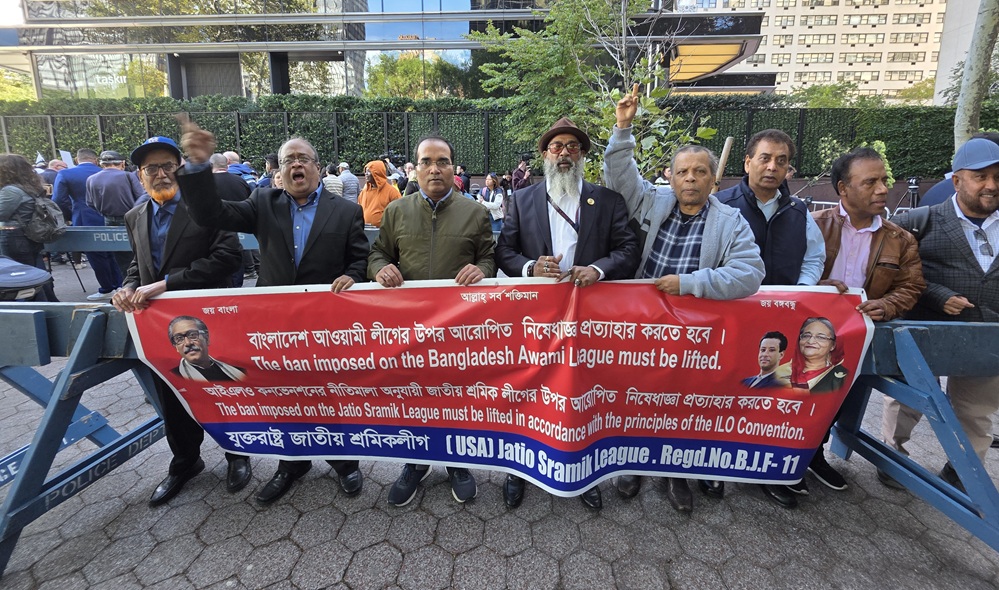
Awami League supporters hold a protest outside the United Nations headquarters in New York on Thursday, September 24. Photo: KHABOR

The protesters chanted a range of slogans, including “Go Back Tarique,” “Terrorist Tarique,” “Khamba Tarique,” “No gas, no electricity—this government is not needed,” “No food, no clothing—this government is not needed,” “There are poles, but no electricity—this government is not needed,” “Police killer Tarique—go back, go back,” and “Grenade Tarique—go back, go back.”

Addressing the rally, speakers said the Awami League played a leading role in the establishment of Bangladesh as an independent and sovereign country. They alleged that banning the party’s political activities undermines the values, ideals and spirit of the country’s Liberation War. The speakers called for the immediate withdrawal of the ban, arguing that it would create political space for what they described as anti-liberation and extremist forces.
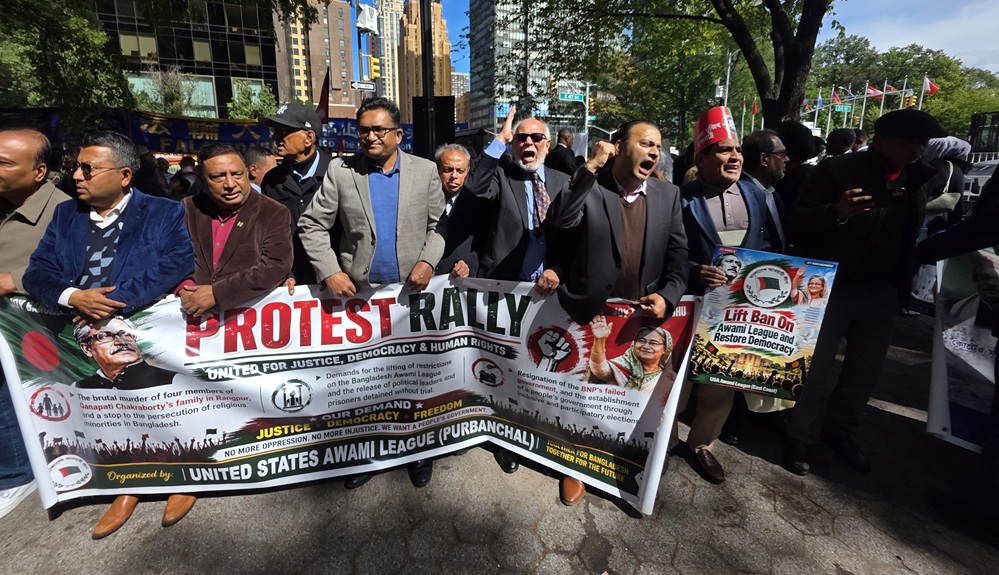
Awami League supporters hold a protest outside the United Nations headquarters in New York on Thursday, September 24. Photo: KHABOR

They also criticized the government over the country’s economic and social situation, citing rising prices, shortages of gas and electricity, problems in the education sector and what they described as a growing “mob culture.” They also alleged that Awami League leaders and activists were being killed and harassed.

The speakers made a number of allegations against BNP Acting Chairman Tarique Rahman. They questioned government decisions concerning aircraft purchases, arguing that greater attention should first be given to essential services and economic challenges inside Bangladesh.

Describing the situation in Bangladesh as a “major crisis,” the speakers alleged that domestic and foreign actors were conspiring over the country’s political and economic future. They claimed that factories and garment industries were facing difficulties and that the country’s production system was being adversely affected.
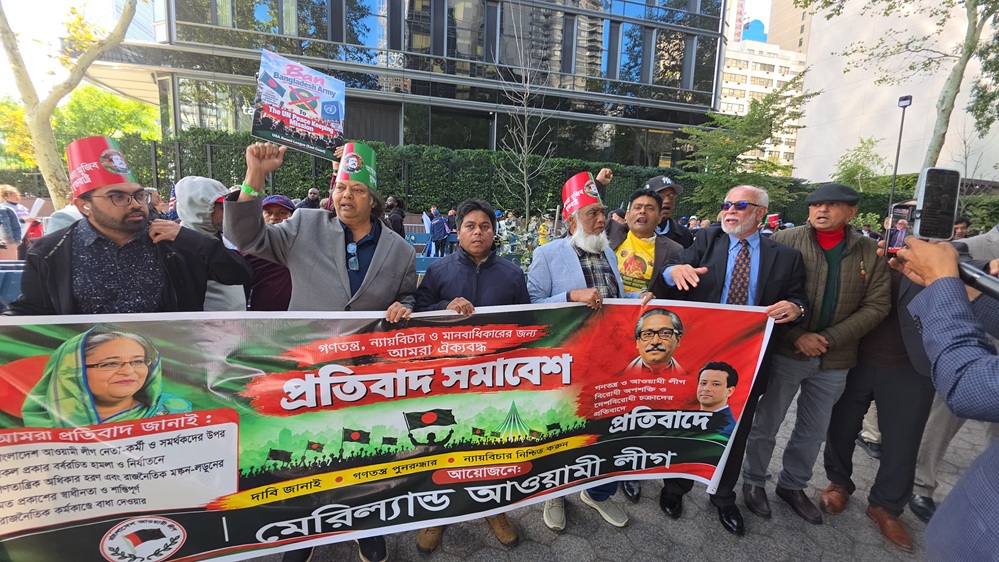
Awami League supporters hold a protest outside the United Nations headquarters in New York on Thursday, September 24. Photo: KHABOR

The speakers also raised concerns about child safety, public health and law and order, alleging that the government was not giving sufficient attention to these issues and was using political retaliation against its opponents.

Speakers further said that banning the Awami League would not end the party’s political existence. Referring to the party’s history, they said the Awami League had returned to politics after facing previous periods of political adversity and expressed confidence that it would again return as a stronger political force.

They also claimed that the ban had left people in Bangladesh and members of the diaspora shocked and angry. Some speakers described the current government as a “black government,” a characterization made by the speakers at the rally.

Among those attending the protest were US Awami League President Dr. Siddiqur Rahman, General Secretary Abdus Samad Azad, adviser Masudul Hasan, former BAKSU General Secretary and freedom fighter Dr. Pradip Ranjan Kar, Organizing Secretary Abul Hasib Mamun, former General Secretary Shamim Chowdhury, founding General Secretary of the US Awami League and mainstream political figure M.A. Salam, journalist Hakikul Islam Khokon, Ramesh Nath, Organizing Secretary Mohiuddin Dewan, freedom fighter Shawkat Akbar Ritchie, Legal Affairs Secretary Advocate Shah Md. Bokhtiar Ali, Education Affairs Secretary M.A. Karim Jahangir, and Dr. Masudul Hasan, president of the US chapter of Sheikh Kamal Parishad.
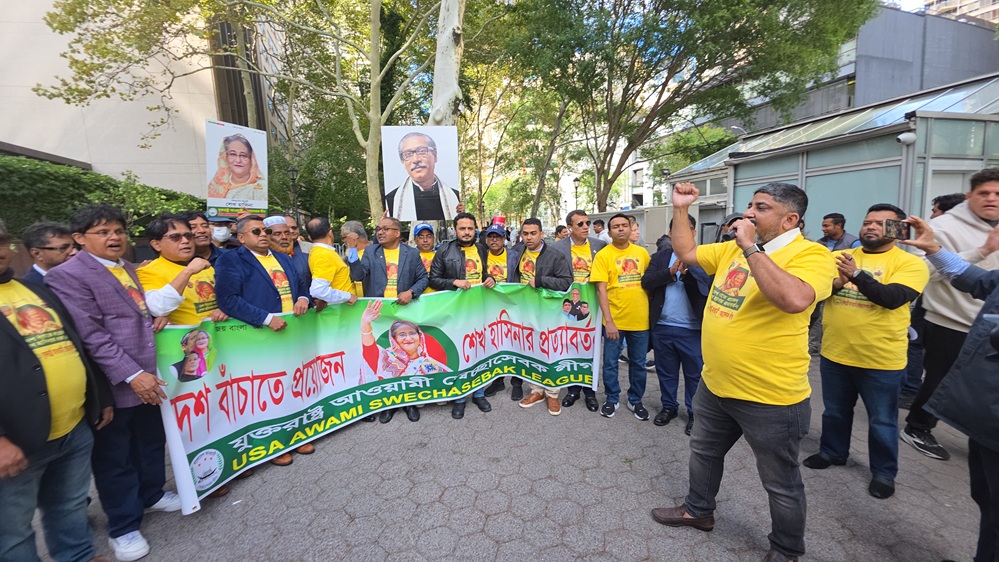
Awami League supporters hold a protest outside the United Nations headquarters in New York on Thursday, September 24. Photo: KHABOR

Also present were Awami League leader and Sheikh Hasina Mancha President freedom fighter Jalal Uddin Jalil, Organizing Secretary Sheikh Selim, Executive Member Shahanara Rahman, Awami League leader and former Union Parishad Chairman Iqbal Hossain, Awami League leaders Akhtar Hossain and Ali Hossain Ghaznavi, among others.

New York State Awami League President and freedom fighter Mujibur Rahman Mia, Vice Presidents Sheikh Atikul Islam and Abul Kashem Bhuiyan, Bangladesh Awami League Foundation Chairman Abdul Kader Mia, New York City Awami League President Rafiqul Rahman Rafiq and General Secretary Emdad Chowdhury also attended.

Others included Connecticut State Awami League General Secretary Humayun Ahmed Chowdhury, Mohila Awami League Joint General Secretary Rumana Akter, Awami League leader A.K. Chowdhury, Jubo League leaders Mizanur Rahman and Mizanur Rahman Chowdhury, US Chhatra League Vice President Shahidul Islam, and US Jubo League leader Khandaker Zahedul Islam.

Virginia State Awami League President G.I. Russell and member Jeba Russell, Metro Washington Awami League President M. Nabi Baki, Vice President Nurul Amin, General Secretary Mohammad Azam and Women’s Affairs Secretary Mohsina Jannat Rimi, as well as Maryland State Awami League President Moinul Majumdar Tapas, Mosharraf Hossain Dulal and Sramik League President Azizul Khokon were also among those present.

The rally concluded with demands for the restoration of the Awami League’s political rights and the return of Sheikh Hasina to Bangladesh, along with calls for a fresh election.


Bangladesh, Pakistan premiers discuss bilateral ties, regional, global issues

Shibbir Ahmed, New York – Prime Minister Tarique Rahman and his Pakistani counterpart Muhammad Shehbaz Sharif on Thursday discussed various aspects of Bangladesh-Pakistan bilateral relations, along with regional and international issues of mutual interest.

The two leaders held a bilateral meeting at the Secretariat Building of the United Nations Headquarters in New York on the sidelines of the 81st session of the United Nations General Assembly (UNGA).

The meeting focused on matters of mutual interest, the regional and international situation, and potential areas of cooperation for the benefit of the peoples of Bangladesh and Pakistan, said Prime Minister’s Assistant Press Secretary KM Nazmul Haque. Tarique Rahman and Shehbaz Sharif underscored the importance of further strengthening relations between the two countries on the basis of mutual respect, understanding and cooperation.

The two premiers also stressed the need for regular communication and continued dialogue on issues of common interest. The meeting took place amid the two countries’ ongoing efforts to enhance bilateral engagement and explore areas of cooperation at regional and international forums.


Bangladesh redesigning primary healthcare system with a focus on prevention: Zubaida

Shibbir Ahmed, New York – Ziaur Rahman Foundation Vice-President and eminent physician Dr Zubaida Rahman on Thursday said Bangladesh is redesigning its primary healthcare system around prevention, early identification and continuity of care, with a stronger frontline workforce and professional midwives at the centre of the transformation.

“Our vision of a Healthy Bangladesh is to move from a treatment-centred system to one that emphasises prevention, early identification and continuity of care, with services closer to people’s homes,” she said.

Addressing a high-level side event titled “From Commitment to Action: Integrating Midwifery into Primary Health Care to End Preventable Maternal and Newborn Deaths” at United Nations Headquarters in New York, Zubaida outlined Bangladesh’s ongoing and planned initiatives to transform its Primary Health Care (PHC) system.

Bangladesh, she said, is working towards an integrated PHC network extending to rural unions and urban wards, supported by a stronger frontline workforce and digital health services.

“Women and children are at the centre of this transformation,” she said.

Zubaida said recruitment of 25,000 professional midwives has already begun, stressing that the initiative is aimed not merely at increasing their number but at integrating them into multidisciplinary PHC teams.

“Our objective is not simply to increase their numbers. We want to integrate them into multidisciplinary PHC teams and provide continuity of care from preconception and pregnancy through childbirth, postnatal and newborn care,” she said. The PHC model presented at the discussion places midwives at the centre of the maternal healthcare journey and seeks to move Bangladesh’s health system from fragmented services towards an integrated and accountable platform, she said.

The platform will connect households and communities with primary healthcare facilities and, when necessary, with secondary, tertiary and specialised care through a functioning referral system, Zubaida said. She said midwife-led PHC could advance three priorities for Bangladesh: better access, stronger financial protection and better value in healthcare.

“It can bring essential care closer to women, reduce unnecessary interventions and out-of-pocket expenditure, and ensure respectful care at the right place and at the right time,” she said. Zubaida said Bangladesh’s approach reflects its broader effort to put people at the centre of development and build a modern health system around prevention, dignity and access. The vision, she said, is to ensure that women receive continuous care throughout the maternal journey rather than accessing fragmented services at different stages.

“Every woman should have access to a skilled professional midwife as part of her PHC team, close to where she lives,” she said, outlining the ambition that guided the discussion. Zubaida said the approach is also intended to provide a model for countries to learn from one another while developing solutions suited to their respective health systems.

“Professional midwives save lives. Our task now is to build health systems that enable them to do so effectively, equitably and sustainably,” she said. Bangladesh looks forward to continuing its engagement with governments, UN agencies, development partners and the global health community to turn the dialogue into practical action, she said.

The discussion brought together health ministers and senior representatives from Sierra Leone, Nepal, Thailand, Indonesia, the Philippines and other countries, along with UN agencies, development partners, professional organisations, civil society representatives and members of the global health community. The event was organised in partnership with the Government of Sweden and the United Nations Population Fund (UNFPA).


Primary healthcare at heart of vision for ‘Healthy Bangladesh’: PM

Shibbir Ahmed, New York – Prime Minister Tarique Rahman on Thursday said his government wants to build a “Healthy Bangladesh” where healthcare begins at home and in the community, placing primary healthcare at the centre of the country’s health reform agenda with particular emphasis on women and children.

“My government is transforming our health system, guided by a simple principle: ‘Prevention is better than cure.’ We want to build a Healthy Bangladesh, where healthcare begins in the home and community,” he said.

The Prime Minister made the remarks while opening a high-level side event titled “From Commitment to Action: Integrating Midwifery into Primary Health Care to End Preventable Maternal and Newborn Deaths” at United Nations Headquarters in New York.

Bangladesh co-hosted the event with Sweden in partnership with the United Nations Population Fund (UNFPA) on the sidelines of the 81st session of the United Nations General Assembly. The event focused on integrating professional midwifery into primary healthcare to improve maternal and newborn care and reduce preventable deaths.

Tarique Rahman outlined plans to strengthen community-based primary healthcare and expand the role of professional midwives as members of multidisciplinary primary healthcare teams.

He said his government intends to recruit 100,000 additional health workers, 80 percent of whom will be women, to connect families with the health system, identify health risks at an early stage and facilitate timely care.

“One professional has a particularly important role in this continuum: the midwife,” he said.

“A professional midwife can become a woman’s trusted health professional from preconception through the postnatal period,” he added.

The Prime Minister said the government has decided to recruit 25,000 professional midwives across Bangladesh and that the process has already begun. He said the midwives would provide essential reproductive healthcare, support antenatal care, promote safe and respectful childbirth, identify complications early and facilitate referrals. They would also support mothers and newborns through breastfeeding, immunisation and healthy childhood development, he said.

Tarique Rahman said Bangladesh had built an important foundation for professional midwifery, including through professional midwifery education, stronger regulation and deployment of midwives at district, sub-district and union-level facilities.

“We now have more than 11,000 licensed midwives, with the objective of reaching 25,000 by 2030,” he said. He also acknowledged the contribution of Sweden and UNFPA to the development of professional midwifery in Bangladesh.

With UNFPA’s cooperation, Bangladesh has expanded midwifery-led care across 22 districts, where skilled midwives have supported more than 154,000 births and managed critical maternal cases, he said.

“These are not merely statistics. They represent mothers returning home safely, and newborns beginning life with hope,” the Prime Minister said. He also outlined the government’s plan to develop an integrated digital health ecosystem under which every citizen would have a Health Card linked to a digital health record and electronic referral system.

“For a woman in rural Bangladesh, her care can be registered close to home, her visits tracked, and her risk factors recorded. If referred to a higher-level hospital, the necessary information should travel with her,” he said.

The Prime Minister said the government’s vision for women’s health extends beyond pregnancy and childbirth and covers women’s health throughout the life course. This includes adolescent health, reproductive health and family planning, as well as prevention and early detection of cervical and breast cancers, he said. “Midwifery must therefore be part of a broader platform for women’s health within Primary Health Care,” Tarique Rahman said. He stressed that the next phase of the initiative should be driven by national ownership and sustainable domestic investment.

“As we open today’s discussion, I leave you with one ambition: Every woman should have access to a skilled professional midwife as part of her Primary Health Care team, close to where she lives,” he said.

“For Bangladesh, this means deploying midwives nationwide, strengthening community health services and referral pathways, and connecting citizens through a modern digital health system,” he added.

“Together, these steps will help us build a healthy, thriving Bangladesh. And this is how we move from commitment to action,” the Prime Minister said.

The event brought together ministers, UN agencies, development partners and health experts to discuss ways of translating commitments on midwifery and primary healthcare into sustainable investments and stronger health systems. UNFPA described the integration of midwifery into primary healthcare as a key strategy for expanding equitable, high-quality and dignified maternal and newborn care.


Trump Signs Greenland Security Agreement With Denmark and Greenland

Shibbir Ahmed, New York — President Donald Trump on Tuesday signed a new security agreement with Denmark and Greenland aimed at strengthening defense cooperation in the Arctic, during the 81st United Nations General Assembly in New York.

Danish Prime Minister Mette Frederiksen and Greenlandic Prime Minister Jens-Frederik Nielsen joined Trump for the signing ceremony. Secretary of State Marco Rubio was also present as the agreement was signed.

The agreement amends and supplements the existing 1951 U.S.-Denmark defense agreement concerning Greenland. It reaffirms the parties’ defense cooperation and provides for expanded U.S. military access and activities in Greenland.

Under the agreement, the United States will be allowed to modernize and expand activities at Pituffik Space Base and establish additional defense areas at Narsarsuaq and Mestersvig, subject to arrangements between the parties. The agreement also provides a framework for establishing additional defense areas in Greenland through consultations and mutual agreement.

The agreement gives U.S. forces specified rights of access and movement in Greenland, including access by land, air and sea between defense areas. It also establishes provisions concerning U.S. aircraft and public vessels operating in Greenland and its territorial waters.

The three parties also agreed to strengthen cooperation on Arctic security, including through greater NATO engagement, planning, military presence, exercises and intelligence gathering.

The agreement includes provisions restricting non-NATO states from establishing military installations or maintaining a persistent military presence in Greenland unless otherwise agreed by the parties. It also contains restrictions related to certain foreign investments and activities considered potential threats to national security or public order.

The document reaffirms the sovereignty and territorial integrity of the Kingdom of Denmark and recognizes the right of the people of Greenland to self-determination under international law. It also states that the agreement has no end date and can be amended only by mutual consent under the existing defense framework.

The White House described the agreement as a major step in strengthening U.S. security interests in the Arctic. The signing took place as world leaders gathered in New York for the 81st session of the United Nations General Assembly.

The agreement was signed in New York on September 22, 2026, in English, Danish and Greenlandic. It will enter into force after the required parliamentary procedures in Denmark and Greenland are completed and the United States receives the necessary diplomatic notification.


PM Seeks Global Support for Dignified Rohingya Repatriation

Shibbir Ahmed, New York — Prime Minister Tarique Rahman has called on the international community to extend stronger support for the dignified repatriation of Rohingyas to their homeland in Myanmar and help find a sustainable solution to the prolonged crisis.

The prime minister made the appeal on Tuesday when Julie Bishop, Special Envoy of the UN Secretary-General on Myanmar, paid a courtesy call on him in New York, where he is attending the 81st session of the United Nations General Assembly.

During the meeting, Tarique Rahman stressed the importance of continued international cooperation to facilitate the safe and dignified return of Rohingyas and resolve the crisis, according to PM’s Additional Press Secretary Atikur Rahman Ruman.

The two sides also discussed the role of the international community in addressing the Rohingya crisis, including efforts to create conditions conducive to their eventual return to Myanmar.

The meeting comes ahead of a high-level Rohingya crisis side event scheduled for Wednesday at UN Headquarters, co-hosted by Bangladesh and The Gambia. The event will focus on finding a durable solution to the protracted displacement, along with justice and accountability.

Bangladesh has consistently called for the safe, voluntary, dignified and sustainable return of Rohingyas to Myanmar, where the crisis originated. The country is currently hosting about 1.2 million Rohingya refugees, placing significant humanitarian, economic and environmental pressure on Bangladesh. Prime Minister Tarique Rahman is scheduled to address the UN General Assembly on September 24.


Tarique Rahman Meets Bhutan PM, Maldives VP & Haitian PM on UNGA Sidelines

Shibbir Ahmed, New York — Bangladesh Prime Minister Tarique Rahman held separate meetings with Bhutanese Prime Minister Dasho Tshering Tobgay and Maldives Vice President Uz Hussain Mohamed Latheef on the sidelines of the 81st session of the United Nations General Assembly in New York on Tuesday.

The meetings were held at the UN Headquarters as Tarique Rahman attended the high-level General Debate of the 81st UNGA, according to the Prime Minister’s Assistant Press Secretary KM Nazmul Haque.During  his meeting with the Bhutanese prime minister and the Maldives vice president, Tarique Rahman discussed ways to further strengthen Bangladesh’s existing friendly and cordial relations with the two countries.

The discussions covered issues of mutual interest as well as opportunities to enhance regional and international cooperation. The leaders also exchanged views on identifying new areas of collaboration to expand bilateral ties and promote the mutual interests and welfare of their respective peoples.

The meetings were part of the prime minister’s diplomatic engagements on the sidelines of the UN General Assembly, where leaders from around the world are gathering to discuss major global and regional issues.

PM holds meeting with Haiti PM

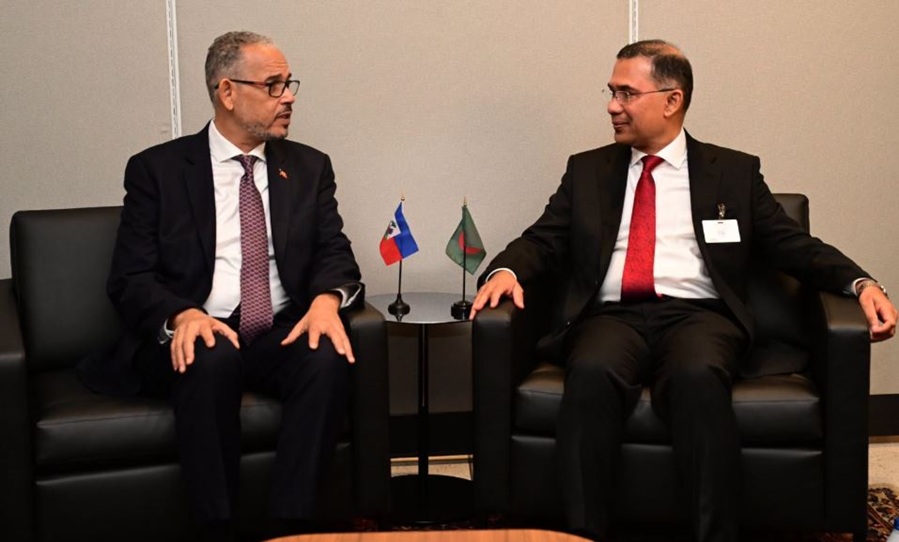
Prime Minister Tarique Rahman today held a meeting with Haitian Prime Minister Alix Didier Fils-Aime at the United Nations (UN) Headquarters on the sidelines of the 81st session of the UN General Assembly. During the meeting held this afternoon (New York time), the two leaders discussed bilateral relations between Bangladesh and Haiti, issues of mutual interest and various aspects of regional and international cooperation, PM’s Assistant Press Secretary KM Nazmul Haque said.

Prime Minister Tarique Rahman held a meeting with Haitian Prime Minister Alix Didier Fils-Aime at the UN Headquarters. Photo: KHABOR

They also exchanged views on ways to further strengthen cooperation for the mutual benefit of the peoples of the two countries and explored opportunities to expand bilateral relations in various areas. Prime Minister Tarique Rahman’s UN engagements began today with a welcome breakfast hosted by UN Secretary-General Antonio Guterres for heads of delegation and their spouses.

He later attended the opening session and the high-level General Debate of the General Assembly. During his visit, the Prime Minister is scheduled to hold a series of bilateral and high-level meetings with heads of state and government and leaders of international organisations. He is scheduled to address the General Debate of the 81st session of the United Nations General Assembly on September 24.


Tarique Rahman, World Bank President Discuss Bangladesh’s Development Priorities

Shibbir Ahmed, New York — Bangladesh Prime Minister Tarique Rahman and World Bank Group President Ajay Banga discussed Bangladesh’s development priorities and economic progress during a meeting at the United Nations Headquarters on Tuesday. The meeting took place on the sidelines of the 81st session of the United Nations General Assembly, according to the Prime Minister’s Assistant Press Secretary KM Nazmul Haque.

The two sides discussed issues of mutual interest and exchanged views on strengthening the World Bank’s cooperation with Bangladesh in its development activities. They also explored potential new areas of partnership that could support Bangladesh’s development priorities and economic progress in the coming years.

The meeting was part of Tarique Rahman’s bilateral engagements during his visit to New York for the UN General Assembly, where he is scheduled to participate in discussions on major international and development issues.


Tarique Rahman Joins 81st UN General Assembly General Debate

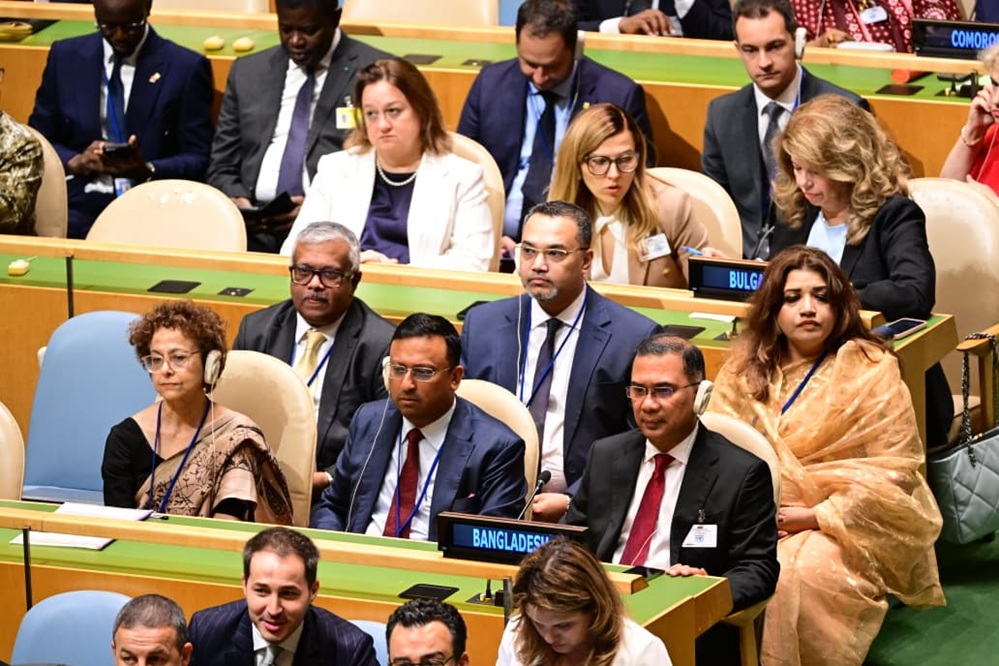
Shibbir Ahmed, New York – Prime Minister Tarique Rahman today attended the high level general debate of the 81st session of the United Nations General Assembly (UNGA) at the UN Headquarters here. The Prime Minister, accompanied by his wife Dr Zubaida Rahman, joined the debate at the North Delegates’ Lounge of the UN Headquarters at 9:00am (New York time), said PM’s Assistant Press Secretary K M Nazmul Haque.

UN Secretary-General Antonio Guterres addressed it, chaired by the president of UNGA 81st session and Bangladesh Foreign Minister Dr Khalilur Rahman. Upon his arrival at the venue, the Prime Minister was accorded a formal welcome. He then joined other world leaders at the high-level discussions of the prestigious global forum. The 81st UNGA session is focusing on a range of major global issues, including climate change, resolution of global conflicts, achievement of the Sustainable Development Goals (SDGs) and international economic cooperation.

On the sidelines of the session, Prime Minister Tarique Rahman is expected to hold a number of bilateral meetings with heads of state and government and representatives of various international organisations.

Prime Minister Tarique Rahman attended a high-level general debate of the 81st session of the UN General Assembly (UNGA) at the UN Headquarters. Photo: KHABOR

He will also deliver Bangladesh’s statement at the General Debate of the General Assembly, where he is expected to highlight global peacekeeping, climate justice and Bangladesh’s recent socio-economic development.

Foreign Affairs State Minister Humaiun Kobir, Shama Obaed Islam, Prime Minister’s Office spokesperson Mahdi Amin, senior government officials and Bangladesh’s Permanent Representative to the United Nations were also present during the session. The 81st session of the UN General Assembly formally commenced on September 8, while its General Debate began today.


Trump Defends Iran War, Warns of ‘Annihilation’ Without Deal in UN Speech

Shibbir Ahmed, New York — U.S. President Donald Trump used his address to the United Nations General Assembly on Tuesday to defend his administration’s military actions abroad, warn Iran of further escalation if it does not reach a peace agreement, and call for an end to the war in Ukraine. In a roughly 37-minute address at the 81st session of the UN General Assembly in New York, Trump outlined his foreign-policy priorities, including Iran, Ukraine, Venezuela, Cuba, Mexico, artificial intelligence and reform of the United Nations.

Trump strongly defended the U.S.-Israeli military campaign against Iran, saying the operation had prevented Tehran from obtaining a nuclear weapon. He warned that the United States could “annihilate” Iran if a peace agreement is not reached, while also saying he believes a deal could be reached after the U.S. midterm elections on Nov. 3.

“I believe we’ll make a deal right after the election because it doesn’t make sense for them not to,” Trump said. Trump also addressed the Russia-Ukraine war, saying the United States was working with both Moscow and Kyiv and expressing confidence that a settlement could be reached.

“We will get that one done,” Trump said, adding that an agreement could come sooner than many people expect. The president also highlighted U.S. actions in Venezuela and the wider Western Hemisphere. He said Washington would not allow threats against the United States to establish a foothold in the region and said the country would use its military power when necessary to protect what he described as vital U.S. national interests.

On Cuba, Trump described the country as a failed state and said his administration was seeking fundamental political change there. “Communism will never be coming to America, but freedom will be coming to Cuba,” he said. Members of the Cuban delegation walked out of the General Assembly hall while Trump was discussing Cuba, Reuters reported.

Trump also criticized Mexico over drug-cartel violence and described the fight against cartels as a major U.S. security priority. He said his administration had carried out strikes against cartel groups and argued that the United States needed to take stronger action against organizations it considers terrorist threats.

Artificial intelligence was another major theme of the speech. Trump said his administration would use the term “super intelligence” rather than artificial intelligence in official communications and argued against international restrictions that could limit technological development.

He said the United States was leading China and other countries in the AI race and argued that AI could become more transformative than the Industrial Revolution. Trump also renewed his criticism of the International Criminal Court, urging member countries to withdraw and arguing that the court should not have jurisdiction over U.S. military personnel.

Turning to the United Nations itself, Trump said the organization had significant potential but called for further reforms, including reductions in bureaucracy and spending. He criticized what he described as the influence of “globalist bureaucrats” and said the United States would continue pushing for changes at international institutions.

The speech comes as world leaders gather in New York amid continuing conflicts in the Middle East and Ukraine, uncertainty over global economic conditions and growing debate over the international governance of artificial intelligence. The UN’s 81st General Assembly general debate runs from Sept. 22 through Sept. 28.