UN General Assembly 2026: Leaders Discuss Global Crises, AI

Shibbir AHmed, New York — World leaders and senior officials are continuing high-level diplomatic discussions at the 81st United Nations General Assembly in New York, with conflicts, artificial intelligence, climate change, development and international cooperation remaining central issues.

The General Assembly’s high-level week, which runs through September 28, has brought together leaders and representatives from across the world to address major global challenges and debate the future of multilateral cooperation.

The General Debate is scheduled to continue on September 28, following several days of speeches and diplomatic meetings focused on international security, regional conflicts, economic development and emerging global challenges.

Artificial intelligence has emerged as an important issue during this year’s UN discussions. Secretary-General António Guterres has called for stronger international governance of AI and warned that technological developments are moving faster than existing global institutions can respond.

The UN has also placed conflicts and international diplomacy at the center of the General Assembly agenda as governments seek diplomatic approaches to ongoing crises, including tensions in the Middle East. The UN General Assembly’s 81st session is being chaired by Bangladesh’s Khalilur Rahman. The session’s theme is “Restoring trust, managing transformation: A United Nations that delivers for all.”

A major UN meeting taking place today, September 28, is commemorating the 25th anniversary of the adoption of the Durban Declaration and Programme of Action, which focuses on combating racism, racial discrimination, xenophobia and related intolerance.

The high-level week has also included meetings on climate action, sea-level rise and pandemic preparedness, reflecting the broad range of issues being addressed by the international community.

As the high-level portion of the General Assembly concludes, diplomatic attention remains focused on how governments can address conflicts, technological risks and other global challenges through international cooperation.


Cuba Condemns US Pressure, Warns of ‘Law of the Jungle’ at UN

Shibbir Ahmed, New York — Cuba’s Foreign Minister Bruno Eduardo Rodríguez Parrilla has warned that growing military and economic pressure in Latin America and the Caribbean is threatening international law, while accusing the United States of intensifying its longstanding campaign to isolate and weaken Cuba.

Addressing the General Debate of the 81st session of the United Nations General Assembly on Saturday, Rodríguez Parrilla said the international system was facing a rise in what he described as “expansionism, usurpation, plunder” and military and economic aggression.

He argued that fundamental principles of the UN Charter, including the sovereign equality of states, were under increasing pressure. The Cuban foreign minister called for the United Nations to be strengthened and made “more democratic and effective,” with a closer connection to the people it serves.

Cuba accuses US of economic pressure

A major part of Rodríguez Parrilla’s address focused on Cuba’s decades-long confrontation with Washington. He accused the United States of escalating economic pressure on Cuba since January, including what he called an “energy blockade” and efforts to discourage other countries from exporting fuel to the island. According to the Cuban minister, more than 7,000 containers were stranded in ports, including shipments containing food, medicines and medical equipment. He said some of the shipments had already been paid for by Cuban private companies.

Rodríguez Parrilla also accused Washington of putting pressure on foreign investors, restricting tourism and limiting Cuba’s access to financing, technology and international markets. He further criticized US efforts to discourage governments from maintaining arrangements under which Cuban medical professionals provide healthcare overseas.

“The economic warfare is aimed against the people,” Rodríguez Parrilla said, characterizing the alleged impact on Cuban families as deliberate “collective punishment.” He rejected claims that Cuba poses a threat to US national security.

“Cuba is not a threat; the blockade is!” he declared.

Havana says it remains open to dialogue

Despite his criticism of US policy, Rodríguez Parrilla said Cuba remained willing to engage in dialogue with Washington. He said any negotiations should be based on sovereign equality, respect for international law, non-interference in domestic affairs and the absence of preconditions. The Cuban government has maintained for decades that the US economic embargo has imposed significant costs on the country’s economy, while Washington has defended its policies on various political and security grounds.

Cuba outlines changes at home

The foreign minister also highlighted changes Cuba is pursuing in response to its economic and social difficulties. He pointed to a new program adopted by the National People’s Power Assembly that introduces new economic practices, actors and concepts while maintaining Cuba’s constitutional framework and socialist system.

According to Rodríguez Parrilla, the process is intended to address the needs of the Cuban population while pursuing what he described as greater social justice and protecting the country’s sovereignty and right to self-determination.

Warning over militarization in Latin America

Turning to the wider region, Rodríguez Parrilla criticized what he described as attempts at militarization, intervention and domination in Latin America and the Caribbean. He rejected the Monroe Doctrine and referred to the region’s 2014 declaration as a Zone of Peace.

The Cuban foreign minister also expressed solidarity with Small Island Developing States facing the effects of climate change, reiterated Cuba’s support for Nicaragua, backed Puerto Rico’s right to self-determination, and supported calls for reparations to African and Caribbean nations over colonialism and the transatlantic slave trade.

Concluding his address, Rodríguez Parrilla warned that allowing powerful states to impose their will through intimidation and coercion would create an unstable international order. “The law of the jungle cannot be the future of humanity,” he told the General Assembly, urging countries to strengthen the United Nations and preserve its role in international affairs.


Jaishankar Warns of ‘Weaponisation of Everything’ at UN

Shibbir Ahmed, New York — Indian External Affairs Minister S. Jaishankar has warned that the world is witnessing the “weaponisation of everything,” with finance, market access, supply chains and technology increasingly being used as tools of pressure. Addressing the General Debate of the 81st United Nations General Assembly in New York on Saturday, Jaishankar said growing conflicts and confrontations were undermining international security, economic progress and development, particularly affecting countries in the Global South.

“What we are actually seeing is a weaponisation of everything,” Jaishankar said, referring to the growing use of economic and technological tools as leverage. He said a mindset of extreme competition was undermining institutions and creating new chokepoints in global trade and cooperation.

According to Jaishankar, the trend extends from finance and market access to supply chains and technology. He said countries were increasingly focused on reducing risks and diversifying their economic relationships, but warned that the overall atmosphere was becoming less conducive to trust and goodwill.

Concerns Over Global Conflicts

Jaishankar also addressed ongoing conflicts in the Gulf, Ukraine and West Asia. He called for restraint, de-escalation and the protection of civilians, while stressing the importance of maintaining the uninterrupted flow of energy and commerce. He particularly condemned attacks on commercial shipping and seafarers in international waterways, saying the loss of Indian and other nationals in such attacks was “simply unacceptable.”

India has also launched a Group of Friends on Safety and Security of Shipping and Seafarers, with 23 other partners, aimed at strengthening international attention to maritime safety. On Ukraine, Jaishankar said India supports efforts to bring the conflict to an end, while reiterating the importance of protecting food and energy supplies. Regarding West Asia, he said India supports a two-state solution as the basis for a durable and lasting peace and called for humanitarian assistance for Palestinians.

Warning Over Global South’s ‘4F Crisis’

Jaishankar said developing countries were facing what he described as a “4F crisis” involving food, fuel, fertiliser and finance. He warned that fertiliser shortages, disruptions to grain movements and other global pressures were increasing the challenges faced by developing nations. He also argued that restrictions on market access and non-market practices were making it harder for countries in the Global South to industrialise. Jaishankar further raised concerns about artificial intelligence, saying technology that was expected to create opportunities could also become a source of anxiety if misused.

Call for a More Representative Global Order

The Indian minister also called for reforms to international institutions, arguing that the global order established after World War II is facing new realities. He said the world is moving toward a more multipolar system and that countries should engage through dialogue and cooperation. He also argued that large sections of humanity should not be excluded from global decision-making.

Jaishankar’s address placed India’s concerns about terrorism, maritime security, economic pressures, technology and global governance within a broader call for greater stability and international cooperation.


Russia Backs India’s Bid for Permanent UN Security Council Seat

Shibbir Ahmed, New York — Russia has backed India’s bid for a permanent seat on the United Nations Security Council, with Foreign Minister Sergey Lavrov calling for greater representation of Asia, Africa and Latin America in the powerful UN body. Speaking during the general debate of the 81st United Nations General Assembly in New York on Saturday, Lavrov said Moscow supports the candidacies of both India and Brazil for permanent membership of the Security Council.

“We are in favour of broadening the representation of Asia, Africa, and Latin America. We support Brazil’s and India’s candidatures for a permanent seat,” Lavrov said, according to reports of his UNGA address. Lavrov also said Russia opposed allocating additional permanent seats to Western countries, specifically mentioning Germany and Japan. He argued that any reform of the Security Council should preserve the prerogatives of its existing permanent members while increasing representation from the Global South.

The Security Council currently has 15 members, including five permanent members — China, France, Russia, the United Kingdom and the United States — which hold veto power. The remaining 10 members are elected for two-year terms. India has for years sought a permanent seat on the Security Council as part of broader efforts to reform the UN’s principal body responsible for international peace and security. India has argued that the Council’s composition should better reflect contemporary geopolitical and economic realities.

Russia’s latest statement adds to recent international support for India’s bid. During the current UNGA session, Mauritius and Portugal also expressed support for India’s candidature, while other countries have called for broader reform of the Security Council. The issue of Security Council reform has gained renewed attention at the 81st UN General Assembly, where countries from the Global South have continued to call for greater representation in the UN’s decision-making institutions.

Russia’s position, however, distinguishes between the countries seeking permanent membership. While Moscow supports India and Brazil, Lavrov opposed additional permanent seats for Germany and Japan, according to reports of his speech. The debate over expansion of the Security Council remains subject to negotiations among UN member states, and Russia’s support for particular candidates does not itself change the Council’s membership.


Bangladesh Sramik League Holds Protest Outside UN Headquarters in New York

NEW YORK: A protest rally was held outside the United Nations headquarters in New York on Wednesday, with the Bangladesh Sramik League USA chapter calling for the withdrawal of the ban imposed on the Bangladesh Awami League and the Sramik League. The protest was organized at 2 p.m. during the ongoing United Nations General Assembly session. Organizers said the demonstration was aimed at drawing international attention to their demands, including the withdrawal of restrictions on the Sramik League in accordance with the principles of International Labour Organization (ILO) conventions.

Nazmul Alam Romen, an executive member of the central committee of the Bangladesh Sramik League, addressed the rally as the chief guest. The event was chaired by Kazi Azizul Haque Khokon, president of the Sramik League USA, and moderated by Jewel Ahmed, general secretary of the organization. Speakers alleged that following August 5, 2024, the activities of the Bangladesh Awami League and its affiliated and associated organizations were banned through an executive order. They further claimed that the activities of the Bangladesh Sramik League, which they described as affiliated with the International Labour Organization (ILO) and the International Trade Union Confederation (ITUC), were also prohibited in violation of labour laws.

The speakers said the right to form and join trade unions is recognized by the ILO as a fundamental labour right. They said protecting trade union rights is important for ensuring democratic conditions in the workplace and allowing workers to pursue their legitimate demands.

Referring to ILO conventions, the speakers said Convention No. 87 protects freedom of association and the right to organize, while Convention No. 98 provides protection against anti-union discrimination. They alleged that the ban on the Sramik League’s activities through an executive order violates these principles.

The speakers also alleged that the headquarters of the Bangladesh Awami League and the Sramik League at 23 Bangabandhu Avenue in Dhaka had been burned and destroyed, while offices of various trade unions affiliated with the Sramik League had been closed.

They further claimed that thousands of Sramik League activists had lost their jobs and that workers had been killed or injured in attacks, while others were being harassed through what they described as false cases.

The rally called for the withdrawal of the restrictions on the Bangladesh Awami League and the immediate lifting of the ban on the Sramik League’s activities, which the speakers said should be done in accordance with ILO conventions. The speakers also called on the ILO, ITUC, international human rights organizations and the broader international community to take notice of their concerns.

Among those attending the rally were Sramik League USA leaders M.A. Alam Biplob, Laskar Moyzur Rahman Jewel, Abdur Razzak Anwar, Md. Motaleb Hossain and Saidul Islam, among others.


Tarique Rahman on world stage, voicing Bangladesh’s aspirations

Shibbir Ahmed, New York  — The vast General Assembly Hall of the United Nations fell into attention as Prime Minister Tarique Rahman walked to the podium, dressed in a black suit and red tie, smiling and acknowledging greetings from the audience. As he took the floor at the 81st session of the United Nations General Assembly, the hall broke into applause. For a moment, the attention of Bangladesh and the wider international community turned to the Bangladeshi leader standing at the podium of the world’s premier multilateral forum.

It was more than a speech by a head of government. From the global stage, Tarique Rahman presented Bangladesh’s aspirations, concerns and expectations, placing the country’s priorities before the international community at a time when conflicts, displacement and humanitarian crises continue to challenge the world.

At the outset of his address, the prime minister paid tribute to the martyrs of Bangladesh’s Liberation War and recalled the contributions of those who sacrificed their lives in the struggle for democracy, justice and people’s rights. He also paid respect to those killed and injured during the July-August 2024 mass uprising. He then turned to the challenges confronting the international community.

In a world witnessing conflicts, displacement and humanitarian suffering, Tarique Rahman called for disputes to be resolved through dialogue, diplomacy and mutual cooperation. He said international relations should be founded on equality, fairness, mutual interests, respect and dignity, while stressing the importance of the United Nations in building an understanding-based global community that respects the independence and sovereignty of all nations.

He also reaffirmed Bangladesh’s support for UN initiatives aimed at promoting global humanity and world peace. The prime minister’s message on peace was closely linked to Bangladesh’s longstanding positions on disarmament, nuclear non-proliferation and arms control. He said the diversion of development resources towards military expenditure remained an obstacle to lasting peace.

The issue of Palestine also featured prominently in his address. Tarique Rahman reaffirmed Bangladesh’s support for the legitimate demands of the Palestinian people, including their right to self-determination and to establish an independent State of Palestine. The Rohingya crisis was another major issue Bangladesh placed before the international community. Referring to more than 1.2 million forcibly displaced Rohingyas from Myanmar who have been sheltered in Bangladesh for more than nine years, the prime minister said the source of the crisis lies in Myanmar and that its solution must also be found there.

“The only solution to this problem is the safe return of the displaced Rohingya population to their homeland, Myanmar,” he said, calling for firm and effective international support for their repatriation. He also urged the international community to continue life-saving humanitarian assistance until their safe return becomes possible. Migration was another issue through which Bangladesh articulated its concerns before the global community.

As one of the world’s major labour-sending countries, Bangladesh reiterated its commitment to regular, safe and orderly migration and called for stronger international cooperation to protect the rights, dignity and welfare of migrants. Tarique Rahman also highlighted Bangladesh’s role in global peace efforts, reaffirming the country’s commitment to multilateralism and its engagement with the UN Peacebuilding Commission.

He recalled the contributions of Bangladeshi peacekeepers serving in UN missions around the world and highlighted the participation of Bangladeshi women in peacekeeping, reflecting the country’s commitment to the Women, Peace and Security agenda. Climate change, another major concern for Bangladesh, also featured in the country’s broader priorities at the UNGA. Despite being highly vulnerable to the impacts of climate change, Bangladesh contributes relatively little to global greenhouse-gas emissions. The country has therefore continued to call for stronger international action on climate justice, climate finance and adaptation support.

Beyond the immediate global challenges, Tarique Rahman’s address also carried a strong message about Bangladesh’s own aspirations. The prime minister spoke of building a prosperous, self-reliant and welfare-oriented democratic Bangladesh through recovery, restoration and reconstruction, with emphasis on youth employment, women’s empowerment, education, skills development, innovation and social protection.

He outlined a vision of a country where young people can pursue their ambitions without fear, women can live with confidence and every child has the opportunity to realise their potential. He also highlighted the importance of preparing Bangladesh for a rapidly changing global environment shaped by technology and artificial intelligence. Yet the significance of the occasion extended beyond the contents of the speech itself.

Tarique Rahman’s appearance at the UN General Assembly marked another chapter in Bangladesh’s political history, as he became the third member of his family to address the world body. His father, Shaheed President Ziaur Rahman, addressed the UN General Assembly in 1980, focusing on issues including poverty, hunger, economic development and greater international cooperation. His mother, former Prime Minister Khaleda Zia, first addressed the General Assembly in 1993 and subsequently addressed the UN on several occasions.

More than four decades after his father’s first appearance at the world body, Tarique Rahman stood at the same global podium as Prime Minister of Bangladesh. The moment therefore brought together a chapter of family history and the contemporary aspirations Bangladesh sought to present before the international community. But beyond that legacy, the prime minister’s presence at the UN offered Bangladesh an opportunity to articulate its position on some of the most pressing issues confronting humanity — peace and conflict, Palestine, the Rohingya crisis, migration, climate change, development and multilateral cooperation.

From the floor of the General Assembly Hall, Bangladesh placed its message before the international community: dialogue over confrontation, diplomacy over conflict, cooperation over division and human dignity as a shared global responsibility. Tarique Rahman concluded his address by reaffirming Bangladesh’s support for the principles and values of the United Nations in the cause of establishing world peace.


PM reaffirms Bangladesh’s support for global humanity, world peace

Shibbir Ahmed, New York — Prime Minister Tarique Rahman today reaffirmed Bangladesh’s support for United Nations initiatives aimed at promoting global humanity and world peace, calling for conflicts to be resolved through dialogue, diplomacy and mutual cooperation.

“Today, I reaffirm Bangladesh’s support for any initiative of the United Nations aimed at establishing global humanity and world peace,” he said while addressing the General Debate of the 81st session of the United Nations General Assembly at the UN Headquarters in New York.

The Prime Minister said human-made conflicts had created unrest in many countries, resulting in large-scale displacement and humanitarian crises, while wars and conflicts were placing severe pressure on the global economy. He said energy security crises, disruptions to global energy supply systems and rising inflation were further worsening the economic situation.

“We believe that any conflict should be resolved through dialogue, diplomatic processes and mutual cooperation,” he said. Tarique Rahman said equality, fairness, protection of mutual interests, respect and dignity should form the basis of bilateral and multilateral relations among states.

“We aspire to a peaceful world, a humane global community where, rather than nuclear weapons, reason and debate, diplomacy, education and humanity become the instruments of change,” he said.

The Prime Minister said Bangladesh viewed the United Nations as the centre of efforts to establish an understanding-based global community that respects the independence and sovereignty of states. He said the tendency in various countries to divert development budgets towards military expenditure was an obstacle to world peace.

“As a peace-loving nation, Bangladesh remains committed to the goal of complete and general disarmament, preventing the proliferation of nuclear weapons and arms control,” he said.

Bangladesh and UN peacebuilding

Tarique Rahman reaffirmed Bangladesh’s commitment to multilateralism in maintaining international peace and security, saying the theme of the 81st UNGA — “Restoring Trust, Managing Transformation: A United Nations that Delivers for All” — was highly relevant to the prevailing global situation. He said Bangladesh, as Vice-Chair of the Peacebuilding Commission, continued to advocate sustainable peace, conflict prevention and inclusive peacebuilding.

The Prime Minister also highlighted Bangladesh’s contribution to UN peacekeeping missions, saying Bangladeshi peacekeepers were serving humanity in different countries around the world. He said the participation of Bangladeshi women in peacekeeping missions, despite challenging circumstances, reflected Bangladesh’s commitment to advancing the “Women, Peace and Security” agenda.

Support for Palestine

Turning to Palestine, Tarique Rahman said the people of Bangladesh, who cherish democracy, were deeply concerned about the suffering of the Palestinian people.

“Bangladesh reaffirms its unwavering support for their legitimate demands, including their right to self-determination and their right to establish an independent State of Palestine,” he said.

Rohingya crisis

The Prime Minister also called for continued international support for the forcibly displaced Rohingyas from Myanmar, saying Bangladesh had been providing shelter to more than 1.2 million Rohingyas for more than nine years. He said the only solution to the Rohingya crisis was the safe return of the displaced population to their homeland in Myanmar. Tarique Rahman called upon the United Nations and the international community to continue life-saving assistance programmes for the Rohingyas until their repatriation.

Safe and orderly migration

On migration, the Prime Minister called for stronger international cooperation to protect the rights, dignity and welfare of migrants. “Bangladesh expects stronger global cooperation to ensure the rights, dignity and welfare of migrants,” he said. He said migration was as old as human civilisation and migrants were making important contributions to the economies of both their countries of origin and destination.

Tarique Rahman said Bangladesh remained committed to ensuring regular, safe and orderly migration. The Prime Minister reiterated that Bangladesh would continue supporting efforts to build a peaceful and humane global community based on dialogue, mutual respect, diplomacy and cooperation.


Safe repatriation is only solution to Rohingya crisis: PM

Shibbir Ahmed, New York— Prime Minister Tarique Rahman today said the only solution to the Rohingya crisis is the safe return of the displaced Rohingya population to their homeland in Myanmar, calling for firm and effective support from the United Nations and the international community for a lasting solution.

“The only solution to this problem is the safe return of the displaced Rohingya population to their homeland, Myanmar,” he said while addressing the General Debate of the 81st session of the United Nations General Assembly in New York.

“For more than nine years, Bangladesh has been providing shelter to more than 1.2 million forcibly displaced Rohingyas from Myanmar,” the Prime Minister said. He said the prolonged presence of the Rohingyas had placed immense pressure on Bangladesh’s resources, environment, security and local communities.

“Bangladesh, a densely populated country, believes that the source and origin of the Rohingya crisis lie in Myanmar; therefore, its solution also lies there,” he said. Tarique Rahman urged the United Nations and the international community to continue life-saving assistance programmes for the displaced Rohingyas until their repatriation to Myanmar.

“If the international community fails to ensure justice for the displaced Rohingya population, this may turn into a humanitarian crisis in the near future,” he warned.

Call for peaceful resolution of conflicts

The Prime Minister also called for stronger international efforts to address major global humanitarian and political challenges, saying human-made conflicts had created unrest in many countries and displaced large numbers of people. He said wars and conflicts were placing severe pressure on the global economy, while energy security crises, disruptions to global energy supply systems and rising inflation were worsening the economic situation.

“We believe that any conflict should be resolved through dialogue, diplomatic processes and mutual cooperation,” he said. Tarique Rahman said equality, fairness, protection of mutual interests, respect and dignity should form the basis of bilateral and multilateral relations among states.

“We aspire to a peaceful world, a humane global community where, rather than lethal weapons, reason and debate, diplomacy, education and humanity become the instruments of change,” he said.

Support for Palestine

Turning to the Palestine issue, the Prime Minister said the people of Bangladesh, who cherish democracy, were deeply concerned about the suffering of the Palestinian people.

“Bangladesh reaffirms its unwavering support for their legitimate demands, including their right to self-determination and their right to establish an independent State of Palestine,” he said.

Migration and international cooperation

On migration, Tarique Rahman said migration was as old as human civilisation and migrants were making important contributions to the economies of both their countries of origin and destination. He said the Bangladesh government was committed to ensuring regular, safe and orderly migration.

“Bangladesh expects stronger global cooperation to ensure the rights, dignity and welfare of migrants,” the Prime Minister said. Tarique Rahman also reaffirmed Bangladesh’s commitment to multilateralism in maintaining international peace and security, saying the United Nations should remain at the centre of efforts to establish an understanding-based global community that respects the independence and sovereignty of states.

He said the tendency in various countries to divert development budgets towards military expenditure was an obstacle to world peace.

“As a peace-loving nation, Bangladesh remains committed to the goal of complete and general disarmament, preventing the proliferation of nuclear weapons and arms control,” he said. The Prime Minister reaffirmed Bangladesh’s support for UN initiatives aimed at promoting global peace and humanity.

Climate change

On climate change, Tarique Rahman said Bangladesh was one of the countries most vulnerable to its adverse impacts despite making little contribution to global carbon emissions.

“In these circumstances, Bangladesh has chosen the path of building resilience to withstand and overcome these risks,” he said. The Prime Minister called for stronger global action at COP31 on climate justice, climate finance and adaptation support. He said Bangladesh had strengthened its programmes to protect the environment and build resilience against climate risks.

The government had launched a programme to plant 250 million trees across the country over the next five years, while placing emphasis on clean and solar energy, he said. Tarique Rahman also said Bangladesh had launched a programme to excavate 20,000 kilometres of canals across the country to help address flooding and drought.

He stressed the importance of cooperation in transboundary water management while reaffirming Bangladesh’s commitment to water conservation and pollution prevention. The Prime Minister concluded by reiterating Bangladesh’s unwavering support for the principles and values of the United Nations in the cause of establishing world peace.


Govt pursuing 3-R strategy to repair Bangladesh: PM

Shibbir Ahmed, New York — Prime Minister Tarique Rahman today said his government is pursuing a 3-R strategy — Recovery, Restoration and Reconstruction — to repair Bangladesh, which he described as having been ravaged by more than one and a half decades of “fascist rule and exploitation.”

“To repair Bangladesh, which was ravaged by fascist rule and exploitation, the Government is pursuing a 3-R strategy — Recovery, Restoration and Reconstruction,” he said while addressing the 81st session of the United Nations General Assembly at the UN Headquarters in New York.

The Prime Minister said Bangladesh had freed itself from what he described as enforced disappearances, killings, abductions, corruption, looting and money laundering and was once again embarking on the path of democracy.

He said an immense horizon of possibilities had opened before Bangladesh and that his government had begun implementing extensive programmes to transform the country’s working-age population into skilled human resources by harnessing its demographic dividend.

“Detailed measures have been taken to create extensive employment opportunities and develop Bangladesh as a ‘manufacturing hub’,” he said, seeking support from the country’s development partners in this endeavour.

The government has allocated US$50 million in the current fiscal year to create opportunities for young entrepreneurs, researchers and innovators to implement start-up initiatives, he said.

Focus on women’s empowerment

Highlighting the government’s focus on women’s empowerment, Tarique Rahman said women were at the forefront of its plans for the country’s socio-economic transformation, noting that women account for more than half of Bangladesh’s population.

He said the government was prioritising women’s education, employment and entrepreneurship, including expanded access to cash financing, particularly in the small and medium-sized industries sector. Free education opportunities for women up to the undergraduate level had also been made available, he said.

The Prime Minister said the government wanted to ensure not only electoral democracy but also the democratisation of the economy so that the benefits of economic growth and prosperity reached every family and citizen.

To this end, the government had introduced social protection initiatives such as the Family Card, Farmers’ Card, Sports Card and e-Health Card to support economically disadvantaged people.

He described the Family Card, issued in the name of the female head of each household, as a symbol of women’s economic empowerment and said the government planned to introduce a Universal Card by integrating various support cards.

31-point programme and development

Tarique Rahman said the government was implementing its 31-point programme presented to the people ahead of the February 12 national election. He said 73 percent of the programme’s activities were directly aligned with the UN Sustainable Development Goals’ “Leave No One Behind” theme, while another 27 percent were indirectly aligned.

The government hoped implementation of the programmes would reduce development disparities between urban and rural areas and strengthen accountability and inclusive sustainable development under the 2030 Agenda, he said.

Education, health and sports

The Prime Minister said his government had given special importance to education, health and sports and had made the highest-ever budget allocation for the education sector.

“There are plans to gradually increase education spending to 5 per cent of GDP within the next five years,” he said. He said a curriculum had been developed with an emphasis on technical and practical education to establish an ethically sound and employment-oriented education system.

School bags, uniforms and free midday meals were being provided to primary students from the first grade, he said, expressing hope that the initiatives would increase school enrolment and improve the quality of education.

Sports had also been included as a subject in the education curriculum for the first time, with the aim of establishing sports as a profession, he said. More than two million students participated in a month-long nationwide football tournament last June as part of the initiative, he added.

Call for dialogue to resolve conflicts

Turning to the international situation, Tarique Rahman said human-made conflicts had created unrest in many countries, causing displacement and humanitarian crises while placing pressure on the global economy, energy security and supply systems and contributing to rising inflation.

He said conflicts should be resolved through dialogue, diplomatic processes and mutual cooperation, with equality, fairness, protection of mutual interests, respect and dignity forming the basis of bilateral and multilateral relations.

Bangladesh sees the United Nations as the centre of efforts to establish an understanding-based global community that respects the independence and sovereignty of states, he said.

Tarique Rahman reaffirmed Bangladesh’s commitment to general and complete disarmament, prevention of nuclear weapons proliferation and arms control, while supporting UN initiatives aimed at promoting global peace.

He also reaffirmed Bangladesh’s support for the legitimate demands of the Palestinian people, including their right to self-determination and to establish an independent State of Palestine.

Rohingya crisis

On the Rohingya crisis, the Prime Minister said Bangladesh had been providing shelter to more than 1.2 million forcibly displaced Rohingyas from Myanmar for more than nine years, putting immense pressure on the country’s resources, environment, security and local communities.

“The only solution to this problem is the safe return of the displaced Rohingya population to their homeland, Myanmar,” he said. He called for firm and effective support from the United Nations and the international community for a lasting solution and urged continued life-saving assistance for the Rohingyas until their repatriation.

“If the international community fails to ensure justice for the displaced Rohingya population, this may turn into a humanitarian crisis in the near future,” he added.

Climate change and development

On climate change, Tarique Rahman said Bangladesh was among the countries most vulnerable to its adverse impacts despite making little contribution to global carbon emissions. He said Bangladesh expected stronger global action at COP31 on climate justice, climate finance and adaptation support. The government has launched a programme to plant 250 million trees across the country over the next five years, while placing emphasis on clean and solar energy, he said.

He also said a programme had been launched to excavate 20,000 kilometres of canals across the country to help address flooding and drought. The government had begun implementing the Teesta Master Plan and the Padma Barrage project to increase freshwater flow into the Sundarbans and conserve water through large reservoirs, he said.

Technology and AI

On science and technology, the Prime Minister said Bangladesh’s large young population and growing digital capabilities had created new possibilities, but access to advanced technology, knowledge and research must be made available to all.

“We do not want today’s digital divide to become tomorrow’s artificial intelligence divide,” he said, stressing technology transfer, skills development and affordable access to modern technologies for developing countries. He called for an effective UN policy framework to ensure that the benefits of artificial intelligence and social media could be used positively around the world.

LDC graduation and global cooperation

The Prime Minister also called for continued international support as Bangladesh prepares to graduate from the Least Developed Country category, particularly through assured financing, greater market access, technology transfer and capacity building.

He said regional trade facilitation, connectivity and meaningful cooperation could help countries achieve shared prosperity in an increasingly interdependent world. Tarique Rahman also stressed the need to ensure sustainable production of vaccines, medical supplies and diagnostic equipment in developing countries so that they remain readily accessible to all.

‘Bangladesh First: Bangladesh for All’

Tarique Rahman said Bangladesh wanted to establish a prosperous, self-reliant and welfare-oriented democratic state where everyone, irrespective of political affiliation, religion or race, could live safely with equal rights, respect and dignity.

“Bangladesh’s progress in the areas of democracy, human rights, good governance, accountability, political stability and the investment environment is continuing,” he said, adding that the government was working to establish a safe and stable Bangladesh with a business- and investment-friendly environment.

“We want to build a Bangladesh where young people can pursue their dreams without fear or hindrance, women can lead their lives with confidence, and every child can grow up with the opportunity to realise their full potential,” he said.

“Above all, the people will have the assurance of a safe and peaceful life. That is why we say, ‘Bangladesh First: Bangladesh for All’.”

Earlier remarks

Earlier in his address, Tarique Rahman congratulated the President of the 81st session of the UN General Assembly on his election and assured Bangladesh’s full support during his tenure. He paid tribute to the martyred freedom fighters of Bangladesh and recalled the contributions of those who sacrificed their lives in the struggle to establish democracy, justice and people’s rights since independence.

He also paid respect to those killed and injured during the July-August 2024 mass uprising. The Prime Minister said the people had entrusted the Bangladesh Nationalist Party (BNP) with the responsibility of governing the state through the “fair, free and impartial” national election held on February 12 this year.

He said he felt nostalgic standing before the UN General Assembly as his father, Shaheed President Ziaur Rahman, and his mother, former Prime Minister the late Khaleda Zia, had also addressed the world from the same platform on behalf of Bangladesh and its people.

Tarique Rahman said Bangladesh remained committed to multilateralism in maintaining international peace and security and, as Vice-Chair of the UN Peacebuilding Commission, continued to advocate sustainable peace, conflict prevention and inclusive peacebuilding.

He also highlighted the contributions of Bangladeshi peacekeepers and women peacekeepers to UN missions around the world. On migration, he said the government was committed to ensuring regular, safe and orderly migration and called for stronger global cooperation to protect the rights, dignity and welfare of migrants. Concluding his address, the Prime Minister reaffirmed Bangladesh’s unwavering support for the principles and values of the United Nations in the cause of establishing world peace.


PM pledges to establish prosperous, democratic Bangladesh

Shibbir Ahmed, New York — Prime Minister Tarique Rahman today pledged to build a prosperous, self-reliant and welfare-oriented democratic Bangladesh by ensuring political and economic empowerment of the people and creating equal opportunities for all.

“We want to establish a prosperous, self-reliant, welfare-oriented democratic state where everyone, irrespective of political affiliation, religion or race, can live without anxiety and in safety, with equal rights, respect and dignity,” he said. The Prime Minister made the remarks while addressing the General Debate of the 81st session of the United Nations General Assembly at the UN headquarters in New York.

He said his government was working to establish a safe and stable Bangladesh with a business- and investment-friendly environment while strengthening democracy, human rights, good governance, accountability and political stability. Tarique Rahman said the government was pursuing a three-pronged strategy — Recovery, Restoration and Reconstruction — to rebuild Bangladesh.

“Bangladesh is now once again embarking on the path of democracy,” he said, adding that the government was taking steps to transform the country’s working-age population into skilled human resources by harnessing its demographic dividend. He said detailed measures had been taken to create extensive employment opportunities and develop Bangladesh as a “manufacturing hub.”

The government has allocated US$50 million in the current fiscal year to provide opportunities for young entrepreneurs, researchers and innovators to implement start-up initiatives, he said. The Prime Minister said women were at the forefront of the government’s plans for the country’s socio-economic transformation, noting that women account for more than half of Bangladesh’s population.

“The government is giving priority to women’s education, women’s employment and the creation of women entrepreneurs,” he said. He said access to cash financing had been expanded for women, particularly in the small and medium-sized industries sector, to support the development of women-led businesses. The government had also introduced free education opportunities for women up to the undergraduate level, he said.

Tarique Rahman said the government sought to ensure not only electoral democracy but also the democratisation of the economy so that the benefits of economic growth and prosperity reached every family and citizen. To this end, the government had introduced social protection initiatives, including the Family Card, Farmers’ Card, Sports Card and e-Health Card, to support economically disadvantaged people.

“The government considers the ‘Family Card’, issued in the name of the female head of each household, to be a symbol of women’s economic empowerment,” the Prime Minister said. He said the government also planned to introduce a “Universal Card” by integrating the various cards designed to provide support in different sectors. The Prime Minister said the government had placed special emphasis on education, health and sports and had made the highest-ever allocation for the education sector in the country’s history.

“There are plans to gradually increase education spending to 5 per cent of GDP within the next five years,” he said. He said a new curriculum had been developed with greater emphasis on technical and practical education to build an ethically sound and employment-oriented education system.

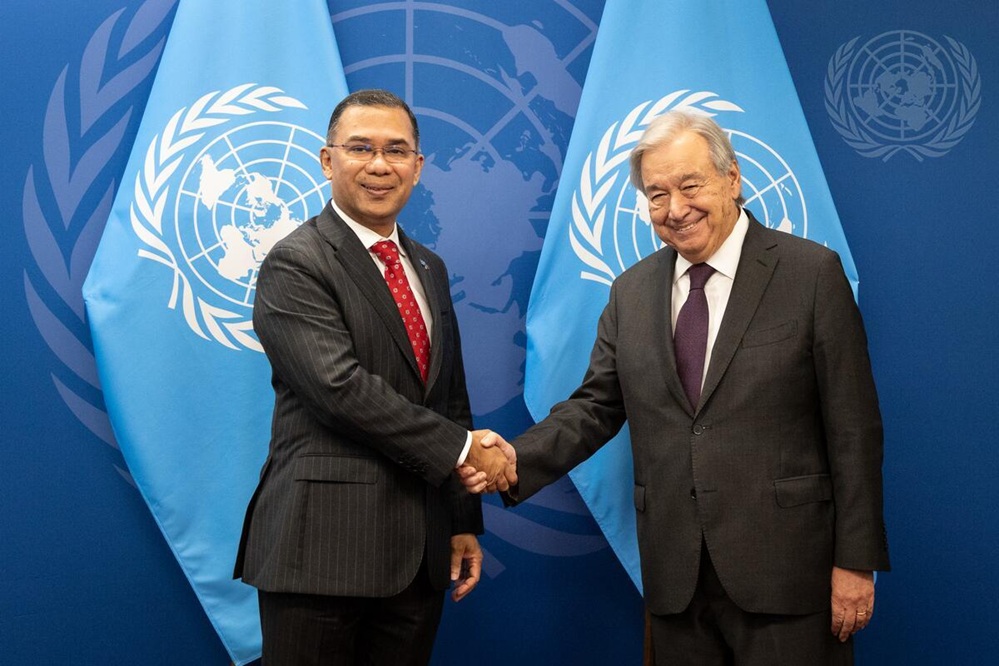
Secretary-General António Guterres (right) meets with Tarique Rahman, Prime Minister of the People’s Republic of Bangladesh.UN Photo/Ariana Lindquist

School bags, uniforms and free midday meals were being provided to primary school students from the first grade, he said, expressing hope that the initiatives would boost school enrolment and improve the quality of education. Tarique Rahman said sports had also been introduced as a subject in the education curriculum for the first time, with the aim of establishing sports as a profession.

As part of the initiative, more than two million students participated in a month-long football tournament held across the country in June, he said. The Prime Minister said science and technology would shape the future as the world entered a new era driven by artificial intelligence, biotechnology and scientific innovation. He said Bangladesh’s large young population and expanding digital capabilities had created new opportunities, but access to advanced technology, knowledge and research needed to be made available to all.

“We do not want today’s digital divide to become tomorrow’s artificial intelligence divide,” he said. Tarique Rahman said Bangladesh respected innovation and intellectual property while stressing the importance of technology transfer, skills development and affordable access to modern technologies.

“It is now time for the United Nations to adopt an effective policy framework so that the benefits of the development and rapid expansion of artificial intelligence and social media can be used positively in countries around the world,” he said. Turning to the Rohingya crisis, Tarique Rahman said Bangladesh had been sheltering more than 1.2 million forcibly displaced Rohingyas from Myanmar for more than nine years.

He said the only solution to the crisis was the safe and dignified return of the displaced Rohingya population to their homeland in Myanmar and called for continued life-saving assistance until their repatriation. The Prime Minister said Bangladesh was continuing its progress in democracy, human rights, good governance, accountability, political stability and improving the investment environment.

“In the present democratic Bangladesh, we welcome partnership, innovation and both domestic and foreign investment,” he said. Tarique Rahman said the government wanted to build a Bangladesh where young people could pursue their dreams without fear or hindrance, women could lead their lives with confidence and every child could grow up with opportunities to realise their full potential.

“Above all, the people will have the assurance of a safe and peaceful life. That is why we say, ‘Bangladesh First: Bangladesh for All’,” he added.