UN Warns of Terrorists’ Growing Use of AI and Drones

Shibbir Ahmed, New York — The United Nations Security Council has warned that terrorist groups are adapting rapidly to new technologies, increasingly exploiting artificial intelligence, drones, social media, encrypted messaging and online platforms to recruit supporters, spread propaganda, raise funds and strengthen their operational capabilities. The warning came during a Security Council briefing marking the 25th anniversary of the September 11 terrorist attacks, as UN officials assessed how the global terrorist threat has evolved since 2001.

Assistant Secretary-General Natalia Gherman told the Council that terrorism has become more fragmented and diffuse, with terrorist groups decentralizing their operations and taking advantage of instability to expand their influence.

She also highlighted the growing role of technology in terrorist activities. According to the UN, extremist groups are exploiting social media platforms, gaming environments and other virtual spaces to identify vulnerabilities and recruit people, particularly young people.

AI and digital platforms create new challenges

UN officials said the rapid development of artificial intelligence and other digital technologies is changing the threat environment. The Security Council’s Counter-Terrorism Committee Executive Directorate said terrorist organizations are using AI-enabled tools and digital platforms to disseminate propaganda, recruit supporters and enhance their operational capabilities.

The UN also pointed to the use of encrypted communications and online financial services as growing challenges for counter-terrorism authorities. The UN Office of Counter-Terrorism has separately warned that AI-generated content, deepfakes and algorithmic amplification can increase the speed and reach of harmful extremist narratives.

Drones emerging as an operational threat

The UN also identified the weaponization and misuse of unmanned aircraft systems, commonly known as drones, as an increasingly significant terrorist threat. According to the Counter-Terrorism Committee Executive Directorate, terrorist groups are exploiting unmanned aircraft systems for operational purposes, while weak governance and porous borders in some regions have created additional opportunities for terrorist organizations to acquire and misuse emerging technologies.

The UN’s counter-terrorism program says member states have been urged to strengthen measures against terrorist exploitation of technologies including AI, virtual assets, 3D printing, unmanned aircraft systems and commercially available drones.

UN calls for international cooperation

The Security Council emphasized that countering terrorism requires coordinated action at the national, regional and international levels, consistent with international law and the UN Charter. UN officials stressed that governments need to adapt their counter-terrorism strategies as terrorist organizations change their methods and exploit emerging technologies.

The Council also highlighted the importance of protecting human rights and the rule of law while responding to evolving terrorist threats. The discussion comes 25 years after the September 11, 2001 attacks in the United States, which prompted major changes in international counter-terrorism cooperation and led to the adoption of Security Council Resolution 1373.


Up to 101,000 North Korean Workers Still Deployed Overseas

Shibbir Ahmed, NEW YORK — North Korea continues to deploy tens of thousands of workers overseas in violation of United Nations sanctions, generating hundreds of millions of dollars that the country’s government allegedly uses to support its nuclear weapons and ballistic missile programs, according to a new report released Wednesday by the Multilateral Sanctions Monitoring Team (MSMT).

The MSMT, a multilateral mechanism established in October 2024 to monitor implementation of UN sanctions against North Korea, estimated that between 35,600 and 101,280 North Korean workers remain deployed abroad, with nearly all located in China and Russia.

The report says the overseas labor network generated an estimated $450 million to $800 million in 2025, despite UN Security Council resolutions requiring member states to end such employment and repatriate North Korean nationals earning income in their territories.

According to the MSMT, at least 17 countries are suspected of continuing to host North Korean workers. The UN Security Council adopted measures in 2017 under Resolutions 2375 and 2397 that prohibited member states from providing work authorization to North Korean nationals and required countries to repatriate North Koreans earning income in their jurisdictions by the end of 2019.

China and Russia remain major destinations

The report estimates that between 20,000 and 70,000 North Korean workers are deployed in China. While an estimated 10,000 to 20,000 workers were temporarily repatriated from China between 2023 and 2025, the MSMT said approximately 10,000 new North Korean workers arrived in China between January 2025 and January 2026. Russia has also become a major destination for North Korean laborers. The MSMT estimates that between 15,000 and 30,000 North Korean workers were in Russia at the end of 2025.

The report says some North Korean workers in Russia have been involved in manufacturing military drones and other activities connected to Russia’s defense-industrial sector. The MSMT identified North Korean workers at facilities involved in areas including drone production, arms manufacturing, steel processing and shipbuilding. The report also says Russia has used a student-visa scheme that the MSMT considers a mechanism for disguising some North Korean workers as students.

Most wages allegedly seized by North Korea

The MSMT estimates that North Korean authorities confiscate 80% to 90% of workers’ wages. In some cases, the report says, the amount taken can exceed workers’ actual earnings, leaving them indebted to the North Korean government.

North Korean authorities also maintain strict controls over workers’ movements and contacts with outsiders, according to the report. Workers who attempt to defect face the risk of retaliation against family members who remain in North Korea.

The report estimates that a North Korean worker in Russia generates an average of about $7,500 in annual wages, while monthly earnings can be several times higher than those of workers in China, depending on the industry.

MSMT seeks restoration of UN expert panel

The latest report also addresses the monitoring gap created after the UN Security Council’s 1718 Committee Panel of Experts was disbanded in April 2024 following Russia’s veto of a resolution extending its mandate. The MSMT said its latest findings are intended to help the international community implement existing UN sanctions and identify efforts to circumvent them.

The participating governments called for the UN Security Council to reestablish the Panel of Experts with the same strength and structure it had before its dissolution. The MSMT said it will continue monitoring implementation of UN sanctions related to North Korea and reporting suspected violations and sanctions-evasion activities.

The participating governments also urged UN member states to increase awareness of the risks associated with employing North Korean overseas laborers and to take domestic action against parties and facilitators involved in alleged violations of UN sanctions.

Source: Multilateral Sanctions Monitoring Team (MSMT); joint statement by participating governments.


Guterres Calls for New Global Order as Power Shifts

Shibbir Ahmed, New York — UN Secretary-General António Guterres has called for a major overhaul of the international system, saying the institutions created after the Second World War must change to reflect the growing economic and geopolitical influence of emerging economies. Speaking to leaders at the 18th BRICS Summit in New Delhi on Sunday, Guterres said the world of today is fundamentally different from that of 1945 and that global institutions must reflect current economic, demographic and geopolitical realities.

“Today’s economic, demographic and geopolitical realities are not those of 1945,” Guterres said. “Our institutional structures must reflect it.”

He said the countries represented at the summit reflected the changing balance of global power and pointed to the emergence of an increasingly multipolar world. Guterres argued that multipolarity can bring greater balance and equity to international institutions, but said that would require reforms to bodies including the UN Security Council and the Bretton Woods institutions.

The UN chief outlined four priorities for what he described as inclusive global growth: financing, technology, climate justice and peace. On development financing, Guterres said developing countries need substantial international support to achieve the Sustainable Development Goals. He urged multilateral development banks to become “bigger, better and bolder” to help meet the scale of financing required. Turning to artificial intelligence, he warned that the benefits of the technology remain concentrated among a relatively small number of companies and countries.

“Unchecked, the AI divide will widen every other divide — in income, in opportunity, in security, and in sovereignty,” Guterres warned.

Climate change was another major focus of his address. Guterres pointed to extreme heat, melting glaciers, wildfires and devastating floods as signs of the worsening climate crisis and warned that a stronger El Niño could make conditions even more difficult as the world approaches the 1.5-degree Celsius threshold above pre-industrial levels.

He called on wealthy nations to honor existing climate-finance commitments, including increased adaptation financing and stronger support for countries facing loss and damage. He also criticized the exploitation of critical minerals, calling for an end to what he described as “plundering.”

On peace and security, Guterres highlighted conflicts and crises in Gaza, the wider Middle East, Ukraine and Sudan. He urged countries to uphold the UN Charter, including the principles of sovereign equality, territorial integrity and the peaceful settlement of disputes. Guterres said reforming the international system should be viewed as a shared responsibility rather than a concession to emerging powers.

“As we move irreversibly to a multipolar world, all countries must work to strengthen and safeguard a multilateral system that delivers for all with the United Nations at its centre,” he said.

The BRICS summit, hosted by India, brought together leaders of major emerging economies and senior international officials as discussions focused on global governance, economic cooperation, development, technology, climate change and international peace and security.


Syria Destroys Assad-Era Chemical Weapons as UN Hails First Verified Destruction Since 2014

Shibbir Ahmed, UNITED NATIONS, NY — September 4, 2026: Syria has begun destroying remnants of the chemical weapons programme inherited from the government of former President Bashar al-Assad, marking a major step in the country’s efforts to dismantle its clandestine chemical arsenal under international oversight.

The development was highlighted during a United Nations Security Council briefing on Syria’s chemical weapons programme, where UN officials reported that the Organisation for the Prohibition of Chemical Weapons (OPCW) had verified the destruction of chemical munitions in Syria for the first time since 2014.

UN High Representative for Disarmament Affairs Izumi Nakamitsu told the Council that the verified destruction represented “significant progress” in international efforts to eliminate Syria’s remaining chemical weapons capabilities.

According to UN and Reuters reporting, the destruction includes 42 aerial bombs, along with additional chemical-weapons-related production and storage facilities. The verification represents the first confirmed destruction of Syrian chemical munitions by the OPCW since the international disarmament process began more than a decade ago.

Remnants discovered after Assad’s fall

The latest operation follows the discovery earlier this year of previously undeclared chemical-weapons materials in Syria. In May, an OPCW expert team working with Syrian authorities reported finding previously undeclared chemical munitions, chemical substances, equipment and extensive documentation linked to the former government’s chemical weapons programme.

The OPCW said its investigation found dozens of previously undeclared chemical munitions, including aerial bombs of the same type associated with chemical attacks in Ltamenah in 2017 and Khan Shaykhun in 2017, as well as rockets of a type associated with the 2013 Ghouta chemical attack.

The discovery was significant because the OPCW had repeatedly raised questions about gaps and inconsistencies in Syria’s earlier declarations concerning the full extent of its chemical weapons programme. Following the fall of the Assad government in December 2024, Syria’s new authorities opened the door to renewed international inspections and cooperation with the OPCW.

International verification

The OPCW plays the central technical role in identifying, securing and destroying Syria’s remaining chemical weapons materials, while the issue continues to be addressed by the UN Security Council under its existing mandate.

The OPCW said in July that Syria’s rights and privileges under the Chemical Weapons Convention had been reinstated after the country’s new authorities demonstrated progress in cooperating with the organisation. The decision followed steps including amendments to Syria’s declaration, preparations for facility agreements and plans for verification and destruction activities.

The current process is therefore not simply a Syrian announcement of destruction. The significance lies in the fact that the destruction has been independently verified by the OPCW.

That distinction is crucial in international chemical-weapons disarmament, where verification is intended to establish that declared materials have actually been destroyed and cannot simply be transferred, concealed or reused.

Damascus promises further action

Syria’s representative to the United Nations, Ibrahim Olabi, told the Security Council that the destruction programme was intended to protect Syrians and prevent chemical weapons from falling into the wrong hands. The Syrian government has said it is cooperating with international experts to address the chemical weapons legacy left by the previous government.

The authorities are also preparing legal proceedings involving individuals allegedly connected to the former chemical weapons programme. Reuters reported that Syria is preparing trials involving 18 suspects, including senior figures allegedly connected to the programme.

The move could add an important accountability dimension to the international disarmament effort: not only destroying the remaining weapons and materials, but also investigating responsibility for their development and use.

Concerns over military activity

The Security Council discussion also reflected broader regional tensions. Syria’s UN representative criticized Israeli military actions in Syria, arguing that strikes could complicate chemical-weapons operations and place personnel involved in the destruction process at risk. Türkiye also raised concerns that Israeli military activity could make the disarmament effort more difficult.

Those claims remain part of the broader political dispute surrounding Syria and should be distinguished from the independently verified technical findings concerning chemical-weapons destruction.

A milestone after more than a decade

The latest development represents a significant change from the period when Syria’s chemical weapons programme was the subject of intense international confrontation. Syria joined the Chemical Weapons Convention in 2013, following international pressure after the deadly chemical attack in Ghouta. The OPCW subsequently supervised the removal and destruction of declared chemical weapons, but questions remained about whether Syria had fully disclosed the scope of its programme.
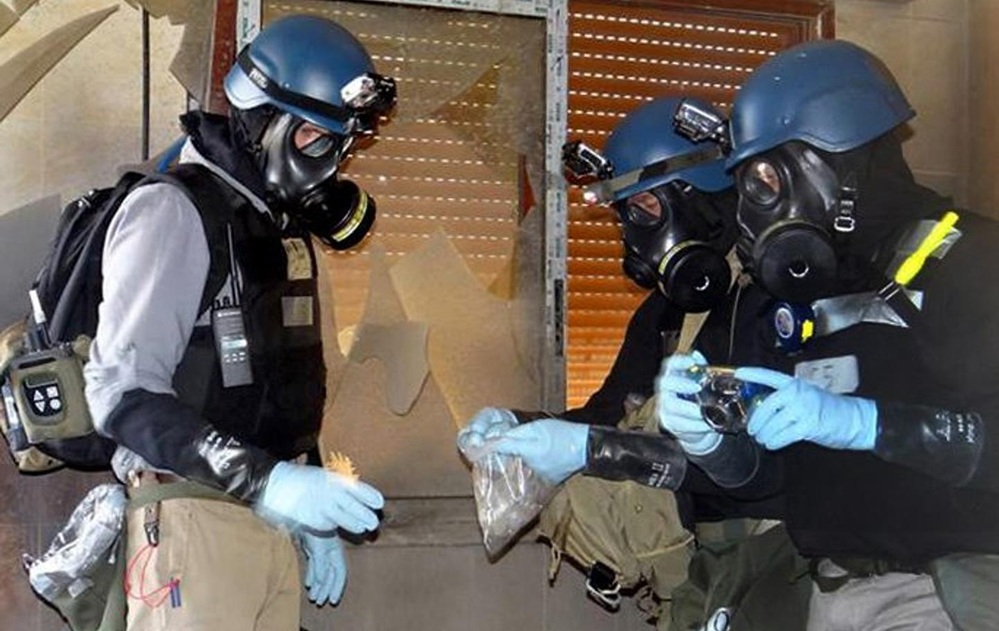
The discovery of previously undeclared materials in 2026 reinforced those concerns. The new Syrian authorities’ cooperation with the OPCW has now created an opportunity for international inspectors to revisit sites, collect documentation, identify undeclared materials and oversee their destruction.

The OPCW said its current work includes efforts to establish a complete and accurate inventory of remnants of the Assad-era programme and ultimately ensure their destruction in accordance with the Chemical Weapons Convention.

UN welcomes progress but warns work remains

The UN briefing made clear that the destruction of 42 aerial bombs and other materials does not mean the Syrian chemical weapons dossier is closed. International inspectors still have work to do to determine the full extent of the former programme, verify Syria’s declarations and oversee the destruction of remaining chemical-weapons-related materials.

The OPCW has previously said that more than 100 locations across Syria were considered potentially relevant to the former chemical weapons programme, with high-priority sites selected for investigation based on information gathered over many years.

For the United Nations and the OPCW, the immediate objective is therefore twofold: complete the inventory and ensure the irreversible destruction of everything that remains. The first verified destruction since 2014 nevertheless represents an important milestone.

After years of international disputes over Syria’s chemical weapons declarations, the combination of renewed Syrian cooperation, OPCW inspections and verified destruction could mark the beginning of a new phase in efforts to permanently eliminate the country’s chemical weapons legacy.

For the Security Council, however, the challenge remains ensuring that the process continues safely, transparently and under international verification until the entire inherited programme is accounted for and eliminated.