U.S. Cuts Staffing at Four Middle East Embassies Amid Iran Threats

WASHINGTON DC — The United States is reducing staffing at four embassies in the Middle East following intelligence warnings that Iran has intensified efforts to target American personnel in the region and beyond, according to U.S. officials and a report by The Associated Press. The staffing reductions affect U.S. embassies in Jordan, Lebanon, Qatar and the United Arab Emirates. The diplomatic missions will remain open but will operate under restricted conditions, officials said.

In a memo sent Friday to Secretary of State Marco Rubio, Director of National Intelligence Jay Clayton warned that Iran had substantially increased its efforts to target U.S. personnel. Clayton said intelligence assessments indicated that alleged plots targeting American citizens had reached advanced stages in the Middle East and other countries. The memo did not publicly identify specific targets or provide details about the alleged plots.

U.S. officials said concerns about Iranian threats, along with the risk of attacks by Yemen’s Iran-backed Houthi rebels, contributed to the decision to reduce staffing at the four embassies. The State Department had cited increased threats from the Houthis when announcing the staffing changes but had not initially publicly identified direct Iranian threats as a reason for the measures.

The latest reductions differ from measures announced earlier in Saudi Arabia, where nonessential U.S. government personnel and their families were ordered to leave the country. Personnel at the four embassies affected by the latest decision have not been ordered to depart, according to the report.

The developments come amid renewed regional fighting and growing concerns about the security of American diplomatic and military personnel. Iran’s Islamic Revolutionary Guard Corps has also threatened U.S. military bases in the region over American assistance to commercial shipping through the Strait of Hormuz, a strategically important waterway for global energy supplies. Any escalation around the strait could have wider consequences for international shipping, energy markets and regional security.

The staffing changes come as diplomatic efforts to resume formal negotiations between Washington and Tehran continue amid a stalemate in the conflict. President Donald Trump said Friday that the United States could undertake further military action against Iran if Tehran did not agree to negotiations. U.S. officials have denied that the embassy staffing reductions are connected to preparations for potential new U.S. and Israeli strikes against Iran.

The situation remains fluid, with Washington balancing diplomatic efforts against security concerns involving American personnel and regional allies. Source: The Associated Press, citing U.S. officials and an intelligence memo. Additional details were reported by Axios.


U.S. Announces New Visa Restrictions Over Child Abduction Cases

Shibbir Ahmed, Washington, DC — The Trump administration announced a new visa restriction policy Monday aimed at pressuring foreign officials to help resolve international parental child abduction cases involving children taken across international borders.

The policy targets foreign government officials, judges, judicial administrators, law enforcement officials and others who are determined to be responsible for, or complicit in, intentionally obstructing the prompt resolution of international parental child abduction cases.

Under the new policy, the United States may restrict visa issuance to individuals who intentionally fail to implement or comply with laws, policies or court orders intended to resolve such cases and facilitate the return of children to their country of habitual residence. The restrictions may also apply to the immediate family members of targeted individuals. The State Department said the policy provides the department with an additional accountability tool to encourage countries to meet their obligations and cooperate in resolving cases.

“The Department proactively works to prevent abductions and facilitate the quick and safe return of abducted children to their country of habitual residence,” the department said in its announcement.

The administration said the policy is intended to strengthen U.S. efforts to protect American children abducted across international borders and reunite them with their parents. The State Department also said the measures are intended to promote accountability when countries fail to meet their obligations under international law. The new visa restrictions are being implemented pursuant to Section 212(a)(3)(C) of the Immigration and Nationality Act.

The department emphasized that the United States remains committed to protecting the safety and well-being of American children involved in international parental child abduction cases.


Landau Calls for Shift From Aid to Investment in U.S. Economic Diplomacy

Shibbir Ahmed, New York — U.S. Deputy Secretary of State Christopher Landau has called for a stronger focus on trade and private investment as a long-term alternative to traditional foreign aid, saying economic diplomacy should play a central role in strengthening relationships between countries. Speaking at a Trade Over Aid Deals Showcase on September 25, Landau said economic and commercial issues had for decades taken a back seat in diplomacy, which he argued had too often focused primarily on political, military and security matters.

‘Economic and commercial issues should be treated as a core element of diplomacy’, Landau said, arguing that governments have a responsibility to create prosperity, economic opportunities and jobs for their people. Landau said economic projects can create lasting relationships that survive changes in government. While acknowledging that aid programs can help countries remain afloat, he argued that long-term economic projects can provide more sustainable value by generating investment, infrastructure, employment and economic growth.

He also emphasized that foreign investment does not necessarily mean a loss of national sovereignty. According to Landau, governments should establish clear terms and conditions for investments so that both investors and host countries understand their respective obligations and potential returns.

‘Investment is an engine of growth’, Landau said, urging governments and businesses to view foreign capital as an opportunity to expand economic activity rather than as a threat to sovereignty. He described investment relationships as potentially “win-win” arrangements, saying capital inflows can support infrastructure, jobs and economic growth while also strengthening political and commercial ties between countries.

U.S. private sector at the center

Landau said one of his priorities as deputy secretary is to improve communication between the U.S. government and American companies seeking investment opportunities overseas. He noted that during trips around the world, he frequently hears foreign governments asking why American companies are absent from projects where businesses from other countries have submitted bids.

Landau said he had previously focused largely on American companies directly operating overseas, including construction, infrastructure, oil and mining firms. He said he now sees a greater role for U.S. financial capital, particularly from New York City, which he described as the world’s financial capital.

‘There are trillions of dollars here that can be deployed around the world,’ Landau said, arguing that attracting capital providers could help connect foreign investment opportunities with American operating companies. He said he recently met with major capital providers to discuss why they were not investing in certain countries and what obstacles were preventing greater U.S. participation.

Calls for a more coordinated U.S. approach

Landau also acknowledged concerns from private investors about the fragmented nature of the U.S. government’s economic engagement overseas. He said investors sometimes want the U.S. government to have a financial stake or other involvement in projects to reduce risks associated with political changes in foreign countries.

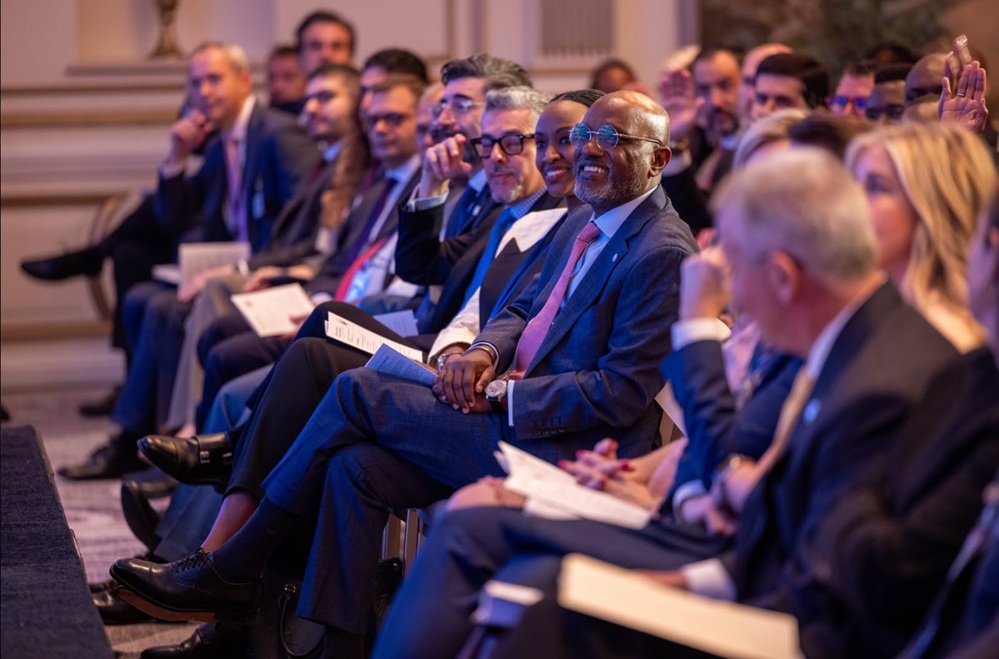
Government officials, private-sector representatives and international participants attend the “Trade Over Aid Deals Showcase” as U.S. officials discuss expanding trade and investment opportunities.

Landau said he wants the State Department, Commerce Department, Export-Import Bank, Development Finance Corporation and Millennium Challenge Corporation to work more closely together and make the U.S. government a more accessible “one-stop shop” for businesses seeking to invest overseas.

He cited the Pacific Islands as one region where he believes greater investment opportunities exist. Landau said he had organized a business summit and investment roundtable in Honolulu in February with Pacific Island leaders and U.S. private-sector representatives to identify sectors where investment could be expanded.

Landau said the U.S. government’s role is to improve communication between governments, businesses and investors and help identify opportunities for private capital. Concluding his remarks, Landau reaffirmed his commitment to expanding the global role of American businesses and called for what he described as an “unprecedented golden era for the American private sector around the world.”


Bangladesh-U.S. Relations Gain New Momentum: Bethany Morrison

Shibbir Ahmed, New York: Bangladesh-U.S. relations are currently on a positive trajectory, with Washington highlighting recent progress in trade, aviation and civilian nuclear cooperation as important developments in bilateral ties. Bethany Morrison, Deputy Assistant Secretary for South and Central Asian Affairs at the U.S. Department of State, made the remarks during a briefing on South Asia at the New York Foreign Press Center on Thursday.

“We are also in a good place with Bangladesh,” Morrison said, pointing to recent high-level engagement and expanding cooperation between the two countries.

Bangladesh Foreign Minister Meets President Trump

Morrison noted that Bangladesh’s foreign minister had the opportunity to meet with U.S. President Donald Trump earlier this week. She described the meeting as an important example of high-level engagement between Washington and Dhaka.

Highlighting recent trade cooperation, Morrison also referred to a major commercial agreement involving Boeing. She said President Trump had also posted about the development on his Truth Social account on Thursday morning.

Civilian Nuclear Cooperation

Morrison also said Bangladesh and the United States are preparing to sign a memorandum of understanding (MoU) on civilian nuclear cooperation. According to Morrison, the MoU is expected to be signed on Friday with the participation of a U.S. undersecretary. The proposed agreement could open another area of cooperation between the two countries, particularly in the peaceful use of nuclear technology and related civilian applications.

U.S. Sees Greater Engagement in South Asia

Morrison described the recent high-level contacts and agreements with Bangladesh as part of broader progress in U.S.-Bangladesh relations. Speaking about Washington’s wider policy toward South Asia, she said the Trump administration is placing greater importance on the region than in the past.

She indicated that the United States expects further progress in its relations with Bangladesh and other South Asian countries in the coming days. Journalists from Bangladesh, India, Nepal, South Korea, the United States and other countries attended the briefing at the New York Foreign Press Center.


U.S. Says Decisions on Awami League and Sheikh Hasina Are Bangladesh’s to Make

Shibbir Ahmed, New York – The United States has said it has taken no position on lifting restrictions on Bangladesh’s Awami League or on allowing former Prime Minister Sheikh Hasina to return to Bangladesh and participate in the country’s political process. Washington has also not taken an official position on the judicial proceedings against Sheikh Hasina, a senior U.S. State Department official said during an on-background briefing on South Asia at the New York Foreign Press Center on Thursday.

Asked whether the United States supports lifting restrictions on the Awami League and allowing Sheikh Hasina to return to Bangladesh and participate in politics, the official said Washington does not want to take sides in Bangladesh’s domestic political affairs.

The official said the United States is working with Bangladesh’s elected government and wants to strengthen bilateral relations with the aim of helping build a stronger, safer and more prosperous Bangladesh. Asked whether the decision to lift restrictions on the Awami League was ultimately a matter for the United States, the official replied that it was “a decision for the government of Bangladesh.”

No official U.S. position on Sheikh Hasina’s trial

The issue of Sheikh Hasina’s trial and possible return to Bangladesh was also raised by journalist Lovlu Ansar. He asked about the U.S. position on the verdict against Hasina by a Bangladeshi court, her reported desire to return to the country and her request for an opportunity to challenge proceedings conducted in her absence.

In response, the U.S. official said Washington has not taken an official position on the matter. The official described the issue as an important point of disagreement in India-Bangladesh relations and said the United States hopes India and Bangladesh will resolve the matter through discussions between the two countries.

The official also said Washington has not taken a specific position on what should be done regarding Sheikh Hasina. The United States, the official added, wants to see improved relations between India and Bangladesh and encourages both countries to strengthen their bilateral ties.

U.S. responds to questions about AQIS in Bangladesh

The briefing also touched on concerns regarding the activities of Al-Qaeda in the Indian Subcontinent (AQIS). Journalist Lovlu Ansar referred to a report by the UN Security Council sanctions monitoring team that raised concerns about AQIS attempting to establish small clandestine terrorist cells in several countries, including Bangladesh. Asked about Bangladesh’s response and the U.S. position on the issue, the official said he was not familiar with the details of the specific report.

However, he described Al-Qaeda as a terrorist organization and said the United States would work with countries on counterterrorism efforts. The official declined to comment specifically on the report because he had not reviewed its details.

U.S. does not want Bangladesh to choose sides

The official was also asked about Bangladesh’s efforts to maintain relations with the United States, India and China. He said Washington does not want Bangladesh to be forced to choose one side over another. At the same time, he said Bangladesh should make careful decisions regarding sensitive sectors, including critical infrastructure and telecommunications. The United States, he said, wants to help Bangladesh protect its sovereignty and systems while providing alternatives in strategically sensitive areas.

“We’re not saying you have to choose between this or that. We want to provide alternatives for these countries, particularly in their sensitive sectors,” the official said.

U.S. monitoring Imran Khan’s situation

The briefing also included a question about former Pakistani Prime Minister Imran Khan. The U.S. official said Washington is closely monitoring developments surrounding Khan’s legal cases and health situation. However, the official said U.S. involvement in the matter remains primarily limited to monitoring developments.


U.S. Expands Cuba Sanctions, Targets Military and Nickel Sectors

Shibbir Ahmed, WASHINGTON DC — The United States on Thursday announced new sanctions against eight Cuban entities and three individuals as part of the Trump administration’s broader effort to restrict Cuba’s military capabilities and sources of revenue. The U.S. Department of State said the latest measures target elements of Cuba’s military research and development apparatus as well as entities connected to the country’s nickel and mining sector.

The designations were imposed under Executive Order 14404, issued in May 2026. The order authorizes sanctions against foreign persons involved in specified activities related to Cuba, including operations in the defense, metals and mining, energy, financial-services and security sectors. Four Cuban military enterprises were designated for operating in or having operated in the defense and related-materials sector.

They are the Centro de Investigacion y Desarrollo de Simuladores (SIMPRO), which the State Department says develops and manufactures simulators and training programs for Cuba’s Revolutionary Armed Forces and other government entities; the Centro de Investigacion y Desarrollo Naval (CIDNAV), involved in research programs for the Cuban Revolutionary Navy; the Centro de Investigacion y Desarrollo de Armamento de Infanteria (CIDAI), involved in research related to infantry weapons; and Centro de Investigacion, Desarrollo y Produccion Grito de Baire (GELCOM), which produces electronics and communications equipment.

The United States also sanctioned three senior Cuban military officials associated with those enterprises: Joaquin Francisco Cancio Monteagudo, director general of SIMPRO; Dioglis Pedrera Arguello, director general of CIDNAV; and Julio Hurtado Betancourt, director general of CIDAI.

Four additional entities connected to Cuba’s nickel industry were also designated: SERCONI, CEPRONIQUEL, CEDINIQ and PINARES S.A. The State Department identified them as state-linked organizations involved in technical services, engineering, research and mineral surveying associated with Cuba’s nickel sector.

Under the sanctions, property and interests in property belonging to designated persons that are in the United States or under the possession or control of U.S. persons are blocked. U.S. persons are generally prohibited from engaging in transactions involving blocked property unless authorized or exempt.

The measures also create sanctions risks for certain foreign persons that conduct specified transactions with persons designated under E.O. 14404 or operate in sectors covered by the order. OFAC says E.O. 14404 operates alongside, rather than replacing, the existing Cuban Assets Control Regulations.

The latest action follows several rounds of U.S. sanctions against Cuban entities and officials during 2026. Earlier measures have also targeted Cuba’s financial channels, energy-related entities and resource-exploitation apparatus. The State Department said the ultimate objective of the sanctions is to encourage changes in behavior by the Cuban government.