Blue Wave Sweeps Across America: Democrats Regain Control of Senate and House

Shibbir Ahmed, Washington, D.C. – The 2026 U.S. midterm elections have brought a major shift in the balance of political power in Washington, with the Democratic Party reclaiming control of both chambers of Congress. Defeating President Donald Trump’s Republican Party by significant margins, Democrats secured majorities in the Senate and the House of Representatives. Democratic candidates also captured several governorships previously held by Republicans in key states. The results of Tuesday’s, November 3, election are being viewed as a new “blue wave” in American politics.

As of Wednesday morning, November 4, preliminary election figures show that Democrats, including two independent senators who caucus with them, have secured 54 seats in the 100-member Senate. Republicans hold 44 seats, while the outcomes of two races remain unresolved. The shift marks a major political victory for Democrats, who faced a Republican-controlled Senate before the election. A similar trend has emerged in the House of Representatives. Of the 435 seats, 218 are required for a majority. Preliminary results show Democrats winning 228 seats, compared with 139 for Republicans, while counting continues in the remaining districts. The results indicate that Democrats have taken control of both chambers of Congress.

Some of the most significant Senate victories came in states traditionally considered Republican strongholds. Democrats reportedly reclaimed Republican-held Senate seats in Kansas, Iowa, Texas, Ohio, Maine, North Carolina and South Carolina. The result in Kansas has drawn particular attention, as it marks the election of a Democratic senator in the state for the first time in nearly a century. Adam Hamilton defeated Republican Senator Roger Marshall, creating a new chapter in the state’s political history. In Iowa, Josh Turek defeated Republican Ashley Hinson to return the Senate seat to Democratic hands. The victory is especially notable because President Trump won Iowa by a significant margin in the 2024 presidential election.

In Texas, James Talarico secured a historic victory by defeating Republican Ken Paxton. The Democratic win in a state long dominated by Republicans carries considerable national political significance. In his victory speech, Talarico declared, “We have taken Texas back.” In Ohio, former Democratic Senator Sherrod Brown defeated Republican Jon Husted to return to the Senate. In Maine, former state Senate leader Troy Jackson defeated longtime Republican Senator Susan Collins. Along with the victories in Iowa, Kansas and Texas, these results played an important role in giving Democrats a Senate majority. In North Carolina, former Governor Roy Cooper defeated Republican Michael Whatley, delivering another Senate seat to the Democrats.

Michigan also witnessed a historic Democratic victory. Abdul El-Sayed defeated Republican candidate and former congressman Mike Rogers, becoming the first Muslim elected to the U.S. Senate, according to the preliminary results described in the supplied election account. El-Sayed is set to succeed retiring Democratic Senator Gary Peters. Despite facing personal attacks from President Trump and Vice President JD Vance during the campaign, El-Sayed used his victory speech to deliver pointed remarks directed at both men. Addressing Vance as “habibi,” an Arabic term meaning “my dear” or “beloved,” El-Sayed noted that the vice president would be constitutionally obligated to swear him into office in January. He described the situation as a “delicious irony.” Turning to Trump, El-Sayed said that if the president continued to struggle with pronouncing his name, he could simply call him “Senator” after the swearing-in ceremony.

The Senate elections also produced several other historic milestones. In Minnesota, Democrat Peggy Flanagan defeated Republican Michele Tafoya, becoming the first Native American woman elected to the U.S. Senate. Flanagan, the state’s sitting lieutenant governor, is expected to bring greater representation for Indigenous communities to the nation’s highest legislative chamber. In New Hampshire, Democrat Chris Pappas defeated former Republican Senator John Sununu, becoming the first openly gay man elected to the U.S. Senate. Along with El-Sayed’s victory in Michigan, these results represent significant milestones in the political representation of Muslim Americans, Indigenous communities and LGBTQ Americans.

Democrats also made substantial gains in the House of Representatives, reportedly capturing more than two dozen seats previously held by Republicans. Democratic candidates won in several districts where Trump had secured comfortable victories in the 2024 presidential election. In Indiana’s 5th Congressional District, Democrat J.D. Ford defeated three-term Republican Congresswoman Victoria Spartz. In a border district in Texas, Latin Grammy-winning musician Bobby Pulido defeated Republican Congresswoman Monica De La Cruz. Democrats also won three of Iowa’s four congressional districts. Victories by Christina Bohannan, Sarah Trone Garriott and Lindsay James point to a significant Democratic comeback in the state.

The election has also opened the possibility of another historic development in the House leadership. If Democratic House leader Hakeem Jeffries is elected speaker, he would become the first Black speaker in U.S. history. The new Congress is scheduled to convene on January 3, 2027, when members will elect the speaker. Jeffries’ election to the post is not yet official, but the Democratic majority gives him a clear opportunity to secure the position.

Democrats also recorded notable victories in gubernatorial races. According to the preliminary results in the supplied account, Democrats Keisha Lance Bottoms in Georgia, Amy Acton in Ohio, Rob Sand in Iowa and Gina Hinojosa in Texas defeated Republican candidates to take control of governorships previously held by the GOP. Bottoms’ victory in Georgia would make her the first Black woman governor in U.S. history and the state’s first Black governor. In Ohio, Acton would become the state’s first elected female governor. Hinojosa’s victory in Texas is also being described as politically significant, as it would mark the state’s first Democratic governor since 1990. In Iowa, Sand’s victory would return a Democrat to the governor’s office after two decades.

In Nevada, Democrat Aaron Ford defeated Republican incumbent Governor Joe Lombardo, becoming the state’s first Black governor. In New Mexico, Deb Haaland made history as the first Native American woman elected governor. Republicans, however, held on to the governorship in Florida, where Byron Donalds won and became the state’s first Black governor. The result demonstrates that Republicans managed to retain control of the governor’s office in Florida despite the broader Democratic gains. In Alabama, Republican Senator Tommy Tuberville was elected governor. In Oregon, Democrat Tina Kotek won re-election, while Democrat Jocelyn Benson secured victory in Michigan’s gubernatorial race.

The election results pose a major political challenge for President Donald Trump’s administration. With Democrats controlling both the House and Senate for the next two years, the president’s legislative agenda, key appointments and budget initiatives could face significant obstacles. Democratic control of congressional committees will also give the party greater authority to investigate the administration’s policies and activities. However, Trump’s presidential veto power remains intact, meaning that Democratic control of Congress does not automatically give the party the ability to block every White House decision.

Voter concerns about the cost of living, inflation, the war with Iran and government corruption reportedly played important roles in shaping the election outcome. Exit polling suggested that a significant share of voters wanted stronger congressional oversight of presidential power. Although Trump actively campaigned for Republican candidates, several candidates backed by the president reportedly suffered defeats in key states.

Overall, the 2026 midterm elections signal a major shift in America’s political balance of power. The Democratic Party’s return to control of both chambers of Congress, its victories in traditionally Republican states and the reported historic election of Muslim, Indigenous, Black and openly gay candidates have made this election a significant moment in American political history. The full impact of the results will become clearer after the new Congress takes office in January 2027.


Tom Suozzi Expresses Interest in Reviving Bangladesh Caucus After November Elections

Irin Rahman, New York – Democratic Congressman Tom Suozzi has expressed interest in reviving and rebuilding the inactive Bangladesh Caucus in the U.S. Congress following the November 3 midterm elections. He has indicated his willingness to help reactivate the congressional group and take on a leadership role to advance the interests of Bangladesh and Bangladeshi Americans.

Suozzi shared his intentions while speaking with prominent members of the Bangladeshi and South Asian communities during a Diwali celebration at the Hindu Temple Society auditorium in Flushing on Monday evening, October 26.

Representing New York’s 3rd Congressional District, which includes parts of Long Island and Queens, Suozzi serves on the influential House Ways and Means Committee, which oversees key areas of tax policy, trade and Social Security. He is also associated with the House Select Committee on China.

Known for his centrist political approach, Suozzi advocates bipartisan cooperation and practical solutions rather than ideological confrontation. He also serves as a Democratic co-chair of the Problem Solvers Caucus in the House of Representatives.

Community representatives hope that his involvement could help bring renewed attention to issues affecting Bangladeshi Americans and strengthen their representation in Washington.

Among those attending the event were former State Minister Enamul Haque Shamim, former parliamentary whip Nazrul Islam Babu, National Press Club President and former lawmaker Farida Yasmin, journalist and editor Naim Nizam, Queens Democratic Party District Leader Dr. Dilip Nath, New American Voters Association President Dipa Nath, Dr. Pradip Kar, founder of Genocide ’71, Shaktigupta, associated with the New York Police Department, Bijoy Sarkar, a founding member of the U.S. chapter of Oikya Parishad, and Shyamal Chakraborty, a leader of United Hindus.

Republican Congressman Benjamin Gilman was the founding chairman of the congressional Bangladesh Caucus. Following his death, Democratic Congressman Joseph Crowley assumed a leadership role in the caucus.

Crowley represented New York’s 7th Congressional District from 1999 to 2003 and the 14th District from 2003 to 2019. His district included several communities with significant Bangladeshi American populations. After Crowley lost the 2018 Democratic primary to Alexandria Ocasio-Cortez, the caucus became increasingly inactive, according to community observers.

Against this backdrop, Suozzi’s expressed interest in helping revive the Bangladesh Caucus has generated renewed optimism among Bangladeshi Americans in New York. A revitalized caucus could provide an important platform for raising community concerns, strengthening engagement with U.S. lawmakers and promoting closer ties between the United States and Bangladesh. However, Suozzi’s formal appointment as chair and the proposed reorganization have yet to be officially confirmed.


New York’s 17th District Emerges as Key Battleground in Fight for Congress

Shibbir Ahmed, New York — The race for New York’s 17th Congressional District is shaping up as a closely contested battle between Republican incumbent Mike Lawler and Democratic challenger Cait Conley, with the outcome potentially influencing which party controls the U.S. House of Representatives. The district, covering Rockland and Putnam counties and parts of Westchester County, is among the competitive suburban seats that could determine the balance of power in Washington after the November 3 midterm elections.

A CBS New York report published October 23 described the contest as a toss-up, highlighting the importance of household costs, including groceries, heating, gasoline and other everyday expenses.

Lawler, seeking a third term, has emphasized his congressional record, bipartisan work and proposals related to domestic energy production and Social Security. The Rockland County Republican has also sought to distinguish his approach from criticism that he is too closely aligned with President Donald Trump. Conley, a West Point graduate and military veteran, is campaigning on affordability, utility costs and government accountability. She has criticized Lawler’s record and argued that voters need stronger representation on economic issues. The candidates’ contrasting approaches reflect broader national debates over the economy, immigration, the Trump administration and the direction of federal policy.

An Emerson College Polling/PIX11 survey conducted September 27–29 among 400 likely voters found Conley at 47.9% and Lawler at 45.6%, with 6.5% undecided. The poll’s stated credibility interval was plus or minus 4.9 percentage points.

A separate poll conducted by McLaughlin & Associates on September 28–30 put Lawler ahead, 50% to 47%. The differing results underscore the uncertainty surrounding the race. Decision Desk HQ’s forecast, updated October 23, gave Conley a 59% modeled chance of winning and Lawler 41%. Such figures are forecasts, not guarantees of the final result.

The race is important because control of the House could shape congressional oversight, spending negotiations and the legislative agenda during the final two years of Trump’s current term. The district’s competitive political makeup, close polling and national attention have drawn substantial campaign spending and visits from prominent political figures. Voters will decide the contest on November 3, when congressional races across the country will determine the next balance of power in Washington.


Democrats Eye House Majority as Midterm Elections Approach

Shibbir Ahmed, Washington DC — House Democratic Leader Hakeem Jeffries says Democrats are on the verge of regaining control of the U.S. House of Representatives as the November midterm elections approach, setting the stage for a potentially significant shift in the balance of power in Washington. “We’re on the verge of taking back control of the House,” Jeffries told The Associated Press during a campaign stop in Ohio, expressing confidence in his party’s prospects.

Democrats are seeking to capitalize on the political climate to flip competitive congressional districts and reclaim the House majority currently held by Republicans. The outcome of the elections could determine how much influence President Donald Trump has over the legislative agenda during the remainder of his term.

Jeffries has been campaigning across the country, urging voters to support Democratic candidates in closely contested races. Party leaders believe gains in battleground districts, including areas that supported Trump in the 2024 presidential election, could help Democrats secure a majority. The Democratic leader has drawn comparisons with the 2018 midterm elections, when Democrats gained control of the House during Trump’s first term.

However, the outcome remains uncertain. Republicans are working to defend vulnerable seats, while both parties are investing resources in competitive districts that could determine control of the chamber.

Democratic leaders are also preparing a policy agenda in case they regain control of the House. Their priorities include addressing the cost of living, restoring Affordable Care Act tax credits, challenging Republican healthcare policies and increasing congressional oversight of the Trump administration. Jeffries could become the next speaker of the House if Democrats win a majority and elect him to the position. He would make history as the first Black American to serve as House speaker.

The November 3 midterm elections will determine control of Congress for the next legislative session. A Democratic victory in the House would give the party greater power to shape legislation, conduct investigations and challenge the administration’s policies. Republicans, meanwhile, are campaigning to retain their majority and maintain support for Trump’s legislative agenda.

With control of the House potentially hinging on a limited number of competitive races, the final weeks of campaigning are expected to play a crucial role in determining the political direction of Washington.


Congressman Gregory Meeks Calls for Joint Efforts to End Bangladesh Crisis

NEW YORK — U.S. Congressman Gregory W. Meeks has called for collective efforts to help restore normalcy in Bangladesh, strengthen democratic institutions, uphold the rule of law and protect press freedom. Meeks, the Ranking Member of the U.S. House Foreign Affairs Committee, made the remarks during an exchange meeting with members of the Bangladeshi-American community in New York on September 28.

Speaking about Bangladesh’s political situation, Meeks said he expects Democrats to regain majorities in both chambers of Congress in the November 3 midterm elections. He said that if he again becomes chairman of the House Foreign Affairs Committee, he intends to visit Bangladesh, observe the situation firsthand and work through Congress to provide appropriate direction to the U.S. administration.

Meeks also referred to a December 23, 2025 letter that he and four other members of Congress sent to Bangladesh’s then-Chief Adviser Muhammad Yunus. The letter urged the interim government to work with political parties across the political spectrum to create conditions for free, fair and inclusive elections and to restore confidence in the neutrality of state institutions.

The lawmakers also expressed concern that suspending the activities of a political party or restarting what they described as a flawed International Crimes Tribunal would undermine those objectives. Meeks said Bangladesh needs stronger democratic institutions, effective rule of law and safeguards for media freedom.

Turning to the United States, the congressman also expressed concern about what he described as growing pressure on media outlets and dissenting voices. Referring to disputes involving CNN, Politico and MS NOW and their access to the White House and Air Force One, he said measures affecting the media and people expressing dissent were inconsistent with American democratic values.

Meeks said he wanted to see Bangladesh return to a stable political environment. He also pledged that, if he again serves as chairman of the House Foreign Affairs Committee, he would visit Bangladesh and engage with relevant authorities regarding the country’s situation.

Bangladesh Situation Discussed

The exchange meeting was organized with the assistance of Sector Commanders Forum-Muktijuddho ’71 and the Bangabandhu Foundation. Bangabandhu Foundation President Abdul Kader Mia chaired the event, while Queens Democratic Party District Leader Dr. Dilip Nath moderated it.

Former Bangladeshi Foreign Minister and former Permanent Representative of Bangladesh to the United Nations A.K. Abdul Momen and former National Press Club President Farida Yasmin spoke about Bangladesh’s political and social situation. They alleged that opposition voices and political activists had faced arrests, violence and legal cases following the July-August 2024 protests and the formation of the interim government led by Muhammad Yunus.

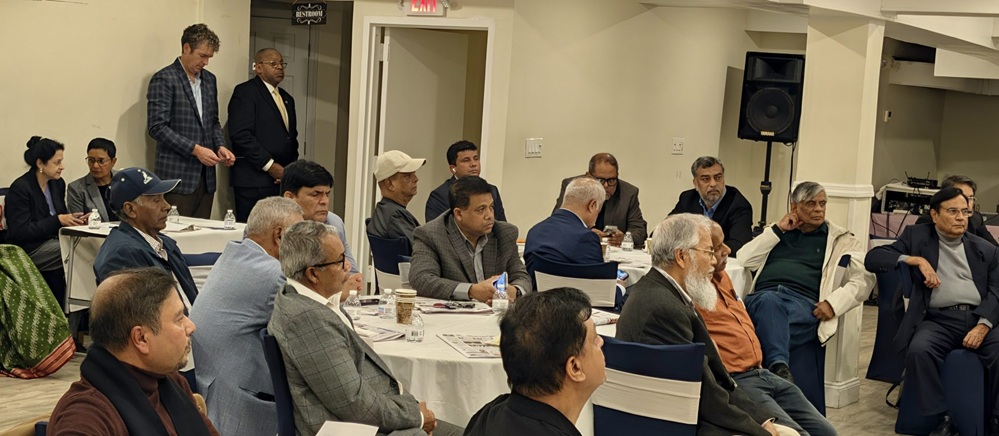
Bangladeshi-American community members attend a meeting with U.S. Congressman Gregory Meeks in New York to discuss Bangladesh’s political situation, democracy and the rule of law. Photo: KHABOR

They also alleged that members and supporters of the Awami League had been subjected to violence and that religious minorities had faced attacks. The speakers further criticized the suspension of Awami League activities, alleged mistreatment of freedom fighters and legal action against journalists whose reporting they said was not favored by the government.

The speakers called for the lifting of restrictions on the Awami League and urged the U.S. Congress to support what they described as the need for an early election. They also sought congressional intervention for the release of journalists and other political detainees facing what they characterized as politically motivated murder cases.

Bangladeshi-American Community Leaders Attend

At the beginning of the event, Abdul Kader Mia welcomed Congressman Meeks by presenting him with a traditional uttariya amid applause from attendees. Also present on the stage were Bangabandhu Foundation Senior Vice President Engineer Md. Fazlul Haque, Bangladesh Muslim Center of Brooklyn President Alhaj Abul Hashem, community organizer Enamul Haque Shamim, Aminul Islam Amin and Nazrul Islam Babu. The United States Bangabandhu Parishad, Sandwip Pourashava Welfare Association and Haque Medical Office served as co-hosts of the event.

Among the attendees were writer, columnist and editor Naim Nizam; World Bangla 24 TV CEO Alim Khan Akash; journalist Sultana Rahman; freedom fighter and journalist Lablu Ansar; journalist Sazzad Hossain Sobuj; Jago Prohori Editorial Board President Dr. Mahabbur Rahman Tuku; Sheikh Kamal Smriti Parishad President and freedom fighter Dr. Masudul Hasan; Sandwip Association Convener Sirajul Mawla; former Sandwip Association President Nazrul Islam Babul; Sandwip Pourashava Welfare Association President Md. Zafarullah; Sandwip Education and Cultural Society President Mosharraf Hossain, Secretary Abdul Hamid and Treasurer Ahsan Ullah Saki.

Others included community leader Mobasher Hossain, freedom fighter Kadir Mia, freedom fighter and businessman Saraf Sarkar, social organizer Sakhawat Ali, businessman and community organizer Ifzal Chowdhury, Chattogram Association General Secretary Ariful Islam Arif, Bauria Janakalyan Association Adviser Abul Kashem, Ekattor Genocide Foundation founder and freedom fighter Dr. Pradip Kar, community leader Abdul Jalil, Afsar Mohammad, Abu Taher M. Rahman, Yasin Arafat Bappi, politician Baker Bhuiyan, Democrat Morshed Alam, Engineer Mohammad Ali Siddiqui and Imdad Chowdhury, among others.

The guests were introduced by Bangabandhu Foundation Secretary Kamal Hossain Mithu. Dipa Nath, president of NAVA, and Linda Ramparteb coordinated fundraising activities for the congressman.

Call for Unity

In his closing remarks, Abdul Kader Mia thanked the attendees and called for unity to help Bangladesh overcome what he described as misrule. He urged the community to learn from past mistakes and move forward with the goal of completing what he described as the unfinished work of building “Sonar Bangla,” referring to the political vision associated with the country’s founding leadership.


Trump Signs Funding Bill to Keep U.S. Government Open Through December

Shibbir Ahmed, WASHINGTON DC — President Donald Trump has signed a short-term government funding bill designed to keep the U.S. federal government operating through December 11, averting the threat of another government shutdown just weeks before the November midterm elections.

Trump signed the legislation Wednesday, September 2, after the U.S. House of Representatives approved the measure by an overwhelming bipartisan vote of 370–48. The Senate had already approved the legislation in August.

The measure, known as a continuing resolution, extends federal funding beyond the beginning of the new fiscal year on October 1. It largely maintains existing funding levels while giving Congress additional time to negotiate and approve the full set of spending bills needed to finance the federal government through fiscal year 2027.

Shutdown threat pushed beyond midterm elections

Without congressional action, federal funding was scheduled to expire at the end of September. That would have raised the possibility of a government shutdown during the final weeks of the midterm-election campaign. Instead, lawmakers have moved the deadline to December 11.

The timing is politically significant. Americans will vote in the November 3 midterm elections, and both Republicans and Democrats had strong incentives to prevent another prolonged disruption of federal services during the campaign season. The legislation gives Congress roughly two additional months to negotiate a longer-term agreement.

However, the agreement does not resolve the underlying budget dispute. Congress still has to complete the regular appropriations process covering major areas of federal spending, including defense, housing, energy and homeland security.

Bipartisan House vote

The House vote demonstrated unusually broad support for the temporary measure. The bill passed 370–48, reflecting support from members of both parties. Its passage followed the Senate’s earlier approval in August, allowing the legislation to reach Trump’s desk before the September 30 funding deadline. The overwhelming vote also underscored the political desire in Washington to avoid another shutdown. The United States experienced major funding disruptions during Trump’s second presidency, making another shutdown particularly politically risky as voters prepare to go to the polls.

What happens next?

The immediate crisis has been postponed, but the budget battle is far from over. Congress must now return to the more difficult task of reaching agreement on full-year appropriations for fiscal year 2027. The December 11 deadline will give lawmakers another opportunity to negotiate, but it also creates a new potential funding showdown later this year.

The outcome of the November elections could significantly influence those negotiations. If control of either chamber changes, the political balance surrounding federal spending, taxation, immigration, defense and domestic programs could shift substantially. For now, however, federal agencies have greater certainty that funding will continue beyond October 1.

A temporary solution, not a permanent budget

The legislation should therefore be viewed as a temporary political compromise rather than a final budget agreement. A continuing resolution allows the government to operate while Congress works toward completing its annual appropriations bills. It prevents the immediate disruption associated with a funding lapse but leaves many of the major disagreements unresolved.

The temporary agreement also means that the next major budget confrontation is likely to occur after the midterm elections, when lawmakers return to Washington with a new political landscape.

For federal employees, contractors and millions of Americans who depend on government services, the immediate message is straightforward: there will be no federal government shutdown at the beginning of October because of the current funding deadline.

But Washington’s budget battle has only been delayed. The next deadline — December 11, 2026 — could once again put Congress and the White House under pressure to reach a deal. With the midterm elections approaching and major disagreements over federal spending still unresolved, the temporary peace in Washington may prove to be just that — temporary.