Bangladesh Showcases Jute as Global Climate Solution at COP31 in Türkiye

Shibbir Ahmed, New York – Bangladesh has showcased jute as a renewable, biodegradable and commercially viable alternative to plastic at the COP31 climate conference in Türkiye, highlighting the potential of the country’s traditional golden fibre to support global climate action and sustainable economic growth. State Minister for Foreign Affairs Shama Obaed Islam presented Bangladesh’s jute sector as a practical solution to environmental challenges while chairing a high-level side event at the Bangladesh Pavilion in the Blue Zone of COP31 in Antalya on Friday.

The event, titled “Natural Fibres, Zero Waste and Frugal Adaptation: Jute as a Solution from Bangladesh for the COP31 Action Agenda,” brought together policymakers, international organisations and environmental experts, according to a Foreign Ministry press release. For the first time at a UN climate conference, Bangladesh has established a dedicated Jute Pavilion, displaying around 550 kilograms of jute products across 130 varieties.

The initiative aims to promote jute as a global alternative to plastic pollution while expanding exports, encouraging sustainable manufacturing and creating climate-friendly economic opportunities.

In her welcome address, Shama thanked the government and people of Türkiye and the COP31 Presidency for their hospitality. She said Bangladesh had the agricultural resources, industrial capacity and technical expertise needed to produce sustainable jute products on a commercial scale.

“The materials we choose today will shape the planet our children inherit tomorrow,” she said. Highlighting the environmental benefits of jute, the state minister said natural fibres and zero-waste initiatives could jointly reduce plastic pollution and support a circular economy.

She also praised Türkiye’s Zero Waste movement and highlighted Bangladesh’s experience in affordable climate adaptation, including floating gardens, early warning systems and saline-tolerant crops. The event was organised by the Ministries of Foreign Affairs, Textiles and Jute, and Agriculture in partnership with Türkiye’s Zero Waste Foundation, the United Nations Office for Project Services (UNOPS) and the Global Center on Adaptation (GCA).

Chairman of the Environment Committee of Türkiye’s Grand National Assembly Mehmet Galip Ensarioglu praised Bangladesh’s expertise in jute, describing it as a valuable example of developing environmentally sustainable industries. He said climate policies should balance environmental objectives with the development priorities of individual countries. UNOPS Asia-Pacific Regional Director Sara Austin Netzer highlighted Bangladesh’s ability to connect natural resources, farmers, designers and manufacturers to develop sustainable products.

She reaffirmed UNOPS’ commitment to supporting Bangladesh in green construction, climate-resilient infrastructure and implementation of its third Nationally Determined Contribution (NDC 3.0). Threading Change founder Sophia Yang emphasised the need to replace plastic-based synthetic textiles with natural fibres, identifying Bangladesh as an important source of sustainable materials for the global fashion industry.

Kosovo’s Minister of Environment and Spatial Planning Fitore Pacolli expressed interest in Bangladeshi jute products and potential cooperation with local designers to develop environmentally friendly alternatives.

Aroha founder Matthew McKinnon described Bangladesh’s Jute Pavilion as a demonstration of the versatility of jute and its potential contribution to international climate action. GCA specialist Dr Feisal Rahman also expressed interest in expanding cooperation with Bangladesh on locally led climate adaptation and sustainable development.


PM Tarique Rahman Outlines Bangladesh’s Green Growth Vision at COP31

ANTALYA, Turkiye – Prime Minister Tarique Rahman today said Bangladesh is committed to building a trillion-dollar, climate-resilient and sustainable economy, stressing that economic growth and environmental protection must go hand in hand.

“Guided by our philosophy of ‘Bangladesh Before All’, we believe economic growth and environmental protection must go hand in hand. Our industrialisation and development must protect nature and maintain ecological balance,” he said while addressing the High-Level Segment of the UN Climate Change Conference (COP31) here.

The Prime Minister said Bangladesh is on the frontline of climate change, although its contribution to global greenhouse gas emissions is less than 0.5 percent. “Despite these challenges, we remain committed to building a trillion-dollar, climate-resilient and sustainable economy,” he said.

Outlining the steps taken towards a green transition, Tarique Rahman said the government has set a target of meeting 20 percent of the country’s electricity needs from renewable sources by 2030, in line with the Paris Agreement and the goal of net-zero emissions.

“We are working to develop 4,000 megawatts of solar power, supported by special tax incentives. We are promoting waste to energy as well,” he said. Tarique Rahman said the government is encouraging green industrialisation, with close to 300 LEED-certified ready-made garment factories now operating in the country.

“We are advancing eco-friendly transport, including electric vehicles. We are promoting environment-friendly products such as jute bags. We are also developing a national framework for carbon trading,” he added.

The Prime Minister said Bangladesh plans to plant 250 million trees over the next five years. “To protect our environment, we are digging 20,000 kilometres of rivers and canals, alongside the Padma Barrage and Teesta Barrage Master Plan, to retain water, reduce flood risks, revive wetlands, and recharge groundwater,” the premier said. Mangroves are also being restored on reclaimed coastal land to protect communities and strengthen climate resilience, he added.

Pointing to the limitations of the global climate finance system, the Prime Minister said it remains inadequate and does not properly address the needs and priorities of developing countries.

“Climate-related losses and damages are putting a heavy burden on our economies. At the same time, rising debt payments and limited financial resources are making things even harder,” he said.

“Climate-vulnerable countries need grants, not more loans that increase their debt,” the Prime Minister said, adding that they also need reliable financial support, access to modern technology and stronger support for adaptation.

Guided by the principle of Common but Differentiated Responsibilities and Respective Capabilities, he called for five urgent actions. Tarique Rahman called for allocating at least 50 percent of international climate finance to adaptation, based on each country’s priorities, while also supporting emission reduction efforts.

He also urged introducing debt-relief measures, including Debt-for-Climate Swaps and Climate-Resilient Debt Clauses, for vulnerable countries, and ensuring fair access to climate-friendly technologies and their transfer to developing countries.

The Prime Minister further called for speeding up the shift to renewable energy through affordable finance, skills development and a fair energy transition, and for adopting the Belem-Antalya Action Mechanism for a just transition at COP31, with fair finance and fair trade at its heart.

He also stressed the need to ensure the participation of women and young people in climate action, create decent green jobs and reduce global emissions to keep the 1.5-degree Celsius goal within reach. Expressing hope for a successful COP31, Tarique Rahman said Bangladesh expects the conference to deliver meaningful, balanced and ambitious outcomes, especially for the countries most vulnerable to climate change.

“Let us turn our commitments into action. Let us strengthen global solidarity and build a sustainable future together,” he said. At the outset of his speech, the Prime Minister thanked the Government of Turkiye for hosting COP31 and Australia for leading the negotiations.


Shama Urges Stronger UN for a Peaceful World

DHAKA — State Minister for Foreign Affairs Shama Obaed Islam has called for a stronger United Nations and greater international solidarity to address global challenges and build a peaceful, prosperous and just world.

“An effective UN and stronger international solidarity are essential to addressing today’s global challenges and building a peaceful, prosperous and just world,” she said. She made the remarks at a United Nations Day celebration organized by Zonta International, District 25, and the Zonta Clubs of Bangladesh at a hotel in Dhaka.

Shama reaffirmed Bangladesh’s commitment to the UN’s three pillars—development, peace and security, and human rights—under the leadership of Prime Minister Tarique Rahman. She highlighted Bangladesh’s longstanding contributions to UN peacekeeping and peacebuilding, reiterating the government’s commitment to advancing multilateralism.

The state minister also emphasized Bangladesh’s role in promoting dialogue, building consensus and strengthening international cooperation through constructive engagement at the ongoing 81st session of the UN General Assembly, presided over by Foreign Minister Dr. Khalilur Rahman.

On sustainable development, she stressed the importance of predictable international support, affordable financing, technology transfer and continued market access for countries such as Bangladesh that are pursuing graduation from least developed country (LDC) status. She also reiterated Bangladesh’s commitment to advancing the 2030 Agenda for Sustainable Development.

Highlighting women’s empowerment, Shama recognized Bangladeshi women’s contributions to UN peacekeeping and called for stronger efforts to address gender-based violence, digital harassment and barriers to equal opportunities.

She underscored the importance of initiatives such as the recently launched “Dhaka Dialogue” in advancing the UN Women, Peace and Security agenda. The state minister further called for stronger UN engagement to facilitate the early and sustainable return of Rohingya refugees to their ancestral homes in Myanmar.

Kosovo Ambassador to Bangladesh Lulzim Pllana attended the event as a special guest. Members of the diplomatic community, representatives of Zonta International and the Zonta Clubs of Bangladesh, and other invited guests also attended the celebration.


Bangladesh seeks more time for sustainable LDC graduation

Shibbir Ahmed, New York – Bangladesh has called for an extended preparatory period before graduating from the least developed country (LDC) category, saying additional time would help ensure a smooth and sustainable transition and build a more resilient post-graduation economy.

“For Bangladesh, an extended preparatory period will support a smooth, sustainable and irreversible graduation and a resilient post-graduation economy,” State Minister for Foreign Affairs Humayun Kabir told the annual ministerial meeting of LDC foreign ministers at the United Nations Headquarters in New York. He also sought the continued support of the LDC Group as Bangladesh’s request is considered by the United Nations General Assembly.

Kabir said graduating countries need additional time to maintain macroeconomic stability, undertake critical reforms and implement effective transition strategies. Looking ahead to the midterm review of the Doha Programme of Action, he outlined six priorities for LDCs, including reversing the decline in official development assistance, expanding access to concessional financing, improving market access and securing predictable climate finance for adaptation and loss and damage.

He also called for stronger international cooperation to combat illicit financial flows and recover stolen assets, while urging greater support for industrialisation, technology transfer and digital inclusion.

“Geopolitical tensions, economic volatility, debt distress, declining ODA, food and energy insecurity and climate crisis are testing our resilience,” Kabir said. He noted that economic growth among LDCs remained below the seven-percent target, with growth projected at 4.6 percent in 2026 and five percent in 2027. The State Minister said Bangladesh’s “3R” strategy — Recovery, Restoration and Reconstruction — was aimed at laying the foundation for sustainable development.

He thanked Nepal for its leadership as chair of the LDC Group, expressed solidarity with the country following a recent natural disaster and welcomed The Gambia as the incoming chair. Bangladesh’s call for additional preparation time comes as the country seeks to address the economic and structural challenges associated with its transition out of the LDC category while maintaining long-term development momentum.


Global Financial Architecture Must Support Sustainable Development: Titumir

Shibbir Ahmed, New York — Dr. Rashed Al Mahmud Titumir, Adviser to the Prime Minister on the Ministries of Finance and Planning, has called for comprehensive reform of the global financial architecture to ensure affordable, predictable and vulnerability-sensitive financing for developing countries.

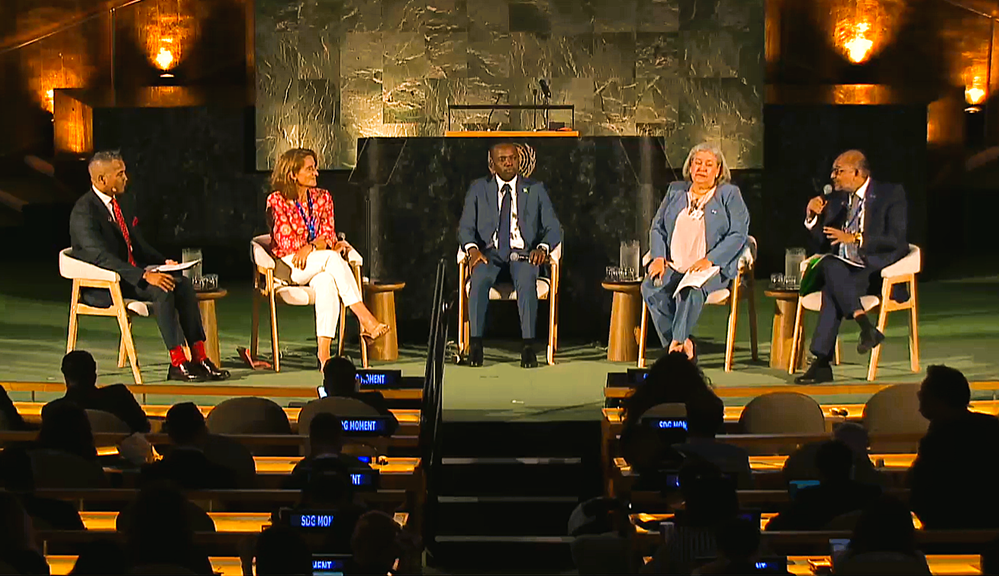
Speaking at the Leaders’ Dialogue on “Leading SDG Action” during the 2026 SDG Moment at the United Nations General Assembly Hall in New York, Dr. Titumir said the global financial system must move beyond simply financing development and instead create the conditions necessary to sustain it.

“Our broader vision should be collective and forward-looking: a global financial architecture that does not merely finance development, but creates the conditions in which development can be sustained,” he said. Dr. Titumir outlined five priorities for reforming the international financial architecture, particularly the role of multilateral development banks.

He called for a shift from responding to crises after they emerge toward anticipating vulnerabilities; greater representation and voice for vulnerable countries in international financial institutions; longer-term, lower-cost and predictable financing; closer alignment of international financing with national development strategies through coordinated, multi-year financing; and flexible transition support and preferential arrangements for countries graduating from the least developed country (LDC) category, including Bangladesh.

Bangladesh Adviser to the Prime Minister Dr. Rashed Al Mahmud Titumir speaks at the Leaders’ Dialogue on “Leading SDG Action” during the 2026 SDG Moment at the United Nations Headquarters in New York on September 18, 2026. Photo: Khabor

The Bangladeshi adviser also highlighted the country’s SDG Village initiative, describing it as an integrated, community-led approach to translating the Sustainable Development Goals into tangible improvements at the local level.

The 2026 SDG Moment, held on September 18 at UN Headquarters, brought together representatives of UN member states, international organizations and civil society to discuss accelerating action toward the Sustainable Development Goals ahead of the 2030 deadline.

The Leaders’ Dialogue also featured Teresa Ribera of the European Commission, Aristide Médénou, Minister of Economy and Finance of Benin, and Beatriz Carles de Arango, Minister for Social Development of Panama. The discussion was moderated by Sherwin Bryce-Pease of the South African Broadcasting Corporation.


‘This Is Not 1945’: Bangladesh’s Khalilur Rahman Opens UNGA 81

Shibbir Ahmed, UN, New York: The United Nations General Assembly opened its 81st session on Tuesday at United Nations Headquarters in New York, with Bangladesh’s veteran diplomat Khalilur Rahman taking over as president and calling for renewed global trust in the international organization amid wars, humanitarian crises, climate change and deepening geopolitical divisions.

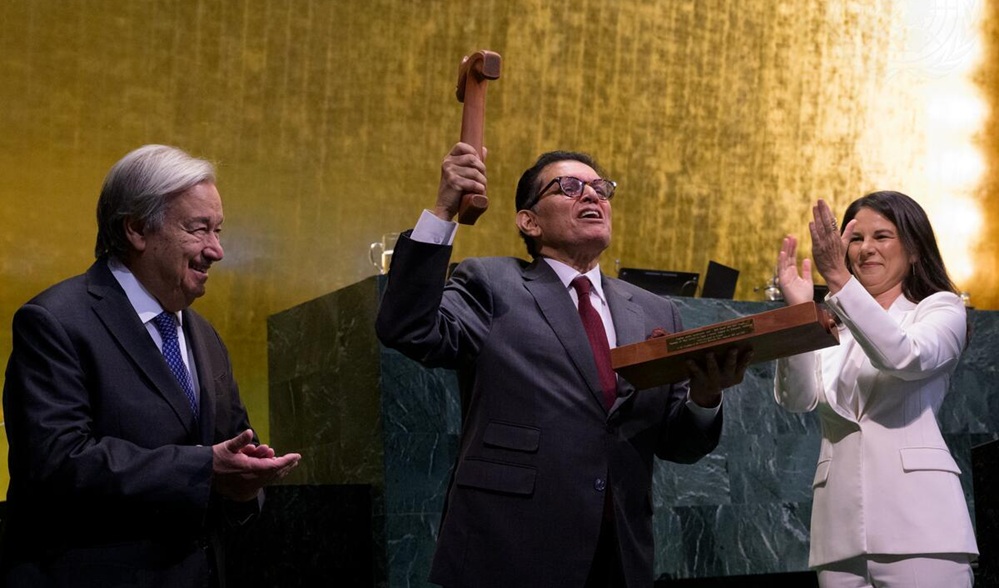
Rahman formally assumed the presidency after receiving the traditional Icelandic wooden gavel from outgoing General Assembly President Annalena Baerbock. In his opening remarks, he said the United Nations must adapt to the realities of a rapidly changing world and become more responsive to the needs and expectations of people across the globe.

“We must make the United Nations fit for the future,” Rahman said, stressing the importance of listening to civil society and giving greater space to voices outside governments and traditional diplomatic institutions.

“We have a situation where trust is in deficit. This is not 1945. This is the 81st session. The world has moved on. The Organization must move on, and I’ll help that process,” he said.

Rahman has placed restoring trust and managing global transformation at the center of his presidency. His agenda includes strengthening international peace and security, accelerating progress toward the 2030 Sustainable Development Goals, addressing climate change, protecting human rights, supporting refugees and migrants, promoting responsible technological development and advancing reform of the United Nations and the broader multilateral system.

The new session begins at a time of heightened international tensions, with conflicts in several regions, growing humanitarian emergencies, geopolitical rivalries, persistent poverty and inequality, and increasing concerns over climate-related disasters. The risk of nuclear escalation has also added to concerns about international peace and security.

United Nations Secretary-General António Guterres, speaking at the opening of the session, said rebuilding confidence in the multilateral system had become one of the defining challenges of the current era.

“Rebuilding trust in the multilateral system is the defining challenge of our time,” Guterres said, arguing that international cooperation remains essential at a moment when the world is confronting crises that cannot be effectively addressed by individual countries acting alone.

Guterres said institutions across the multilateral system, including the Security Council and international financial institutions, are under growing pressure to respond to the realities of the present day. He warned that international law and human rights are too often violated with impunity, while geopolitical mistrust and suspicion continue to prevent the international community from reaching effective solutions.

Despite those difficulties, Guterres said he remained hopeful about the ability of the General Assembly to contribute to a better future. Through diplomacy, dialogue and cooperation, he said, countries can work to rebuild trust and goodwill and help ensure that future generations inherit a more peaceful and sustainable world.

The opening of the 81st session also marked the conclusion of Baerbock’s term as president of the General Assembly. Addressing member states at the final meeting of the 80th session, she defended the continuing importance of the United Nations despite criticism of its shortcomings.

Baerbock said she was more convinced than ever of the importance and necessity of the organization. She pointed to the work of United Nations agencies and peacekeeping missions around the world as evidence of the practical impact of the international body.

She cited the role of the United Nations Children’s Fund in helping millions of children and the contribution of peacekeepers to protecting civilians in conflict-affected areas. Baerbock also warned that the positive work of the United Nations often receives less public attention than negative developments, particularly in an environment where divisive and hateful content can spread rapidly.

Climate change and sustainable development are expected to remain major issues during the new session. Rahman has called for stronger international efforts to build climate resilience and protect the environment, while also accelerating progress toward the 2030 Sustainable Development Goals.

The new president has emphasized the need to ensure that development reaches vulnerable populations and that no country is excluded from international efforts to address poverty, inequality, education, health, food security and other development challenges.

Human rights and humanitarian action are also central to the new presidency. Continuing conflicts and instability have displaced millions of people, increasing pressure on the international community to protect refugees and migrants and provide assistance to populations affected by war and persecution.

The rapid development of artificial intelligence and other emerging technologies is another issue expected to receive greater attention. Rahman has called for technological innovation that is inclusive and responsibly governed, with appropriate safeguards to protect people and future generations.

United Nations reform is also expected to feature prominently during the 81st session. The international political and economic landscape has changed substantially since the organization was established in 1945, prompting continued debate over whether its institutions adequately reflect the realities of the contemporary world.

Questions surrounding representation, inclusiveness and the effectiveness of international decision-making have become increasingly important, particularly for developing countries seeking a greater voice in global affairs.

Another major diplomatic issue during the coming year will be the selection of the next United Nations secretary-general. Guterres is scheduled to complete his term, with his successor expected to take office in January 2027.

Rahman brings extensive diplomatic experience to the presidency of the General Assembly. He previously served as foreign minister of Bangladesh and held senior positions including national security adviser and high representative for the Rohingya issue in Bangladesh’s interim government. He has also held senior positions within the United Nations system and was a founding member of East West University in Dhaka.

His assumption of the presidency gives Bangladesh a prominent role in one of the international community’s most representative forums at a particularly challenging moment for multilateral diplomacy.

As the 81st session begins, the central challenge for the General Assembly will be whether countries can overcome deep political divisions and rebuild confidence in international cooperation. For Rahman, the task is rooted in a simple premise: the world has changed significantly since 1945, and the United Nations must evolve with it.


Moyeen Seeks Stronger World Bank Support for Bangladesh Development

DHAKA – LGRD and Cooperatives Minister Dr Abdul Moyeen Khan has expressed hope that the World Bank will further strengthen its support for the country’s sustainable development and improvement of people’s quality of life. He said various government initiatives are underway in important areas such as water supply, sanitation, rural development and addressing the impacts of climate change.

Continued support from development partners is necessary to make these activities more effective and sustainable, he said when World Bank Division Director for Bangladesh and Bhutan Jean Pesme paid a courtesy call on him at his office at the Secretariat today.

Various issues including the World Bank’s support for various ongoing development projects in Bangladesh, water supply and sanitation systems, rural development, climate change and local government sector were discussed.

The minister said the government and development partners need to work in coordination to accelerate and sustain the country’s development activities. He said WB support could play an important role in strengthening the capacity of the local government sector and ensuring quality civic services reach people at their doorsteps.

The minister expressed gratitude for the World Bank’s longstanding support for Bangladesh’s development journey and hoped that the bank would continue its support for the country’s key development initiatives in the future.

During the exchange of views, emphasis was placed on further strengthening the existing cooperation between Bangladesh and the World Bank. LGD Md Shahidul Hassan, senior officials from the ministry and the WB were present at the meeting.