Trump Launches America.gov as Unified Digital Gateway to U.S. Government Services
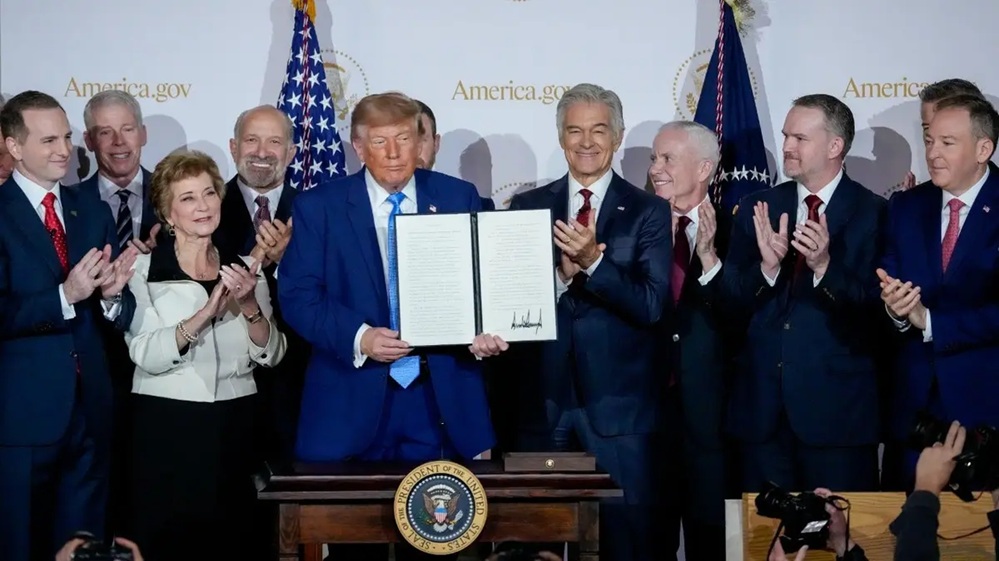
Shibbir Ahmed, Washington DC — President Donald Trump on Tuesday launched America.gov, a new digital platform designed to provide Americans with a single entry point to federal government information and services, as the administration seeks to simplify how people interact with the U.S. government. The platform was unveiled September 29 in Washington alongside an executive order directing the establishment of America.gov as a unified digital “front door” for Americans seeking federal information and covered online services.
The administration says America.gov uses artificial intelligence and information drawn from government websites to help users find answers and navigate federal services through a conversational interface. The U.S. General Services Administration said America.gov combines information from more than 29,000 government websites with AI-enhanced search technology, allowing users to find information and guidance without having to navigate a fragmented network of individual agency websites.
The executive order says Americans have traditionally been required to search across multiple federal agencies, interpret government terminology, provide the same information repeatedly and verify their identities through different systems. America.gov is intended to change that process by providing a single digital point of entry through which users can communicate in plain language, receive information and, where authorized and technically available, complete federal government transactions.
AI-powered access to federal services
The new platform is designed to allow users to describe what they need rather than determine which federal agency is responsible for providing the service. The GSA said the platform can help users find information about government benefits, passport services, Social Security and other federal needs. The administration’s executive order directs federal agencies to identify qualifying online services and integrate them with America.gov in a secure and privacy-preserving manner.
The order also calls for the integration of Login.gov as the authentication service for America.gov. Under the plan, agencies will continue to maintain control over their own records, systems, statutory responsibilities and decision-making authority. The order specifically states that the unified access system is not intended to create a centralized federal system of records about Americans. Privacy protections are also included in the order, including data minimization, secure authentication, auditable authorization and disclosure practices consistent with federal law.
Passport services among planned features
Secretary of State Marco Rubio said at the launch event that the State Department is partnering with America.gov to overhaul the passport application experience. Rubio announced that, beginning next year, Americans will be able to apply for their first U.S. passport entirely online. Applicants will be able to sign in through Login.gov, use information already held by the government where available, submit a photograph from a phone or other device, make a payment and track the status of the application. Rubio said the administration’s goal is for the vast majority of Americans to be able to apply for a passport or passport card through America.gov by the end of 2027.
Agencies given 90 days for implementation guidance
The executive order directs the Office of Management and Budget to issue implementation guidance to federal agencies within 90 days. Agencies will then be required to identify covered services, integrate those services with America.gov where appropriate and provide usage and performance information to the General Services Administration and OMB. The order defines covered services generally as public-facing federal services that serve more than 100,000 users during a 12-month period and can be accessed or applied for online. The order excludes Internal Revenue Service tax filing services, as well as services provided by the Department of War and elements of the Intelligence Community.
Existing government services will remain available
The administration says America.gov is intended to provide an additional, simplified way to access federal services rather than eliminate existing methods. The executive order specifically preserves existing lawful methods of obtaining government services, including in-person, telephone, mail and agency-specific digital services. That means Americans will not be required to use America.gov as the sole method of interacting with the federal government.
New passport design planned for 2028
Rubio also unveiled the planned design of a new U.S. passport expected in 2028. The redesigned passport features the American eagle and the Great Seal and includes artwork depicting major moments in U.S. history. Rubio said the new passport will visually represent 250 years of American history, with imagery ranging from the Revolutionary era and westward expansion to aviation, the raising of the American flag at Iwo Jima and the Artemis space program. The State Department also plans to change how the passport is packaged and delivered.
America.gov represents broader government technology push
The launch comes as the Trump administration expands its focus on artificial intelligence and digital technology as tools for government services. The new website is currently centered on AI-assisted information access, while additional transaction capabilities are expected to be introduced as federal agencies integrate their services with the platform.
The administration has described America.gov as a fundamental shift toward organizing government services around the needs of citizens rather than around the structure of federal agencies. For Americans, the intended result is a single digital starting point for finding federal information, understanding available services and eventually completing more government transactions online.