Govt Aims to Make Teaching First Choice for Top Talent: PM

DHAKA- Prime Minister Tarique Rahman today said the government is working to make teaching a first-choice profession for meritorious people by reforming teacher recruitment and the education system.

“Teaching can never be a profession of last resort or merely another job. Rather, we are reshaping teacher recruitment and the education system to ensure that the most meritorious people choose teaching as their first choice of profession,” he said. The Prime Minister was addressing as the chief guest at a ceremony at Osmani Memorial Auditorium here marking World Teachers’ Day 2026 and honouring selected teachers from primary to higher education levels with the national ‘Eminent Teacher Award’.

Tarique Rahman said, “We believe that the dignity of the state is linked to the honour and dignity of teachers in the state and society. If the dignity of teachers remains intact in society, the image of the state is enhanced.”

This year’s theme of World Teachers’ Day is: “Standing with Teachers: 60 Years of Protecting the Profession, Enhancing Dignity and Shaping Our Future.”

The Prime Minister expressed his profound respect to teachers of all primary and secondary schools, colleges, madrasas, technical institutions and universities across the country, and congratulated those who received the ‘Eminent Teacher Award’ for their merit and competence.

He said if teachers could become the “need and loved ones” of their students, it would be easier for the students to face global challenges as responsible citizens through education.

Referring to teachers as “ideal role models” for every student after they move beyond the family school, Tarique Rahman said the government is formulating and implementing plans so that teachers can confidently present themselves as role models before their students.

In the era of rapid development of social media and artificial intelligence (AI), he said, there is no alternative to technical and practical education beyond conventional teaching methods.

“So, changing the strategies of learning and teaching and modernising the education curriculum is the demand of the time,” he said.

The government has formulated a new curriculum based on the realities of the time, and students will receive textbooks based on the new curriculum within this year, the Premier said, adding that the methods of learning and teaching are extremely important to ensure that students do not become alienated from books.

“Instead of mere memorisation, we have to raise the questions of ‘why’ and ‘how’ in the minds of students. If curiosity is created, a student can become his or her own teacher,” he continued.

Tarique Rahman said “joyful learning” has become popular across the world, particularly among school students.

For the first time in Bangladesh, he said, the Ministry of Education is providing sixth-grade students with a new book titled “Learning with Happiness”. Similar books will be introduced for other grades in phases.

The prime minister said the education system currently faces both immense opportunities and major challenges. Artificial intelligence has opened up vast opportunities for acquiring knowledge, while technical and practical knowledge has become indispensable instead of certificate-based knowledge, he added.

Referring to the new challenges created for teachers by rapid advances in information technology, Tarique Rahman said teachers’ training colleges need to be further modernised to meet the challenges of the time.

“We do not want to see technology as a substitute for teachers. Rather, technology will be the strength of teachers,” he said, adding that the government is advancing the “One Teacher, One Tab” programme to this end.

The prime minister said teachers would be able to use digital lesson plans, question banks, students’ learning progress data and necessary teaching materials through their tablets. Multimedia classrooms are also being
expanded at educational institutions across the country, while free Wi-Fi facilities are being increased, he added.

The Premier said the government wants to build an education system where no child is deprived of education.”It is also essential to ensure that even if someone drops out at any stage of their educational life for any reason, they do not remain unemployed,” he said.

Describing education as the biggest priority of the incumbent government, Tarique Rahman said the highest-ever allocation for education has been made in the national budget for the first time in the country’s history and the allocation will be increased gradually.

Highlighting the scale of secondary education, he said there are currently around 21,000 institutions at the secondary level, where more than 300,000 teachers are providing education to millions of students.

“Much of secondary education depends on private and MPO-listed institutions,” he said.

“There is still some disparity between urban and rural areas in terms of educational opportunities,” the Prime Minister said, adding that the government has various plans to ensure that students in both urban and rural
areas have access to skilled teachers and modern technology.

Describing the government’s approach to reforming the education system, he said its core foundations are equal opportunities, quality education and non-discriminatory access.

Tarique Rahman said employment-oriented education is necessary, but employment is not the sole purpose of education. “Moral and character development is also one of the key objectives of education. If knowledge is not linked with morality, it can become a cause of harm rather than benefit to society,” he continued.

Urging teachers to make truthfulness, a sense of responsibility, empathy, patriotism, humanity, discipline and respect for others integral parts of education, he said teachers play the most important role after families in
instilling moral values in students.

Highlighting various government measures to ensure teachers’ financial security and make teaching a more dignified and competitive profession, the Prime Minister said the government is working particularly for teachers at the primary, secondary and higher-secondary levels.

He further said the President and the Prime Minister invite people from different professions and sections of society to state functions at national occasions, including Independence Day and Victory Day.

“From this year, based on a policy, the concerned authorities are being instructed to make it mandatory to invite at least one teacher each from primary and secondary schools to such events,” he said.

Tarique Rahman said a teacher, whether serving or retired, remains worthy of the state’s respect throughout his or her life because of the noble profession.

Mentioning instructions to end harassment of teachers in receiving salaries and retirement benefits, he said a teacher should not have to visit offices and suffer hardship merely to receive salary or retirement benefits.

“The money due to a teacher must reach their bank account on time and in accordance with the rules,” he said. The Premier said the country’s teachers are one of the key instruments for building a knowledge-based state and society. World Teachers’ Day is observed globally on October 5 every year to highlight the importance of teachers’ dignity, rights, professional development and ensuring quality education.

Chaired by Education Minister Dr. A N M Ehsanul Hoque Milon, it was also addressed, among others, by National Professor Dr Mahbub Ullah, Prime Minister’s Office Spokesperson Mahdi Amin, State Minister for Primary and Mass Education Bobby Hajjaj and Chairman of the Parliamentary Standing Committee on the Ministry of Education Md Selim Bhuiyan.


Govt moving ahead to implement promises made to people: PM

DHAKA – Prime Minister Tarique Rahman today said the new government, having received a strong mandate from the people, is moving ahead with a clear action plan to fulfill its commitments over the next five years. “Our priorities are to protect national interests, maintain policy continuity, ensure economic stability and carry out institutional reforms. We are now moving directly from commitments to implementation,” he said.

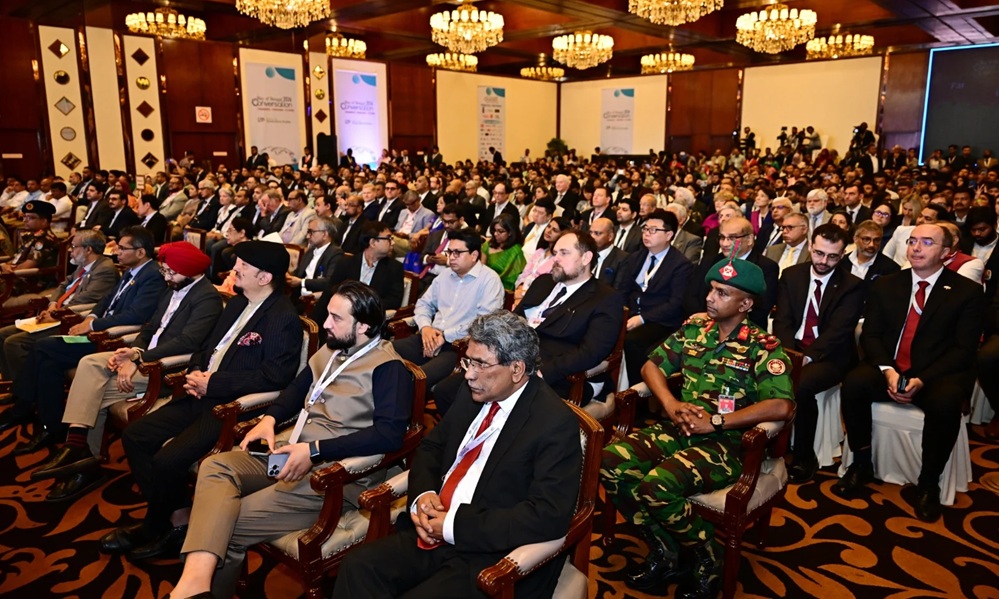
The prime minister was addressing the inaugural session of the three-day international conference ‘Bay of Bengal Conversation (BOBC) 2026’, organised by the Centre for Governance Studies (CGS), at Pan Pacific Sonargaon Hotel here this morning. This year’s BOBC is being held under the theme “Fragments, Frontiers and Futures: Navigating Power, Technology and Trust in a World Rewritten”. Around 200 speakers, more than 300 delegates and over 1,000 participants from more than 100 countries are taking part in the conference, which is being held from October 3 to 5.

Former Serbian President Boris Tadic, former Maldivian President Mohamed Nasheed and former Malian Prime Minister Moussa Mara, among others, are participating in the conference along with former and incumbent state officials, diplomats, policymakers, researchers, business leaders, technologists and experts from different countries. The prime minister said the government has taken initiatives to make Bangladesh an attractive investment destination and transform the country into a strong hub for production and investment.

“We want to create extensive employment opportunities in production, services, exports and all other sectors,” he said. Emphasising the need for policy certainty for investors, the prime minister said continuity in long-term policies would provide them with the necessary assurance. He said the government’s social protection programmes had been designed to give priority to the most disadvantaged people.

Under the Family Card initiative, financial assistance will reach the hands of mothers in every family, beginning with the poorest and most marginalised communities, he said. The Farmers Card will connect farmers with government incentives, agricultural services and markets, while the Health Card will ensure access to healthcare for all, he said, adding that ultimately the Universal Card would bring integrated government services under one umbrella.

Mentioning the government’s pledge to take healthcare to people’s doorsteps, the prime minister said the government is working to recruit 100,000 health workers, around 80 percent of whom will be women. They will provide primary healthcare, health advice and necessary referral services at the grassroots level, he said, adding that the government is also giving special attention to maternal and child health.

On education reform, the prime minister said education should not be limited to obtaining certificates but should prepare students for real life. “We are working to ensure a joyful learning environment,” he said. He said culture, sports, values and ethics would have an important place in the curriculum to help build children’s character. Students would be given the opportunity to learn a third language, while technical and vocational education would be expanded alongside general education.

The government has taken initiatives to provide free uniforms, schoolbags, midday meals and stipends from the first grade, while expanding free education for girls up to the graduate level, he said. Describing the country’s large young population as one of the key drivers of national progress, the prime minister said skills development and suitable employment opportunities were essential to harnessing the demographic advantage.

“The government is focusing on improving language skills, creating employment opportunities, technological transformation and wider use of artificial intelligence. We are supporting innovation, entrepreneurship and start-ups. We want our young people to compete on the global stage and transform brain drain into brain circulation,” he said Describing agriculture as a mainstay of the economy, Tarique Rahman said access to technology, irrigation, agricultural finance and markets are being made easier.

He said support would be provided to fisheries, livestock and rural entrepreneurs, while agricultural processing and agro-product export industries needed to be developed as a complement to food security.

“A strong rural economy can build a strong Bangladesh,” the prime minister said. Highlighting the importance of water security, he said the government has planned to excavate 20,000 kilometres of canals and waterways over the next five years. The Padma Barrage project is being advanced and a master plan for the Teesta is being prepared for water conservation and management, he said, adding that these initiatives would support agriculture while strengthening climate resilience.

On environmental protection, Tarique Rahman said 250 million trees would be planted over the next five years. He said Bangladesh is also expanding solar power use, promoting waste recycling and taking a leading role in establishing environment-friendly green factories.

“Of the world’s top 100 LEED-certified factories, 53 are now in Bangladesh,” he said. The prime minister said developing clean and environment- friendly cities could reduce waste, strengthen climate resilience and further dynamise the national economy. Stressing institutional reforms, he said strong state institutions were essential for development. “We are strengthening institutional transparency and accountability. Human rights, democratic values and freedom of expression must be protected,” he said.

Emphasising equal application of the rule of law to every citizen, the prime minister said an institutional culture would be developed in which state institutions would genuinely remain dedicated to serving the people of Bangladesh. On the Rohingya crisis, he said Bangladesh was still hosting around 1.2 million Rohingya refugees. “Our main objective is to ensure their swift, voluntary, safe, dignified and sustainable repatriation to Myanmar,” he said.

Calling for continued political support and international financing from the global community, he said the root causes of the crisis must also be addressed. “The crisis originated in Myanmar and its solution must also be found in Myanmar,” he said. Referring to the Bay of Bengal as one of the major pillars of Bangladesh’s future economic potential, Tarique Rahman said the Bay had been shaping Bangladesh’s destiny for generations.

Given Bangladesh’s geographic and strategic location, he said, the country had opportunities to become more deeply connected with the world through seaports, waterways and the coastal economy. There is immense potential in shipping, fisheries, tourism, energy and regional supply chains, he said. The prime minister said deeper bilateral and multilateral engagement was needed to transform the region’s shared geography into shared prosperity.

“Cooperation can be further expanded in trade, energy, education, technology, climate and maritime sectors. New markets can be opened and more opportunities can be created for young people. We can build stronger cooperative relations based on equality, fairness and justice,” he said. Stating that Bangladesh believes in dialogue, partnership and mutual respect, Tarique Rahman said the country would continue to work positively with all its regional and global partners while safeguarding national interests and sovereignty. “Because peace and harmony are the foundations of shared prosperity and development,” he said.

The prime minister called for transforming the Bay of Bengal region into an area where every state could prosper together, benefit equally and extend meaningful cooperation to its citizens.

“Bangladesh is fully prepared to play its rightful role in this regard,” he said. The five thematic pillars of this year’s BOBC are geopolitics, security and strategic competition, artificial intelligence, cyberspace and information power, trade, connectivity and strategic growth, and climate, resilience and human security.


PM Opens Tk 1,542cr Flood Control, Drainage and Irrigation Project in Feni

PARSHURAM, Feni – Prime Minister Tarique Rahman today inaugurated the Tk1,542.16-crore Muhuri-Kohua Flood Control, Drainage and Irrigation Project rehabilitation(Phase I) at Feni aiming to strengthen flood protection, drainage and irrigation facilities in the district. The Prime Minister inaugurated the project at around 2.17 pm today at the Kheyaghat Ghat-Muhuri Bridge area in Parshuram upazila and later exchanged greetings with local people at the venue.

The Executive Committee of the National Economic Council (ECNEC) approved the project on June 16 at an estimated cost of Tk1,542.16 crore. Under the project, 67.92 kilometres of flood-control embankments will be rehabilitated, 11.73 kilometres of riverbanks protected and 83.50 kilometres of rivers and water bodies re-excavated. Besides, 27 irrigation structures will be rehabilitated and 77 inlets will be constructed under the project, which is scheduled to be completed by 2030.

In its next phase, there are plans to construct new embankments along the Muhuri and Kohua rivers and undertake embankment construction, excavation and rehabilitation works along the Silonia River. Environment, Forest and Climate change Minister and Feni-3 Lawmaker Abdul Awal Mintoo, Water Resources Minister Shahiduddin Chowdhury Anee, State Minister for Water Resources Forhad Hossain Azad, Feni-1 Lawmaker Rafiqul Alam Maznu, Feni-2 Lwmaker Joynal Abedin, Lawmaker Rehana Akter Ranu, among other, were present on the occasion.

Earlier, the Prime Minister arrived in Feni at around 1:15pm on his daylong tour to attend a series of programmes. After inaugurating the Muhuri-Kohua project in Parshuram, he is scheduled to travel to Fulgazi, where he will join a tree-planting programme at Begum Khaleda Zia Women’s College. He will later visit the Fulgazi District Council Dak Bungalow, where he will inaugurate the supply of electricity to the national grid from the rooftop solar power system installed at the facility.

The Prime Minister will then rest and offer prayers at the Dak Bungalow. Later in the afternoon, he will attend a programme at Fulgazi Government Pilot High School ground, where he will distribute Family Cards and Farmer Cards and provide honorariums to mosque imams, muezzins, khadims and priests. He is also scheduled to address a public gathering at the venue before returning to Dhaka in the evening.

Under a government initiative, solar systems with a combined capacity of 962.5 kilowatts have been installed on government buildings in Fulgazi, Parshuram and Chhagalnaiya upazilas, including 415 kilowatts in Chhagalnaiya, 298 kilowatts in Parshuram and 249 kilowatts in Fulgazi. A total of 510 people in Fulgazi are set to receive Family Cards, while 7,643 people across Feni district will receive Farmer Cards. Honorariums will also be provided to 238 imams, muezzins, khadims and priests in Fulgazi.

Tarique Rahman’s maternal grandfather Easkandar Majumder’s ancestral home is in Sreepur village of Fulgazi upazila in Feni. Feni-1 constituency also has a longstanding association with his mother, former Prime Minister Begum Khaleda Zia, who was elected from the constituency several times since 1991.


PM leaves New York for home after attending UNGA session

New York – Prime Minister Tarique Rahman today left New York for home after winding up a five-day visit packed with high-level engagements, including his maiden address to the General Debate of the 81st United Nations General Assembly where he placed Bangladesh’s aspirations and priorities before the global community.

“An Emirates flight carrying the Prime Minister, his wife Dr Zubaida Rahman and members of his entourage departed John F Kennedy International Airport at 11:30pm (New York time) for Dhaka via Dubai,” Prime Minister’s Press Secretary Saleh Shibly told KHABOR.

The flight is scheduled to reach Dubai at 8:00pm on September 26 and depart for Dhaka at 2:00am on September 27. The Prime Minister is scheduled to arrive at Hazrat Shahjalal International Airport at 8:40am the same day.

During the visit, he presented Bangladesh’s positions on global peace and security, climate change, sustainable development, humanitarian issues, economic cooperation and the Rohingya crisis.

In his UNGA address on September 24, the Prime Minister reaffirmed Bangladesh’s support for UN initiatives aimed at establishing global humanity and world peace, calling for conflicts to be resolved through dialogue, diplomacy and mutual cooperation.

He also pledged to establish a prosperous, self-reliant and welfare-oriented democratic Bangladesh by ensuring political and economic empowerment of the people and equal opportunities for all, while outlining the government’s 3-R strategy of Recovery, Restoration and Reconstruction.

On the Rohingya crisis, he said safe and dignified repatriation to their homeland is the only solution to the prolonged crisis and sought stronger international support for creating conditions conducive to their voluntary return.

During the visit, the Prime Minister discussed the crisis separately with UN Secretary-General’s Special Envoy on Myanmar Julie Bishop and UN High Commissioner for Refugees Barham Salih.

The Prime Minister also met Turkish President Recep Tayyip Erdogan, with the two leaders discussing ways to expand Bangladesh-Türkiye trade and investment and diversify cooperation in economic sectors, while underscoring the importance of coordination on regional and international issues.

In separate meetings with Bhutanese Prime Minister Dasho Tshering Tobgay and Maldives Vice-President Uz Hussain Mohamed Latheef, Tarique Rahman discussed strengthening existing friendly relations and exploring new areas of bilateral, regional and international cooperation. At a meeting with World Bank Group President Ajay Banga, they discussed Bangladesh’s development priorities, economic progress, strengthening World Bank cooperation and exploring new areas of partnership.

The Prime Minister also held a meeting with Haitian Prime Minister Alix Didier Fils-Aimé, discussing bilateral relations, mutual interests and regional and international cooperation.

On September 22, Tarique Rahman and his wife joined a welcome breakfast hosted by UN Secretary-General Antonio Guterres for world leaders and their spouses before attending the opening of the 81st UNGA General Debate. In the evening, they attended a reception hosted by the US President for leaders joining the General Assembly.

On September 23, the Prime Minister held a breakfast meeting with representatives of the Gates Foundation, Visa Foundation, Rockefeller Foundation, International Rescue Committee and Rotary International, where Bangladesh’s perspectives on humanitarian challenges, international cooperation, climate change, sustainable development and economic partnership were highlighted.
He also met Gates Foundation CEO Mark Suzman and discussed public health, child healthcare, vaccination, affordable vaccines, preventive healthcare and health-system modernisation.

The Prime Minister also addressed the high-level meeting on “Climate Action and the Just Transition”, calling for collective global action to build a safer and more sustainable future for the next generation, including deeper emission cuts and predictable climate finance for climate-vulnerable countries.

A bilateral meeting with Croatian Prime Minister Andrej Plenkovic focused on expanding trade and investment, economic partnership, skilled manpower, education and technology, as well as greater coordination at multilateral forums.

The visit also featured economic diplomacy, including the signing of an agreement by Biman Bangladesh Airlines with Boeing to purchase 11 aircraft as Bangladesh seeks to expand its aviation sector and open new international routes.

On September 24, before his UNGA address, the Prime Minister delivered opening remarks at a high-level meeting on the existential threat posed by sea-level rise, calling for faster and deeper global emission cuts, predictable and accessible adaptation finance, wider access to climate-smart technologies and stronger international cooperation.

He also held a bilateral meeting with Pakistani Prime Minister Muhammad Shehbaz Sharif, with the two premiers discussing bilateral relations, regional and international situations and potential areas of cooperation.

At a Bangladesh-Sweden-UNFPA high-level event on midwifery, Tarique Rahman outlined his vision of a “Healthy Bangladesh”, placing primary healthcare at the centre of health reform.

He said the government plans to recruit 100,000 additional health workers, including 80,000 women, and 25,000 professional midwives, while developing an integrated digital health system.

The Prime Minister also held a bilateral meeting with UN Secretary-General Antonio Guterres, who expressed gratitude for Bangladesh’s role in sheltering the Rohingyas and contributing troops to UN peacekeeping operations, while praising Bangladesh’s role in climate resilience and multilateral affairs.

Tarique Rahman also met Thai Prime Minister Anutin Charnvirakul before delivering his UNGA address and later attended a dinner hosted in his honour by Bangladesh’s Permanent Representative to the UN.

On the final day of his New York visit, the Prime Minister attended a breakfast meeting with Wall Street representatives hosted by JPMorgan at its Manhattan Headquarters and held a bilateral meeting with Kuwait’s Crown Prince Sheikh Sabah Khaled Al-Hamad Al-Sabah.


PM to present Bangladesh’s vision, people’s aspirations at UNGA

Shibbir Ahmed, New York – Prime Minister Tarique Rahman will present Bangladesh’s vision for the future, national interests and aspirations of its people at the global forum of the United Nations General Assembly, with a focus on ensuring inclusive development, said PMO Spokesperson Mahdi Amin.

“Carrying the patriotism, emotions, sentiments and aspirations of the people, Prime Minister Tarique Rahman will present before the global community what Bangladesh’s vision for the future should be, how the country’s interests can be safeguarded and how inclusive development can be ensured,” he said.

Mahdi Amin made the remarks at a press conference in the lobby of the Hyatt Grand Central New York hotel at 9:00pm local time today after the premier arrived in New York to attend the UN General Assembly. He said the prime minister has arrived in New York on a historic visit as the head of a representative government elected by the people’s vote after a long time.

Referring to the historical context, he said, “Shaheed President Ziaur Rahman and Begum Khaleda Zia had presented Bangladesh’s position, vision and plans before the global community. As part of that historical continuity, their son, Prime Minister Tarique Rahman, will likewise uphold the spirit of patriotism and present Bangladesh’s interests and rights on the global stage.”

Mahdi Amin said the prime minister will deliver his address at the UN General Assembly on Thursday. Describing the prime minister’s visit as a very brief one, the spokesperson said he was moving away from the usual practice of lengthy foreign visits and would stay in New York for only a short period.

“Excluding the two days spent on travel, he will stay in New York for only four working days and will attend a number of bilateral and multilateral meetings,” he said. Regarding the size of the delegation, Mahdi Amin said the prime minister had completely broken away from the traditional practice and arrived with a small delegation for the brief visit.

“Officially, there are only 35 people here. Besides them, there are only essential media, security and personal staff. Prime Minister’s wife Dr Zubaida Rahman is also accompanying him,” he said. Informing that the prime minister’s official engagements will begin Tuesday, he said he would attend the opening session at the UN Headquarters at 9:00am, where heads of state and government of different countries will be present.

Earlier in the morning, he will attend a “Welcome Breakfast Reception” hosted at the invitation of the UN Secretary-General. PM’s Press Secretary AAM Saleh Shibly, Additional Press Secretary Atikur Rahman Ruman and Bangladesh’s Deputy Permanent Representative to the United Nations A K M Wahiduzzaman were also present at the press conference.