UN Urges U.S. to Take Further Action Over Marshall Islands Nuclear Legacy

Shibbir Ahmed, New York — The United Nations has called on the United States to take further steps to address the long-term health, environmental and human rights consequences of its nuclear weapons testing program in the Marshall Islands. A report presented to the UN Human Rights Council in Geneva on Thursday said Washington should provide additional healthcare support to people affected by the tests and release classified records related to the nuclear testing program. The report said the consequences of the tests continue to affect Marshallese communities decades after the testing ended.

The United States conducted 67 nuclear weapons tests in the Marshall Islands between 1946 and 1958. One of the most powerful tests, known as Castle Bravo, was carried out at Bikini Atoll in 1954.

According to the UN human rights office, the human cost of the testing program has been severe and long-lasting. The report pointed to continuing health problems, displacement from contaminated areas and social stigma faced by people exposed to radiation.

UN Deputy High Commissioner for Human Rights Awa Dabo told the Human Rights Council that the consequences of the nuclear testing program remain a continuing issue for the Marshallese people.

The UN report called for effective remedies, including healthcare and access to information concerning the nuclear legacy. Marshall Islands representatives have also urged the international community to help address unresolved claims and the continuing effects of nuclear contamination.

The Marshall Islands has repeatedly raised concerns over the long-term consequences of the U.S. testing program, including damage to communities, traditional lands and public health. A previous UN human rights report also documented barriers to the full realization of the rights of people affected by the nuclear legacy.

Washington, however, has previously maintained that it has fulfilled its responsibilities under agreements with the Marshall Islands. The U.S. government has said the 1986 Compact of Free Association and related agreements constituted a full settlement of claims arising from the nuclear testing program. It has also said that more than $600 million has been provided to affected communities and that various health, environmental and other assistance programs remain in place.

The latest UN call comes as the Marshall Islands continues to seek greater international attention to the health, environmental and human rights consequences of the nuclear tests. The dispute over how much remains to be done reflects a longstanding difference between Washington’s position that its obligations have been addressed and calls from Marshallese representatives and UN human rights officials for additional measures.


Landau Calls for Shift From Aid to Investment in U.S. Economic Diplomacy

Shibbir Ahmed, New York — U.S. Deputy Secretary of State Christopher Landau has called for a stronger focus on trade and private investment as a long-term alternative to traditional foreign aid, saying economic diplomacy should play a central role in strengthening relationships between countries. Speaking at a Trade Over Aid Deals Showcase on September 25, Landau said economic and commercial issues had for decades taken a back seat in diplomacy, which he argued had too often focused primarily on political, military and security matters.

‘Economic and commercial issues should be treated as a core element of diplomacy’, Landau said, arguing that governments have a responsibility to create prosperity, economic opportunities and jobs for their people. Landau said economic projects can create lasting relationships that survive changes in government. While acknowledging that aid programs can help countries remain afloat, he argued that long-term economic projects can provide more sustainable value by generating investment, infrastructure, employment and economic growth.

He also emphasized that foreign investment does not necessarily mean a loss of national sovereignty. According to Landau, governments should establish clear terms and conditions for investments so that both investors and host countries understand their respective obligations and potential returns.

‘Investment is an engine of growth’, Landau said, urging governments and businesses to view foreign capital as an opportunity to expand economic activity rather than as a threat to sovereignty. He described investment relationships as potentially “win-win” arrangements, saying capital inflows can support infrastructure, jobs and economic growth while also strengthening political and commercial ties between countries.

U.S. private sector at the center

Landau said one of his priorities as deputy secretary is to improve communication between the U.S. government and American companies seeking investment opportunities overseas. He noted that during trips around the world, he frequently hears foreign governments asking why American companies are absent from projects where businesses from other countries have submitted bids.

Landau said he had previously focused largely on American companies directly operating overseas, including construction, infrastructure, oil and mining firms. He said he now sees a greater role for U.S. financial capital, particularly from New York City, which he described as the world’s financial capital.

‘There are trillions of dollars here that can be deployed around the world,’ Landau said, arguing that attracting capital providers could help connect foreign investment opportunities with American operating companies. He said he recently met with major capital providers to discuss why they were not investing in certain countries and what obstacles were preventing greater U.S. participation.

Calls for a more coordinated U.S. approach

Landau also acknowledged concerns from private investors about the fragmented nature of the U.S. government’s economic engagement overseas. He said investors sometimes want the U.S. government to have a financial stake or other involvement in projects to reduce risks associated with political changes in foreign countries.

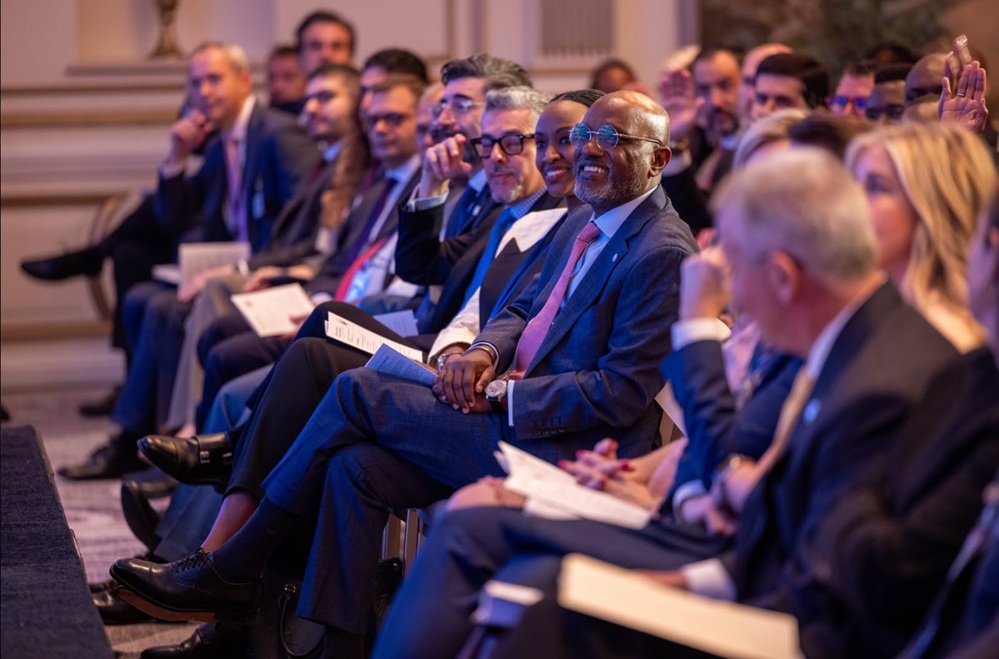
Government officials, private-sector representatives and international participants attend the “Trade Over Aid Deals Showcase” as U.S. officials discuss expanding trade and investment opportunities.

Landau said he wants the State Department, Commerce Department, Export-Import Bank, Development Finance Corporation and Millennium Challenge Corporation to work more closely together and make the U.S. government a more accessible “one-stop shop” for businesses seeking to invest overseas.

He cited the Pacific Islands as one region where he believes greater investment opportunities exist. Landau said he had organized a business summit and investment roundtable in Honolulu in February with Pacific Island leaders and U.S. private-sector representatives to identify sectors where investment could be expanded.

Landau said the U.S. government’s role is to improve communication between governments, businesses and investors and help identify opportunities for private capital. Concluding his remarks, Landau reaffirmed his commitment to expanding the global role of American businesses and called for what he described as an “unprecedented golden era for the American private sector around the world.”


Nepal Floods Highlight Urgent Need for Global Climate Action: GCF Chief

Shibbir Ahmed, United Nations, New York: The devastating floods in Nepal and recent wildfires in Europe should serve as a wake-up call for the world to take more urgent action against the growing risks of climate change, said Mafalda Duarte, Executive Director of the Green Climate Fund (GCF).

In an interview with Agence France-Presse (AFP) in Palau, Duarte said climate change was receiving less urgency in global politics than other major crises. While the international community has demonstrated the ability to mobilise large amounts of funding quickly in response to wars, conflicts and other emergencies, climate-related challenges have not received a similar response, she said.

Duarte warned that the world is moving closer to several climate “tipping points”, beyond which reversing environmental damage could become increasingly difficult or even impossible.

“We can mobilise money quickly when we choose to respond to an emergency,” Duarte said, stressing that climate change should be treated with the same sense of urgency.

She cited Nepal’s recent floods, along with heatwaves and wildfires in Europe, as examples of the increasingly widespread impacts of climate change. According to Duarte, climate-related disasters are no longer confined to developing countries. Both developed and developing nations are increasingly facing the consequences of a changing climate.

Growing Concern Over Nepal Disaster

The recent floods and landslides in Nepal’s Himalayan region have caused extensive destruction and raised fresh concerns about the vulnerability of mountain communities to extreme weather events. The disaster occurred in the Himalayan region near the Nepal-China border, with sudden flows of water and large amounts of debris affecting several areas.

Nepal’s Prime Minister Balendra Shah has also described the disaster as a serious warning about the growing risks associated with climate change and called for stronger international action to support countries vulnerable to climate-related disasters.

Experts say rising global temperatures are contributing to changes in Himalayan glaciers, snow cover and other environmental conditions, potentially increasing the risks of floods, landslides and glacier-related disasters. However, determining the precise contribution of climate change to any individual disaster requires further scientific analysis.

Concerns Over Climate Finance

The Green Climate Fund provides financial support to developing countries for climate adaptation, resilience and efforts to reduce greenhouse-gas emissions. According to the BSS/AFP report, the fund has invested about $19 billion across 134 developing countries.

However, concerns remain over the future of international climate finance. The report said the United States withdrew from the fund in January, while Britain halved its contribution in May. Duarte stressed that climate-vulnerable countries need faster and more accessible financing to prepare for and respond to the growing impacts of climate change.

Pacific Region Sees Increased Investment

Duarte is currently in Palau, where leaders of Pacific island nations are attending their annual summit. For many of these small island states, climate change represents a major threat to their security, economies and long-term survival. The Green Climate Fund has increased its investment in the Pacific region significantly. Over the past three years, its investment there has doubled to around $1 billion.

Duarte acknowledged that accessing climate finance remains difficult for many small island nations. She said efforts were under way to streamline the process, with the average approval period now taking about nine months.

Tina Stege, the climate envoy of the Marshall Islands, has also called for faster and more tangible progress on climate finance. She expressed frustration over the limited funding available through the separate United Nations-backed “loss and damage” mechanism, which is intended to help vulnerable developing countries address the impacts of climate-related disasters.

Duarte said there was still time to act on climate change, but the window for effective action was narrowing. She urged governments and the international community to move faster, increase climate financing and work together to address the growing risks posed by a warming planet.