Hasina Says She Will Return to Bangladesh in December ‘At Any Cost’

Desk News: Former Bangladesh Prime Minister Sheikh Hasina says she remains determined to return to Bangladesh from exile in India in December, despite facing a death sentence over her government’s deadly crackdown on protesters following her ouster in a mass uprising in 2024. Hasina fled to India after student-led protests forced her from power and has remained there since. She was later sentenced to death by a Bangladeshi special tribunal for crimes against humanity in connection with the crackdown.

The United Nations has said in a report that nearly 1,400 people were killed during the violence. Hasina has denied wrongdoing, rejected the tribunal’s verdict and questioned the legitimacy of the trial. Bangladesh has repeatedly sought her extradition from India, but New Delhi has not handed her over. Hasina first announced in August that she intended to return to Bangladesh in December.

“If death is my destiny, I would rather die on the soil of my own country, among my own people,” Hasina told The Associated Press in an email response. “So, I will return to Bangladesh. That decision has not changed.”

The AP sent questions to Hasina last week, and she responded Wednesday. Hasina, who served as prime minister from 2009 until 2024, did not reveal how she plans to return to Bangladesh. She could face arrest if she enters the country.

“I know that I may be arrested when I return. I may be imprisoned, tortured or even killed. I am fully aware of those possibilities. But I cannot spend the rest of my life watching my people suffer from a distance,” she told AP.

Following Hasina’s ouster, Nobel Peace Prize laureate Muhammad Yunus headed an interim administration that governed Bangladesh for about 18 months. An election held under the Yunus administration later brought Tarique Rahman, the son of former Prime Minister Khaleda Zia and a longtime political rival of Hasina, to power in a landslide victory. Hasina’s Awami League was barred from participating in the election.

Her planned return comes as the Awami League faces an uncertain political future. The party remains banned, while many of its senior leaders have been arrested or have gone into exile.

Hasina alleged that at least 20,000 members of her party have been killed since August 2024. She also claimed that thousands of supporters have been arrested, tortured or forced into hiding, while others have lost homes, businesses and livelihoods because of their political affiliations.

“There is no normal political or democratic environment,” Hasina said, accusing the authorities of systematically suppressing the Awami League. The government says arrests have been made in connection with specific allegations and cases. Human Rights Watch and other rights organizations have also raised concerns over civil and political rights in Bangladesh. Hasina expressed concern about what she described as the growing influence of hard-line and extremist groups in the country.

“The present political environment has allowed extremist elements to become more confident,” she said. The government has denied allegations of widespread intimidation of minorities and the growing influence of extremist groups, while the country has faced continued criticism over its law-and-order situation. Asked whether she expected countries such as the United States and India to pressure Bangladesh to guarantee her safe return, Hasina said she did not seek protection from foreign powers.

“I value friendship and cooperation with all nations. That has always been our (Bangladesh’s) foreign policy. But I do not need the blessing of a foreign power to return to my own country,” she said. Hasina has remained in India since leaving Bangladesh after the 2024 mass uprising that ended her 15-year rule.


Michael Rubin Questions UN Role in Bangladesh’s 2024 Political Crisis

Shibbir Ahmed , New York – American analyst Michael Rubin has questioned the United Nations’ role in assessing the violence surrounding Bangladesh’s July–August 2024 uprising and the fall of former Prime Minister Sheikh Hasina. Rubin alleges that the UN’s death toll and its broader interpretation of the crisis warrant greater scrutiny and transparency. Rubin argues that international officials have not adequately examined the role of Islamist political groups in Bangladesh’s political transition. He also questions whether Western governments and the United Nations have approached allegations against Hasina’s government with sufficient impartiality.

Rubin’s article highlights a discrepancy between the UN’s estimate of approximately 1,400 deaths during the 2024 unrest and a figure of around 800 deaths that he attributes to the Awami League. He calls on international officials to publish a comprehensive list identifying those killed, along with evidence supporting the reported figures. According to Rubin, such disclosure would allow the public and independent investigators to examine the numbers and the circumstances surrounding the deaths.

Rubin compares Bangladesh’s political transition with the Iranian Revolution of 1979 and Egypt’s political upheaval in 2013. He argues that international policymakers should carefully assess the potential influence of Islamist political movements and their implications for secular governance, democracy and social tolerance. He also raises concerns about Jamaat-e-Islami, referring to the party’s historical role during Bangladesh’s 1971 Liberation War. Rubin contends that international responses to Bangladesh’s political crisis have insufficiently addressed the risks he associates with Islamist political influence.

Following Hasina’s removal from office in August 2024, Nobel Peace Prize laureate Muhammad Yunus led Bangladesh’s interim administration. Rubin questions the relationship between Yunus, international officials and the political narrative surrounding the uprising. He also criticizes UN Secretary-General António Guterres and Western officials, arguing that the organization should disclose the evidence and methodology underlying its casualty estimates.

The central issue, according to Rubin, is whether international assessments of the crisis have been sufficiently transparent and impartial.

Rubin calling for a political process that allows competing parties to participate freely in elections. He argues that Bangladesh’s future should protect democratic participation, secular governance, economic development and social tolerance. His remarks makes serious allegations about the United Nations and the political forces involved in Bangladesh’s transition.


‘The Yunus Files: Unmasking a Fake Saint’ Launched in Jackson Heights

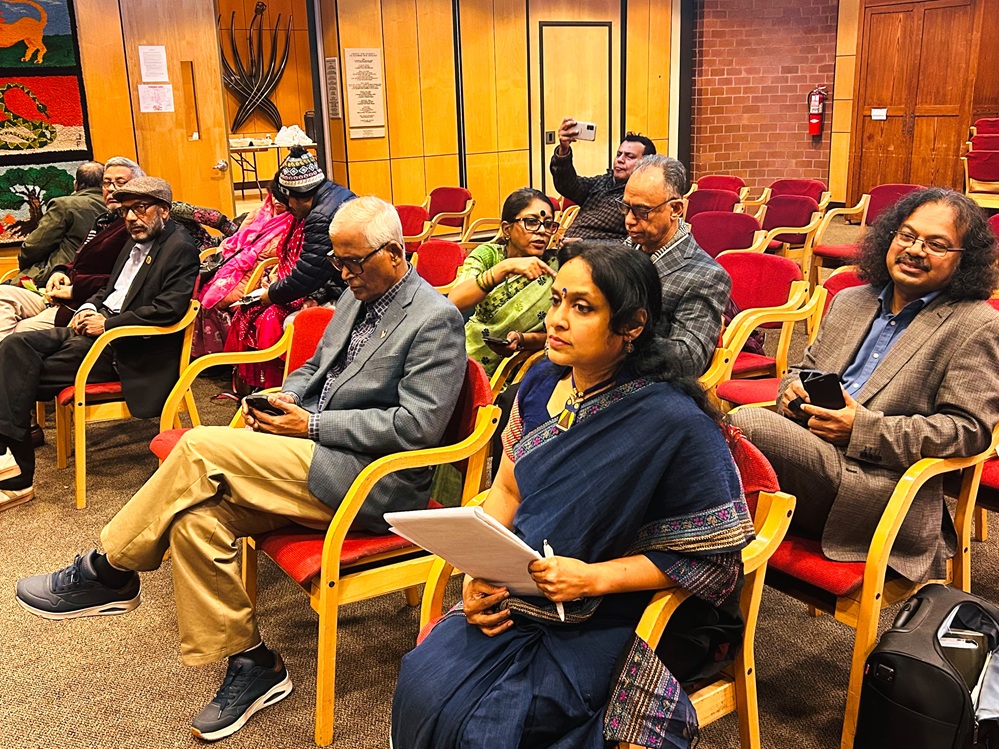
Special Correspondent | New York – A book launch and discussion for The Yunus Files: Unmasking a Fake Saint, authored by Aminul Haque Polash and Probir Bidhan, was held in Jackson Heights, Queens, on Friday, October 23, 2026. The event took place at 6 p.m. at the Jewish Center of Jackson Heights, located at 37-06 77th Street. Organized by Nalanda Publications, the gathering brought together members of the Bangladeshi diaspora, journalists, writers, educators and cultural figures for a discussion of the book and its political and social themes.

The book examines Muhammad Yunus’s international public image, his activities and his various roles, presenting the authors’ critical perspectives on his public record. Speakers at the event discussed the book’s chapters and its relevance to contemporary political debates in Bangladesh. Veteran journalist Fazlur Rahman chaired the event. Tajul Imam addressed the gathering as the chief guest, while poet and analyst Hasan Al Abdullah served as the keynote discussant.

Hasan Al Abdullah referred to selected passages from the book and presented his assessment of Yunus’s role in Bangladesh’s political and social developments. His remarks included criticism of Yunus’s leadership and its implications for the country.

Freedom fighter Golam Miraj attended as a special guest and criticized what he described as the treatment of freedom fighters during the period of Yunus’s leadership. Awami League leaders Pradip Kar and Mohammad Ali Siddiqui also shared their critical views on Yunus’s political positions and activities.

Co-author Aminul Haque Polash joined the event online and spoke about the background to the book and his personal motivations for writing it. Educator and social activist Hosne Ara Begum discussed the book’s central themes, overall arguments and contemporary relevance.

Writer and children’s literature author Humayun Kabir Dhali addressed the historical significance of Bangabandhu Sheikh Mujibur Rahman’s March 7 speech and criticized the handling of the commemorative day during the period of Yunus’s leadership.

Journalist and writer Shibbir Ahmed presented his views on Yunus’s past activities, while poet and filmmaker Rowshan Ara Nipa offered an analytical discussion of several chapters of the book. Other attendees included Sirajul Islam, Amanul Islam, Shawkat Akbar, Manzur Talukder, Rashid Abedin, Salma Begum, Rumana Akter, Farhin Shah and Jalal Uddin, among others.

Redwanur Rahman Jewel, publisher representing Nalanda Publications, thanked the attendees for participating. Poet and short-story writer Nazneen Siman moderated the program. Speakers expressed hope that the book would encourage readers to examine contemporary history and politics and engage with the questions raised by its authors. The program concluded with refreshments for guests and readers.


Congressman Gregory Meeks Calls for Joint Efforts to End Bangladesh Crisis

NEW YORK — U.S. Congressman Gregory W. Meeks has called for collective efforts to help restore normalcy in Bangladesh, strengthen democratic institutions, uphold the rule of law and protect press freedom. Meeks, the Ranking Member of the U.S. House Foreign Affairs Committee, made the remarks during an exchange meeting with members of the Bangladeshi-American community in New York on September 28.

Speaking about Bangladesh’s political situation, Meeks said he expects Democrats to regain majorities in both chambers of Congress in the November 3 midterm elections. He said that if he again becomes chairman of the House Foreign Affairs Committee, he intends to visit Bangladesh, observe the situation firsthand and work through Congress to provide appropriate direction to the U.S. administration.

Meeks also referred to a December 23, 2025 letter that he and four other members of Congress sent to Bangladesh’s then-Chief Adviser Muhammad Yunus. The letter urged the interim government to work with political parties across the political spectrum to create conditions for free, fair and inclusive elections and to restore confidence in the neutrality of state institutions.

The lawmakers also expressed concern that suspending the activities of a political party or restarting what they described as a flawed International Crimes Tribunal would undermine those objectives. Meeks said Bangladesh needs stronger democratic institutions, effective rule of law and safeguards for media freedom.

Turning to the United States, the congressman also expressed concern about what he described as growing pressure on media outlets and dissenting voices. Referring to disputes involving CNN, Politico and MS NOW and their access to the White House and Air Force One, he said measures affecting the media and people expressing dissent were inconsistent with American democratic values.

Meeks said he wanted to see Bangladesh return to a stable political environment. He also pledged that, if he again serves as chairman of the House Foreign Affairs Committee, he would visit Bangladesh and engage with relevant authorities regarding the country’s situation.

Bangladesh Situation Discussed

The exchange meeting was organized with the assistance of Sector Commanders Forum-Muktijuddho ’71 and the Bangabandhu Foundation. Bangabandhu Foundation President Abdul Kader Mia chaired the event, while Queens Democratic Party District Leader Dr. Dilip Nath moderated it.

Former Bangladeshi Foreign Minister and former Permanent Representative of Bangladesh to the United Nations A.K. Abdul Momen and former National Press Club President Farida Yasmin spoke about Bangladesh’s political and social situation. They alleged that opposition voices and political activists had faced arrests, violence and legal cases following the July-August 2024 protests and the formation of the interim government led by Muhammad Yunus.

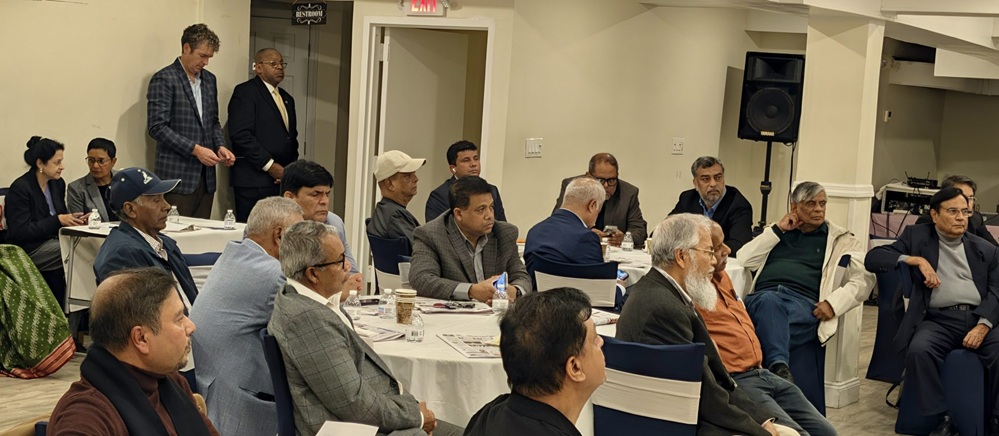
Bangladeshi-American community members attend a meeting with U.S. Congressman Gregory Meeks in New York to discuss Bangladesh’s political situation, democracy and the rule of law. Photo: KHABOR

They also alleged that members and supporters of the Awami League had been subjected to violence and that religious minorities had faced attacks. The speakers further criticized the suspension of Awami League activities, alleged mistreatment of freedom fighters and legal action against journalists whose reporting they said was not favored by the government.

The speakers called for the lifting of restrictions on the Awami League and urged the U.S. Congress to support what they described as the need for an early election. They also sought congressional intervention for the release of journalists and other political detainees facing what they characterized as politically motivated murder cases.

Bangladeshi-American Community Leaders Attend

At the beginning of the event, Abdul Kader Mia welcomed Congressman Meeks by presenting him with a traditional uttariya amid applause from attendees. Also present on the stage were Bangabandhu Foundation Senior Vice President Engineer Md. Fazlul Haque, Bangladesh Muslim Center of Brooklyn President Alhaj Abul Hashem, community organizer Enamul Haque Shamim, Aminul Islam Amin and Nazrul Islam Babu. The United States Bangabandhu Parishad, Sandwip Pourashava Welfare Association and Haque Medical Office served as co-hosts of the event.

Among the attendees were writer, columnist and editor Naim Nizam; World Bangla 24 TV CEO Alim Khan Akash; journalist Sultana Rahman; freedom fighter and journalist Lablu Ansar; journalist Sazzad Hossain Sobuj; Jago Prohori Editorial Board President Dr. Mahabbur Rahman Tuku; Sheikh Kamal Smriti Parishad President and freedom fighter Dr. Masudul Hasan; Sandwip Association Convener Sirajul Mawla; former Sandwip Association President Nazrul Islam Babul; Sandwip Pourashava Welfare Association President Md. Zafarullah; Sandwip Education and Cultural Society President Mosharraf Hossain, Secretary Abdul Hamid and Treasurer Ahsan Ullah Saki.

Others included community leader Mobasher Hossain, freedom fighter Kadir Mia, freedom fighter and businessman Saraf Sarkar, social organizer Sakhawat Ali, businessman and community organizer Ifzal Chowdhury, Chattogram Association General Secretary Ariful Islam Arif, Bauria Janakalyan Association Adviser Abul Kashem, Ekattor Genocide Foundation founder and freedom fighter Dr. Pradip Kar, community leader Abdul Jalil, Afsar Mohammad, Abu Taher M. Rahman, Yasin Arafat Bappi, politician Baker Bhuiyan, Democrat Morshed Alam, Engineer Mohammad Ali Siddiqui and Imdad Chowdhury, among others.

The guests were introduced by Bangabandhu Foundation Secretary Kamal Hossain Mithu. Dipa Nath, president of NAVA, and Linda Ramparteb coordinated fundraising activities for the congressman.

Call for Unity

In his closing remarks, Abdul Kader Mia thanked the attendees and called for unity to help Bangladesh overcome what he described as misrule. He urged the community to learn from past mistakes and move forward with the goal of completing what he described as the unfinished work of building “Sonar Bangla,” referring to the political vision associated with the country’s founding leadership.


Grameen Kalyan Must Pay Tk 666 Crore in Taxes: High Court

DHAKA: The High Court has paved the way for Grameen Kalyan to pay Tk 666.91 crore in taxes to the National Board of Revenue (NBR), dismissing two rules that had earlier been issued in connection with the tax dispute. A High Court Division bench comprising Justice Md Mozibur Rahman Miah and Justice Rezaul Karim pronounced the judgment after hearing the petitions.

Senior Advocate Abdullah Al Mamun appeared for Grameen Kalyan, while Deputy Attorney General Abdus Samad Azad represented the state. According to the state lawyer, following Thursday’s judgment, Grameen Kalyan will have to pay a total of Tk 666.91 crore to the NBR for the tax years from 2012 to 2017. The dispute concerns tax assessments made by the NBR for those years. Grameen Kalyan had challenged the tax demands before the High Court.

The case had previously gone through another round of proceedings. In August 2024, an earlier High Court bench had rejected Grameen Kalyan’s petitions, effectively allowing the NBR to recover the disputed taxes.

However, that judgment was subsequently withdrawn after concerns arose over a possible conflict of interest involving one of the judges, who had previously appeared as a lawyer for the government in the same matter. The case was then sent for a fresh hearing. Following the renewed hearing, the newly constituted High Court bench dismissed the two rules, resulting in the latest ruling in favour of the NBR’s tax claim.

Grameen Kalyan is a non-profit social business organisation founded by Nobel laureate economist Dr Muhammad Yunus. The latest judgment clears a major legal hurdle to the recovery of the disputed tax amount for the 2012–2017 tax years. It was not immediately clear whether Grameen Kalyan would challenge the judgment before the Appellate Division.