Guterres Calls for New Global Order as Power Shifts

Shibbir Ahmed, New York — UN Secretary-General António Guterres has called for a major overhaul of the international system, saying the institutions created after the Second World War must change to reflect the growing economic and geopolitical influence of emerging economies. Speaking to leaders at the 18th BRICS Summit in New Delhi on Sunday, Guterres said the world of today is fundamentally different from that of 1945 and that global institutions must reflect current economic, demographic and geopolitical realities.

“Today’s economic, demographic and geopolitical realities are not those of 1945,” Guterres said. “Our institutional structures must reflect it.”

He said the countries represented at the summit reflected the changing balance of global power and pointed to the emergence of an increasingly multipolar world. Guterres argued that multipolarity can bring greater balance and equity to international institutions, but said that would require reforms to bodies including the UN Security Council and the Bretton Woods institutions.

The UN chief outlined four priorities for what he described as inclusive global growth: financing, technology, climate justice and peace. On development financing, Guterres said developing countries need substantial international support to achieve the Sustainable Development Goals. He urged multilateral development banks to become “bigger, better and bolder” to help meet the scale of financing required. Turning to artificial intelligence, he warned that the benefits of the technology remain concentrated among a relatively small number of companies and countries.

“Unchecked, the AI divide will widen every other divide — in income, in opportunity, in security, and in sovereignty,” Guterres warned.

Climate change was another major focus of his address. Guterres pointed to extreme heat, melting glaciers, wildfires and devastating floods as signs of the worsening climate crisis and warned that a stronger El Niño could make conditions even more difficult as the world approaches the 1.5-degree Celsius threshold above pre-industrial levels.

He called on wealthy nations to honor existing climate-finance commitments, including increased adaptation financing and stronger support for countries facing loss and damage. He also criticized the exploitation of critical minerals, calling for an end to what he described as “plundering.”

On peace and security, Guterres highlighted conflicts and crises in Gaza, the wider Middle East, Ukraine and Sudan. He urged countries to uphold the UN Charter, including the principles of sovereign equality, territorial integrity and the peaceful settlement of disputes. Guterres said reforming the international system should be viewed as a shared responsibility rather than a concession to emerging powers.

“As we move irreversibly to a multipolar world, all countries must work to strengthen and safeguard a multilateral system that delivers for all with the United Nations at its centre,” he said.

The BRICS summit, hosted by India, brought together leaders of major emerging economies and senior international officials as discussions focused on global governance, economic cooperation, development, technology, climate change and international peace and security.


UN Chief Calls for Peace in Gaza, Ukraine and Sudan

Shibbir Ahmed, UN, New York: United Nations Secretary-General António Guterres has called for peace and an end to conflicts from Gaza and the wider Middle East to Ukraine and Sudan, warning that the world urgently needs greater international cooperation to address escalating crises.

Speaking at the BRICS Summit in New Delhi on Sunday, Guterres said conflicts around the world continue to cause immense suffering and instability, underscoring the need for countries to work together to promote peace and resolve disputes through diplomacy.

He highlighted the devastating humanitarian situation in Gaza and other conflict zones, while also pointing to the wars in Ukraine and Sudan as major challenges facing the international community. Guterres said the international community must not allow ongoing conflicts to become normalized and stressed the importance of collective efforts to achieve lasting peace.

His remarks came as world leaders gathered for the BRICS Summit, where global security, economic cooperation and major international crises were among the key issues under discussion. The UN chief has repeatedly called for an immediate end to violence in conflict zones and urged world powers to strengthen diplomatic efforts to protect civilians and uphold international law.


Khalilur Rahman Puts UN Reform at Top of Presidency Agenda

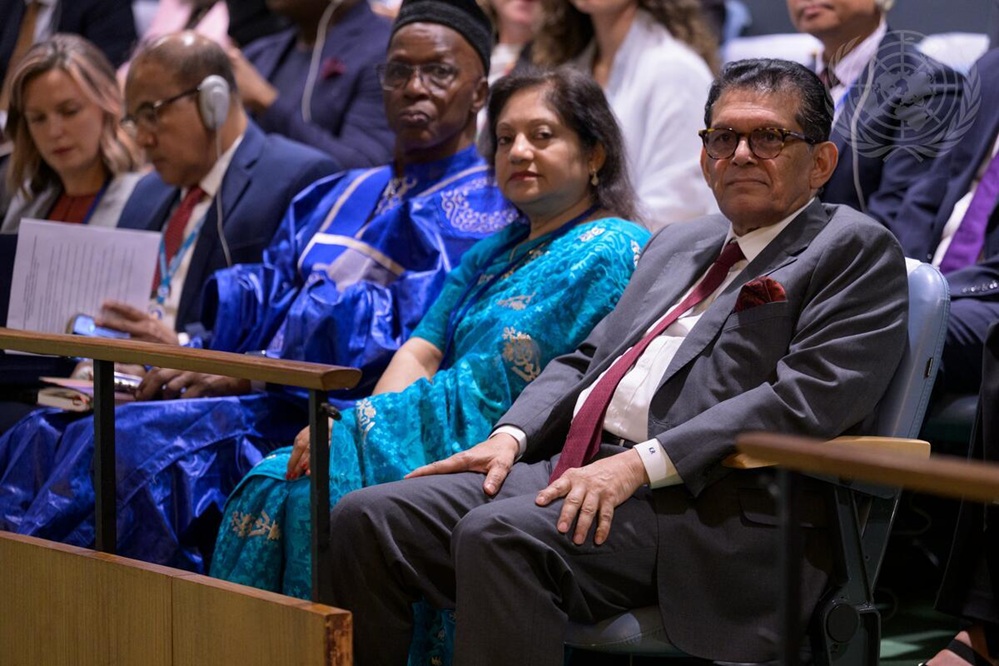
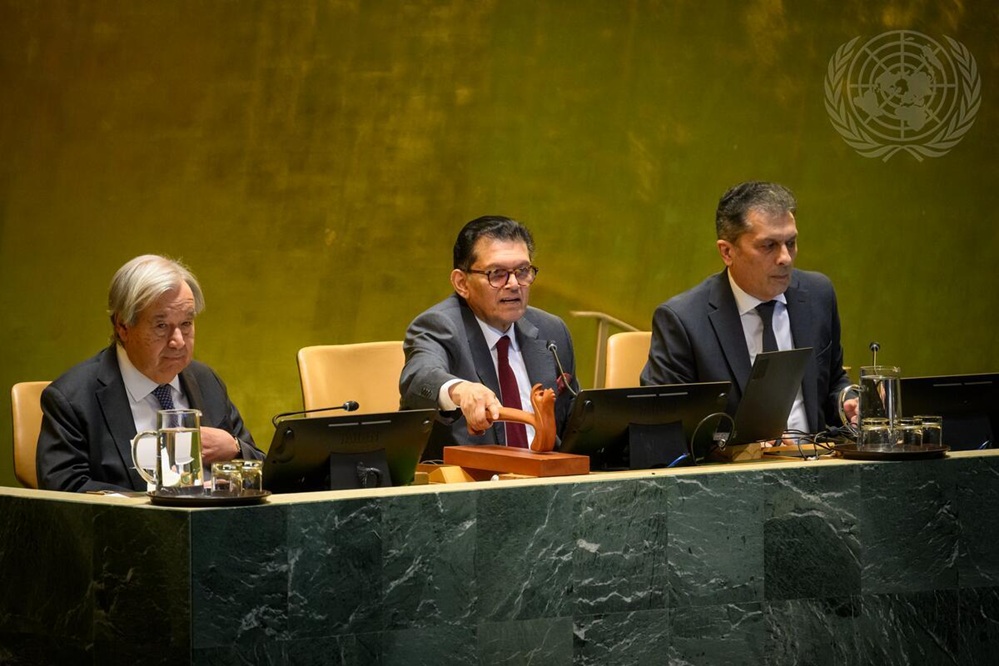
Shibbir Ahmed, United Nations, New York: Bangladesh’s Foreign Minister Dr. Khalilur Rahman has assumed the presidency of the 81st session of the United Nations General Assembly, pledging to prioritize dialogue, cooperation, rebuilding trust and meaningful reform of the world body. Speaking to reporters at UN Headquarters in New York on Tuesday ahead of the formal opening of the 81st session, Rahman said the multilateral system is facing unprecedented pressure and a growing deficit of trust.

Against this backdrop, he stressed the importance of finding common ground among countries despite their differences and pursuing solutions through dialogue and cooperation. According to the United Nations, Rahman was elected president of the General Assembly on June 2, 2026, and formally took office on September 8. He will preside over the 193-member General Assembly for the next year. The theme of the 81st session is “Restoring Trust, Managing Transformation: A United Nations That Delivers for All.”

Rahman acknowledged that many international disputes cannot be resolved quickly. However, he said disagreements should not prevent countries from identifying areas of common interest and working together. He said his presidency would remain firmly grounded in the UN Charter and the mandates entrusted to the organization by its member states. He also emphasized that global challenges can be addressed more effectively when countries work collectively and seek solutions through dialogue rather than confrontation.

UN Reform a Key Priority

Meaningful reform of the United Nations will be one of the central priorities of Rahman’s presidency. He said deeper reform is necessary to make the world body more effective and better prepared to respond to the challenges of the future. According to Rahman, public confidence in the United Nations has declined, making it necessary to strengthen the organization not only for the present but also for the generations ahead.

His broader agenda for the 81st session includes peace and security, progress toward the Sustainable Development Goals, climate and environmental protection, human rights, governance of emerging technologies including artificial intelligence, and reform of the United Nations. Rahman also pledged continued support for UN Secretary-General António Guterres’ reform efforts.

Giving Greater Space to Voices Beyond Governments

Rahman also called for greater participation in UN affairs by civil society, the media, academics, industry and innovation communities. Referring to the opening words of the UN Charter, “We the peoples of the United Nations,” he said the organization should not be viewed solely as an institution of member states.

He stressed the need to create greater opportunities for people from different sectors to contribute their views and participate in the work of the United Nations. While “Restoring Trust, Managing Transformation” remains the central theme of his presidency, Rahman said making the United Nations fit for the future would also be a major objective.

Pledge to Keep Rohingya Voices Heard

Responding to a question about how the United Nations can represent stateless populations, particularly the Rohingya, Rahman said the concept of “the peoples of the United Nations” should not be restricted by nationality or legal status.

Drawing on his previous experience as Bangladesh’s High Representative on Rohingya Issues, he said he had witnessed firsthand the suffering of forcibly displaced Rohingyas and their strong desire to return to their homeland.

Recalling a visit by UN Secretary-General António Guterres to the Rohingya refugee camps in Bangladesh, Rahman said refugees had repeatedly expressed their desire to return home. He said Bangladesh had helped bring the voices of the Rohingya to the United Nations and pledged to continue raising their concerns during his presidency.

Dialogue During High-Level Week

Rahman described the presence of world leaders at the upcoming high-level week as an important opportunity to promote dialogue and diplomacy. The General Debate of the 81st General Assembly is scheduled to take place from September 22 to 28, bringing together heads of state and government and senior representatives from around the world.

Rahman expressed hope that world leaders would use their addresses to emphasize dialogue and diplomacy as means of resolving conflicts and reaffirm their commitments to development, human well-being and human rights. He said the presidency would review the priorities outlined by world leaders and seek areas that could form the basis of a common agenda.

“I Will Be President for All Countries”

Rahman emphasized that, as president of the General Assembly, he would represent all member states, regardless of whether they supported his election. He also addressed the selection of the next UN secretary-general, saying he would remain faithful to the process established by the UN Charter.

Under the Charter, the Security Council recommends a candidate for secretary-general and the General Assembly makes the appointment. Rahman said he would work closely with member states and the president of the Security Council to facilitate the process and ensure a smooth transition of leadership.

The 80th session of the General Assembly concluded at UN Headquarters on September 8, followed by Rahman’s formal assumption of the presidency of the 81st session. His election marks Bangladesh’s return to the presidency of the General Assembly after four decades. Former Bangladeshi Foreign Minister Humayun Rashid Choudhury presided over the 41st session in 1986-87.

Rahman, who first attended the United Nations as a member of Bangladesh’s delegation in 1985, described his return to the organization four decades later as a remarkable moment, while noting how dramatically the world has changed during the intervening years.

As president of the 81st session, Rahman will seek to promote dialogue in a deeply divided world, rebuild confidence in multilateralism and help make the United Nations more effective in confronting the challenges of the future.