UN Rights Council Condemns Taliban Restrictions on Women

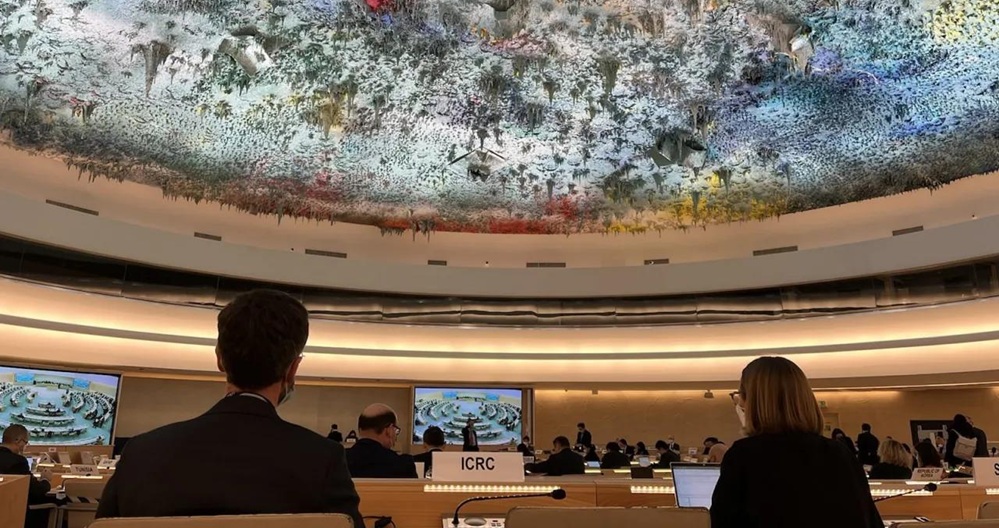
GENEVA — The United Nations Human Rights Council on Monday unanimously called on Afghanistan’s Taliban authorities to repeal policies restricting the fundamental rights and freedoms of women and girls, warning that the country’s institutionalized discrimination has reached an alarming level.

The 47-member council adopted the resolution without a vote, expressing serious concern over what it described as the “grave, worsening, widespread and systematic oppression” of women and girls under Taliban rule.

The resolution condemned what the council called the Taliban’s institutionalization of discrimination, segregation and exclusion of women and girls, as well as restrictions affecting their dignity and participation in public life.

The Taliban returned to power in Afghanistan in 2021 and subsequently introduced a series of measures based on its interpretation of Islamic law. The restrictions have particularly affected women and girls, including limits on employment, access to public spaces and education.

Girls have been barred from attending secondary schools beyond approximately the age of 12, while women have faced restrictions on employment and access to various public places, including parks.

The council said it was deeply concerned by what it described as the continuing and systematic erosion of women’s rights in Afghanistan. It said the Taliban had imposed an expanding network of decrees and institutional controls that had affected many aspects of both public and private life.

According to the resolution, the measures have contributed to a society marked by what the council described as “ideological conformity, fear and exclusion.”

The council called on the Taliban to repeal policies and practices restricting the human rights and fundamental freedoms of women and girls, including their rights to education, employment, peaceful assembly and political participation.

It also urged the international community to take human rights and fundamental freedoms into account in its engagement with authorities and other stakeholders in Afghanistan.

The resolution condemned discrimination against women and girls and expressed concern over other alleged human rights abuses in the country, including sexual slavery of boys, child marriage and forced marriage.

The council also voiced concern over what it described as deeply entrenched impunity in Afghanistan and expressed sympathy for the suffering of the Afghan population.

The resolution was introduced by a group of 37 European countries, together with Canada and Chile. The council also voted to extend the mandate of the United Nations independent special rapporteur on human rights in Afghanistan for another year.

The resolution adds to continuing international pressure on the Taliban over its treatment of women and girls. While the Taliban authorities have sought greater international engagement since returning to power, their restrictions on women’s rights remain a major obstacle in relations with much of the international community.


UNHCR Warns 5.8 Million Refugee Children Were Out of School in 2025

Shibbir Ahmed, New York — Some 5.8 million refugee children — nearly half of all school-aged refugee children worldwide — were out of school in 2025, the United Nations refugee agency UNHCR said Friday, warning that funding cuts could threaten hard-won progress in refugee education. According to UNHCR’s latest education report, an estimated 13.1 million refugee children of school age were living around the world in 2025. Of those, 44 percent were not enrolled in school.

The agency said the growing pressure on humanitarian and development funding risks reversing progress made in recent years and could leave more refugee children without access to education. The challenge becomes particularly severe as refugee children move from primary to secondary education. UNHCR said access to education declines significantly at the secondary level, with poverty, protection concerns and other barriers affecting children and adolescents, particularly girls.

Despite the overall challenges, UNHCR reported some progress in higher education. Refugee enrolment in tertiary education reached a record 11 percent in 2025, up from 9 percent in 2024, with more than 450,000 refugees enrolled in higher education.

UNHCR said the progress remains uneven. In low-income and conflict-affected countries, only about 2 percent of refugees were enrolled in higher education, compared with 13 percent of nationals, according to the agency’s report. The agency is calling on governments, international organisations and development partners to protect funding for refugee education and strengthen national education systems in countries hosting refugees.

UNHCR High Commissioner Barham Salih said education provides refugees with opportunities for greater self-reliance and warned that funding reductions could undermine years of investment. The report was highlighted during the UN Geneva press briefing on October 2, where UNHCR presented its latest findings on refugee education.

The report comes as humanitarian agencies face increasing financial pressure and competing global crises. UNHCR has warned that reductions in humanitarian funding are already affecting assistance and protection services for forcibly displaced people.


UN, Red Cross Warn of ‘Moral Red Line’ Over Autonomous Weapons

Shibbir Ahmed, New York: The United Nations and the International Committee of the Red Cross on Tuesday issued a renewed and urgent call for international rules governing autonomous weapons, warning that the world is dangerously close to a point where machines could autonomously target human beings.

UN Secretary-General António Guterres and International Committee of the Red Cross President Mirjana Spoljaric said governments must act urgently to prevent weapons from making life-and-death decisions without meaningful human control.

“We are now dangerously close to crossing a moral red line: the autonomous targeting of humans by machines,” the two leaders said in a joint appeal issued in Geneva on August 25. They called for negotiations to begin immediately on a legally binding international instrument establishing clear prohibitions and restrictions on autonomous weapon systems.

Risks are increasing

The UN and Red Cross said their fundamental concerns have remained unchanged since they first called for specific restrictions three years ago, but the risks have intensified as weapons technology has advanced rapidly.

Autonomous weapons are systems capable of selecting and engaging targets with limited or no direct human intervention. The growing use of artificial intelligence in military technology has raised concerns that machines could eventually determine independently who should be attacked.

The organizations stressed that autonomous weapons are not a distant possibility. A race toward greater autonomy in weapons systems is already underway, while international regulations have not kept pace with technological development.

Human judgment must remain central

A major concern is whether autonomous systems can reliably distinguish between combatants and civilians, particularly in complex battlefield conditions. Humanitarian organizations have also warned about the difficulty of determining responsibility when an autonomous system makes a fatal error. If a machine independently selects and attacks a person, questions could arise over who should be held legally responsible for the consequences.

At a Geneva briefing, the UN Office for Disarmament Affairs emphasized that some decisions should never be removed from human hands — particularly the decision over whether another human being lives or dies.

International talks have made limited progress

Governments have been discussing autonomous weapons under the United Nations framework since 2014. Important groundwork has been established through the UN General Assembly and the Group of Governmental Experts working under the Convention on Certain Conventional Weapons.

However, negotiations have struggled to keep pace with rapidly advancing technology. The UN and Red Cross now want governments to move beyond discussions and establish concrete international rules. The renewed appeal comes ahead of further international discussions in Geneva and a major review conference scheduled for November.

Growing use of artificial intelligence in warfare

Concerns have increased as artificial intelligence-assisted and semi-autonomous weapons have become more prominent in modern conflicts, including in Ukraine, Sudan, Gaza, Iran and the Gulf region. Some fully autonomous defensive systems are already in military use, including systems designed to intercept incoming missiles. However, there is currently no confirmed evidence that fully autonomous weapons have been used to deliberately target humans without human involvement.

The UN and Red Cross argue that governments should establish safeguards before technology reaches a point where machines can independently make decisions over human life.

“This year must mark a turning point,” the two organizations said, urging governments to show political determination and move toward decisive international action.