Japan Plans $1.2 Billion Investment in Bangladesh Tourism

DHAKA: Japanese investors have announced plans for an initial investment of $1.2 billion in Bangladesh’s tourism and hospitality sector, signaling potential new opportunities for foreign investment in the country’s tourism industry. The announcement was made during a meeting with Civil Aviation and Tourism Minister M. Rashiduzzaman Millat at the Bangladesh Secretariat on Sunday afternoon.

According to a ministry press release, the Japanese delegation expressed strong interest in investing in Bangladesh’s tourism industry and working with the government to develop tourism infrastructure and hospitality facilities. Welcoming the initiative, Minister Millat assured the investors of the government’s cooperation, saying necessary steps would be taken once formal investment proposals were submitted.

The minister said the government was keen to attract foreign investment through mutually beneficial public-private partnerships (PPPs), ensuring positive outcomes for both investors and Bangladesh. Highlighting the country’s tourism potential, Millat pointed to the Sundarbans, the world’s largest mangrove forest, Cox’s Bazar’s extensive natural sea beach and the scenic tea gardens of Sylhet.

He said international investment, alongside improvements in tourism infrastructure and services, could help unlock the sector’s potential. Describing Japan as a longstanding development partner, the minister highlighted its contributions to Bangladesh’s major infrastructure projects. He expressed optimism that Japanese investment and expertise could support the growth of the country’s tourism industry.

Millat also instructed the relevant authorities to arrange visits for the Japanese delegation to potential tourism destinations so they could assess investment opportunities. A delegation from the Bangladesh Tourism Board (BTB) is expected to facilitate visits to prospective sites and help investors identify suitable projects.

The Japanese representatives reaffirmed their interest in building a long-term partnership with Bangladesh in tourism and hospitality. The proposed $1.2 billion investment will move forward for consideration once the investors submit formal proposals to the government.


PM Tarique Rahman Calls for Stronger Trade, Investment Ties with China

DHAKA — Prime Minister Tarique Rahman today called for further expansion of bilateral trade, investment and development cooperation between Bangladesh and China. He made the remarks during a farewell meeting with outgoing Chinese Ambassador Yao Wen at the Prime Minister’s Office.

According to Prime Minister’s Deputy Press Secretary Hasan Shiplu, the meeting discussed a range of issues of mutual interest, including the Rohingya crisis. During the meeting, Yao Wen congratulated Tarique Rahman on his participation in the 81st session of the United Nations General Assembly and his various engagements in New York.

The Chinese ambassador reaffirmed China’s continued support for Bangladesh’s development efforts and expressed hope that bilateral relations between the two countries would be further strengthened. The meeting also underscored the importance of expanding economic engagement between Bangladesh and China, particularly in trade, investment and development cooperation.

State Minister for Foreign Affairs Humaiun Kobir and Chairman of the Bangladesh Investment Development Authority (BIDA) Chowdhury Ashik Mahmud Bin Harun were present at the meeting. Deputy Chief of Mission of the Chinese Embassy Liu Yuyin accompanied the outgoing ambassador.


Landau Calls for Shift From Aid to Investment in U.S. Economic Diplomacy

Shibbir Ahmed, New York — U.S. Deputy Secretary of State Christopher Landau has called for a stronger focus on trade and private investment as a long-term alternative to traditional foreign aid, saying economic diplomacy should play a central role in strengthening relationships between countries. Speaking at a Trade Over Aid Deals Showcase on September 25, Landau said economic and commercial issues had for decades taken a back seat in diplomacy, which he argued had too often focused primarily on political, military and security matters.

‘Economic and commercial issues should be treated as a core element of diplomacy’, Landau said, arguing that governments have a responsibility to create prosperity, economic opportunities and jobs for their people. Landau said economic projects can create lasting relationships that survive changes in government. While acknowledging that aid programs can help countries remain afloat, he argued that long-term economic projects can provide more sustainable value by generating investment, infrastructure, employment and economic growth.

He also emphasized that foreign investment does not necessarily mean a loss of national sovereignty. According to Landau, governments should establish clear terms and conditions for investments so that both investors and host countries understand their respective obligations and potential returns.

‘Investment is an engine of growth’, Landau said, urging governments and businesses to view foreign capital as an opportunity to expand economic activity rather than as a threat to sovereignty. He described investment relationships as potentially “win-win” arrangements, saying capital inflows can support infrastructure, jobs and economic growth while also strengthening political and commercial ties between countries.

U.S. private sector at the center

Landau said one of his priorities as deputy secretary is to improve communication between the U.S. government and American companies seeking investment opportunities overseas. He noted that during trips around the world, he frequently hears foreign governments asking why American companies are absent from projects where businesses from other countries have submitted bids.

Landau said he had previously focused largely on American companies directly operating overseas, including construction, infrastructure, oil and mining firms. He said he now sees a greater role for U.S. financial capital, particularly from New York City, which he described as the world’s financial capital.

‘There are trillions of dollars here that can be deployed around the world,’ Landau said, arguing that attracting capital providers could help connect foreign investment opportunities with American operating companies. He said he recently met with major capital providers to discuss why they were not investing in certain countries and what obstacles were preventing greater U.S. participation.

Calls for a more coordinated U.S. approach

Landau also acknowledged concerns from private investors about the fragmented nature of the U.S. government’s economic engagement overseas. He said investors sometimes want the U.S. government to have a financial stake or other involvement in projects to reduce risks associated with political changes in foreign countries.

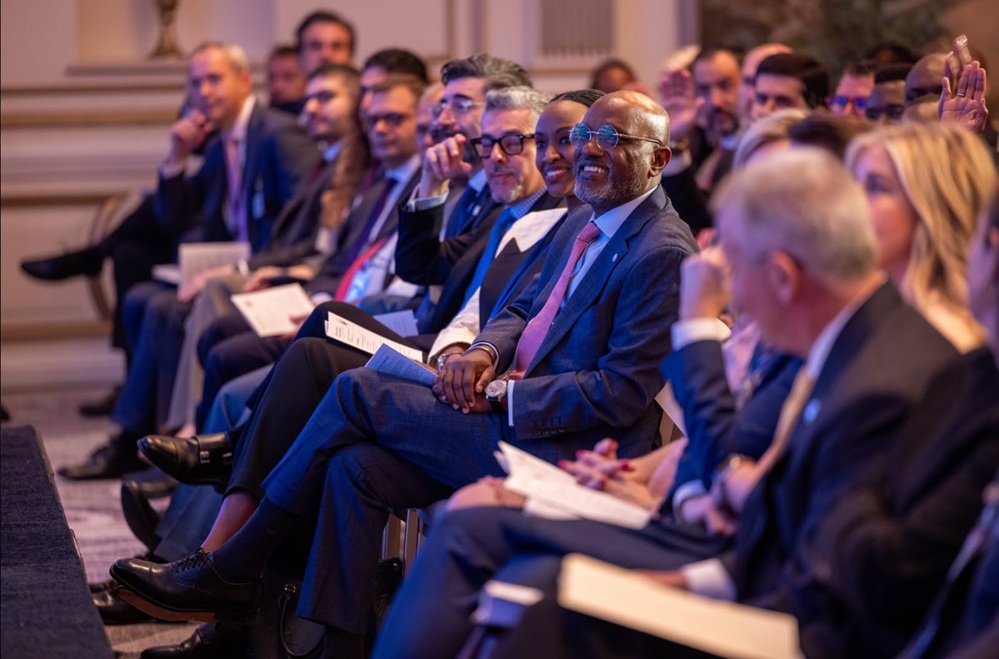
Government officials, private-sector representatives and international participants attend the “Trade Over Aid Deals Showcase” as U.S. officials discuss expanding trade and investment opportunities.

Landau said he wants the State Department, Commerce Department, Export-Import Bank, Development Finance Corporation and Millennium Challenge Corporation to work more closely together and make the U.S. government a more accessible “one-stop shop” for businesses seeking to invest overseas.

He cited the Pacific Islands as one region where he believes greater investment opportunities exist. Landau said he had organized a business summit and investment roundtable in Honolulu in February with Pacific Island leaders and U.S. private-sector representatives to identify sectors where investment could be expanded.

Landau said the U.S. government’s role is to improve communication between governments, businesses and investors and help identify opportunities for private capital. Concluding his remarks, Landau reaffirmed his commitment to expanding the global role of American businesses and called for what he described as an “unprecedented golden era for the American private sector around the world.”


US Envoy, BEPZA Chief Discuss Labor Standards

DHAKA — U.S. Ambassador to Bangladesh Brent T. Christensen and Labor Attaché Leena Khan met with Bangladesh Export Processing Zones Authority (BEPZA) Executive Chairman Major General Abul Kalam Mohammad Ziaur Rahman to discuss ways to strengthen Bangladesh-U.S. relations through high labor standards.

The meeting, held in Dhaka on Monday, focused on the importance of maintaining strong labor standards as a foundation for sustainable economic growth, improved working conditions and a stronger business environment in Bangladesh. According to the U.S. Embassy, the discussions highlighted how high labor standards can benefit workers and businesses while contributing to long-term economic growth in both countries.

The meeting also underscored the importance of continued cooperation between Bangladesh and the United States on labor issues as the two countries seek to deepen their broader economic and commercial relationship. High labor standards are increasingly important to Bangladesh’s export-oriented industries, particularly the ready-made garment sector, which remains heavily dependent on access to major international markets.

Improving workplace safety, protecting workers’ rights and ensuring compliance with internationally recognized labor standards can also help strengthen the competitiveness of Bangladeshi businesses and attract greater foreign investment. The discussions between the U.S. delegation and BEPZA leadership come at a time when Bangladesh is seeking to further modernize its export-processing zones and improve the overall investment environment.

BEPZA oversees the country’s export processing zones, which host domestic and foreign-invested companies engaged in export-oriented manufacturing and employ a large workforce. The U.S. side has repeatedly emphasized labor rights and workplace standards as important elements of the broader Bangladesh-U.S. trade and economic relationship. Ambassador Christensen and Labor Attaché Leena Khan’s meeting with the BEPZA executive chairman reflects Washington’s continued engagement with Bangladeshi authorities on labor issues and economic cooperation.

Both sides emphasized the potential for stronger cooperation to create a more favorable environment for workers and businesses while supporting sustainable and mutually beneficial economic growth. The meeting is expected to contribute to ongoing efforts to deepen Bangladesh-U.S. economic ties through improved labor practices, stronger worker protections and a more competitive investment environment.


US Envoy Eyes Stronger Trade Ties

DHAKA: Bangladesh-US trade relations could see more positive outcomes over the next 30 years and beyond if Bangladesh fulfills its commitments under the Agreement on Reciprocal Trade, US Ambassador to Bangladesh Brent Christensen has said. He made the remarks on Saturday (September 12) at a ceremony marking the 30th anniversary of the American Chamber of Commerce in Bangladesh (AmCham Bangladesh) in the capital.

“Congratulations to the American Chamber of Commerce in Bangladesh on 30 years of advancing US-Bangladesh commercial relations. Over the past 30 years, AmCham Bangladesh has been a reliable partner of the US government, and I am confident that if Bangladesh fulfills its commitments under the Agreement on Reciprocal Trade, we will see even more positive results over the next 30 years and beyond,” the ambassador said.

Current and former AmCham leaders, representatives of member companies, government policymakers, diplomats, business leaders and other distinguished guests attended the event. The programme was organized to commemorate AmCham Bangladesh’s three-decade contribution to strengthening Bangladesh-US economic relations, particularly in trade and investment.

The event began with the national anthems of Bangladesh and the United States, followed by a screening of a commemorative documentary titled “30 Years of Making Possibilities Possible,” produced to mark AmCham Bangladesh’s 30th anniversary.

In his welcome address, AmCham Bangladesh President Syed Mohammad Kamal highlighted the organization’s journey from a vision three decades ago to becoming a strong platform for business, investment and Bangladesh-US economic partnership.

He expressed gratitude to the chamber’s founding members and former leaders for their vision, leadership and contributions to its development. Speaking about AmCham’s future priorities, Kamal emphasized the need for a clear two-year energy roadmap, a more investment-friendly business environment, greater attention to intellectual property rights and cybersecurity, and effective implementation of regulatory reforms.

He also urged the government to make greater use of the global experience, technology, knowledge and capabilities of AmCham and its member companies. At the event, AmCham Bangladesh Vice President and MetLife Bangladesh Chief Executive Officer Ala Uddin Ahmed announced the launch of the “AmCham Excellence Award” to recognize outstanding contributions across various sectors.