British Council Celebrates 75 Years in Bangladesh with Duchess of Edinburgh

Sushmita Saha, Dhaka — The British Council has marked 75 years of its operations in Bangladesh with a special celebration in Dhaka, highlighting its longstanding contributions to education, English language learning, arts, culture and international partnerships. The anniversary event was held at the British Council’s office in Dhaka and brought together former students, changemakers, institutional leaders and partners who have been connected with the organization’s work in education, creativity and international collaboration over the years.

The event was given added significance by the presence of Her Royal Highness Sophie, the Duchess of Edinburgh, who joined the celebration to recognize the longstanding educational and cultural ties between Bangladesh and the United Kingdom. During her visit, the Duchess met with young people involved in women’s empowerment, green entrepreneurship and international education initiatives. She listened to their experiences and learned about their work, aspirations and community-focused initiatives.

The Duchess was also presented with an artwork created by a winner of the British Council’s Young Learner Art Competition. The competition is linked to the international Shoe Bing Space Art Residency Competition 2026–27, which encourages young students to explore the possibilities of art beyond Earth. Through the competition, young learners have been encouraged to imagine how creativity, science and space could contribute to a more connected and peaceful future.

Since opening its first office in Dhaka in 1951, the British Council has worked with individuals, institutions and communities across Bangladesh to expand access to education, promote English language learning and encourage cultural exchange. Over the decades, students, teachers, artists, entrepreneurs and leaders from different generations have become involved in its programs and partnerships.

The 75th anniversary celebration highlighted three key areas of the British Council’s work: empowering young people, supporting culture and creative activities, and expanding opportunities for international connections and relationships.

Participants and alumni associated with the British Council’s Green Entrepreneurship initiative, Women of the World (WOW), international education programs and scholarship initiatives shared their experiences at the event. They discussed how these programs had influenced their work and created opportunities for international collaboration and professional engagement.

British Council Bangladesh Country Director Stephen Forbes said the organization had worked with individuals and institutions across Bangladesh for the past 75 years to create new opportunities through education, English and the arts.

“Over time, the needs of the country and the expectations of people are changing. We also need to adapt the way we work to reflect those changes,” Forbes said. “We want young people to have the skills and confidence they need to shape their own futures and opportunities to connect internationally.”

He added that the British Council would continue working to expand cooperation between Bangladesh and the United Kingdom and further strengthen the existing relationship between the two countries.

Dhaka University Vice-Chancellor Professor Dr. A. B. M. Obaidul Islam said the relationship between the British Council and the University of Dhaka had a long history. He noted that their collaboration had extended beyond being neighboring institutions to include education, culture, exchange of ideas and international connections.

“Future generations will face opportunities and challenges that previous generations could hardly have imagined,” he said, emphasizing the need for new skills, a broader understanding of the world, digital knowledge, creativity and resilience. He stressed that universities need to work with organizations such as the British Council to ensure that future generations have access to the knowledge, connections and opportunities they need.

The Dhaka event was part of the British Council’s wider activities marking 75 years in Bangladesh. The celebration also recognized the contributions of individuals and partners who have helped advance the organization’s work over several decades. The British Council said it would continue its work in English language learning, education, arts and culture to strengthen mutual learning and lasting connections between the people of Bangladesh and the United Kingdom.

The British Council is the United Kingdom’s international organization for cultural relations and educational opportunities. Through arts, culture, English language and education, it works to build connections, understanding and trust between people in the UK and people in other countries.

Founded in 1934, the British Council operates as a UK-based charity governed by Royal Charter. It receives grant-in-aid support from the UK government and reaches millions of people worldwide through its programs, online platforms, broadcasts and publications.


Govt Aims to Make Teaching First Choice for Top Talent: PM

DHAKA- Prime Minister Tarique Rahman today said the government is working to make teaching a first-choice profession for meritorious people by reforming teacher recruitment and the education system.

“Teaching can never be a profession of last resort or merely another job. Rather, we are reshaping teacher recruitment and the education system to ensure that the most meritorious people choose teaching as their first choice of profession,” he said. The Prime Minister was addressing as the chief guest at a ceremony at Osmani Memorial Auditorium here marking World Teachers’ Day 2026 and honouring selected teachers from primary to higher education levels with the national ‘Eminent Teacher Award’.

Tarique Rahman said, “We believe that the dignity of the state is linked to the honour and dignity of teachers in the state and society. If the dignity of teachers remains intact in society, the image of the state is enhanced.”

This year’s theme of World Teachers’ Day is: “Standing with Teachers: 60 Years of Protecting the Profession, Enhancing Dignity and Shaping Our Future.”

The Prime Minister expressed his profound respect to teachers of all primary and secondary schools, colleges, madrasas, technical institutions and universities across the country, and congratulated those who received the ‘Eminent Teacher Award’ for their merit and competence.

He said if teachers could become the “need and loved ones” of their students, it would be easier for the students to face global challenges as responsible citizens through education.

Referring to teachers as “ideal role models” for every student after they move beyond the family school, Tarique Rahman said the government is formulating and implementing plans so that teachers can confidently present themselves as role models before their students.

In the era of rapid development of social media and artificial intelligence (AI), he said, there is no alternative to technical and practical education beyond conventional teaching methods.

“So, changing the strategies of learning and teaching and modernising the education curriculum is the demand of the time,” he said.

The government has formulated a new curriculum based on the realities of the time, and students will receive textbooks based on the new curriculum within this year, the Premier said, adding that the methods of learning and teaching are extremely important to ensure that students do not become alienated from books.

“Instead of mere memorisation, we have to raise the questions of ‘why’ and ‘how’ in the minds of students. If curiosity is created, a student can become his or her own teacher,” he continued.

Tarique Rahman said “joyful learning” has become popular across the world, particularly among school students.

For the first time in Bangladesh, he said, the Ministry of Education is providing sixth-grade students with a new book titled “Learning with Happiness”. Similar books will be introduced for other grades in phases.

The prime minister said the education system currently faces both immense opportunities and major challenges. Artificial intelligence has opened up vast opportunities for acquiring knowledge, while technical and practical knowledge has become indispensable instead of certificate-based knowledge, he added.

Referring to the new challenges created for teachers by rapid advances in information technology, Tarique Rahman said teachers’ training colleges need to be further modernised to meet the challenges of the time.

“We do not want to see technology as a substitute for teachers. Rather, technology will be the strength of teachers,” he said, adding that the government is advancing the “One Teacher, One Tab” programme to this end.

The prime minister said teachers would be able to use digital lesson plans, question banks, students’ learning progress data and necessary teaching materials through their tablets. Multimedia classrooms are also being
expanded at educational institutions across the country, while free Wi-Fi facilities are being increased, he added.

The Premier said the government wants to build an education system where no child is deprived of education.”It is also essential to ensure that even if someone drops out at any stage of their educational life for any reason, they do not remain unemployed,” he said.

Describing education as the biggest priority of the incumbent government, Tarique Rahman said the highest-ever allocation for education has been made in the national budget for the first time in the country’s history and the allocation will be increased gradually.

Highlighting the scale of secondary education, he said there are currently around 21,000 institutions at the secondary level, where more than 300,000 teachers are providing education to millions of students.

“Much of secondary education depends on private and MPO-listed institutions,” he said.

“There is still some disparity between urban and rural areas in terms of educational opportunities,” the Prime Minister said, adding that the government has various plans to ensure that students in both urban and rural
areas have access to skilled teachers and modern technology.

Describing the government’s approach to reforming the education system, he said its core foundations are equal opportunities, quality education and non-discriminatory access.

Tarique Rahman said employment-oriented education is necessary, but employment is not the sole purpose of education. “Moral and character development is also one of the key objectives of education. If knowledge is not linked with morality, it can become a cause of harm rather than benefit to society,” he continued.

Urging teachers to make truthfulness, a sense of responsibility, empathy, patriotism, humanity, discipline and respect for others integral parts of education, he said teachers play the most important role after families in
instilling moral values in students.

Highlighting various government measures to ensure teachers’ financial security and make teaching a more dignified and competitive profession, the Prime Minister said the government is working particularly for teachers at the primary, secondary and higher-secondary levels.

He further said the President and the Prime Minister invite people from different professions and sections of society to state functions at national occasions, including Independence Day and Victory Day.

“From this year, based on a policy, the concerned authorities are being instructed to make it mandatory to invite at least one teacher each from primary and secondary schools to such events,” he said.

Tarique Rahman said a teacher, whether serving or retired, remains worthy of the state’s respect throughout his or her life because of the noble profession.

Mentioning instructions to end harassment of teachers in receiving salaries and retirement benefits, he said a teacher should not have to visit offices and suffer hardship merely to receive salary or retirement benefits.

“The money due to a teacher must reach their bank account on time and in accordance with the rules,” he said. The Premier said the country’s teachers are one of the key instruments for building a knowledge-based state and society. World Teachers’ Day is observed globally on October 5 every year to highlight the importance of teachers’ dignity, rights, professional development and ensuring quality education.

Chaired by Education Minister Dr. A N M Ehsanul Hoque Milon, it was also addressed, among others, by National Professor Dr Mahbub Ullah, Prime Minister’s Office Spokesperson Mahdi Amin, State Minister for Primary and Mass Education Bobby Hajjaj and Chairman of the Parliamentary Standing Committee on the Ministry of Education Md Selim Bhuiyan.


Melania Trump Expands Fostering the Future Together Coalition to 57 Nations

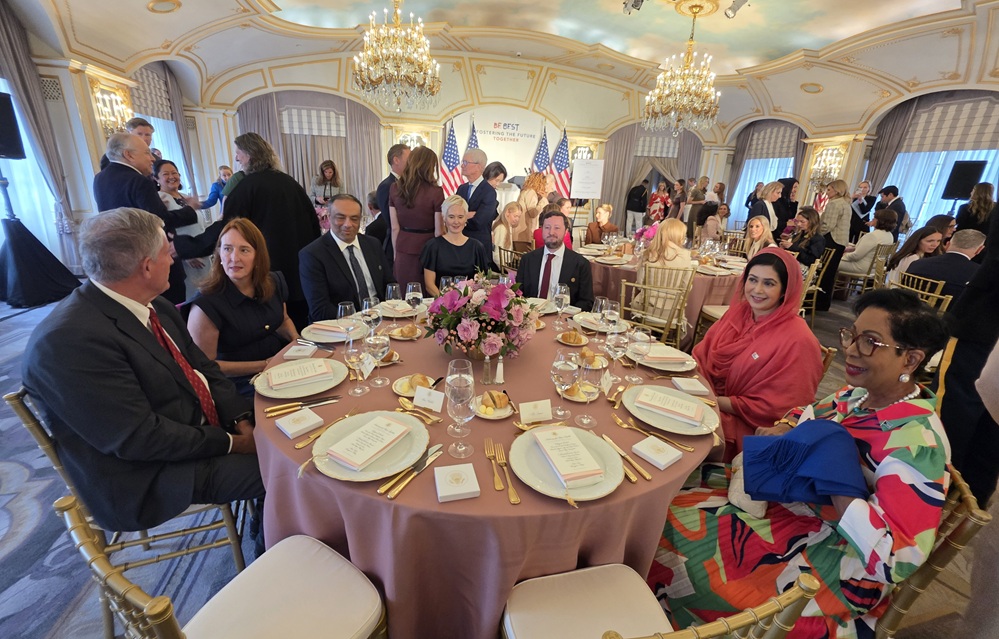
Shibbir Ahmed, New York — First Lady Melania Trump on Tuesday reconvened members of her Fostering the Future Together initiative in New York during the high-level week of the 81st United Nations General Assembly, announcing new technology partnerships, international events and an expansion of the coalition to 57 participating countries.

The gathering brought together representatives from countries including the United Kingdom, South Korea, the Philippines, Poland, Ukraine, Türkiye, the United Arab Emirates, Panama and Canada, according to the White House.

“Together, we are a beautiful range of cultures, languages, histories, and traditions,” Trump said. “And yet, we stand unified around one everlasting truth: the future of our world will be determined by what we do for our children today.”

Fostering the Future Together is described by the White House as a global coalition focused on empowering children through technology and education. Trump said the initiative is intended to provide young people with opportunities to learn, create and develop skills for the future.

New International Events Announced

Trump announced several Fostering the Future Together events planned for 2026.

They include a G20 event in Miami, which Trump plans to host, an ASEAN conference in Manila hosted by Philippine First Lady Liza Araneta Marcos, a European regional meeting hosted by Polish First Lady Marta Nawrocka, and a Caribbean regional meeting hosted by Saint Kitts and Nevis First Lady Diani Prince-Drew. “These leaders have stepped forward to activate their regions,” Trump said, adding that the initiative would provide support for their efforts.

Representatives and participants from countries around the world attend the Fostering the Future Together gathering in New York. Photo: KHABOR

Technology Partnerships

The First Lady also announced new private-sector partnerships involving Adobe, Amazon, Intel, Starlink, Google and Zoom. The companies are being brought into the initiative as part of its focus on expanding children’s access to technology and education. Tim Cook, executive chairman of Apple, and Enrique Lores, CEO of HP, also attended the gathering, according to the White House.

Trump emphasized that access to technology alone does not constitute empowerment and called for young people to be taught how to use technological tools responsibly and effectively.

“We must give our children the tools—and teach them how to use those tools wisely,” she said.

Focus on Technology and Education

In her remarks, Trump highlighted the rapid development of artificial intelligence and other technologies, describing the current period as a major technological transformation. She cited technologies including artificial intelligence, video communications, mobile computing, autonomous vehicles, virtual environments and biometric identification as examples of technologies that have moved from the realm of science fiction into everyday life.

She also called on participating countries and technology companies to help young people develop the knowledge and skills necessary to participate in an increasingly technology-driven economy.

“Our Fostering the Future Together coalition must strive to empower the youth of our nations to bend the boundaries of imagination, explore new frontiers of intellect, have the courage to take calculated risks, and build toward advancement of society,” Trump said.

Coalition Expands to 57 Countries

The White House said the initiative now includes 57 participating nations. Trump said the coalition’s long-term purpose is to create opportunities for children regardless of where they are born. Fostering the Future Together was announced during the 80th UN General Assembly in 2025. According to the White House, Trump subsequently convened the initiative’s inaugural Global Coalition Summit in Washington in spring 2026, bringing together first spouses and technology-sector leaders.

The latest gathering took place during the UN General Assembly’s high-level week in New York. The United Nations says the general debate of the 81st session is being held from September 22 to 26 and again on September 28.

Trump said the initiative’s success should ultimately be measured by its impact on future generations rather than by the meetings and speeches themselves. “Years from now, our children may not remember the meetings we held or the speeches we gave. But they will live with the consequences of what we do here,” she said.


Where Is the Future of Our Youth?

Mashiur Rahman Majumdar: A significant share of Bangladesh’s population is young. This large youth population represents an enormous opportunity for the country. At the same time, failure to create adequate employment and develop the necessary skills could turn that opportunity into a serious economic and social challenge.

When a young person completes an education and then spends years waiting for employment, the consequences extend beyond individual hardship. The country also loses the productive potential of a generation. Expanding access to education alone is therefore not enough. Education must be connected more closely to the actual demands of the labor market.

Young people need practical training and opportunities in technology, artificial intelligence, information technology, modern agriculture, manufacturing, healthcare and entrepreneurship. Equal opportunities must also be ensured for young women and those living in economically disadvantaged or underserved regions.

Creating employment is not solely the responsibility of the government. The private sector, educational institutions and industries must work together to develop a workforce equipped for a changing economy. Young people should have opportunities not only to seek jobs, but also to become entrepreneurs, skilled professionals and innovators.

Investing in young people is, in reality, an investment in the country’s future. The decisions made today will determine whether tomorrow’s Bangladesh is more skilled, productive and competitive in the global economy.

  • Journalist, Bronx, New York.