US Unemployment Stays Low as Job Growth Slows Before Midterms

WASHINGTON DC — The United States is heading into the November midterm elections with unemployment near historically low levels, but a weakening pace of hiring, persistent inflation and declining confidence in the economy are complicating the picture for President Donald Trump and his Republican Party.

The unemployment rate stood at 4.2% in September, a level generally associated with a labor market close to full employment. But the latest employment figures show an economy that is no longer generating jobs at the pace seen during the post-pandemic recovery, with employers becoming more cautious about hiring and workers losing some of the bargaining power they previously enjoyed.

Employers added just 29,000 jobs in September, well below the 90,000 increase economists surveyed by Reuters had expected. Payroll growth for August was also revised downward. Despite the weak hiring figures, there has been little evidence of a broad increase in layoffs, with unemployment claims remaining near historically low levels.

The labor market’s changing dynamics are creating a more complicated economic environment ahead of the November 3 elections. While Americans who have jobs continue to support consumer spending, fewer workers are finding the rapidly rising wages and abundant employment opportunities that characterized the years immediately following the pandemic.

Inflation has further weakened the benefits of wage growth. Real disposable income growth has remained below 2%, meaning that after accounting for rising prices, many households have seen only modest increases in the amount of money available for spending and saving.

The labor supply is also facing structural pressures. An aging population and lower birth rates are limiting the growth of the workforce, while tighter immigration policies have further affected the number of workers available to employers. The labor force remains below the record level reached in late 2025, according to the Reuters analysis.

Manufacturing employment presents another challenge for the administration. Trump campaigned on expanding American manufacturing through tariffs and deregulation, but manufacturing employment has so far shown limited improvement. The sector employed about 12.6 million people, roughly 21,000 fewer than when Trump took office in January 2025, according to Reuters.

The broader economy is also facing renewed inflationary pressure. The U.S. services sector expanded in September, but activity slowed slightly and the prices paid by businesses for inputs rose to their highest level in more than four years, according to an Institute for Supply Management survey reported Monday. Higher fuel and commodity costs, along with supply-chain disruptions, are adding to concerns about inflation.

The Federal Reserve is closely watching the conflicting signals. A weaker September jobs report has reduced expectations of another interest-rate increase at the central bank’s October meeting, although persistent inflation could keep another increase on the table later in the year.

For the White House, the economic record presents both strengths and vulnerabilities. The low unemployment rate provides evidence of continued labor-market resilience, but slower hiring and elevated living costs are shaping how households experience the economy.

With voters preparing to choose members of Congress in November, the distinction between a technically strong labor market and the day-to-day economic experience of households could become increasingly important. The economy continues to expand and layoffs remain limited, but the post-pandemic period of rapid hiring and strong wage gains has clearly lost momentum.

The result is an economy entering the midterm campaign with low unemployment but fewer signs of the extraordinary labor-market strength that defined the earlier recovery. For voters and policymakers alike, the central question is increasingly whether the current stability can be maintained while inflation, energy costs and slower job creation continue to put pressure on American households.


Trump Steps Up Midterm Campaign Offensive Ahead of 2026 Elections

Shibbir Ahmed, Washington DC — President Donald Trump is intensifying his campaign activity ahead of the November 3 midterm elections, embarking on a 32-day political tour aimed at helping Republican candidates defend the party’s majorities in Congress. Trump’s campaign push took him to Ohio on Saturday, where he rallied Republican supporters in Vandalia and campaigned for Senator Jon Husted and other GOP candidates in one of the country’s closely watched Senate contests.

The Ohio appearance followed campaign stops in Republican-leaning states including Texas, Oklahoma and Alabama, as Trump seeks to mobilize Republican voters and use his national profile to support candidates across the country. Reuters reported that Trump has been using rallies in strongly Republican areas while also focusing attention on competitive races.

Ohio has become a significant focus of the Republican campaign because control of the Senate could depend on a small number of competitive races. At Saturday’s rally, Trump endorsed Husted, who is seeking election to the Senate seat he currently occupies after being appointed to fill the vacancy created when JD Vance became vice president. Former Democratic Senator Sherrod Brown is seeking to return to the Senate and is challenging Husted.

Trump also campaigned for Republican gubernatorial candidate Vivek Ramaswamy, who is facing Democrat Amy Acton. The president used the rally to promote his administration’s economic policies and defend the expansion of large data centers in Ohio, which have become a contentious issue because of concerns over electricity costs, land use and the impact of artificial-intelligence infrastructure on local communities. Trump argued that data-center investment would bring economic benefits to Ohio and warned that restricting such projects could push investment toward China.

Trump began his latest midterm campaign offensive Thursday, traveling to Texas before continuing to Oklahoma and Alabama. The White House and Republican National Committee have described an intensive schedule of appearances designed to boost Republican candidates and turnout before Election Day.

Reuters reported that Trump is seeking to persuade voters to focus on his administration’s economic record while Republicans campaign on issues including manufacturing, energy costs, immigration and economic growth. Trump has also promoted a proposal to provide a $5,000 payment to adult Americans if Republicans retain control of both chambers of Congress. The proposal would require congressional action and has drawn questions about its potential cost.

The campaign comes as economic concerns remain a major issue for voters. An AP-NORC poll conducted September 24-28 found that only 26% of U.S. adults approved of Trump’s handling of the economy, while 17% approved of his handling of the cost of living. The poll found that 65% of respondents attributed persistent high costs more to Trump’s policies than to factors outside his control.

The economic environment has complicated the Republican campaign as candidates seek to defend their party’s record while addressing voter concerns over prices, energy costs and employment. Trump has responded by arguing that the administration’s policies are producing economic gains that are not adequately reflected in public perceptions.

The president’s intensified campaigning reflects the importance of the midterms to the remainder of his second term. Republicans currently control both the House and Senate, and the November elections will determine the balance of power in Congress for the next two years. Trump has urged Republican voters to treat the election as a referendum on his administration and has repeatedly asked supporters to vote as though he himself were on the ballot.

The president’s campaign schedule is expected to continue through the final weeks before Election Day, with appearances designed to support candidates in competitive races as well as strengthen Republican turnout in areas where the party traditionally performs strongly.

For Trump and Republican candidates, the campaign now enters its most intensive phase, with economic conditions, energy prices, immigration, artificial-intelligence infrastructure and the administration’s broader record all expected to remain central issues through November 3.


Trump Launches America.gov as Unified Digital Gateway to U.S. Government Services

Shibbir Ahmed, Washington DC — President Donald Trump on Tuesday launched America.gov, a new digital platform designed to provide Americans with a single entry point to federal government information and services, as the administration seeks to simplify how people interact with the U.S. government. The platform was unveiled September 29 in Washington alongside an executive order directing the establishment of America.gov as a unified digital “front door” for Americans seeking federal information and covered online services.

The administration says America.gov uses artificial intelligence and information drawn from government websites to help users find answers and navigate federal services through a conversational interface. The U.S. General Services Administration said America.gov combines information from more than 29,000 government websites with AI-enhanced search technology, allowing users to find information and guidance without having to navigate a fragmented network of individual agency websites.

The executive order says Americans have traditionally been required to search across multiple federal agencies, interpret government terminology, provide the same information repeatedly and verify their identities through different systems. America.gov is intended to change that process by providing a single digital point of entry through which users can communicate in plain language, receive information and, where authorized and technically available, complete federal government transactions.

AI-powered access to federal services

The new platform is designed to allow users to describe what they need rather than determine which federal agency is responsible for providing the service. The GSA said the platform can help users find information about government benefits, passport services, Social Security and other federal needs. The administration’s executive order directs federal agencies to identify qualifying online services and integrate them with America.gov in a secure and privacy-preserving manner.

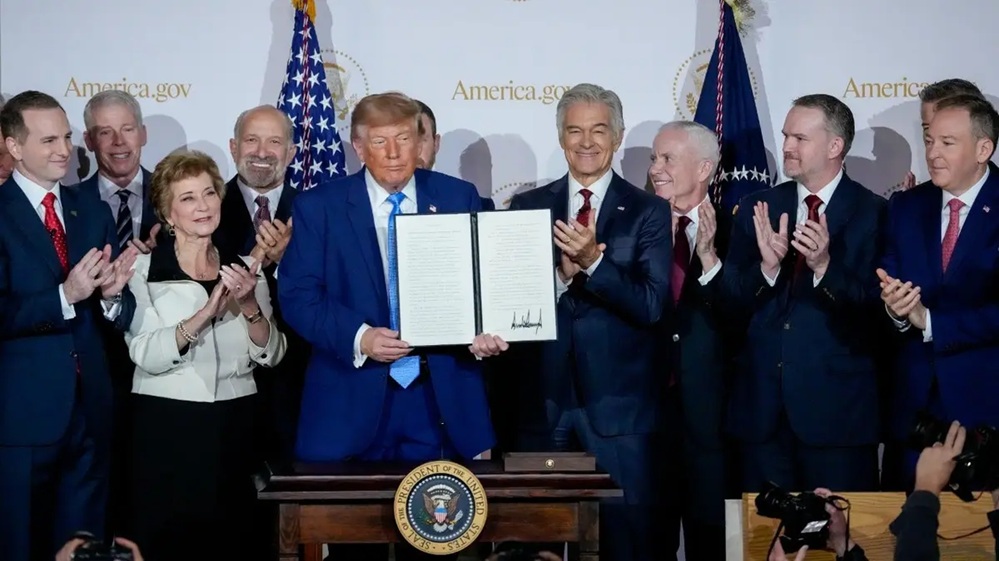
President Donald Trump holds up the executive order establishing America.gov during its launch event in Washington, D.C., on September 29, 2026. Administration officials joined the president at the event. Photo: WH

The order also calls for the integration of Login.gov as the authentication service for America.gov. Under the plan, agencies will continue to maintain control over their own records, systems, statutory responsibilities and decision-making authority. The order specifically states that the unified access system is not intended to create a centralized federal system of records about Americans. Privacy protections are also included in the order, including data minimization, secure authentication, auditable authorization and disclosure practices consistent with federal law.

Passport services among planned features

Secretary of State Marco Rubio said at the launch event that the State Department is partnering with America.gov to overhaul the passport application experience. Rubio announced that, beginning next year, Americans will be able to apply for their first U.S. passport entirely online. Applicants will be able to sign in through Login.gov, use information already held by the government where available, submit a photograph from a phone or other device, make a payment and track the status of the application. Rubio said the administration’s goal is for the vast majority of Americans to be able to apply for a passport or passport card through America.gov by the end of 2027.

Agencies given 90 days for implementation guidance

The executive order directs the Office of Management and Budget to issue implementation guidance to federal agencies within 90 days. Agencies will then be required to identify covered services, integrate those services with America.gov where appropriate and provide usage and performance information to the General Services Administration and OMB. The order defines covered services generally as public-facing federal services that serve more than 100,000 users during a 12-month period and can be accessed or applied for online. The order excludes Internal Revenue Service tax filing services, as well as services provided by the Department of War and elements of the Intelligence Community.

Existing government services will remain available

The administration says America.gov is intended to provide an additional, simplified way to access federal services rather than eliminate existing methods. The executive order specifically preserves existing lawful methods of obtaining government services, including in-person, telephone, mail and agency-specific digital services. That means Americans will not be required to use America.gov as the sole method of interacting with the federal government.

New passport design planned for 2028

Rubio also unveiled the planned design of a new U.S. passport expected in 2028. The redesigned passport features the American eagle and the Great Seal and includes artwork depicting major moments in U.S. history. Rubio said the new passport will visually represent 250 years of American history, with imagery ranging from the Revolutionary era and westward expansion to aviation, the raising of the American flag at Iwo Jima and the Artemis space program. The State Department also plans to change how the passport is packaged and delivered.

America.gov represents broader government technology push

The launch comes as the Trump administration expands its focus on artificial intelligence and digital technology as tools for government services. The new website is currently centered on AI-assisted information access, while additional transaction capabilities are expected to be introduced as federal agencies integrate their services with the platform.

The administration has described America.gov as a fundamental shift toward organizing government services around the needs of citizens rather than around the structure of federal agencies. For Americans, the intended result is a single digital starting point for finding federal information, understanding available services and eventually completing more government transactions online.


Trump Reportedly Rejects Iran’s Proposal to Reopen Strait of Hormuz

Washington DC — U.S. President Donald Trump has reportedly rejected an Iranian proposal aimed at reopening the Strait of Hormuz within seven days and ending fighting across the region, according to a report by The Wall Street Journal cited by Reuters.

Iran has been seeking an agreement that would reopen the strategically important waterway and establish a pause in the wider regional conflict. Tehran said the proposal was transmitted to the United States through Qatari mediators.

Iranian Foreign Minister Abbas Araqchi said the plan would trigger a seven-day countdown to reopening the strait if Washington agreed to the terms. Tehran has also called for the lifting of U.S. restrictions affecting Iranian ports, the release of frozen Iranian funds and the removal of oil sanctions.

However, The Wall Street Journal reported that Trump had rejected the proposal. Reuters said it could not immediately independently confirm the report, and Iran was still awaiting an official U.S. response.

The uncertainty comes as the Strait of Hormuz remains central to the international economic consequences of the conflict. The waterway is a critical route for global energy shipments, and prolonged disruption has contributed to concerns about oil supplies and shipping costs.

Iran has said it is prepared to discuss broader issues after hostilities are paused, but Tehran has ruled out concessions on several aspects of its nuclear program. The latest developments leave the diplomatic initiative in an uncertain position as Washington considers its response and regional tensions continue.


US, China Agree to $30 Billion Tariff Cut and AI Dialogue

Washington DC — The United States and China have agreed to a reciprocal tariff-reduction arrangement covering about $30 billion in trade, while also establishing a new dialogue on artificial intelligence, according to China’s Foreign Ministry and reporting by Reuters.

The agreement was reached during Chinese President Xi Jinping’s visit to the United States and his meeting with U.S. President Donald Trump. The two sides described the discussions as part of broader efforts to manage trade disputes and maintain communication between the world’s two largest economies.

Under the arrangement, the United States and China will reduce tariffs affecting certain goods, with the agreement reportedly covering about $30 billion in reciprocal trade. U.S. Trade Representative Jamieson Greer separately said Washington and Beijing had reached understandings concerning several categories of goods, including agricultural products, medical devices and consumer goods. Further details are expected to be released by U.S. officials.

The two countries also agreed to establish a new channel for discussions on artificial intelligence. The mechanism is intended to improve communication between Washington and Beijing over AI-related issues, including incidents that could have broader security implications. The AI component comes as both countries compete for technological leadership while attempting to manage concerns over the security implications of rapidly advancing artificial intelligence.

The latest trade understanding follows years of escalating economic tensions between Washington and Beijing. Previous tariff measures had pushed duties on some goods to exceptionally high levels before the two sides moved toward a temporary reduction and broader negotiations. The new agreement does not resolve all U.S.-China trade disputes, but it creates additional areas for negotiation and communication between the two governments.


Bangladesh-U.S. Relations Gain New Momentum: Bethany Morrison

Shibbir Ahmed, New York: Bangladesh-U.S. relations are currently on a positive trajectory, with Washington highlighting recent progress in trade, aviation and civilian nuclear cooperation as important developments in bilateral ties. Bethany Morrison, Deputy Assistant Secretary for South and Central Asian Affairs at the U.S. Department of State, made the remarks during a briefing on South Asia at the New York Foreign Press Center on Thursday.

“We are also in a good place with Bangladesh,” Morrison said, pointing to recent high-level engagement and expanding cooperation between the two countries.

Bangladesh Foreign Minister Meets President Trump

Morrison noted that Bangladesh’s foreign minister had the opportunity to meet with U.S. President Donald Trump earlier this week. She described the meeting as an important example of high-level engagement between Washington and Dhaka.

Highlighting recent trade cooperation, Morrison also referred to a major commercial agreement involving Boeing. She said President Trump had also posted about the development on his Truth Social account on Thursday morning.

Civilian Nuclear Cooperation

Morrison also said Bangladesh and the United States are preparing to sign a memorandum of understanding (MoU) on civilian nuclear cooperation. According to Morrison, the MoU is expected to be signed on Friday with the participation of a U.S. undersecretary. The proposed agreement could open another area of cooperation between the two countries, particularly in the peaceful use of nuclear technology and related civilian applications.

U.S. Sees Greater Engagement in South Asia

Morrison described the recent high-level contacts and agreements with Bangladesh as part of broader progress in U.S.-Bangladesh relations. Speaking about Washington’s wider policy toward South Asia, she said the Trump administration is placing greater importance on the region than in the past.

She indicated that the United States expects further progress in its relations with Bangladesh and other South Asian countries in the coming days. Journalists from Bangladesh, India, Nepal, South Korea, the United States and other countries attended the briefing at the New York Foreign Press Center.


Trump Signs Greenland Security Agreement With Denmark and Greenland

Shibbir Ahmed, New York — President Donald Trump on Tuesday signed a new security agreement with Denmark and Greenland aimed at strengthening defense cooperation in the Arctic, during the 81st United Nations General Assembly in New York.

Danish Prime Minister Mette Frederiksen and Greenlandic Prime Minister Jens-Frederik Nielsen joined Trump for the signing ceremony. Secretary of State Marco Rubio was also present as the agreement was signed.

The agreement amends and supplements the existing 1951 U.S.-Denmark defense agreement concerning Greenland. It reaffirms the parties’ defense cooperation and provides for expanded U.S. military access and activities in Greenland.

Under the agreement, the United States will be allowed to modernize and expand activities at Pituffik Space Base and establish additional defense areas at Narsarsuaq and Mestersvig, subject to arrangements between the parties. The agreement also provides a framework for establishing additional defense areas in Greenland through consultations and mutual agreement.

The agreement gives U.S. forces specified rights of access and movement in Greenland, including access by land, air and sea between defense areas. It also establishes provisions concerning U.S. aircraft and public vessels operating in Greenland and its territorial waters.

The three parties also agreed to strengthen cooperation on Arctic security, including through greater NATO engagement, planning, military presence, exercises and intelligence gathering.

The agreement includes provisions restricting non-NATO states from establishing military installations or maintaining a persistent military presence in Greenland unless otherwise agreed by the parties. It also contains restrictions related to certain foreign investments and activities considered potential threats to national security or public order.

The document reaffirms the sovereignty and territorial integrity of the Kingdom of Denmark and recognizes the right of the people of Greenland to self-determination under international law. It also states that the agreement has no end date and can be amended only by mutual consent under the existing defense framework.

The White House described the agreement as a major step in strengthening U.S. security interests in the Arctic. The signing took place as world leaders gathered in New York for the 81st session of the United Nations General Assembly.

The agreement was signed in New York on September 22, 2026, in English, Danish and Greenlandic. It will enter into force after the required parliamentary procedures in Denmark and Greenland are completed and the United States receives the necessary diplomatic notification.


Trump Defends Iran War, Warns of ‘Annihilation’ Without Deal in UN Speech

Shibbir Ahmed, New York — U.S. President Donald Trump used his address to the United Nations General Assembly on Tuesday to defend his administration’s military actions abroad, warn Iran of further escalation if it does not reach a peace agreement, and call for an end to the war in Ukraine. In a roughly 37-minute address at the 81st session of the UN General Assembly in New York, Trump outlined his foreign-policy priorities, including Iran, Ukraine, Venezuela, Cuba, Mexico, artificial intelligence and reform of the United Nations.

Trump strongly defended the U.S.-Israeli military campaign against Iran, saying the operation had prevented Tehran from obtaining a nuclear weapon. He warned that the United States could “annihilate” Iran if a peace agreement is not reached, while also saying he believes a deal could be reached after the U.S. midterm elections on Nov. 3.

“I believe we’ll make a deal right after the election because it doesn’t make sense for them not to,” Trump said. Trump also addressed the Russia-Ukraine war, saying the United States was working with both Moscow and Kyiv and expressing confidence that a settlement could be reached.

“We will get that one done,” Trump said, adding that an agreement could come sooner than many people expect. The president also highlighted U.S. actions in Venezuela and the wider Western Hemisphere. He said Washington would not allow threats against the United States to establish a foothold in the region and said the country would use its military power when necessary to protect what he described as vital U.S. national interests.

On Cuba, Trump described the country as a failed state and said his administration was seeking fundamental political change there. “Communism will never be coming to America, but freedom will be coming to Cuba,” he said. Members of the Cuban delegation walked out of the General Assembly hall while Trump was discussing Cuba, Reuters reported.

Trump also criticized Mexico over drug-cartel violence and described the fight against cartels as a major U.S. security priority. He said his administration had carried out strikes against cartel groups and argued that the United States needed to take stronger action against organizations it considers terrorist threats.

Artificial intelligence was another major theme of the speech. Trump said his administration would use the term “super intelligence” rather than artificial intelligence in official communications and argued against international restrictions that could limit technological development.

He said the United States was leading China and other countries in the AI race and argued that AI could become more transformative than the Industrial Revolution. Trump also renewed his criticism of the International Criminal Court, urging member countries to withdraw and arguing that the court should not have jurisdiction over U.S. military personnel.

Turning to the United Nations itself, Trump said the organization had significant potential but called for further reforms, including reductions in bureaucracy and spending. He criticized what he described as the influence of “globalist bureaucrats” and said the United States would continue pushing for changes at international institutions.

The speech comes as world leaders gather in New York amid continuing conflicts in the Middle East and Ukraine, uncertainty over global economic conditions and growing debate over the international governance of artificial intelligence. The UN’s 81st General Assembly general debate runs from Sept. 22 through Sept. 28.


Trump Praises NYC Mayor Zohran Mamdani in New York Meeting

Shibbir Ahmed, New York — President Donald Trump offered high praise for New York City Mayor Zohran Mamdani on Monday, putting aside past political hostility during a closed-door meeting at Gracie Mansion. The roughly one-hour meeting focused on key municipal challenges, including federal immigration policies and a massive proposed affordable housing project.

The encounter marked a striking shift from the bitter rhetoric of the mayoral campaign, when Trump heavily criticized Mamdani. However, following their third face-to-face meeting—and the first hosted on the mayor’s turf ahead of the United Nations General Assembly—the two leaders struck a remarkably cordial tone.

Speaking to reporters at a joint press conference on the lawn of the mayor’s official residence, Trump expressed optimism about the city’s leadership. “Hopefully, you’re going to be a great mayor,” Trump said, addressing Mamdani directly. “I can say you’re going to be a great mayor, and you’re off to a start. … He’s certainly got potential, great potential.”

For his part, Mayor Mamdani acknowledged their clear political differences, particularly regarding federal immigration enforcement, but emphasized his commitment to pragmatic cooperation. Mamdani noted that he voiced his strong stance on keeping immigrant New Yorkers safe, while also advancing discussions on a major proposal to construct 12,000 new homes above a Queens rail yard.

“The president and I have been very frank about the many disagreements we have,” Mamdani told reporters, while affirming that maintaining open channels of communication remains essential for delivering results for the city. The meeting also touched on broader national matters, with Trump addressing media policy questions during the appearance.


CNN, MS NOW and Politico Sue Trump Administration Over White House Press Access

Shibbir Ahmed, Washington DC — CNN, MS NOW and Politico have filed a federal lawsuit against President Donald Trump’s administration, challenging the decision to bar their journalists from the White House. The three news organizations filed the lawsuit Monday in the U.S. District Court for the District of Columbia, arguing that the administration’s action violates constitutional protections for freedom of the press. They are seeking an emergency order that would restore their journalists’ access to the White House while the case proceeds.

The dispute began after the White House announced Friday that journalists from CNN, MS NOW and Politico would no longer be allowed on White House grounds. Their reporters were subsequently denied entry and had their press credentials disabled or confiscated. In their legal challenge, the three organizations argue that their access was revoked because the administration objected to their reporting. They also argue that the government acted without adequate notice or due process and violated their First Amendment rights.

President Trump has defended the restrictions, saying the administration is targeting what he describes as “fake news” rather than the free press. The White House has argued that the outlets can continue reporting on the administration even though their access to the White House has been restricted.

The case has also affected the White House press pool. CNN had been scheduled to provide video coverage for the television pool during Trump’s trip to New York for the United Nations General Assembly. The pool subsequently announced that it would not provide replacement coverage after CNN was prevented from carrying out its assignment.

Other major television networks, including ABC, CBS, NBC and Fox, have suspended their participation in the White House video pool in response to the dispute, according to Reuters. The lawsuit now places the dispute over White House press access before a federal court, which could determine whether the administration can exclude the three news organizations under the circumstances at issue.