Guterres Calls for End to US-Iran Conflict, Urges Return to Diplomacy

Shibbir Ahmed, New York — United Nations Secretary-General António Guterres on Tuesday called for an end to the ongoing conflict between the United States and Iran, urging all parties to step back from confrontation and return to diplomatic negotiations as the crisis continues to disrupt vital trade routes across the Middle East.

Speaking at a joint press appearance in Islamabad with Pakistan’s Deputy Prime Minister and Foreign Minister Mohammad Ishaq Dar, Guterres issued a direct appeal to the parties involved in the conflict.

“End the conflict. Return to diplomacy,” Guterres said, calling at the same time for the full restoration of navigational rights and freedoms in accordance with international law.

His remarks came at the beginning of a two-day official visit to Pakistan, where the UN chief is expected to discuss regional security, diplomacy, humanitarian issues and climate change.

The current crisis began in late February following joint U.S. and Israeli strikes against Iran. Tehran responded with attacks against targets in Gulf countries and Jordan and moved to restrict transit through the Strait of Hormuz, one of the world’s most strategically important maritime passages.

The waterway is a major route for international shipments of crude oil, liquefied natural gas and other commodities. Disruptions in the strait have created significant uncertainty for global shipping and energy markets.

Guterres said hundreds of ships and their crews have been stuck at sea for months as a result of the continuing crisis. The disruption has raised concerns well beyond the region, with the security of international shipping and the uninterrupted movement of energy supplies becoming central issues in the conflict.

The conflict has also contributed to fighting along Yemen’s Red Sea coast. Iran-backed Houthi forces are engaged in fighting with Yemeni government troops supported by Saudi Arabia over control of the strategically important Bab al-Mandab Strait. The waterway is a critical maritime passage linking the Red Sea with the Gulf of Aden and the wider international shipping network. The developments have added another layer to an already complex regional crisis, with several strategic waterways now affected by military tensions.

Guterres used his visit to Pakistan to recognize Islamabad’s efforts to facilitate dialogue between Washington and Tehran. He praised Pakistan’s role in helping establish conditions for negotiations and pointed specifically to the June 17 Islamabad Memorandum of Understanding, the subsequent ceasefire and the framework created for further talks.

The UN secretary-general described Pakistan’s role as significant and said the country’s efforts demonstrated the importance of mediation and diplomacy at a time of increasing international division.

“Every Pakistani should be proud of that pivotal role,” Guterres said. He also praised Pakistan as a country that has continued to support multilateral diplomacy and international cooperation.

Guterres also addressed the broader Middle East crisis, saying lasting peace in the region cannot be achieved without addressing the political rights of the Palestinian people. He said the right of the Palestinian people to self-determination remains an important element of any long-term regional peace effort.

The UN chief expressed hope that the Middle East could move toward greater peace and prosperity through dialogue and cooperation. His comments come as the region continues to face overlapping conflicts and humanitarian challenges.

During his remarks, Guterres also highlighted Pakistan’s longstanding contribution to United Nations peacekeeping. He paid tribute to more than 180 Pakistani peacekeepers who have died while serving in UN missions around the world. Guterres also referred to a recent Security Council resolution led by Pakistan and Denmark that strengthens accountability for crimes against UN peacekeepers.

According to the secretary-general, the resolution received support from 153 countries, making it the most widely co-sponsored Security Council resolution in the organization’s history. He also acknowledged the heavy toll of terrorist attacks on Pakistan and expressed solidarity with those affected.

Pakistan’s role in hosting millions of Afghans displaced by conflict and instability was another issue raised during the visit. Guterres said the United Nations would continue working with Pakistan to ensure that the return of Afghan refugees is voluntary, safe and dignified.

The issue remains sensitive as Pakistan manages the long-term humanitarian and security consequences of decades of conflict in neighboring Afghanistan.

Guterres also used his visit to highlight Pakistan’s vulnerability to climate change. Recalling his previous visit to the country during the devastating 2022 floods, he said Pakistan remains on the front lines of climate-related disasters despite contributing only a small share of global greenhouse-gas emissions.

He praised Pakistan’s involvement in establishing the Loss and Damage Fund and highlighted the country’s efforts to expand clean energy. The UN chief again urged developed countries to take the lead in significantly reducing global emissions during the current decade.

Guterres’ appeal comes as the United States-Iran conflict continues to create security and economic risks across the Middle East. The disruption of major maritime routes, the expansion of fighting into neighboring areas and the potential impact on global energy and trade have increased pressure for a diplomatic solution. From Islamabad, the UN secretary-general made clear that his preferred path forward is negotiation rather than further escalation.

“End the conflict. Return to diplomacy,” he said.

For Pakistan, meanwhile, the visit provides an opportunity to reinforce its role as a diplomatic channel between major powers while emphasizing its broader concerns over regional stability, humanitarian protection and climate security.


Iranian Delegation Leaves New York Early Amid US-Iran Tensions

Shibbir Ahmed, New York — U.S. Secretary of State Marco Rubio ordered Iranian Foreign Minister Abbas Araghchi and his delegation to leave New York earlier than scheduled, according to two U.S. officials familiar with the matter, adding a new dimension to ongoing diplomatic tensions between Washington and Tehran. Iranian President Masoud Pezeshkian left New York last week after delivering his address to the United Nations General Assembly. Araghchi, however, remained in the city as efforts continued toward indirect discussions with the United States on reopening the Strait of Hormuz, ending the ongoing conflict and restarting negotiations over Iran’s nuclear program.

According to U.S. officials, weekend meetings involving Iranian and Qatari mediators produced little progress. Rubio subsequently instructed the Iranian delegation on Monday to leave New York immediately. One U.S. official said the delegation had remained in the country after the high-level UN meetings had ended and was no longer expected to stay. Araghchi and members of his delegation left New York early Tuesday and were expected to travel back to Iran via Doha, Qatar.

Iran, however, rejected the U.S. account. Iran’s permanent mission to the United Nations said the delegation had not been ordered to leave or expelled from the United States. The mission said its departure schedule had been arranged in advance and had been communicated to the U.S. State Department on September 17.

The Iranian mission also accused Washington of spreading what it described as “baseless” reports following the lack of progress in the negotiations. The conflicting accounts have highlighted the differences between Washington and Tehran over the circumstances surrounding the delegation’s departure.

Indirect discussions between the United States and Iran have continued with Qatar playing a mediating role. Key issues remain unresolved, including the reopening of the Strait of Hormuz, sanctions, frozen Iranian assets, the ongoing conflict and Iran’s nuclear program.

The departure of the Iranian delegation comes as diplomatic contacts between Washington and Tehran continue, but the two sides have yet to reach an agreement aimed at resolving the broader conflict and their longstanding disputes.


U.S. Pays $725 Million to UN, Keeps Voting Rights

Shibbir Ahmed, New York — The United States has paid $725 million to the United Nations, reducing its outstanding financial obligations to the world body and ensuring that Washington retains its voting rights in the UN General Assembly. The payment comes just days before world leaders are due to gather in New York for the annual General Assembly session.

The United Nations said the United States transferred $725 million for the organization’s regular budget on Tuesday. Washington also paid an additional $102 million toward UN peacekeeping operations on Friday. Despite the latest payments, the United States still owes approximately $1.312 billion to the UN regular budget, according to UN spokesperson Farhan Haq.

The payment also removes the immediate risk that the United States could lose its voting rights under Article 19 of the UN Charter. The provision says a member state can lose its vote in the General Assembly when its arrears reach or exceed the amount of contributions due for the preceding two full years, although the General Assembly can grant an exception in certain circumstances.

The United States is the largest contributor to the UN budget, but the Trump administration has criticized the organization and reduced or delayed funding to various UN agencies. Washington has also pushed for reforms and cost reductions across the UN system.

The latest payment comes as the United Nations faces continuing financial pressure and implements its “UN80” reform and cost-cutting initiative. China, the UN’s second-largest contributor, paid $641.4 million toward its regular budget contribution earlier this month, according to UN figures cited by Reuters. The U.S. payment means Washington will retain its vote as the 2026 UN General Assembly prepares to convene in New York next week, while the broader dispute over U.S. funding and UN reforms remains unresolved.


81st UN General Assembly Opens in New York Amid Global Crises

Shibbir Ahmed, UN, NEW YORK — The 81st session of the United Nations General Assembly officially opens Tuesday in New York, bringing together the world’s nations at a time of intensifying conflicts, humanitarian crises, economic uncertainty and growing pressure on the multilateral system. The ordinary session will run from September 8, 2026, through September 7, 2027, according to the United Nations. Bangladesh’s Khalilur Rahman is serving as president of the 81st General Assembly session.

The theme of this year’s session is “Restoring Trust, Managing Transformation: A United Nations That Delivers for All.” The theme reflects growing international concern over the ability of multilateral institutions to respond effectively to war, humanitarian emergencies, climate change, inequality and rapid technological change.

The opening of the session comes as the international community faces multiple major crises, including ongoing armed conflicts and humanitarian emergencies. The General Assembly is expected to provide a major diplomatic forum for member states to discuss peace and security, sustainable development, human rights and international cooperation.

Khalilur Rahman, who was elected president of the 81st session in June, has outlined six major priorities for his presidency: peace and security, sustainable development, climate resilience, human rights and humanitarian protection, inclusive innovation and renewed multilateralism.

His vision also places emphasis on strengthening the United Nations’ ability to deliver practical results and rebuilding confidence in the multilateral system. The opening session is only the beginning of an intense period of diplomacy at UN Headquarters. The General Assembly’s high-level general debate is scheduled for later in September, when heads of state and government from around the world are expected to gather in New York.

The United Nations says the 81st session will also address major issues including peace and security, sustainable development, climate action, human rights, artificial intelligence and reform of the UN system. With the world facing deep geopolitical divisions, the 81st General Assembly is set to test whether nations can rebuild trust and find common ground through multilateral diplomacy.


Rohingya Crisis: Beyond Relief, Bangladesh Needs Diplomacy for a Solution

Editorial:

Bangladesh’s Rohingya crisis is no longer simply a humanitarian emergency. After years of hosting a large displaced population, the crisis has increasingly become intertwined with national security, border management, economic pressure, environmental degradation and regional stability.

Bangladesh has demonstrated remarkable humanitarian responsibility by providing shelter and assistance to Rohingya refugees fleeing violence in Myanmar. But humanitarian assistance, however essential, cannot be a permanent solution. The longer the crisis continues, the greater the burden becomes for Bangladesh—and the greater the risks become for the refugees themselves.

The fundamental question is therefore becoming increasingly difficult to avoid: How long can Bangladesh continue to manage the crisis without a credible pathway to resolving it?

Food, healthcare, education and shelter remain essential for the Rohingya population. International humanitarian assistance must continue. But relief programmes address the consequences of displacement, not its root causes.

The central issue remains unchanged: why are the Rohingya unable to return safely to their homeland, and what must be done to create the conditions for a voluntary, safe and dignified return?That is where diplomacy must take centre stage.

A humanitarian crisis with security implications 

The prolonged presence of large refugee communities has placed significant pressure on Bangladesh, particularly in Cox’s Bazar and surrounding areas. Local infrastructure, public services, the environment and economic opportunities have all faced additional pressure.

There is also a growing security dimension. Concerns over organised crime, human trafficking, narcotics networks, illegal arms flows and the activities of armed groups in and around refugee camps cannot be ignored. At the same time, it is important not to stigmatise the Rohingya population as a whole. The overwhelming majority are victims of displacement who want security, basic rights and the opportunity to return home.

The challenge for Bangladesh is to protect the refugee population while preventing criminal and armed networks from exploiting the vulnerability created by prolonged displacement. This requires stronger law enforcement, intelligence cooperation, border surveillance and action against trafficking and organised crime. But security measures must also remain consistent with humanitarian principles. Ordinary refugees should not become victims of collective suspicion or punishment.

Myanmar remains at the centre of the problem

Ultimately, the Rohingya crisis cannot be permanently resolved inside Bangladesh because the root of the displacement lies in Myanmar. The continuing instability in Myanmar, particularly in Rakhine State, makes the prospect of safe and sustainable repatriation increasingly complicated. If conditions inside Rakhine do not allow refugees to return with adequate security and basic rights, simply sending people back would not constitute a genuine solution.

Unsafe repatriation is not a solution; it risks creating another cycle of displacement. For that reason, Bangladesh must continue to insist that any repatriation process be voluntary, safe, dignified and sustainable. The international community also has a responsibility that goes beyond humanitarian fundraising.

From aid diplomacy to solution-oriented diplomacy

For years, international attention has focused heavily on humanitarian assistance. That support has been indispensable. But the international response cannot remain confined to raising funds to sustain refugee camps indefinitely. The objective must now be to build a credible international framework for a lasting political solution.

Bangladesh should intensify diplomatic engagement with the United Nations, regional organisations and countries capable of exercising political and economic influence over Myanmar. The major powers and regional actors must be encouraged to play a more active role in creating conditions for safe and sustainable repatriation.

Diplomatic discussions should move beyond general expressions of concern. There must be greater focus on practical questions: security guarantees, citizenship and legal rights, freedom of movement, access to essential services, property and livelihood rights, and international monitoring of the repatriation process. Without addressing these issues, repatriation risks becoming a numbers exercise rather than a durable solution.

Bangladesh cannot carry the burden indefinitely

Bangladesh has already carried a substantial humanitarian and economic burden. International support for refugees must therefore continue, but the burden on host communities must also receive greater attention. The people of Cox’s Bazar and surrounding areas should not feel that they have been forgotten while international attention remains focused exclusively on the refugee population.

Development assistance should therefore address both refugees and host communities. Infrastructure, healthcare, education, employment opportunities and environmental protection require sustained investment. This is not about placing refugees and local residents against each other. It is about recognising that long-term stability depends on supporting both communities.

The next generation is at stake

Perhaps the most serious long-term concern is the future of Rohingya children and young people. A generation is growing up in an environment defined by displacement and uncertainty. Without adequate education, skills and hope for a better future, prolonged marginalisation can create frustration and vulnerability to exploitation by criminal or armed groups.

Education and skills development must therefore remain central to the humanitarian response. Providing young Rohingya with opportunities is not simply an act of charity; it is also an investment in regional stability.

At the same time, Bangladesh must strengthen the security and governance of the camps without turning them into permanent detention-like environments. Humanitarian protection and security are not mutually exclusive. In fact, effective humanitarian management can itself reduce security risks.

Bangladesh needs a stronger diplomatic strategy

Bangladesh now needs to move beyond crisis management towards a more comprehensive diplomatic strategy. The country should pursue three objectives simultaneously: protecting the humanitarian rights of the Rohingya, safeguarding Bangladesh’s national security, and creating sustained international pressure for safe and dignified repatriation.

These objectives should not be treated as competing priorities. They are interconnected parts of the same solution. Bangladesh should also ensure that the Rohingya issue remains on the international agenda. Global attention tends to shift as new conflicts and crises emerge. But the absence of headlines does not mean the crisis has disappeared.

Diplomatic engagement must therefore be continuous, coordinated and evidence-based. Bangladesh has a strong moral and legal argument for seeking international support. But moral appeals alone are not enough. Dhaka needs a clear strategy, measurable diplomatic objectives and stronger coordination with countries that have influence over Myanmar.

Relief must continue—but it cannot be the destination

The international community should not mistake the relative stability of the refugee camps for resolution of the crisis. A camp can provide temporary shelter. It cannot replace a homeland. Humanitarian assistance can save lives. It cannot resolve statelessness. International funding can sustain basic services. It cannot guarantee a political settlement. That is why the international response must evolve from relief diplomacy to solution-oriented diplomacy.

Bangladesh should continue providing humanitarian protection, but it should also make clear that the country cannot be expected to carry the consequences of a crisis it did not create indefinitely. The Rohingya crisis has reached a point where humanitarian responsibility and national security must be addressed together. Ignoring either dimension would be a mistake.

Bangladesh needs stronger border security, better camp management and tougher action against criminal networks. But it also needs sustained international diplomacy aimed at changing the conditions that made mass displacement possible in the first place.

The ultimate solution lies not in making refugee camps more permanent, but in making return possible. The Rohingya crisis will not be solved by relief alone. It will be solved when diplomacy produces the conditions for a safe, voluntary and dignified return.

For Bangladesh, the message should now be clear: aid must continue, but the goal must be a solution. The Rohingya crisis cannot remain a permanent humanitarian burden when what is urgently needed is a lasting political and diplomatic settlement.


Irene Khan Takes Office as Bangladesh’s UN Representative

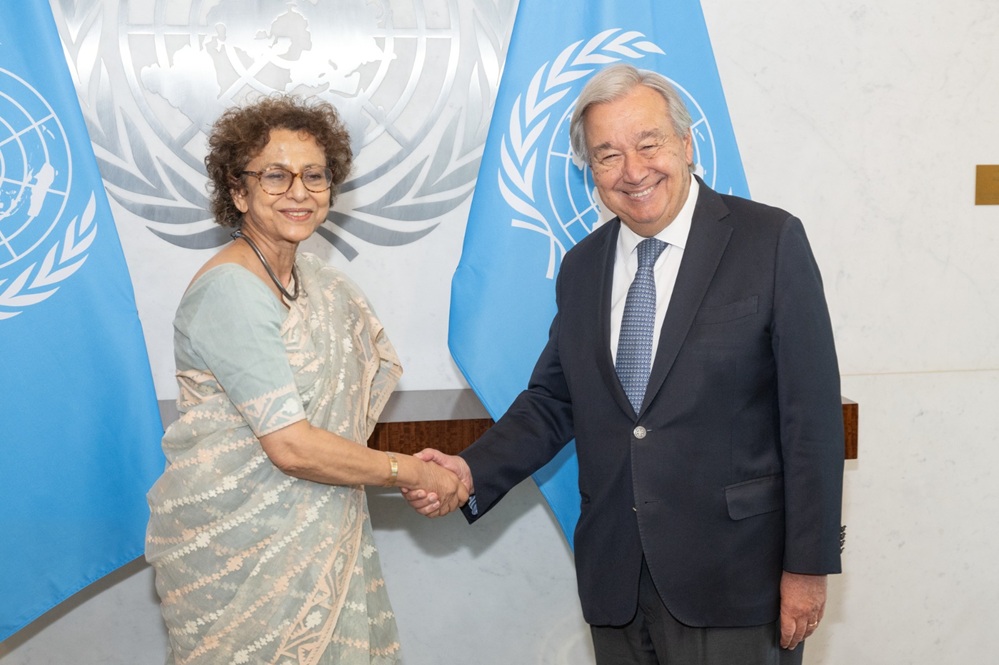
Shibbir Ahmed, UN, New York: Irene Zubaida Khan, a veteran international human rights advocate, has taken office as Bangladesh’s Permanent Representative to the United Nations in New York. Khan presented her credentials to United Nations Secretary-General António Guterres at UN Headquarters in New York on Friday, formally assuming her role as Bangladesh’s envoy to the world body.

She brings decades of experience in human rights, international law, refugee protection, the rule of law and sustainable development, including senior roles at the United Nations and other international organizations.

Before taking up her new role, Khan had served since 2020 as the UN Special Rapporteur on the promotion and protection of the right to freedom of opinion and expression. From 2001 to 2009, she served as Secretary-General of Amnesty International, becoming the first woman to lead the organization.

From 2012 to 2019, Khan served as Director-General of the International Development Law Organization (IDLO). Earlier in her career, she spent 21 years with the Office of the United Nations High Commissioner for Refugees (UNHCR), holding a number of senior positions including Chief of Mission in India and Deputy Director of the Division of International Protection.

Khan received the Sydney Peace Prize in 2006 and is the author of The Unheard Truth: Poverty and Human Rights. She studied law at the University of Manchester and Harvard Law School.


CIA Chief John Ratcliffe Travels to Moscow for Talks With Russian Officials

Shibbir Ahmed, Washington DC: CIA Director John Ratcliffe traveled to Moscow on Tuesday for meetings with Russian officials, according to U.S. media reports citing people familiar with the trip. The visit was not publicly announced, and the CIA and Kremlin have not disclosed who Ratcliffe met or what was discussed.

Ratcliffe’s trip marks the first known visit to Moscow by a U.S. CIA director since William Burns traveled there in November 2021, when Burns met Russian President Vladimir Putin amid growing tensions over Ukraine. Russia launched its full-scale invasion of Ukraine several months later.

The unusual trip became public after a U.S. Air Force C-17 Globemaster III was tracked flying from the United States through Latvia and then to Moscow. A U.S. diplomatic motorcade was also seen in the Russian capital.

The purpose of Ratcliffe’s visit remains unclear. It comes as U.S.-mediated efforts to end Russia’s war in Ukraine remain stalled, while Washington is also dealing with heightened tensions involving Russia and Iran. U.S. officials reportedly asked Ukraine to avoid certain strikes on Russian territory while the American delegation was in Moscow, according to reports cited by U.S. media.

Ratcliffe has previously been involved in sensitive U.S.-Russia contacts, including negotiations connected to prisoner and detainee exchanges. His Moscow visit therefore raises questions about whether the discussions could involve Ukraine, detainees, Russia-Iran relations, or broader U.S.-Russia security issues. However, there is currently no official confirmation of the agenda.

The Kremlin has not publicly confirmed a meeting with Ratcliffe, and U.S. officials have declined to comment on the reported visit.

The development is likely to draw significant international attention because it represents an unusually high-level U.S. engagement with Moscow at a time when relations remain deeply strained and the Ukraine peace process is uncertain.