Bangladesh seeks more time for sustainable LDC graduation

Shibbir Ahmed, New York – Bangladesh has called for an extended preparatory period before graduating from the least developed country (LDC) category, saying additional time would help ensure a smooth and sustainable transition and build a more resilient post-graduation economy.

“For Bangladesh, an extended preparatory period will support a smooth, sustainable and irreversible graduation and a resilient post-graduation economy,” State Minister for Foreign Affairs Humayun Kabir told the annual ministerial meeting of LDC foreign ministers at the United Nations Headquarters in New York. He also sought the continued support of the LDC Group as Bangladesh’s request is considered by the United Nations General Assembly.

Kabir said graduating countries need additional time to maintain macroeconomic stability, undertake critical reforms and implement effective transition strategies. Looking ahead to the midterm review of the Doha Programme of Action, he outlined six priorities for LDCs, including reversing the decline in official development assistance, expanding access to concessional financing, improving market access and securing predictable climate finance for adaptation and loss and damage.

He also called for stronger international cooperation to combat illicit financial flows and recover stolen assets, while urging greater support for industrialisation, technology transfer and digital inclusion.

“Geopolitical tensions, economic volatility, debt distress, declining ODA, food and energy insecurity and climate crisis are testing our resilience,” Kabir said. He noted that economic growth among LDCs remained below the seven-percent target, with growth projected at 4.6 percent in 2026 and five percent in 2027. The State Minister said Bangladesh’s “3R” strategy — Recovery, Restoration and Reconstruction — was aimed at laying the foundation for sustainable development.

He thanked Nepal for its leadership as chair of the LDC Group, expressed solidarity with the country following a recent natural disaster and welcomed The Gambia as the incoming chair. Bangladesh’s call for additional preparation time comes as the country seeks to address the economic and structural challenges associated with its transition out of the LDC category while maintaining long-term development momentum.


Global Financial Architecture Must Support Sustainable Development: Titumir

Shibbir Ahmed, New York — Dr. Rashed Al Mahmud Titumir, Adviser to the Prime Minister on the Ministries of Finance and Planning, has called for comprehensive reform of the global financial architecture to ensure affordable, predictable and vulnerability-sensitive financing for developing countries.

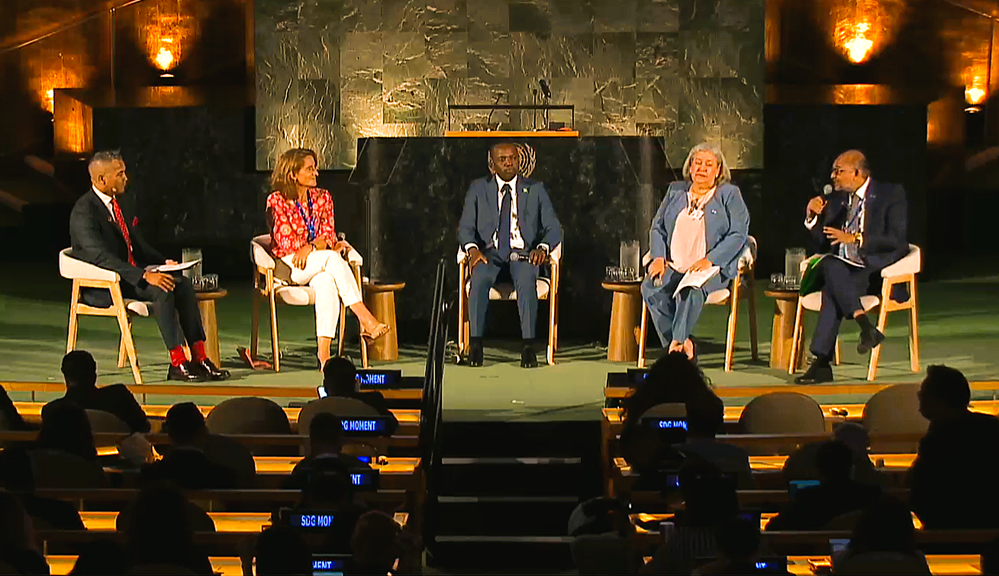
Speaking at the Leaders’ Dialogue on “Leading SDG Action” during the 2026 SDG Moment at the United Nations General Assembly Hall in New York, Dr. Titumir said the global financial system must move beyond simply financing development and instead create the conditions necessary to sustain it.

“Our broader vision should be collective and forward-looking: a global financial architecture that does not merely finance development, but creates the conditions in which development can be sustained,” he said. Dr. Titumir outlined five priorities for reforming the international financial architecture, particularly the role of multilateral development banks.

He called for a shift from responding to crises after they emerge toward anticipating vulnerabilities; greater representation and voice for vulnerable countries in international financial institutions; longer-term, lower-cost and predictable financing; closer alignment of international financing with national development strategies through coordinated, multi-year financing; and flexible transition support and preferential arrangements for countries graduating from the least developed country (LDC) category, including Bangladesh.

Bangladesh Adviser to the Prime Minister Dr. Rashed Al Mahmud Titumir speaks at the Leaders’ Dialogue on “Leading SDG Action” during the 2026 SDG Moment at the United Nations Headquarters in New York on September 18, 2026. Photo: Khabor

The Bangladeshi adviser also highlighted the country’s SDG Village initiative, describing it as an integrated, community-led approach to translating the Sustainable Development Goals into tangible improvements at the local level.

The 2026 SDG Moment, held on September 18 at UN Headquarters, brought together representatives of UN member states, international organizations and civil society to discuss accelerating action toward the Sustainable Development Goals ahead of the 2030 deadline.

The Leaders’ Dialogue also featured Teresa Ribera of the European Commission, Aristide Médénou, Minister of Economy and Finance of Benin, and Beatriz Carles de Arango, Minister for Social Development of Panama. The discussion was moderated by Sherwin Bryce-Pease of the South African Broadcasting Corporation.