India Detains Protesters Ahead of Election Chief Demonstration
NEW DELHI — Indian authorities detained protesters, opposition figures and journalists in Delhi ahead of a demonstration demanding the resignation of the country’s election chief, according to a Reuters report. Security restrictions were imposed in parts of the capital ahead of the protest, which centers on allegations concerning revisions to voter lists and the independence of India’s electoral process.
Opposition figures and critics have alleged that changes to voter rolls could unfairly benefit the ruling Bharatiya Janata Party (BJP). The Election Commission has disputed criticism of its electoral procedures. The protest adds to tensions over electoral transparency and the role of India’s election authorities, an issue with implications for public confidence in the country’s democratic institutions.
The allegations remain contested, and claims of political interference should be assessed against documentary evidence and responses from the Election Commission and the government. The developments have drawn attention to the balance between maintaining public order and protecting freedom of expression, peaceful assembly and press freedom in the world’s most populous country.
Congressman Gregory Meeks Calls for Joint Efforts to End Bangladesh Crisis
NEW YORK — U.S. Congressman Gregory W. Meeks has called for collective efforts to help restore normalcy in Bangladesh, strengthen democratic institutions, uphold the rule of law and protect press freedom. Meeks, the Ranking Member of the U.S. House Foreign Affairs Committee, made the remarks during an exchange meeting with members of the Bangladeshi-American community in New York on September 28.
Speaking about Bangladesh’s political situation, Meeks said he expects Democrats to regain majorities in both chambers of Congress in the November 3 midterm elections. He said that if he again becomes chairman of the House Foreign Affairs Committee, he intends to visit Bangladesh, observe the situation firsthand and work through Congress to provide appropriate direction to the U.S. administration.
Meeks also referred to a December 23, 2025 letter that he and four other members of Congress sent to Bangladesh’s then-Chief Adviser Muhammad Yunus. The letter urged the interim government to work with political parties across the political spectrum to create conditions for free, fair and inclusive elections and to restore confidence in the neutrality of state institutions.
The lawmakers also expressed concern that suspending the activities of a political party or restarting what they described as a flawed International Crimes Tribunal would undermine those objectives. Meeks said Bangladesh needs stronger democratic institutions, effective rule of law and safeguards for media freedom.
Turning to the United States, the congressman also expressed concern about what he described as growing pressure on media outlets and dissenting voices. Referring to disputes involving CNN, Politico and MS NOW and their access to the White House and Air Force One, he said measures affecting the media and people expressing dissent were inconsistent with American democratic values.
Meeks said he wanted to see Bangladesh return to a stable political environment. He also pledged that, if he again serves as chairman of the House Foreign Affairs Committee, he would visit Bangladesh and engage with relevant authorities regarding the country’s situation.
Bangladesh Situation Discussed
The exchange meeting was organized with the assistance of Sector Commanders Forum-Muktijuddho ’71 and the Bangabandhu Foundation. Bangabandhu Foundation President Abdul Kader Mia chaired the event, while Queens Democratic Party District Leader Dr. Dilip Nath moderated it.
Former Bangladeshi Foreign Minister and former Permanent Representative of Bangladesh to the United Nations A.K. Abdul Momen and former National Press Club President Farida Yasmin spoke about Bangladesh’s political and social situation. They alleged that opposition voices and political activists had faced arrests, violence and legal cases following the July-August 2024 protests and the formation of the interim government led by Muhammad Yunus.
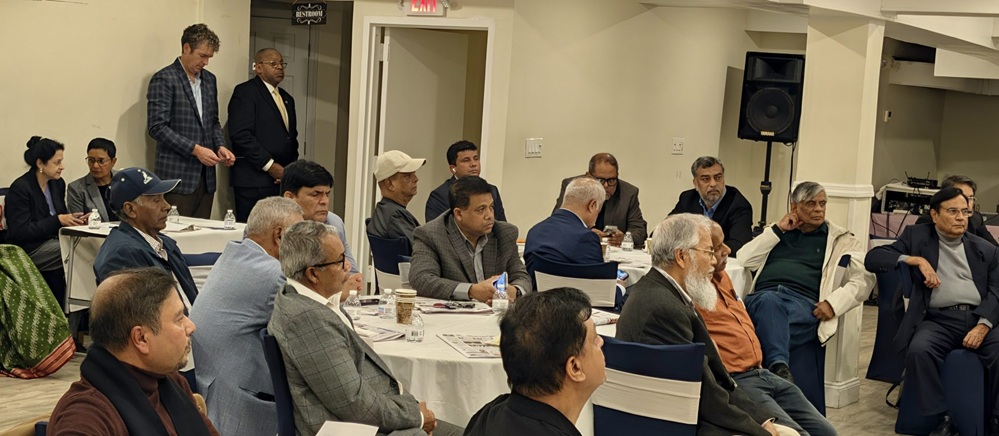
Bangladeshi-American community members attend a meeting with U.S. Congressman Gregory Meeks in New York to discuss Bangladesh’s political situation, democracy and the rule of law. Photo: KHABOR
They also alleged that members and supporters of the Awami League had been subjected to violence and that religious minorities had faced attacks. The speakers further criticized the suspension of Awami League activities, alleged mistreatment of freedom fighters and legal action against journalists whose reporting they said was not favored by the government.
The speakers called for the lifting of restrictions on the Awami League and urged the U.S. Congress to support what they described as the need for an early election. They also sought congressional intervention for the release of journalists and other political detainees facing what they characterized as politically motivated murder cases.
Bangladeshi-American Community Leaders Attend
At the beginning of the event, Abdul Kader Mia welcomed Congressman Meeks by presenting him with a traditional uttariya amid applause from attendees. Also present on the stage were Bangabandhu Foundation Senior Vice President Engineer Md. Fazlul Haque, Bangladesh Muslim Center of Brooklyn President Alhaj Abul Hashem, community organizer Enamul Haque Shamim, Aminul Islam Amin and Nazrul Islam Babu. The United States Bangabandhu Parishad, Sandwip Pourashava Welfare Association and Haque Medical Office served as co-hosts of the event.
Among the attendees were writer, columnist and editor Naim Nizam; World Bangla 24 TV CEO Alim Khan Akash; journalist Sultana Rahman; freedom fighter and journalist Lablu Ansar; journalist Sazzad Hossain Sobuj; Jago Prohori Editorial Board President Dr. Mahabbur Rahman Tuku; Sheikh Kamal Smriti Parishad President and freedom fighter Dr. Masudul Hasan; Sandwip Association Convener Sirajul Mawla; former Sandwip Association President Nazrul Islam Babul; Sandwip Pourashava Welfare Association President Md. Zafarullah; Sandwip Education and Cultural Society President Mosharraf Hossain, Secretary Abdul Hamid and Treasurer Ahsan Ullah Saki.
Others included community leader Mobasher Hossain, freedom fighter Kadir Mia, freedom fighter and businessman Saraf Sarkar, social organizer Sakhawat Ali, businessman and community organizer Ifzal Chowdhury, Chattogram Association General Secretary Ariful Islam Arif, Bauria Janakalyan Association Adviser Abul Kashem, Ekattor Genocide Foundation founder and freedom fighter Dr. Pradip Kar, community leader Abdul Jalil, Afsar Mohammad, Abu Taher M. Rahman, Yasin Arafat Bappi, politician Baker Bhuiyan, Democrat Morshed Alam, Engineer Mohammad Ali Siddiqui and Imdad Chowdhury, among others.
The guests were introduced by Bangabandhu Foundation Secretary Kamal Hossain Mithu. Dipa Nath, president of NAVA, and Linda Ramparteb coordinated fundraising activities for the congressman.
Call for Unity
In his closing remarks, Abdul Kader Mia thanked the attendees and called for unity to help Bangladesh overcome what he described as misrule. He urged the community to learn from past mistakes and move forward with the goal of completing what he described as the unfinished work of building “Sonar Bangla,” referring to the political vision associated with the country’s founding leadership.
Democracy’s Strength Lies in Institutions, Not Individuals
A democratic state does not depend solely on holding elections. Its long-term stability depends on the strength of public institutions, accountability, the rule of law, and the protection of citizens’ rights. Governments may change and political leaders may come and go, but strong and impartial institutions provide continuity and stability to the state.
For Bangladesh, the key question in advancing democracy should therefore not simply be who is in power, but how effectively and accountably the country’s institutions function. The Election Commission, judiciary, civil administration, law enforcement agencies and local government institutions all need to earn and maintain public confidence.
Political differences and competition are natural features of a democracy. However, political conflicts should never be allowed to weaken state institutions. Those in power must remain accountable, while opposition political forces must also respect democratic rules and the law.
The most effective way to strengthen democracy is to build a political culture in which the transfer of power is accepted as a normal part of democratic life and state institutions serve the public interest rather than the interests of any individual or political group.
The fundamental challenge for Bangladesh’s democratic future is clear: Can the country move beyond personality-driven politics and build institutions strong enough to serve the people and withstand political change?
President Calls for Stronger Local Government
DHAKA: President Mirza Fakhrul Islam Alamgir today said democracy must be institutionalized and the local government system strengthened to consolidate democracy in the country. He made the remarks when administrators from 33 district councils paid a courtesy call on him at Bangabhaban this afternoon. Describing local government as one of the key pillars of democracy, the president urged the district council administrators to work actively to eliminate corruption left behind by the previous era.
During the meeting, the district council administrators placed several demands before the president, including raising their status. The president assured them of government cooperation in resolving their problems, saying, “This government is the government of the people and will take quick steps in this regard.”
Fakhrul Islam said the government is working seriously to strengthen the local government system as part of efforts to decentralize power. The president also recalled the active participation of district council administrators in restoring democracy and their role in the long-running movement against fascism. He urged the administrators to bring greater dynamism to development activities, ensure effective citizen services at the local level, and maintain administrative transparency.
Democracy and Accountability: Where Is Accountability When Parliamentary Committees Are Weak?
Editorial:
Democracy is not limited to elections, voting rights or the formation of a government. The real strength of a democratic system lies in transparency, oversight and accountability in the exercise of power. Parliamentary committees are among the most important institutional mechanisms for ensuring that accountability.
A government exercises enormous authority in the name of the people. Parliament, therefore, must have the ability to scrutinise how that authority is being used. When parliamentary committees are unable to perform their duties effectively and independently, oversight of the executive becomes weaker. That raises a fundamental question: if parliamentary committees are weak, who will hold the government accountable?
The role of parliamentary committees is far more important than simply holding meetings or calling government officials to provide explanations. Committees are expected to examine government policies, expenditures, development projects, administrative decisions and the performance of public institutions. They can identify irregularities, question failures and recommend corrective measures.
Effective parliamentary oversight creates an institutional check on executive power. It helps ensure that public money is spent properly, government decisions are examined and public institutions remain answerable for their actions.
But oversight loses much of its meaning if committees are constrained by political influence, excessive partisanship, administrative obstacles or a lack of access to information. A committee that cannot independently examine government actions cannot effectively fulfil its constitutional and democratic purpose.
Accountability must also extend to the implementation of parliamentary committee recommendations. If a committee identifies irregularities and makes recommendations, but the relevant ministry or agency simply ignores them, what happens next? The public should be able to know which recommendations have been implemented, which have not, and why.
Parliament represents the people. Every institution operating with public money must ultimately remain accountable to the public. This is one of the fundamental principles of democratic governance.
The independence and effectiveness of parliamentary committees are therefore critical. Committee members should have access to relevant documents, information and expert assistance. They should be able to question officials and investigate matters of public interest without unnecessary interference.
The opposition also has an important role to play. In a parliamentary democracy, the opposition’s responsibility extends beyond criticising the government from the floor of Parliament. Parliamentary committees provide an institutional avenue through which government policies and decisions can be examined more closely. Meaningful opposition participation can strengthen oversight and help maintain a balance of power.
At the same time, accountability should not become an excuse for political obstruction. Parliamentary scrutiny should be based on facts, evidence and public interest rather than partisan calculations. Good decisions should be recognised, while failures and irregularities should be exposed without fear or favour. That is the essence of responsible parliamentary practice.
For Bangladesh, strengthening parliamentary committees should therefore be an important part of strengthening democratic institutions. A Parliament does not become strong merely by passing laws. Its real strength also depends on its ability to scrutinise government actions and demand answers on behalf of citizens.
Regular committee meetings, greater transparency, access to information, effective follow-up mechanisms and meaningful implementation of recommendations are essential. Committee proceedings and reports should receive appropriate public attention so that citizens can understand how their elected representatives are performing their oversight responsibilities.
Political parties also have a responsibility in this regard. Parliamentary committees should not become extensions of partisan politics. National interest and public accountability must come before party loyalty.
Ultimately, the principle is simple: if political power comes from the people, those who exercise that power must be answerable to the people.
Parliamentary committees are one of the principal institutional mechanisms for demanding that accountability. Weak committees therefore do not merely weaken parliamentary procedures; they weaken the broader democratic system of checks and balances.
A functioning democracy needs a strong government, but it also needs a strong Parliament and effective parliamentary committees. Power without oversight is dangerous, and democracy without accountability is incomplete.