Govt pursuing 3-R strategy to repair Bangladesh: PM

Shibbir Ahmed, New York — Prime Minister Tarique Rahman today said his government is pursuing a 3-R strategy — Recovery, Restoration and Reconstruction — to repair Bangladesh, which he described as having been ravaged by more than one and a half decades of “fascist rule and exploitation.”

“To repair Bangladesh, which was ravaged by fascist rule and exploitation, the Government is pursuing a 3-R strategy — Recovery, Restoration and Reconstruction,” he said while addressing the 81st session of the United Nations General Assembly at the UN Headquarters in New York.

The Prime Minister said Bangladesh had freed itself from what he described as enforced disappearances, killings, abductions, corruption, looting and money laundering and was once again embarking on the path of democracy.

He said an immense horizon of possibilities had opened before Bangladesh and that his government had begun implementing extensive programmes to transform the country’s working-age population into skilled human resources by harnessing its demographic dividend.

“Detailed measures have been taken to create extensive employment opportunities and develop Bangladesh as a ‘manufacturing hub’,” he said, seeking support from the country’s development partners in this endeavour.

The government has allocated US$50 million in the current fiscal year to create opportunities for young entrepreneurs, researchers and innovators to implement start-up initiatives, he said.

Focus on women’s empowerment

Highlighting the government’s focus on women’s empowerment, Tarique Rahman said women were at the forefront of its plans for the country’s socio-economic transformation, noting that women account for more than half of Bangladesh’s population.

He said the government was prioritising women’s education, employment and entrepreneurship, including expanded access to cash financing, particularly in the small and medium-sized industries sector. Free education opportunities for women up to the undergraduate level had also been made available, he said.

The Prime Minister said the government wanted to ensure not only electoral democracy but also the democratisation of the economy so that the benefits of economic growth and prosperity reached every family and citizen.

To this end, the government had introduced social protection initiatives such as the Family Card, Farmers’ Card, Sports Card and e-Health Card to support economically disadvantaged people.

He described the Family Card, issued in the name of the female head of each household, as a symbol of women’s economic empowerment and said the government planned to introduce a Universal Card by integrating various support cards.

31-point programme and development

Tarique Rahman said the government was implementing its 31-point programme presented to the people ahead of the February 12 national election. He said 73 percent of the programme’s activities were directly aligned with the UN Sustainable Development Goals’ “Leave No One Behind” theme, while another 27 percent were indirectly aligned.

The government hoped implementation of the programmes would reduce development disparities between urban and rural areas and strengthen accountability and inclusive sustainable development under the 2030 Agenda, he said.

Education, health and sports

The Prime Minister said his government had given special importance to education, health and sports and had made the highest-ever budget allocation for the education sector.

“There are plans to gradually increase education spending to 5 per cent of GDP within the next five years,” he said. He said a curriculum had been developed with an emphasis on technical and practical education to establish an ethically sound and employment-oriented education system.

School bags, uniforms and free midday meals were being provided to primary students from the first grade, he said, expressing hope that the initiatives would increase school enrolment and improve the quality of education.

Sports had also been included as a subject in the education curriculum for the first time, with the aim of establishing sports as a profession, he said. More than two million students participated in a month-long nationwide football tournament last June as part of the initiative, he added.

Call for dialogue to resolve conflicts

Turning to the international situation, Tarique Rahman said human-made conflicts had created unrest in many countries, causing displacement and humanitarian crises while placing pressure on the global economy, energy security and supply systems and contributing to rising inflation.

He said conflicts should be resolved through dialogue, diplomatic processes and mutual cooperation, with equality, fairness, protection of mutual interests, respect and dignity forming the basis of bilateral and multilateral relations.

Bangladesh sees the United Nations as the centre of efforts to establish an understanding-based global community that respects the independence and sovereignty of states, he said.

Tarique Rahman reaffirmed Bangladesh’s commitment to general and complete disarmament, prevention of nuclear weapons proliferation and arms control, while supporting UN initiatives aimed at promoting global peace.

He also reaffirmed Bangladesh’s support for the legitimate demands of the Palestinian people, including their right to self-determination and to establish an independent State of Palestine.

Rohingya crisis

On the Rohingya crisis, the Prime Minister said Bangladesh had been providing shelter to more than 1.2 million forcibly displaced Rohingyas from Myanmar for more than nine years, putting immense pressure on the country’s resources, environment, security and local communities.

“The only solution to this problem is the safe return of the displaced Rohingya population to their homeland, Myanmar,” he said. He called for firm and effective support from the United Nations and the international community for a lasting solution and urged continued life-saving assistance for the Rohingyas until their repatriation.

“If the international community fails to ensure justice for the displaced Rohingya population, this may turn into a humanitarian crisis in the near future,” he added.

Climate change and development

On climate change, Tarique Rahman said Bangladesh was among the countries most vulnerable to its adverse impacts despite making little contribution to global carbon emissions. He said Bangladesh expected stronger global action at COP31 on climate justice, climate finance and adaptation support. The government has launched a programme to plant 250 million trees across the country over the next five years, while placing emphasis on clean and solar energy, he said.

He also said a programme had been launched to excavate 20,000 kilometres of canals across the country to help address flooding and drought. The government had begun implementing the Teesta Master Plan and the Padma Barrage project to increase freshwater flow into the Sundarbans and conserve water through large reservoirs, he said.

Technology and AI

On science and technology, the Prime Minister said Bangladesh’s large young population and growing digital capabilities had created new possibilities, but access to advanced technology, knowledge and research must be made available to all.

“We do not want today’s digital divide to become tomorrow’s artificial intelligence divide,” he said, stressing technology transfer, skills development and affordable access to modern technologies for developing countries. He called for an effective UN policy framework to ensure that the benefits of artificial intelligence and social media could be used positively around the world.

LDC graduation and global cooperation

The Prime Minister also called for continued international support as Bangladesh prepares to graduate from the Least Developed Country category, particularly through assured financing, greater market access, technology transfer and capacity building.

He said regional trade facilitation, connectivity and meaningful cooperation could help countries achieve shared prosperity in an increasingly interdependent world. Tarique Rahman also stressed the need to ensure sustainable production of vaccines, medical supplies and diagnostic equipment in developing countries so that they remain readily accessible to all.

‘Bangladesh First: Bangladesh for All’

Tarique Rahman said Bangladesh wanted to establish a prosperous, self-reliant and welfare-oriented democratic state where everyone, irrespective of political affiliation, religion or race, could live safely with equal rights, respect and dignity.

“Bangladesh’s progress in the areas of democracy, human rights, good governance, accountability, political stability and the investment environment is continuing,” he said, adding that the government was working to establish a safe and stable Bangladesh with a business- and investment-friendly environment.

“We want to build a Bangladesh where young people can pursue their dreams without fear or hindrance, women can lead their lives with confidence, and every child can grow up with the opportunity to realise their full potential,” he said.

“Above all, the people will have the assurance of a safe and peaceful life. That is why we say, ‘Bangladesh First: Bangladesh for All’.”

Earlier remarks

Earlier in his address, Tarique Rahman congratulated the President of the 81st session of the UN General Assembly on his election and assured Bangladesh’s full support during his tenure. He paid tribute to the martyred freedom fighters of Bangladesh and recalled the contributions of those who sacrificed their lives in the struggle to establish democracy, justice and people’s rights since independence.

He also paid respect to those killed and injured during the July-August 2024 mass uprising. The Prime Minister said the people had entrusted the Bangladesh Nationalist Party (BNP) with the responsibility of governing the state through the “fair, free and impartial” national election held on February 12 this year.

He said he felt nostalgic standing before the UN General Assembly as his father, Shaheed President Ziaur Rahman, and his mother, former Prime Minister the late Khaleda Zia, had also addressed the world from the same platform on behalf of Bangladesh and its people.

Tarique Rahman said Bangladesh remained committed to multilateralism in maintaining international peace and security and, as Vice-Chair of the UN Peacebuilding Commission, continued to advocate sustainable peace, conflict prevention and inclusive peacebuilding.

He also highlighted the contributions of Bangladeshi peacekeepers and women peacekeepers to UN missions around the world. On migration, he said the government was committed to ensuring regular, safe and orderly migration and called for stronger global cooperation to protect the rights, dignity and welfare of migrants. Concluding his address, the Prime Minister reaffirmed Bangladesh’s unwavering support for the principles and values of the United Nations in the cause of establishing world peace.
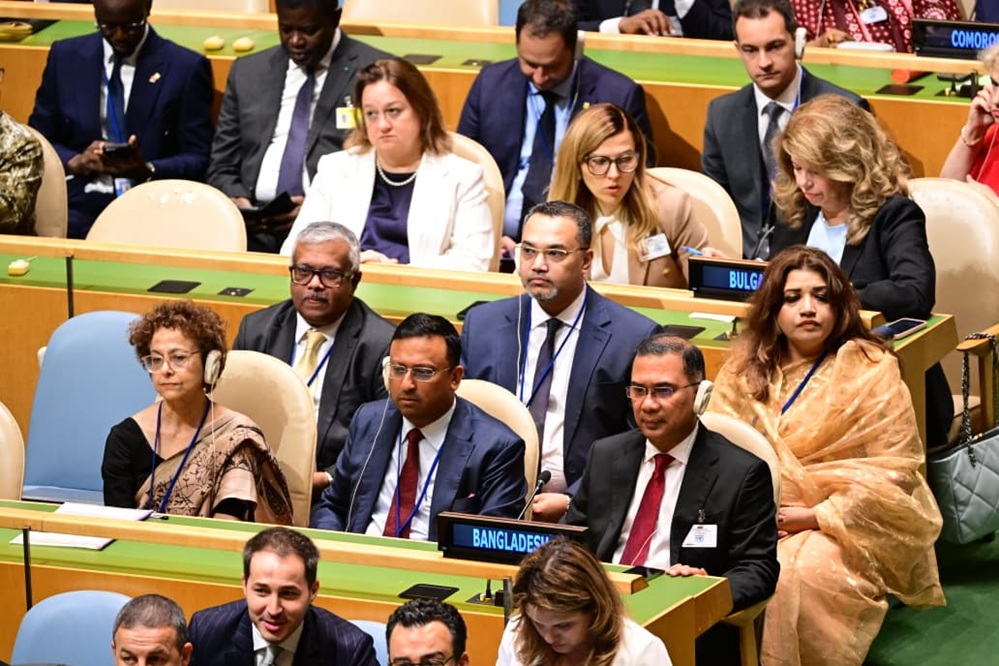


Tarique Rahman Joins 81st UN General Assembly General Debate

Shibbir Ahmed, New York – Prime Minister Tarique Rahman today attended the high level general debate of the 81st session of the United Nations General Assembly (UNGA) at the UN Headquarters here. The Prime Minister, accompanied by his wife Dr Zubaida Rahman, joined the debate at the North Delegates’ Lounge of the UN Headquarters at 9:00am (New York time), said PM’s Assistant Press Secretary K M Nazmul Haque.

UN Secretary-General Antonio Guterres addressed it, chaired by the president of UNGA 81st session and Bangladesh Foreign Minister Dr Khalilur Rahman. Upon his arrival at the venue, the Prime Minister was accorded a formal welcome. He then joined other world leaders at the high-level discussions of the prestigious global forum. The 81st UNGA session is focusing on a range of major global issues, including climate change, resolution of global conflicts, achievement of the Sustainable Development Goals (SDGs) and international economic cooperation.

On the sidelines of the session, Prime Minister Tarique Rahman is expected to hold a number of bilateral meetings with heads of state and government and representatives of various international organisations.

Prime Minister Tarique Rahman attended a high-level general debate of the 81st session of the UN General Assembly (UNGA) at the UN Headquarters. Photo: KHABOR

He will also deliver Bangladesh’s statement at the General Debate of the General Assembly, where he is expected to highlight global peacekeeping, climate justice and Bangladesh’s recent socio-economic development.

Foreign Affairs State Minister Humaiun Kobir, Shama Obaed Islam, Prime Minister’s Office spokesperson Mahdi Amin, senior government officials and Bangladesh’s Permanent Representative to the United Nations were also present during the session. The 81st session of the UN General Assembly formally commenced on September 8, while its General Debate began today.


PM Tarique Rahman Arrives in New York for 81st UN General Assembly

Shibbir Ahmed, New York — Prime Minister Tarique Rahman arrived in New York on Monday to attend the 81st session of the United Nations General Assembly (UNGA), beginning a packed diplomatic visit that will include his address to the General Assembly, meetings with world leaders and engagements on climate change, the Rohingya crisis, global business and development.

The Prime Minister arrived at John F. Kennedy International Airport aboard a Turkish Airlines flight following a stopover in Istanbul. His wife, Dr Zubaida Rahman, and members of his delegation accompanied him.

Prime Minister’s Deputy Press Secretary Jahidul Islam Rony said the flight landed at JFK International Airport at around 6:20 p.m. New York time. Bangladesh’s Permanent Representative to the United Nations, Irene Zubaida Khan, and Bangladesh Ambassador to the United States Tareq Md Ariful Islam received the Prime Minister at the airport. Following his arrival, a motorcade escorted the Prime Minister to Hyatt Grand Central New York, where he is scheduled to stay during his visit.

Bangladeshi community welcomes Prime Minister

BNP leaders and activists, along with members of the Bangladeshi expatriate community, gathered in New York to welcome the Prime Minister. Supporters carrying banners, posters and festoons assembled near the airport and along parts of the route leading toward Manhattan. As the Prime Minister’s motorcade passed, members of the crowd waved and chanted slogans, while the Prime Minister responded by waving to them. Jackson Heights, home to one of the largest Bangladeshi communities in New York, was also decorated with banners, posters and festoons marking his visit.

UNGA address scheduled for September 24

The centerpiece of the Prime Minister’s New York visit will be his address to the 81st UN General Assembly on September 24. His official engagements are scheduled to begin on September 22, when he will attend a welcome breakfast hosted by UN Secretary-General António Guterres for heads of state and government and their spouses at UN Headquarters.

He will subsequently attend the opening of the UNGA general debate and hold a series of bilateral and courtesy meetings with foreign leaders and senior officials of international organizations.

Among his scheduled engagements are meetings with Turkish President Recep Tayyip Erdoğan, Bhutanese Prime Minister Tshering Tobgay, World Bank Group President Ajay Banga and Haitian Prime Minister Alix Didier Fils-Aimé.

The Prime Minister is also scheduled to meet UN Secretary-General’s Special Envoy on Myanmar Julie Bishop, European Council President António Costa, UN High Commissioner for Refugees Barham Salih, UN High Commissioner for Human Rights Volker Türk and Meta’s Chief Global Affairs Officer Joel Kaplan. In the evening, the Prime Minister and Dr Zubaida Rahman are scheduled to attend a reception hosted by the US President for visiting heads of state and government and their spouses.

Rohingya crisis and climate action on agenda

On September 23, the Prime Minister is scheduled to attend a breakfast meeting with representatives of international charitable and humanitarian organizations at the Bangladesh Permanent Mission to the United Nations. He will also participate in a high-level event focusing on the Rohingya crisis and efforts to achieve a durable solution to the prolonged displacement through justice and accountability.

Climate change will feature prominently on the Prime Minister’s agenda. He is scheduled to participate in the UN high-level meeting on “Climate Action and the Just Transition” and hold a bilateral meeting with Croatian Prime Minister Andrej Plenković.

Boeing Global President Dr Brendan Nelson is also scheduled to call on the Prime Minister at his hotel, where a signing ceremony involving Bangladesh government representatives is expected to take place.

Sea-level rise, maternal health and bilateral meetings

On September 24, Prime Minister Tarique Rahman is scheduled to deliver opening remarks at a high-level meeting addressing the existential threats posed by sea-level rise. He will also attend an event titled “From Commitment to Action: Integrating Midwifery into Primary Health Care to End Preventable Maternal and Newborn Deaths,” where he is expected to deliver opening remarks.

The Prime Minister is scheduled to hold a bilateral meeting with Pakistani Prime Minister Muhammad Shehbaz Sharif and meet UN Secretary-General António Guterres and Thai Prime Minister Anutin Charnvirakul.

Later in the day, he is expected to address the General Assembly. His speech is tentatively scheduled for around 5:30 p.m. New York time, although the timing may change depending on the progress of the general debate. Following his UNGA address, the Prime Minister is scheduled to attend a dinner hosted in his honor by Bangladesh’s Permanent Representative to the United Nations.

Wall Street engagement before departure

On September 25, the Prime Minister is scheduled to attend a breakfast meeting with Wall Street representatives hosted by JPMorgan at its Manhattan headquarters. He will also hold a bilateral meeting with Kuwait’s Crown Prince Sheikh Sabah Khaled Al-Hamad Al-Sabah and attend a lunch meeting with Prince Zeid Al Hussein, President of the International Peace Institute.

Before concluding his New York visit, the Prime Minister is also scheduled to meet BNP leaders in the United States. He is expected to depart New York for Dhaka at 11 p.m. on September 25 aboard Emirates flight EK202 via Dubai and arrive in Bangladesh on September 27.


Tarique to Highlight Democracy, Rohingya Crisis at UNGA

DHAKA — Prime Minister Tarique Rahman is set to highlight Bangladesh’s renewed democratic journey and its positions on major global challenges when he addresses the 81st session of the United Nations General Assembly on September 24, Foreign Secretary Asad Alam Siam said Sunday. The prime minister will leave Dhaka for New York on Monday for the high-level UNGA proceedings. According to the Foreign Secretary, his maiden address to the General Assembly as prime minister will outline the government’s vision for Bangladesh and its approach to key regional and international issues.

At a press conference at the Ministry of Foreign Affairs, Siam said Tarique’s speech would cover Bangladesh’s democratic transition, the rule of law and accountability, global peace and security, climate change, sustainable development and economic cooperation.

The prime minister is also expected to address youth and women’s empowerment, education and health, the Rohingya crisis, equitable access to modern technology and reform of the multilateral system. The speech will be Tarique Rahman’s first appearance at the General Assembly as Bangladesh’s prime minister. It will also mark the first UNGA participation of the incumbent government, according to the Foreign Secretary.

Rohingya crisis to feature prominently

The protracted Rohingya crisis is expected to be a major focus of Bangladesh’s diplomatic engagement in New York. Tarique is scheduled to attend a Bangladesh-hosted side event on the Rohingya issue on September 23, where he is expected to seek stronger international cooperation toward the repatriation of Rohingyas who fled to Bangladesh from Myanmar.

Siam said Bangladesh would again use the gathering of world leaders to draw attention to the scale of the crisis, the challenges it poses and the international assistance required to address it. Bangladesh has consistently called for the safe, voluntary, dignified and sustainable return of Rohingyas to Myanmar as a lasting solution to the crisis.

Climate change and sea-level rise

Climate change will also be a prominent issue during the prime minister’s UN engagements. On September 23, Tarique is scheduled to participate in a high-level meeting on “Climate Action and the Just Transition,” convened at the initiative of the UN secretary-general. The following day, he will deliver opening remarks at a high-level meeting addressing the existential threats posed by sea-level rise.

At the climate-related meetings, Bangladesh is expected to emphasize the priorities of climate-vulnerable countries, including climate finance, adaptation, technology transfer, loss and damage, and climate justice.

Global inequality and maternal health

Tarique will also participate in a high-level meeting focused on tackling the global inequality crisis, jointly organized by Brazil, South Africa, Norway and Spain. A Bangladesh-hosted side event on maternal and newborn health and midwifery is also scheduled for September 24. The prime minister is expected to discuss government initiatives on maternal and child health and the importance of skilled and professionally trained midwives.

Bilateral meetings

Alongside the UNGA program, Tarique is scheduled to hold bilateral meetings with the Crown Prince of Kuwait and the prime ministers of Croatia, Bhutan, Thailand, Pakistan and Haiti. According to the Foreign Secretary, the discussions are expected to cover political and economic relations, trade and investment, development cooperation, the Rohingya crisis and other issues of mutual interest.

The prime minister is also scheduled to meet UN Secretary-General António Guterres, the president of the European Council, the president of the World Bank Group, the UN secretary-general’s special envoy on Myanmar, and the UN high commissioners for refugees and human rights. He is also expected to meet the president of the International Peace Institute.

Economic diplomacy

Tarique’s New York visit will also include an economic diplomacy component, with meetings planned with senior representatives of Meta, Wall Street and other business organizations. The discussions are expected to focus on Bangladesh’s investment climate, manufacturing, infrastructure and technology, human-resource and skills development, and employment opportunities for young people.

The prime minister is scheduled to leave New York for Dhaka on September 25 after completing his official engagements. The Foreign Secretary said the visit would provide an opportunity for Bangladesh to present its priorities to the international community and strengthen bilateral and multilateral cooperation.

Bangladesh will be presiding over the 81st UN General Assembly this year, with Foreign Minister Khalilur Rahman serving as president of the 193-member General Assembly for its one-year term.


PM Tarique Heads to New York, to Address UNGA on Sept. 24

DHAKA — Prime Minister Tarique Rahman will leave Dhaka on Monday for New York to attend the 81st session of the United Nations General Assembly and is scheduled to address the General Debate on September 24, the Foreign Ministry said Sunday. Foreign Secretary Asad Alam Siam told reporters at the Ministry of Foreign Affairs that the prime minister’s address will outline the government’s positions on Bangladesh’s democratic transition and a range of national and global issues.

According to the Foreign Secretary, Tarique Rahman is expected to speak about the rule of law and accountability, global peace and security, climate change, sustainable development and economic cooperation. He is also expected to highlight youth and women’s empowerment, education and health, the Rohingya crisis, equitable access to modern technology and reform of the multilateral system.

The visit will mark Tarique Rahman’s first participation in the UN General Assembly as Bangladesh’s prime minister. It will also be the first appearance at the UN’s highest-level global forum by the incumbent government, according to the Foreign Secretary. Bangladesh’s Foreign Minister is serving as president of the 81st General Assembly session, which officials described as an additional significance for the country’s participation this year.

Packed diplomatic schedule

Tarique Rahman’s official engagements are scheduled to begin on September 22 with a welcome breakfast hosted by UN Secretary-General António Guterres for heads of state and government. He is also scheduled to attend the opening of the high-level segment and a reception hosted by the U.S. president for heads of state and government and their spouses.

On September 23, the prime minister is expected to meet representatives of international charitable and humanitarian organizations. He will also participate in a high-level meeting on global inequality and attend a meeting on climate action and a just transition.

The Rohingya crisis will be another major focus of the visit. At a side event on the crisis, Tarique Rahman is expected to call for greater international cooperation to facilitate the earliest possible repatriation of Rohingyas to Myanmar. At climate-related meetings, Bangladesh is expected to emphasize issues including climate finance, adaptation, technology transfer, loss and damage, and climate justice.

Sea-level rise and maternal health

On September 24, the prime minister is scheduled to deliver opening remarks at a high-level UN meeting addressing the threats posed by sea-level rise. The United Nations has scheduled the high-level meeting for September 24 at its New York headquarters. The meeting will bring together world leaders and other stakeholders to discuss international cooperation and practical measures to address the growing impacts of rising sea levels, particularly on vulnerable coastal and low-lying countries.

Tarique Rahman is also scheduled to address a Bangladesh-hosted side event on maternal and newborn health and midwifery. He is expected to outline government initiatives concerning maternal and child health and emphasize the importance of trained midwifery services.

Bilateral meetings

On the sidelines of the General Assembly, the prime minister is scheduled to hold bilateral meetings with the crown prince of Kuwait and the prime ministers of Croatia, Bhutan, Thailand, Pakistan and Haiti. According to the Foreign Secretary, the meetings are expected to cover bilateral political and economic relations, trade and investment, development cooperation, the Rohingya crisis and other issues of mutual interest.

Tarique Rahman is also expected to meet UN Secretary-General António Guterres, the president of the European Council, the president of the World Bank Group, the UN Secretary-General’s special envoy on Myanmar, and the UN high commissioners for refugees and human rights. He is additionally scheduled to meet the president of the International Peace Institute.

Focus on investment and economic diplomacy

Economic diplomacy will also feature during the visit, with meetings planned between the prime minister and senior representatives of Meta, Wall Street and other business organizations. The discussions are expected to focus on Bangladesh’s investment environment, manufacturing, infrastructure and technology, human-resource and skills development, and employment opportunities for young people.

The prime minister is scheduled to leave New York for Dhaka on the night of September 25. The Foreign Secretary said the government hopes the visit will help expand Bangladesh’s bilateral and multilateral cooperation and present its priorities to the international community.


UN General Assembly 2026: World Leaders Gather in New York

Shibbir Ahmed, New York: World leaders are converging on New York as the United Nations prepares for the high-level week of its 81st General Assembly, with wars, global security, artificial intelligence, climate change and the future of multilateral cooperation expected to dominate discussions. The high-level segment of the 81st session will take place at United Nations Headquarters in New York beginning September 22, with the General Debate continuing through September 26 and September 28. Nearly 130 heads of state and government are expected to participate in the annual gathering, according to current reporting.

The theme of this year’s General Assembly is “Restoring Trust, Managing Transformation: A United Nations That Delivers for All.” The 81st session officially opened on September 8. The gathering comes at a time of heightened international tensions, with the wars in the Middle East and Ukraine, global energy and food-security concerns, and the rapid development of artificial intelligence among the major issues facing governments.

The Middle East is expected to feature prominently in diplomatic discussions. The Ukraine war will also remain a major international issue, while leaders are expected to discuss humanitarian concerns and the broader challenges facing the international system. Reuters reported that the UN is also facing financial pressures and questions about its role in responding to major global crises.

AI emerges as a major global issue

Artificial intelligence is expected to receive significant attention during this year’s UN meetings. UN officials and governments are examining how the international community can establish appropriate rules and cooperation mechanisms as AI technology develops rapidly.

OpenAI CEO Sam Altman is also scheduled to brief the UN Security Council during the General Assembly week at an open session focused on artificial intelligence and international security. The meeting is expected to address both the opportunities and security risks associated with rapidly advancing AI technologies.

Climate, sea-level rise and pandemic preparedness

The General Assembly’s formal program includes several high-level meetings dealing with major global challenges. A high-level meeting on the 40th anniversary of the Declaration on the Right to Development is scheduled for September 23. On September 24, world leaders will address the existential threats posed by sea-level rise, while September 25 will focus on pandemic prevention, preparedness and response. A meeting commemorating the 25th anniversary of the Durban Declaration and Programme of Action is scheduled for September 28.

Climate change and sustainable development are also expected to feature prominently throughout the week as governments discuss efforts to accelerate progress toward the Sustainable Development Goals.

Diplomatic meetings beyond the General Debate

The UN General Assembly week traditionally provides an opportunity for leaders to hold numerous bilateral and multilateral meetings on the sidelines of the formal sessions. The European Union, for example, is planning several meetings and initiatives during the week, including a Partners for Multilateralism, International Law, Peace and Prosperity Summit on September 21, co-hosted by the European Council, Canada and Kenya.

The annual gathering is therefore expected to turn New York into the center of international diplomacy, with leaders using the week not only to address the General Assembly but also to negotiate and discuss issues affecting global peace, security, development and international cooperation.

With conflicts continuing in several regions and governments facing new challenges from technology, climate change and economic pressures, the 81st General Assembly is set to become one of the year’s most closely watched international diplomatic gatherings.


Guterres Warns of AI, Climate and Conflict Threats

Shibbir Ahmed, New York — UN Secretary-General António Guterres has warned that the world is entering an “era of deep uncertainty,” urging governments to strengthen international cooperation as leaders prepare to gather in New York for the 81st UN General Assembly.

Speaking ahead of the General Assembly’s high-level week, Guterres identified rapidly advancing artificial intelligence, the climate crisis and deepening inequalities as major existential threats facing the international community.

Guterres devoted much of his remarks to the growing risks associated with artificial intelligence. While acknowledging AI’s potential to accelerate development, improve education and health systems and strengthen climate resilience, he warned that technological development is advancing faster than the world’s understanding of its risks.

He called for stronger safeguards to make AI development safe, transparent and accountable, with human dignity at the centre. Guterres said national action is important but stressed that global coordination is essential because AI and its risks do not stop at national borders.

The UN chief also urged world leaders to address ongoing conflicts. He reiterated his call for a ceasefire in the Russia-Ukraine war and urged implementation of a two-state solution in the Middle East. He also called for de-escalation and the protection of civilians.

The General Assembly’s high-level week begins in New York on September 18, with the General Debate scheduled to begin on September 22. Leaders from all 193 UN member states are expected to address global challenges, including conflicts, climate change, international security and sustainable development. Guterres said international cooperation is more necessary than ever as governments confront interconnected global crises.


Guterres Calls for New Global Order as Power Shifts

Shibbir Ahmed, New York — UN Secretary-General António Guterres has called for a major overhaul of the international system, saying the institutions created after the Second World War must change to reflect the growing economic and geopolitical influence of emerging economies. Speaking to leaders at the 18th BRICS Summit in New Delhi on Sunday, Guterres said the world of today is fundamentally different from that of 1945 and that global institutions must reflect current economic, demographic and geopolitical realities.

“Today’s economic, demographic and geopolitical realities are not those of 1945,” Guterres said. “Our institutional structures must reflect it.”

He said the countries represented at the summit reflected the changing balance of global power and pointed to the emergence of an increasingly multipolar world. Guterres argued that multipolarity can bring greater balance and equity to international institutions, but said that would require reforms to bodies including the UN Security Council and the Bretton Woods institutions.

The UN chief outlined four priorities for what he described as inclusive global growth: financing, technology, climate justice and peace. On development financing, Guterres said developing countries need substantial international support to achieve the Sustainable Development Goals. He urged multilateral development banks to become “bigger, better and bolder” to help meet the scale of financing required. Turning to artificial intelligence, he warned that the benefits of the technology remain concentrated among a relatively small number of companies and countries.

“Unchecked, the AI divide will widen every other divide — in income, in opportunity, in security, and in sovereignty,” Guterres warned.

Climate change was another major focus of his address. Guterres pointed to extreme heat, melting glaciers, wildfires and devastating floods as signs of the worsening climate crisis and warned that a stronger El Niño could make conditions even more difficult as the world approaches the 1.5-degree Celsius threshold above pre-industrial levels.

He called on wealthy nations to honor existing climate-finance commitments, including increased adaptation financing and stronger support for countries facing loss and damage. He also criticized the exploitation of critical minerals, calling for an end to what he described as “plundering.”

On peace and security, Guterres highlighted conflicts and crises in Gaza, the wider Middle East, Ukraine and Sudan. He urged countries to uphold the UN Charter, including the principles of sovereign equality, territorial integrity and the peaceful settlement of disputes. Guterres said reforming the international system should be viewed as a shared responsibility rather than a concession to emerging powers.

“As we move irreversibly to a multipolar world, all countries must work to strengthen and safeguard a multilateral system that delivers for all with the United Nations at its centre,” he said.

The BRICS summit, hosted by India, brought together leaders of major emerging economies and senior international officials as discussions focused on global governance, economic cooperation, development, technology, climate change and international peace and security.


‘This Is Not 1945’: Bangladesh’s Khalilur Rahman Opens UNGA 81

Shibbir Ahmed, UN, New York: The United Nations General Assembly opened its 81st session on Tuesday at United Nations Headquarters in New York, with Bangladesh’s veteran diplomat Khalilur Rahman taking over as president and calling for renewed global trust in the international organization amid wars, humanitarian crises, climate change and deepening geopolitical divisions.

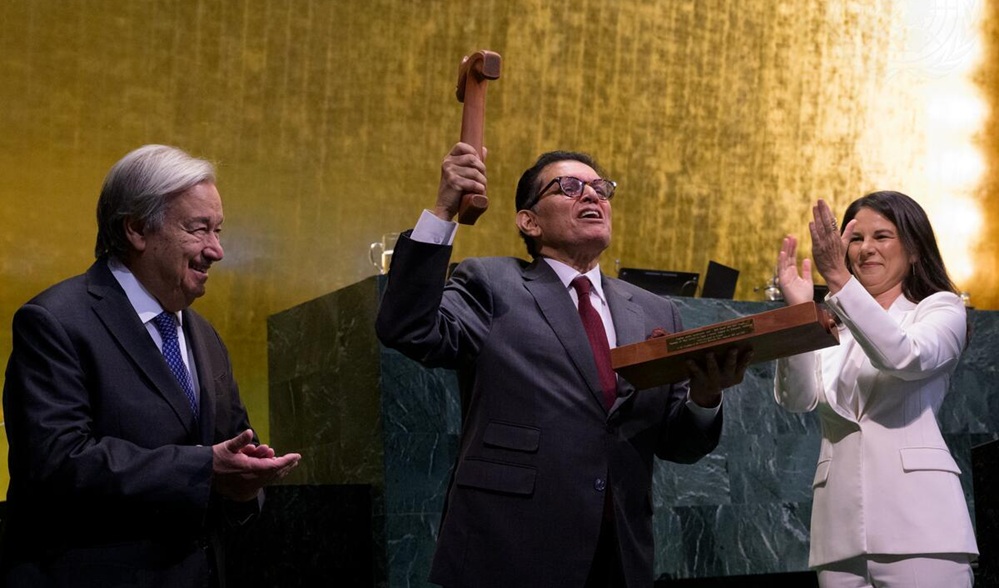
Rahman formally assumed the presidency after receiving the traditional Icelandic wooden gavel from outgoing General Assembly President Annalena Baerbock. In his opening remarks, he said the United Nations must adapt to the realities of a rapidly changing world and become more responsive to the needs and expectations of people across the globe.

“We must make the United Nations fit for the future,” Rahman said, stressing the importance of listening to civil society and giving greater space to voices outside governments and traditional diplomatic institutions.

“We have a situation where trust is in deficit. This is not 1945. This is the 81st session. The world has moved on. The Organization must move on, and I’ll help that process,” he said.

Rahman has placed restoring trust and managing global transformation at the center of his presidency. His agenda includes strengthening international peace and security, accelerating progress toward the 2030 Sustainable Development Goals, addressing climate change, protecting human rights, supporting refugees and migrants, promoting responsible technological development and advancing reform of the United Nations and the broader multilateral system.

The new session begins at a time of heightened international tensions, with conflicts in several regions, growing humanitarian emergencies, geopolitical rivalries, persistent poverty and inequality, and increasing concerns over climate-related disasters. The risk of nuclear escalation has also added to concerns about international peace and security.

United Nations Secretary-General António Guterres, speaking at the opening of the session, said rebuilding confidence in the multilateral system had become one of the defining challenges of the current era.

“Rebuilding trust in the multilateral system is the defining challenge of our time,” Guterres said, arguing that international cooperation remains essential at a moment when the world is confronting crises that cannot be effectively addressed by individual countries acting alone.

Guterres said institutions across the multilateral system, including the Security Council and international financial institutions, are under growing pressure to respond to the realities of the present day. He warned that international law and human rights are too often violated with impunity, while geopolitical mistrust and suspicion continue to prevent the international community from reaching effective solutions.

Despite those difficulties, Guterres said he remained hopeful about the ability of the General Assembly to contribute to a better future. Through diplomacy, dialogue and cooperation, he said, countries can work to rebuild trust and goodwill and help ensure that future generations inherit a more peaceful and sustainable world.

The opening of the 81st session also marked the conclusion of Baerbock’s term as president of the General Assembly. Addressing member states at the final meeting of the 80th session, she defended the continuing importance of the United Nations despite criticism of its shortcomings.

Baerbock said she was more convinced than ever of the importance and necessity of the organization. She pointed to the work of United Nations agencies and peacekeeping missions around the world as evidence of the practical impact of the international body.

She cited the role of the United Nations Children’s Fund in helping millions of children and the contribution of peacekeepers to protecting civilians in conflict-affected areas. Baerbock also warned that the positive work of the United Nations often receives less public attention than negative developments, particularly in an environment where divisive and hateful content can spread rapidly.

Climate change and sustainable development are expected to remain major issues during the new session. Rahman has called for stronger international efforts to build climate resilience and protect the environment, while also accelerating progress toward the 2030 Sustainable Development Goals.

The new president has emphasized the need to ensure that development reaches vulnerable populations and that no country is excluded from international efforts to address poverty, inequality, education, health, food security and other development challenges.

Human rights and humanitarian action are also central to the new presidency. Continuing conflicts and instability have displaced millions of people, increasing pressure on the international community to protect refugees and migrants and provide assistance to populations affected by war and persecution.

The rapid development of artificial intelligence and other emerging technologies is another issue expected to receive greater attention. Rahman has called for technological innovation that is inclusive and responsibly governed, with appropriate safeguards to protect people and future generations.

United Nations reform is also expected to feature prominently during the 81st session. The international political and economic landscape has changed substantially since the organization was established in 1945, prompting continued debate over whether its institutions adequately reflect the realities of the contemporary world.

Questions surrounding representation, inclusiveness and the effectiveness of international decision-making have become increasingly important, particularly for developing countries seeking a greater voice in global affairs.

Another major diplomatic issue during the coming year will be the selection of the next United Nations secretary-general. Guterres is scheduled to complete his term, with his successor expected to take office in January 2027.

Rahman brings extensive diplomatic experience to the presidency of the General Assembly. He previously served as foreign minister of Bangladesh and held senior positions including national security adviser and high representative for the Rohingya issue in Bangladesh’s interim government. He has also held senior positions within the United Nations system and was a founding member of East West University in Dhaka.

His assumption of the presidency gives Bangladesh a prominent role in one of the international community’s most representative forums at a particularly challenging moment for multilateral diplomacy.

As the 81st session begins, the central challenge for the General Assembly will be whether countries can overcome deep political divisions and rebuild confidence in international cooperation. For Rahman, the task is rooted in a simple premise: the world has changed significantly since 1945, and the United Nations must evolve with it.


Central Park Adapts to Climate Change While Helping Cool New York City

NEW YORK — As climate change brings hotter temperatures and more frequent extreme weather to New York City, Central Park is taking on an increasingly important role in helping the city adapt. The vast green space in the heart of Manhattan is more than a destination for recreation. Its trees, lawns, vegetation and water features help moderate temperatures and provide relief from the heat of the surrounding city.

The effects of a changing climate are becoming increasingly visible across New York, including higher temperatures and growing pressure on urban infrastructure. In this environment, parks such as Central Park are becoming an important part of the city’s climate-resilience efforts, according to the United Nations.

Urban green spaces can help reduce the “heat island” effect created when buildings, roads and other paved surfaces absorb and retain heat. Trees and vegetation provide shade while also releasing moisture into the atmosphere, helping cool the surrounding environment.

Central Park also offers other environmental benefits. Its natural landscape can help absorb rainfall, support biodiversity and provide residents with access to nature in one of the world’s most densely populated cities.

For New Yorkers, these benefits can become particularly important during periods of extreme heat. The park provides cooler spaces where people can escape some of the intense temperatures found in heavily built-up neighborhoods.

But adapting the park itself to a changing climate is also becoming necessary. Maintaining trees and vegetation, protecting natural areas and managing water resources are increasingly important as temperatures rise and weather patterns become less predictable.

Central Park therefore represents a broader lesson for cities around the world: protecting and expanding urban nature can be both a climate-adaptation strategy and an investment in public health and quality of life.

As New York continues to confront the effects of climate change, the park’s role is evolving. What was once primarily designed as a place for recreation and escape from the city is increasingly functioning as part of the city’s natural infrastructure — helping New York remain more livable as the climate changes.