Guterres Warns of AI, Climate and Conflict Threats

Shibbir Ahmed, New York — UN Secretary-General António Guterres has warned that the world is entering an “era of deep uncertainty,” urging governments to strengthen international cooperation as leaders prepare to gather in New York for the 81st UN General Assembly.

Speaking ahead of the General Assembly’s high-level week, Guterres identified rapidly advancing artificial intelligence, the climate crisis and deepening inequalities as major existential threats facing the international community.

Guterres devoted much of his remarks to the growing risks associated with artificial intelligence. While acknowledging AI’s potential to accelerate development, improve education and health systems and strengthen climate resilience, he warned that technological development is advancing faster than the world’s understanding of its risks.

He called for stronger safeguards to make AI development safe, transparent and accountable, with human dignity at the centre. Guterres said national action is important but stressed that global coordination is essential because AI and its risks do not stop at national borders.

The UN chief also urged world leaders to address ongoing conflicts. He reiterated his call for a ceasefire in the Russia-Ukraine war and urged implementation of a two-state solution in the Middle East. He also called for de-escalation and the protection of civilians.

The General Assembly’s high-level week begins in New York on September 18, with the General Debate scheduled to begin on September 22. Leaders from all 193 UN member states are expected to address global challenges, including conflicts, climate change, international security and sustainable development. Guterres said international cooperation is more necessary than ever as governments confront interconnected global crises.


Guterres Calls for New Global Order as Power Shifts

Shibbir Ahmed, New York — UN Secretary-General António Guterres has called for a major overhaul of the international system, saying the institutions created after the Second World War must change to reflect the growing economic and geopolitical influence of emerging economies. Speaking to leaders at the 18th BRICS Summit in New Delhi on Sunday, Guterres said the world of today is fundamentally different from that of 1945 and that global institutions must reflect current economic, demographic and geopolitical realities.

“Today’s economic, demographic and geopolitical realities are not those of 1945,” Guterres said. “Our institutional structures must reflect it.”

He said the countries represented at the summit reflected the changing balance of global power and pointed to the emergence of an increasingly multipolar world. Guterres argued that multipolarity can bring greater balance and equity to international institutions, but said that would require reforms to bodies including the UN Security Council and the Bretton Woods institutions.

The UN chief outlined four priorities for what he described as inclusive global growth: financing, technology, climate justice and peace. On development financing, Guterres said developing countries need substantial international support to achieve the Sustainable Development Goals. He urged multilateral development banks to become “bigger, better and bolder” to help meet the scale of financing required. Turning to artificial intelligence, he warned that the benefits of the technology remain concentrated among a relatively small number of companies and countries.

“Unchecked, the AI divide will widen every other divide — in income, in opportunity, in security, and in sovereignty,” Guterres warned.

Climate change was another major focus of his address. Guterres pointed to extreme heat, melting glaciers, wildfires and devastating floods as signs of the worsening climate crisis and warned that a stronger El Niño could make conditions even more difficult as the world approaches the 1.5-degree Celsius threshold above pre-industrial levels.

He called on wealthy nations to honor existing climate-finance commitments, including increased adaptation financing and stronger support for countries facing loss and damage. He also criticized the exploitation of critical minerals, calling for an end to what he described as “plundering.”

On peace and security, Guterres highlighted conflicts and crises in Gaza, the wider Middle East, Ukraine and Sudan. He urged countries to uphold the UN Charter, including the principles of sovereign equality, territorial integrity and the peaceful settlement of disputes. Guterres said reforming the international system should be viewed as a shared responsibility rather than a concession to emerging powers.

“As we move irreversibly to a multipolar world, all countries must work to strengthen and safeguard a multilateral system that delivers for all with the United Nations at its centre,” he said.

The BRICS summit, hosted by India, brought together leaders of major emerging economies and senior international officials as discussions focused on global governance, economic cooperation, development, technology, climate change and international peace and security.


‘This Is Not 1945’: Bangladesh’s Khalilur Rahman Opens UNGA 81

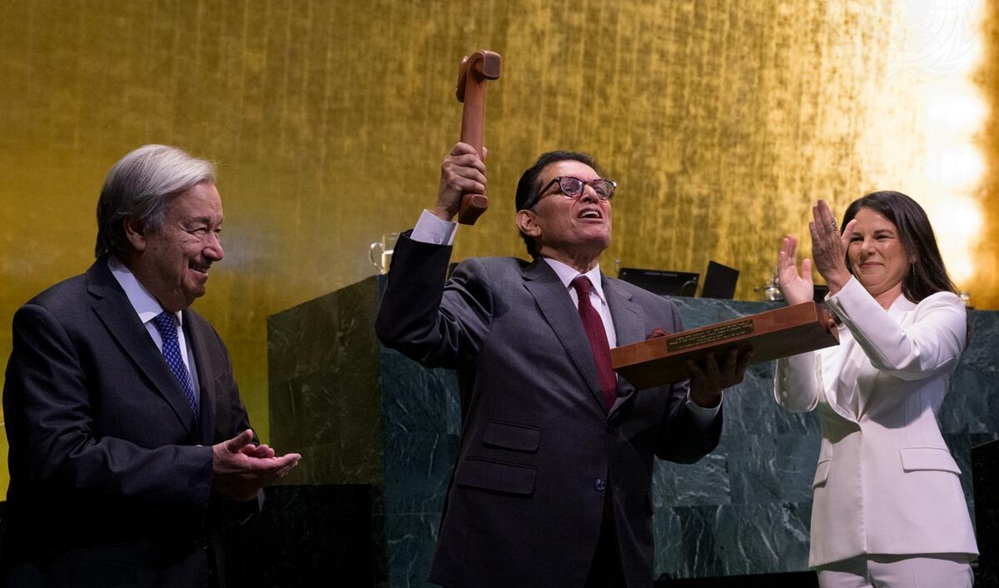
Shibbir Ahmed, UN, New York: The United Nations General Assembly opened its 81st session on Tuesday at United Nations Headquarters in New York, with Bangladesh’s veteran diplomat Khalilur Rahman taking over as president and calling for renewed global trust in the international organization amid wars, humanitarian crises, climate change and deepening geopolitical divisions.

Rahman formally assumed the presidency after receiving the traditional Icelandic wooden gavel from outgoing General Assembly President Annalena Baerbock. In his opening remarks, he said the United Nations must adapt to the realities of a rapidly changing world and become more responsive to the needs and expectations of people across the globe.

“We must make the United Nations fit for the future,” Rahman said, stressing the importance of listening to civil society and giving greater space to voices outside governments and traditional diplomatic institutions.

“We have a situation where trust is in deficit. This is not 1945. This is the 81st session. The world has moved on. The Organization must move on, and I’ll help that process,” he said.

Rahman has placed restoring trust and managing global transformation at the center of his presidency. His agenda includes strengthening international peace and security, accelerating progress toward the 2030 Sustainable Development Goals, addressing climate change, protecting human rights, supporting refugees and migrants, promoting responsible technological development and advancing reform of the United Nations and the broader multilateral system.
The new session begins at a time of heightened international tensions, with conflicts in several regions, growing humanitarian emergencies, geopolitical rivalries, persistent poverty and inequality, and increasing concerns over climate-related disasters. The risk of nuclear escalation has also added to concerns about international peace and security.

United Nations Secretary-General António Guterres, speaking at the opening of the session, said rebuilding confidence in the multilateral system had become one of the defining challenges of the current era.

“Rebuilding trust in the multilateral system is the defining challenge of our time,” Guterres said, arguing that international cooperation remains essential at a moment when the world is confronting crises that cannot be effectively addressed by individual countries acting alone.

Guterres said institutions across the multilateral system, including the Security Council and international financial institutions, are under growing pressure to respond to the realities of the present day. He warned that international law and human rights are too often violated with impunity, while geopolitical mistrust and suspicion continue to prevent the international community from reaching effective solutions.

Despite those difficulties, Guterres said he remained hopeful about the ability of the General Assembly to contribute to a better future. Through diplomacy, dialogue and cooperation, he said, countries can work to rebuild trust and goodwill and help ensure that future generations inherit a more peaceful and sustainable world.

The opening of the 81st session also marked the conclusion of Baerbock’s term as president of the General Assembly. Addressing member states at the final meeting of the 80th session, she defended the continuing importance of the United Nations despite criticism of its shortcomings.

Baerbock said she was more convinced than ever of the importance and necessity of the organization. She pointed to the work of United Nations agencies and peacekeeping missions around the world as evidence of the practical impact of the international body.

She cited the role of the United Nations Children’s Fund in helping millions of children and the contribution of peacekeepers to protecting civilians in conflict-affected areas. Baerbock also warned that the positive work of the United Nations often receives less public attention than negative developments, particularly in an environment where divisive and hateful content can spread rapidly.

Climate change and sustainable development are expected to remain major issues during the new session. Rahman has called for stronger international efforts to build climate resilience and protect the environment, while also accelerating progress toward the 2030 Sustainable Development Goals.

The new president has emphasized the need to ensure that development reaches vulnerable populations and that no country is excluded from international efforts to address poverty, inequality, education, health, food security and other development challenges.

Human rights and humanitarian action are also central to the new presidency. Continuing conflicts and instability have displaced millions of people, increasing pressure on the international community to protect refugees and migrants and provide assistance to populations affected by war and persecution.

The rapid development of artificial intelligence and other emerging technologies is another issue expected to receive greater attention. Rahman has called for technological innovation that is inclusive and responsibly governed, with appropriate safeguards to protect people and future generations.

United Nations reform is also expected to feature prominently during the 81st session. The international political and economic landscape has changed substantially since the organization was established in 1945, prompting continued debate over whether its institutions adequately reflect the realities of the contemporary world.

Questions surrounding representation, inclusiveness and the effectiveness of international decision-making have become increasingly important, particularly for developing countries seeking a greater voice in global affairs.

Another major diplomatic issue during the coming year will be the selection of the next United Nations secretary-general. Guterres is scheduled to complete his term, with his successor expected to take office in January 2027.

Rahman brings extensive diplomatic experience to the presidency of the General Assembly. He previously served as foreign minister of Bangladesh and held senior positions including national security adviser and high representative for the Rohingya issue in Bangladesh’s interim government. He has also held senior positions within the United Nations system and was a founding member of East West University in Dhaka.

His assumption of the presidency gives Bangladesh a prominent role in one of the international community’s most representative forums at a particularly challenging moment for multilateral diplomacy.

As the 81st session begins, the central challenge for the General Assembly will be whether countries can overcome deep political divisions and rebuild confidence in international cooperation. For Rahman, the task is rooted in a simple premise: the world has changed significantly since 1945, and the United Nations must evolve with it.


Central Park Adapts to Climate Change While Helping Cool New York City

NEW YORK — As climate change brings hotter temperatures and more frequent extreme weather to New York City, Central Park is taking on an increasingly important role in helping the city adapt. The vast green space in the heart of Manhattan is more than a destination for recreation. Its trees, lawns, vegetation and water features help moderate temperatures and provide relief from the heat of the surrounding city.

The effects of a changing climate are becoming increasingly visible across New York, including higher temperatures and growing pressure on urban infrastructure. In this environment, parks such as Central Park are becoming an important part of the city’s climate-resilience efforts, according to the United Nations.

Urban green spaces can help reduce the “heat island” effect created when buildings, roads and other paved surfaces absorb and retain heat. Trees and vegetation provide shade while also releasing moisture into the atmosphere, helping cool the surrounding environment.

Central Park also offers other environmental benefits. Its natural landscape can help absorb rainfall, support biodiversity and provide residents with access to nature in one of the world’s most densely populated cities.

For New Yorkers, these benefits can become particularly important during periods of extreme heat. The park provides cooler spaces where people can escape some of the intense temperatures found in heavily built-up neighborhoods.

But adapting the park itself to a changing climate is also becoming necessary. Maintaining trees and vegetation, protecting natural areas and managing water resources are increasingly important as temperatures rise and weather patterns become less predictable.

Central Park therefore represents a broader lesson for cities around the world: protecting and expanding urban nature can be both a climate-adaptation strategy and an investment in public health and quality of life.

As New York continues to confront the effects of climate change, the park’s role is evolving. What was once primarily designed as a place for recreation and escape from the city is increasingly functioning as part of the city’s natural infrastructure — helping New York remain more livable as the climate changes.


Nepal Floods Highlight Urgent Need for Global Climate Action: GCF Chief

Shibbir Ahmed, United Nations, New York: The devastating floods in Nepal and recent wildfires in Europe should serve as a wake-up call for the world to take more urgent action against the growing risks of climate change, said Mafalda Duarte, Executive Director of the Green Climate Fund (GCF).

In an interview with Agence France-Presse (AFP) in Palau, Duarte said climate change was receiving less urgency in global politics than other major crises. While the international community has demonstrated the ability to mobilise large amounts of funding quickly in response to wars, conflicts and other emergencies, climate-related challenges have not received a similar response, she said.

Duarte warned that the world is moving closer to several climate “tipping points”, beyond which reversing environmental damage could become increasingly difficult or even impossible.

“We can mobilise money quickly when we choose to respond to an emergency,” Duarte said, stressing that climate change should be treated with the same sense of urgency.

She cited Nepal’s recent floods, along with heatwaves and wildfires in Europe, as examples of the increasingly widespread impacts of climate change. According to Duarte, climate-related disasters are no longer confined to developing countries. Both developed and developing nations are increasingly facing the consequences of a changing climate.

Growing Concern Over Nepal Disaster

The recent floods and landslides in Nepal’s Himalayan region have caused extensive destruction and raised fresh concerns about the vulnerability of mountain communities to extreme weather events. The disaster occurred in the Himalayan region near the Nepal-China border, with sudden flows of water and large amounts of debris affecting several areas.

Nepal’s Prime Minister Balendra Shah has also described the disaster as a serious warning about the growing risks associated with climate change and called for stronger international action to support countries vulnerable to climate-related disasters.

Experts say rising global temperatures are contributing to changes in Himalayan glaciers, snow cover and other environmental conditions, potentially increasing the risks of floods, landslides and glacier-related disasters. However, determining the precise contribution of climate change to any individual disaster requires further scientific analysis.

Concerns Over Climate Finance

The Green Climate Fund provides financial support to developing countries for climate adaptation, resilience and efforts to reduce greenhouse-gas emissions. According to the BSS/AFP report, the fund has invested about $19 billion across 134 developing countries.

However, concerns remain over the future of international climate finance. The report said the United States withdrew from the fund in January, while Britain halved its contribution in May. Duarte stressed that climate-vulnerable countries need faster and more accessible financing to prepare for and respond to the growing impacts of climate change.

Pacific Region Sees Increased Investment

Duarte is currently in Palau, where leaders of Pacific island nations are attending their annual summit. For many of these small island states, climate change represents a major threat to their security, economies and long-term survival. The Green Climate Fund has increased its investment in the Pacific region significantly. Over the past three years, its investment there has doubled to around $1 billion.

Duarte acknowledged that accessing climate finance remains difficult for many small island nations. She said efforts were under way to streamline the process, with the average approval period now taking about nine months.

Tina Stege, the climate envoy of the Marshall Islands, has also called for faster and more tangible progress on climate finance. She expressed frustration over the limited funding available through the separate United Nations-backed “loss and damage” mechanism, which is intended to help vulnerable developing countries address the impacts of climate-related disasters.

Duarte said there was still time to act on climate change, but the window for effective action was narrowing. She urged governments and the international community to move faster, increase climate financing and work together to address the growing risks posed by a warming planet.


Moyeen Seeks Stronger World Bank Support for Bangladesh Development

DHAKA – LGRD and Cooperatives Minister Dr Abdul Moyeen Khan has expressed hope that the World Bank will further strengthen its support for the country’s sustainable development and improvement of people’s quality of life. He said various government initiatives are underway in important areas such as water supply, sanitation, rural development and addressing the impacts of climate change.

Continued support from development partners is necessary to make these activities more effective and sustainable, he said when World Bank Division Director for Bangladesh and Bhutan Jean Pesme paid a courtesy call on him at his office at the Secretariat today.

Various issues including the World Bank’s support for various ongoing development projects in Bangladesh, water supply and sanitation systems, rural development, climate change and local government sector were discussed.

The minister said the government and development partners need to work in coordination to accelerate and sustain the country’s development activities. He said WB support could play an important role in strengthening the capacity of the local government sector and ensuring quality civic services reach people at their doorsteps.

The minister expressed gratitude for the World Bank’s longstanding support for Bangladesh’s development journey and hoped that the bank would continue its support for the country’s key development initiatives in the future.

During the exchange of views, emphasis was placed on further strengthening the existing cooperation between Bangladesh and the World Bank. LGD Md Shahidul Hassan, senior officials from the ministry and the WB were present at the meeting.