PM Tarique Rahman Returns Home from New York After UNGA Visit

DHAKA — Prime Minister Tarique Rahman returned home Sunday morning after concluding a five-day visit to New York, where he attended the 81st session of the United Nations General Assembly (UNGA), delivered his maiden address to the General Debate and held a series of high-level bilateral and multilateral meetings. An Emirates flight carrying the prime minister, his wife Dr. Zubaida Rahman and members of his entourage landed at Hazrat Shahjalal International Airport at 8:21 a.m., according to PM’s Deputy Press Secretary Hasan Shiplu.

Local Government, Rural Development and Cooperatives Minister Dr. Abdul Moyeen Khan, Chief Whip Nurul Islam Moni, Prime Minister’s Defence Adviser Brigadier General (retd.) AKM Shamsul Islam, Whip Miah Nuruddin Ahmad Apu, local MP SM Jahangir Hossain, Cabinet Secretary Nasimul Ghani and Prime Minister’s Principal Secretary ABM Abdus Sattar received the prime minister at the airport.

Tarique Rahman left Dhaka on September 21 and reached New York the same day after a stopover in Istanbul. He departed New York on September 25 and travelled through Dubai before returning to Dhaka. During his four working days in New York, the prime minister took part in 30 engagements, including 11 bilateral meetings, eight UNGA-related engagements and 11 institutional meetings. The prime minister and members of his delegation collectively represented Bangladesh at around 80 engagements, according to BSS.

A major highlight of the visit was Tarique Rahman’s first address to the UNGA General Debate on September 24. In his speech, he outlined Bangladesh’s positions on global peace and security, sustainable development, climate change, economic cooperation and humanitarian issues, while calling for conflicts to be resolved through dialogue, diplomacy and cooperation.

The prime minister held bilateral meetings with the leaders of Türkiye, Iran, Pakistan, Croatia, Haiti, Bhutan and Thailand. He also met the vice president of the Maldives, the crown prince of Kuwait, the UAE’s deputy prime minister and foreign minister, the Saudi foreign minister and Sweden’s foreign minister. The discussions covered bilateral relations, trade and investment, economic cooperation, manpower exports, energy security, regional and international issues and other areas of mutual interest.

The Rohingya crisis was another major issue during the visit. Tarique Rahman called for stronger international support for the safe, voluntary and dignified repatriation of Rohingyas to Myanmar and discussed the issue with UN Secretary-General António Guterres, UN Special Envoy on Myanmar Julie Bishop and UN High Commissioner for Refugees Barham Salih.

Climate change and the impact of rising sea levels also featured prominently in the prime minister’s engagements. He called for stronger global action to reduce emissions, greater access to climate finance and technology, and international cooperation to address climate-induced displacement and loss and damage. At a Bangladesh-Sweden-UNFPA high-level event on midwifery, Tarique Rahman outlined his government’s vision of a “Healthy Bangladesh,” with primary healthcare at the centre of health-sector reform. He said the government plans to recruit additional health workers and professional midwives while developing an integrated digital health system.

Economic diplomacy was also a significant part of the visit. At a breakfast meeting with Wall Street representatives hosted by JPMorgan Chase, the prime minister discussed Bangladesh’s economic prospects, investment opportunities and potential partnerships. During the visit, Biman Bangladesh Airlines also signed an agreement with Boeing for the purchase of 11 aircraft as Bangladesh plans to expand its aviation sector and open new international routes.

Tarique Rahman also held meetings with World Bank Group President Ajay Banga, Gates Foundation CEO Mark Suzman, International Peace Institute President and CEO Zeid Ra’ad Al Hussein and UN High Commissioner for Human Rights Volker Türk, among others. On September 22, Tarique Rahman and Dr. Zubaida Rahman attended a welcome breakfast hosted by UN Secretary-General António Guterres for world leaders and their spouses before attending the opening of the UNGA General Debate. They later attended a reception hosted by US President Donald Trump for leaders participating in the General Assembly.

Dr. Zubaida Rahman also took part in several high-level engagements during the visit, including the UN General Assembly’s Platform of Women Leaders, the First Spouses’ Dialogue and a high-level event focusing on maternal and child health and midwifery. The New York visit marked Tarique Rahman’s first participation in the UN General Assembly as prime minister and included a broad programme of diplomatic, economic, humanitarian and multilateral engagements.


Fatikchhari MP Sarwar Alamgir Honored in New York

NEW YORK — Fatikchhari MP Sarwar Alamgir was accorded a reception at Radhuni Restaurant in the Church-McDonald area of New York on Thursday night, September 25. The event was organized at the initiative of Mohammad Hanif, chief adviser and former president of the Chattogram Association of New York. The reception was chaired by Mohammad Hanif and moderated by Md. Ariful Islam, general secretary of the Chattogram Association of New York. Among those attending were New York City Councilwoman Shahana Hanif, former Chattogram Association president Kazi Shakhawat Hossain Azam, current president Abu Taher, and poet and writer Shamsuddin Mahmud of Washington, D.C., along with prominent members of the Bangladeshi-American community.

In his speech as the chief guest, Sarwar Alamgir recalled his longstanding family relationship with Mohammad Hanif and his family. “Hanif bhai has not merely acted like an elder brother; he has always stood by me as my elder brother. I am therefore very happy to be able to visit New York and attend this gathering as his guest first,” Alamgir said. Alamgir also highlighted various initiatives undertaken for the development of Fatikchhari and expressed his determination to take necessary measures to eliminate terrorism and improve law and order in the constituency.

He also thanked Prime Minister Tarique Rahman for nominating him from Fatikchhari.  New York City Councilwoman Shahana Hanif said that although she was born and raised in New York City, her roots are in Fatikchhari.

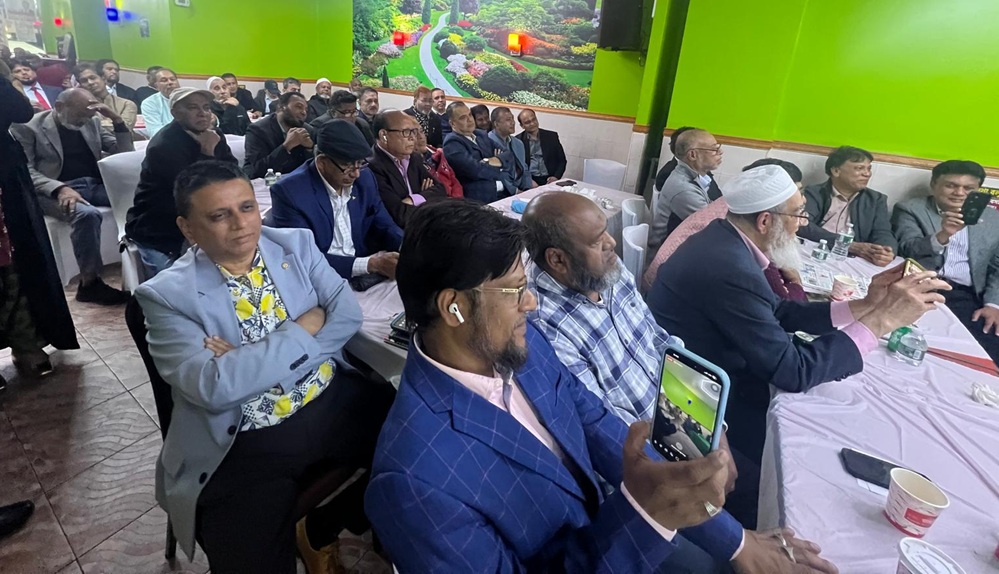
Members of the Bangladeshi-American community attend a reception honoring Fatikchhari MP Sarwar Alamgir in New York on September 25. Photo: KHABOR

“I am a New York City Councilwoman. I was born and raised here, but my roots are in Fatikchhari,” she said. Shahana Hanif expressed her happiness that the people of Fatikchhari have a leader like Sarwar Alamgir. She also expressed hope that Alamgir would provide necessary advice and cooperation to Prime Minister Tarique Rahman not only for the development of Fatikchhari but also for the broader development of Bangladesh.

During the event, poet and writer Shamsuddin Mahmud presented two of his books to Sarwar Alamgir as gifts. The program concluded with guests being served traditional Chattogram-style mezbani cuisine. Recent reporting also identifies Sarwar Alamgir as the MP for Chattogram-2 (Fatikchhari) and confirms that he is currently serving as a lawmaker.


PM leaves New York for home after attending UNGA session

New York – Prime Minister Tarique Rahman today left New York for home after winding up a five-day visit packed with high-level engagements, including his maiden address to the General Debate of the 81st United Nations General Assembly where he placed Bangladesh’s aspirations and priorities before the global community.

“An Emirates flight carrying the Prime Minister, his wife Dr Zubaida Rahman and members of his entourage departed John F Kennedy International Airport at 11:30pm (New York time) for Dhaka via Dubai,” Prime Minister’s Press Secretary Saleh Shibly told KHABOR.

The flight is scheduled to reach Dubai at 8:00pm on September 26 and depart for Dhaka at 2:00am on September 27. The Prime Minister is scheduled to arrive at Hazrat Shahjalal International Airport at 8:40am the same day.

During the visit, he presented Bangladesh’s positions on global peace and security, climate change, sustainable development, humanitarian issues, economic cooperation and the Rohingya crisis.

In his UNGA address on September 24, the Prime Minister reaffirmed Bangladesh’s support for UN initiatives aimed at establishing global humanity and world peace, calling for conflicts to be resolved through dialogue, diplomacy and mutual cooperation.

He also pledged to establish a prosperous, self-reliant and welfare-oriented democratic Bangladesh by ensuring political and economic empowerment of the people and equal opportunities for all, while outlining the government’s 3-R strategy of Recovery, Restoration and Reconstruction.

On the Rohingya crisis, he said safe and dignified repatriation to their homeland is the only solution to the prolonged crisis and sought stronger international support for creating conditions conducive to their voluntary return.

During the visit, the Prime Minister discussed the crisis separately with UN Secretary-General’s Special Envoy on Myanmar Julie Bishop and UN High Commissioner for Refugees Barham Salih.

The Prime Minister also met Turkish President Recep Tayyip Erdogan, with the two leaders discussing ways to expand Bangladesh-Türkiye trade and investment and diversify cooperation in economic sectors, while underscoring the importance of coordination on regional and international issues.

In separate meetings with Bhutanese Prime Minister Dasho Tshering Tobgay and Maldives Vice-President Uz Hussain Mohamed Latheef, Tarique Rahman discussed strengthening existing friendly relations and exploring new areas of bilateral, regional and international cooperation. At a meeting with World Bank Group President Ajay Banga, they discussed Bangladesh’s development priorities, economic progress, strengthening World Bank cooperation and exploring new areas of partnership.

The Prime Minister also held a meeting with Haitian Prime Minister Alix Didier Fils-Aimé, discussing bilateral relations, mutual interests and regional and international cooperation.

On September 22, Tarique Rahman and his wife joined a welcome breakfast hosted by UN Secretary-General Antonio Guterres for world leaders and their spouses before attending the opening of the 81st UNGA General Debate. In the evening, they attended a reception hosted by the US President for leaders joining the General Assembly.

On September 23, the Prime Minister held a breakfast meeting with representatives of the Gates Foundation, Visa Foundation, Rockefeller Foundation, International Rescue Committee and Rotary International, where Bangladesh’s perspectives on humanitarian challenges, international cooperation, climate change, sustainable development and economic partnership were highlighted.
He also met Gates Foundation CEO Mark Suzman and discussed public health, child healthcare, vaccination, affordable vaccines, preventive healthcare and health-system modernisation.

The Prime Minister also addressed the high-level meeting on “Climate Action and the Just Transition”, calling for collective global action to build a safer and more sustainable future for the next generation, including deeper emission cuts and predictable climate finance for climate-vulnerable countries.

A bilateral meeting with Croatian Prime Minister Andrej Plenkovic focused on expanding trade and investment, economic partnership, skilled manpower, education and technology, as well as greater coordination at multilateral forums.

The visit also featured economic diplomacy, including the signing of an agreement by Biman Bangladesh Airlines with Boeing to purchase 11 aircraft as Bangladesh seeks to expand its aviation sector and open new international routes.

On September 24, before his UNGA address, the Prime Minister delivered opening remarks at a high-level meeting on the existential threat posed by sea-level rise, calling for faster and deeper global emission cuts, predictable and accessible adaptation finance, wider access to climate-smart technologies and stronger international cooperation.

He also held a bilateral meeting with Pakistani Prime Minister Muhammad Shehbaz Sharif, with the two premiers discussing bilateral relations, regional and international situations and potential areas of cooperation.

At a Bangladesh-Sweden-UNFPA high-level event on midwifery, Tarique Rahman outlined his vision of a “Healthy Bangladesh”, placing primary healthcare at the centre of health reform.

He said the government plans to recruit 100,000 additional health workers, including 80,000 women, and 25,000 professional midwives, while developing an integrated digital health system.

The Prime Minister also held a bilateral meeting with UN Secretary-General Antonio Guterres, who expressed gratitude for Bangladesh’s role in sheltering the Rohingyas and contributing troops to UN peacekeeping operations, while praising Bangladesh’s role in climate resilience and multilateral affairs.

Tarique Rahman also met Thai Prime Minister Anutin Charnvirakul before delivering his UNGA address and later attended a dinner hosted in his honour by Bangladesh’s Permanent Representative to the UN.

On the final day of his New York visit, the Prime Minister attended a breakfast meeting with Wall Street representatives hosted by JPMorgan at its Manhattan Headquarters and held a bilateral meeting with Kuwait’s Crown Prince Sheikh Sabah Khaled Al-Hamad Al-Sabah.


Tarique Rahman on world stage, voicing Bangladesh’s aspirations

Shibbir Ahmed, New York  — The vast General Assembly Hall of the United Nations fell into attention as Prime Minister Tarique Rahman walked to the podium, dressed in a black suit and red tie, smiling and acknowledging greetings from the audience. As he took the floor at the 81st session of the United Nations General Assembly, the hall broke into applause. For a moment, the attention of Bangladesh and the wider international community turned to the Bangladeshi leader standing at the podium of the world’s premier multilateral forum.

It was more than a speech by a head of government. From the global stage, Tarique Rahman presented Bangladesh’s aspirations, concerns and expectations, placing the country’s priorities before the international community at a time when conflicts, displacement and humanitarian crises continue to challenge the world.

At the outset of his address, the prime minister paid tribute to the martyrs of Bangladesh’s Liberation War and recalled the contributions of those who sacrificed their lives in the struggle for democracy, justice and people’s rights. He also paid respect to those killed and injured during the July-August 2024 mass uprising. He then turned to the challenges confronting the international community.

In a world witnessing conflicts, displacement and humanitarian suffering, Tarique Rahman called for disputes to be resolved through dialogue, diplomacy and mutual cooperation. He said international relations should be founded on equality, fairness, mutual interests, respect and dignity, while stressing the importance of the United Nations in building an understanding-based global community that respects the independence and sovereignty of all nations.

He also reaffirmed Bangladesh’s support for UN initiatives aimed at promoting global humanity and world peace. The prime minister’s message on peace was closely linked to Bangladesh’s longstanding positions on disarmament, nuclear non-proliferation and arms control. He said the diversion of development resources towards military expenditure remained an obstacle to lasting peace.

The issue of Palestine also featured prominently in his address. Tarique Rahman reaffirmed Bangladesh’s support for the legitimate demands of the Palestinian people, including their right to self-determination and to establish an independent State of Palestine. The Rohingya crisis was another major issue Bangladesh placed before the international community. Referring to more than 1.2 million forcibly displaced Rohingyas from Myanmar who have been sheltered in Bangladesh for more than nine years, the prime minister said the source of the crisis lies in Myanmar and that its solution must also be found there.

“The only solution to this problem is the safe return of the displaced Rohingya population to their homeland, Myanmar,” he said, calling for firm and effective international support for their repatriation. He also urged the international community to continue life-saving humanitarian assistance until their safe return becomes possible. Migration was another issue through which Bangladesh articulated its concerns before the global community.

As one of the world’s major labour-sending countries, Bangladesh reiterated its commitment to regular, safe and orderly migration and called for stronger international cooperation to protect the rights, dignity and welfare of migrants. Tarique Rahman also highlighted Bangladesh’s role in global peace efforts, reaffirming the country’s commitment to multilateralism and its engagement with the UN Peacebuilding Commission.

He recalled the contributions of Bangladeshi peacekeepers serving in UN missions around the world and highlighted the participation of Bangladeshi women in peacekeeping, reflecting the country’s commitment to the Women, Peace and Security agenda. Climate change, another major concern for Bangladesh, also featured in the country’s broader priorities at the UNGA. Despite being highly vulnerable to the impacts of climate change, Bangladesh contributes relatively little to global greenhouse-gas emissions. The country has therefore continued to call for stronger international action on climate justice, climate finance and adaptation support.

Beyond the immediate global challenges, Tarique Rahman’s address also carried a strong message about Bangladesh’s own aspirations. The prime minister spoke of building a prosperous, self-reliant and welfare-oriented democratic Bangladesh through recovery, restoration and reconstruction, with emphasis on youth employment, women’s empowerment, education, skills development, innovation and social protection.

He outlined a vision of a country where young people can pursue their ambitions without fear, women can live with confidence and every child has the opportunity to realise their potential. He also highlighted the importance of preparing Bangladesh for a rapidly changing global environment shaped by technology and artificial intelligence. Yet the significance of the occasion extended beyond the contents of the speech itself.

Tarique Rahman’s appearance at the UN General Assembly marked another chapter in Bangladesh’s political history, as he became the third member of his family to address the world body. His father, Shaheed President Ziaur Rahman, addressed the UN General Assembly in 1980, focusing on issues including poverty, hunger, economic development and greater international cooperation. His mother, former Prime Minister Khaleda Zia, first addressed the General Assembly in 1993 and subsequently addressed the UN on several occasions.

More than four decades after his father’s first appearance at the world body, Tarique Rahman stood at the same global podium as Prime Minister of Bangladesh. The moment therefore brought together a chapter of family history and the contemporary aspirations Bangladesh sought to present before the international community. But beyond that legacy, the prime minister’s presence at the UN offered Bangladesh an opportunity to articulate its position on some of the most pressing issues confronting humanity — peace and conflict, Palestine, the Rohingya crisis, migration, climate change, development and multilateral cooperation.

From the floor of the General Assembly Hall, Bangladesh placed its message before the international community: dialogue over confrontation, diplomacy over conflict, cooperation over division and human dignity as a shared global responsibility. Tarique Rahman concluded his address by reaffirming Bangladesh’s support for the principles and values of the United Nations in the cause of establishing world peace.


PM reaffirms Bangladesh’s support for global humanity, world peace

Shibbir Ahmed, New York — Prime Minister Tarique Rahman today reaffirmed Bangladesh’s support for United Nations initiatives aimed at promoting global humanity and world peace, calling for conflicts to be resolved through dialogue, diplomacy and mutual cooperation.

“Today, I reaffirm Bangladesh’s support for any initiative of the United Nations aimed at establishing global humanity and world peace,” he said while addressing the General Debate of the 81st session of the United Nations General Assembly at the UN Headquarters in New York.

The Prime Minister said human-made conflicts had created unrest in many countries, resulting in large-scale displacement and humanitarian crises, while wars and conflicts were placing severe pressure on the global economy. He said energy security crises, disruptions to global energy supply systems and rising inflation were further worsening the economic situation.

“We believe that any conflict should be resolved through dialogue, diplomatic processes and mutual cooperation,” he said. Tarique Rahman said equality, fairness, protection of mutual interests, respect and dignity should form the basis of bilateral and multilateral relations among states.

“We aspire to a peaceful world, a humane global community where, rather than nuclear weapons, reason and debate, diplomacy, education and humanity become the instruments of change,” he said.

The Prime Minister said Bangladesh viewed the United Nations as the centre of efforts to establish an understanding-based global community that respects the independence and sovereignty of states. He said the tendency in various countries to divert development budgets towards military expenditure was an obstacle to world peace.

“As a peace-loving nation, Bangladesh remains committed to the goal of complete and general disarmament, preventing the proliferation of nuclear weapons and arms control,” he said.

Bangladesh and UN peacebuilding

Tarique Rahman reaffirmed Bangladesh’s commitment to multilateralism in maintaining international peace and security, saying the theme of the 81st UNGA — “Restoring Trust, Managing Transformation: A United Nations that Delivers for All” — was highly relevant to the prevailing global situation. He said Bangladesh, as Vice-Chair of the Peacebuilding Commission, continued to advocate sustainable peace, conflict prevention and inclusive peacebuilding.

The Prime Minister also highlighted Bangladesh’s contribution to UN peacekeeping missions, saying Bangladeshi peacekeepers were serving humanity in different countries around the world. He said the participation of Bangladeshi women in peacekeeping missions, despite challenging circumstances, reflected Bangladesh’s commitment to advancing the “Women, Peace and Security” agenda.

Support for Palestine

Turning to Palestine, Tarique Rahman said the people of Bangladesh, who cherish democracy, were deeply concerned about the suffering of the Palestinian people.

“Bangladesh reaffirms its unwavering support for their legitimate demands, including their right to self-determination and their right to establish an independent State of Palestine,” he said.

Rohingya crisis

The Prime Minister also called for continued international support for the forcibly displaced Rohingyas from Myanmar, saying Bangladesh had been providing shelter to more than 1.2 million Rohingyas for more than nine years. He said the only solution to the Rohingya crisis was the safe return of the displaced population to their homeland in Myanmar. Tarique Rahman called upon the United Nations and the international community to continue life-saving assistance programmes for the Rohingyas until their repatriation.

Safe and orderly migration

On migration, the Prime Minister called for stronger international cooperation to protect the rights, dignity and welfare of migrants. “Bangladesh expects stronger global cooperation to ensure the rights, dignity and welfare of migrants,” he said. He said migration was as old as human civilisation and migrants were making important contributions to the economies of both their countries of origin and destination.

Tarique Rahman said Bangladesh remained committed to ensuring regular, safe and orderly migration. The Prime Minister reiterated that Bangladesh would continue supporting efforts to build a peaceful and humane global community based on dialogue, mutual respect, diplomacy and cooperation.


Safe repatriation is only solution to Rohingya crisis: PM

Shibbir Ahmed, New York— Prime Minister Tarique Rahman today said the only solution to the Rohingya crisis is the safe return of the displaced Rohingya population to their homeland in Myanmar, calling for firm and effective support from the United Nations and the international community for a lasting solution.

“The only solution to this problem is the safe return of the displaced Rohingya population to their homeland, Myanmar,” he said while addressing the General Debate of the 81st session of the United Nations General Assembly in New York.

“For more than nine years, Bangladesh has been providing shelter to more than 1.2 million forcibly displaced Rohingyas from Myanmar,” the Prime Minister said. He said the prolonged presence of the Rohingyas had placed immense pressure on Bangladesh’s resources, environment, security and local communities.

“Bangladesh, a densely populated country, believes that the source and origin of the Rohingya crisis lie in Myanmar; therefore, its solution also lies there,” he said. Tarique Rahman urged the United Nations and the international community to continue life-saving assistance programmes for the displaced Rohingyas until their repatriation to Myanmar.

“If the international community fails to ensure justice for the displaced Rohingya population, this may turn into a humanitarian crisis in the near future,” he warned.

Call for peaceful resolution of conflicts

The Prime Minister also called for stronger international efforts to address major global humanitarian and political challenges, saying human-made conflicts had created unrest in many countries and displaced large numbers of people. He said wars and conflicts were placing severe pressure on the global economy, while energy security crises, disruptions to global energy supply systems and rising inflation were worsening the economic situation.

“We believe that any conflict should be resolved through dialogue, diplomatic processes and mutual cooperation,” he said. Tarique Rahman said equality, fairness, protection of mutual interests, respect and dignity should form the basis of bilateral and multilateral relations among states.

“We aspire to a peaceful world, a humane global community where, rather than lethal weapons, reason and debate, diplomacy, education and humanity become the instruments of change,” he said.

Support for Palestine

Turning to the Palestine issue, the Prime Minister said the people of Bangladesh, who cherish democracy, were deeply concerned about the suffering of the Palestinian people.

“Bangladesh reaffirms its unwavering support for their legitimate demands, including their right to self-determination and their right to establish an independent State of Palestine,” he said.

Migration and international cooperation

On migration, Tarique Rahman said migration was as old as human civilisation and migrants were making important contributions to the economies of both their countries of origin and destination. He said the Bangladesh government was committed to ensuring regular, safe and orderly migration.

“Bangladesh expects stronger global cooperation to ensure the rights, dignity and welfare of migrants,” the Prime Minister said. Tarique Rahman also reaffirmed Bangladesh’s commitment to multilateralism in maintaining international peace and security, saying the United Nations should remain at the centre of efforts to establish an understanding-based global community that respects the independence and sovereignty of states.

He said the tendency in various countries to divert development budgets towards military expenditure was an obstacle to world peace.

“As a peace-loving nation, Bangladesh remains committed to the goal of complete and general disarmament, preventing the proliferation of nuclear weapons and arms control,” he said. The Prime Minister reaffirmed Bangladesh’s support for UN initiatives aimed at promoting global peace and humanity.

Climate change

On climate change, Tarique Rahman said Bangladesh was one of the countries most vulnerable to its adverse impacts despite making little contribution to global carbon emissions.

“In these circumstances, Bangladesh has chosen the path of building resilience to withstand and overcome these risks,” he said. The Prime Minister called for stronger global action at COP31 on climate justice, climate finance and adaptation support. He said Bangladesh had strengthened its programmes to protect the environment and build resilience against climate risks.

The government had launched a programme to plant 250 million trees across the country over the next five years, while placing emphasis on clean and solar energy, he said. Tarique Rahman also said Bangladesh had launched a programme to excavate 20,000 kilometres of canals across the country to help address flooding and drought.

He stressed the importance of cooperation in transboundary water management while reaffirming Bangladesh’s commitment to water conservation and pollution prevention. The Prime Minister concluded by reiterating Bangladesh’s unwavering support for the principles and values of the United Nations in the cause of establishing world peace.


Govt pursuing 3-R strategy to repair Bangladesh: PM

Shibbir Ahmed, New York — Prime Minister Tarique Rahman today said his government is pursuing a 3-R strategy — Recovery, Restoration and Reconstruction — to repair Bangladesh, which he described as having been ravaged by more than one and a half decades of “fascist rule and exploitation.”

“To repair Bangladesh, which was ravaged by fascist rule and exploitation, the Government is pursuing a 3-R strategy — Recovery, Restoration and Reconstruction,” he said while addressing the 81st session of the United Nations General Assembly at the UN Headquarters in New York.

The Prime Minister said Bangladesh had freed itself from what he described as enforced disappearances, killings, abductions, corruption, looting and money laundering and was once again embarking on the path of democracy.

He said an immense horizon of possibilities had opened before Bangladesh and that his government had begun implementing extensive programmes to transform the country’s working-age population into skilled human resources by harnessing its demographic dividend.

“Detailed measures have been taken to create extensive employment opportunities and develop Bangladesh as a ‘manufacturing hub’,” he said, seeking support from the country’s development partners in this endeavour.

The government has allocated US$50 million in the current fiscal year to create opportunities for young entrepreneurs, researchers and innovators to implement start-up initiatives, he said.

Focus on women’s empowerment

Highlighting the government’s focus on women’s empowerment, Tarique Rahman said women were at the forefront of its plans for the country’s socio-economic transformation, noting that women account for more than half of Bangladesh’s population.

He said the government was prioritising women’s education, employment and entrepreneurship, including expanded access to cash financing, particularly in the small and medium-sized industries sector. Free education opportunities for women up to the undergraduate level had also been made available, he said.

The Prime Minister said the government wanted to ensure not only electoral democracy but also the democratisation of the economy so that the benefits of economic growth and prosperity reached every family and citizen.

To this end, the government had introduced social protection initiatives such as the Family Card, Farmers’ Card, Sports Card and e-Health Card to support economically disadvantaged people.

He described the Family Card, issued in the name of the female head of each household, as a symbol of women’s economic empowerment and said the government planned to introduce a Universal Card by integrating various support cards.

31-point programme and development

Tarique Rahman said the government was implementing its 31-point programme presented to the people ahead of the February 12 national election. He said 73 percent of the programme’s activities were directly aligned with the UN Sustainable Development Goals’ “Leave No One Behind” theme, while another 27 percent were indirectly aligned.

The government hoped implementation of the programmes would reduce development disparities between urban and rural areas and strengthen accountability and inclusive sustainable development under the 2030 Agenda, he said.

Education, health and sports

The Prime Minister said his government had given special importance to education, health and sports and had made the highest-ever budget allocation for the education sector.

“There are plans to gradually increase education spending to 5 per cent of GDP within the next five years,” he said. He said a curriculum had been developed with an emphasis on technical and practical education to establish an ethically sound and employment-oriented education system.

School bags, uniforms and free midday meals were being provided to primary students from the first grade, he said, expressing hope that the initiatives would increase school enrolment and improve the quality of education.

Sports had also been included as a subject in the education curriculum for the first time, with the aim of establishing sports as a profession, he said. More than two million students participated in a month-long nationwide football tournament last June as part of the initiative, he added.

Call for dialogue to resolve conflicts

Turning to the international situation, Tarique Rahman said human-made conflicts had created unrest in many countries, causing displacement and humanitarian crises while placing pressure on the global economy, energy security and supply systems and contributing to rising inflation.

He said conflicts should be resolved through dialogue, diplomatic processes and mutual cooperation, with equality, fairness, protection of mutual interests, respect and dignity forming the basis of bilateral and multilateral relations.

Bangladesh sees the United Nations as the centre of efforts to establish an understanding-based global community that respects the independence and sovereignty of states, he said.

Tarique Rahman reaffirmed Bangladesh’s commitment to general and complete disarmament, prevention of nuclear weapons proliferation and arms control, while supporting UN initiatives aimed at promoting global peace.

He also reaffirmed Bangladesh’s support for the legitimate demands of the Palestinian people, including their right to self-determination and to establish an independent State of Palestine.

Rohingya crisis

On the Rohingya crisis, the Prime Minister said Bangladesh had been providing shelter to more than 1.2 million forcibly displaced Rohingyas from Myanmar for more than nine years, putting immense pressure on the country’s resources, environment, security and local communities.

“The only solution to this problem is the safe return of the displaced Rohingya population to their homeland, Myanmar,” he said. He called for firm and effective support from the United Nations and the international community for a lasting solution and urged continued life-saving assistance for the Rohingyas until their repatriation.

“If the international community fails to ensure justice for the displaced Rohingya population, this may turn into a humanitarian crisis in the near future,” he added.

Climate change and development

On climate change, Tarique Rahman said Bangladesh was among the countries most vulnerable to its adverse impacts despite making little contribution to global carbon emissions. He said Bangladesh expected stronger global action at COP31 on climate justice, climate finance and adaptation support. The government has launched a programme to plant 250 million trees across the country over the next five years, while placing emphasis on clean and solar energy, he said.

He also said a programme had been launched to excavate 20,000 kilometres of canals across the country to help address flooding and drought. The government had begun implementing the Teesta Master Plan and the Padma Barrage project to increase freshwater flow into the Sundarbans and conserve water through large reservoirs, he said.

Technology and AI

On science and technology, the Prime Minister said Bangladesh’s large young population and growing digital capabilities had created new possibilities, but access to advanced technology, knowledge and research must be made available to all.

“We do not want today’s digital divide to become tomorrow’s artificial intelligence divide,” he said, stressing technology transfer, skills development and affordable access to modern technologies for developing countries. He called for an effective UN policy framework to ensure that the benefits of artificial intelligence and social media could be used positively around the world.

LDC graduation and global cooperation

The Prime Minister also called for continued international support as Bangladesh prepares to graduate from the Least Developed Country category, particularly through assured financing, greater market access, technology transfer and capacity building.

He said regional trade facilitation, connectivity and meaningful cooperation could help countries achieve shared prosperity in an increasingly interdependent world. Tarique Rahman also stressed the need to ensure sustainable production of vaccines, medical supplies and diagnostic equipment in developing countries so that they remain readily accessible to all.

‘Bangladesh First: Bangladesh for All’

Tarique Rahman said Bangladesh wanted to establish a prosperous, self-reliant and welfare-oriented democratic state where everyone, irrespective of political affiliation, religion or race, could live safely with equal rights, respect and dignity.

“Bangladesh’s progress in the areas of democracy, human rights, good governance, accountability, political stability and the investment environment is continuing,” he said, adding that the government was working to establish a safe and stable Bangladesh with a business- and investment-friendly environment.

“We want to build a Bangladesh where young people can pursue their dreams without fear or hindrance, women can lead their lives with confidence, and every child can grow up with the opportunity to realise their full potential,” he said.

“Above all, the people will have the assurance of a safe and peaceful life. That is why we say, ‘Bangladesh First: Bangladesh for All’.”

Earlier remarks

Earlier in his address, Tarique Rahman congratulated the President of the 81st session of the UN General Assembly on his election and assured Bangladesh’s full support during his tenure. He paid tribute to the martyred freedom fighters of Bangladesh and recalled the contributions of those who sacrificed their lives in the struggle to establish democracy, justice and people’s rights since independence.

He also paid respect to those killed and injured during the July-August 2024 mass uprising. The Prime Minister said the people had entrusted the Bangladesh Nationalist Party (BNP) with the responsibility of governing the state through the “fair, free and impartial” national election held on February 12 this year.

He said he felt nostalgic standing before the UN General Assembly as his father, Shaheed President Ziaur Rahman, and his mother, former Prime Minister the late Khaleda Zia, had also addressed the world from the same platform on behalf of Bangladesh and its people.

Tarique Rahman said Bangladesh remained committed to multilateralism in maintaining international peace and security and, as Vice-Chair of the UN Peacebuilding Commission, continued to advocate sustainable peace, conflict prevention and inclusive peacebuilding.

He also highlighted the contributions of Bangladeshi peacekeepers and women peacekeepers to UN missions around the world. On migration, he said the government was committed to ensuring regular, safe and orderly migration and called for stronger global cooperation to protect the rights, dignity and welfare of migrants. Concluding his address, the Prime Minister reaffirmed Bangladesh’s unwavering support for the principles and values of the United Nations in the cause of establishing world peace.


PM pledges to establish prosperous, democratic Bangladesh

Shibbir Ahmed, New York — Prime Minister Tarique Rahman today pledged to build a prosperous, self-reliant and welfare-oriented democratic Bangladesh by ensuring political and economic empowerment of the people and creating equal opportunities for all.

“We want to establish a prosperous, self-reliant, welfare-oriented democratic state where everyone, irrespective of political affiliation, religion or race, can live without anxiety and in safety, with equal rights, respect and dignity,” he said. The Prime Minister made the remarks while addressing the General Debate of the 81st session of the United Nations General Assembly at the UN headquarters in New York.

He said his government was working to establish a safe and stable Bangladesh with a business- and investment-friendly environment while strengthening democracy, human rights, good governance, accountability and political stability. Tarique Rahman said the government was pursuing a three-pronged strategy — Recovery, Restoration and Reconstruction — to rebuild Bangladesh.

“Bangladesh is now once again embarking on the path of democracy,” he said, adding that the government was taking steps to transform the country’s working-age population into skilled human resources by harnessing its demographic dividend. He said detailed measures had been taken to create extensive employment opportunities and develop Bangladesh as a “manufacturing hub.”

The government has allocated US$50 million in the current fiscal year to provide opportunities for young entrepreneurs, researchers and innovators to implement start-up initiatives, he said. The Prime Minister said women were at the forefront of the government’s plans for the country’s socio-economic transformation, noting that women account for more than half of Bangladesh’s population.

“The government is giving priority to women’s education, women’s employment and the creation of women entrepreneurs,” he said. He said access to cash financing had been expanded for women, particularly in the small and medium-sized industries sector, to support the development of women-led businesses. The government had also introduced free education opportunities for women up to the undergraduate level, he said.

Tarique Rahman said the government sought to ensure not only electoral democracy but also the democratisation of the economy so that the benefits of economic growth and prosperity reached every family and citizen. To this end, the government had introduced social protection initiatives, including the Family Card, Farmers’ Card, Sports Card and e-Health Card, to support economically disadvantaged people.

“The government considers the ‘Family Card’, issued in the name of the female head of each household, to be a symbol of women’s economic empowerment,” the Prime Minister said. He said the government also planned to introduce a “Universal Card” by integrating the various cards designed to provide support in different sectors. The Prime Minister said the government had placed special emphasis on education, health and sports and had made the highest-ever allocation for the education sector in the country’s history.

“There are plans to gradually increase education spending to 5 per cent of GDP within the next five years,” he said. He said a new curriculum had been developed with greater emphasis on technical and practical education to build an ethically sound and employment-oriented education system.

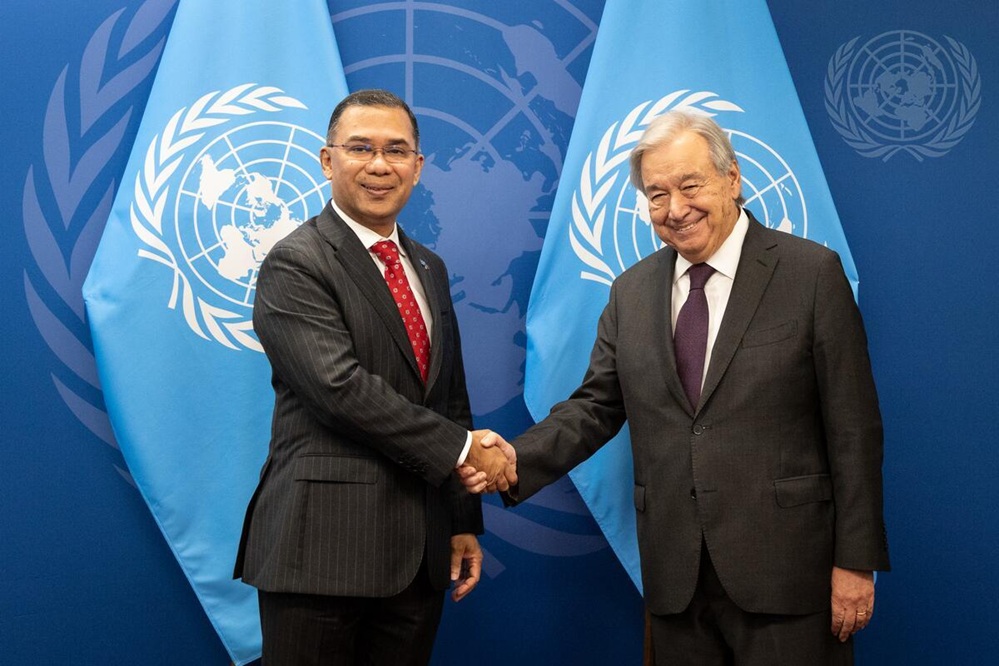
Secretary-General António Guterres (right) meets with Tarique Rahman, Prime Minister of the People’s Republic of Bangladesh.UN Photo/Ariana Lindquist

School bags, uniforms and free midday meals were being provided to primary school students from the first grade, he said, expressing hope that the initiatives would boost school enrolment and improve the quality of education. Tarique Rahman said sports had also been introduced as a subject in the education curriculum for the first time, with the aim of establishing sports as a profession.

As part of the initiative, more than two million students participated in a month-long football tournament held across the country in June, he said. The Prime Minister said science and technology would shape the future as the world entered a new era driven by artificial intelligence, biotechnology and scientific innovation. He said Bangladesh’s large young population and expanding digital capabilities had created new opportunities, but access to advanced technology, knowledge and research needed to be made available to all.

“We do not want today’s digital divide to become tomorrow’s artificial intelligence divide,” he said. Tarique Rahman said Bangladesh respected innovation and intellectual property while stressing the importance of technology transfer, skills development and affordable access to modern technologies.

“It is now time for the United Nations to adopt an effective policy framework so that the benefits of the development and rapid expansion of artificial intelligence and social media can be used positively in countries around the world,” he said. Turning to the Rohingya crisis, Tarique Rahman said Bangladesh had been sheltering more than 1.2 million forcibly displaced Rohingyas from Myanmar for more than nine years.

He said the only solution to the crisis was the safe and dignified return of the displaced Rohingya population to their homeland in Myanmar and called for continued life-saving assistance until their repatriation. The Prime Minister said Bangladesh was continuing its progress in democracy, human rights, good governance, accountability, political stability and improving the investment environment.

“In the present democratic Bangladesh, we welcome partnership, innovation and both domestic and foreign investment,” he said. Tarique Rahman said the government wanted to build a Bangladesh where young people could pursue their dreams without fear or hindrance, women could lead their lives with confidence and every child could grow up with opportunities to realise their full potential.

“Above all, the people will have the assurance of a safe and peaceful life. That is why we say, ‘Bangladesh First: Bangladesh for All’,” he added.


Bangladesh, Pakistan premiers discuss bilateral ties, regional, global issues

Shibbir Ahmed, New York – Prime Minister Tarique Rahman and his Pakistani counterpart Muhammad Shehbaz Sharif on Thursday discussed various aspects of Bangladesh-Pakistan bilateral relations, along with regional and international issues of mutual interest.

The two leaders held a bilateral meeting at the Secretariat Building of the United Nations Headquarters in New York on the sidelines of the 81st session of the United Nations General Assembly (UNGA).

The meeting focused on matters of mutual interest, the regional and international situation, and potential areas of cooperation for the benefit of the peoples of Bangladesh and Pakistan, said Prime Minister’s Assistant Press Secretary KM Nazmul Haque. Tarique Rahman and Shehbaz Sharif underscored the importance of further strengthening relations between the two countries on the basis of mutual respect, understanding and cooperation.

The two premiers also stressed the need for regular communication and continued dialogue on issues of common interest. The meeting took place amid the two countries’ ongoing efforts to enhance bilateral engagement and explore areas of cooperation at regional and international forums.


Why Bangladesh must reconsider its trade agreement with the US

M.G. Quibria: Some trade deals are negotiated. Others are simply accepted. Bangladesh’s Agreement on Reciprocal Trade (ART) with the United States, signed in the last frantic days of an interim government, looks unmistakably like the second kind. And seven months later, Dhaka is still making commitments under a bargain whose legal foundations have crumbled twice.

An old grievance, formalised

The programme that produced it began on April 2, 2025, when President Trump unveiled what his administration called “Liberation Day”: country-by-country tariffs calculated using a formula publicly associated with trade adviser Peter Navarro and built around each nation’s trade surplus with the United States. According to Regime Change, the 2026 book by New York Times reporters Maggie Haberman and Jonathan Swan, when the President found the competing economic estimates from Navarro, Treasury Secretary Scott Bessent and Commerce Secretary Howard Lutnick unsatisfying, he turned to aide Natalie Harp to produce numbers closer to what he already intuitively believed, undercutting any claim to scientific rigour in how the tariff rates presented on Liberation Day were determined. Indeed, the President’s instinct behind the policy was long-standing. In a full-page advertisement in the New York Times, the Washington Post and the Boston Globe on September 2, 1987, Trump argued that America’s allies were free-riding on US trade and defence policy and ought to pay for it. Thirty-nine years later, the same argument animates the reciprocal tariff programme.

Out of that programme came the ART, the bilateral instrument Washington has used to reset tariff terms one country at a time. Partners could be classified into five rough groups: first, nations with a fully signed ART; second, nations with only a framework, still under negotiation; third, nations offered bespoke “strategic trade and investment” arrangements, such as Korea and Japan, instead of a standard treaty; fourth, Gulf states substituting investment pledges for any treaty; and fifth, nations where talks have broken down into open disputes. As of this writing, of the ten countries that have actually signed the ART, Bangladesh’s agreement has the strongest claim to being the most one-sided. Not because any single clause is exotic; most of its mechanisms exist, in some form, in some other countries’ agreements too. It is the aggregate, how the obligations stack up and the peculiar circumstances under which Dhaka signed at all, that sets it apart.

The ground shifts twice

The legal scaffolding beneath the tariff side of the ART programme has meanwhile been dismantled and rebuilt twice. On February 20, 2026, the Supreme Court ruled that the International Emergency Economic Powers Act (IEEPA) never authorised a president to impose tariffs at all, striking down the Liberation Day regime in its entirety, including the country-specific caps individual ARTs had negotiated. Within days, the administration invoked Section 122 of the Trade Act of 1974 to address a serious balance-of-payments crisis and imposed a flat 10% global surcharge, a stopgap capped by statute at 150 days. That, too, expired on schedule on July 24, 2026, and was replaced, without a day’s gap in collections, by new Section 301 tariffs targeting inadequate enforcement of forced-labour import bans, set at 10% or 12.5% across sixty economies. A second Section 301 investigation, aimed at resetting rates based on “excess manufacturing capacity” across sixteen economies, including China and Vietnam, remains unresolved months past its own informal deadline, with its statutory window stretching into March 2027. Bangladesh, notably, is featured in both investigations.

Through all of this, the underlying non-tariff commitments inside the ARTs, including investment pledges, forced-labour provisions and standards recognition, have proven sturdier than the tariffs themselves, surviving as separate memoranda even as the specific rate attached to each deal was rebuilt from scratch: first under IEEPA, then Section 122, then Section 301. Against this backdrop of a legal foundation that keeps giving way, Bangladesh’s bargain has to be understood.

A deal nobody can quite explain

The first puzzle is why, among South Asian nations, Bangladesh rushed to sign first. Looking back, it’s hard to identify what that haste bought. If the goal was to lock in better terms than a slower negotiation might yield, the text doesn’t bear that out. Its neighbours all declined to sign anything resembling a full ART and appear none the worse for their caution. Pakistan and Sri Lanka remain in active, unhurried negotiations, without conceding Bangladesh’s terms. India operates under its own separate interim framework, despite being in the crosshairs of the Lindsey O. Graham Sanctioning Russia and Iran Act, which targets purchasers of discounted Russian oil and gas. More tellingly, Vietnam and the Philippines, both of which export far more to the United States and run considerably larger trade surpluses than Bangladesh, have signed no comparable agreement at all. If exposure to American tariff pressure were the deciding factor, those are the economies that should have moved first. Instead, it was Bangladesh, with lower exports and a smaller trade surplus, that signed the most sweeping and asymmetric text of the ten.

Signed by a government on its way out

Compounding the puzzle is the timing. Bangladesh signed its ART on February 9, 2026, under the outgoing interim administration of Dr Muhammad Yunus, three days before a national election that would replace it. No elected parliament debated or approved it before it was signed, and the new one has not scrutinised it since taking office. No one has clearly explained what economic or political calculus persuaded an interim government to lock in an open-ended trade relationship on its way out the door. Critics are right to call this what it is: a lame-duck administration locking its successors into commitments the country never had a chance to vote on. That charge doesn’t apply to the other signatories, whose governments actually had a mandate to sign.

A textual imbalance without precedent

The imbalance is visible even in the drafting. One textual count in the Bangladeshi press noted that the ART uses 179 instances of the mandatory “shall”, most of which are attached to Bangladeshi commitments. Such counts are an imperfect measure of substantive burden, but the broader text leaves little doubt about the direction of the obligations: Bangladesh promises considerably more than Washington does. No comparable analysis has been published for the other ARTs, so this is suggestive rather than a verified ranking.

The harshest penalty on the highest starting tariff

An analysis by the non-partisan think tank Peterson Institute for International Economics concludes that these ART deals were “built to push America’s trade partners away from China”. Bangladesh’s agreement carries a non-market-economy clause, foreclosing new trade deals with countries the US designates as non-market economies, including China, Russia, Vietnam, Belarus and others, on pain of snapback tariffs. For Bangladesh, the non-market clause sits in the same maximum-severity tier as five other agreements, including Cambodia’s and Guatemala’s. What is unusual is what is riding on it: Bangladesh’s original “Liberation Day” tariff was 37%, among the highest of any ART signatory, so a snapback would cost Dhaka more than almost any peer. It is, in effect, the same gun pointed at everyone, but loaded heaviest for Dhaka.

Reaching beyond tariffs

The agreement’s obligations extend well beyond market access, reaching into Bangladesh’s regulatory discretion, digital governance, procurement behaviour and its future room to manoeuvre with third countries. Its specific commitments include not contesting US export-tax rebates at the WTO and not applying VAT measures that discriminate against US goods. None of these mechanisms, taken individually, is exotic; versions appear in some other cases. What makes Bangladesh’s case distinctive is the accumulation: a documented obligation imbalance without precedent, one of the highest snapback tariffs in the group and a signing process with no democratic mandate. Whether that combination makes it objectively “the worst” of the ten ARTs is a matter of interpretation.

An exchange that keeps getting more unequal

Post-signing developments have widened the imbalance, not narrowed it. Dhaka has kept expanding its Boeing commitments in a confusing sequence. Bangladesh raised its planned Boeing purchase from 14 to 25 aircraft in July 2025. Yet, on April 30, 2026, Biman Bangladesh Airlines formally ordered 14 jets, its largest-ever order, valued at about $3.7 billion. Then, on August 30, US envoy Sergio Gor announced that Bangladesh had committed “billions of dollars” to buy still more Boeing aircraft, “significantly increasing” its initial order, without identifying the number, models, price or contractual status of the additional planes. The next day, President Trump disclosed that Prime Minister Tarique Rahman had written to him concerning a Boeing purchase. Trump thanked Rahman for his “decision of purchase”, adding, “Boeing will not let you down, and I will not forget.” Yet Bangladeshi officials subsequently said that no separate agreement beyond Biman’s 14-aircraft order had been signed. What additional purchase Trump was thanking Rahman for, and whether it represents a firm contract, a political commitment or merely an intention to buy more aircraft, therefore remains publicly unclear.

The contrast with Indonesia is instructive. Garuda Indonesia, negotiating a comparable Boeing commitment under its own ART, had still not signed a binding contract as of late 2026, while Indonesia’s sovereign wealth fund warned that deliveries could take up to seven years, given Boeing’s production backlog and unresolved financing questions. The Strategic Trade and Investment deals with Japan and Korea have been so large that the Wall Street Journal argues they will never materialise. The same uncertainty has been flagged with respect to the Gulf countries.

Bangladesh, by comparison, has moved faster and further, committing to more while securing less in return, even as its underlying agreement is, by most measures, the most lopsided of the treaties.

What makes the speed more striking still is what the process appears to have skipped over. Biman is, by its own numbers, in no position for a $3.7 billion wager: it loses money on most of its international routes, carries more than Tk 6,000 crore in unpaid dues to the Civil Aviation Authority and has turned a profit in only a few years of its existence. It is, in other words, a loss-making carrier committing to its largest-ever purchase on a timetable set by the seller and the geopolitics of a trade dispute, not by any internal business logic. A capital commitment of this magnitude would ordinarily trigger commensurate due diligence, including board-level risk assessment, fleet-financing review and route-profitability modelling. There is no evidence that any of this happened.

The pattern repeats in energy. On August 12, 2026, Bangladesh’s cabinet cleared a twelve-year liquefied natural gas deal with Gunvor USA covering 117 cargoes, roughly 7.5 million tonnes, through 2038. The contract was awarded without competitive bidding, through an unusual state-to-state pricing formula negotiated with a private trading firm, and the government has defended it as prudent hedging against Qatar’s own difficulties in meeting its LNG commitments amid regional tensions.

Meanwhile, the reciprocal side of the bargain remains thin to the point of translucence. Bangladesh’s garment sector, which accounts for more than 85% of everything the country exports to the United States, now faces a real cumulative burden considerably higher than the headline figures suggest: the 10% Section 301 forced-labour duty stacks on top of an existing 15.6% MFN tariff on apparel, pushing the effective rate into the mid-20% range. In exchange, the US commitment on garments, under Article 5.3 of the agreement, remains only a promise to “establish a mechanism” for zero-tariff access tied to US-origin cotton and fibre, with no volume guarantees or deadline. Bangladesh is executing binding, multi-billion-dollar purchase commitments in real time against a promise that, more than half a year after signing, remains entirely undrawn and vague.

A legal irony, and a democratic one

There is further legal ambiguity. The agreement contemplated domestic procedures before entry into force, and Washington’s February announcement explicitly said those procedures remained to be completed. The striking point, therefore, is not that the ART “does not exist”. It is that Dhaka has acted with more certainty than the underlying tariff regime warrants. Aircraft orders, LNG contracts and purchase pledges are all proceeding on schedule against a treaty that, strictly speaking, does not yet exist. The irony compounds: the agreement’s own snapback clause authorises Washington to reimpose tariffs under Executive Order 14257 if Bangladesh defaults, but the Supreme Court has already struck that order down, and neither government has said what replaces it. Dhaka, in effect, is honouring the letter of a contract with no legal force, enforced by a threat that no longer exists.

A second irony is more political than legal. Bangladesh, as of this year, has once again emerged as a democracy. One might expect a vigorous parliamentary reckoning with a sweeping, open-ended trade deal signed by an outgoing, unelected administration. Dhaka also inherited a clear opening to ask whether the bargain still made sense once the legal foundation of Washington’s original tariff threat collapsed. Instead, the commitments have continued and may be expanding. The mystery is no longer why Bangladesh signed such a deal. It is why, having gained both the democratic authority and the legal opening to reconsider it, Dhaka appears so reluctant to use either.

Dr M.G. Quibria is an economist and public policy commentator whose work explores trade, development, governance and democratic change in Bangladesh and beyond. He can be reached at mgquibria.morgan@gmail.com.