Bangladesh Extends Bir Muktijoddha Enlistment Deadline to October 7
DHAKA — The Ministry of Liberation War Affairs has extended the deadline for submitting applications for fresh gazette enlistment as Bir Muktijoddha (Valiant Freedom Fighter) to October 7, 2026. According to a gazette notification issued Thursday, eligible individuals can submit their applications for enlistment within the extended deadline. The ministry said no new applications will be accepted after October 7.
A memorandum issued by the ministry’s Gazette Branch requested its Information and Communication Technology (ICT) Branch to take necessary steps to publish the public notice on the ministry’s website. The memorandum was signed by Under Secretary Haridas Thakur.
The ministry said applications for enlistment as Bir Muktijoddha had previously been received at various times, followed by verification processes. Under the prescribed procedure, applications are considered for gazette enlistment after verification of an applicant’s role during the Liberation War, along with relevant documents and other supporting information.
The ministry said there are provisions for verifying applications through the National Freedom Fighters Council and the relevant administrative authorities. The extension provides applicants additional time to submit their applications before the process closes for new submissions.
Bangladesh-U.S. Relations Gain New Momentum: Bethany Morrison
Shibbir Ahmed, New York: Bangladesh-U.S. relations are currently on a positive trajectory, with Washington highlighting recent progress in trade, aviation and civilian nuclear cooperation as important developments in bilateral ties. Bethany Morrison, Deputy Assistant Secretary for South and Central Asian Affairs at the U.S. Department of State, made the remarks during a briefing on South Asia at the New York Foreign Press Center on Thursday.
“We are also in a good place with Bangladesh,” Morrison said, pointing to recent high-level engagement and expanding cooperation between the two countries.
Bangladesh Foreign Minister Meets President Trump
Morrison noted that Bangladesh’s foreign minister had the opportunity to meet with U.S. President Donald Trump earlier this week. She described the meeting as an important example of high-level engagement between Washington and Dhaka.
Highlighting recent trade cooperation, Morrison also referred to a major commercial agreement involving Boeing. She said President Trump had also posted about the development on his Truth Social account on Thursday morning.
Civilian Nuclear Cooperation
Morrison also said Bangladesh and the United States are preparing to sign a memorandum of understanding (MoU) on civilian nuclear cooperation. According to Morrison, the MoU is expected to be signed on Friday with the participation of a U.S. undersecretary. The proposed agreement could open another area of cooperation between the two countries, particularly in the peaceful use of nuclear technology and related civilian applications.
U.S. Sees Greater Engagement in South Asia
Morrison described the recent high-level contacts and agreements with Bangladesh as part of broader progress in U.S.-Bangladesh relations. Speaking about Washington’s wider policy toward South Asia, she said the Trump administration is placing greater importance on the region than in the past.
She indicated that the United States expects further progress in its relations with Bangladesh and other South Asian countries in the coming days. Journalists from Bangladesh, India, Nepal, South Korea, the United States and other countries attended the briefing at the New York Foreign Press Center.
Tarique Rahman on world stage, voicing Bangladesh’s aspirations
Shibbir Ahmed, New York — The vast General Assembly Hall of the United Nations fell into attention as Prime Minister Tarique Rahman walked to the podium, dressed in a black suit and red tie, smiling and acknowledging greetings from the audience. As he took the floor at the 81st session of the United Nations General Assembly, the hall broke into applause. For a moment, the attention of Bangladesh and the wider international community turned to the Bangladeshi leader standing at the podium of the world’s premier multilateral forum.
It was more than a speech by a head of government. From the global stage, Tarique Rahman presented Bangladesh’s aspirations, concerns and expectations, placing the country’s priorities before the international community at a time when conflicts, displacement and humanitarian crises continue to challenge the world.
At the outset of his address, the prime minister paid tribute to the martyrs of Bangladesh’s Liberation War and recalled the contributions of those who sacrificed their lives in the struggle for democracy, justice and people’s rights. He also paid respect to those killed and injured during the July-August 2024 mass uprising. He then turned to the challenges confronting the international community.
In a world witnessing conflicts, displacement and humanitarian suffering, Tarique Rahman called for disputes to be resolved through dialogue, diplomacy and mutual cooperation. He said international relations should be founded on equality, fairness, mutual interests, respect and dignity, while stressing the importance of the United Nations in building an understanding-based global community that respects the independence and sovereignty of all nations.
He also reaffirmed Bangladesh’s support for UN initiatives aimed at promoting global humanity and world peace. The prime minister’s message on peace was closely linked to Bangladesh’s longstanding positions on disarmament, nuclear non-proliferation and arms control. He said the diversion of development resources towards military expenditure remained an obstacle to lasting peace.
The issue of Palestine also featured prominently in his address. Tarique Rahman reaffirmed Bangladesh’s support for the legitimate demands of the Palestinian people, including their right to self-determination and to establish an independent State of Palestine. The Rohingya crisis was another major issue Bangladesh placed before the international community. Referring to more than 1.2 million forcibly displaced Rohingyas from Myanmar who have been sheltered in Bangladesh for more than nine years, the prime minister said the source of the crisis lies in Myanmar and that its solution must also be found there.
“The only solution to this problem is the safe return of the displaced Rohingya population to their homeland, Myanmar,” he said, calling for firm and effective international support for their repatriation. He also urged the international community to continue life-saving humanitarian assistance until their safe return becomes possible. Migration was another issue through which Bangladesh articulated its concerns before the global community.
As one of the world’s major labour-sending countries, Bangladesh reiterated its commitment to regular, safe and orderly migration and called for stronger international cooperation to protect the rights, dignity and welfare of migrants. Tarique Rahman also highlighted Bangladesh’s role in global peace efforts, reaffirming the country’s commitment to multilateralism and its engagement with the UN Peacebuilding Commission.
He recalled the contributions of Bangladeshi peacekeepers serving in UN missions around the world and highlighted the participation of Bangladeshi women in peacekeeping, reflecting the country’s commitment to the Women, Peace and Security agenda. Climate change, another major concern for Bangladesh, also featured in the country’s broader priorities at the UNGA. Despite being highly vulnerable to the impacts of climate change, Bangladesh contributes relatively little to global greenhouse-gas emissions. The country has therefore continued to call for stronger international action on climate justice, climate finance and adaptation support.
Beyond the immediate global challenges, Tarique Rahman’s address also carried a strong message about Bangladesh’s own aspirations. The prime minister spoke of building a prosperous, self-reliant and welfare-oriented democratic Bangladesh through recovery, restoration and reconstruction, with emphasis on youth employment, women’s empowerment, education, skills development, innovation and social protection.
He outlined a vision of a country where young people can pursue their ambitions without fear, women can live with confidence and every child has the opportunity to realise their potential. He also highlighted the importance of preparing Bangladesh for a rapidly changing global environment shaped by technology and artificial intelligence. Yet the significance of the occasion extended beyond the contents of the speech itself.
Tarique Rahman’s appearance at the UN General Assembly marked another chapter in Bangladesh’s political history, as he became the third member of his family to address the world body. His father, Shaheed President Ziaur Rahman, addressed the UN General Assembly in 1980, focusing on issues including poverty, hunger, economic development and greater international cooperation. His mother, former Prime Minister Khaleda Zia, first addressed the General Assembly in 1993 and subsequently addressed the UN on several occasions.
More than four decades after his father’s first appearance at the world body, Tarique Rahman stood at the same global podium as Prime Minister of Bangladesh. The moment therefore brought together a chapter of family history and the contemporary aspirations Bangladesh sought to present before the international community. But beyond that legacy, the prime minister’s presence at the UN offered Bangladesh an opportunity to articulate its position on some of the most pressing issues confronting humanity — peace and conflict, Palestine, the Rohingya crisis, migration, climate change, development and multilateral cooperation.
From the floor of the General Assembly Hall, Bangladesh placed its message before the international community: dialogue over confrontation, diplomacy over conflict, cooperation over division and human dignity as a shared global responsibility. Tarique Rahman concluded his address by reaffirming Bangladesh’s support for the principles and values of the United Nations in the cause of establishing world peace.
PM reaffirms Bangladesh’s support for global humanity, world peace
Shibbir Ahmed, New York — Prime Minister Tarique Rahman today reaffirmed Bangladesh’s support for United Nations initiatives aimed at promoting global humanity and world peace, calling for conflicts to be resolved through dialogue, diplomacy and mutual cooperation.
“Today, I reaffirm Bangladesh’s support for any initiative of the United Nations aimed at establishing global humanity and world peace,” he said while addressing the General Debate of the 81st session of the United Nations General Assembly at the UN Headquarters in New York.
The Prime Minister said human-made conflicts had created unrest in many countries, resulting in large-scale displacement and humanitarian crises, while wars and conflicts were placing severe pressure on the global economy. He said energy security crises, disruptions to global energy supply systems and rising inflation were further worsening the economic situation.
“We believe that any conflict should be resolved through dialogue, diplomatic processes and mutual cooperation,” he said. Tarique Rahman said equality, fairness, protection of mutual interests, respect and dignity should form the basis of bilateral and multilateral relations among states.
“We aspire to a peaceful world, a humane global community where, rather than nuclear weapons, reason and debate, diplomacy, education and humanity become the instruments of change,” he said.
The Prime Minister said Bangladesh viewed the United Nations as the centre of efforts to establish an understanding-based global community that respects the independence and sovereignty of states. He said the tendency in various countries to divert development budgets towards military expenditure was an obstacle to world peace.
“As a peace-loving nation, Bangladesh remains committed to the goal of complete and general disarmament, preventing the proliferation of nuclear weapons and arms control,” he said.
Bangladesh and UN peacebuilding
Tarique Rahman reaffirmed Bangladesh’s commitment to multilateralism in maintaining international peace and security, saying the theme of the 81st UNGA — “Restoring Trust, Managing Transformation: A United Nations that Delivers for All” — was highly relevant to the prevailing global situation. He said Bangladesh, as Vice-Chair of the Peacebuilding Commission, continued to advocate sustainable peace, conflict prevention and inclusive peacebuilding.
The Prime Minister also highlighted Bangladesh’s contribution to UN peacekeeping missions, saying Bangladeshi peacekeepers were serving humanity in different countries around the world. He said the participation of Bangladeshi women in peacekeeping missions, despite challenging circumstances, reflected Bangladesh’s commitment to advancing the “Women, Peace and Security” agenda.
Support for Palestine
Turning to Palestine, Tarique Rahman said the people of Bangladesh, who cherish democracy, were deeply concerned about the suffering of the Palestinian people.
“Bangladesh reaffirms its unwavering support for their legitimate demands, including their right to self-determination and their right to establish an independent State of Palestine,” he said.
Rohingya crisis
The Prime Minister also called for continued international support for the forcibly displaced Rohingyas from Myanmar, saying Bangladesh had been providing shelter to more than 1.2 million Rohingyas for more than nine years. He said the only solution to the Rohingya crisis was the safe return of the displaced population to their homeland in Myanmar. Tarique Rahman called upon the United Nations and the international community to continue life-saving assistance programmes for the Rohingyas until their repatriation.
Safe and orderly migration
On migration, the Prime Minister called for stronger international cooperation to protect the rights, dignity and welfare of migrants. “Bangladesh expects stronger global cooperation to ensure the rights, dignity and welfare of migrants,” he said. He said migration was as old as human civilisation and migrants were making important contributions to the economies of both their countries of origin and destination.
Tarique Rahman said Bangladesh remained committed to ensuring regular, safe and orderly migration. The Prime Minister reiterated that Bangladesh would continue supporting efforts to build a peaceful and humane global community based on dialogue, mutual respect, diplomacy and cooperation.
Safe repatriation is only solution to Rohingya crisis: PM
Shibbir Ahmed, New York— Prime Minister Tarique Rahman today said the only solution to the Rohingya crisis is the safe return of the displaced Rohingya population to their homeland in Myanmar, calling for firm and effective support from the United Nations and the international community for a lasting solution.
“The only solution to this problem is the safe return of the displaced Rohingya population to their homeland, Myanmar,” he said while addressing the General Debate of the 81st session of the United Nations General Assembly in New York.
“For more than nine years, Bangladesh has been providing shelter to more than 1.2 million forcibly displaced Rohingyas from Myanmar,” the Prime Minister said. He said the prolonged presence of the Rohingyas had placed immense pressure on Bangladesh’s resources, environment, security and local communities.
“Bangladesh, a densely populated country, believes that the source and origin of the Rohingya crisis lie in Myanmar; therefore, its solution also lies there,” he said. Tarique Rahman urged the United Nations and the international community to continue life-saving assistance programmes for the displaced Rohingyas until their repatriation to Myanmar.
“If the international community fails to ensure justice for the displaced Rohingya population, this may turn into a humanitarian crisis in the near future,” he warned.
Call for peaceful resolution of conflicts
The Prime Minister also called for stronger international efforts to address major global humanitarian and political challenges, saying human-made conflicts had created unrest in many countries and displaced large numbers of people. He said wars and conflicts were placing severe pressure on the global economy, while energy security crises, disruptions to global energy supply systems and rising inflation were worsening the economic situation.
“We believe that any conflict should be resolved through dialogue, diplomatic processes and mutual cooperation,” he said. Tarique Rahman said equality, fairness, protection of mutual interests, respect and dignity should form the basis of bilateral and multilateral relations among states.
“We aspire to a peaceful world, a humane global community where, rather than lethal weapons, reason and debate, diplomacy, education and humanity become the instruments of change,” he said.
Support for Palestine
Turning to the Palestine issue, the Prime Minister said the people of Bangladesh, who cherish democracy, were deeply concerned about the suffering of the Palestinian people.
“Bangladesh reaffirms its unwavering support for their legitimate demands, including their right to self-determination and their right to establish an independent State of Palestine,” he said.
Migration and international cooperation
On migration, Tarique Rahman said migration was as old as human civilisation and migrants were making important contributions to the economies of both their countries of origin and destination. He said the Bangladesh government was committed to ensuring regular, safe and orderly migration.
“Bangladesh expects stronger global cooperation to ensure the rights, dignity and welfare of migrants,” the Prime Minister said. Tarique Rahman also reaffirmed Bangladesh’s commitment to multilateralism in maintaining international peace and security, saying the United Nations should remain at the centre of efforts to establish an understanding-based global community that respects the independence and sovereignty of states.
He said the tendency in various countries to divert development budgets towards military expenditure was an obstacle to world peace.
“As a peace-loving nation, Bangladesh remains committed to the goal of complete and general disarmament, preventing the proliferation of nuclear weapons and arms control,” he said. The Prime Minister reaffirmed Bangladesh’s support for UN initiatives aimed at promoting global peace and humanity.
Climate change
On climate change, Tarique Rahman said Bangladesh was one of the countries most vulnerable to its adverse impacts despite making little contribution to global carbon emissions.
“In these circumstances, Bangladesh has chosen the path of building resilience to withstand and overcome these risks,” he said. The Prime Minister called for stronger global action at COP31 on climate justice, climate finance and adaptation support. He said Bangladesh had strengthened its programmes to protect the environment and build resilience against climate risks.
The government had launched a programme to plant 250 million trees across the country over the next five years, while placing emphasis on clean and solar energy, he said. Tarique Rahman also said Bangladesh had launched a programme to excavate 20,000 kilometres of canals across the country to help address flooding and drought.
He stressed the importance of cooperation in transboundary water management while reaffirming Bangladesh’s commitment to water conservation and pollution prevention. The Prime Minister concluded by reiterating Bangladesh’s unwavering support for the principles and values of the United Nations in the cause of establishing world peace.
PM pledges to establish prosperous, democratic Bangladesh
Shibbir Ahmed, New York — Prime Minister Tarique Rahman today pledged to build a prosperous, self-reliant and welfare-oriented democratic Bangladesh by ensuring political and economic empowerment of the people and creating equal opportunities for all.
“We want to establish a prosperous, self-reliant, welfare-oriented democratic state where everyone, irrespective of political affiliation, religion or race, can live without anxiety and in safety, with equal rights, respect and dignity,” he said. The Prime Minister made the remarks while addressing the General Debate of the 81st session of the United Nations General Assembly at the UN headquarters in New York.
He said his government was working to establish a safe and stable Bangladesh with a business- and investment-friendly environment while strengthening democracy, human rights, good governance, accountability and political stability. Tarique Rahman said the government was pursuing a three-pronged strategy — Recovery, Restoration and Reconstruction — to rebuild Bangladesh.
“Bangladesh is now once again embarking on the path of democracy,” he said, adding that the government was taking steps to transform the country’s working-age population into skilled human resources by harnessing its demographic dividend. He said detailed measures had been taken to create extensive employment opportunities and develop Bangladesh as a “manufacturing hub.”
The government has allocated US$50 million in the current fiscal year to provide opportunities for young entrepreneurs, researchers and innovators to implement start-up initiatives, he said. The Prime Minister said women were at the forefront of the government’s plans for the country’s socio-economic transformation, noting that women account for more than half of Bangladesh’s population.
“The government is giving priority to women’s education, women’s employment and the creation of women entrepreneurs,” he said. He said access to cash financing had been expanded for women, particularly in the small and medium-sized industries sector, to support the development of women-led businesses. The government had also introduced free education opportunities for women up to the undergraduate level, he said.
Tarique Rahman said the government sought to ensure not only electoral democracy but also the democratisation of the economy so that the benefits of economic growth and prosperity reached every family and citizen. To this end, the government had introduced social protection initiatives, including the Family Card, Farmers’ Card, Sports Card and e-Health Card, to support economically disadvantaged people.
“The government considers the ‘Family Card’, issued in the name of the female head of each household, to be a symbol of women’s economic empowerment,” the Prime Minister said. He said the government also planned to introduce a “Universal Card” by integrating the various cards designed to provide support in different sectors. The Prime Minister said the government had placed special emphasis on education, health and sports and had made the highest-ever allocation for the education sector in the country’s history.
“There are plans to gradually increase education spending to 5 per cent of GDP within the next five years,” he said. He said a new curriculum had been developed with greater emphasis on technical and practical education to build an ethically sound and employment-oriented education system.
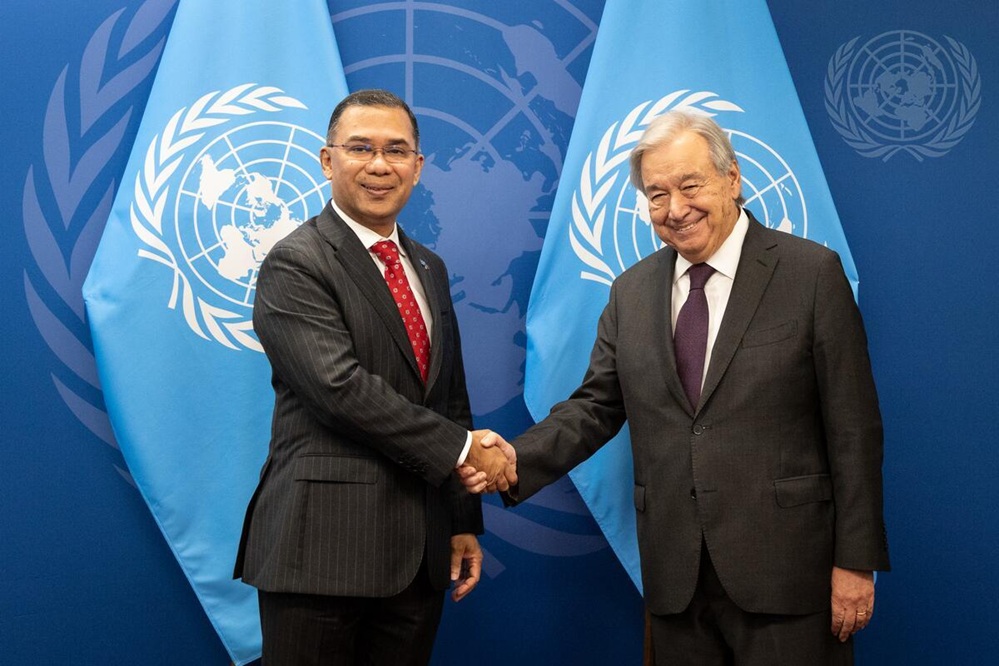
Secretary-General António Guterres (right) meets with Tarique Rahman, Prime Minister of the People’s Republic of Bangladesh.UN Photo/Ariana Lindquist
School bags, uniforms and free midday meals were being provided to primary school students from the first grade, he said, expressing hope that the initiatives would boost school enrolment and improve the quality of education. Tarique Rahman said sports had also been introduced as a subject in the education curriculum for the first time, with the aim of establishing sports as a profession.
As part of the initiative, more than two million students participated in a month-long football tournament held across the country in June, he said. The Prime Minister said science and technology would shape the future as the world entered a new era driven by artificial intelligence, biotechnology and scientific innovation. He said Bangladesh’s large young population and expanding digital capabilities had created new opportunities, but access to advanced technology, knowledge and research needed to be made available to all.
“We do not want today’s digital divide to become tomorrow’s artificial intelligence divide,” he said. Tarique Rahman said Bangladesh respected innovation and intellectual property while stressing the importance of technology transfer, skills development and affordable access to modern technologies.
“It is now time for the United Nations to adopt an effective policy framework so that the benefits of the development and rapid expansion of artificial intelligence and social media can be used positively in countries around the world,” he said. Turning to the Rohingya crisis, Tarique Rahman said Bangladesh had been sheltering more than 1.2 million forcibly displaced Rohingyas from Myanmar for more than nine years.
He said the only solution to the crisis was the safe and dignified return of the displaced Rohingya population to their homeland in Myanmar and called for continued life-saving assistance until their repatriation. The Prime Minister said Bangladesh was continuing its progress in democracy, human rights, good governance, accountability, political stability and improving the investment environment.
“In the present democratic Bangladesh, we welcome partnership, innovation and both domestic and foreign investment,” he said. Tarique Rahman said the government wanted to build a Bangladesh where young people could pursue their dreams without fear or hindrance, women could lead their lives with confidence and every child could grow up with opportunities to realise their full potential.
“Above all, the people will have the assurance of a safe and peaceful life. That is why we say, ‘Bangladesh First: Bangladesh for All’,” he added.
US Awami League Holds Protest Outside UN Headquarters in New York
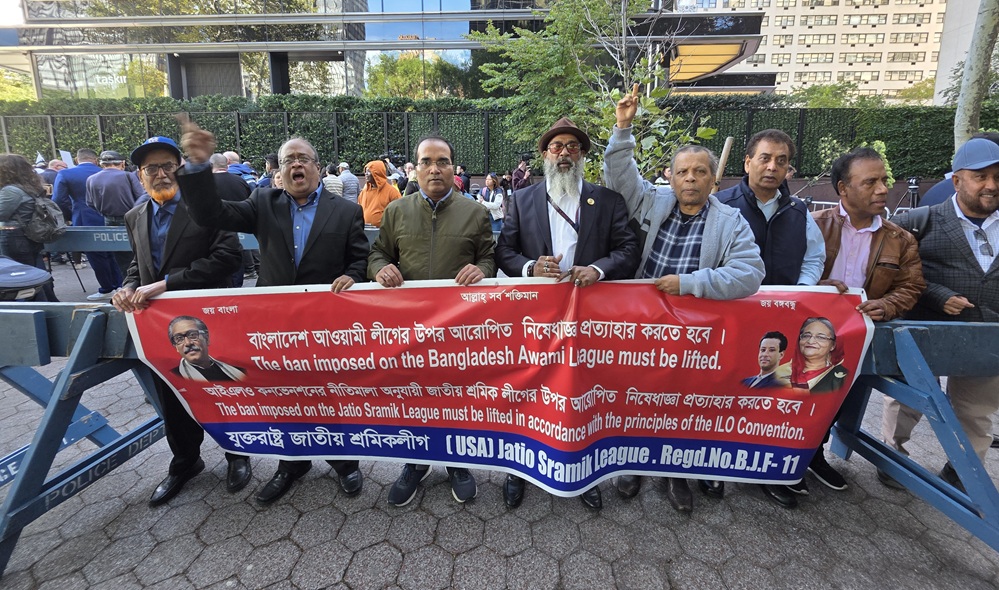
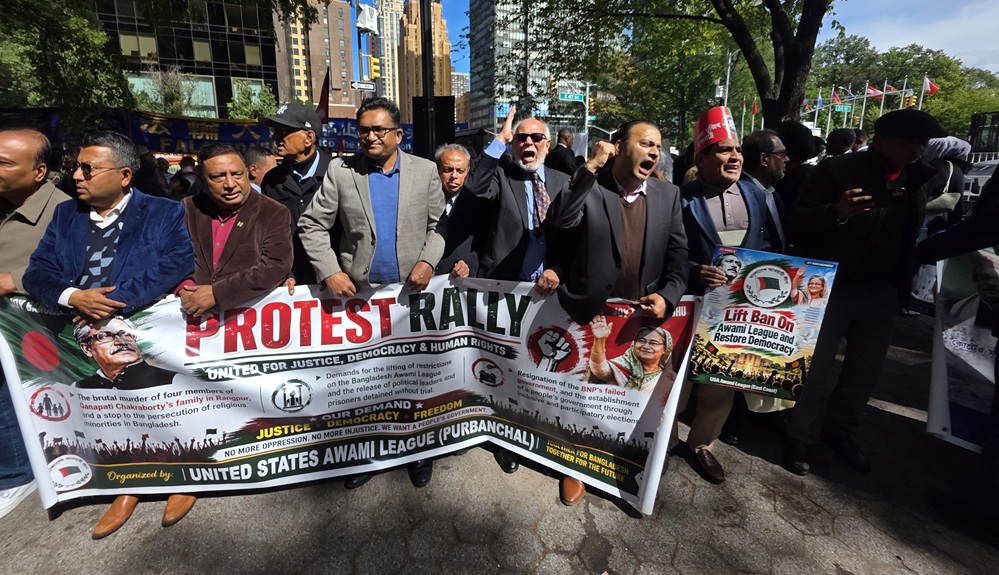
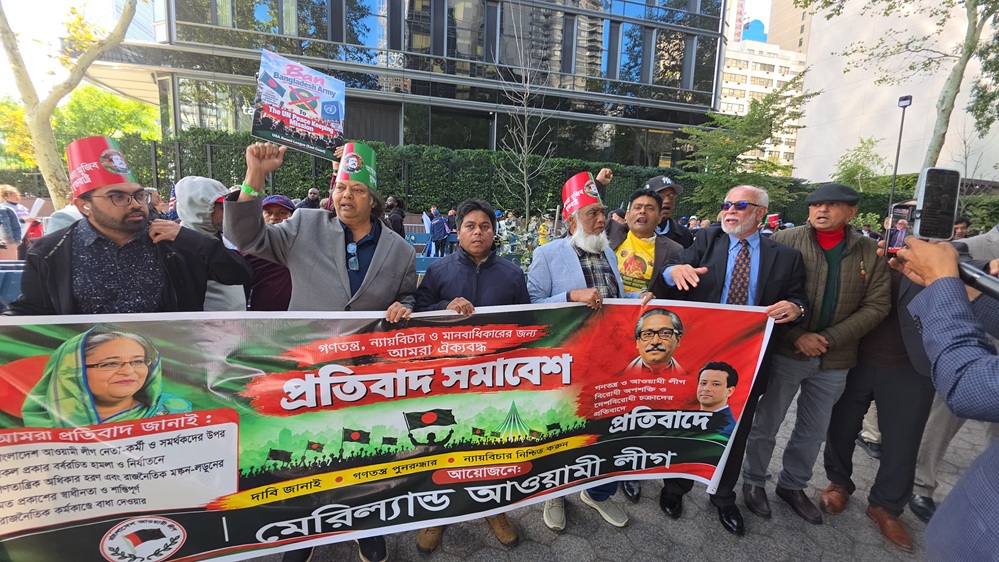
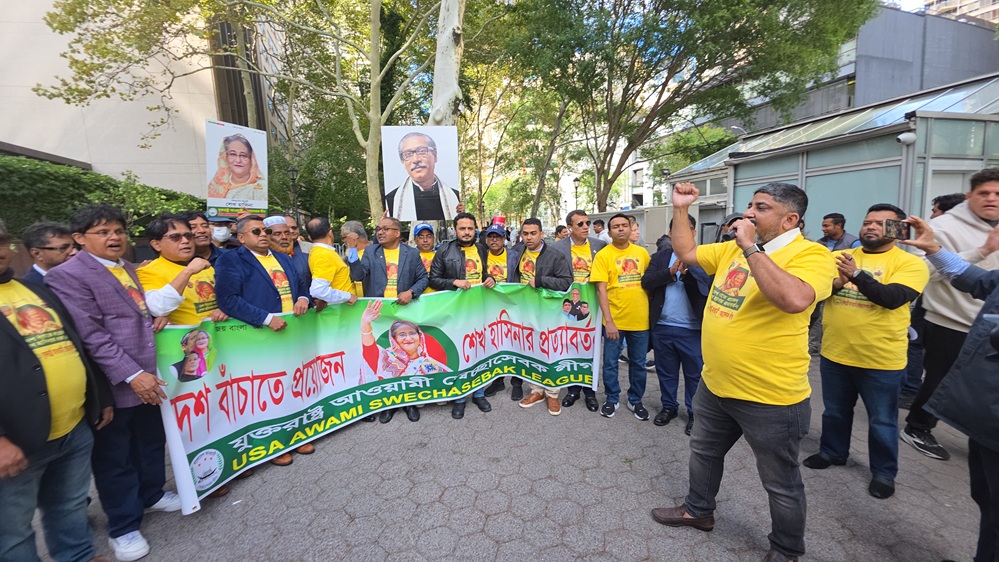
NEW YORK CORRESPONDENT: The US Awami League, Awami family members, and affiliated and associate organizations held a protest rally outside the United Nations headquarters in New York on Thursday, September 24, protesting the ban on all activities of the Bangladesh Awami League, death sentences against former Prime Minister Sheikh Hasina and other senior party leaders, and what they described as moves to hand over Saint Martin’s Island, ports and transit corridors to foreign interests.
The rally was held at noon outside the UN headquarters, with Awami League leaders and activists arriving from different states across the United States. Participants included leaders and activists from the US Awami League, US Jubo League, US Mohila League, US Chhatra League, US Sramik League, US Swechhasebak League, Michigan Awami League, Virginia State Awami League, Metro Washington Awami League, Maryland State Awami League, New York State Awami League, New York City Awami League, US Awami League South, US Awami League East, US Awami League West, and the organization Amra Mujib Sainik, among others.
Awami League supporters hold a protest outside the United Nations headquarters in New York on Thursday, September 24. Photo: KHABOR
The protesters chanted a range of slogans, including “Go Back Tarique,” “Terrorist Tarique,” “Khamba Tarique,” “No gas, no electricity—this government is not needed,” “No food, no clothing—this government is not needed,” “There are poles, but no electricity—this government is not needed,” “Police killer Tarique—go back, go back,” and “Grenade Tarique—go back, go back.”
Addressing the rally, speakers said the Awami League played a leading role in the establishment of Bangladesh as an independent and sovereign country. They alleged that banning the party’s political activities undermines the values, ideals and spirit of the country’s Liberation War. The speakers called for the immediate withdrawal of the ban, arguing that it would create political space for what they described as anti-liberation and extremist forces.
Awami League supporters hold a protest outside the United Nations headquarters in New York on Thursday, September 24. Photo: KHABOR
They also criticized the government over the country’s economic and social situation, citing rising prices, shortages of gas and electricity, problems in the education sector and what they described as a growing “mob culture.” They also alleged that Awami League leaders and activists were being killed and harassed.
The speakers made a number of allegations against BNP Acting Chairman Tarique Rahman. They questioned government decisions concerning aircraft purchases, arguing that greater attention should first be given to essential services and economic challenges inside Bangladesh.
Describing the situation in Bangladesh as a “major crisis,” the speakers alleged that domestic and foreign actors were conspiring over the country’s political and economic future. They claimed that factories and garment industries were facing difficulties and that the country’s production system was being adversely affected.
Awami League supporters hold a protest outside the United Nations headquarters in New York on Thursday, September 24. Photo: KHABOR
The speakers also raised concerns about child safety, public health and law and order, alleging that the government was not giving sufficient attention to these issues and was using political retaliation against its opponents.
Speakers further said that banning the Awami League would not end the party’s political existence. Referring to the party’s history, they said the Awami League had returned to politics after facing previous periods of political adversity and expressed confidence that it would again return as a stronger political force.
They also claimed that the ban had left people in Bangladesh and members of the diaspora shocked and angry. Some speakers described the current government as a “black government,” a characterization made by the speakers at the rally.
Among those attending the protest were US Awami League President Dr. Siddiqur Rahman, General Secretary Abdus Samad Azad, adviser Masudul Hasan, former BAKSU General Secretary and freedom fighter Dr. Pradip Ranjan Kar, Organizing Secretary Abul Hasib Mamun, former General Secretary Shamim Chowdhury, founding General Secretary of the US Awami League and mainstream political figure M.A. Salam, journalist Hakikul Islam Khokon, Ramesh Nath, Organizing Secretary Mohiuddin Dewan, freedom fighter Shawkat Akbar Ritchie, Legal Affairs Secretary Advocate Shah Md. Bokhtiar Ali, Education Affairs Secretary M.A. Karim Jahangir, and Dr. Masudul Hasan, president of the US chapter of Sheikh Kamal Parishad.
Awami League supporters hold a protest outside the United Nations headquarters in New York on Thursday, September 24. Photo: KHABOR
Also present were Awami League leader and Sheikh Hasina Mancha President freedom fighter Jalal Uddin Jalil, Organizing Secretary Sheikh Selim, Executive Member Shahanara Rahman, Awami League leader and former Union Parishad Chairman Iqbal Hossain, Awami League leaders Akhtar Hossain and Ali Hossain Ghaznavi, among others.
New York State Awami League President and freedom fighter Mujibur Rahman Mia, Vice Presidents Sheikh Atikul Islam and Abul Kashem Bhuiyan, Bangladesh Awami League Foundation Chairman Abdul Kader Mia, New York City Awami League President Rafiqul Rahman Rafiq and General Secretary Emdad Chowdhury also attended.
Others included Connecticut State Awami League General Secretary Humayun Ahmed Chowdhury, Mohila Awami League Joint General Secretary Rumana Akter, Awami League leader A.K. Chowdhury, Jubo League leaders Mizanur Rahman and Mizanur Rahman Chowdhury, US Chhatra League Vice President Shahidul Islam, and US Jubo League leader Khandaker Zahedul Islam.
Virginia State Awami League President G.I. Russell and member Jeba Russell, Metro Washington Awami League President M. Nabi Baki, Vice President Nurul Amin, General Secretary Mohammad Azam and Women’s Affairs Secretary Mohsina Jannat Rimi, as well as Maryland State Awami League President Moinul Majumdar Tapas, Mosharraf Hossain Dulal and Sramik League President Azizul Khokon were also among those present.
The rally concluded with demands for the restoration of the Awami League’s political rights and the return of Sheikh Hasina to Bangladesh, along with calls for a fresh election.
Awami League Protest in New York Over Death Sentences for 7 Leaders
New York Correspondent: The US Awami League and its affiliated organisations staged a protest rally and procession in New York on Tuesday evening against the death sentences handed down by Bangladesh’s International Crimes Tribunal-2 against seven Awami League and affiliated-organisation leaders, including Awami League General Secretary and former minister Obaidul Quader.
The protest was held at Diversity Plaza in Jackson Heights on Tuesday (September 15). Following the rally, protesters marched through nearby streets carrying banners and placards. Leaders and activists of the US Awami League, US Chhatra League, Volunteer League, Labour League, Mohila Awami League, New York State Awami League and New York Metropolitan Awami League took part in the programme.
Several national-level Awami League leaders and former lawmakers were also present, according to organisers. They included former Water Resources Minister and former Awami League Organising Secretary Enamul Haque Shamim, Awami League Publicity and Social Welfare Secretary Aminul Islam Amin, former State Minister and former lawmaker Mohammad Zahid Ahsan Russel, and former lawmaker and former Bangladesh Chhatra League General Secretary Nazrul Islam Babu.
US Awami League President Dr. Siddiqur Rahman and General Secretary Abdus Samad Azad, along with leaders from different levels of the organisation, also attended the programme.
The protesters carried banners and placards rejecting the tribunal’s verdict. The organisers described the cases against the party leaders as politically motivated and characterised the verdict as an act of political retaliation and a predetermined judicial process. These are the political claims of the US Awami League and the protesters.
At the rally, speakers expressed their opposition to the tribunal’s verdict and called for its cancellation. They also called for due legal process and justice, arguing that political disputes should not determine judicial outcomes.
Seven Sentenced to Death by Tribunal
Earlier on Tuesday, International Crimes Tribunal-2 sentenced seven people to death in a crimes-against-humanity case related to the July-August 2024 mass uprising in Bangladesh.
Those sentenced to death are Awami League General Secretary and former minister Obaidul Quader; Awami League Joint General Secretary AFM Bahauddin Nasim; former State Minister for Information and Broadcasting Mohammad Ali Arafat; Jubo League Chairman Sheikh Fazle Shams Parash; Jubo League General Secretary Md Mainul Hossain Khan Nikhil; Bangladesh Chhatra League President Md Saddam Hossain; and its General Secretary Sheikh Wali Asif Inan.
The three-member tribunal, headed by Justice Nazrul Islam Chowdhury, delivered the verdict on Tuesday. The seven accused were tried in absentia and remain at large, according to Bangladesh Sangbad Sangstha (BSS).
The prosecution had accused the seven of involvement in crimes against humanity during the July 2024 mass uprising, including murder, attempted murder, torture, incitement, conspiracy and other acts. The tribunal ruled that the charges against the accused had been proved beyond reasonable doubt. Chief Prosecutor Md Aminul Islam also said after the verdict that most of the charges had been proved beyond reasonable doubt.
The tribunal also ordered the confiscation of 50 percent of the movable and immovable properties of Obaidul Quader, AFM Bahauddin Nasim, Mohammad Ali Arafat, Sheikh Fazle Shams Parash and Mainul Hossain Khan Nikhil. It directed that proceeds from the sale of the confiscated properties be used to compensate people killed or injured during the July-August 2024 uprising or their families.
The defence had previously argued before the tribunal that the prosecution failed to prove the charges beyond reasonable doubt.
The New York protest came hours after the tribunal announced its verdict in Dhaka, bringing the latest political and judicial developments in Bangladesh into the streets of Jackson Heights, home to a large Bangladeshi-American community.
Saima Wazed Resigns as WHO Regional Director, Denies Allegations
NEW YORK: Saima Wazed has resigned as the World Health Organization’s (WHO) Regional Director for South-East Asia. According to her resignation letter seen by Reuters, she stepped down amid investigations by the WHO and Bangladeshi authorities into allegations of fraud and document forgery. Her resignation took effect immediately.
Wazed assumed the position of WHO Regional Director for South-East Asia in early 2024 for a five-year term. However, she had been on unpaid administrative leave since July 2025. Earlier, in March 2025, Bangladesh’s Anti-Corruption Commission filed a case against her over allegations of fraud and forgery.
According to the Reuters report, allegations against Wazed included financial irregularities related to a trip to China, providing inaccurate information concerning her educational qualifications, and the alleged illegal acquisition of land in Bangladesh. Wazed has denied the allegations.
A July 3, 2026 letter from her lawyers, seen by Reuters, said the allegation concerning expenses from her China trip did not involve travel fraud. Instead, they said an assistant had made an administrative error while processing the repayment of routine expenses. The amount involved was $901.
Responding to questions about her educational qualifications, Wazed said she had received an honorary doctorate in recognition of her work on autism in Bangladesh and had informed WHO Director-General Tedros Adhanom Ghebreyesus about it.
Regarding the land allegations, Wazed said in her resignation letter that she had acquired the property before joining the WHO. She also said she was entitled to the land under a Bangladeshi law applicable to members of the family of Bangladesh’s founding leader, Sheikh Mujibur Rahman.
In her resignation letter, Wazed further alleged that she had been prevented from effectively carrying out her responsibilities. She said the situation had destroyed her trust and confidence in the WHO leadership. She also said nearly a year without a salary had made her financial situation unsustainable.
The WHO told Reuters that a committee had recommended removing Wazed from her position one day before her resignation. The organization said her resignation would now be considered by the Regional Committee and the Executive Board. A WHO spokesperson said the process had been handled with fairness and appropriate procedures while protecting the organization’s interests and ability to fulfill its responsibilities.
The WHO is preparing to begin the process of selecting Wazed’s successor. Two Reuters sources said nominations are expected to be announced on October 12, applications are expected to be reviewed in December, and the election is planned for January 24. Until a new Regional Director is elected, Dr. Nilesh Buddh will serve in the role.
The Regional Director for WHO’s South-East Asia Region is one of the organization’s key leadership positions. The position involves overseeing the WHO’s response to disease outbreaks and emergencies and helping implement the organization’s policies in accordance with regional circumstances. Member states elect the Regional Director every five years. Bangladesh and India are among the countries in the region.
UN Calls for Independent Oversight of Bangladesh Security Forces
Shibbir Ahmed, UN, New York: The United Nations has called for the establishment of a strong and independent national institution to oversee the activities of Bangladesh’s security and law enforcement agencies. UN High Commissioner for Human Rights Volker Türk made the remarks on Monday, September 7, during the 63rd session of the UN Human Rights Council in Geneva, while addressing global human rights issues and developments in Bangladesh.
Türk reiterated the UN’s call for effective and independent oversight of law enforcement agencies in Bangladesh. He stressed the importance of ensuring accountability and providing mechanisms for independent investigations into allegations of human rights violations involving security and law enforcement personnel.
Recommendations Following the July-August 2024 Events
The UN’s latest remarks follow its fact-finding report on the human rights situation surrounding the July-August 2024 protests in Bangladesh. The UN Human Rights Office published its fact-finding report on February 12, 2025, containing a series of recommendations concerning accountability, institutional reform, independent investigations and civilian oversight.
The recommendations also called for strengthening the independence and effectiveness of Bangladesh’s National Human Rights Commission, including ensuring that it has the necessary authority and capacity to investigate allegations of human rights violations involving security forces.
Oversight, Not Direct UN Control
The UN’s call does not mean that the United Nations is seeking to directly control or supervise Bangladesh’s security forces. Rather, the recommendation calls for Bangladesh to establish an independent and effective national oversight mechanism capable of monitoring security and law enforcement agencies and independently investigating allegations of human rights abuses. The latest statement by the UN human rights chief is part of the organization’s continuing call for stronger accountability, institutional reform and human rights protections in Bangladesh.