News of Resignation Order for Ishraq Hossain Is False: Press Officer

DHAKA: The office of State Minister for Liberation War Affairs Ishraq Hossain has strongly rejected reports circulating in various media outlets and on social media claiming that he has resigned or been instructed to resign, describing the reports as “completely false, baseless, and politically motivated.”

In a press statement issued on Sunday and signed by the minister’s press officer, Mahfuz Kabir Mukta, the office condemned the reports and urged the public not to be misled by what it described as deliberate misinformation.

The statement said that Minister Ishraq Hossain has been performing his duties with dedication and integrity. It also clarified that no instructions had been issued by the government’s senior leadership for him to step down and that there was no basis for such rumors. According to the statement, an interest-driven group is allegedly spreading fabricated information to achieve political objectives and create confusion among the public.

Ishraq Hossain’s Firearm Incident Explained

The statement also addressed an incident that took place on October 17 in Gandaria, within the minister’s parliamentary constituency, during a social resistance campaign against drugs. According to the minister’s office, he displayed his personal firearm in a lawful act of self-defense amid the situation that arose during the program. The statement noted that the minister had already explained his position regarding the incident. It further criticized reports linking the incident to his alleged resignation, calling such coverage misleading and contrary to journalistic ethics.

Media Urged to Withdraw False Reports

The press statement called on all media outlets and members of the public not to be influenced by what it described as misinformation. It also demanded that media outlets that had published the alleged resignation news withdraw their reports immediately. Otherwise, the statement warned, appropriate legal action could be taken against those responsible for spreading the misinformation. The minister’s office reiterated that reports of Ishraq Hossain’s resignation or an order directing him to resign are unfounded, according to the official statement.


Tarique Rahman Asks State Minister Ishraque Hossain to Resign

Dhaka: A political controversy has emerged in Bangladesh following reports that Prime Minister Tarique Rahman instructed State Minister Ishraque Hossain to resign from the cabinet. According to media reports, the reported directive came after controversy surrounding Ishraque Hossain’s participation in an anti-drug operation in Dhaka while carrying a firearm.

The issue reportedly came into focus following a cabinet meeting at the Secretariat on Sunday. However, an official government confirmation and confirmation that a formal resignation has been submitted are necessary to establish the latest status of the matter. The reports have sparked discussion in Bangladesh’s political circles. Further clarification is expected if the government or the individuals concerned issue an official statement.


Plaintiff Withdraws Case Against Hasina, 183 Others in Chattogram

Chattogram: A Chattogram court has approved the withdrawal of a criminal case filed against deposed prime minister Sheikh Hasina and 183 others after complainant Kofil Uddin informed the court that the dispute had been amicably resolved. Additional Chief Metropolitan Magistrate Md Mohidul Islam passed the order on October 8, accepting the complainant’s petition to withdraw the case, which was filed on November 18, 2024.

Earlier, on July 13, 2026, Kofil Uddin told Metropolitan Magistrate Md Abu Bakar Siddique that the dispute had been settled out of court. He also stated that he had no objection to the accused being discharged.

Kofil Uddin, son of late Jebol Hossain of Anowara, had filed the complaint alleging that he was injured by gunfire and explosions during clashes between protesters and Awami League activists in Chattogram’s New Market area on August 4, 2024.

Following a court order for an investigation, Police Bureau of Investigation (PBI) Metro Inspector Syed Mohammad Ahsanul Islam submitted a report to the Chattogram court in March this year. The report accused 66 Awami League leaders and activists, including Hasina, in connection with attacks on protesters.

The PBI recommended discharging 26 accused, including former PBI chief Banaj Kumar Mazumder, former Dhaka Metropolitan Police Detective Branch chief Harun-or-Rashid and former Chattogram Metropolitan Police commissioner Saiful Islam, saying it had found no evidence of their involvement.

According to the report, evidence was found that Hasina, former road transport minister Obaidul Quader, former home minister Asaduzzaman Khan Kamal, former inspector general of police Chowdhury Abdullah Al Mamun and former education minister Mohibul Hasan Chowdhury Nowfel had incited and directed efforts to suppress the student movement.

The investigating officer identified Kofil Uddin as a day labourer and said he had actively participated in the quota reform and anti-discrimination movement in the Kotwali area. Speaking to Journalists on Thursday, Kofil Uddin said he had actively participated in the July uprising and filed the case seeking justice.

However, he said he had experienced injustice and discrimination himself in the months following the uprising.

“I was targeted by the students who led the movement against the Awami League. I was beaten and even jailed on allegations that I was associated with the Jubo League and Chhatra League,” Kofil Uddin said. He claimed that although he had interacted with many people, including members of the Jubo League and Chhatra League, he had never held any position in either organisation.

“So, I withdrew the case. I found no benefit in continuing the case,” he said.


Hasina Vows Return to Bangladesh, Demands Free Elections

Shibbir Ahmed, New York — Awami League President and former Bangladesh Prime Minister Sheikh Hasina has expressed her desire to return to Bangladesh in December, calling for the restoration of democracy, voting rights, and the rule of law in the country.

In an interview with the Press Trust of India (PTI), Hasina said Bangladesh was going through a serious national crisis. According to her, democratic space had narrowed, the judiciary was being used for political retaliation, media freedom had been restricted, and law and order had deteriorated. She also said that minorities were facing insecurity, extremist forces had regained ground, and the economy had suffered. She said factory closures, rising unemployment, declining investment, electricity and gas shortages, and increasing prices were putting pressure on ordinary families.

Hasina said returning to Bangladesh could expose her to the risk of arrest, imprisonment, or even death. Referring to the killing of members of her family in 1975, her return to Bangladesh in 1981, and the grenade attack on August 21, 2004, she said those experiences had not changed her determination.

According to Hasina, the death sentence handed down against her was politically motivated and delivered without giving her an adequate opportunity to defend herself. She said many Awami League leaders had left the country to protect their lives, while those remaining in Bangladesh were also facing pressure.

Hasina said the Awami League maintained an organisational base across Bangladesh. According to her, the party was demanding democracy, the rule of law, the release of political prisoners, the withdrawal of what she described as false cases, protection for minorities, action against extremism, and economic recovery.

She said the Awami League wanted to return to power through free and fair elections. However, she added that the party would have to accept the people’s decision if voters elected another political party.

Hasina said Bangladesh’s foreign policy should be guided by the principle of “friendship to all, malice towards none.” She described India as Bangladesh’s closest neighbour and historic friend, while identifying China as an important partner. She also stressed the importance of maintaining relations with Japan, the United States, Europe, ASEAN, and the Muslim world.

She highlighted cooperation with India during her government’s tenure in security, connectivity, energy, trade, and border management. She referred to the Ganges water-sharing treaty, the Chittagong Hill Tracts Peace Accord, the Land Boundary Agreement, the exchange of enclaves, bus and train links, port access, and energy cooperation.

Speaking about the Teesta River management project, Hasina said it should be transparent, technically sound, and environmentally responsible. According to her, the issue was connected to water resources, agriculture, the environment, people’s livelihoods, and relations between Bangladesh and India. She said a solution should be pursued through dialogue and mutual respect to ensure Bangladesh’s fair share of Teesta waters.

Hasina described Bangladesh’s decision not to participate in the BRICS summit held in India as unfortunate and immature. In her view, the decision had harmed Bangladesh’s national interests and caused the country to miss opportunities for international cooperation. She said foreign policy should not be driven by personal considerations or political reactions, adding that Bangladesh needed to maintain balanced relations with different countries.

Hasina said Bangladesh’s economy had expanded from approximately $70 billion to $450 billion during the Awami League government’s tenure. According to figures she cited, per capita income had increased from $482 to $2,784. She said the poverty rate had fallen from 41 per cent to 18.6 per cent, while extreme poverty had declined from 25.1 per cent to 5.6 per cent.

She also said Bangladesh’s power generation capacity had increased from 3,782 megawatts to more than 28,000 megawatts. Among the development projects she highlighted were the Padma Bridge, metro rail, the Rooppur Nuclear Power Plant, the Matarbari project, the Karnaphuli Tunnel, the Bangabandhu Satellite, roads, bridges, ports, economic zones, community clinics, and housing projects for landless families.

Discussing the current economic situation, Hasina said GDP growth had slowed, non-performing loans had increased, investment had declined, and unemployment had risen. She claimed that more than 500 factories had closed and over 20 million people had become newly unemployed.

She also said many industrialists and businesspeople were in prison or in hiding. According to her, the government was borrowing between Tk 7 billion and Tk 9 billion daily from banks, while the costs of various projects had increased by between 50 per cent and 250 per cent.

Addressing the measles situation, Hasina said there had been delays in procuring vaccines and that Muhammad Yunus had been warned about shortages of vaccines for children. She alleged that vaccines had not been procured on time and that the issue had not subsequently been addressed with the urgency required. Hasina claimed that more than 1,000 children had died and held Muhammad Yunus and Tarique Rahman responsible for the situation.

Speaking about the 2024 student movement, Hasina said her government had taken steps to resolve the dispute over quotas. She noted that the quota system had been abolished following the student movement in 2018. According to her, the protests continued in 2024 even after the demands had been addressed and later developed into a movement to bring down the government.

Referring to a statement by Muhammad Yunus, Hasina questioned who had been involved in planning, financing, and organising violence during the movement. She said a judicial commission had been formed to investigate violence on July 18, 2024, but alleged that it was discontinued after Yunus came to power. She further claimed that participants in the movement had received legal protection while numerous cases had been filed against Awami League leaders and activists. Hasina said an independent investigation was needed to identify those who ordered, organised, financed, or benefited from killings, arson, and other acts of violence.

Hasina said her government had taken initiatives to encourage the Bangladesh Nationalist Party (BNP) to participate in the 2024 election. She claimed that Khaleda Zia had been invited for talks and that proposals had been made to include representatives of different political parties in the government during the election period. According to Hasina, the BNP rejected these proposals and boycotted the election.

She referred to incidents involving attacks and arson targeting vehicles, trains, schools, and polling centres at different times. She also mentioned the Hefazat-e-Islam movement in 2013, pre-election violence in 2014, the Holey Artisan attack in 2016, and the BNP’s participation in the 2018 election. Hasina said political parties should participate in elections and accept the people’s verdict in a democracy.

Hasina called on the international community to support democracy, human rights, the rule of law, political participation, and media freedom in Bangladesh. She said it would not be possible to build an inclusive Bangladesh by banning a major political party, keeping its leaders in prison, restricting media freedom, and excluding millions of people from the political process. In the PTI interview, Hasina reiterated her desire to return to Bangladesh and emphasised the restoration of democracy, voting rights, and the rule of law.

Two Sent to Jail Over Attempt to Erase Rabindranath Tagore Mural in Dhaka

DHAKA — A court in Dhaka has ordered the detention of two people, including Al Nur Mohammad Ayash, president of the State Dialogue Forum, in a case filed over an attempt to erase a mural of Nobel laureate Rabindranath Tagore outside the Bangladesh Shilpakala Academy. The other accused is Marzia Khandaker Rimi.

Police produced the two accused before the Dhaka Chief Metropolitan Magistrate Court on Tuesday after completing their remand. The investigating officer sought to keep them in custody until the investigation is completed, while their lawyers filed bail petitions.

After hearing both sides, Metropolitan Magistrate Riyad Hasan rejected their bail applications and ordered that they be sent to jail. On October 11, an additional chief metropolitan magistrate in Dhaka, Joshita Islam, had granted three days of remand for Ayash and two days for Rimi.

The incident took place on October 10, when a group of young people allegedly attempted to erase Tagore’s mural on a wall outside the Shilpakala Academy. A confrontation reportedly broke out between the group and police after officers intervened to stop them.

A woman was seen applying black ink to the mural, according to the account of the incident. A police officer intervened to prevent her from doing so. Following the incident, Shahbagh Police Station Sub-Inspector Ziaul Haque filed a case alleging criminal conspiracy, the promotion of enmity between different groups, and hurting religious sentiments. The court’s decision to deny bail means the two accused will remain in jail while the investigation proceeds.


PM Backs KUET Waste-to-Fuel Project

DHAKA — Prime Minister Tarique Rahman has assured researchers of government support for a project to produce fuel oil from human waste, sewage, kitchen waste and agricultural residues. The prime minister gave the assurance on Saturday after viewing a demonstration of the technology at his office in Tejgaon, according to his Deputy Press Secretary Md Suzauddhowla (Sujan Mahmud).

Khulna University of Engineering and Technology (KUET) Professor Dr Md Khalekuzzaman briefed the prime minister on the research, its progress and the prospects for commercial production. The researchers have been developing the technology for nearly a decade using Hydrothermal Liquefaction (HTL), a process that converts wet organic waste into biocrude under high temperature and pressure.

Laboratory tests have reportedly achieved biocrude yields of 50 to 55 percent, with further progress in producing diesel-rich biocrude. The next step is to establish a pilot plant capable of processing one to three tonnes of waste daily to evaluate production efficiency, costs and commercial viability. The proposed facility is estimated to cost Tk 100 crore to Tk 120 crore.

According to the researchers, successful commercial-scale implementation could eventually replace 10 to 15 percent of Bangladesh’s imported crude oil and save an estimated Tk 6,500 crore to Tk 13,000 crore in foreign exchange annually.

However, the researchers acknowledged that these projections depend on successful scale-up and assessments of the technology’s economic viability. They said the project could help reduce fuel import dependence, improve waste management, curb environmental pollution and create opportunities for a domestic fuel industry.

Power and Energy Minister Iqbal Hassan Mahmood Tuku, State Minister Aninda Islam Amit, University Grants Commission member Professor Dr Abdullah-Al-Mamun, KUET Vice-Chancellor Professor Muhammad Masud and Bangladesh Petroleum Corporation Chairman Dr Md Rafiqul Islam were also present at the demonstration.


New York Labor League President Khokon Dies at 58; Body Sent to Bangladesh

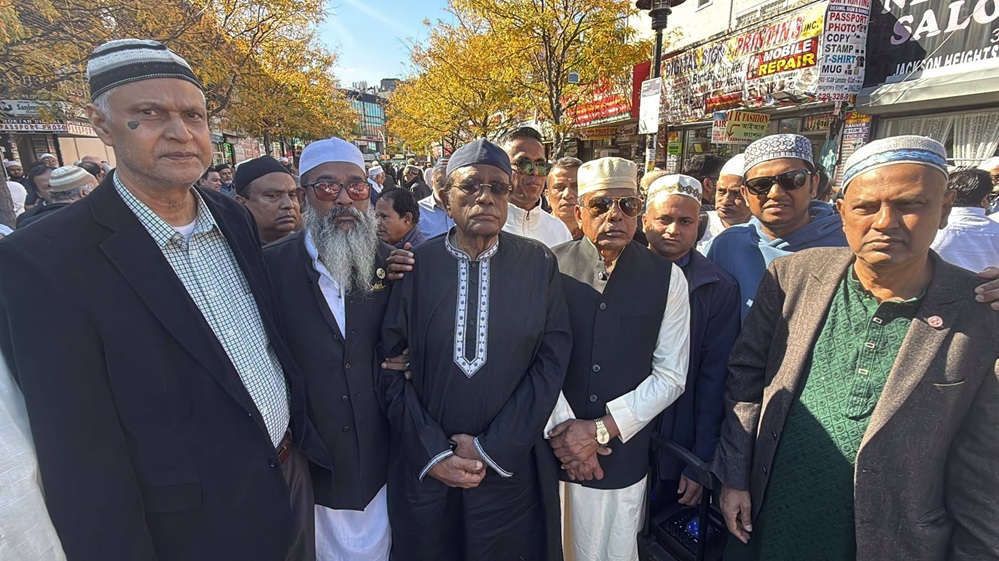
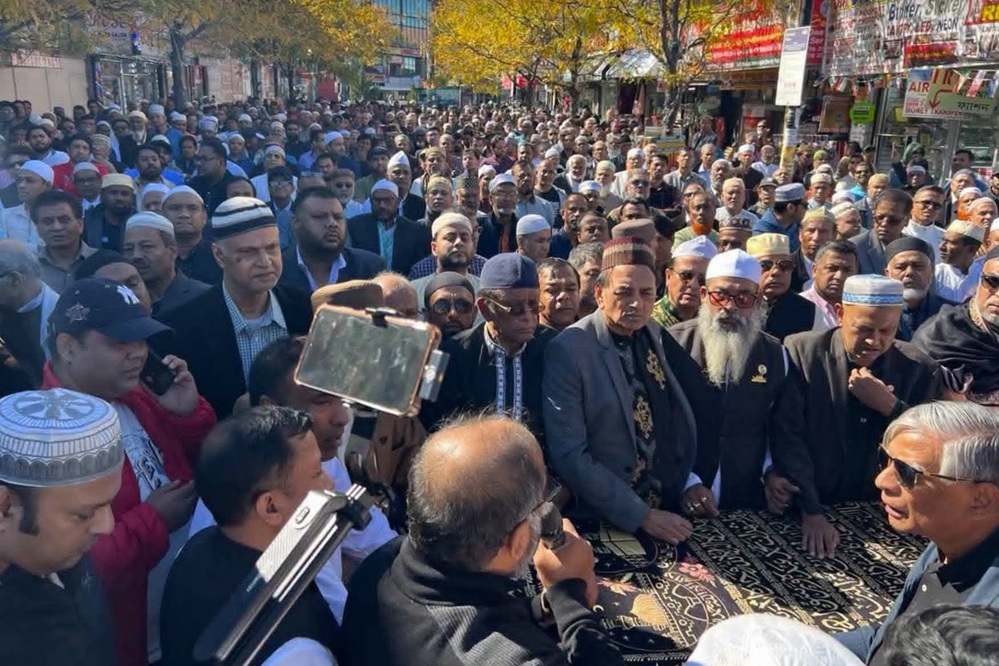
Shibbir Ahmed, New York — Kazi Azizul Haque Khokon, 58, president of the United States Labor League, was remembered with tears, prayers and heartfelt tributes as hundreds of Bangladeshi expatriates from across the political spectrum gathered to pay their final respects to the community leader in New York City.

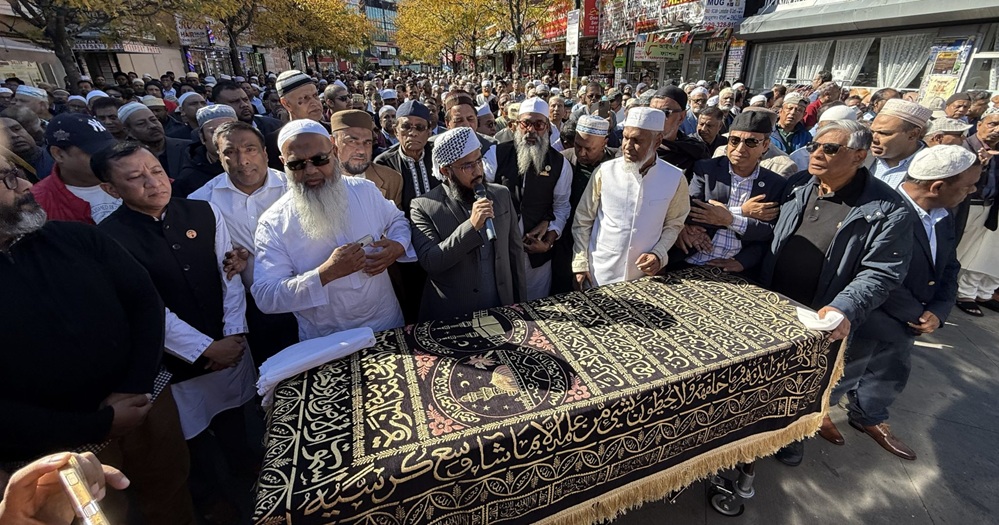
Thousands of worshippers and mourners attended his funeral prayers after Jumu’ah on October 9 at Diversity Plaza in Jackson Heights, Queens. Community members, political leaders and longtime acquaintances gathered to bid farewell to Khokon, whose death had left many in the Bangladeshi diaspora in mourning.

Khokon reportedly suffered a cardiac emergency while traveling by bus to work on October 3. When he could not be located, a report was filed with police. Friends and political associates searched for him before his body was found at Bellevue’s morgue on the evening of October 7.

Originally from Magura, Bangladesh, Khokon came to the United States in 1992. According to people familiar with his circumstances, he had not obtained permanent immigration status and spent his years in the country living as a bachelor.

Before the funeral prayers, Jewel Ahmed, secretary of the U.S. Labor League, appealed to anyone who had outstanding financial matters with Khokon to contact him. Hossain Rana, an Awami League leader and one of the owners of Obosor Book Corner, where Khokon worked in Jackson Heights, also asked anyone who believed Khokon had wronged them to forgive him.

Ataur Rahman Selim, president of the Bangladesh Society, prayed for the forgiveness of Khokon’s soul and said the organization was taking responsibility for the funeral arrangements and the costs associated with sending his body to Bangladesh.

The funeral drew a broad cross-section of the Bangladeshi-American political and community leadership. Those attending included Moin Chowdhury, a Democratic Party district leader-at-large and attorney; Siddiqur Rahman, president of the U.S. Awami League; General Secretary Abdus Samad Azad; spokesperson Dr. Masudul Hasan; Awami League leader Engineer Mohammad Ali Siddiqui; Haji Enam; Misbah Ahmed; Rafiqul Rahman and Imdad Chowdhury, president and general secretary of the New York City Awami League, respectively.

Also present were Mujibur Rahman Mia, president of the State Awami League and a freedom fighter; General Secretary Shaheen Azmal; Abdur Rahim Badsha, chief adviser to the U.S. Labor League; H.M. Iqbal and Syed Kibria Zaman, president and general secretary of the Swechchhasebak League; former president Nuruzzaman Sardar; Momtaz Shahnaz, president of the Women’s Awami League; Shahahana Rahman, an executive committee member of the U.S. Awami League; former member of parliament Nazrul Islam Babu; Mahmud Hasan and Hridoy Mia, president and general secretary of the U.S. Chhatra League; Harun Bhuiyan and Fahad Solaiman, president and general secretary of the JBBBA; and Mahiyuddin Dewan and Mohammad Ali, senior vice president and general secretary of the Bangladesh Society, among others.

Following the funeral prayers, a vehicle carrying Khokon’s coffin departed for John F. Kennedy International Airport. His body was scheduled to leave for Dhaka on an Emirates flight that night, according to the information provided by community representatives.

Meanwhile, members of the Awami League and affiliated organizations gathered at Nabanna Party Hall on the evening of October 8 in response to a call from the Labor League. They reportedly raised approximately $10,000 to assist with arrangements related to Khokon’s death and support his family.

Jewel Ahmed and Dr. Masudul Hasan said the collected funds, along with cash reportedly found in Khokon’s pocket, would be sent to his brothers and sisters in Magura. Khokon’s funeral brought together political colleagues, community leaders and expatriates from different backgrounds, reflecting the connections he had built during his decades in the United States. As his body was prepared for its final journey to Bangladesh, members of the community offered prayers and expressed condolences to his family.


Bangladesh Model Canal Programme to Create Jobs for 2,400 Families

Nazirur Rahman Sohel, Dhaka — The Bangladesh government is preparing to launch a pilot Model Canal programme aimed at creating employment opportunities, diversifying livelihoods and improving environmental sustainability through the planned use of re-excavated government-owned canals and water bodies.

The initiative, led by the Ministry of Disaster Management and Relief, will cover 20 selected canals across eight divisions, with an estimated 2,400 ultra-poor families expected to benefit. Prime Minister Tarique Rahman is scheduled to inaugurate the programme in Lalmonirhat on November 19, according to information from the ministry.

Under the concept of “Not Just Canal Excavation, but Multifaceted Use of Excavated Canals,” the government intends to transform restored canals into productive community resources rather than using them solely for drainage and water management.

The programme will promote social forestry along canal banks, fish and duck farming, seasonal vegetable cultivation and cottage industries, while preserving the natural flow and water-retention capacity of canals. It also aims to improve navigation, strengthen local livelihoods and generate sustainable employment for vulnerable households.

Disaster Management and Relief Minister Asadul Habib Dulu said the initiative builds on the canal excavation campaign launched by Shaheed President Ziaur Rahman, which sought to restore the country’s water resources and support agricultural development. According to the minister, many canals have gradually become silted up because of neglect and illegal encroachment, reducing their capacity to support drainage, irrigation and other essential activities.

The government is now pursuing a broader programme to re-excavate 20,000 kilometres of rivers, streams and canals over five years, in line with the BNP’s election manifesto. Four government ministries are jointly implementing the initiative, with the Ministry of Disaster Management and Relief responsible for 7,000 kilometres.

Dulu said the ministry completed 1,200 kilometres of canal excavation during the last fiscal year against its assigned target. He explained that the Model Canal programme would introduce a more comprehensive approach by combining waterway restoration with productive economic activities and environmental conservation. A central objective of the Model Canal programme is to create income-generating opportunities for disadvantaged families living near restored waterways.

The government plans to encourage fish and duck farming in suitable canal sections, seasonal vegetable cultivation along canal banks and tree planting under social forestry initiatives. Cottage industries and other locally appropriate economic activities are also expected to contribute to employment generation.

These activities are intended to help participating families develop more diversified sources of income while making productive use of public water resources. The programme also supports the government’s wider target of planting 25 crore trees across Bangladesh. Integrating social forestry with canal restoration could help improve vegetation cover, protect canal banks and contribute to environmental conservation.

Officials say the approach is designed to help ultra-poor households move gradually towards economic self-reliance through productive livelihoods rather than depending exclusively on social assistance or allowances. The initiative places particular emphasis on preserving the environmental and water-management functions of canals while introducing new economic uses.

According to the programme’s concept paper, activities will be planned to maintain natural water flow and water-retention capacity, helping canals continue to support drainage, irrigation and other local needs.

Restored waterways can play an important role in managing seasonal water flows and supporting agricultural production. Their effective management may also help communities strengthen resilience against water-related disasters, although outcomes will depend on local conditions and implementation.

Minister Dulu said the programme would be implemented in accordance with the Environmental Conservation Act and the Water Body Management Policy. The ministry would also respect the existing legal, administrative and technical responsibilities of relevant government departments and institutions.

This coordination will be important to ensure that commercial and livelihood activities do not undermine the public, environmental and agricultural functions of the canals.

The Model Canal initiative forms part of the government’s broader commitment to expanding irrigation facilities, conserving water resources and accelerating agricultural production. Under the five-year nationwide plan, the excavation and re-excavation of rivers, streams, canals and other water bodies is intended to restore lost water flows and improve the availability of water for agricultural and community use.

The government is also continuing efforts to restore waterways through public participation, following the tradition of voluntary canal excavation associated with Ziaur Rahman’s earlier campaign. By linking restoration work with farming, aquaculture, forestry and small-scale industries, the Model Canal programme seeks to create a closer connection between environmental management and rural economic development.

Its success will depend on effective coordination among government agencies, protection against renewed encroachment, responsible management of canal banks and water, and the ability of participating families to sustain their livelihood activities over time.

The planned launch of the Model Canal programme represents an effort to broaden the role of canal restoration in Bangladesh’s rural development strategy. With 20 canals selected across eight divisions and approximately 2,400 ultra-poor families expected to benefit, the pilot will test whether restored waterways can support environmental protection alongside employment generation and income diversification.

If implemented effectively, the programme could provide a framework for combining water-resource management, social forestry, agricultural development and community-based economic activities in other parts of the country. The initiative’s long-term impact will depend on how successfully the government preserves the canals’ natural functions while ensuring that local communities can benefit from them sustainably.


Bangladesh Opens Embassy in Ireland to Strengthen Bilateral Ties

DHAKA — Bangladesh has formally opened its embassy in Ireland, establishing a permanent diplomatic platform to strengthen bilateral relations, expand cooperation and enhance engagement with the Bangladeshi community in the country. The embassy began its administrative operations on Thursday from a temporary chancery at Alexandra House in Ballsbridge, Dublin, an area that hosts several diplomatic missions, according to a press release issued by Bangladesh’s Ministry of Foreign Affairs.

Mohammed Nore Alam, Bangladesh’s ambassador-designate to Ireland, assumed charge of the mission on Thursday. He is expected to present his credentials to the President of Ireland in due course. The establishment of the resident embassy marks a new milestone in Bangladesh-Ireland relations and is expected to facilitate closer diplomatic engagement and cooperation in areas of mutual interest, the ministry said.

The embassy will also serve as a dedicated platform for engaging with the estimated 25,000 Bangladeshi nationals living in Ireland. Passport, visa and other consular services will be introduced after the necessary administrative and logistical arrangements are completed. The services will be available to Bangladeshi nationals as well as other eligible applicants.

The Ministry of Foreign Affairs said details regarding the launch of consular services, including dates, procedures and other relevant information, will be announced through official channels. Bangladesh said it looks forward to further developing its friendly and mutually beneficial relations with Ireland through the newly established resident embassy.


Bangladesh Police Launches Cyber Police Unit for AI-Era Policing

DHAKA — Bangladesh Police has launched a dedicated Cyber Police Unit to strengthen cybercrime investigations, digital security and technology-driven policing as criminal activities increasingly evolve in the era of artificial intelligence. Home Minister Salahuddin Ahmed formally inaugurated the specialised unit at the Hall of Pride at Police Headquarters on Thursday.

Speaking at a press briefing after the inauguration, the home minister said the rapid development of artificial intelligence and changing patterns of crime require law enforcement agencies to move beyond conventional policing and adopt technology- and knowledge-based approaches.

“In the era of artificial intelligence, the nature of crime is changing rapidly. Our policing system must evolve accordingly. The Cyber Police Unit is a major step towards transforming Bangladesh Police into a modern, technology-driven and knowledge-based force,” he said.

The new unit represents a major institutional step toward establishing a technology-led policing framework capable of responding to increasingly sophisticated cyber and digital crimes. The Cyber Police Unit will be headed by an Additional Inspector General of Police (Additional IGP). Mohammad Iqbal Hossain has initially been assigned to lead the unit.

At the divisional level, deputy inspectors general (DIGs) and additional DIGs will oversee cyber-policing activities. At the district level, superintendents of police (SPs) or designated senior officers will be responsible for cyber-related operations.

Dedicated sub-inspectors, assistant sub-inspectors and constables will also be deployed at police stations to provide cyber-related services and assist with investigations. According to the approved organisational structure, the unit will have a total strength of 4,592 personnel. Initially, experienced and trained members of the existing police force will be deployed, while additional recruitment will be carried out to fill the remaining positions.

The government is also creating a specialised technical workforce within the unit through contractual and outsourced recruitment of professionals with expertise in cyber security and digital investigations. The unit plans to recruit specialists in areas including system analysis, financial data analysis, cyber security, network administration, dark-web analysis, cryptocurrency analysis, malware analysis, social-media analysis, emergency response and disaster recovery. These specialists will be recruited under separate competitive remuneration arrangements.

IT-trained members of the regular police force will receive priority for deployment to the unit, while senior officers and technical specialists will undergo advanced training both in Bangladesh and abroad. A modern digital forensic laboratory is also being established under the Cyber Police Unit. The facility will be equipped with advanced technology and specialised tools for cyber investigations.

The laboratory is expected to support investigations involving financial crimes, money laundering, social-media-related offences, misinformation, drug-related crimes and extremist activities conducted through digital platforms. The home minister said the new structure would also bring together cyber-investigation activities that had previously been carried out separately by different police units.

“Cyber investigations were previously carried out in a fragmented manner across different units. The new Cyber Police Unit will bring these activities under a single, coordinated framework, helping us improve investigative efficiency, technological capability and institutional coordination,” he said.

Salahuddin Ahmed expressed hope that the specialised unit would strengthen Bangladesh’s capacity to prevent and investigate cybercrime and address the misuse of cyberspace. Senior Secretary of the Ministry of Home Affairs Manzur Morshed Chowdhury, Inspector General of Police Md Ali Hossain Fakir, and other senior police officials attended the briefing.