PM Urges DP World to Invest in Bangladesh’s Free Trade Zones, Rail-Based ICDs
DHAKA — Prime Minister Tarique Rahman has urged global logistics company DP World to expand its investments in Bangladesh, particularly in free trade zones and rail-based inland container depots (ICDs), as the country seeks to strengthen its trade and logistics infrastructure.
The prime minister made the call during a meeting with a delegation from DP World led by Board Chairman Essa Kazim at the Secretariat on Thursday.
According to Prime Minister’s Assistant Press Secretary KM Nazmul Haque, the meeting focused on expanding Bangladesh-UAE trade and investment, developing port and logistics facilities, and exploring opportunities for further cooperation between the two sides.
A major issue discussed was the 15-year concession agreement between Bangladesh and DP World for the operation and modernisation of the Chattogram Container Terminal.
Under the agreement, DP World will operate and maintain the Chattogram Container Terminal along with its overflow container yard. The partnership is expected to contribute to the modernisation of the terminal, improve operational efficiency and strengthen Bangladesh’s overall port and logistics infrastructure.
During the meeting, Prime Minister Tarique Rahman also sought information about DP World’s plans for new investments in Bangladesh, including the development of free trade zones and rail-connected inland container depots.
In response, the DP World delegation expressed interest in cooperation and investment in these areas.
The prime minister also invited DP World and other international investors to explore investment opportunities in Bangladesh.
The discussions also covered potential initiatives to improve Bangladesh’s port infrastructure, expand regional trade connectivity and develop a more modern, efficient and integrated logistics system.
The proposed investments in free trade zones and rail-based ICDs could further connect Bangladesh’s ports with inland industrial and commercial centres, supporting more efficient movement of export and import cargo across the country.
PM pledges to establish prosperous, democratic Bangladesh
Shibbir Ahmed, New York — Prime Minister Tarique Rahman today pledged to build a prosperous, self-reliant and welfare-oriented democratic Bangladesh by ensuring political and economic empowerment of the people and creating equal opportunities for all.
“We want to establish a prosperous, self-reliant, welfare-oriented democratic state where everyone, irrespective of political affiliation, religion or race, can live without anxiety and in safety, with equal rights, respect and dignity,” he said. The Prime Minister made the remarks while addressing the General Debate of the 81st session of the United Nations General Assembly at the UN headquarters in New York.
He said his government was working to establish a safe and stable Bangladesh with a business- and investment-friendly environment while strengthening democracy, human rights, good governance, accountability and political stability. Tarique Rahman said the government was pursuing a three-pronged strategy — Recovery, Restoration and Reconstruction — to rebuild Bangladesh.
“Bangladesh is now once again embarking on the path of democracy,” he said, adding that the government was taking steps to transform the country’s working-age population into skilled human resources by harnessing its demographic dividend. He said detailed measures had been taken to create extensive employment opportunities and develop Bangladesh as a “manufacturing hub.”
The government has allocated US$50 million in the current fiscal year to provide opportunities for young entrepreneurs, researchers and innovators to implement start-up initiatives, he said. The Prime Minister said women were at the forefront of the government’s plans for the country’s socio-economic transformation, noting that women account for more than half of Bangladesh’s population.
“The government is giving priority to women’s education, women’s employment and the creation of women entrepreneurs,” he said. He said access to cash financing had been expanded for women, particularly in the small and medium-sized industries sector, to support the development of women-led businesses. The government had also introduced free education opportunities for women up to the undergraduate level, he said.
Tarique Rahman said the government sought to ensure not only electoral democracy but also the democratisation of the economy so that the benefits of economic growth and prosperity reached every family and citizen. To this end, the government had introduced social protection initiatives, including the Family Card, Farmers’ Card, Sports Card and e-Health Card, to support economically disadvantaged people.
“The government considers the ‘Family Card’, issued in the name of the female head of each household, to be a symbol of women’s economic empowerment,” the Prime Minister said. He said the government also planned to introduce a “Universal Card” by integrating the various cards designed to provide support in different sectors. The Prime Minister said the government had placed special emphasis on education, health and sports and had made the highest-ever allocation for the education sector in the country’s history.
“There are plans to gradually increase education spending to 5 per cent of GDP within the next five years,” he said. He said a new curriculum had been developed with greater emphasis on technical and practical education to build an ethically sound and employment-oriented education system.
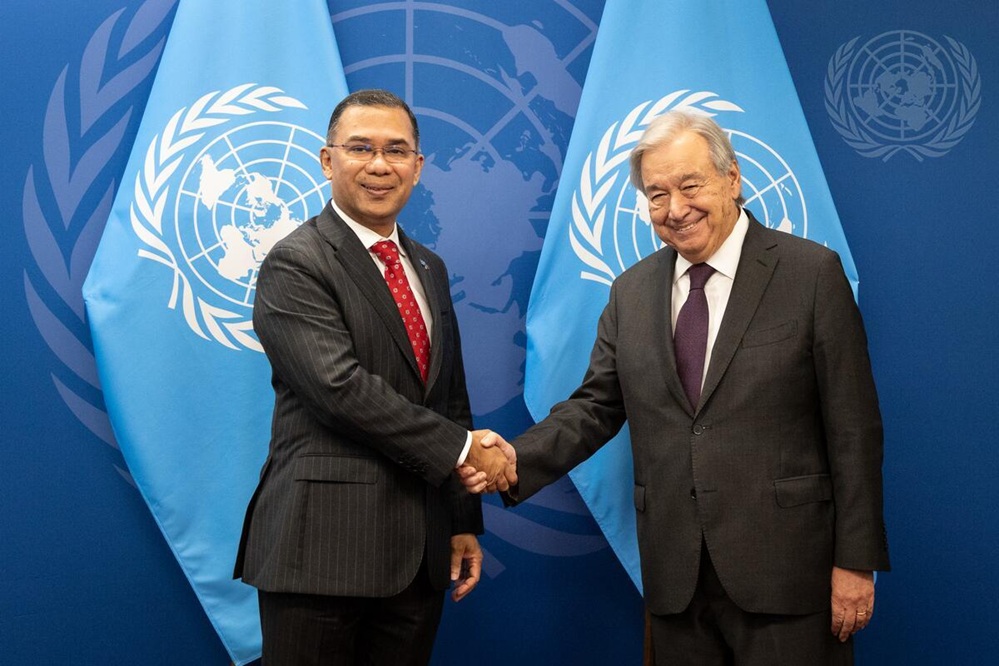
Secretary-General António Guterres (right) meets with Tarique Rahman, Prime Minister of the People’s Republic of Bangladesh.UN Photo/Ariana Lindquist
School bags, uniforms and free midday meals were being provided to primary school students from the first grade, he said, expressing hope that the initiatives would boost school enrolment and improve the quality of education. Tarique Rahman said sports had also been introduced as a subject in the education curriculum for the first time, with the aim of establishing sports as a profession.
As part of the initiative, more than two million students participated in a month-long football tournament held across the country in June, he said. The Prime Minister said science and technology would shape the future as the world entered a new era driven by artificial intelligence, biotechnology and scientific innovation. He said Bangladesh’s large young population and expanding digital capabilities had created new opportunities, but access to advanced technology, knowledge and research needed to be made available to all.
“We do not want today’s digital divide to become tomorrow’s artificial intelligence divide,” he said. Tarique Rahman said Bangladesh respected innovation and intellectual property while stressing the importance of technology transfer, skills development and affordable access to modern technologies.
“It is now time for the United Nations to adopt an effective policy framework so that the benefits of the development and rapid expansion of artificial intelligence and social media can be used positively in countries around the world,” he said. Turning to the Rohingya crisis, Tarique Rahman said Bangladesh had been sheltering more than 1.2 million forcibly displaced Rohingyas from Myanmar for more than nine years.
He said the only solution to the crisis was the safe and dignified return of the displaced Rohingya population to their homeland in Myanmar and called for continued life-saving assistance until their repatriation. The Prime Minister said Bangladesh was continuing its progress in democracy, human rights, good governance, accountability, political stability and improving the investment environment.
“In the present democratic Bangladesh, we welcome partnership, innovation and both domestic and foreign investment,” he said. Tarique Rahman said the government wanted to build a Bangladesh where young people could pursue their dreams without fear or hindrance, women could lead their lives with confidence and every child could grow up with opportunities to realise their full potential.
“Above all, the people will have the assurance of a safe and peaceful life. That is why we say, ‘Bangladesh First: Bangladesh for All’,” he added.
Bangladesh, US discuss boosting trade and investment
DHAKA: Bangladesh and the United States discussed ways to increase US investment, expand bilateral trade and create a more business-friendly environment during a meeting between Commerce Minister Khandker Abdul Muktadir and US Ambassador to Bangladesh Brent T. Christensen. The meeting was held Monday at the Federation of Bangladesh Chambers of Commerce and Industry (FBCCI) office in Dhaka. The two sides discussed expanding bilateral trade, cooperation in the energy sector and recent policy reforms, according to information released following the meeting.
US ambassador stresses transparency in major projects
During the meeting, Ambassador Christensen highlighted the importance of maintaining a transparent and competitive environment for major infrastructure projects. Speaking about a floating liquefied natural gas (LNG) terminal, or FSRU project, the ambassador said greater transparency and open competition would help strengthen the confidence of foreign investors.
He also said US companies are interested in working in Bangladesh and emphasized the importance of ensuring fair opportunities for competition. Commerce Minister Khandker Abdul Muktadir welcomed US investors and said proposals from US companies demonstrating the ability to deliver an FSRU within the shortest possible timeframe would receive priority consideration.
Import policy also discussed
The meeting also covered Bangladesh’s new import policy. The US ambassador welcomed several positive changes in the new policy but said some provisions could be made more business-friendly. The commerce minister said the import policy is an ongoing process and that necessary reforms are being reviewed regularly in line with market conditions and economic realities.
The two sides also discussed the removal of an earlier requirement for foreign companies to appoint local agents when purchasing strategic equipment. The minister said allowing direct engagement with manufacturers has improved transparency in the procurement process and reduced the influence of intermediaries.
Energy cooperation
Energy cooperation was another key issue discussed at the meeting. Ambassador Christensen described Bangladesh’s agreement with international energy supplier Gunvor as a positive development. The commerce minister said the government would continue to give the highest priority to protecting Bangladesh’s national interests in all such arrangements.
Officials from Bangladesh’s Ministry of Industries, Ministry of Commerce and the US Embassy also attended the meeting. Both sides expressed hope that regular discussions would help further strengthen the commercial relationship between Bangladesh and the United States.