Joy Urges West to Address Bangladesh Political Rights

LONDON — Sajeeb Wazed Joy, son and former adviser to ousted prime minister Sheikh Hasina, has urged Western governments to speak out over political detentions and the exclusion of the Awami League from Bangladesh’s political process, warning that continued silence could contribute to instability and affect Western economic and security interests.

Joy made the remarks by video link on September 29 at a London seminar organised by the Global Centre for Democratic Governance at One Great George Street. The event focused on democracy, human rights and the rule of law in Bangladesh.

During his address, Joy accused Britain and other Western governments of overlooking alleged abuses while maintaining commercial ties with Bangladesh. He alleged that politicians and journalists had been detained for extended periods without due process and questioned the legitimacy of an election in which the Awami League was excluded. His comments covered developments since Sheikh Hasina left office in August 2024.

Bangladesh’s interim government banned Awami League activities in May 2025 pending proceedings before the International Crimes Tribunal related to the suppression of the 2024 uprising. The authorities said the measure was aimed at protecting national security and people involved in the proceedings.

The February 2026 parliamentary election received a generally positive assessment from international observers, although concerns remained over political inclusion. The Commonwealth’s final report described the election as peaceful, orderly and transparent while also highlighting the consequences of the Awami League’s exclusion and continuing concerns over media freedom and political participation.

Human Rights Watch, meanwhile, reported in July 2025 that many arrests of people perceived to be Awami League supporters appeared arbitrary and politically motivated. The organisation also said that some forms of repression associated with Hasina’s government, including widespread enforced disappearances, appeared to have ended.

Joy also blamed the military for five deaths during unrest in Gopalganj in July 2025. Human Rights Watch likewise reported five deaths in clashes involving security forces and Awami League supporters. The military said at the time that its personnel had acted in self-defence after warnings were ignored and troops came under attack. The competing accounts leave questions over the precise circumstances and responsibility for the deaths.

Joy also raised concerns about Bangladesh’s ability to finance aircraft purchases and imported gas, while claiming that domestic investment had effectively stopped. Available economic data, however, provide a more mixed picture. Boeing announced on September 23 that Biman Bangladesh Airlines had ordered 11 additional aircraft, bringing the airline’s total orders during 2026 to 25. The announcement confirms the aircraft purchases but does not establish whether Bangladesh has missed contractual payments or demonstrate its ability to meet all future financial obligations.

Similarly, available investment data do not support a literal claim that domestic investment has stopped. A January 2026 economic review by the Centre for Policy Dialogue estimated private investment at 22.48 percent of GDP in fiscal year 2025, compared with 23.96 percent a year earlier.

Bangladesh nevertheless continues to face significant economic challenges. The International Monetary Fund has highlighted fiscal constraints, stress in the banking sector and persistent inflation. In its assessment, the IMF projected economic growth of 3.5 percent for fiscal year 2027 and called for reforms to increase government revenue and strengthen the banking sector.

Joy concluded his remarks by warning of renewed political confrontation and security risks. He also urged Bangladeshis living abroad to engage with their elected representatives and encourage them to raise issues involving human rights, democratic participation and political inclusion in Bangladesh.


Congressman Gregory Meeks Calls for Joint Efforts to End Bangladesh Crisis

NEW YORK — U.S. Congressman Gregory W. Meeks has called for collective efforts to help restore normalcy in Bangladesh, strengthen democratic institutions, uphold the rule of law and protect press freedom. Meeks, the Ranking Member of the U.S. House Foreign Affairs Committee, made the remarks during an exchange meeting with members of the Bangladeshi-American community in New York on September 28.

Speaking about Bangladesh’s political situation, Meeks said he expects Democrats to regain majorities in both chambers of Congress in the November 3 midterm elections. He said that if he again becomes chairman of the House Foreign Affairs Committee, he intends to visit Bangladesh, observe the situation firsthand and work through Congress to provide appropriate direction to the U.S. administration.

Meeks also referred to a December 23, 2025 letter that he and four other members of Congress sent to Bangladesh’s then-Chief Adviser Muhammad Yunus. The letter urged the interim government to work with political parties across the political spectrum to create conditions for free, fair and inclusive elections and to restore confidence in the neutrality of state institutions.

The lawmakers also expressed concern that suspending the activities of a political party or restarting what they described as a flawed International Crimes Tribunal would undermine those objectives. Meeks said Bangladesh needs stronger democratic institutions, effective rule of law and safeguards for media freedom.

Turning to the United States, the congressman also expressed concern about what he described as growing pressure on media outlets and dissenting voices. Referring to disputes involving CNN, Politico and MS NOW and their access to the White House and Air Force One, he said measures affecting the media and people expressing dissent were inconsistent with American democratic values.

Meeks said he wanted to see Bangladesh return to a stable political environment. He also pledged that, if he again serves as chairman of the House Foreign Affairs Committee, he would visit Bangladesh and engage with relevant authorities regarding the country’s situation.

Bangladesh Situation Discussed

The exchange meeting was organized with the assistance of Sector Commanders Forum-Muktijuddho ’71 and the Bangabandhu Foundation. Bangabandhu Foundation President Abdul Kader Mia chaired the event, while Queens Democratic Party District Leader Dr. Dilip Nath moderated it.

Former Bangladeshi Foreign Minister and former Permanent Representative of Bangladesh to the United Nations A.K. Abdul Momen and former National Press Club President Farida Yasmin spoke about Bangladesh’s political and social situation. They alleged that opposition voices and political activists had faced arrests, violence and legal cases following the July-August 2024 protests and the formation of the interim government led by Muhammad Yunus.

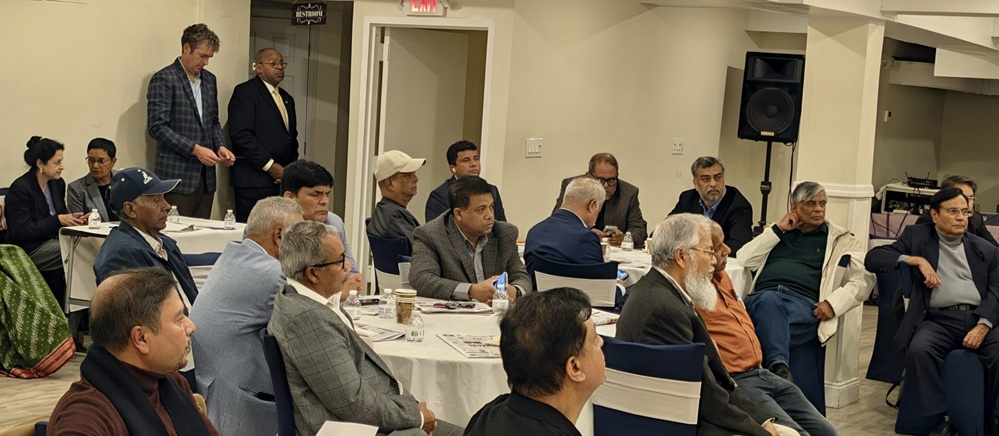
Bangladeshi-American community members attend a meeting with U.S. Congressman Gregory Meeks in New York to discuss Bangladesh’s political situation, democracy and the rule of law. Photo: KHABOR

They also alleged that members and supporters of the Awami League had been subjected to violence and that religious minorities had faced attacks. The speakers further criticized the suspension of Awami League activities, alleged mistreatment of freedom fighters and legal action against journalists whose reporting they said was not favored by the government.

The speakers called for the lifting of restrictions on the Awami League and urged the U.S. Congress to support what they described as the need for an early election. They also sought congressional intervention for the release of journalists and other political detainees facing what they characterized as politically motivated murder cases.

Bangladeshi-American Community Leaders Attend

At the beginning of the event, Abdul Kader Mia welcomed Congressman Meeks by presenting him with a traditional uttariya amid applause from attendees. Also present on the stage were Bangabandhu Foundation Senior Vice President Engineer Md. Fazlul Haque, Bangladesh Muslim Center of Brooklyn President Alhaj Abul Hashem, community organizer Enamul Haque Shamim, Aminul Islam Amin and Nazrul Islam Babu. The United States Bangabandhu Parishad, Sandwip Pourashava Welfare Association and Haque Medical Office served as co-hosts of the event.

Among the attendees were writer, columnist and editor Naim Nizam; World Bangla 24 TV CEO Alim Khan Akash; journalist Sultana Rahman; freedom fighter and journalist Lablu Ansar; journalist Sazzad Hossain Sobuj; Jago Prohori Editorial Board President Dr. Mahabbur Rahman Tuku; Sheikh Kamal Smriti Parishad President and freedom fighter Dr. Masudul Hasan; Sandwip Association Convener Sirajul Mawla; former Sandwip Association President Nazrul Islam Babul; Sandwip Pourashava Welfare Association President Md. Zafarullah; Sandwip Education and Cultural Society President Mosharraf Hossain, Secretary Abdul Hamid and Treasurer Ahsan Ullah Saki.

Others included community leader Mobasher Hossain, freedom fighter Kadir Mia, freedom fighter and businessman Saraf Sarkar, social organizer Sakhawat Ali, businessman and community organizer Ifzal Chowdhury, Chattogram Association General Secretary Ariful Islam Arif, Bauria Janakalyan Association Adviser Abul Kashem, Ekattor Genocide Foundation founder and freedom fighter Dr. Pradip Kar, community leader Abdul Jalil, Afsar Mohammad, Abu Taher M. Rahman, Yasin Arafat Bappi, politician Baker Bhuiyan, Democrat Morshed Alam, Engineer Mohammad Ali Siddiqui and Imdad Chowdhury, among others.

The guests were introduced by Bangabandhu Foundation Secretary Kamal Hossain Mithu. Dipa Nath, president of NAVA, and Linda Ramparteb coordinated fundraising activities for the congressman.

Call for Unity

In his closing remarks, Abdul Kader Mia thanked the attendees and called for unity to help Bangladesh overcome what he described as misrule. He urged the community to learn from past mistakes and move forward with the goal of completing what he described as the unfinished work of building “Sonar Bangla,” referring to the political vision associated with the country’s founding leadership.