Joy Urges West to Address Bangladesh Political Rights

LONDON — Sajeeb Wazed Joy, son and former adviser to ousted prime minister Sheikh Hasina, has urged Western governments to speak out over political detentions and the exclusion of the Awami League from Bangladesh’s political process, warning that continued silence could contribute to instability and affect Western economic and security interests.

Joy made the remarks by video link on September 29 at a London seminar organised by the Global Centre for Democratic Governance at One Great George Street. The event focused on democracy, human rights and the rule of law in Bangladesh.

During his address, Joy accused Britain and other Western governments of overlooking alleged abuses while maintaining commercial ties with Bangladesh. He alleged that politicians and journalists had been detained for extended periods without due process and questioned the legitimacy of an election in which the Awami League was excluded. His comments covered developments since Sheikh Hasina left office in August 2024.

Bangladesh’s interim government banned Awami League activities in May 2025 pending proceedings before the International Crimes Tribunal related to the suppression of the 2024 uprising. The authorities said the measure was aimed at protecting national security and people involved in the proceedings.

The February 2026 parliamentary election received a generally positive assessment from international observers, although concerns remained over political inclusion. The Commonwealth’s final report described the election as peaceful, orderly and transparent while also highlighting the consequences of the Awami League’s exclusion and continuing concerns over media freedom and political participation.

Human Rights Watch, meanwhile, reported in July 2025 that many arrests of people perceived to be Awami League supporters appeared arbitrary and politically motivated. The organisation also said that some forms of repression associated with Hasina’s government, including widespread enforced disappearances, appeared to have ended.

Joy also blamed the military for five deaths during unrest in Gopalganj in July 2025. Human Rights Watch likewise reported five deaths in clashes involving security forces and Awami League supporters. The military said at the time that its personnel had acted in self-defence after warnings were ignored and troops came under attack. The competing accounts leave questions over the precise circumstances and responsibility for the deaths.

Joy also raised concerns about Bangladesh’s ability to finance aircraft purchases and imported gas, while claiming that domestic investment had effectively stopped. Available economic data, however, provide a more mixed picture. Boeing announced on September 23 that Biman Bangladesh Airlines had ordered 11 additional aircraft, bringing the airline’s total orders during 2026 to 25. The announcement confirms the aircraft purchases but does not establish whether Bangladesh has missed contractual payments or demonstrate its ability to meet all future financial obligations.

Similarly, available investment data do not support a literal claim that domestic investment has stopped. A January 2026 economic review by the Centre for Policy Dialogue estimated private investment at 22.48 percent of GDP in fiscal year 2025, compared with 23.96 percent a year earlier.

Bangladesh nevertheless continues to face significant economic challenges. The International Monetary Fund has highlighted fiscal constraints, stress in the banking sector and persistent inflation. In its assessment, the IMF projected economic growth of 3.5 percent for fiscal year 2027 and called for reforms to increase government revenue and strengthen the banking sector.

Joy concluded his remarks by warning of renewed political confrontation and security risks. He also urged Bangladeshis living abroad to engage with their elected representatives and encourage them to raise issues involving human rights, democratic participation and political inclusion in Bangladesh.


Govt pursuing 3-R strategy to repair Bangladesh: PM

Shibbir Ahmed, New York — Prime Minister Tarique Rahman today said his government is pursuing a 3-R strategy — Recovery, Restoration and Reconstruction — to repair Bangladesh, which he described as having been ravaged by more than one and a half decades of “fascist rule and exploitation.”

“To repair Bangladesh, which was ravaged by fascist rule and exploitation, the Government is pursuing a 3-R strategy — Recovery, Restoration and Reconstruction,” he said while addressing the 81st session of the United Nations General Assembly at the UN Headquarters in New York.

The Prime Minister said Bangladesh had freed itself from what he described as enforced disappearances, killings, abductions, corruption, looting and money laundering and was once again embarking on the path of democracy.

He said an immense horizon of possibilities had opened before Bangladesh and that his government had begun implementing extensive programmes to transform the country’s working-age population into skilled human resources by harnessing its demographic dividend.

“Detailed measures have been taken to create extensive employment opportunities and develop Bangladesh as a ‘manufacturing hub’,” he said, seeking support from the country’s development partners in this endeavour.

The government has allocated US$50 million in the current fiscal year to create opportunities for young entrepreneurs, researchers and innovators to implement start-up initiatives, he said.

Focus on women’s empowerment

Highlighting the government’s focus on women’s empowerment, Tarique Rahman said women were at the forefront of its plans for the country’s socio-economic transformation, noting that women account for more than half of Bangladesh’s population.

He said the government was prioritising women’s education, employment and entrepreneurship, including expanded access to cash financing, particularly in the small and medium-sized industries sector. Free education opportunities for women up to the undergraduate level had also been made available, he said.

The Prime Minister said the government wanted to ensure not only electoral democracy but also the democratisation of the economy so that the benefits of economic growth and prosperity reached every family and citizen.

To this end, the government had introduced social protection initiatives such as the Family Card, Farmers’ Card, Sports Card and e-Health Card to support economically disadvantaged people.

He described the Family Card, issued in the name of the female head of each household, as a symbol of women’s economic empowerment and said the government planned to introduce a Universal Card by integrating various support cards.

31-point programme and development

Tarique Rahman said the government was implementing its 31-point programme presented to the people ahead of the February 12 national election. He said 73 percent of the programme’s activities were directly aligned with the UN Sustainable Development Goals’ “Leave No One Behind” theme, while another 27 percent were indirectly aligned.

The government hoped implementation of the programmes would reduce development disparities between urban and rural areas and strengthen accountability and inclusive sustainable development under the 2030 Agenda, he said.

Education, health and sports

The Prime Minister said his government had given special importance to education, health and sports and had made the highest-ever budget allocation for the education sector.

“There are plans to gradually increase education spending to 5 per cent of GDP within the next five years,” he said. He said a curriculum had been developed with an emphasis on technical and practical education to establish an ethically sound and employment-oriented education system.

School bags, uniforms and free midday meals were being provided to primary students from the first grade, he said, expressing hope that the initiatives would increase school enrolment and improve the quality of education.

Sports had also been included as a subject in the education curriculum for the first time, with the aim of establishing sports as a profession, he said. More than two million students participated in a month-long nationwide football tournament last June as part of the initiative, he added.

Call for dialogue to resolve conflicts

Turning to the international situation, Tarique Rahman said human-made conflicts had created unrest in many countries, causing displacement and humanitarian crises while placing pressure on the global economy, energy security and supply systems and contributing to rising inflation.

He said conflicts should be resolved through dialogue, diplomatic processes and mutual cooperation, with equality, fairness, protection of mutual interests, respect and dignity forming the basis of bilateral and multilateral relations.

Bangladesh sees the United Nations as the centre of efforts to establish an understanding-based global community that respects the independence and sovereignty of states, he said.

Tarique Rahman reaffirmed Bangladesh’s commitment to general and complete disarmament, prevention of nuclear weapons proliferation and arms control, while supporting UN initiatives aimed at promoting global peace.

He also reaffirmed Bangladesh’s support for the legitimate demands of the Palestinian people, including their right to self-determination and to establish an independent State of Palestine.

Rohingya crisis

On the Rohingya crisis, the Prime Minister said Bangladesh had been providing shelter to more than 1.2 million forcibly displaced Rohingyas from Myanmar for more than nine years, putting immense pressure on the country’s resources, environment, security and local communities.

“The only solution to this problem is the safe return of the displaced Rohingya population to their homeland, Myanmar,” he said. He called for firm and effective support from the United Nations and the international community for a lasting solution and urged continued life-saving assistance for the Rohingyas until their repatriation.

“If the international community fails to ensure justice for the displaced Rohingya population, this may turn into a humanitarian crisis in the near future,” he added.

Climate change and development

On climate change, Tarique Rahman said Bangladesh was among the countries most vulnerable to its adverse impacts despite making little contribution to global carbon emissions. He said Bangladesh expected stronger global action at COP31 on climate justice, climate finance and adaptation support. The government has launched a programme to plant 250 million trees across the country over the next five years, while placing emphasis on clean and solar energy, he said.

He also said a programme had been launched to excavate 20,000 kilometres of canals across the country to help address flooding and drought. The government had begun implementing the Teesta Master Plan and the Padma Barrage project to increase freshwater flow into the Sundarbans and conserve water through large reservoirs, he said.

Technology and AI

On science and technology, the Prime Minister said Bangladesh’s large young population and growing digital capabilities had created new possibilities, but access to advanced technology, knowledge and research must be made available to all.

“We do not want today’s digital divide to become tomorrow’s artificial intelligence divide,” he said, stressing technology transfer, skills development and affordable access to modern technologies for developing countries. He called for an effective UN policy framework to ensure that the benefits of artificial intelligence and social media could be used positively around the world.

LDC graduation and global cooperation

The Prime Minister also called for continued international support as Bangladesh prepares to graduate from the Least Developed Country category, particularly through assured financing, greater market access, technology transfer and capacity building.

He said regional trade facilitation, connectivity and meaningful cooperation could help countries achieve shared prosperity in an increasingly interdependent world. Tarique Rahman also stressed the need to ensure sustainable production of vaccines, medical supplies and diagnostic equipment in developing countries so that they remain readily accessible to all.

‘Bangladesh First: Bangladesh for All’

Tarique Rahman said Bangladesh wanted to establish a prosperous, self-reliant and welfare-oriented democratic state where everyone, irrespective of political affiliation, religion or race, could live safely with equal rights, respect and dignity.

“Bangladesh’s progress in the areas of democracy, human rights, good governance, accountability, political stability and the investment environment is continuing,” he said, adding that the government was working to establish a safe and stable Bangladesh with a business- and investment-friendly environment.

“We want to build a Bangladesh where young people can pursue their dreams without fear or hindrance, women can lead their lives with confidence, and every child can grow up with the opportunity to realise their full potential,” he said.

“Above all, the people will have the assurance of a safe and peaceful life. That is why we say, ‘Bangladesh First: Bangladesh for All’.”

Earlier remarks

Earlier in his address, Tarique Rahman congratulated the President of the 81st session of the UN General Assembly on his election and assured Bangladesh’s full support during his tenure. He paid tribute to the martyred freedom fighters of Bangladesh and recalled the contributions of those who sacrificed their lives in the struggle to establish democracy, justice and people’s rights since independence.

He also paid respect to those killed and injured during the July-August 2024 mass uprising. The Prime Minister said the people had entrusted the Bangladesh Nationalist Party (BNP) with the responsibility of governing the state through the “fair, free and impartial” national election held on February 12 this year.

He said he felt nostalgic standing before the UN General Assembly as his father, Shaheed President Ziaur Rahman, and his mother, former Prime Minister the late Khaleda Zia, had also addressed the world from the same platform on behalf of Bangladesh and its people.

Tarique Rahman said Bangladesh remained committed to multilateralism in maintaining international peace and security and, as Vice-Chair of the UN Peacebuilding Commission, continued to advocate sustainable peace, conflict prevention and inclusive peacebuilding.

He also highlighted the contributions of Bangladeshi peacekeepers and women peacekeepers to UN missions around the world. On migration, he said the government was committed to ensuring regular, safe and orderly migration and called for stronger global cooperation to protect the rights, dignity and welfare of migrants. Concluding his address, the Prime Minister reaffirmed Bangladesh’s unwavering support for the principles and values of the United Nations in the cause of establishing world peace.


PM pledges to establish prosperous, democratic Bangladesh

Shibbir Ahmed, New York — Prime Minister Tarique Rahman today pledged to build a prosperous, self-reliant and welfare-oriented democratic Bangladesh by ensuring political and economic empowerment of the people and creating equal opportunities for all.

“We want to establish a prosperous, self-reliant, welfare-oriented democratic state where everyone, irrespective of political affiliation, religion or race, can live without anxiety and in safety, with equal rights, respect and dignity,” he said. The Prime Minister made the remarks while addressing the General Debate of the 81st session of the United Nations General Assembly at the UN headquarters in New York.

He said his government was working to establish a safe and stable Bangladesh with a business- and investment-friendly environment while strengthening democracy, human rights, good governance, accountability and political stability. Tarique Rahman said the government was pursuing a three-pronged strategy — Recovery, Restoration and Reconstruction — to rebuild Bangladesh.

“Bangladesh is now once again embarking on the path of democracy,” he said, adding that the government was taking steps to transform the country’s working-age population into skilled human resources by harnessing its demographic dividend. He said detailed measures had been taken to create extensive employment opportunities and develop Bangladesh as a “manufacturing hub.”

The government has allocated US$50 million in the current fiscal year to provide opportunities for young entrepreneurs, researchers and innovators to implement start-up initiatives, he said. The Prime Minister said women were at the forefront of the government’s plans for the country’s socio-economic transformation, noting that women account for more than half of Bangladesh’s population.

“The government is giving priority to women’s education, women’s employment and the creation of women entrepreneurs,” he said. He said access to cash financing had been expanded for women, particularly in the small and medium-sized industries sector, to support the development of women-led businesses. The government had also introduced free education opportunities for women up to the undergraduate level, he said.

Tarique Rahman said the government sought to ensure not only electoral democracy but also the democratisation of the economy so that the benefits of economic growth and prosperity reached every family and citizen. To this end, the government had introduced social protection initiatives, including the Family Card, Farmers’ Card, Sports Card and e-Health Card, to support economically disadvantaged people.

“The government considers the ‘Family Card’, issued in the name of the female head of each household, to be a symbol of women’s economic empowerment,” the Prime Minister said. He said the government also planned to introduce a “Universal Card” by integrating the various cards designed to provide support in different sectors. The Prime Minister said the government had placed special emphasis on education, health and sports and had made the highest-ever allocation for the education sector in the country’s history.

“There are plans to gradually increase education spending to 5 per cent of GDP within the next five years,” he said. He said a new curriculum had been developed with greater emphasis on technical and practical education to build an ethically sound and employment-oriented education system.

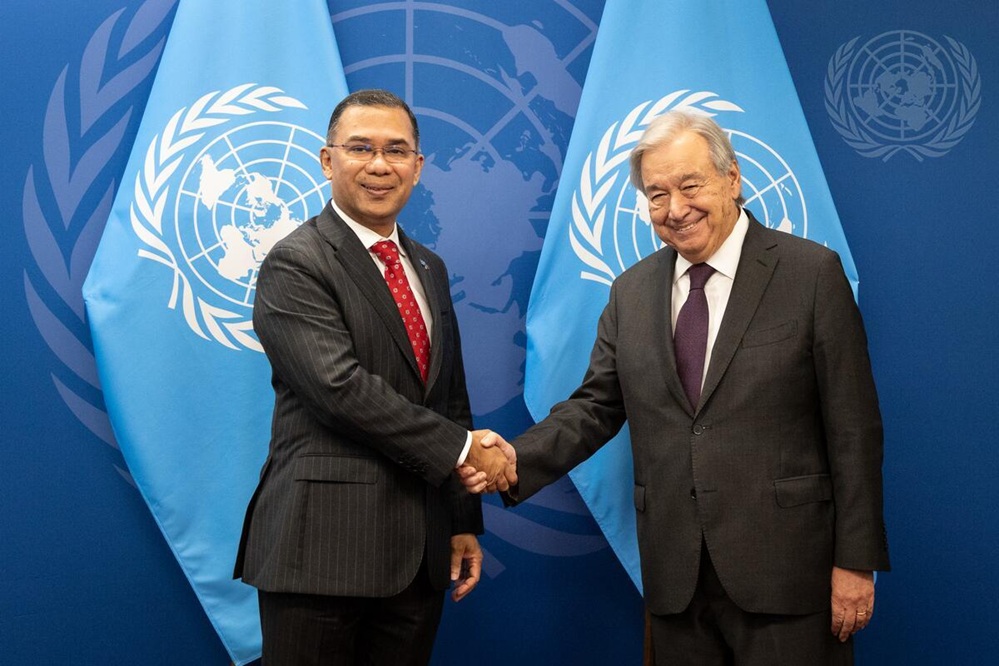
Secretary-General António Guterres (right) meets with Tarique Rahman, Prime Minister of the People’s Republic of Bangladesh.UN Photo/Ariana Lindquist

School bags, uniforms and free midday meals were being provided to primary school students from the first grade, he said, expressing hope that the initiatives would boost school enrolment and improve the quality of education. Tarique Rahman said sports had also been introduced as a subject in the education curriculum for the first time, with the aim of establishing sports as a profession.

As part of the initiative, more than two million students participated in a month-long football tournament held across the country in June, he said. The Prime Minister said science and technology would shape the future as the world entered a new era driven by artificial intelligence, biotechnology and scientific innovation. He said Bangladesh’s large young population and expanding digital capabilities had created new opportunities, but access to advanced technology, knowledge and research needed to be made available to all.

“We do not want today’s digital divide to become tomorrow’s artificial intelligence divide,” he said. Tarique Rahman said Bangladesh respected innovation and intellectual property while stressing the importance of technology transfer, skills development and affordable access to modern technologies.

“It is now time for the United Nations to adopt an effective policy framework so that the benefits of the development and rapid expansion of artificial intelligence and social media can be used positively in countries around the world,” he said. Turning to the Rohingya crisis, Tarique Rahman said Bangladesh had been sheltering more than 1.2 million forcibly displaced Rohingyas from Myanmar for more than nine years.

He said the only solution to the crisis was the safe and dignified return of the displaced Rohingya population to their homeland in Myanmar and called for continued life-saving assistance until their repatriation. The Prime Minister said Bangladesh was continuing its progress in democracy, human rights, good governance, accountability, political stability and improving the investment environment.

“In the present democratic Bangladesh, we welcome partnership, innovation and both domestic and foreign investment,” he said. Tarique Rahman said the government wanted to build a Bangladesh where young people could pursue their dreams without fear or hindrance, women could lead their lives with confidence and every child could grow up with opportunities to realise their full potential.

“Above all, the people will have the assurance of a safe and peaceful life. That is why we say, ‘Bangladesh First: Bangladesh for All’,” he added.


Bangladesh seeks more time for sustainable LDC graduation

Shibbir Ahmed, New York – Bangladesh has called for an extended preparatory period before graduating from the least developed country (LDC) category, saying additional time would help ensure a smooth and sustainable transition and build a more resilient post-graduation economy.

“For Bangladesh, an extended preparatory period will support a smooth, sustainable and irreversible graduation and a resilient post-graduation economy,” State Minister for Foreign Affairs Humayun Kabir told the annual ministerial meeting of LDC foreign ministers at the United Nations Headquarters in New York. He also sought the continued support of the LDC Group as Bangladesh’s request is considered by the United Nations General Assembly.

Kabir said graduating countries need additional time to maintain macroeconomic stability, undertake critical reforms and implement effective transition strategies. Looking ahead to the midterm review of the Doha Programme of Action, he outlined six priorities for LDCs, including reversing the decline in official development assistance, expanding access to concessional financing, improving market access and securing predictable climate finance for adaptation and loss and damage.

He also called for stronger international cooperation to combat illicit financial flows and recover stolen assets, while urging greater support for industrialisation, technology transfer and digital inclusion.

“Geopolitical tensions, economic volatility, debt distress, declining ODA, food and energy insecurity and climate crisis are testing our resilience,” Kabir said. He noted that economic growth among LDCs remained below the seven-percent target, with growth projected at 4.6 percent in 2026 and five percent in 2027. The State Minister said Bangladesh’s “3R” strategy — Recovery, Restoration and Reconstruction — was aimed at laying the foundation for sustainable development.

He thanked Nepal for its leadership as chair of the LDC Group, expressed solidarity with the country following a recent natural disaster and welcomed The Gambia as the incoming chair. Bangladesh’s call for additional preparation time comes as the country seeks to address the economic and structural challenges associated with its transition out of the LDC category while maintaining long-term development momentum.


Tarique Rahman, World Bank President Discuss Bangladesh’s Development Priorities

Shibbir Ahmed, New York — Bangladesh Prime Minister Tarique Rahman and World Bank Group President Ajay Banga discussed Bangladesh’s development priorities and economic progress during a meeting at the United Nations Headquarters on Tuesday. The meeting took place on the sidelines of the 81st session of the United Nations General Assembly, according to the Prime Minister’s Assistant Press Secretary KM Nazmul Haque.

The two sides discussed issues of mutual interest and exchanged views on strengthening the World Bank’s cooperation with Bangladesh in its development activities. They also explored potential new areas of partnership that could support Bangladesh’s development priorities and economic progress in the coming years.

The meeting was part of Tarique Rahman’s bilateral engagements during his visit to New York for the UN General Assembly, where he is scheduled to participate in discussions on major international and development issues.


Where Is the Future of Our Youth?

Mashiur Rahman Majumdar: A significant share of Bangladesh’s population is young. This large youth population represents an enormous opportunity for the country. At the same time, failure to create adequate employment and develop the necessary skills could turn that opportunity into a serious economic and social challenge.

When a young person completes an education and then spends years waiting for employment, the consequences extend beyond individual hardship. The country also loses the productive potential of a generation. Expanding access to education alone is therefore not enough. Education must be connected more closely to the actual demands of the labor market.

Young people need practical training and opportunities in technology, artificial intelligence, information technology, modern agriculture, manufacturing, healthcare and entrepreneurship. Equal opportunities must also be ensured for young women and those living in economically disadvantaged or underserved regions.

Creating employment is not solely the responsibility of the government. The private sector, educational institutions and industries must work together to develop a workforce equipped for a changing economy. Young people should have opportunities not only to seek jobs, but also to become entrepreneurs, skilled professionals and innovators.

Investing in young people is, in reality, an investment in the country’s future. The decisions made today will determine whether tomorrow’s Bangladesh is more skilled, productive and competitive in the global economy.

  • Journalist, Bronx, New York.


US Envoy Eyes Stronger Trade Ties

DHAKA: Bangladesh-US trade relations could see more positive outcomes over the next 30 years and beyond if Bangladesh fulfills its commitments under the Agreement on Reciprocal Trade, US Ambassador to Bangladesh Brent Christensen has said. He made the remarks on Saturday (September 12) at a ceremony marking the 30th anniversary of the American Chamber of Commerce in Bangladesh (AmCham Bangladesh) in the capital.

“Congratulations to the American Chamber of Commerce in Bangladesh on 30 years of advancing US-Bangladesh commercial relations. Over the past 30 years, AmCham Bangladesh has been a reliable partner of the US government, and I am confident that if Bangladesh fulfills its commitments under the Agreement on Reciprocal Trade, we will see even more positive results over the next 30 years and beyond,” the ambassador said.

Current and former AmCham leaders, representatives of member companies, government policymakers, diplomats, business leaders and other distinguished guests attended the event. The programme was organized to commemorate AmCham Bangladesh’s three-decade contribution to strengthening Bangladesh-US economic relations, particularly in trade and investment.

The event began with the national anthems of Bangladesh and the United States, followed by a screening of a commemorative documentary titled “30 Years of Making Possibilities Possible,” produced to mark AmCham Bangladesh’s 30th anniversary.

In his welcome address, AmCham Bangladesh President Syed Mohammad Kamal highlighted the organization’s journey from a vision three decades ago to becoming a strong platform for business, investment and Bangladesh-US economic partnership.

He expressed gratitude to the chamber’s founding members and former leaders for their vision, leadership and contributions to its development. Speaking about AmCham’s future priorities, Kamal emphasized the need for a clear two-year energy roadmap, a more investment-friendly business environment, greater attention to intellectual property rights and cybersecurity, and effective implementation of regulatory reforms.

He also urged the government to make greater use of the global experience, technology, knowledge and capabilities of AmCham and its member companies. At the event, AmCham Bangladesh Vice President and MetLife Bangladesh Chief Executive Officer Ala Uddin Ahmed announced the launch of the “AmCham Excellence Award” to recognize outstanding contributions across various sectors.


Moyeen Seeks Stronger World Bank Support for Bangladesh Development

DHAKA – LGRD and Cooperatives Minister Dr Abdul Moyeen Khan has expressed hope that the World Bank will further strengthen its support for the country’s sustainable development and improvement of people’s quality of life. He said various government initiatives are underway in important areas such as water supply, sanitation, rural development and addressing the impacts of climate change.

Continued support from development partners is necessary to make these activities more effective and sustainable, he said when World Bank Division Director for Bangladesh and Bhutan Jean Pesme paid a courtesy call on him at his office at the Secretariat today.

Various issues including the World Bank’s support for various ongoing development projects in Bangladesh, water supply and sanitation systems, rural development, climate change and local government sector were discussed.

The minister said the government and development partners need to work in coordination to accelerate and sustain the country’s development activities. He said WB support could play an important role in strengthening the capacity of the local government sector and ensuring quality civic services reach people at their doorsteps.

The minister expressed gratitude for the World Bank’s longstanding support for Bangladesh’s development journey and hoped that the bank would continue its support for the country’s key development initiatives in the future.

During the exchange of views, emphasis was placed on further strengthening the existing cooperation between Bangladesh and the World Bank. LGD Md Shahidul Hassan, senior officials from the ministry and the WB were present at the meeting.


Nearly 600,000 Jobs at Risk in Bangladesh: World Bank

Shibbir Ahmed, Washington DC: Nearly 600,000 jobs in Bangladesh could be at risk if the economic fallout from the ongoing Middle East conflict persists, according to a World Bank assessment. The warning comes as Bangladesh faces rising fuel prices, severe gas shortages, disruptions to fertilizer production and growing pressure on industries and household incomes.

The World Bank’s mid-June assessment, prepared as part of a proposed Contingent Emergency Response Project, said the conflict could significantly weaken Bangladesh’s economic recovery and slow the pace of poverty reduction.

The assessment estimates that the number of people expected to move out of poverty in 2026 could fall from around 1.7 million to about 500,000 because of the conflict. Bangladesh had already been facing rising poverty. The World Bank estimated that the number of poor people increased by about 1.4 million in 2025, as weak job creation, slow growth in labor incomes and persistent inflation reduced the poverty-reducing impact of economic growth.

Energy crisis adds to pressure

The energy sector is among the areas most severely affected. Natural gas accounts for more than half of Bangladesh’s primary energy supply, while domestic gas production has fallen significantly from its 2016 peak. The country also relies heavily on the Middle East for imported energy, sourcing about 60–65% of its crude oil and 55–60% of its LNG from the region.

The conflict has disrupted LNG supplies, with five of Petrobangla’s six LNG supply contracts reportedly placed under force majeure. Spot LNG prices have risen to around $24–$28 per million British thermal units (MMBtu), more than double their previous level.

Higher energy costs are also expected to put additional pressure on inflation. The World Bank assessment said that passing higher energy prices on to consumers could increase inflation by more than 0.5 percentage points, with further effects on food and non-food prices.

Fertilizer production disrupted

Bangladesh’s agriculture sector is also vulnerable to the crisis. Gas shortages have forced five of the country’s six domestic urea fertilizer plants to suspend production, while international urea prices have increased by around 30%. The World Bank warned that fertilizer prices could potentially rise much further if the disruption continues, increasing production costs for farmers and putting additional pressure on food prices.

Smallholder farmers, who represent a significant share of Bangladesh’s population, could be particularly exposed to higher input costs and supply disruptions.

Industries and workers under pressure

The energy crisis is also affecting industrial activity. Factory operating hours, production and new industrial gas connections have reportedly been affected, while some businesses have faced rising operating costs.

The World Bank’s projection of nearly 600,000 jobs at risk reflects the broader economic consequences of higher energy costs, supply disruptions, weaker production and inflation. Economists have also pointed to signs of the crisis already appearing in the labor market, including factory closures, reduced working hours and job losses.

Government finances face additional strain

The crisis could also increase pressure on Bangladesh’s public finances. Higher energy subsidies could substantially increase government expenditure, potentially reducing the fiscal space available for social protection and emergency programs, according to the World Bank assessment.

The World Bank has already approved $1.1 billion in emergency financing for Bangladesh to help protect food security, support vulnerable households and businesses, and address volatility in global fertilizer and fuel markets.

Risk, not a confirmed job-loss figure

The World Bank’s figure of nearly 600,000 should be understood as a projection of potential job losses if the crisis continues, rather than a confirmed number of workers who will definitely lose their jobs.

The final impact will depend on how long the Middle East conflict lasts, global energy and fertilizer prices, supply conditions and Bangladesh’s ability to manage the economic shock. For Bangladesh, however, the warning highlights the vulnerability of an economy already struggling with inflation, weak job creation and limited fiscal space.

Source: World Bank assessment on Bangladesh’s proposed Contingent Emergency Response Project.