Bangladesh Mass Arrests Raise Human Rights Concerns, Says Human Rights Watch
Shibbir Ahmed, New York – International human rights organization Human Rights Watch (HRW) has raised concerns over the mass detention of opposition political activists in Bangladesh, warning of growing threats to political freedoms and human rights. In a report published on October 5, HRW said police detained approximately 290 people attending a meeting of the Jatiya Samajtantrik Dal (JSD), a left-wing political party, in Dhaka on September 26.
According to the report written by Elaine Pearson, HRW’s Asia director, members of the ruling Bangladesh Nationalist Party’s (BNP) youth wing, Jubo Dal, alleged that the gathering was a secret meeting of the banned Awami League. The report said a court remanded 27 of those detained to custody over allegations that they had chanted “Joy Bangla,” a slogan associated with the Awami League.
The JSD was part of the 14-party alliance led by the Awami League, which governed Bangladesh from 2009 until 2024. The Sheikh Hasina government fell following student-led protests in 2024, during which hundreds of people were killed by security forces, according to the HRW report.
HRW also reported that police detained 12 Awami League activists in Barisal on September 26 over allegations that they had held a secret meeting to plan sabotage. Two days later, another 15 people were arrested in Dhaka under Bangladesh’s 2009 Anti-Terrorism Act on similar allegations. According to the report, those detained said they had gathered to mark former Prime Minister Sheikh Hasina’s birthday.
The report noted that serious human rights violations occurred during Hasina’s rule, including extrajudicial killings, enforced disappearances, torture and arbitrary detention of political opponents. The BNP also faced severe repression while it was in opposition. However, HRW stressed that past human rights abuses do not justify similar violations by the current government.
The organization expressed concern over the arbitrary detention of perceived Awami League supporters and the rollback of human rights safeguards proposed by the interim government.
International human rights law protects freedom of expression and association. According to HRW, violations committed under a previous government cannot justify restrictions on the same rights under a new administration. The report underscores continuing concerns over the protection of political freedoms, due process and the rule of law in Bangladesh.
JFK Airport Protest Against Dr. Yunus Over Bangladesh Politics
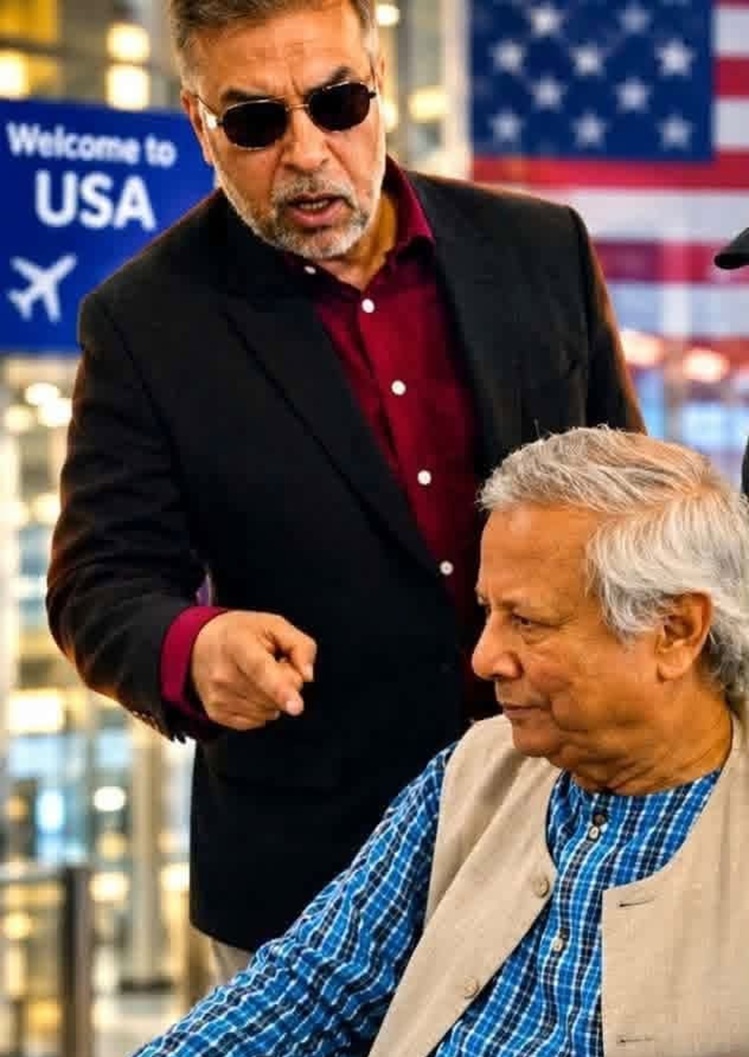
NEW YORK: Activists affiliated with the Awami League have claimed that they staged a protest against Dr. Muhammad Yunus at John F. Kennedy International Airport in New York on October 12, expressing anger over Bangladesh’s political situation and the restrictions imposed on their party’s political activities. In a social media post accompanying a video, the activists claimed that a group led by Imdad Chowdhury, general secretary of the New York Metropolitan Awami League, confronted Yunus at the airport.
According to the post, other participants included Mizan Chowdhury, general secretary of the US Jubo League; Sakhawat Hossain Chanchal, vice president of the New York Metropolitan Awami League; Tanvir Kaisar, general secretary of the Jackson Heights Awami League; and Jubo League leader Sagor.
The post raised several allegations concerning Bangladesh’s political environment, including claims of political repression, mob violence, police killings, attacks on opposition activists, arrests, assaults, killings, torture, and vandalism and looting of homes and businesses. These allegations reflect the protesters’ claims and have not been independently verified in connection with the airport incident.
The activists also expressed anger over the ban on the Awami League’s political activities and questioned the purpose of Yunus’s visit to the United States. According to the social media account, they sought answers from him about Bangladesh’s political situation. The post further claimed that Yunus left the area quickly with his associates without responding to their questions. The circumstances of the encounter could not be independently established from the account provided.
Dr. Muhammad Yunus assumed leadership of Bangladesh’s interim government after Sheikh Hasina’s government fell in August 2024 following a student-led mass uprising. The political transition prompted discussions about democratic reform, accountability, judicial independence, and investigations into alleged human rights violations committed under the previous administration.
At the same time, the interim government faced criticism over political violence, retaliatory attacks, arrests, and law enforcement practices. Following the change of government, cases were filed against numerous Awami League leaders and activists, and several were arrested. Concerns were also raised about alleged politically motivated harassment, arbitrary detention, and the need to uphold due process.
These developments have placed political accountability and human rights protection at the center of Bangladesh’s ongoing political debate. Ensuring justice for past abuses while protecting the legal rights and security of citizens regardless of political affiliation remains a significant challenge.
Imdad Chowdhury confronts Dr. Muhammad Yunus at New York’s JFK International Airport, raising questions about Bangladesh’s political situation and the ban on Awami League activities, according to a social media post accompanying the video.
On May 11, 2025, Yunus’s interim government announced a decision to prohibit all activities of the Awami League under the Anti-Terrorism Act. The government said the measure was taken in the interest of national security while legal proceedings concerning serious allegations against the party were underway. Allegations of involvement in deaths during the 2024 uprising were among the issues cited in the context of the decision.
The Awami League rejected the ban, calling it unacceptable. The decision triggered debate over the party’s ability to conduct public political activities, maintain its organizational structure, and participate in the country’s political process.
The restrictions also raised broader questions about political pluralism, freedom of association, and the distinction between prosecuting individuals accused of crimes and restricting the activities of an entire political organization.
Human Rights Watch’s World Report 2026 raised concerns about arrests under the interim government, including the detention of thousands of people described as political opponents. The report discussed the detention of Awami League leaders, members, and supporters, difficulties in obtaining bail, and the importance of ensuring due process. The broader human rights debate has focused on whether arrests are based on credible evidence and whether detainees receive fair treatment under the law. Human rights advocates have emphasized that allegations of criminal conduct should be investigated individually and adjudicated through independent legal proceedings.
Concerns have also persisted over mob attacks, harassment of political opponents, and obstruction of political meetings and demonstrations. Public humiliation, physical assaults, and organized pressure intended to silence political activity pose challenges to the rule of law and the protection of civil liberties.
In a July 2025 assessment, Human Rights Watch said retaliatory violence and human rights violations had continued following the fall of Sheikh Hasina’s government. The organization cited attacks on Hindu homes in Rangpur and clashes in Gopalganj in which five people were killed. It also expressed concern over the detention of people considered supporters of the Awami League following the Gopalganj violence.
These incidents underscored the risks of political retaliation during periods of transition. Human rights advocates have stressed that allegations against individuals or groups should be addressed through impartial investigations, credible evidence, and fair judicial proceedings rather than collective punishment.
Bangladesh’s political landscape has continued to evolve following the February 2026 national election. As a result, scrutiny of the interim government’s decisions has increasingly intersected with questions about political rights, arrests, and freedom of expression under the current administration.
In an October 5, 2026, report, Human Rights Watch said police took approximately 290 people into custody from a meeting of a left-wing political party in Dhaka. According to the report, authorities alleged that those detained had attended a clandestine meeting of the banned Awami League. The organization also reported that 27 of the detainees were subsequently sent to court custody.
The reported incident renewed concerns about the use of mass detention in cases involving alleged political affiliation or participation in gatherings associated with a banned party. Human rights advocates argue that accountability for abuses committed under previous administrations must go hand in hand with protections against arbitrary detention and politically motivated restrictions under the current government. Political affiliation alone should not determine a person’s right to freedom, a fair hearing, or peaceful political participation.
Bangladesh’s political divisions have also become increasingly visible among expatriate communities in the United States. Political rallies, competing slogans, and allegations of confrontations involving supporters of rival parties have highlighted tensions within the Bangladeshi diaspora, particularly in New York.
The claimed October 12 protest against Yunus at JFK Airport is another example of how developments in Bangladesh continue to shape political activism among expatriate Awami League supporters.
The airport incident also highlights the competing narratives surrounding Bangladesh’s political transition. Supporters of the former ruling party have raised concerns about political exclusion and alleged repression, while the authorities have cited accountability for serious alleged crimes as a justification for restrictions and legal proceedings.
The claims surrounding the airport encounter, however, should be distinguished from independently established facts about the incident and the broader political allegations.
Bangladesh’s political future will depend in part on whether the country can pursue accountability for past human rights violations while safeguarding political freedoms, public safety, and the rule of law. Allegations of crimes should be investigated impartially, with individuals held accountable on the basis of evidence and through fair legal proceedings. At the same time, political identity should not be grounds for collective punishment, arbitrary detention, or violence.
As Bangladesh continues to navigate the consequences of the 2024 political upheaval and the subsequent transition of power, ensuring equal protection under the law and meaningful political participation remains essential to restoring public confidence in democratic institutions.
South Jersey Metro Awami League Celebrates Sheikh Hasina’s 80th Birthday in Atlantic City
Subrata Chowdhury, ATLANTIC CITY, NJ — The South Jersey Metro Awami League celebrated the 80th birthday of Sheikh Hasina on Thursday night, October 8, at the Bangladesh Community Center in Atlantic City, New Jersey. The event was presided over by veteran Awami League leader Abdur Rafiq. Moniruzzaman Monir conducted the program, while Nur Mohammad led the prayers.
Several party leaders and community members addressed the gathering, including Abu Nasar, Belal Hossain, Abdur Rahim, Belal Uddin, Rakhal Das, Jhulan Pal, Sirajul Haque, Rowshan Uddin, Nur Mohammad, Shahana Ferdousi, and Ahsanul Islam Khan, among others.
During the event, speakers expressed their support for Sheikh Hasina and pledged to continue their political struggle until she could return to Bangladesh. They emphasized their commitment to the former prime minister and called for continued efforts toward their stated political objective.
Party leaders and activists also extended their wishes for Sheikh Hasina’s long life and well-being on the occasion of her birthday. The program concluded with a cake-cutting ceremony marking the birthday celebration.
Joy Urges West to Address Bangladesh Political Rights
LONDON — Sajeeb Wazed Joy, son and former adviser to ousted prime minister Sheikh Hasina, has urged Western governments to speak out over political detentions and the exclusion of the Awami League from Bangladesh’s political process, warning that continued silence could contribute to instability and affect Western economic and security interests.
Joy made the remarks by video link on September 29 at a London seminar organised by the Global Centre for Democratic Governance at One Great George Street. The event focused on democracy, human rights and the rule of law in Bangladesh.
During his address, Joy accused Britain and other Western governments of overlooking alleged abuses while maintaining commercial ties with Bangladesh. He alleged that politicians and journalists had been detained for extended periods without due process and questioned the legitimacy of an election in which the Awami League was excluded. His comments covered developments since Sheikh Hasina left office in August 2024.
Bangladesh’s interim government banned Awami League activities in May 2025 pending proceedings before the International Crimes Tribunal related to the suppression of the 2024 uprising. The authorities said the measure was aimed at protecting national security and people involved in the proceedings.
The February 2026 parliamentary election received a generally positive assessment from international observers, although concerns remained over political inclusion. The Commonwealth’s final report described the election as peaceful, orderly and transparent while also highlighting the consequences of the Awami League’s exclusion and continuing concerns over media freedom and political participation.
Human Rights Watch, meanwhile, reported in July 2025 that many arrests of people perceived to be Awami League supporters appeared arbitrary and politically motivated. The organisation also said that some forms of repression associated with Hasina’s government, including widespread enforced disappearances, appeared to have ended.
Joy also blamed the military for five deaths during unrest in Gopalganj in July 2025. Human Rights Watch likewise reported five deaths in clashes involving security forces and Awami League supporters. The military said at the time that its personnel had acted in self-defence after warnings were ignored and troops came under attack. The competing accounts leave questions over the precise circumstances and responsibility for the deaths.
Joy also raised concerns about Bangladesh’s ability to finance aircraft purchases and imported gas, while claiming that domestic investment had effectively stopped. Available economic data, however, provide a more mixed picture. Boeing announced on September 23 that Biman Bangladesh Airlines had ordered 11 additional aircraft, bringing the airline’s total orders during 2026 to 25. The announcement confirms the aircraft purchases but does not establish whether Bangladesh has missed contractual payments or demonstrate its ability to meet all future financial obligations.
Similarly, available investment data do not support a literal claim that domestic investment has stopped. A January 2026 economic review by the Centre for Policy Dialogue estimated private investment at 22.48 percent of GDP in fiscal year 2025, compared with 23.96 percent a year earlier.
Bangladesh nevertheless continues to face significant economic challenges. The International Monetary Fund has highlighted fiscal constraints, stress in the banking sector and persistent inflation. In its assessment, the IMF projected economic growth of 3.5 percent for fiscal year 2027 and called for reforms to increase government revenue and strengthen the banking sector.
Joy concluded his remarks by warning of renewed political confrontation and security risks. He also urged Bangladeshis living abroad to engage with their elected representatives and encourage them to raise issues involving human rights, democratic participation and political inclusion in Bangladesh.
U.S. Says Decisions on Awami League and Sheikh Hasina Are Bangladesh’s to Make
Shibbir Ahmed, New York – The United States has said it has taken no position on lifting restrictions on Bangladesh’s Awami League or on allowing former Prime Minister Sheikh Hasina to return to Bangladesh and participate in the country’s political process. Washington has also not taken an official position on the judicial proceedings against Sheikh Hasina, a senior U.S. State Department official said during an on-background briefing on South Asia at the New York Foreign Press Center on Thursday.
Asked whether the United States supports lifting restrictions on the Awami League and allowing Sheikh Hasina to return to Bangladesh and participate in politics, the official said Washington does not want to take sides in Bangladesh’s domestic political affairs.
The official said the United States is working with Bangladesh’s elected government and wants to strengthen bilateral relations with the aim of helping build a stronger, safer and more prosperous Bangladesh. Asked whether the decision to lift restrictions on the Awami League was ultimately a matter for the United States, the official replied that it was “a decision for the government of Bangladesh.”
No official U.S. position on Sheikh Hasina’s trial
The issue of Sheikh Hasina’s trial and possible return to Bangladesh was also raised by journalist Lovlu Ansar. He asked about the U.S. position on the verdict against Hasina by a Bangladeshi court, her reported desire to return to the country and her request for an opportunity to challenge proceedings conducted in her absence.
In response, the U.S. official said Washington has not taken an official position on the matter. The official described the issue as an important point of disagreement in India-Bangladesh relations and said the United States hopes India and Bangladesh will resolve the matter through discussions between the two countries.
The official also said Washington has not taken a specific position on what should be done regarding Sheikh Hasina. The United States, the official added, wants to see improved relations between India and Bangladesh and encourages both countries to strengthen their bilateral ties.
U.S. responds to questions about AQIS in Bangladesh
The briefing also touched on concerns regarding the activities of Al-Qaeda in the Indian Subcontinent (AQIS). Journalist Lovlu Ansar referred to a report by the UN Security Council sanctions monitoring team that raised concerns about AQIS attempting to establish small clandestine terrorist cells in several countries, including Bangladesh. Asked about Bangladesh’s response and the U.S. position on the issue, the official said he was not familiar with the details of the specific report.
However, he described Al-Qaeda as a terrorist organization and said the United States would work with countries on counterterrorism efforts. The official declined to comment specifically on the report because he had not reviewed its details.
U.S. does not want Bangladesh to choose sides
The official was also asked about Bangladesh’s efforts to maintain relations with the United States, India and China. He said Washington does not want Bangladesh to be forced to choose one side over another. At the same time, he said Bangladesh should make careful decisions regarding sensitive sectors, including critical infrastructure and telecommunications. The United States, he said, wants to help Bangladesh protect its sovereignty and systems while providing alternatives in strategically sensitive areas.
“We’re not saying you have to choose between this or that. We want to provide alternatives for these countries, particularly in their sensitive sectors,” the official said.
U.S. monitoring Imran Khan’s situation
The briefing also included a question about former Pakistani Prime Minister Imran Khan. The U.S. official said Washington is closely monitoring developments surrounding Khan’s legal cases and health situation. However, the official said U.S. involvement in the matter remains primarily limited to monitoring developments.
US Awami League Holds Protest Outside UN Headquarters in New York
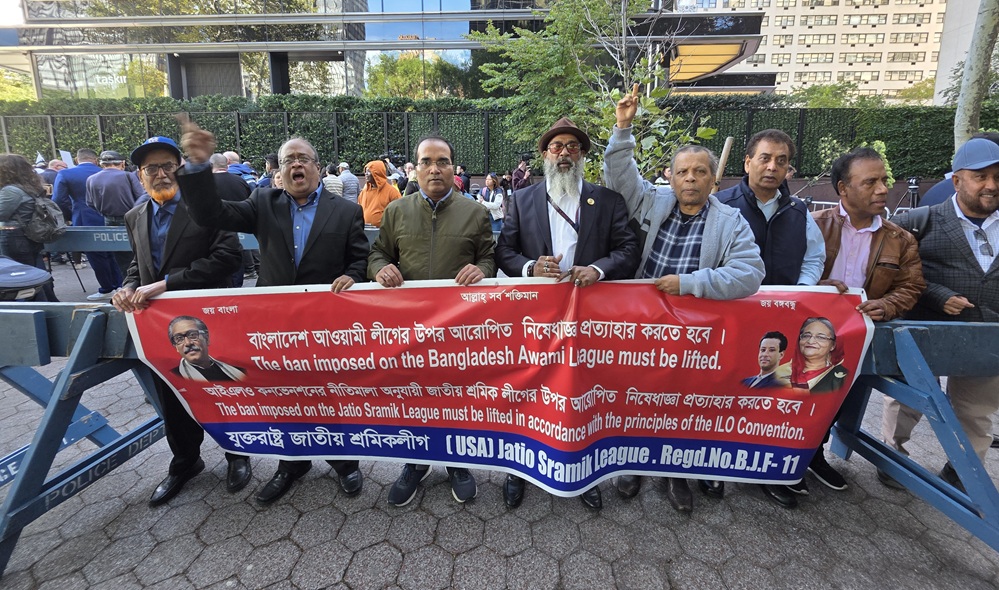
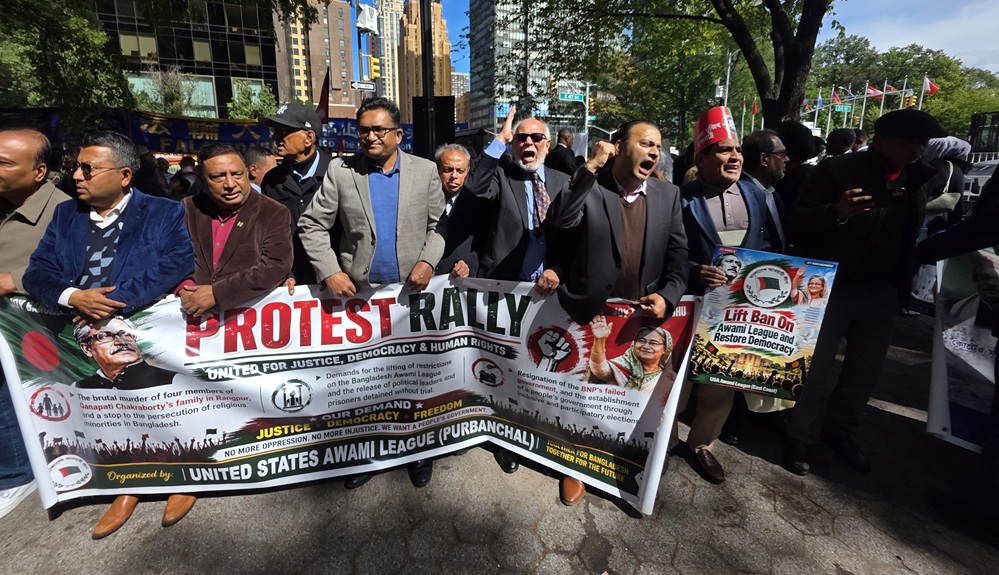
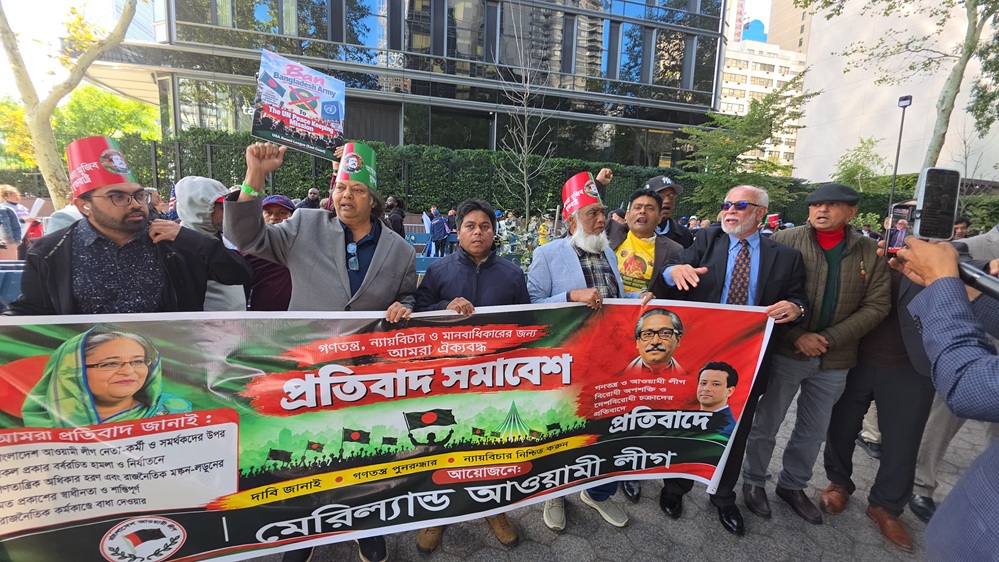
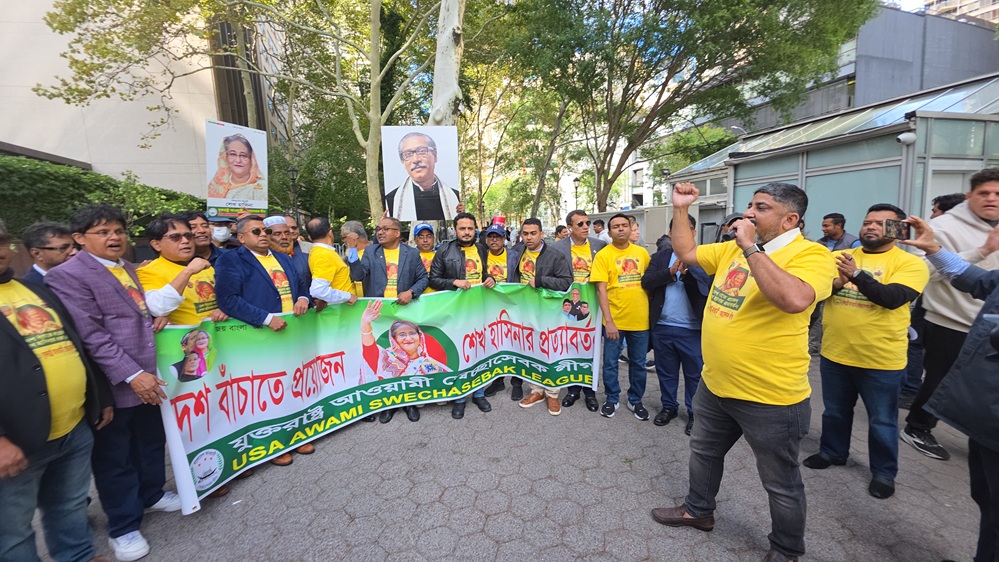
NEW YORK CORRESPONDENT: The US Awami League, Awami family members, and affiliated and associate organizations held a protest rally outside the United Nations headquarters in New York on Thursday, September 24, protesting the ban on all activities of the Bangladesh Awami League, death sentences against former Prime Minister Sheikh Hasina and other senior party leaders, and what they described as moves to hand over Saint Martin’s Island, ports and transit corridors to foreign interests.
The rally was held at noon outside the UN headquarters, with Awami League leaders and activists arriving from different states across the United States. Participants included leaders and activists from the US Awami League, US Jubo League, US Mohila League, US Chhatra League, US Sramik League, US Swechhasebak League, Michigan Awami League, Virginia State Awami League, Metro Washington Awami League, Maryland State Awami League, New York State Awami League, New York City Awami League, US Awami League South, US Awami League East, US Awami League West, and the organization Amra Mujib Sainik, among others.
Awami League supporters hold a protest outside the United Nations headquarters in New York on Thursday, September 24. Photo: KHABOR
The protesters chanted a range of slogans, including “Go Back Tarique,” “Terrorist Tarique,” “Khamba Tarique,” “No gas, no electricity—this government is not needed,” “No food, no clothing—this government is not needed,” “There are poles, but no electricity—this government is not needed,” “Police killer Tarique—go back, go back,” and “Grenade Tarique—go back, go back.”
Addressing the rally, speakers said the Awami League played a leading role in the establishment of Bangladesh as an independent and sovereign country. They alleged that banning the party’s political activities undermines the values, ideals and spirit of the country’s Liberation War. The speakers called for the immediate withdrawal of the ban, arguing that it would create political space for what they described as anti-liberation and extremist forces.
Awami League supporters hold a protest outside the United Nations headquarters in New York on Thursday, September 24. Photo: KHABOR
They also criticized the government over the country’s economic and social situation, citing rising prices, shortages of gas and electricity, problems in the education sector and what they described as a growing “mob culture.” They also alleged that Awami League leaders and activists were being killed and harassed.
The speakers made a number of allegations against BNP Acting Chairman Tarique Rahman. They questioned government decisions concerning aircraft purchases, arguing that greater attention should first be given to essential services and economic challenges inside Bangladesh.
Describing the situation in Bangladesh as a “major crisis,” the speakers alleged that domestic and foreign actors were conspiring over the country’s political and economic future. They claimed that factories and garment industries were facing difficulties and that the country’s production system was being adversely affected.
Awami League supporters hold a protest outside the United Nations headquarters in New York on Thursday, September 24. Photo: KHABOR
The speakers also raised concerns about child safety, public health and law and order, alleging that the government was not giving sufficient attention to these issues and was using political retaliation against its opponents.
Speakers further said that banning the Awami League would not end the party’s political existence. Referring to the party’s history, they said the Awami League had returned to politics after facing previous periods of political adversity and expressed confidence that it would again return as a stronger political force.
They also claimed that the ban had left people in Bangladesh and members of the diaspora shocked and angry. Some speakers described the current government as a “black government,” a characterization made by the speakers at the rally.
Among those attending the protest were US Awami League President Dr. Siddiqur Rahman, General Secretary Abdus Samad Azad, adviser Masudul Hasan, former BAKSU General Secretary and freedom fighter Dr. Pradip Ranjan Kar, Organizing Secretary Abul Hasib Mamun, former General Secretary Shamim Chowdhury, founding General Secretary of the US Awami League and mainstream political figure M.A. Salam, journalist Hakikul Islam Khokon, Ramesh Nath, Organizing Secretary Mohiuddin Dewan, freedom fighter Shawkat Akbar Ritchie, Legal Affairs Secretary Advocate Shah Md. Bokhtiar Ali, Education Affairs Secretary M.A. Karim Jahangir, and Dr. Masudul Hasan, president of the US chapter of Sheikh Kamal Parishad.
Awami League supporters hold a protest outside the United Nations headquarters in New York on Thursday, September 24. Photo: KHABOR
Also present were Awami League leader and Sheikh Hasina Mancha President freedom fighter Jalal Uddin Jalil, Organizing Secretary Sheikh Selim, Executive Member Shahanara Rahman, Awami League leader and former Union Parishad Chairman Iqbal Hossain, Awami League leaders Akhtar Hossain and Ali Hossain Ghaznavi, among others.
New York State Awami League President and freedom fighter Mujibur Rahman Mia, Vice Presidents Sheikh Atikul Islam and Abul Kashem Bhuiyan, Bangladesh Awami League Foundation Chairman Abdul Kader Mia, New York City Awami League President Rafiqul Rahman Rafiq and General Secretary Emdad Chowdhury also attended.
Others included Connecticut State Awami League General Secretary Humayun Ahmed Chowdhury, Mohila Awami League Joint General Secretary Rumana Akter, Awami League leader A.K. Chowdhury, Jubo League leaders Mizanur Rahman and Mizanur Rahman Chowdhury, US Chhatra League Vice President Shahidul Islam, and US Jubo League leader Khandaker Zahedul Islam.
Virginia State Awami League President G.I. Russell and member Jeba Russell, Metro Washington Awami League President M. Nabi Baki, Vice President Nurul Amin, General Secretary Mohammad Azam and Women’s Affairs Secretary Mohsina Jannat Rimi, as well as Maryland State Awami League President Moinul Majumdar Tapas, Mosharraf Hossain Dulal and Sramik League President Azizul Khokon were also among those present.
The rally concluded with demands for the restoration of the Awami League’s political rights and the return of Sheikh Hasina to Bangladesh, along with calls for a fresh election.
Banned AL to be deal with both politically and administratively: Anee
CHATTOGRAM – Water Resources Minister and BNP Joint Secretary General Shahiduddin Chowdhury Anee described Awami League (AL) as a banned political organization, asserting that the party is endeavoring to destabilize society through organizing ‘flash processions’ across multiple locations. Such activities will be dealt with both political and administrative measures, he said.
“Efforts by the banned Awami League to provoke civil unrest via flash processions in Chattogram will be handled through political and administrative channels. It is imperative that we prevent them from engaging in any form of unlawful conducts, anarchic behavior, or terrorist activities,” he stated. He told journalists following a special consultation meeting on the district’s law and order situation at the Chattogram Circuit House this afternoon.
Emphasizing the significance of the meeting on the law and order, Shahiduddin Chowdhury Anee said, “This is precisely why today’s gathering—a session of the District Law and Order Coordination Committee—proved to be so vital. We engaged in comprehensive discussions and formulated decisions in collaboration with administrative officials and elected public representatives to mitigate concerns including theft, mugging, robbery, snatching, illegal firearms, and narcotics trafficking. Our objective is to guarantee that the district maintains effective coordination and stability in the forthcoming period.”
Matters such as illegal firearms, narcotics trafficking, hill cutting, and unauthorized sand extraction are receiving equal attention alongside general law and order concerns, the Water Resources Minister said, “Currently, we find ourselves obligated to implement certain stringent measures”.
“For the people’s welfare and to fulfill their requirements, we are directing our efforts toward particular initiatives—especially the confiscation of illegal firearms, the elimination of narcotics operations, and the prevention of hill cutting and sand extraction activities. We have recognized that these practices frequently contribute to the deterioration of law and order conditions. We have thoroughly examined these issues and are implementing suitable interventions,” he said.
He further stated, “With profound dedication to our responsibilities, and guided by the leadership of Prime Minister Tarique Rahman, we have implemented targeted measures to resolve the situation and strengthen law and order—particularly throughout Chattogram city and the surrounding district. InshaAllah, the residents of this region will shortly witness the positive outcomes of these endeavors.”
Earlier, Water Resources Minister Md. Shahiduddin Chowdhury Anee joined a view exchanging meeting on law and order circumstances as the chief guest. Deputy Commissioner Mohammad Jahidul Islam Mian presided over the event.
Ershad Ullah, MP, Sarwar Jamal Nizam, MP, Abu Sufian, MP, and Humam Quader Chowdhury, accompanied by Chattogram Divisional Commissioner Dr. Md. Ziauddin, Chattogram Range DIG Md. Abdul Quddus Chowdhury, and Chattogram Metropolitan Police (CMP) Commissioner Hasan Md. Shawkat Ali, among others, spoke at the programme.
BNP-Awami League Tensions Escalate in New York, Riot Police Intervene
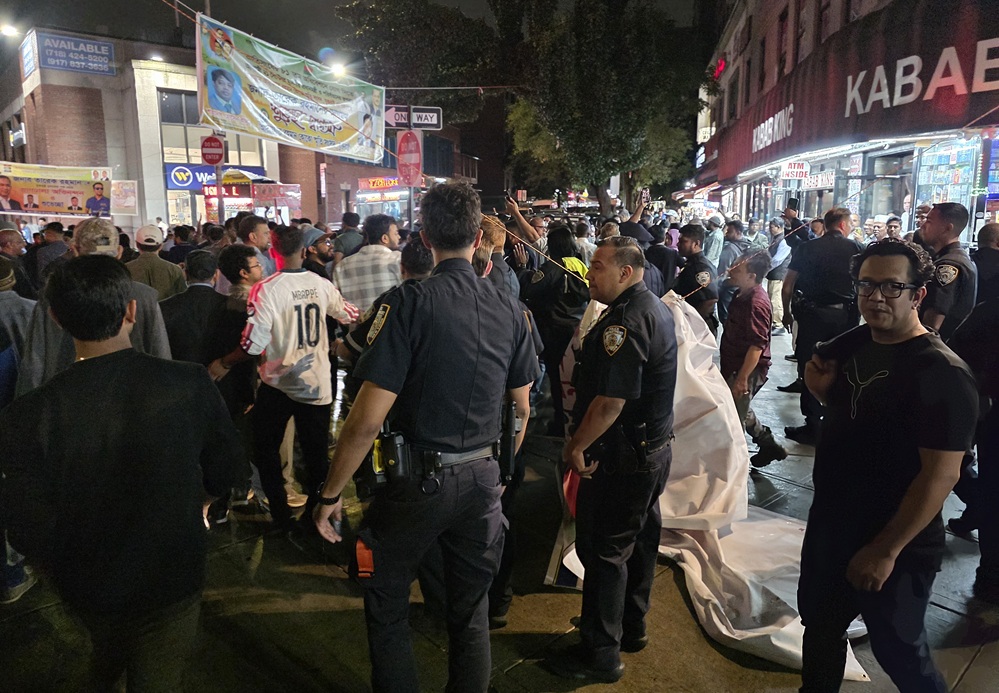
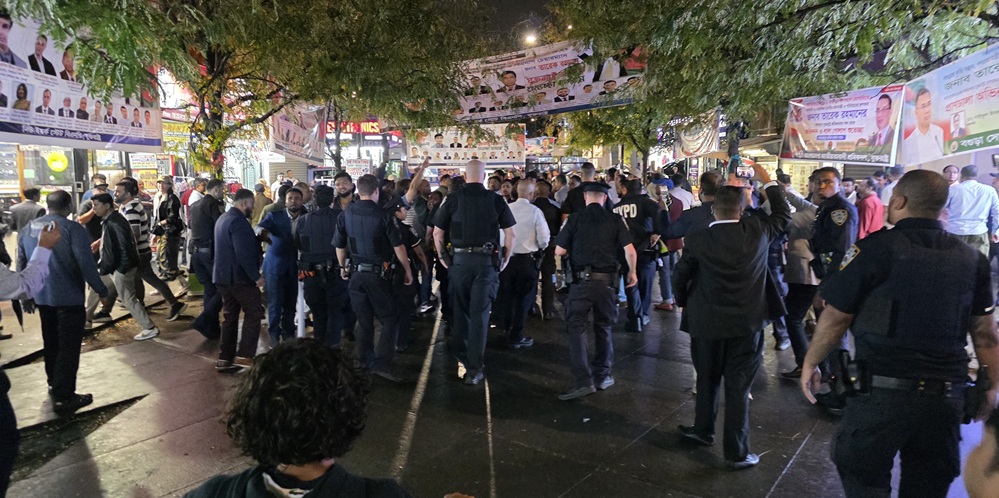
NEW YORK — Tensions between supporters of Bangladesh’s ruling Bangladesh Nationalist Party (BNP) and the opposition Awami League escalated in New York’s Jackson Heights on Sunday evening, September 20, as rival groups gathered for competing programmes ahead of Prime Minister Tarique Rahman’s visit to the city for the 81st session of the United Nations General Assembly.
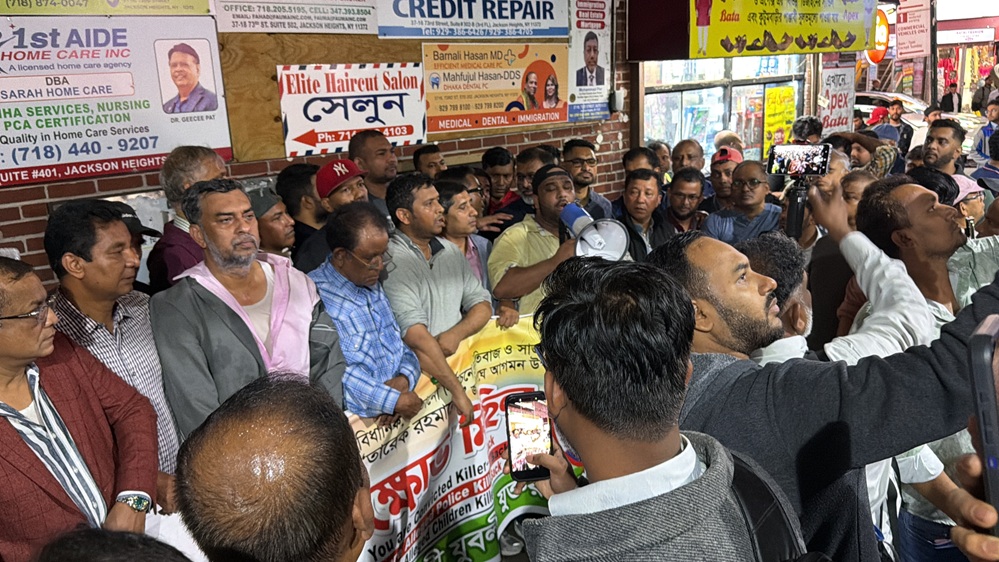
The situation at Diversity Plaza became increasingly tense as supporters of the BNP gathered to welcome Tarique Rahman, while a large group of Awami League activists assembled nearby chanting, “Wherever Tarique goes, resistance will follow.”
The two sides initially exchanged competing slogans before the confrontation reportedly escalated into pushing, shoving and verbal altercations. The BNP alleged that several banners welcoming Tarique Rahman were torn down by Awami League activists, further intensifying tensions.
A section of the Awami League gathering during the tense face-off between Awami League and BNP supporters at Diversity Plaza in Jackson Heights. Photo: Khabor
According to witnesses, several hundred activists from both sides were involved in the confrontation. Multiple teams of the New York Police Department responded to the scene after receiving reports of the escalating situation. More than 50 riot-control officers subsequently moved between the two groups and attempted to keep them separated.
Police eventually intervened more forcefully as the two sides continued their confrontation. The area remained crowded with competing chants, while traffic was temporarily disrupted. Pedestrians moved away from the scene as police worked to prevent the situation from escalating further.
The confrontation comes as Bangladeshi political groups in New York prepare for a series of activities surrounding Tarique Rahman’s visit. BNP supporters have been organizing welcome programmes in Jackson Heights and elsewhere in the city. Recent reporting also confirms that BNP activists gathered in Jackson Heights ahead of the prime minister’s arrival.
Tarique Rahman left Dhaka on September 21 to attend the 81st UN General Assembly. According to Bangladesh Sangbad Sangstha (BSS), he is scheduled to arrive at John F. Kennedy International Airport at about 5:55 p.m. New York time after a stopover in Istanbul. He is scheduled to address the General Assembly on September 24 and depart New York for Dhaka on September 25.
New York police officers remove BNP supporters from the area during the tense confrontation between Awami League and BNP supporters at Diversity Plaza in Jackson Heights. Photo: Khabor
The United Nations’ high-level week for the 81st General Assembly is scheduled for September 22–29, with the general debate taking place from September 22 to 26 and again on September 28.
Meanwhile, Awami League leader Imdad Chowdhury said the party is preparing to mobilize about 1,000 activists at JFK Airport as part of its “Wherever Tarique, Resistance There” programme. He said permission had been obtained from the relevant airport authorities for the gathering.
BNP leader Golam Faruk Shaheen, meanwhile, said hundreds of BNP supporters would gather at JFK Airport to welcome Tarique Rahman. He also said the BNP had obtained the necessary authorization for its programme.
A section of the Awami League gathering during the tense face-off between Awami League and BNP supporters in Jackson Heights. Photo: Khabor
The competing plans are expected to require additional security measures at the airport. Police may establish separate areas and security barriers to keep the two groups at a safe distance from each other.
Security arrangements are also being heightened in New York during the UN General Assembly’s high-level week, when heads of state, government leaders and senior officials from around the world gather at the United Nations headquarters. The UN’s official schedule places the 81st General Assembly’s high-level week from September 22 through September 29.
The latest confrontation in Jackson Heights has raised concerns within the Bangladeshi-American community about the possibility of further tensions during Tarique Rahman’s visit, particularly around the airport and other locations where competing political groups are expected to gather.
Sheikh Hasina to Address US Awami League Press Meet Sept. 24
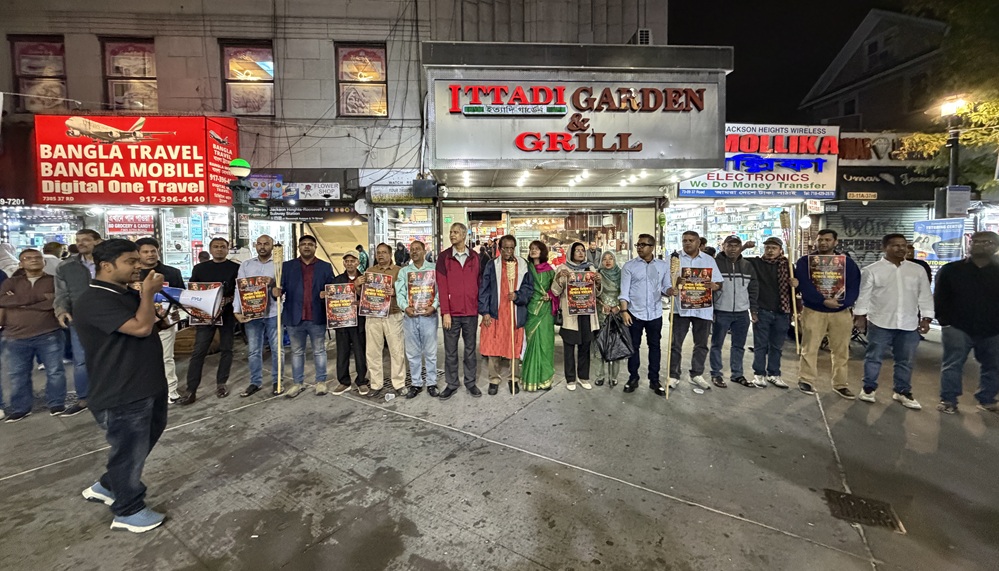
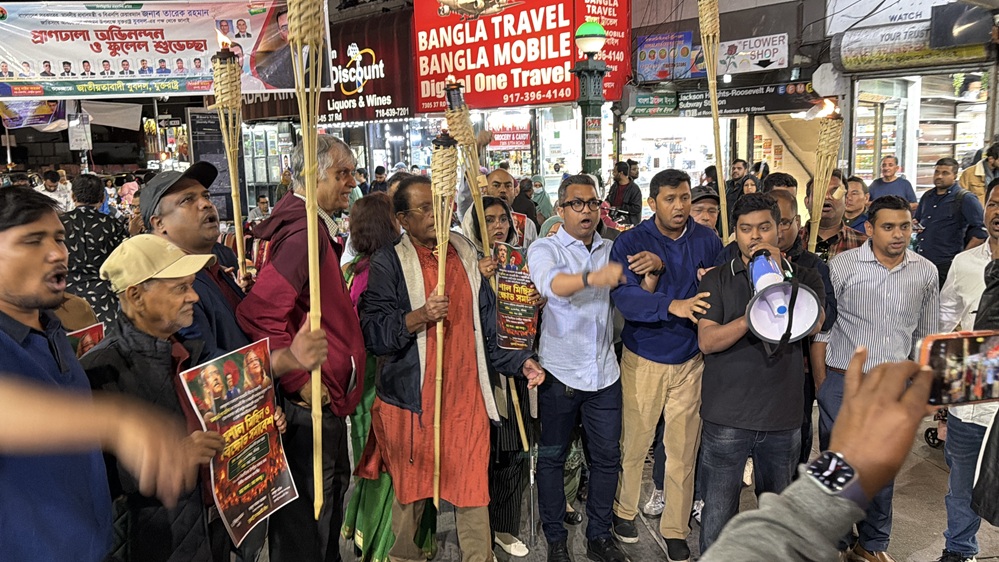
New York — The US Awami League is scheduled to hold a press conference in New York at 8 p.m. on September 24, with Bangladesh Awami League President and former Prime Minister Sheikh Hasina expected to participate as the chief guest, according to the organization. The announcement was made by US Awami League President Dr. Siddiqur Rahman during a torchlight procession and protest rally organized by the party at Diversity Plaza in Jackson Heights, New York, on Saturday, September 19.
According to Dr. Siddiqur Rahman, Sheikh Hasina will deliver what the organization described as a guideline-setting address on the future of Bangladesh. He also said she would make an important decision concerning her planned return to Bangladesh in December. Sheikh Hasina said in a Reuters interview published in July that she planned to return to Bangladesh in December, despite facing legal proceedings and a death sentence. She has been living in India since leaving Bangladesh in August 2024.
Torchlight rally in Jackson Heights
The September 19 rally brought together leaders and activists from the US Awami League and its affiliated organizations, including the Jubo League, Sramik League, Swechchhasebak League, Mohila Awami League and Chhatra League. Participants chanted slogans including “Go back, go back, Tarique, Tarique” and “Step down, step down, Tarique, Tarique” during the procession and rally.
The program was chaired by US Awami League President Dr. Siddiqur Rahman and moderated by the organization’s General Secretary Abdus Samad Azad. According to the organizers, the protest was held in response to court verdicts involving Sheikh Hasina and leaders of the Awami League and its affiliated organizations, the situation surrounding the lockdown in Dhaka, and the planned visit of BNP Chairman and Prime Minister Tarique Rahman to the United States.
Addressing the gathering, Dr. Siddiqur Rahman said the US Awami League would organize protest and resistance programs wherever Tarique Rahman is present between September 21 and 25. He also called on Awami League supporters living in the United States to participate in programs organized by the US Awami League.
Sheikh Hasina’s planned December return
Sheikh Hasina has publicly said she intends to return to Bangladesh in December. In an interview with Reuters published in July, she said she planned to return from India despite the legal consequences she could face. In August, she again said she intended to return to Bangladesh and that the exact date would be announced when the time was appropriate, while indicating that she wanted the return to take place in December.
The issue has gained renewed attention following recent court proceedings involving former Awami League officials. On September 15, a Bangladesh tribunal sentenced seven former aides of Sheikh Hasina to death in absentia in cases connected to the 2024 crackdown, according to Al Jazeera. The report said the defendants were convicted of crimes including murder and inciting killings.
Political activity intensifies in New York
Tarique Rahman’s visit to New York for the 81st session of the United Nations General Assembly has prompted increased political activity among Bangladeshis in the United States.
The US Awami League leadership said it has planned a series of demonstrations, protests and other programs in New York and elsewhere in the United States throughout the period of Tarique Rahman’s stay for the UN General Assembly. According to party leaders, Awami League supporters from different US states and other countries have begun arriving in the United States to participate in the planned programs.
The BNP’s US organization has also been holding programs ahead of Tarique Rahman’s visit, including a “Meet the Press” event in New York, where the party called on expatriate Bangladeshis to support its activities surrounding the prime minister’s UNGA visit.
With competing political groups preparing separate programs around the UN General Assembly, the period is expected to bring increased political activity within the Bangladeshi-American community in New York.
The US Awami League says Sheikh Hasina’s September 24 address will focus on Bangladesh’s future and will include an announcement concerning her planned return to the country. The details of that announcement remain to be seen.
Awami League Protest in New York Over Death Sentences for 7 Leaders
New York Correspondent: The US Awami League and its affiliated organisations staged a protest rally and procession in New York on Tuesday evening against the death sentences handed down by Bangladesh’s International Crimes Tribunal-2 against seven Awami League and affiliated-organisation leaders, including Awami League General Secretary and former minister Obaidul Quader.
The protest was held at Diversity Plaza in Jackson Heights on Tuesday (September 15). Following the rally, protesters marched through nearby streets carrying banners and placards. Leaders and activists of the US Awami League, US Chhatra League, Volunteer League, Labour League, Mohila Awami League, New York State Awami League and New York Metropolitan Awami League took part in the programme.
Several national-level Awami League leaders and former lawmakers were also present, according to organisers. They included former Water Resources Minister and former Awami League Organising Secretary Enamul Haque Shamim, Awami League Publicity and Social Welfare Secretary Aminul Islam Amin, former State Minister and former lawmaker Mohammad Zahid Ahsan Russel, and former lawmaker and former Bangladesh Chhatra League General Secretary Nazrul Islam Babu.
US Awami League President Dr. Siddiqur Rahman and General Secretary Abdus Samad Azad, along with leaders from different levels of the organisation, also attended the programme.
The protesters carried banners and placards rejecting the tribunal’s verdict. The organisers described the cases against the party leaders as politically motivated and characterised the verdict as an act of political retaliation and a predetermined judicial process. These are the political claims of the US Awami League and the protesters.
At the rally, speakers expressed their opposition to the tribunal’s verdict and called for its cancellation. They also called for due legal process and justice, arguing that political disputes should not determine judicial outcomes.
Seven Sentenced to Death by Tribunal
Earlier on Tuesday, International Crimes Tribunal-2 sentenced seven people to death in a crimes-against-humanity case related to the July-August 2024 mass uprising in Bangladesh.
Those sentenced to death are Awami League General Secretary and former minister Obaidul Quader; Awami League Joint General Secretary AFM Bahauddin Nasim; former State Minister for Information and Broadcasting Mohammad Ali Arafat; Jubo League Chairman Sheikh Fazle Shams Parash; Jubo League General Secretary Md Mainul Hossain Khan Nikhil; Bangladesh Chhatra League President Md Saddam Hossain; and its General Secretary Sheikh Wali Asif Inan.
The three-member tribunal, headed by Justice Nazrul Islam Chowdhury, delivered the verdict on Tuesday. The seven accused were tried in absentia and remain at large, according to Bangladesh Sangbad Sangstha (BSS).
The prosecution had accused the seven of involvement in crimes against humanity during the July 2024 mass uprising, including murder, attempted murder, torture, incitement, conspiracy and other acts. The tribunal ruled that the charges against the accused had been proved beyond reasonable doubt. Chief Prosecutor Md Aminul Islam also said after the verdict that most of the charges had been proved beyond reasonable doubt.
The tribunal also ordered the confiscation of 50 percent of the movable and immovable properties of Obaidul Quader, AFM Bahauddin Nasim, Mohammad Ali Arafat, Sheikh Fazle Shams Parash and Mainul Hossain Khan Nikhil. It directed that proceeds from the sale of the confiscated properties be used to compensate people killed or injured during the July-August 2024 uprising or their families.
The defence had previously argued before the tribunal that the prosecution failed to prove the charges beyond reasonable doubt.
The New York protest came hours after the tribunal announced its verdict in Dhaka, bringing the latest political and judicial developments in Bangladesh into the streets of Jackson Heights, home to a large Bangladeshi-American community.