Sheikh Hasina Expects to Return to Bangladesh by December 31

NEW DELHI: Former Prime Minister and Awami League President Sheikh Hasina has reiterated her expectation of returning to Bangladesh by December 31. During a meeting with party leaders in New Delhi on November 13, she reportedly called for her return to the country, the lifting of the ban on the Awami League, the withdrawal of cases filed against party leaders and activists, and the release of those who have been arrested, according to Imdad Chowdhury, general secretary of the New York City Awami League.

Imdad Chowdhury said Sheikh Hasina wants to challenge the verdict delivered in the trial conducted in her absence. To that end, she has stressed the need for assurances that she would be able to appoint lawyers at home and abroad, pursue an appeal, and receive guarantees for her personal security. According to Imdad, Sheikh Hasina also demanded the trial of former interim government Chief Adviser Muhammad Yunus over allegations of various abuses and irregularities, including the killing of children. She also expressed concern about party leaders and activists facing difficulties and urged families affected by violence to speak out and demand justice.

After the meeting, Imdad Chowdhury said Sheikh Hasina appeared physically fit and well. “I saw the leader looking just as she did before July 2024,” he said. Those present at the meeting with Imdad Chowdhury included New York City Awami League Vice President Sakhawat Hossain Chanchal, US Jubo League General Secretary Mizanur Rahman Chowdhury and several others. Imdad also said that a separate nine-member delegation, led by US Awami League President Siddiqur Rahman and General Secretary Abdus Samad Azad, met Sheikh Hasina around the same time.

According to information provided by Imdad, three Awami League leaders from Cambodia, London and Bangladesh were also in Delhi during the period. Describing the atmosphere at the meeting, Imdad said everyone shared a meal with Sheikh Hasina in an environment similar to the hospitality she used to extend to party leaders and activists at Ganabhaban. Imdad further said that the New York City Awami League has begun preparing a list of people interested in accompanying Sheikh Hasina on her return to Bangladesh. He and Sakhawat Hossain Chanchal have informed her about the initiative, he added.

The report also mentioned that several other Awami League leaders from the United States, including engineer Mohammad Ali Siddiqui, Dr Pradip Kar and Advocate Shah Bakhtiar, have travelled from New York to New Delhi and met Sheikh Hasina on multiple occasions over the past two years.

Meanwhile, Sheikh Hasina’s possible return to Bangladesh has emerged as an important issue in diplomatic discussions between India and Bangladesh. On November 13, Indian External Affairs Ministry spokesperson Randhir Jaiswal declined to give a direct response when asked about her possible return and reports that she could be taken back to Bangladesh on a military aircraft. He said the legal matter referred to by India primarily concerned the extradition process.

Earlier, a BBC Bangla report, citing sources in Delhi, said India might seek assurances on two issues before agreeing to send Sheikh Hasina back to Bangladesh. First, she should be returned through an arrangement similar to the one under which she travelled to India on a Bangladeshi military aircraft. Second, she should be given an opportunity to appeal against the verdict issued against her and participate in the judicial proceedings after returning to Bangladesh. However, the Indian government has not officially confirmed these conditions.

According to a November 9 Reuters report, Sheikh Hasina has applied to the Bangladesh High Commission in New Delhi for a new passport and national identity card as part of preparations for her return to Bangladesh. The application was mentioned in a letter from her lawyers. The Bangladesh government has expressed a negative position regarding her application and has raised the issue of her extradition.

Sheikh Hasina has been staying in India since being ousted from power in August 2024. In November 2025, Bangladesh’s International Crimes Tribunal sentenced her to death in absentia. She has rejected the verdict and described the trial process as politically motivated.

Overall, Sheikh Hasina’s possible return, the ban on the Awami League’s political activities, the judicial proceedings against her and diplomatic relations between India and Bangladesh are likely to remain significant issues in the country’s political discussions in the coming days.


Hasina Has No Legal Right to Obtain Passport, Says BNP Leader Rizvi

DHAKA: BNP Acting Secretary General and Prime Minister’s Political Adviser Advocate Ruhul Kabir Rizvi has said fugitive Awami League leader Sheikh Hasina has no legal scope to obtain a passport. He said Hasina must serve the punishments imposed on her for crimes against humanity and the killings of people, students and workers. She must also face the ongoing trials against her.

Rizvi made the remarks after a protest procession organised by Dhaka Metropolitan South Jubo Dal against what it described as terrorism and anarchy by the banned Awami League. The procession began at the National Press Club and ended at Shahbagh intersection in the capital. Referring to Bangladesh’s political history, Rizvi alleged that Sheikh Hasina’s father, Sheikh Mujibur Rahman, had established authoritarian rule through the formation of BAKSAL.

Citing the 1973 law, Rizvi described Hasina as a fugitive accused in crimes against humanity cases and said she must face the legal consequences and serve the punishments imposed on her. Addressing Jubo Dal and BNP leaders and activists, Rizvi said cocktail explosions and arson attacks would not intimidate leaders and activists of Jatiyatabadi Jubo Dal and other BNP-affiliated organisations.

He said they had continued their political struggle despite enforced disappearances, killings and various forms of repression. Rizvi also referred to Dhaka Metropolitan South Jubo Dal Member Secretary Rabiul Islam Nayan, alleging that he had faced severe torture and physical abuse but remained undeterred.

He further said nationalist forces could not be subdued and that nationalist and democratic forces across the country would build resistance on the streets against any attempt to revive authoritarian rule. Rabiul Islam Nayan and other leaders and activists of Dhaka Metropolitan South Jubo Dal were present at the programme.


HRW: Bangladesh Academics Targeted Over Alleged Pro-Hasina Links

Rights group warns of political retaliation and violations of academic freedom; 404 additional teachers reportedly under investigation at 22 universities

Shibbir Ahmed, New York – Hundreds of academics and students at public universities across Bangladesh are facing disciplinary measures over alleged political affiliations with former Prime Minister Sheikh Hasina and her Awami League party, Human Rights Watch (HRW) said in a report released Tuesday. The international human rights organization warned that punishing individuals for their peaceful political beliefs or affiliations, particularly without transparent investigations and due process, could violate internationally protected rights to freedom of expression and association.

In its statement, HRW said the recent actions risk repeating longstanding patterns of political interference and repression at Bangladesh’s public universities, where successive administrations have been accused of controlling political opinions and targeting academics associated with opposition groups.

“Bangladesh has a long history of political debate in its universities, and only autocrats should fear such discourse, not a government formed following student protests,” said Meenakshi Ganguly, deputy Asia director at Human Rights Watch.

“Bangladesh needs to turn the page on the repression of the past, not repeat it whenever the ruling and opposition parties trade places,” she added.

According to HRW, disciplinary actions against university teachers include dismissals, temporary suspensions, restrictions on teaching responsibilities and removal from academic activities. The allegations reportedly involve complicity in violence during the 2024 protests under Hasina’s Awami League government, participation in alleged subversive activities supporting the party, or discrimination against students wearing Islamic clothing.

Hundreds of students identified as alleged Awami League members or supporters are also facing expulsion, raising concerns about violations of their right to education. HRW said it interviewed more than a dozen affected teachers, examined university correspondence and reviewed a televised discussion and a video posted on social media.

Interviews with teachers and students also confirmed cases involving expulsions, withholding of examination certificates and restrictions on campus access. According to media reports published in August 2026, at least 404 additional academics from 22 universities were placed under investigation over their alleged membership in a pro-Awami League Telegram messaging group.

A professor at a public university, speaking anonymously for security reasons, told HRW that university authorities were targeting teachers aligned with the Awami League who had not supported the 2024 student movement. “We are not allowed to go take classes, we cannot do research work, we cannot do anything,” the professor said.

HRW found that disciplinary actions have affected more than 20 public universities across Bangladesh. At Dhaka University, the country’s most prestigious public university, newly appointed authorities began taking action against academics in September 2024. Forty-four teachers were ordered to stop performing their duties, while another 25 faced restrictions on their teaching assignments.

HRW said these initial measures were imposed without transparent or credible disciplinary investigations.Su bsequently, six academics were formally placed under temporary suspension following an inquiry committee’s findings. Investigations have also been initiated against another 14 teachers.

At Bangladesh Agricultural University in Mymensingh, authorities dismissed, suspended or removed 12 academics from their positions. Another 34 teachers were demoted or had their academic responsibilities restricted. Although the university established an investigation commission, HRW questioned whether the process complied with the institution’s legally established disciplinary procedures.

At Sher-e-Bangla Agricultural University in Dhaka, 12 academics were temporarily suspended and another 10 removed from academic activities following an inquiry process that teachers said they were not allowed to attend. Another 85 teachers were reportedly denied promotions.

The allegations also extend to university students. In March 2025, Dhaka University temporarily suspended 126 students and withheld their examination certificates following a fact-finding committee’s report. The committee said it had found photographic, video or social media evidence suggesting that the students had attacked peaceful protesters.

Police cases also allege the involvement of another 277 students identified as Awami League supporters. Although university authorities have not taken formal disciplinary action against those 277 students, teachers and students told HRW that many have stopped attending campus because they fear arrest.

Several students named in the allegations deny involvement in the violence. However, HRW said the university has not provided an effective formal mechanism for them to respond to the accusations.

Among the academics affected is Professor Mashiur Rahman of Dhaka University’s Department of Sociology, who had been serving as vice-chancellor at another university on deputation since 2017. On September 25, 2024, he was instructed to stop all academic and administrative activities. One allegation against him concerns a televised discussion in July 2024, during which he was accused of directly opposing the student movement and describing it as illegal, baseless and irrational.

However, HRW reviewed a recording of the broadcast and said it found no such comments. Another allegation claims that he incited genocide during a meeting at the prime minister’s residence on August 3, 2024. Rahman told HRW that the meeting had been organized by the University Grants Commission and that all vice-chancellors were required to attend.

He denied making the alleged statement and said no supporting evidence had been presented to him. On August 31, 2026, university authorities recommended his permanent suspension. He is appealing the recommendation.

At Bangladesh Agricultural University, disciplinary proceedings against several teachers are primarily based on their alleged participation in a pro-Awami League procession on August 4, 2024, one day before Hasina left the country. An investigation commission established by the university described the procession as a “terrorist” march.

However, HRW analyzed a video posted on Facebook by the Bangladesh Agricultural University Journalists’ Association on August 4, 2024. The footage shows a group of people walking across the campus while chanting slogans, but no direct confrontation is visible.

Professor Purba Islam of the Department of Pharmacology was suspended on August 4, 2025, over allegations that she chanted slogans during the procession, allegedly supporting repression, persecution and genocide under Hasina’s government. HRW said the video it reviewed did not show evidence of her chanting slogans.

Professor Yahia Khandoker of the Department of Animal Breeding and Genetics was also suspended on August 4, 2025. He was accused of maintaining a clear position in support of Hasina’s alleged mass killings on the university campus. Khandoker told HRW that he had been staying with his family in Dhaka throughout the protest period and was not present at the university. The High Court has stayed his suspension, although the Attorney General’s Office is appealing the decision.

The report also noted that three academics have been convicted by Bangladesh’s International Crimes Tribunal on crimes against humanity charges. Two are currently in prison, while another is awaiting trial. The report recalled that hundreds of people were killed during the police crackdown on student-led protests in July and August 2024, forcing Hasina to leave the country.

The Bangladesh Nationalist Party returned to power following an election in February 2026. Earlier, in May 2025, an interim government had criminalized the activities of the Awami League.

HRW noted that Bangladesh’s universities have historically been affected by partisan politics, with administrations accused of favoring academics aligned with the ruling party in appointments and promotions while taking action against those associated with opposing political groups.

Ganguly warned that retaliatory measures against individuals for peacefully supporting a previous government would demonstrate that freedom of speech and assembly are not adequately protected.

“Universities should be places where people are free to express their views, not places where support is enforced for the government of the day,” she said.


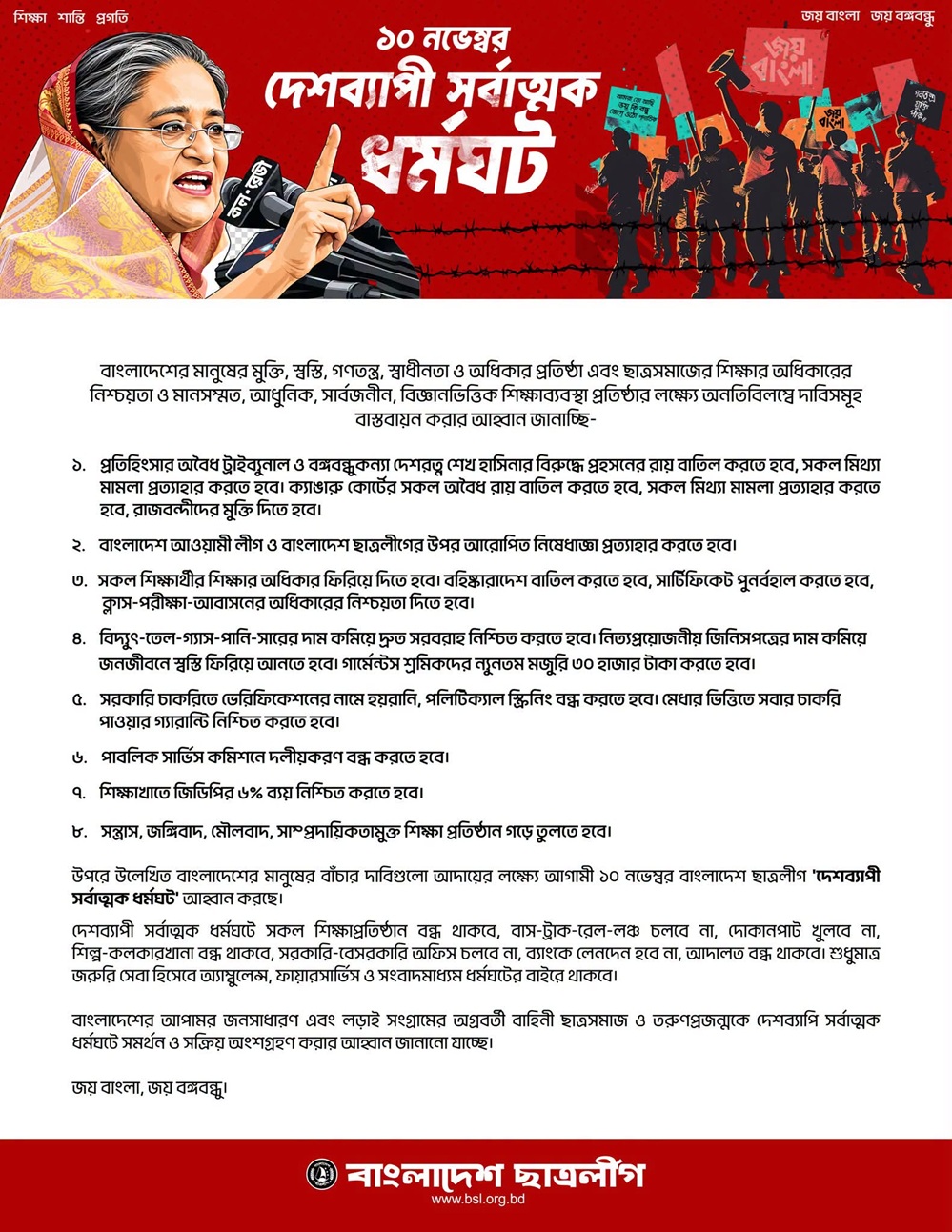
Chhatra League Announces Nationwide Strike on November 10

Desk Report – The Bangladesh Chhatra League has announced a nationwide general strike for November 10, calling for the implementation of eight demands concerning various political and social issues in the country. The organization claims that the Bangladesh Awami League, along with its affiliated and associate organizations, including the Jubo League, Swechchhasebak League and Mohila Awami League, has expressed full support for the programme.

The announcement was made in a press release issued on November 8 and signed by Bangladesh Chhatra League Central Executive Committee President Saddam Hossain and General Secretary Sheikh Wali Asif Inan.

According to the statement, the organization has raised eight demands aimed at ensuring people’s fundamental rights, restoring public welfare and improving the overall quality of the education system. The strike has been called to press for the implementation of these demands, the release said.

The eight demands include the withdrawal of verdicts and cases against Bangladesh Awami League President and former Prime Minister Sheikh Hasina; the lifting of restrictions imposed on the Awami League and Chhatra League; and the release of individuals detained for political reasons.

The organization has also called for the cancellation of expulsion orders against expelled students and the reinstatement of their academic certificates, as well as ensuring a merit-based environment in educational institutions. Other demands include ending alleged political harassment and political screening during government job verification processes and eliminating partisan influence in the Public Service Commission (PSC).

The remaining demands include preventing increases in the prices of electricity, gas, fuel, water and essential commodities; allocating 6 percent of the country’s Gross Domestic Product (GDP) to the education sector; and setting the minimum monthly wage for garment workers at Tk 30,000.

According to the announced programme, educational institutions, shops, industrial facilities, courts, government and private offices, and banking operations are expected to remain closed during the strike on November 10. The statement also calls for suspending bus, truck, train and launch services across road, rail and waterways. However, emergency services, including ambulances and fire services, as well as newspapers and other media organizations, have been exempted from the proposed strike.

In the press release, the Chhatra League, along with the Awami League and its affiliated and associate organizations, urged people from all walks of life, students and young people to participate in the programme and extend their support.


US Should Begin Dialogue with Awami League, Says A.K. Abdul Momen

Irin Rahman, New York: The United States should immediately begin dialogue with the Awami League to help ensure peace and political stability in Bangladesh, prevent extremism and violence, and protect American business and investment interests in the country, former Bangladeshi Foreign Minister Dr. A.K. Abdul Momen said. Dr. Momen made the remarks as the chief guest at a seminar held in New York on November 1.

The seminar, titled “The Activities of the Judiciary in Bangladesh after August 5, 2024 and the Contemporary Context,” was organized by the U.S. chapter of the Sammilito Ainjeebi Samanway Parishad.

Dr. Momen argued that political stability in Bangladesh would be difficult to achieve without dialogue between the United States and the Awami League. He further claimed that long-term stability in Bangladesh cannot be ensured without the participation of the Awami League.

According to Momen, the United States needs a stable and acceptable government in Bangladesh if it wants to continue business, trade and investment in the country. He said the United States should therefore initiate dialogue with the Awami League in its own interest and added that he had already sent a letter to the U.S. government on the matter.

Dr. Momen also discussed the security of Awami League President Sheikh Hasina, whom he said would return to Bangladesh in December. Criticizing the current political situation, Momen claimed that Bangladesh was facing serious challenges in law and order and the economy. He urged the BNP and its political allies to immediately begin dialogue with the Awami League.

He also called for the withdrawal of restrictions against the Awami League and a review of cases filed against its leaders and activists. Momen said ensuring the independence and transparency of the judiciary could help create an environment for political dialogue.

The former foreign minister also expressed gratitude to India for providing shelter to Sheikh Hasina and called on the Indian government to take initiatives for dialogue involving the Bangladesh government, the Awami League, the United States and the European Union. Referring to reports of violence, killings, attacks and legal cases in Bangladesh, Momen urged Bangladeshi-American lawyers to pursue appropriate legal initiatives in U.S. courts.


US Awami League Holds Discussion Meeting in New York on Jail Killing Day

New York: The U.S. chapter of the Bangladesh Awami League held a discussion meeting in New York to commemorate Jail Killing Day. The event was held on November 3 at the party room of Nabanna Restaurant in Jackson Heights. The meeting was chaired by Dr. Siddiqur Rahman, president of the U.S. Awami League, and moderated by General Secretary Abdus Samad Azad.

Enamul Haque Shamim, former deputy minister for water resources and organizing secretary of the Bangladesh Awami League, attended the event as a special guest. Among those present were Bangladesh Awami League General Secretary Aminul Islam Amin, former parliamentary whip Nazrul Islam Babu, and Dr. Mahmudul Hasan, vice president of the U.S. Awami League and a central committee member.

Also attending were Shahin Azmal Rafiq, general secretary of the New York State Awami League; Rafiqur Islam, president of the New York City Awami League; General Secretary Emdad Chowdhury; Vice President Sakhawat Hossain Chanchal; and Bangladesh Jubo Mohila League Vice President Mitu Akter.

Leaders of the U.S. Jubo League and Chhatra League, including Sebul Mia, General Secretary Mizanur Rahman Chowdhury, Chhatra League President Mahmudul Hasan and General Secretary Hridoy Mia, also attended along with leaders and activists from various affiliated organizations.

The program began with prayers and a moment of silence in memory of the four national leaders who were killed in Dhaka Central Jail on November 3, 1975. Speakers recalled the sacrifices and political contributions of the four national leaders and also discussed the current political situation in Bangladesh.


Hasina Says She Will Return to Bangladesh in December ‘At Any Cost’

Desk News: Former Bangladesh Prime Minister Sheikh Hasina says she remains determined to return to Bangladesh from exile in India in December, despite facing a death sentence over her government’s deadly crackdown on protesters following her ouster in a mass uprising in 2024. Hasina fled to India after student-led protests forced her from power and has remained there since. She was later sentenced to death by a Bangladeshi special tribunal for crimes against humanity in connection with the crackdown.

The United Nations has said in a report that nearly 1,400 people were killed during the violence. Hasina has denied wrongdoing, rejected the tribunal’s verdict and questioned the legitimacy of the trial. Bangladesh has repeatedly sought her extradition from India, but New Delhi has not handed her over. Hasina first announced in August that she intended to return to Bangladesh in December.

“If death is my destiny, I would rather die on the soil of my own country, among my own people,” Hasina told The Associated Press in an email response. “So, I will return to Bangladesh. That decision has not changed.”

The AP sent questions to Hasina last week, and she responded Wednesday. Hasina, who served as prime minister from 2009 until 2024, did not reveal how she plans to return to Bangladesh. She could face arrest if she enters the country.

“I know that I may be arrested when I return. I may be imprisoned, tortured or even killed. I am fully aware of those possibilities. But I cannot spend the rest of my life watching my people suffer from a distance,” she told AP.

Following Hasina’s ouster, Nobel Peace Prize laureate Muhammad Yunus headed an interim administration that governed Bangladesh for about 18 months. An election held under the Yunus administration later brought Tarique Rahman, the son of former Prime Minister Khaleda Zia and a longtime political rival of Hasina, to power in a landslide victory. Hasina’s Awami League was barred from participating in the election.

Her planned return comes as the Awami League faces an uncertain political future. The party remains banned, while many of its senior leaders have been arrested or have gone into exile.

Hasina alleged that at least 20,000 members of her party have been killed since August 2024. She also claimed that thousands of supporters have been arrested, tortured or forced into hiding, while others have lost homes, businesses and livelihoods because of their political affiliations.

“There is no normal political or democratic environment,” Hasina said, accusing the authorities of systematically suppressing the Awami League. The government says arrests have been made in connection with specific allegations and cases. Human Rights Watch and other rights organizations have also raised concerns over civil and political rights in Bangladesh. Hasina expressed concern about what she described as the growing influence of hard-line and extremist groups in the country.

“The present political environment has allowed extremist elements to become more confident,” she said. The government has denied allegations of widespread intimidation of minorities and the growing influence of extremist groups, while the country has faced continued criticism over its law-and-order situation. Asked whether she expected countries such as the United States and India to pressure Bangladesh to guarantee her safe return, Hasina said she did not seek protection from foreign powers.

“I value friendship and cooperation with all nations. That has always been our (Bangladesh’s) foreign policy. But I do not need the blessing of a foreign power to return to my own country,” she said. Hasina has remained in India since leaving Bangladesh after the 2024 mass uprising that ended her 15-year rule.


Sheikh Hasina Appeals to UN Experts to Lift Ban on Awami League

Shibbir Ahmed, New York — Former Bangladesh Prime Minister Sheikh Hasina has submitted a formal communication to United Nations human-rights experts challenging the continued ban on the activities of the Bangladesh Awami League and seeking urgent international intervention, according to an announcement published by British barristers’ chambers Matrix Chambers on Tuesday.

The communication was submitted on Hasina’s behalf by barrister Steven Powles KC. It challenges restrictions imposed on the Awami League and argues that excluding the country’s former ruling party from political activities undermines fundamental rights, democratic participation and the ability of citizens to participate in public affairs.

According to Matrix Chambers, the submission questions the legality and proportionality of the restrictions and argues that the continued exclusion of the Awami League from electoral politics raises serious concerns about Bangladesh’s democratic process.

The communication reportedly cites provisions of the International Covenant on Civil and Political Rights, including protections for freedom of expression, peaceful assembly, association and participation in public affairs. It argues that the restrictions violate these internationally recognised rights and calls for action to address the situation.

The submission has reportedly been directed to three United Nations human-rights mandate holders: the Special Rapporteur on the promotion and protection of human rights while countering terrorism, the Special Rapporteur on the rights to freedom of peaceful assembly and of association, and the Independent Expert on the promotion of a democratic and equitable international order.

The communication urges the experts to examine the allegations and calls for free, fair and inclusive elections in Bangladesh. It also raises concerns about the political consequences of excluding a major political party and the ability of its supporters to exercise their fundamental rights.

The Awami League’s activities were prohibited by Bangladesh’s interim administration on May 12, 2025, pending the completion of proceedings against its leaders and activists before the International Crimes Tribunal. The restrictions cover the party’s political activities and have remained a contentious issue in the country’s political landscape.

The dispute comes amid continuing debates over accountability for alleged crimes during the former government, the treatment of political opponents and the restoration of democratic institutions. The communication challenges the restrictions on human-rights grounds, but its allegations and legal arguments should not be treated as findings already established by the United Nations.

UN Special Rapporteurs and independent experts can raise alleged violations with governments, request information and issue public statements. However, they do not have the direct authority to overturn domestic legal measures or independently order Bangladesh to restore the Awami League’s activities.

The submission therefore represents an attempt to bring international scrutiny to the restrictions rather than a confirmed decision by the United Nations to lift the ban. As of October 27, Matrix Chambers’ announcement did not report any decision by the UN experts on the specific communication.

The development could bring renewed international attention to the political and human-rights situation in Bangladesh, particularly questions concerning political participation, due process and the conditions necessary for inclusive elections.


Plaintiff Withdraws Case Against Hasina, 183 Others in Chattogram

Chattogram: A Chattogram court has approved the withdrawal of a criminal case filed against deposed prime minister Sheikh Hasina and 183 others after complainant Kofil Uddin informed the court that the dispute had been amicably resolved. Additional Chief Metropolitan Magistrate Md Mohidul Islam passed the order on October 8, accepting the complainant’s petition to withdraw the case, which was filed on November 18, 2024.

Earlier, on July 13, 2026, Kofil Uddin told Metropolitan Magistrate Md Abu Bakar Siddique that the dispute had been settled out of court. He also stated that he had no objection to the accused being discharged.

Kofil Uddin, son of late Jebol Hossain of Anowara, had filed the complaint alleging that he was injured by gunfire and explosions during clashes between protesters and Awami League activists in Chattogram’s New Market area on August 4, 2024.

Following a court order for an investigation, Police Bureau of Investigation (PBI) Metro Inspector Syed Mohammad Ahsanul Islam submitted a report to the Chattogram court in March this year. The report accused 66 Awami League leaders and activists, including Hasina, in connection with attacks on protesters.

The PBI recommended discharging 26 accused, including former PBI chief Banaj Kumar Mazumder, former Dhaka Metropolitan Police Detective Branch chief Harun-or-Rashid and former Chattogram Metropolitan Police commissioner Saiful Islam, saying it had found no evidence of their involvement.

According to the report, evidence was found that Hasina, former road transport minister Obaidul Quader, former home minister Asaduzzaman Khan Kamal, former inspector general of police Chowdhury Abdullah Al Mamun and former education minister Mohibul Hasan Chowdhury Nowfel had incited and directed efforts to suppress the student movement.

The investigating officer identified Kofil Uddin as a day labourer and said he had actively participated in the quota reform and anti-discrimination movement in the Kotwali area. Speaking to Journalists on Thursday, Kofil Uddin said he had actively participated in the July uprising and filed the case seeking justice.

However, he said he had experienced injustice and discrimination himself in the months following the uprising.

“I was targeted by the students who led the movement against the Awami League. I was beaten and even jailed on allegations that I was associated with the Jubo League and Chhatra League,” Kofil Uddin said. He claimed that although he had interacted with many people, including members of the Jubo League and Chhatra League, he had never held any position in either organisation.

“So, I withdrew the case. I found no benefit in continuing the case,” he said.


Hasina Vows Return to Bangladesh, Demands Free Elections

Shibbir Ahmed, New York — Awami League President and former Bangladesh Prime Minister Sheikh Hasina has expressed her desire to return to Bangladesh in December, calling for the restoration of democracy, voting rights, and the rule of law in the country.

In an interview with the Press Trust of India (PTI), Hasina said Bangladesh was going through a serious national crisis. According to her, democratic space had narrowed, the judiciary was being used for political retaliation, media freedom had been restricted, and law and order had deteriorated. She also said that minorities were facing insecurity, extremist forces had regained ground, and the economy had suffered. She said factory closures, rising unemployment, declining investment, electricity and gas shortages, and increasing prices were putting pressure on ordinary families.

Hasina said returning to Bangladesh could expose her to the risk of arrest, imprisonment, or even death. Referring to the killing of members of her family in 1975, her return to Bangladesh in 1981, and the grenade attack on August 21, 2004, she said those experiences had not changed her determination.

According to Hasina, the death sentence handed down against her was politically motivated and delivered without giving her an adequate opportunity to defend herself. She said many Awami League leaders had left the country to protect their lives, while those remaining in Bangladesh were also facing pressure.

Hasina said the Awami League maintained an organisational base across Bangladesh. According to her, the party was demanding democracy, the rule of law, the release of political prisoners, the withdrawal of what she described as false cases, protection for minorities, action against extremism, and economic recovery.

She said the Awami League wanted to return to power through free and fair elections. However, she added that the party would have to accept the people’s decision if voters elected another political party.

Hasina said Bangladesh’s foreign policy should be guided by the principle of “friendship to all, malice towards none.” She described India as Bangladesh’s closest neighbour and historic friend, while identifying China as an important partner. She also stressed the importance of maintaining relations with Japan, the United States, Europe, ASEAN, and the Muslim world.

She highlighted cooperation with India during her government’s tenure in security, connectivity, energy, trade, and border management. She referred to the Ganges water-sharing treaty, the Chittagong Hill Tracts Peace Accord, the Land Boundary Agreement, the exchange of enclaves, bus and train links, port access, and energy cooperation.

Speaking about the Teesta River management project, Hasina said it should be transparent, technically sound, and environmentally responsible. According to her, the issue was connected to water resources, agriculture, the environment, people’s livelihoods, and relations between Bangladesh and India. She said a solution should be pursued through dialogue and mutual respect to ensure Bangladesh’s fair share of Teesta waters.

Hasina described Bangladesh’s decision not to participate in the BRICS summit held in India as unfortunate and immature. In her view, the decision had harmed Bangladesh’s national interests and caused the country to miss opportunities for international cooperation. She said foreign policy should not be driven by personal considerations or political reactions, adding that Bangladesh needed to maintain balanced relations with different countries.

Hasina said Bangladesh’s economy had expanded from approximately $70 billion to $450 billion during the Awami League government’s tenure. According to figures she cited, per capita income had increased from $482 to $2,784. She said the poverty rate had fallen from 41 per cent to 18.6 per cent, while extreme poverty had declined from 25.1 per cent to 5.6 per cent.

She also said Bangladesh’s power generation capacity had increased from 3,782 megawatts to more than 28,000 megawatts. Among the development projects she highlighted were the Padma Bridge, metro rail, the Rooppur Nuclear Power Plant, the Matarbari project, the Karnaphuli Tunnel, the Bangabandhu Satellite, roads, bridges, ports, economic zones, community clinics, and housing projects for landless families.

Discussing the current economic situation, Hasina said GDP growth had slowed, non-performing loans had increased, investment had declined, and unemployment had risen. She claimed that more than 500 factories had closed and over 20 million people had become newly unemployed.

She also said many industrialists and businesspeople were in prison or in hiding. According to her, the government was borrowing between Tk 7 billion and Tk 9 billion daily from banks, while the costs of various projects had increased by between 50 per cent and 250 per cent.

Addressing the measles situation, Hasina said there had been delays in procuring vaccines and that Muhammad Yunus had been warned about shortages of vaccines for children. She alleged that vaccines had not been procured on time and that the issue had not subsequently been addressed with the urgency required. Hasina claimed that more than 1,000 children had died and held Muhammad Yunus and Tarique Rahman responsible for the situation.

Speaking about the 2024 student movement, Hasina said her government had taken steps to resolve the dispute over quotas. She noted that the quota system had been abolished following the student movement in 2018. According to her, the protests continued in 2024 even after the demands had been addressed and later developed into a movement to bring down the government.

Referring to a statement by Muhammad Yunus, Hasina questioned who had been involved in planning, financing, and organising violence during the movement. She said a judicial commission had been formed to investigate violence on July 18, 2024, but alleged that it was discontinued after Yunus came to power. She further claimed that participants in the movement had received legal protection while numerous cases had been filed against Awami League leaders and activists. Hasina said an independent investigation was needed to identify those who ordered, organised, financed, or benefited from killings, arson, and other acts of violence.

Hasina said her government had taken initiatives to encourage the Bangladesh Nationalist Party (BNP) to participate in the 2024 election. She claimed that Khaleda Zia had been invited for talks and that proposals had been made to include representatives of different political parties in the government during the election period. According to Hasina, the BNP rejected these proposals and boycotted the election.

She referred to incidents involving attacks and arson targeting vehicles, trains, schools, and polling centres at different times. She also mentioned the Hefazat-e-Islam movement in 2013, pre-election violence in 2014, the Holey Artisan attack in 2016, and the BNP’s participation in the 2018 election. Hasina said political parties should participate in elections and accept the people’s verdict in a democracy.

Hasina called on the international community to support democracy, human rights, the rule of law, political participation, and media freedom in Bangladesh. She said it would not be possible to build an inclusive Bangladesh by banning a major political party, keeping its leaders in prison, restricting media freedom, and excluding millions of people from the political process. In the PTI interview, Hasina reiterated her desire to return to Bangladesh and emphasised the restoration of democracy, voting rights, and the rule of law.