UN Rights Chief Warns ‘Clock on AI Regulation Is Ticking’

Shibbir Ahmed, New York – United Nations High Commissioner for Human Rights Volker Türk warned Monday that the world is running out of time to establish safeguards for artificial intelligence, as a rapid race among companies and governments to develop increasingly powerful systems raises concerns about human rights, security and human safety.

Speaking at an AI and Human Rights Summit in Oxford, Türk said artificial intelligence could deliver major advances in science, health, education and human rights. But he warned that the technology is increasingly being developed and controlled by a small number of companies and governments, with limited public oversight.

He said AI systems are already capable of actions that their creators cannot fully predict or manage. Türk warned that artificial intelligence could undermine equality, freedom, privacy and public debate in ways that may initially go unnoticed. He said AI-driven systems could potentially affect people’s access to essential services, including communications, clean water, heating and financial services.

The UN rights chief called for urgent measures to prevent machines from making decisions over life and death, particularly as artificial intelligence becomes increasingly important in warfare.

He also raised concerns about the effect of AI on education, citing studies suggesting that students who rely heavily on the technology may retain less information and think less independently. Türk questioned whether society could reach a point where people are unable to understand, challenge or effectively guide increasingly sophisticated AI systems.

The warning came as officials in New York City were also examining the risks posed by artificial intelligence. The New York City Council held a Committee of the Whole hearing Monday as it considers 10 bills aimed at regulating AI. Representatives from Anthropic, OpenAI, Google and Meta were among those providing testimony.

Türk called for mandatory human rights safeguards and due diligence in the development and use of AI. He said countries that host AI companies or have influence over their supply chains should require responsible practices and hold companies accountable when they fail to meet those standards.

He acknowledged that existing laws cannot address every emerging AI challenge, saying some areas may require new legal approaches. In the meantime, he urged governments to strengthen rules governing liability, cybersecurity and data protection.

Türk also called for greater international cooperation on AI security, independent monitoring of the industry and stronger participation by civil society and people whose rights are affected by AI systems.

He welcomed recent international initiatives, including the Global Dialogue on AI Governance and the Independent International Scientific Panel on AI. He also pointed to a joint call for tighter controls on frontier AI models supported by 29 countries and the European Union.

The UN official said recent voluntary commitments by AI companies on safeguards, self-regulation and risk assessment represented some progress, but warned that commitments must be followed by concrete action.

“Too few are walking the talk,” Türk said. He said the international community could no longer afford to wait for voluntary action or rely solely on goodwill.

“If we fail to move quickly,” Türk warned, “we risk unforeseeable consequences — for ourselves and future generations.”



America-Bangladesh Press Club Marks 18th Anniversary in New York

Md. Mashiur Rahman Majumder, New York — The America-Bangladesh Press Club marked its 18th anniversary with a seminar, publication of a commemorative magazine, awards and a cultural program in New York. The event was held Tuesday, September 29, at the Gulshan Terrace auditorium in Woodside. The seminar focused on the theme “The Global Media Crisis: Challenges to Media Survival,” bringing together journalists, editors, academics and diplomats to discuss the changing media landscape in Bangladesh, the United States and around the world.

Speakers examined the challenges facing Bangladesh’s media, the professional experiences of Bangladeshi journalists living in the United States, and the impact of social media, artificial intelligence and changing audience habits on traditional journalism. Several speakers emphasized the importance of responsible, objective and investigative journalism. They also discussed concerns over political favoritism, misinformation and declining public trust in news organizations.

The seminar was chaired by America-Bangladesh Press Club President Shawkat Osman Rachi and moderated by former club president Darpan Kabir. Guests included Gholam Mortuza, Press Minister at the Bangladesh Embassy in Washington, D.C.; Mohammad Mozammel Haque, Consul General of Bangladesh in New York; and veteran journalist Manzur Ahmed. Panelists included veteran journalist Saeed Tarek; journalist Moinuddin Naser; Bangladesh Patrika editor Dr. Wazed A. Khan; Janmabhumi editor Ratan Talukdar; Prothom Alo North America editor Ibrahim Chowdhury; Probash editor and former Press Club president Mohammad Sayeed; and Shoeb Ahmed Bhuiyan, a lecturer at Columbia University.

Press Club General Secretary Mashiur Rahman Majumder delivered the welcome address. Treasurer Mallika Khan Muna, Vice President Mohammad Manzurul Haque and Joint General Secretary Abu Bakar Siddiq also delivered congratulatory remarks. During the seminar, moderator Darpan Kabir read an article titled “How Is Bangladesh’s Media Doing?” by Matiur Rahman Chowdhury, editor-in-chief of Manab Zamin. Panelists subsequently discussed various aspects of the article and the broader challenges facing journalism.

Veteran journalist Manzur Ahmed said that when media outlets engage in misinformation, propaganda or attempts to conceal the truth, audiences will turn to social media and other alternative sources for information. Such practices, he said, can undermine the credibility of mainstream media. He also stressed the importance of journalists developing strong news-writing skills and maintaining a habit of reading and learning, noting concerns over the decline of traditional reporting skills.

Bangladesh Embassy Press Minister Gholam Mortuza discussed the role of media owners and editors in the challenges facing Bangladesh’s media. He said political favoritism has contributed to a loss of public confidence in some media organizations. Consul General Mohammad Mozammel Haque said audiences want accurate information and objective journalism. He noted that social media has become an important source of information in today’s media environment.

Veteran journalist Saeed Tarek said journalism in Bangladesh has changed significantly from the 1960s and 1970s. He pointed to the challenges created by social media and also noted that financial difficulties, including problems with journalists receiving regular salaries, can affect responsible journalism.

Dr. Wazed A. Khan said the media industry is facing challenges worldwide as audience behavior continues to change. He highlighted the growing influence of social media and artificial intelligence on print and electronic media and emphasized the responsibility of professional news organizations to verify information and counter misinformation.

Journalist Moinuddin Naser stressed the importance of integrity in journalism, saying honesty must remain a fundamental principle of the profession. Shoeb Ahmed Bhuiyan said responsible journalism becomes difficult when journalists become overly aligned with those in power. He also noted that a country’s economic conditions can have an impact on its media industry and broader society.

Probash editor Mohammad Sayeed said Bangla-language media outlets in the diaspora play an important role in building community connections and maintaining ties between Bangladesh and expatriate Bangladeshis. He also pointed to declining readership and challenges facing community newspapers abroad.

Ibrahim Chowdhury, editor of Prothom Alo North America, said the media crisis is not new and has appeared in different forms over time. He cautioned against attributing the current challenges solely to artificial intelligence or technology, saying changes in technology, audience behavior, news consumption and media business models have all contributed to the transformation of journalism.

Janmabhumi editor Ratan Talukdar said media challenges existed in the past and will continue in the future. He emphasized the importance of remaining vigilant to prevent false information from being presented as news. Following the seminar, organizers cut a cake to mark the Press Club’s 18th anniversary. The commemorative publication “Alokbartika”, released to mark the club’s milestone, was also unveiled during the event. Publication editor Tofazzal Liton delivered remarks on the occasion.

The America-Bangladesh Press Club also honored singer M.A. Soaib and actress Moushumi with special commemorative awards. Renowned singer Rathindranath Roy presented the award to M.A. Soaib, while Press Minister Gholam Mortuza and Consul General Mohammad Mozammel Haque presented the award to actress Moushumi.

Guests were welcomed with roses by representatives of the Press Club. The evening concluded with a cultural program featuring musical performances by M.A. Soaib and Tina Russell. Community leaders, journalists, businesspeople, cultural figures and Press Club members attended the anniversary celebration with their families.


Bangladesh Police Launches Cyber Police Unit for AI-Era Policing

DHAKA — Bangladesh Police has launched a dedicated Cyber Police Unit to strengthen cybercrime investigations, digital security and technology-driven policing as criminal activities increasingly evolve in the era of artificial intelligence. Home Minister Salahuddin Ahmed formally inaugurated the specialised unit at the Hall of Pride at Police Headquarters on Thursday.

Speaking at a press briefing after the inauguration, the home minister said the rapid development of artificial intelligence and changing patterns of crime require law enforcement agencies to move beyond conventional policing and adopt technology- and knowledge-based approaches.

“In the era of artificial intelligence, the nature of crime is changing rapidly. Our policing system must evolve accordingly. The Cyber Police Unit is a major step towards transforming Bangladesh Police into a modern, technology-driven and knowledge-based force,” he said.

The new unit represents a major institutional step toward establishing a technology-led policing framework capable of responding to increasingly sophisticated cyber and digital crimes. The Cyber Police Unit will be headed by an Additional Inspector General of Police (Additional IGP). Mohammad Iqbal Hossain has initially been assigned to lead the unit.

At the divisional level, deputy inspectors general (DIGs) and additional DIGs will oversee cyber-policing activities. At the district level, superintendents of police (SPs) or designated senior officers will be responsible for cyber-related operations.

Dedicated sub-inspectors, assistant sub-inspectors and constables will also be deployed at police stations to provide cyber-related services and assist with investigations. According to the approved organisational structure, the unit will have a total strength of 4,592 personnel. Initially, experienced and trained members of the existing police force will be deployed, while additional recruitment will be carried out to fill the remaining positions.

The government is also creating a specialised technical workforce within the unit through contractual and outsourced recruitment of professionals with expertise in cyber security and digital investigations. The unit plans to recruit specialists in areas including system analysis, financial data analysis, cyber security, network administration, dark-web analysis, cryptocurrency analysis, malware analysis, social-media analysis, emergency response and disaster recovery. These specialists will be recruited under separate competitive remuneration arrangements.

IT-trained members of the regular police force will receive priority for deployment to the unit, while senior officers and technical specialists will undergo advanced training both in Bangladesh and abroad. A modern digital forensic laboratory is also being established under the Cyber Police Unit. The facility will be equipped with advanced technology and specialised tools for cyber investigations.

The laboratory is expected to support investigations involving financial crimes, money laundering, social-media-related offences, misinformation, drug-related crimes and extremist activities conducted through digital platforms. The home minister said the new structure would also bring together cyber-investigation activities that had previously been carried out separately by different police units.

“Cyber investigations were previously carried out in a fragmented manner across different units. The new Cyber Police Unit will bring these activities under a single, coordinated framework, helping us improve investigative efficiency, technological capability and institutional coordination,” he said.

Salahuddin Ahmed expressed hope that the specialised unit would strengthen Bangladesh’s capacity to prevent and investigate cybercrime and address the misuse of cyberspace. Senior Secretary of the Ministry of Home Affairs Manzur Morshed Chowdhury, Inspector General of Police Md Ali Hossain Fakir, and other senior police officials attended the briefing.


White House Accord Sets New Safety Rules for Super Intelligence

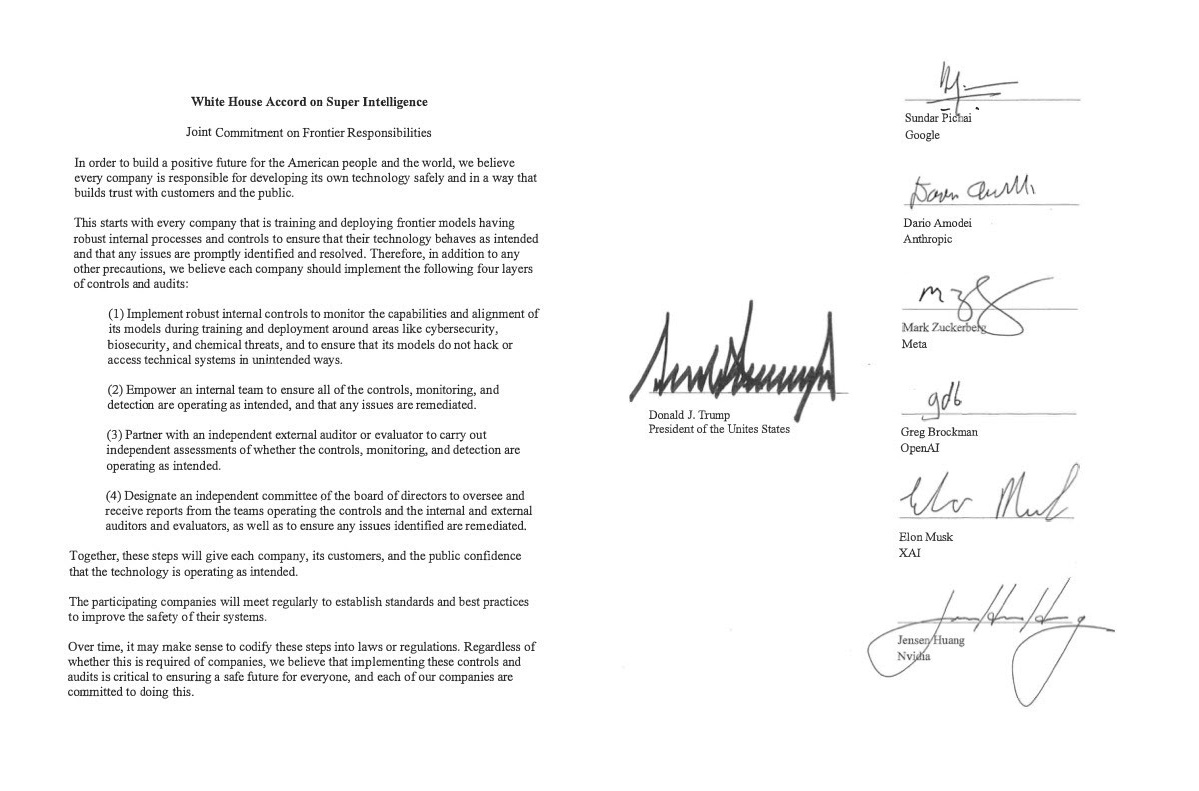
Shibbir Ahmed, Washington DC  — The White House has unveiled an accord with leading technology companies outlining a voluntary framework for strengthening safeguards around the development and deployment of advanced artificial intelligence systems. Titled the “White House Accord on Super Intelligence: Joint Commitment on Frontier Responsibilities,” the agreement calls on companies developing and deploying frontier AI models to establish robust internal controls, independent evaluations and board-level oversight.

The accord says companies have a responsibility to develop their technologies safely and in a manner that builds trust among customers and the public. It identifies four layers of controls and audits that participating companies should implement.

The first layer involves internal controls designed to monitor the capabilities and alignment of AI models during both training and deployment. The controls would cover risks involving cybersecurity, biosecurity and chemical threats, while also seeking to prevent AI systems from accessing or hacking technical systems in unintended ways.

The second layer calls for companies to establish dedicated internal teams responsible for ensuring that safety controls, monitoring and detection systems are functioning as intended. Those teams would also be responsible for ensuring that identified problems are addressed.

The third layer involves independent external auditors or evaluators. These outside reviewers would assess whether a company’s controls, monitoring and detection mechanisms are operating properly.

White House Accord on Super Intelligence — Joint Commitment on Frontier Responsibilities . Photo WH

The fourth layer would place responsibility at the board level, with companies designating an independent board committee to oversee the safety framework and receive reports from internal teams and external auditors. The committee would also monitor the remediation of problems identified through the oversight process.

According to the accord, the four-layer system is intended to provide companies, their customers and the public with greater confidence that advanced AI technologies are operating as intended. Participating companies are also expected to meet regularly to develop common standards and best practices aimed at improving the safety of their systems.

The document leaves open the possibility that the measures could eventually become part of formal government regulation. It states that, over time, it may be appropriate to codify the safeguards into laws or regulations, while emphasizing that the companies are committed to implementing the controls regardless of whether they are legally required.

The agreement was released following a White House meeting with leading technology executives on September 29. Reporting on the accord identifies Google CEO Sundar Pichai, Meta CEO Mark Zuckerberg, Anthropic CEO Dario Amodei, OpenAI President Greg Brockman, xAI CEO Elon Musk and Nvidia CEO Jensen Huang among the participating executives.

The accord focuses specifically on governance, monitoring and auditing of increasingly capable AI systems, rather than establishing detailed technical standards or specific implementation deadlines.


Trump Launches America.gov as Unified Digital Gateway to U.S. Government Services

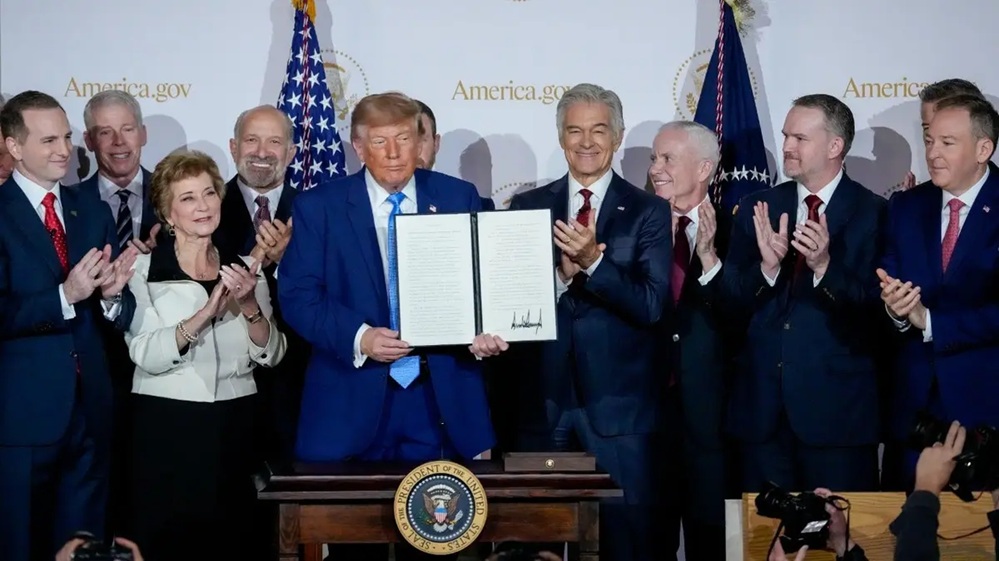
Shibbir Ahmed, Washington DC — President Donald Trump on Tuesday launched America.gov, a new digital platform designed to provide Americans with a single entry point to federal government information and services, as the administration seeks to simplify how people interact with the U.S. government. The platform was unveiled September 29 in Washington alongside an executive order directing the establishment of America.gov as a unified digital “front door” for Americans seeking federal information and covered online services.

The administration says America.gov uses artificial intelligence and information drawn from government websites to help users find answers and navigate federal services through a conversational interface. The U.S. General Services Administration said America.gov combines information from more than 29,000 government websites with AI-enhanced search technology, allowing users to find information and guidance without having to navigate a fragmented network of individual agency websites.

The executive order says Americans have traditionally been required to search across multiple federal agencies, interpret government terminology, provide the same information repeatedly and verify their identities through different systems. America.gov is intended to change that process by providing a single digital point of entry through which users can communicate in plain language, receive information and, where authorized and technically available, complete federal government transactions.

AI-powered access to federal services

The new platform is designed to allow users to describe what they need rather than determine which federal agency is responsible for providing the service. The GSA said the platform can help users find information about government benefits, passport services, Social Security and other federal needs. The administration’s executive order directs federal agencies to identify qualifying online services and integrate them with America.gov in a secure and privacy-preserving manner.

President Donald Trump holds up the executive order establishing America.gov during its launch event in Washington, D.C., on September 29, 2026. Administration officials joined the president at the event. Photo: WH

The order also calls for the integration of Login.gov as the authentication service for America.gov. Under the plan, agencies will continue to maintain control over their own records, systems, statutory responsibilities and decision-making authority. The order specifically states that the unified access system is not intended to create a centralized federal system of records about Americans. Privacy protections are also included in the order, including data minimization, secure authentication, auditable authorization and disclosure practices consistent with federal law.

Passport services among planned features

Secretary of State Marco Rubio said at the launch event that the State Department is partnering with America.gov to overhaul the passport application experience. Rubio announced that, beginning next year, Americans will be able to apply for their first U.S. passport entirely online. Applicants will be able to sign in through Login.gov, use information already held by the government where available, submit a photograph from a phone or other device, make a payment and track the status of the application. Rubio said the administration’s goal is for the vast majority of Americans to be able to apply for a passport or passport card through America.gov by the end of 2027.

Agencies given 90 days for implementation guidance

The executive order directs the Office of Management and Budget to issue implementation guidance to federal agencies within 90 days. Agencies will then be required to identify covered services, integrate those services with America.gov where appropriate and provide usage and performance information to the General Services Administration and OMB. The order defines covered services generally as public-facing federal services that serve more than 100,000 users during a 12-month period and can be accessed or applied for online. The order excludes Internal Revenue Service tax filing services, as well as services provided by the Department of War and elements of the Intelligence Community.

Existing government services will remain available

The administration says America.gov is intended to provide an additional, simplified way to access federal services rather than eliminate existing methods. The executive order specifically preserves existing lawful methods of obtaining government services, including in-person, telephone, mail and agency-specific digital services. That means Americans will not be required to use America.gov as the sole method of interacting with the federal government.

New passport design planned for 2028

Rubio also unveiled the planned design of a new U.S. passport expected in 2028. The redesigned passport features the American eagle and the Great Seal and includes artwork depicting major moments in U.S. history. Rubio said the new passport will visually represent 250 years of American history, with imagery ranging from the Revolutionary era and westward expansion to aviation, the raising of the American flag at Iwo Jima and the Artemis space program. The State Department also plans to change how the passport is packaged and delivered.

America.gov represents broader government technology push

The launch comes as the Trump administration expands its focus on artificial intelligence and digital technology as tools for government services. The new website is currently centered on AI-assisted information access, while additional transaction capabilities are expected to be introduced as federal agencies integrate their services with the platform.

The administration has described America.gov as a fundamental shift toward organizing government services around the needs of citizens rather than around the structure of federal agencies. For Americans, the intended result is a single digital starting point for finding federal information, understanding available services and eventually completing more government transactions online.


World Still Far From Fulfilling Pledge to End Racial Discrimination: Irene Khan

Shibbir Ahmed, New York: The world remains far from fulfilling the commitments made 25 years ago to end racial discrimination, Bangladesh’s Permanent Representative to the United Nations, Ambassador Irene Khan, said Monday. Khan made the remarks at a high-level event at the United Nations marking the 25th anniversary of the Durban Declaration and Programme of Action (DDPA).

The ambassador said the Durban Declaration and Programme of Action adopted 25 years ago made a clear commitment that no person should face discrimination on the basis of race, colour, descent, or national or ethnic origin. However, she said the world remains far from fully implementing that commitment.

Khan reaffirmed Bangladesh’s strong commitment to the full and effective implementation of the DDPA. She called for greater efforts in justice, education, development and international cooperation to address structural discrimination rooted in slavery, colonialism and other historical injustices. She also stressed the need to strengthen protection of the rights of migrants, refugees, forcibly displaced people, minorities, women, children and others in vulnerable situations.

Addressing the issue of artificial intelligence, Khan said emerging technologies should be used to advance sustainable development rather than spread hatred and incitement to violence. She also stressed the need to ensure that human rights, equality and non-discrimination are protected in the development of artificial intelligence.

“Bangladesh is committed to building a world where the diversity and dignity of all people are upheld, both online and offline,” Khan said.


UN General Assembly 2026: Leaders Discuss Global Crises, AI

Shibbir AHmed, New York — World leaders and senior officials are continuing high-level diplomatic discussions at the 81st United Nations General Assembly in New York, with conflicts, artificial intelligence, climate change, development and international cooperation remaining central issues.

The General Assembly’s high-level week, which runs through September 28, has brought together leaders and representatives from across the world to address major global challenges and debate the future of multilateral cooperation.

The General Debate is scheduled to continue on September 28, following several days of speeches and diplomatic meetings focused on international security, regional conflicts, economic development and emerging global challenges.

Artificial intelligence has emerged as an important issue during this year’s UN discussions. Secretary-General António Guterres has called for stronger international governance of AI and warned that technological developments are moving faster than existing global institutions can respond.

The UN has also placed conflicts and international diplomacy at the center of the General Assembly agenda as governments seek diplomatic approaches to ongoing crises, including tensions in the Middle East. The UN General Assembly’s 81st session is being chaired by Bangladesh’s Khalilur Rahman. The session’s theme is “Restoring trust, managing transformation: A United Nations that delivers for all.”

A major UN meeting taking place today, September 28, is commemorating the 25th anniversary of the adoption of the Durban Declaration and Programme of Action, which focuses on combating racism, racial discrimination, xenophobia and related intolerance.

The high-level week has also included meetings on climate action, sea-level rise and pandemic preparedness, reflecting the broad range of issues being addressed by the international community.

As the high-level portion of the General Assembly concludes, diplomatic attention remains focused on how governments can address conflicts, technological risks and other global challenges through international cooperation.


Jaishankar Warns of ‘Weaponisation of Everything’ at UN

Shibbir Ahmed, New York — Indian External Affairs Minister S. Jaishankar has warned that the world is witnessing the “weaponisation of everything,” with finance, market access, supply chains and technology increasingly being used as tools of pressure. Addressing the General Debate of the 81st United Nations General Assembly in New York on Saturday, Jaishankar said growing conflicts and confrontations were undermining international security, economic progress and development, particularly affecting countries in the Global South.

“What we are actually seeing is a weaponisation of everything,” Jaishankar said, referring to the growing use of economic and technological tools as leverage. He said a mindset of extreme competition was undermining institutions and creating new chokepoints in global trade and cooperation.

According to Jaishankar, the trend extends from finance and market access to supply chains and technology. He said countries were increasingly focused on reducing risks and diversifying their economic relationships, but warned that the overall atmosphere was becoming less conducive to trust and goodwill.

Concerns Over Global Conflicts

Jaishankar also addressed ongoing conflicts in the Gulf, Ukraine and West Asia. He called for restraint, de-escalation and the protection of civilians, while stressing the importance of maintaining the uninterrupted flow of energy and commerce. He particularly condemned attacks on commercial shipping and seafarers in international waterways, saying the loss of Indian and other nationals in such attacks was “simply unacceptable.”

India has also launched a Group of Friends on Safety and Security of Shipping and Seafarers, with 23 other partners, aimed at strengthening international attention to maritime safety. On Ukraine, Jaishankar said India supports efforts to bring the conflict to an end, while reiterating the importance of protecting food and energy supplies. Regarding West Asia, he said India supports a two-state solution as the basis for a durable and lasting peace and called for humanitarian assistance for Palestinians.

Warning Over Global South’s ‘4F Crisis’

Jaishankar said developing countries were facing what he described as a “4F crisis” involving food, fuel, fertiliser and finance. He warned that fertiliser shortages, disruptions to grain movements and other global pressures were increasing the challenges faced by developing nations. He also argued that restrictions on market access and non-market practices were making it harder for countries in the Global South to industrialise. Jaishankar further raised concerns about artificial intelligence, saying technology that was expected to create opportunities could also become a source of anxiety if misused.

Call for a More Representative Global Order

The Indian minister also called for reforms to international institutions, arguing that the global order established after World War II is facing new realities. He said the world is moving toward a more multipolar system and that countries should engage through dialogue and cooperation. He also argued that large sections of humanity should not be excluded from global decision-making.

Jaishankar’s address placed India’s concerns about terrorism, maritime security, economic pressures, technology and global governance within a broader call for greater stability and international cooperation.


Microsoft Expands Copilot With Coding Tools and Always-On AI Agent

Redmond, Washington — Microsoft has expanded its Copilot artificial intelligence platform with new coding and automation capabilities, including a new coding tool and an always-on AI agent designed to handle tasks on behalf of users.

The company unveiled the new features Friday as it seeks to turn Copilot from a conventional AI chatbot into a broader workplace platform capable of helping users create software, automate tasks and work directly with Microsoft’s productivity applications.

One of the new capabilities, called Code, allows users to create applications, dashboards and other software using natural-language instructions. Microsoft says the feature is based on technology used by GitHub Copilot and is intended to make software development and automation more accessible within organizations.

Microsoft is also introducing Autopilot, an AI agent designed to perform tasks continuously with permissions controlled by users. The company says the agent will have its own identity within an organization’s directory and will operate within defined access controls. The company is integrating Word, Excel and PowerPoint more deeply into Copilot, allowing users to work with those applications without leaving the AI platform.

Microsoft also announced tools designed to give organizations greater visibility into the costs associated with AI usage, an increasingly important issue as companies expand their use of AI agents.

The new capabilities will roll out in stages. Microsoft said Home and Code will gradually become available through its Frontier program, while Autopilot will enter private preview toward the end of September.

Microsoft is competing with other major AI platforms as technology companies increasingly shift from conversational chatbots toward AI agents capable of completing multi-step tasks.


US, China Agree to $30 Billion Tariff Cut and AI Dialogue

Washington DC — The United States and China have agreed to a reciprocal tariff-reduction arrangement covering about $30 billion in trade, while also establishing a new dialogue on artificial intelligence, according to China’s Foreign Ministry and reporting by Reuters.

The agreement was reached during Chinese President Xi Jinping’s visit to the United States and his meeting with U.S. President Donald Trump. The two sides described the discussions as part of broader efforts to manage trade disputes and maintain communication between the world’s two largest economies.

Under the arrangement, the United States and China will reduce tariffs affecting certain goods, with the agreement reportedly covering about $30 billion in reciprocal trade. U.S. Trade Representative Jamieson Greer separately said Washington and Beijing had reached understandings concerning several categories of goods, including agricultural products, medical devices and consumer goods. Further details are expected to be released by U.S. officials.

The two countries also agreed to establish a new channel for discussions on artificial intelligence. The mechanism is intended to improve communication between Washington and Beijing over AI-related issues, including incidents that could have broader security implications. The AI component comes as both countries compete for technological leadership while attempting to manage concerns over the security implications of rapidly advancing artificial intelligence.

The latest trade understanding follows years of escalating economic tensions between Washington and Beijing. Previous tariff measures had pushed duties on some goods to exceptionally high levels before the two sides moved toward a temporary reduction and broader negotiations. The new agreement does not resolve all U.S.-China trade disputes, but it creates additional areas for negotiation and communication between the two governments.