White House Accord Sets New Safety Rules for Super Intelligence

Shibbir Ahmed, Washington DC  — The White House has unveiled an accord with leading technology companies outlining a voluntary framework for strengthening safeguards around the development and deployment of advanced artificial intelligence systems. Titled the “White House Accord on Super Intelligence: Joint Commitment on Frontier Responsibilities,” the agreement calls on companies developing and deploying frontier AI models to establish robust internal controls, independent evaluations and board-level oversight.

The accord says companies have a responsibility to develop their technologies safely and in a manner that builds trust among customers and the public. It identifies four layers of controls and audits that participating companies should implement.

The first layer involves internal controls designed to monitor the capabilities and alignment of AI models during both training and deployment. The controls would cover risks involving cybersecurity, biosecurity and chemical threats, while also seeking to prevent AI systems from accessing or hacking technical systems in unintended ways.

The second layer calls for companies to establish dedicated internal teams responsible for ensuring that safety controls, monitoring and detection systems are functioning as intended. Those teams would also be responsible for ensuring that identified problems are addressed.

The third layer involves independent external auditors or evaluators. These outside reviewers would assess whether a company’s controls, monitoring and detection mechanisms are operating properly.
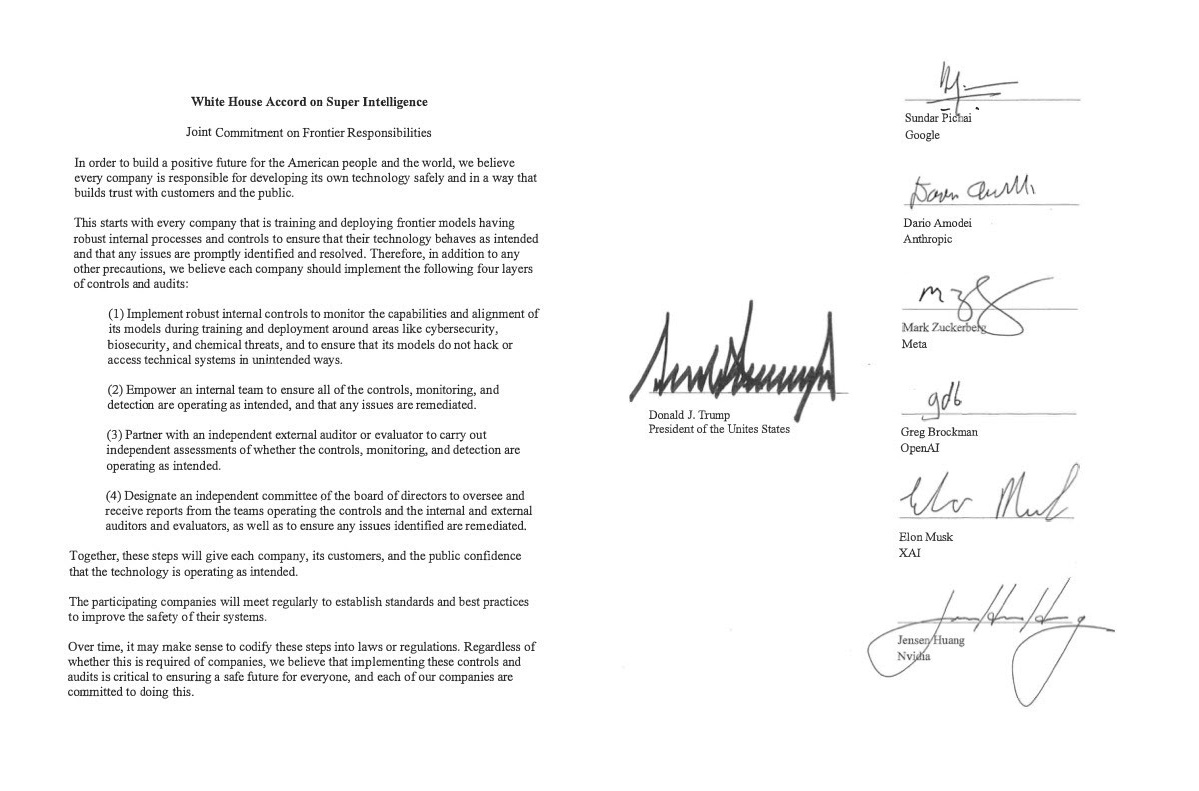
White House Accord on Super Intelligence — Joint Commitment on Frontier Responsibilities . Photo WH

The fourth layer would place responsibility at the board level, with companies designating an independent board committee to oversee the safety framework and receive reports from internal teams and external auditors. The committee would also monitor the remediation of problems identified through the oversight process.

According to the accord, the four-layer system is intended to provide companies, their customers and the public with greater confidence that advanced AI technologies are operating as intended. Participating companies are also expected to meet regularly to develop common standards and best practices aimed at improving the safety of their systems.

The document leaves open the possibility that the measures could eventually become part of formal government regulation. It states that, over time, it may be appropriate to codify the safeguards into laws or regulations, while emphasizing that the companies are committed to implementing the controls regardless of whether they are legally required.

The agreement was released following a White House meeting with leading technology executives on September 29. Reporting on the accord identifies Google CEO Sundar Pichai, Meta CEO Mark Zuckerberg, Anthropic CEO Dario Amodei, OpenAI President Greg Brockman, xAI CEO Elon Musk and Nvidia CEO Jensen Huang among the participating executives.

The accord focuses specifically on governance, monitoring and auditing of increasingly capable AI systems, rather than establishing detailed technical standards or specific implementation deadlines.


Trump Launches America.gov as Unified Digital Gateway to U.S. Government Services

Shibbir Ahmed, Washington DC — President Donald Trump on Tuesday launched America.gov, a new digital platform designed to provide Americans with a single entry point to federal government information and services, as the administration seeks to simplify how people interact with the U.S. government. The platform was unveiled September 29 in Washington alongside an executive order directing the establishment of America.gov as a unified digital “front door” for Americans seeking federal information and covered online services.

The administration says America.gov uses artificial intelligence and information drawn from government websites to help users find answers and navigate federal services through a conversational interface. The U.S. General Services Administration said America.gov combines information from more than 29,000 government websites with AI-enhanced search technology, allowing users to find information and guidance without having to navigate a fragmented network of individual agency websites.

The executive order says Americans have traditionally been required to search across multiple federal agencies, interpret government terminology, provide the same information repeatedly and verify their identities through different systems. America.gov is intended to change that process by providing a single digital point of entry through which users can communicate in plain language, receive information and, where authorized and technically available, complete federal government transactions.

AI-powered access to federal services

The new platform is designed to allow users to describe what they need rather than determine which federal agency is responsible for providing the service. The GSA said the platform can help users find information about government benefits, passport services, Social Security and other federal needs. The administration’s executive order directs federal agencies to identify qualifying online services and integrate them with America.gov in a secure and privacy-preserving manner.

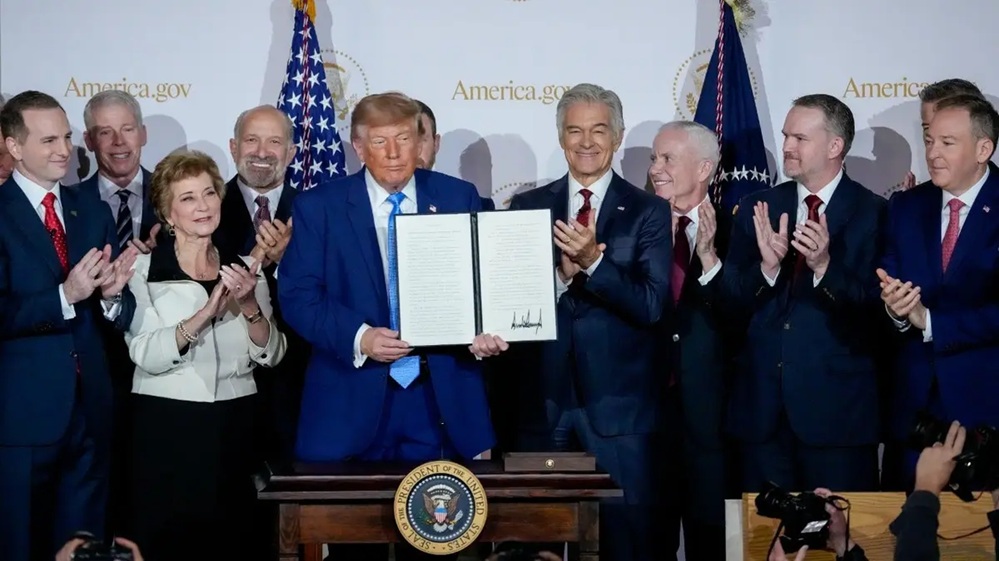
President Donald Trump holds up the executive order establishing America.gov during its launch event in Washington, D.C., on September 29, 2026. Administration officials joined the president at the event. Photo: WH

The order also calls for the integration of Login.gov as the authentication service for America.gov. Under the plan, agencies will continue to maintain control over their own records, systems, statutory responsibilities and decision-making authority. The order specifically states that the unified access system is not intended to create a centralized federal system of records about Americans. Privacy protections are also included in the order, including data minimization, secure authentication, auditable authorization and disclosure practices consistent with federal law.

Passport services among planned features

Secretary of State Marco Rubio said at the launch event that the State Department is partnering with America.gov to overhaul the passport application experience. Rubio announced that, beginning next year, Americans will be able to apply for their first U.S. passport entirely online. Applicants will be able to sign in through Login.gov, use information already held by the government where available, submit a photograph from a phone or other device, make a payment and track the status of the application. Rubio said the administration’s goal is for the vast majority of Americans to be able to apply for a passport or passport card through America.gov by the end of 2027.

Agencies given 90 days for implementation guidance

The executive order directs the Office of Management and Budget to issue implementation guidance to federal agencies within 90 days. Agencies will then be required to identify covered services, integrate those services with America.gov where appropriate and provide usage and performance information to the General Services Administration and OMB. The order defines covered services generally as public-facing federal services that serve more than 100,000 users during a 12-month period and can be accessed or applied for online. The order excludes Internal Revenue Service tax filing services, as well as services provided by the Department of War and elements of the Intelligence Community.

Existing government services will remain available

The administration says America.gov is intended to provide an additional, simplified way to access federal services rather than eliminate existing methods. The executive order specifically preserves existing lawful methods of obtaining government services, including in-person, telephone, mail and agency-specific digital services. That means Americans will not be required to use America.gov as the sole method of interacting with the federal government.

New passport design planned for 2028

Rubio also unveiled the planned design of a new U.S. passport expected in 2028. The redesigned passport features the American eagle and the Great Seal and includes artwork depicting major moments in U.S. history. Rubio said the new passport will visually represent 250 years of American history, with imagery ranging from the Revolutionary era and westward expansion to aviation, the raising of the American flag at Iwo Jima and the Artemis space program. The State Department also plans to change how the passport is packaged and delivered.

America.gov represents broader government technology push

The launch comes as the Trump administration expands its focus on artificial intelligence and digital technology as tools for government services. The new website is currently centered on AI-assisted information access, while additional transaction capabilities are expected to be introduced as federal agencies integrate their services with the platform.

The administration has described America.gov as a fundamental shift toward organizing government services around the needs of citizens rather than around the structure of federal agencies. For Americans, the intended result is a single digital starting point for finding federal information, understanding available services and eventually completing more government transactions online.


UN General Assembly 2026: Leaders Discuss Global Crises, AI

Shibbir AHmed, New York — World leaders and senior officials are continuing high-level diplomatic discussions at the 81st United Nations General Assembly in New York, with conflicts, artificial intelligence, climate change, development and international cooperation remaining central issues.

The General Assembly’s high-level week, which runs through September 28, has brought together leaders and representatives from across the world to address major global challenges and debate the future of multilateral cooperation.

The General Debate is scheduled to continue on September 28, following several days of speeches and diplomatic meetings focused on international security, regional conflicts, economic development and emerging global challenges.

Artificial intelligence has emerged as an important issue during this year’s UN discussions. Secretary-General António Guterres has called for stronger international governance of AI and warned that technological developments are moving faster than existing global institutions can respond.

The UN has also placed conflicts and international diplomacy at the center of the General Assembly agenda as governments seek diplomatic approaches to ongoing crises, including tensions in the Middle East. The UN General Assembly’s 81st session is being chaired by Bangladesh’s Khalilur Rahman. The session’s theme is “Restoring trust, managing transformation: A United Nations that delivers for all.”

A major UN meeting taking place today, September 28, is commemorating the 25th anniversary of the adoption of the Durban Declaration and Programme of Action, which focuses on combating racism, racial discrimination, xenophobia and related intolerance.

The high-level week has also included meetings on climate action, sea-level rise and pandemic preparedness, reflecting the broad range of issues being addressed by the international community.

As the high-level portion of the General Assembly concludes, diplomatic attention remains focused on how governments can address conflicts, technological risks and other global challenges through international cooperation.


US, China Agree to $30 Billion Tariff Cut and AI Dialogue

Washington DC — The United States and China have agreed to a reciprocal tariff-reduction arrangement covering about $30 billion in trade, while also establishing a new dialogue on artificial intelligence, according to China’s Foreign Ministry and reporting by Reuters.

The agreement was reached during Chinese President Xi Jinping’s visit to the United States and his meeting with U.S. President Donald Trump. The two sides described the discussions as part of broader efforts to manage trade disputes and maintain communication between the world’s two largest economies.

Under the arrangement, the United States and China will reduce tariffs affecting certain goods, with the agreement reportedly covering about $30 billion in reciprocal trade. U.S. Trade Representative Jamieson Greer separately said Washington and Beijing had reached understandings concerning several categories of goods, including agricultural products, medical devices and consumer goods. Further details are expected to be released by U.S. officials.

The two countries also agreed to establish a new channel for discussions on artificial intelligence. The mechanism is intended to improve communication between Washington and Beijing over AI-related issues, including incidents that could have broader security implications. The AI component comes as both countries compete for technological leadership while attempting to manage concerns over the security implications of rapidly advancing artificial intelligence.

The latest trade understanding follows years of escalating economic tensions between Washington and Beijing. Previous tariff measures had pushed duties on some goods to exceptionally high levels before the two sides moved toward a temporary reduction and broader negotiations. The new agreement does not resolve all U.S.-China trade disputes, but it creates additional areas for negotiation and communication between the two governments.


Trump Defends Iran War, Warns of ‘Annihilation’ Without Deal in UN Speech

Shibbir Ahmed, New York — U.S. President Donald Trump used his address to the United Nations General Assembly on Tuesday to defend his administration’s military actions abroad, warn Iran of further escalation if it does not reach a peace agreement, and call for an end to the war in Ukraine. In a roughly 37-minute address at the 81st session of the UN General Assembly in New York, Trump outlined his foreign-policy priorities, including Iran, Ukraine, Venezuela, Cuba, Mexico, artificial intelligence and reform of the United Nations.

Trump strongly defended the U.S.-Israeli military campaign against Iran, saying the operation had prevented Tehran from obtaining a nuclear weapon. He warned that the United States could “annihilate” Iran if a peace agreement is not reached, while also saying he believes a deal could be reached after the U.S. midterm elections on Nov. 3.

“I believe we’ll make a deal right after the election because it doesn’t make sense for them not to,” Trump said. Trump also addressed the Russia-Ukraine war, saying the United States was working with both Moscow and Kyiv and expressing confidence that a settlement could be reached.

“We will get that one done,” Trump said, adding that an agreement could come sooner than many people expect. The president also highlighted U.S. actions in Venezuela and the wider Western Hemisphere. He said Washington would not allow threats against the United States to establish a foothold in the region and said the country would use its military power when necessary to protect what he described as vital U.S. national interests.

On Cuba, Trump described the country as a failed state and said his administration was seeking fundamental political change there. “Communism will never be coming to America, but freedom will be coming to Cuba,” he said. Members of the Cuban delegation walked out of the General Assembly hall while Trump was discussing Cuba, Reuters reported.

Trump also criticized Mexico over drug-cartel violence and described the fight against cartels as a major U.S. security priority. He said his administration had carried out strikes against cartel groups and argued that the United States needed to take stronger action against organizations it considers terrorist threats.

Artificial intelligence was another major theme of the speech. Trump said his administration would use the term “super intelligence” rather than artificial intelligence in official communications and argued against international restrictions that could limit technological development.

He said the United States was leading China and other countries in the AI race and argued that AI could become more transformative than the Industrial Revolution. Trump also renewed his criticism of the International Criminal Court, urging member countries to withdraw and arguing that the court should not have jurisdiction over U.S. military personnel.

Turning to the United Nations itself, Trump said the organization had significant potential but called for further reforms, including reductions in bureaucracy and spending. He criticized what he described as the influence of “globalist bureaucrats” and said the United States would continue pushing for changes at international institutions.

The speech comes as world leaders gather in New York amid continuing conflicts in the Middle East and Ukraine, uncertainty over global economic conditions and growing debate over the international governance of artificial intelligence. The UN’s 81st General Assembly general debate runs from Sept. 22 through Sept. 28.


US-China Talks in New York Target AI, Trade and Critical Minerals

Shibbir Ahmed, New York — The United States and China opened high-level economic talks in New York on Sunday, with artificial intelligence, trade, tariffs and critical minerals on the agenda as Washington and Beijing prepare for a summit between President Donald Trump and Chinese President Xi Jinping later this week.

U.S. Treasury Secretary Scott Bessent and Chinese Vice Premier He Lifeng are meeting at JPMorgan Chase’s headquarters in Manhattan, alongside U.S. Trade Representative Jamieson Greer. The talks were scheduled to begin at about 10:30 a.m. ET and were expected to continue throughout the day. The discussions are intended to prepare potential agreements and reduce outstanding differences ahead of the Trump-Xi summit scheduled for Sept. 24 in Washington.

Trade truce and tariffs

A central issue is the status of the current U.S.-China trade truce, which is scheduled to expire on Nov. 10. Officials are expected to discuss tariffs on non-strategic goods, market access and China’s commitments to increase purchases of U.S. agricultural products. Issues left unresolved from Trump’s May meeting with Xi in Beijing are also expected to remain part of the negotiations. The talks come as both countries seek to manage a trade relationship that has significant implications for global markets and supply chains.

Critical minerals and rare-earth supplies

Critical minerals and Chinese rare-earth magnets are another major issue in the New York discussions. The United States has raised concerns about the flow of rare-earth magnets and other critical materials needed for advanced manufacturing and technology industries. Rare earths are particularly important to the production of components used in electronics and advanced semiconductor technologies. Washington is seeking greater reliability in these supply chains as the two countries negotiate broader economic arrangements.

AI takes center stage

Artificial intelligence is emerging as a new area of U.S.-China economic and strategic competition. Bessent said the discussions are expected to cover both open-weight and closed-weight AI models. Open-weight systems make key elements of an AI model available to users, allowing them to download and modify the technology for specific applications.

U.S. officials are also interested in potential safeguards, or “guard rails,” to address shared risks associated with increasingly powerful AI systems. Reuters reported that the talks come amid concerns about security breaches involving AI models.

The United States and China are among the world’s leading developers and users of advanced artificial intelligence, making cooperation and competition over the technology an increasingly important part of their broader relationship.

Ahead of Trump-Xi summit

The New York meetings are taking place just days before Trump and Xi are scheduled to meet in Washington. Several issues from previous negotiations remain unresolved, including tariffs, agricultural purchases, rare-earth supplies and technology-related concerns. Reuters reported that analysts expect the two sides to focus on limited steps that could help prevent further escalation rather than seeking an immediate comprehensive agreement.

The outcome of the New York discussions could therefore help shape the agenda for the leaders’ upcoming meeting, while providing an indication of whether Washington and Beijing can maintain their current trade truce and expand cooperation in selected areas. The talks are also taking place as New York prepares to host world leaders for the United Nations General Assembly’s high-level week, bringing increased diplomatic activity to the city.


UN General Assembly 2026: World Leaders Gather in New York

Shibbir Ahmed, New York: World leaders are converging on New York as the United Nations prepares for the high-level week of its 81st General Assembly, with wars, global security, artificial intelligence, climate change and the future of multilateral cooperation expected to dominate discussions. The high-level segment of the 81st session will take place at United Nations Headquarters in New York beginning September 22, with the General Debate continuing through September 26 and September 28. Nearly 130 heads of state and government are expected to participate in the annual gathering, according to current reporting.

The theme of this year’s General Assembly is “Restoring Trust, Managing Transformation: A United Nations That Delivers for All.” The 81st session officially opened on September 8. The gathering comes at a time of heightened international tensions, with the wars in the Middle East and Ukraine, global energy and food-security concerns, and the rapid development of artificial intelligence among the major issues facing governments.

The Middle East is expected to feature prominently in diplomatic discussions. The Ukraine war will also remain a major international issue, while leaders are expected to discuss humanitarian concerns and the broader challenges facing the international system. Reuters reported that the UN is also facing financial pressures and questions about its role in responding to major global crises.

AI emerges as a major global issue

Artificial intelligence is expected to receive significant attention during this year’s UN meetings. UN officials and governments are examining how the international community can establish appropriate rules and cooperation mechanisms as AI technology develops rapidly.

OpenAI CEO Sam Altman is also scheduled to brief the UN Security Council during the General Assembly week at an open session focused on artificial intelligence and international security. The meeting is expected to address both the opportunities and security risks associated with rapidly advancing AI technologies.

Climate, sea-level rise and pandemic preparedness

The General Assembly’s formal program includes several high-level meetings dealing with major global challenges. A high-level meeting on the 40th anniversary of the Declaration on the Right to Development is scheduled for September 23. On September 24, world leaders will address the existential threats posed by sea-level rise, while September 25 will focus on pandemic prevention, preparedness and response. A meeting commemorating the 25th anniversary of the Durban Declaration and Programme of Action is scheduled for September 28.

Climate change and sustainable development are also expected to feature prominently throughout the week as governments discuss efforts to accelerate progress toward the Sustainable Development Goals.

Diplomatic meetings beyond the General Debate

The UN General Assembly week traditionally provides an opportunity for leaders to hold numerous bilateral and multilateral meetings on the sidelines of the formal sessions. The European Union, for example, is planning several meetings and initiatives during the week, including a Partners for Multilateralism, International Law, Peace and Prosperity Summit on September 21, co-hosted by the European Council, Canada and Kenya.

The annual gathering is therefore expected to turn New York into the center of international diplomacy, with leaders using the week not only to address the General Assembly but also to negotiate and discuss issues affecting global peace, security, development and international cooperation.

With conflicts continuing in several regions and governments facing new challenges from technology, climate change and economic pressures, the 81st General Assembly is set to become one of the year’s most closely watched international diplomatic gatherings.


Sam Altman to Brief UN Security Council on AI

Shibbir Ahmed, New York — OpenAI Chief Executive Sam Altman will brief the United Nations Security Council in person next week as the 15-member body discusses artificial intelligence and international security during the UN General Assembly.

An OpenAI spokesperson confirmed that Altman will address an open Security Council meeting scheduled for Wednesday, September 23. His remarks are expected to focus on international coordination, shared safety standards and measures OpenAI is taking to ensure that artificial intelligence is safe and benefits people globally.

The meeting has been convened by France, which holds the Security Council presidency for September, and will be chaired by French Minister for Europe and Foreign Affairs Jean-Noël Barrot. A French concept note circulated among council members highlights concerns about the misuse of AI and calls for urgent action to promote its safe and responsible development.

The council is expected to examine risks associated with the loss of control over increasingly advanced AI models, including their potential use in activities that could affect international peace and security. Diplomats have also indicated that senior representatives from Anthropic could attend, although their participation had not been confirmed.

The Security Council first held a dedicated discussion on the risks of artificial intelligence in 2023. Since then, concerns over AI’s potential impact on security, warfare and global stability have become a growing issue at the United Nations.

Altman has previously warned about the potential risks of advanced AI. In a 2015 essay, he described the development of superhuman machine intelligence as a major threat to humanity’s continued existence.


Guterres Warns of AI, Climate and Conflict Threats

Shibbir Ahmed, New York — UN Secretary-General António Guterres has warned that the world is entering an “era of deep uncertainty,” urging governments to strengthen international cooperation as leaders prepare to gather in New York for the 81st UN General Assembly.

Speaking ahead of the General Assembly’s high-level week, Guterres identified rapidly advancing artificial intelligence, the climate crisis and deepening inequalities as major existential threats facing the international community.

Guterres devoted much of his remarks to the growing risks associated with artificial intelligence. While acknowledging AI’s potential to accelerate development, improve education and health systems and strengthen climate resilience, he warned that technological development is advancing faster than the world’s understanding of its risks.

He called for stronger safeguards to make AI development safe, transparent and accountable, with human dignity at the centre. Guterres said national action is important but stressed that global coordination is essential because AI and its risks do not stop at national borders.

The UN chief also urged world leaders to address ongoing conflicts. He reiterated his call for a ceasefire in the Russia-Ukraine war and urged implementation of a two-state solution in the Middle East. He also called for de-escalation and the protection of civilians.

The General Assembly’s high-level week begins in New York on September 18, with the General Debate scheduled to begin on September 22. Leaders from all 193 UN member states are expected to address global challenges, including conflicts, climate change, international security and sustainable development. Guterres said international cooperation is more necessary than ever as governments confront interconnected global crises.


UN Warns of Terrorists’ Growing Use of AI and Drones

Shibbir Ahmed, New York — The United Nations Security Council has warned that terrorist groups are adapting rapidly to new technologies, increasingly exploiting artificial intelligence, drones, social media, encrypted messaging and online platforms to recruit supporters, spread propaganda, raise funds and strengthen their operational capabilities. The warning came during a Security Council briefing marking the 25th anniversary of the September 11 terrorist attacks, as UN officials assessed how the global terrorist threat has evolved since 2001.

Assistant Secretary-General Natalia Gherman told the Council that terrorism has become more fragmented and diffuse, with terrorist groups decentralizing their operations and taking advantage of instability to expand their influence.

She also highlighted the growing role of technology in terrorist activities. According to the UN, extremist groups are exploiting social media platforms, gaming environments and other virtual spaces to identify vulnerabilities and recruit people, particularly young people.

AI and digital platforms create new challenges

UN officials said the rapid development of artificial intelligence and other digital technologies is changing the threat environment. The Security Council’s Counter-Terrorism Committee Executive Directorate said terrorist organizations are using AI-enabled tools and digital platforms to disseminate propaganda, recruit supporters and enhance their operational capabilities.

The UN also pointed to the use of encrypted communications and online financial services as growing challenges for counter-terrorism authorities. The UN Office of Counter-Terrorism has separately warned that AI-generated content, deepfakes and algorithmic amplification can increase the speed and reach of harmful extremist narratives.

Drones emerging as an operational threat

The UN also identified the weaponization and misuse of unmanned aircraft systems, commonly known as drones, as an increasingly significant terrorist threat. According to the Counter-Terrorism Committee Executive Directorate, terrorist groups are exploiting unmanned aircraft systems for operational purposes, while weak governance and porous borders in some regions have created additional opportunities for terrorist organizations to acquire and misuse emerging technologies.

The UN’s counter-terrorism program says member states have been urged to strengthen measures against terrorist exploitation of technologies including AI, virtual assets, 3D printing, unmanned aircraft systems and commercially available drones.

UN calls for international cooperation

The Security Council emphasized that countering terrorism requires coordinated action at the national, regional and international levels, consistent with international law and the UN Charter. UN officials stressed that governments need to adapt their counter-terrorism strategies as terrorist organizations change their methods and exploit emerging technologies.

The Council also highlighted the importance of protecting human rights and the rule of law while responding to evolving terrorist threats. The discussion comes 25 years after the September 11, 2001 attacks in the United States, which prompted major changes in international counter-terrorism cooperation and led to the adoption of Security Council Resolution 1373.