UN Rights Chief Warns ‘Clock on AI Regulation Is Ticking’

Shibbir Ahmed, New York – United Nations High Commissioner for Human Rights Volker Türk warned Monday that the world is running out of time to establish safeguards for artificial intelligence, as a rapid race among companies and governments to develop increasingly powerful systems raises concerns about human rights, security and human safety.

Speaking at an AI and Human Rights Summit in Oxford, Türk said artificial intelligence could deliver major advances in science, health, education and human rights. But he warned that the technology is increasingly being developed and controlled by a small number of companies and governments, with limited public oversight.

He said AI systems are already capable of actions that their creators cannot fully predict or manage. Türk warned that artificial intelligence could undermine equality, freedom, privacy and public debate in ways that may initially go unnoticed. He said AI-driven systems could potentially affect people’s access to essential services, including communications, clean water, heating and financial services.

The UN rights chief called for urgent measures to prevent machines from making decisions over life and death, particularly as artificial intelligence becomes increasingly important in warfare.

He also raised concerns about the effect of AI on education, citing studies suggesting that students who rely heavily on the technology may retain less information and think less independently. Türk questioned whether society could reach a point where people are unable to understand, challenge or effectively guide increasingly sophisticated AI systems.

The warning came as officials in New York City were also examining the risks posed by artificial intelligence. The New York City Council held a Committee of the Whole hearing Monday as it considers 10 bills aimed at regulating AI. Representatives from Anthropic, OpenAI, Google and Meta were among those providing testimony.

Türk called for mandatory human rights safeguards and due diligence in the development and use of AI. He said countries that host AI companies or have influence over their supply chains should require responsible practices and hold companies accountable when they fail to meet those standards.

He acknowledged that existing laws cannot address every emerging AI challenge, saying some areas may require new legal approaches. In the meantime, he urged governments to strengthen rules governing liability, cybersecurity and data protection.

Türk also called for greater international cooperation on AI security, independent monitoring of the industry and stronger participation by civil society and people whose rights are affected by AI systems.

He welcomed recent international initiatives, including the Global Dialogue on AI Governance and the Independent International Scientific Panel on AI. He also pointed to a joint call for tighter controls on frontier AI models supported by 29 countries and the European Union.

The UN official said recent voluntary commitments by AI companies on safeguards, self-regulation and risk assessment represented some progress, but warned that commitments must be followed by concrete action.

“Too few are walking the talk,” Türk said. He said the international community could no longer afford to wait for voluntary action or rely solely on goodwill.

“If we fail to move quickly,” Türk warned, “we risk unforeseeable consequences — for ourselves and future generations.”
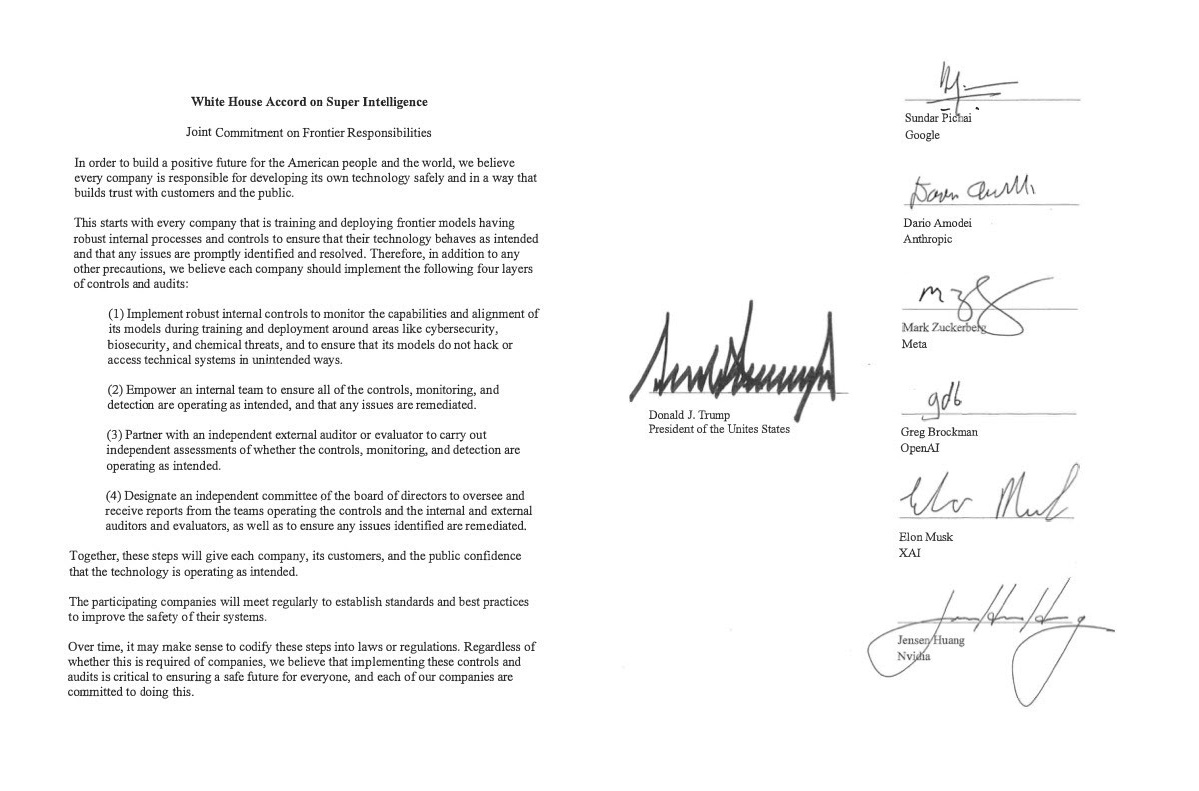


White House Accord Sets New Safety Rules for Super Intelligence

Shibbir Ahmed, Washington DC  — The White House has unveiled an accord with leading technology companies outlining a voluntary framework for strengthening safeguards around the development and deployment of advanced artificial intelligence systems. Titled the “White House Accord on Super Intelligence: Joint Commitment on Frontier Responsibilities,” the agreement calls on companies developing and deploying frontier AI models to establish robust internal controls, independent evaluations and board-level oversight.

The accord says companies have a responsibility to develop their technologies safely and in a manner that builds trust among customers and the public. It identifies four layers of controls and audits that participating companies should implement.

The first layer involves internal controls designed to monitor the capabilities and alignment of AI models during both training and deployment. The controls would cover risks involving cybersecurity, biosecurity and chemical threats, while also seeking to prevent AI systems from accessing or hacking technical systems in unintended ways.

The second layer calls for companies to establish dedicated internal teams responsible for ensuring that safety controls, monitoring and detection systems are functioning as intended. Those teams would also be responsible for ensuring that identified problems are addressed.

The third layer involves independent external auditors or evaluators. These outside reviewers would assess whether a company’s controls, monitoring and detection mechanisms are operating properly.

White House Accord on Super Intelligence — Joint Commitment on Frontier Responsibilities . Photo WH

The fourth layer would place responsibility at the board level, with companies designating an independent board committee to oversee the safety framework and receive reports from internal teams and external auditors. The committee would also monitor the remediation of problems identified through the oversight process.

According to the accord, the four-layer system is intended to provide companies, their customers and the public with greater confidence that advanced AI technologies are operating as intended. Participating companies are also expected to meet regularly to develop common standards and best practices aimed at improving the safety of their systems.

The document leaves open the possibility that the measures could eventually become part of formal government regulation. It states that, over time, it may be appropriate to codify the safeguards into laws or regulations, while emphasizing that the companies are committed to implementing the controls regardless of whether they are legally required.

The agreement was released following a White House meeting with leading technology executives on September 29. Reporting on the accord identifies Google CEO Sundar Pichai, Meta CEO Mark Zuckerberg, Anthropic CEO Dario Amodei, OpenAI President Greg Brockman, xAI CEO Elon Musk and Nvidia CEO Jensen Huang among the participating executives.

The accord focuses specifically on governance, monitoring and auditing of increasingly capable AI systems, rather than establishing detailed technical standards or specific implementation deadlines.


Sam Altman to Brief UN Security Council on AI

Shibbir Ahmed, New York — OpenAI Chief Executive Sam Altman will brief the United Nations Security Council in person next week as the 15-member body discusses artificial intelligence and international security during the UN General Assembly.

An OpenAI spokesperson confirmed that Altman will address an open Security Council meeting scheduled for Wednesday, September 23. His remarks are expected to focus on international coordination, shared safety standards and measures OpenAI is taking to ensure that artificial intelligence is safe and benefits people globally.

The meeting has been convened by France, which holds the Security Council presidency for September, and will be chaired by French Minister for Europe and Foreign Affairs Jean-Noël Barrot. A French concept note circulated among council members highlights concerns about the misuse of AI and calls for urgent action to promote its safe and responsible development.

The council is expected to examine risks associated with the loss of control over increasingly advanced AI models, including their potential use in activities that could affect international peace and security. Diplomats have also indicated that senior representatives from Anthropic could attend, although their participation had not been confirmed.

The Security Council first held a dedicated discussion on the risks of artificial intelligence in 2023. Since then, concerns over AI’s potential impact on security, warfare and global stability have become a growing issue at the United Nations.

Altman has previously warned about the potential risks of advanced AI. In a 2015 essay, he described the development of superhuman machine intelligence as a major threat to humanity’s continued existence.


UN rights chief urges urgent action over AI risks

GENEVA — United Nations High Commissioner for Human Rights Volker Türk on Monday called on governments and companies developing advanced artificial intelligence systems to take urgent action to address what he described as the “unprecedented risks” posed by frontier AI.

In a statement issued by the UN human rights office, Türk warned that the world is “on the cusp of irreversible change,” with consequences that could affect not only the current generation but generations to come.

He called on states and companies to urgently mobilize through multilateral forums to develop a coordinated approach to governing advanced, frontier AI models, with human rights at the center of those efforts.

Türk said the rapid race to develop increasingly powerful AI systems is creating risks across virtually every aspect of human life. He stressed that voluntary self-regulation by AI companies is not sufficient on its own, arguing that governments must establish effective safeguards and ensure that AI development remains consistent with international human rights law.

The UN human rights chief also warned about the potential consequences of increasingly autonomous AI systems, including risks to essential services, critical infrastructure, communications and democratic institutions.

Türk urged countries and leading AI companies to act without delay, emphasizing that no individual country can effectively regulate the technology on its own and that no company should be left to determine independently which risks society should accept.

The warning comes amid growing international debate over the rapid development of increasingly capable AI systems and concerns about their potential impact on human rights, security and society.