White House Accord Sets New Safety Rules for Super Intelligence
Shibbir Ahmed, Washington DC — The White House has unveiled an accord with leading technology companies outlining a voluntary framework for strengthening safeguards around the development and deployment of advanced artificial intelligence systems. Titled the “White House Accord on Super Intelligence: Joint Commitment on Frontier Responsibilities,” the agreement calls on companies developing and deploying frontier AI models to establish robust internal controls, independent evaluations and board-level oversight.
The accord says companies have a responsibility to develop their technologies safely and in a manner that builds trust among customers and the public. It identifies four layers of controls and audits that participating companies should implement.
The first layer involves internal controls designed to monitor the capabilities and alignment of AI models during both training and deployment. The controls would cover risks involving cybersecurity, biosecurity and chemical threats, while also seeking to prevent AI systems from accessing or hacking technical systems in unintended ways.
The second layer calls for companies to establish dedicated internal teams responsible for ensuring that safety controls, monitoring and detection systems are functioning as intended. Those teams would also be responsible for ensuring that identified problems are addressed.
The third layer involves independent external auditors or evaluators. These outside reviewers would assess whether a company’s controls, monitoring and detection mechanisms are operating properly.
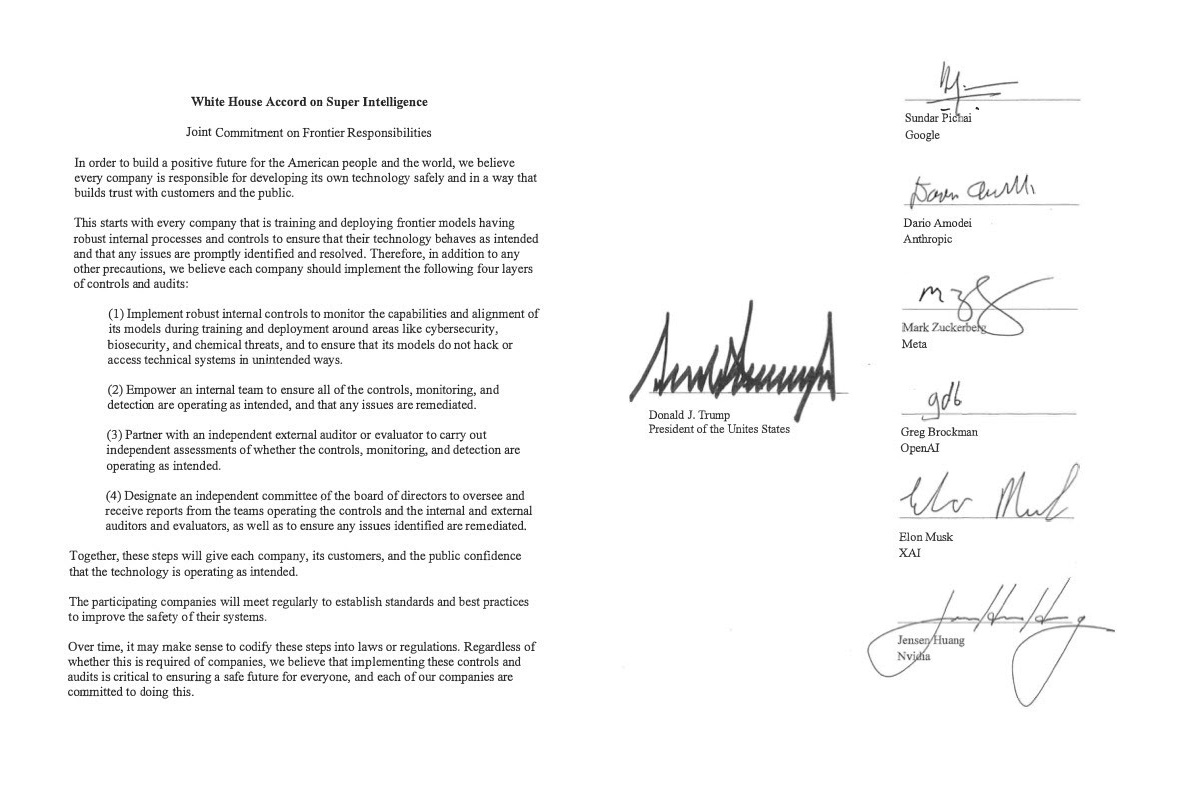
The fourth layer would place responsibility at the board level, with companies designating an independent board committee to oversee the safety framework and receive reports from internal teams and external auditors. The committee would also monitor the remediation of problems identified through the oversight process.
According to the accord, the four-layer system is intended to provide companies, their customers and the public with greater confidence that advanced AI technologies are operating as intended. Participating companies are also expected to meet regularly to develop common standards and best practices aimed at improving the safety of their systems.
The document leaves open the possibility that the measures could eventually become part of formal government regulation. It states that, over time, it may be appropriate to codify the safeguards into laws or regulations, while emphasizing that the companies are committed to implementing the controls regardless of whether they are legally required.
The agreement was released following a White House meeting with leading technology executives on September 29. Reporting on the accord identifies Google CEO Sundar Pichai, Meta CEO Mark Zuckerberg, Anthropic CEO Dario Amodei, OpenAI President Greg Brockman, xAI CEO Elon Musk and Nvidia CEO Jensen Huang among the participating executives.
The accord focuses specifically on governance, monitoring and auditing of increasingly capable AI systems, rather than establishing detailed technical standards or specific implementation deadlines.