PM Urges DP World to Invest in Bangladesh’s Free Trade Zones, Rail-Based ICDs

DHAKA — Prime Minister Tarique Rahman has urged global logistics company DP World to expand its investments in Bangladesh, particularly in free trade zones and rail-based inland container depots (ICDs), as the country seeks to strengthen its trade and logistics infrastructure.

The prime minister made the call during a meeting with a delegation from DP World led by Board Chairman Essa Kazim at the Secretariat on Thursday.

According to Prime Minister’s Assistant Press Secretary KM Nazmul Haque, the meeting focused on expanding Bangladesh-UAE trade and investment, developing port and logistics facilities, and exploring opportunities for further cooperation between the two sides.

A major issue discussed was the 15-year concession agreement between Bangladesh and DP World for the operation and modernisation of the Chattogram Container Terminal.

Under the agreement, DP World will operate and maintain the Chattogram Container Terminal along with its overflow container yard. The partnership is expected to contribute to the modernisation of the terminal, improve operational efficiency and strengthen Bangladesh’s overall port and logistics infrastructure.

During the meeting, Prime Minister Tarique Rahman also sought information about DP World’s plans for new investments in Bangladesh, including the development of free trade zones and rail-connected inland container depots.

In response, the DP World delegation expressed interest in cooperation and investment in these areas.

The prime minister also invited DP World and other international investors to explore investment opportunities in Bangladesh.

The discussions also covered potential initiatives to improve Bangladesh’s port infrastructure, expand regional trade connectivity and develop a more modern, efficient and integrated logistics system.

The proposed investments in free trade zones and rail-based ICDs could further connect Bangladesh’s ports with inland industrial and commercial centres, supporting more efficient movement of export and import cargo across the country.


UN Warns Gaza Crisis Deepens Amid Aid, Reconstruction Challenges

Shibbir Ahmed, New York — Humanitarian conditions in Gaza remain severe as shortages of medical supplies, damaged infrastructure and obstacles to reconstruction continue to challenge efforts to restore essential services.

The United Nations and its humanitarian agencies have repeatedly warned that Gaza’s health system remains under enormous pressure. In a UN Geneva briefing earlier this month, the World Health Organization said that no hospital in Gaza was fully functional, citing chronic shortages of medicines and medical equipment.

WHO said medical supplies can face lengthy approval procedures before entering Gaza. According to the agency, medical shipments had waited a median of 74 days for approval, while some equipment had been repeatedly rejected or delayed.

The consequences extend beyond hospitals. Without adequate diagnostic equipment and laboratory supplies, health authorities face greater difficulty identifying and responding to disease outbreaks. The humanitarian situation is also tied closely to the enormous scale of physical destruction.

A recent UN Trade and Development assessment estimated that Gaza’s recovery and reconstruction needs have reached approximately $71.5 billion. The assessment, based on work by the World Bank, European Union and United Nations, estimated physical infrastructure damage at $35.2 billion and economic and social losses at $22.7 billion as of early 2026.

Housing represents the largest category of damage and reconstruction needs. Educational and healthcare facilities have also suffered extensive damage, with more than half of hospitals and primary healthcare clinics reported as non-functional in the assessment.

Agriculture has been severely affected as well. UNCTAD reported that less than 1.5% of Gaza’s cropland remained accessible and undamaged, increasing dependence on humanitarian food assistance.

The humanitarian crisis is unfolding alongside continuing political disputes over Gaza’s future, security arrangements, disarmament and reconstruction.

A Washington Post report published Thursday said reconstruction remains largely stalled despite a U.S.-backed framework, citing disagreements over implementation and security arrangements. The report said hundreds of thousands of Palestinians continue to live amid extensive destruction and inadequate infrastructure.

For international aid agencies, the challenge is therefore twofold: providing immediate assistance while establishing conditions that allow Gaza’s basic infrastructure and economy to recover.

UNCTAD said large-scale international financial and technical assistance will be required for recovery. It identified rebuilding agriculture, industry, construction, energy and technology as important elements of longer-term economic recovery.

The UN’s humanitarian agencies continue to call for predictable and sufficient access for medical and humanitarian supplies, warning that the scale of need remains far greater than current response capacity.


Oil Prices Surge Above $104 as Middle East Shipping Crisis Deepens

LONDON — Oil prices jumped sharply Thursday as attacks on commercial shipping in the Gulf and Strait of Hormuz intensified concerns about global energy supplies.

Brent crude futures rose about 4.5% to $104.75 a barrel, while U.S. West Texas Intermediate crude increased about 4.5% to $92.28, according to Reuters. Both benchmarks reached their highest levels in more than a week.

The latest price increase reflects a combination of geopolitical and supply concerns. Shipping attacks in the Gulf have increased, while uncertainty surrounding Iran and the security of the Strait of Hormuz has made traders increasingly concerned about the reliability of energy shipments.

The Strait is particularly important because it handled shipments equivalent to approximately 20% of global oil and fuel flows before the current conflict. Any prolonged reduction in traffic could have consequences well beyond the Middle East.

The latest attacks have also increased the cost and difficulty of moving energy products. Shipping companies are reassessing routes, while producers are looking for alternative ways to move oil and fuel to international markets.

At the same time, the United States is facing an additional supply concern because Hurricane Isaias is disrupting offshore oil and gas production in the Gulf of Mexico. Reuters reported that more than 25% of current U.S. Gulf oil production and more than 16% of natural-gas production had been shut in because of the storm as of Wednesday.

Major energy companies, including Shell and Chevron, have curtailed offshore operations as the hurricane approaches.

The International Energy Agency has also moved to accelerate the release of emergency oil stocks and prioritize diesel supplies as governments respond to high fuel prices and supply disruptions.

U.S. inventory data provided another source of upward pressure on prices. Crude inventories declined more than analysts had expected, while diesel inventories also fell.

The combination of Middle East tensions, shipping disruptions and reduced U.S. offshore production has created an unusually uncertain energy market.

For consumers, sustained increases in crude prices could eventually affect gasoline, diesel, airline and transportation costs. The extent of any impact will depend on how long shipping disruptions continue and whether alternative supply routes can compensate for reduced flows through the Gulf. Markets remain particularly sensitive to developments involving Iran and the Strait of Hormuz.


U.S.-Iran Tensions Escalate as Tanker Attacks Raise Risks in Strait of Hormuz

WASHINGTON DC — Tensions between the United States and Iran are intensifying as risks to commercial shipping in and around the Strait of Hormuz increase, raising fresh concerns about global energy supplies and maritime security.

Iran has warned regional countries that attempts to establish or use alternative oil-export routes could be considered hostile, according to regional officials briefed on Tehran’s position. The warnings come after a sharp increase in attacks and incidents involving commercial vessels in the Gulf and the Strait of Hormuz.

Reuters reported Thursday that tanker attacks last week reached their highest level since the current Iran war began. The increase has contributed to a significant decline in vessel traffic through the strategic waterway.

The latest reported incident involved the chemical tanker Acers, which was struck by multiple projectiles north of Qatar. Maritime authorities said members of the crew sustained minor injuries. The incident occurred outside the Strait itself but highlighted concerns that the maritime security threat could extend to approaches involving Qatar, Bahrain, Saudi Arabia, Kuwait and Iraq.

The Strait of Hormuz is one of the world’s most important energy corridors. Before the current conflict, shipments equivalent to roughly 20% of global oil and fuel flows passed through the waterway. Disruptions there can therefore affect not only countries in the Middle East but also energy prices, transportation costs and consumers worldwide.

The United States is considering additional measures toward Iran, while military activity and the security situation in the region continue to evolve. Reuters reported that U.S. naval and other options are under consideration as Washington weighs its response.

Oil-producing countries in the Gulf have been seeking alternative transportation arrangements, including routes that use the Omani side of the Strait before transferring shipments farther out in the Gulf of Oman.

The crisis is also affecting shipping companies. Higher risks and insurance and logistics costs are adding pressure to international trade, while companies are adjusting routes and fees in response to the uncertain security environment.

For Americans, the immediate concern is the potential economic impact. Prolonged disruption around Hormuz could place additional pressure on crude oil, gasoline, diesel and transportation prices.

The situation remains fluid, with governments and shipping operators closely monitoring developments across the Gulf.


Bangladeshi Community Leaders Visit Ailing 1971 Freedom Fighter Harun Chowdhury

VIRGINIA — A group of Bangladeshi community leaders and journalists recently visited veteran journalist and 1971 Liberation War freedom fighter Harun Chowdhury at his Virginia home, offering support and checking on his health.

The delegation included Shibbir Ahmed, ZI Russell, Sheikh Selim, Sadek M. Khan and Jewel Barua. They spent time with the 77-year-old former wartime leader, who is now largely confined to his home because of age-related health problems.

According to family members, Chowdhury is managing several chronic conditions, including diabetes, high cholesterol and high blood pressure. His health problems have significantly reduced his mobility, and he requires assistance with many everyday activities.

The visit provided an opportunity for the group to reminisce about their years of friendship and professional association with Chowdhury. Conversations centered on shared memories, journalism and his long involvement in the Bangladeshi community in the United States.

Chowdhury’s connection to Bangladesh’s Liberation War is a defining part of his life story. During the 1971 war, he trained at Melaghar in Agartala, India, and served with Sector 2’s K Force under Major General Khaled Mosharraf and Major Haider. He later commanded operations in the Srinagar thana area.

After independence, Chowdhury established a career in journalism and literature. He served for many years as the Washington, D.C., representative of Weekly Thikana and wrote extensively about the Liberation War and the media.

Among his published works are Amar Muktijuddho Amar Ahankar 1971, a memoir of his wartime experience, and Shangbadiker Shongbad, a chronicle of journalism. Both were published by Anannya Prokashoni.

The visitors said Chowdhury’s decades of service to Bangladesh, journalism and the expatriate community remain an important part of his legacy. They also encouraged members of the Bangladeshi-American community and his former colleagues to remember him and his family in their thoughts and prayers as he faces continuing health challenges.


BASJ Mezbaan Brings Vibrant Taste of Bangladesh to Atlantic City

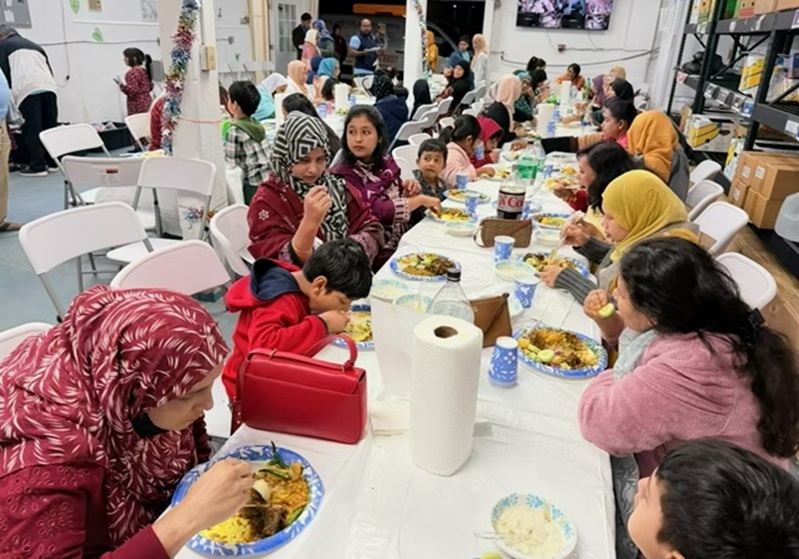
Subrata Chowdhury, Atlantic City: A traditional Mezbaan hosted by the Bangladesh Association of South Jersey (BASJ) was held in a festive atmosphere on Tuesday, October 6, at the Bangladesh Community Center in Atlantic City, New Jersey. The event brought together a large number of Bangladeshi Americans from Atlantic City and surrounding areas, creating an atmosphere filled with excitement, warmth and community spirit.

The Bangladesh Community Center was bustling with activity throughout the event. While some volunteers were busy preparing the traditional Mezbaani dishes, others focused on welcoming and serving guests. The aroma of authentic Bangladeshi food filled the venue, bringing back memories of the familiar sights, flavors and atmosphere of Bangladesh.

A large number of Bangladeshi community members from Atlantic City and nearby areas attended the Mezbaan with their families and friends. In addition to enjoying traditional food, guests spent time catching up, sharing conversations and exchanging greetings. Local mainstream political leaders also attended the community gathering.

For many attendees, the event was more than simply a meal—it was a celebration of Bangladeshi culture, tradition and community in the diaspora. The Bangladesh Community Center was transformed into a small piece of Bangladesh, as the flavors of Mezbaani cuisine, joyful conversations and heartfelt interactions recreated the spirit of a traditional Mezbaan back home.

S

Organizers emphasized the importance of hosting cultural events like this for the younger generation growing up in the United States. Such gatherings provide an opportunity for young Bangladeshi Americans to experience and connect with their heritage, traditions and cultural identity.

The Mezbaan generated considerable enthusiasm throughout the Bangladeshi community. For many attendees, the gathering also provided a welcome opportunity to reconnect with friends and acquaintances after a long time. The combination of traditional food, social interaction and cultural bonding helped strengthen relationships within the Bangladeshi-American community.

BASJ President Zahirul Islam Babul, General Secretary Jakirul Islam Khoka, and Trustee Board President Abdur Rafiq participated in the Mezbaan. They expressed their gratitude to everyone involved in organizing and successfully completing the event.

The organizers hope to continue hosting similar cultural programs in the future so that the younger generation of Bangladeshi Americans can remain closely connected to the culture, traditions and social values of Bangladesh.


DHS Proposes $70,000 Fee for F-1 Students Seeking OPT Work Authorization

Shibbir Ahmed, Washington DC — The U.S. Department of Homeland Security (DHS) has proposed a new fee structure for international students seeking employment through the Optional Practical Training (OPT) program, including a $70,000 fee for initial OPT participation and a $30,000 fee for subsequent participation.

Under the proposed rule, the fees would be paid by Student and Exchange Visitor Program (SEVP)-certified schools rather than directly by F-1 students. DHS said the proposal is intended to address fraud and abuse, strengthen the integrity of the immigration system and protect U.S. workers.

The proposal would require a school to pay $70,000 when an F-1 student is initially recommended for OPT. A $30,000 fee would apply to any subsequent OPT authorization, including subsequent participation such as a STEM OPT extension.

“Optional Practical Training was never meant to be a back door into the American workforce, a subsidy for cheap labor, or a prize for those who game the system,” a DHS spokesperson said.

DHS said the proposed fees are intended to discourage the misuse of the OPT program and encourage schools to exercise greater oversight when recommending students for employment authorization.

Under current federal regulations, eligible F-1 students may participate in OPT when the employment is directly related to their major area of study. Students must receive a recommendation from their designated school official (DSO) and apply for employment authorization through U.S. Citizenship and Immigration Services (USCIS).

F-1 students may participate in OPT before completing their academic program, known as pre-completion OPT, or after completing their program, known as post-completion OPT. Eligible students can generally receive up to 12 months of OPT at each education level. Students who earn degrees in science, technology, engineering or mathematics (STEM) fields may qualify for an additional 24-month extension.

DHS said the proposed rule follows concerns identified by the Student and Exchange Visitor Program (SEVP) regarding fraud and abuse involving schools, designated school officials, employers and F-1 students.

According to DHS, officials have identified schemes involving problematic worksites and so-called “pay-to-stay” arrangements, in which students allegedly maintain their immigration status through arrangements that do not reflect the intended purpose of practical training.

Under the proposed system, SEVP-certified schools would have to pay the applicable fee before their designated school officials recommend an F-1 student for OPT in the Student and Exchange Visitor Information System (SEVIS).

The fee would also have to be paid before the student applies for employment authorization with USCIS. DHS said USCIS would not grant employment authorization if the required fee had not been paid by the school.

The proposed fee would not be linked to a particular employer. Instead, it would apply when a school recommends an F-1 student for any type of OPT. The collected fees would be deposited into the U.S. Treasury.

The proposal comes as the Trump administration continues to pursue changes to immigration and employment programs involving international students and foreign workers. The proposed OPT fee is separate from other immigration measures and remains subject to the federal rulemaking process.

The proposed fees would represent a significant new cost for colleges and universities that recommend international students for OPT. The program is widely used by international students seeking U.S. work experience after completing their studies, particularly graduates in STEM fields.

DHS will accept public comments on the proposed rule beginning October 8 and continuing through November 9. The Paperwork Reduction Act section of the proposal will have a separate 60-day public comment period.

After the comment period ends, DHS will review the submissions and other materials received from the public. The agency may revise the proposal before issuing a final rule. The proposal is not yet a final regulation. Until DHS completes the rulemaking process and issues a final rule, the proposed $70,000 and $30,000 fees do not constitute final OPT requirements.


Bangabandhu’s ‘The Unfinished Memoirs’ Published in 14 Languages

Staff Correspondent: The autobiography of Bangabandhu Sheikh Mujibur Rahman, The Unfinished Memoirs, has been translated into several foreign languages, reaching readers in Asia, Europe and the Middle East.

Alongside the original Bengali edition and its English translation, the book has been translated into Urdu, Japanese, Chinese, Arabic, French, Hindi, Turkish, Nepali, Spanish, Assamese, Russian and Thai.

At an event marking the publication of the Braille edition of The Unfinished Memoirs on October 7, 2020, then Prime Minister Sheikh Hasina said the book had been translated into 14 languages and that permission had been sought to translate it into several more languages.

However, reports published around that time did not provide a complete list of all 14 languages.

The Unfinished Memoirs was first published in June 2012. The English edition was published alongside the Bengali version. The English translation was done by Dr Fakrul Alam, professor of English at the University of Dhaka.

Bangabandhu began writing his memoirs while in prison between 1967 and 1969. Four handwritten notebooks were recovered later and were used as the basis for editing and publishing the book.

The memoir contains accounts of Bangabandhu’s childhood, family background, education, political activities, the Bengal famine of 1943, communal riots in Calcutta and Bihar, the partition of India, the Language Movement, the formation and activities of the Awami Muslim League and Awami League, the United Front election, and political developments during the Pakistan period.

The early foreign-language editions included English, Chinese, Japanese and Urdu. The Japanese edition was translated by Kazuhiro Watanabe of the Bengali section of Japan Broadcasting Corporation (NHK) and published by Asahi Shoten.

The Urdu edition was published under the title Adhoori Yaadein (ادھوری یادیں). A 2013 edition published by Oxford University Press in Pakistan lists Yaowar Aman as the translator.

The Arabic edition was published in 2016 with an initiative from Palestine. On December 11 that year, Palestinian Foreign Minister Dr Riyad N. A. Malki handed a copy of the Arabic edition of The Unfinished Memoirs to then Prime Minister Sheikh Hasina at Ganabhaban in Dhaka.

Contemporary reports said Palestine had translated and published the book in Arabic and had taken steps to distribute it in other Arab countries.

The Arabic edition was translated by Palestinian translator Mohammad Dibaja (محمد ديباجة). Dr Syed Abdullah Al-Maruf, a professor of Arabic at the University of Dhaka, edited the translation.

According to published comments by Al-Maruf, the initial Arabic translation was based on the English edition. He later edited and revised the translation.

The Arabic edition is listed in an academic source from the University of Dhaka with the Arabic title Seeratun Zatiyyatun Lam Taktamil (سيرة ذاتية لم تكتمل) and Mohammad Dibaja as the translator.

Published reports have also mentioned Kuwait in connection with the publication or printing of the Arabic edition.

The French edition was published in 2017 by French publishing house Ginkgo Éditeur. It was translated by Professor France Bhattacharya, professor emeritus at the National Institute for Oriental Languages and Civilisations (INALCO) in Paris. The French edition was also presented at the Salon du Livre in Paris.

The book was subsequently translated into Hindi, Spanish, Turkish, Nepali, Assamese and Russian.

On October 11, 2018, Sheikh Hasina formally unveiled the Spanish edition of The Unfinished Memoirs at Ganabhaban. The edition was published through the Embassy of Spain in Dhaka. Reports from the time said the book was then available in 10 languages, including Bengali, English, Hindi, Chinese, Japanese, French, Urdu, Arabic and Spanish.

The Nepali edition was published under the title Ti Adhura Sansmaranharu (ती अधुरा संस्मरणहरु). Former Nepali foreign secretary and former SAARC secretary general Arjun Bahadur Thapa and Professor Mahesh Poudel were associated with the translation.

At the October 7, 2020 event marking the unveiling of the Braille edition, Sheikh Hasina said The Unfinished Memoirs had been translated into 14 languages and that permission had been sought for translations into several other languages.

The complete list of those 14 languages was not provided in the reports published at the time. Different government and media reports mentioned English, Urdu, Japanese, Chinese, Arabic, French, Hindi, Turkish, Nepali, Spanish, Assamese and Russian.

A Thai edition was published in August 2022. The South Asia Studies Center of Chulalongkorn University and the Bangladesh Embassy in Bangkok jointly organised the unveiling ceremony.

The Thai translation team was led by Assistant Professor Dr Jirayut Sinthuphan, director of the South Asia Studies Center at Chulalongkorn University.

Information released at the time of the Thai edition stated that the book had previously been translated into English, Urdu, Japanese, Chinese, Arabic, French, Hindi, Turkish, Nepali, Spanish, Assamese and Russian.

With the addition of Thai, the number of foreign languages became 13. Including Bengali, the original language, the total became 14.

A Marathi edition was also published later. The Marathi edition, titled Apurna Atmakatha, was unveiled in Mumbai on October 12, 2021, at an initiative of the Bangladesh Deputy High Commission. The translation was done by writer and journalist Aparna Velnkar, while Anand Limaye was the publisher.

Various lists published at different times have also mentioned other languages, including Persian, Italian, Malay and Korean. The publication dates, publishers and translation details of all such editions, however, are not consistently available in the published sources.

The publication of the Braille edition added another format to the book’s editions. On October 7, 2020, Sheikh Hasina unveiled the six-volume Braille edition of The Unfinished Memoirs.

The book, first published in Bengali in 2012 and translated into English in the same year, has since been published in multiple languages. The Arabic edition was handed over to Sheikh Hasina by Palestinian Foreign Minister Riyad Al-Malki in 2016.

By the time the Thai edition was unveiled in 2022, information released by the organisers listed 13 foreign languages—English, Urdu, Japanese, Chinese, Arabic, French, Hindi, Turkish, Nepali, Spanish, Assamese, Russian and Thai—in addition to Bengali. :::



Guterres Calls for Permanent Ceasefire Three Years After October 7 Attacks

Shibbir Ahmed, New York — Three years after the Hamas-led attacks on Israel on Oct. 7, 2023, United Nations Secretary-General António Guterres condemned the killings and hostage-taking while calling for an end to the continuing suffering of both Israelis and Palestinians.

In a message marking the anniversary, Guterres said more than 1,200 Israelis and foreign nationals were killed in the attacks, in which civilians were targeted in their homes, communities and at a music festival. Another 251 people were abducted and taken hostage in Gaza, according to the United Nations.

“Nothing can justify these atrocities,” Guterres said, recalling meetings with Israeli families whose lives were devastated by the attacks. He also cited reports of torture, sexual violence and other mistreatment of hostages, as well as deaths in captivity and during the subsequent fighting.

Guterres also highlighted the extensive Palestinian civilian toll from the war that followed. According to UN agencies, more than 70,000 Palestinians, including about 20,000 children, have been killed, while more than 100,000 have been wounded. Nearly all of Gaza’s estimated 2.1 million residents have been displaced, and large parts of the territory have been destroyed.

“Civilians continue to endure intolerable conditions,” Guterres said, adding that their suffering “demands an end – now.”

The secretary-general said the ceasefire reached in October 2025 had brought some relief but had not yet delivered lasting security, sufficient humanitarian assistance or a credible path toward recovery and peace.

He urged all parties to fulfill their commitments and proceed to the next phase of the ceasefire under UN Security Council Resolution 2803. He also called for humanitarian aid to enter Gaza on a large scale and for the ceasefire to become permanent.

The UN humanitarian office, OCHA, said Israeli authorities had suspended the entry of cargo into Gaza on Monday and announced another suspension for Wednesday, citing security concerns related to the anniversary.

Guterres said the anniversary should serve not only as a day of mourning but also as an opportunity to pursue a different future in which Israelis and Palestinians can live together with their rights, dignity and aspirations respected.


US supports vaccination drive to protect 3.4 million children

Ruma Bhoumik, Dhaka – The United States is supporting Bangladesh’s national measles-rubella catch-up vaccination campaign through UNICEF, with the aim of protecting 3.4 million children aged six to 59 months amid the ongoing outbreak. US Chargé d’Affaires Eric Geelan today visited the vaccination campaign at T&T Field in Korail, Banani, here.

The campaign, launched on September 26, is being supported under the United States’ America First Global Health Strategy, according to a statement attributable to US Mission Spokesperson Poornima Rai.

He was joined by State Minister for Health Dr Mohammad Abdul Muhit, Dhaka North City Corporation Administrator Md Shafiqul Islam Khan and DNCC Chief Health Officer Brigadier General Imrul Kayes Chowdhury.

UNICEF Bangladesh Chief of Communications and Advocacy Miguel Mateos Muñoz and UNICEF Bangladesh Immunization Lead Dr Riad Mahmud were also present. The campaign represents a nationwide effort to vaccinate vulnerable children against measles and rubella as Bangladesh continues to respond to the current outbreak.

The US support, channelled through UNICEF, is aimed at strengthening the government’s immunisation response and expanding vaccine coverage among children in the target age group.