People are ultimate source of power: PM

SANGSAD BHABAN – Prime Minister and BNP Chairman Tarique Rahman today said the government has started preliminary work to fulfill its commitments to the people as they are the source of all political power. “Bangladesh Nationalist Party (BNP) believes that the people of this country are the source of all political power. The present government has already started the preliminary work to implement the promises made to them,” he said.

The premier said this while replying to a supplementary question from treasury bench member from Patuakhali-4 constituency ABM Mosharrof Hossain in the House with Speaker Hafiz Uddin Ahmed in the chair. Highlighting the role of elected public representatives, he said all programmes will be presented gradually in parliament by the lawmakers, who have been elected through a neutral election and to be implemented accordingly.

Criticizing past political parties for making empty promises, the Leader of the House said, “In the past, many political parties made various promises, and some even distributed tickets”.

“However, the mandate given by the people in the last election has proven that people have spontaneously supported BNP’s welfare-oriented plans, including ‘Family Card’ and ‘Farmer Card’,” he added. Expressing gratitude to the countrymen, Tarique Rahman said, the government will fully honour the trust placed by the people on it. “We are firmly committed to fulfilling every promise made to them with our highest efforts,” he added.


Funeral Held for Bangladeshi Teen Killed in Truck Accident in New York

Desk Report: The funeral for Nishat Jannat, 19, a Bangladeshi teenager who was killed in a truck accident in Woodside, New York, was held on Tuesday, March 31, after Zuhr prayers at Baitul Jannah Mosque. Community leaders and local residents attended the ceremony.

Nishat Jannat was killed while crossing the road in the Woodside area of Queens when she was struck by a garbage truck. The incident occurred late Sunday night near Roosevelt Avenue and 62nd Street. Emergency responders pronounced her dead at the scene.

She was a student at the City College of New York and also worked as a receptionist at a parking garage. Her father, Helal Uddin, serves as the imam of Baitul Jannah Mosque. Following the funeral prayers, she was laid to rest in New York. Nishat was originally from Uttar Ghorgao village in Golapganj upazila, Sylhet, Bangladesh, and had moved to the United States with her family around eight years ago.

The truck driver involved in the accident remained at the scene and sustained minor injuries. Police said no arrests have been made, and the incident is under investigation. The tragic death has left the local Bangladeshi community in deep grief.


Italy Knocked Out of World Cup — Third Consecutive Failure

Desk Report: Four-time world champions Italy have failed to qualify for the 2026 FIFA World Cup, crashing out after a defeat to Bosnia and Herzegovina in the European playoff final. Italy made a strong start to the match, taking the lead through Moise Kean. However, their momentum was disrupted when defender Alessandro Bastoni was sent off in the first half, reducing the team to 10 men. Bosnia equalized later through Haris Tabaković, bringing the game level.

With the match ending 1–1 after regulation and extra time, the outcome was decided by a penalty shootout. Italy suffered a heavy 4–1 defeat, missing two of their penalties, while Bosnia converted all of theirs.

This loss marks Italy’s third consecutive failure to qualify for the World Cup (2018, 2022, and 2026), a significant setback for one of football’s most historic teams. Head coach Gennaro Gattuso expressed regret over the result and apologized to fans, stating that although the team gave their best effort, they ultimately fell short.Once a dominant force in world football, Italy has now endured a prolonged period of decline, having not appeared in a World Cup since 2014.


Awami League and Pro-Liberation Groups Celebrate Independence Day in New York

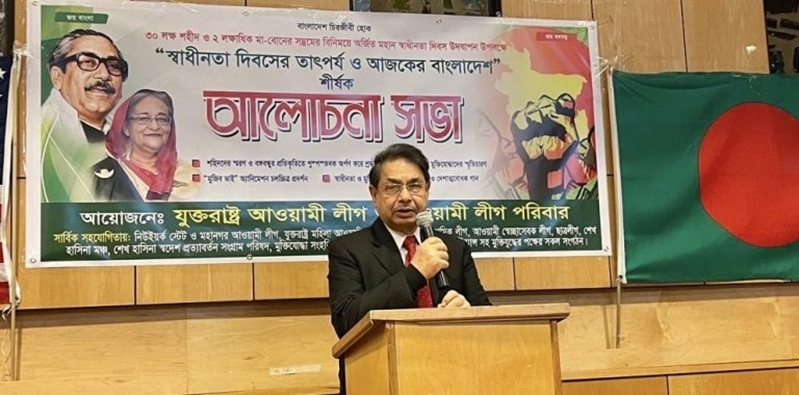
New York: The 56th Independence Day of Bangladesh was celebrated with enthusiasm by the United States Awami League, its affiliated organizations, and various pro-Liberation groups, including political, social, and cultural associations. Journalists, poets, researchers, and prominent expatriate leaders also attended the event.

The program was held on the evening of March 22 at Juice Center in Jackson Heights, New York City. It was presided over by Dr. Pradip Ranjan Kar, veteran freedom fighter, former General Secretary of BAKSU, and advisor to the US Awami League. The event was jointly organized by US Awami League Office Secretary Engineer Mohammad Ali Siddiqui and Legal Secretary Advocate Shah Mohammad Bakhtiar Ali.

The discussion, titled “The Significance of Independence Day and Today’s Bangladesh,” featured speeches by senior journalist and US Awami League advisor Hakikul Islam Khokon, freedom fighters Golam Mostofa Khan Miraj, Shawkat Akbar Richy, Faruk Hossain, Khurshid Anwar Bablu, Ismail Khan Ansari, Helal Majid, poet and freedom fighter Avinash Acharya, and Dr. Selina Afrin Rita, child of a martyr family and YouTube host. Other leaders from Awami League and its affiliated organizations also addressed the gathering.

Patriotic poetry recitations were delivered by Hasan Al Abdullah, Minhaj Ahmed Shammu, Gopon Saha, and Awami League leader Rina Abedin. The program began with a collective rendition of the national anthem, followed by a one-minute silence honoring the martyrs of the 1952 Language Movement, the 1962–1969 education and democracy movements, the 1971 Liberation War, the assassination of Sheikh Mujibur Rahman and his family in 1975, the 2004 grenade attack on Sheikh Hasina, and other struggles for democracy.

Speakers expressed concern over the resurgence of forces defeated in 1971 and emphasized the need for unity at home and abroad. They called for keeping the spirit of liberation alive, strengthening the legacy of Bangabandhu Sheikh Mujibur Rahman, and ensuring that those responsible for historical atrocities face justice.


New York State BNP Pledges Unity in Support of Tarique Rahman’s Development Agenda

New York: Leaders of the New York State unit of the Bangladesh Nationalist Party (BNP) have expressed their commitment to accelerating Bangladesh’s development under the leadership of Tarique Rahman. The pledge was made during a discussion meeting held on March 29 at Diversity Plaza in New York City, organized to mark Independence Day.

In his opening remarks, BNP central committee member Gias Ahmed said that following Tarique Rahman’s vision, expatriate Bangladeshis remain united in working to build a democratic and prosperous Bangladesh, fulfilling the dreams of the late President Ziaur Rahman.

Speaking as a special guest, BNP USA Joint Secretary General Akter Hossain Badal highlighted that party members abroad are committed to supporting Tarique Rahman, the rightful successor to Ziaur Rahman and former Prime Minister Khaleda Zia, in building an equitable society.

Another special guest, Golam Faruk Shaheen, member of the BNP Chairperson’s Foreign Affairs Advisory Committee, said that expatriate activists—long engaged in political struggle—now face the critical task of providing full support for Tarique Rahman’s development mission.

The event, moderated by State BNP General Secretary Saidur Rahman Said and chaired by State BNP President Oliullah Atikur Rahman, was attended by numerous party leaders and activists. The program concluded with a special prayer for the martyrs of Bangladesh’s Liberation War. Organizers expressed gratitude to participants for attending despite adverse weather conditions.


RUET launches reverse osmosis water treatment plant

RAJSHAHI – The long-standing problem of iron-rich water at Rajshahi University of Engineering and Technology (RUET) is set to be resolved. On Tuesday, a modern Reverse Osmosis (RO) water treatment plant was experimentally launched for the first time in four of the university’s residential halls. The university administration hopes this will ensure safe and hygienic drinking water for the resident students.

According to university sources, the technical installation of the plant has been completed on the rooftops of four newly constructed residential halls—Student Hall-1, Student Hall-2, Nawab Faizunnesa Chowdhurani Hall (Female Hall-1), and Female Hall-2.

The project, implemented by the university’s Planning and Development Office, cost approximately Taka 30 lakh being supervised by Professor Dr. H. M. Russell, Director of the Planning and Development Office.

He said, “The plant has initially been launched in these four halls. This initiative can provide an effective solution to the long-standing problem of iron-rich water in the Rajshahi region. There are plans to expand the project further in the future.”

Students have long faced difficulties with drinking water quality due to high iron content in the region’s groundwater. As part of a special initiative by the university administration, these plants have been installed to address the problem.

Reverse Osmosis is a modern water purification method that removes harmful substances, excess salts, iron, and other impurities through a specialized membrane. The resulting water is completely safe and hygienic for drinking.

Students have described the university’s initiative as timely and necessary. They expressed hope that the launch of this plant will provide a permanent solution to water quality issues and anticipate that this facility will soon be extended to other residential halls and academic buildings across the campus. Officials viewed this step to ensure safe water supply as a significant milestone in improving the quality of life on the RUET campus.


UGC chairman proposes BIMSTEC higher education network

DHAKA – University Grants Commission (UGC) Chairman Professor Dr. Mamun Ahmed has proposed the formation of a ‘BIMSTEC Higher Education Network’ to ensure smooth and seamless exchange of teachers, researchers and students among higher education institutions of BIMSTEC member countries.

He made the proposal while chairing a session at the closing ceremony of a seminar titled ‘Bridging Regions, Building Futures: BIMSTEC under the Spotlight’ held at the Professor Muzaffar Ahmed Chowdhury Auditorium of Dhaka University.

The seminar was jointly organized by the Department of International Relations of Dhaka University and the BIMSTEC Secretariat. Dr. Mamun said such a regional network would facilitate the introduction of joint degree programmes, easier credit transfer for students and coordinated research activities among universities in member states.

He noted that universities in the region have long operated in isolation despite shared history, culture and development challenges, stressing the need for stronger regional academic cooperation.

Highlighting the current global context marked by geopolitical changes, climate risks and shifting economic priorities, he said it is essential to bring together scholars and policymakers across the region. He emphasized strengthening joint initiatives in digital connectivity, blue economy, STEM education and climate resilience.

He also said the Bay of Bengal is not just a geographical boundary but an important medium of regional connectivity, adding that human resource development must be prioritized to build a stable and prosperous region, where higher education plays a key role.

He underscored the importance of such seminars in aligning higher education with regional needs and called for building concrete partnerships, advancing joint initiatives and strengthening institutional trust. Professor Dr Md Abdul Mannan of Dhaka University delivered the vote of thanks at the end of the event.


Govt considers online classes for metropolitan educational institutions: Milon

DHAKA  – Education Minister Dr. ANM Ehsanul Hoque Milon today said the government is considering introducing online classes in educational institutions, particularly in metropolitan areas, in view of the evolving global situation.

“In metropolitan areas where students depend on bus transportation, we are considering online classes. But no final decision has yet been taken,” he told journalists after a meeting with the Prime Minister at the Secretariat’s Cabinet Building this afternoon.

Dr. Milon said the government is actively reviewing how classes will be conducted and how the education system will operate in the coming days, taking into account the current international context.

“The issue applies nationwide, but especially in metropolitan areas where students depend on bus transportation, we are considering online classes,” he added, noting that no final decision has yet been taken.

“The Ministry of Education will soon send a set of proposals to the Cabinet Division considering the prevailing global conflict situation,” he said, adding that a final decision will be taken after receiving approval from the authorities concerned.

Referring to the meeting, the minister said that the Prime Minister has given important directives to ensure the continuity of the ongoing pace of the education system, which will be implemented accordingly.

He also noted that due to international crises, along with disruptions caused by Ramadan holidays and various domestic movements, significant instructional hours have already been lost, which the government must take into account.

“However, if we shift completely to online education, there is a risk of becoming socially disconnected. So, any decision will be taken carefully after thorough consideration,” the Education Minister added.


All reform initiatives must be implemented within constitutional framework: Law Minister

SANGSAD BHABAN – Law Minister Md. Asaduzzaman today said that all reform initiatives must be implemented within the framework of the Constitution, stressing that the constitution remains the supreme legal foundation of the state and parliament. He said this while taking part in a discussion on the motion for summoning the session of the Constitution Reform Council in parliament today.

Opposition Leader Dr Shafiqur Rahman placed the motion in the House under the Section 62 of the Rules of Procedure for summoning the session of the Constitution Reform Council in line with July National Charter (Constitution Reform) Implementation Order, 2025. The Law Minister said that opposition members who questioned the legitimacy of the constitutional process should carefully read the relevant ordinance and provisions.

He said the July Charter is the central focus of current political discourse and that it represents the public mandate following the July 24 mass uprising. “The people have given us the mandate to conduct all activities under the constitution and bring necessary reforms through parliament,” he said.

The law minister explained that the July Charter outlines reform measures that must be adopted through parliamentary processes rather than through extra-constitutional means.High lighting key constitutional commitments in the July Charter, Asaduzzaman referred to provisions on women’s representation and the proposal to appoint a deputy speaker from the opposition.

He noted that the government had demonstrated commitment to democratic values by offering the deputy speaker position to the opposition in line with the July Charter spirit.

The minister stressed that the Constitution is deeply connected with the sacrifices of the Liberation War martyrs and the democratic struggles of the people, adding that the constitution has been amended at different times to restore democracy, judicial independence and multi-party governance.

He recalled the restoration of parliamentary democracy in 1991 under Begum Khaleda Zia and said that constitutional continuity and democratic reform have always been achieved through parliamentary processes. “Our commitment is to move forward through constitutional amendments in line with the July Charter and the people’s mandate,” he added.

Asaduzzaman further stated that any order or directive without constitutional backing cannot be treated as law, explaining that ordinances issued under Article 93 of the constitution carry legal validity, whereas other orders without constitutional authority cannot bind parliament. He emphasized that parliament is sovereign in law-making and cannot be compelled by unauthorized orders.

The law minister also highlighted historical precedents, noting that many countries adopted constitutions through political consensus and parliamentary processes. He said Bangladesh must follow the same path by amending the constitution through a parliamentary committee and democratic deliberation.

Welcoming the proposal to form a special parliamentary committee on constitutional reform, he urged the Speaker to constitute a committee where all parties can discuss and analyze the July Charter provisions and bring a constitutional amendment accordingly.

“The July Charter should guide reforms, but all actions must be taken through constitutional and parliamentary procedures,” he said, adding that national unity and democratic consensus are essential for sustainable constitutional reform.


PM asks Education Ministry to find ways to ease school hour city traffic

DHAKA – Prime Minister Tarique Rahman today directed the Education Ministry to explore alternative measures to ease traffic congestion in the capital during school hours. The premier came up with the directive at a meeting with Education Minister Dr ANM Ehsanul Hoque Milon and State Minister for Primary and Mass Education Bobby Hajjaj at the Bangladesh Secretariat here this morning.

Prime Minister’s Additional Press Secretary Atikur Rahman Ruman said possible ways to reduce traffic congestion in city during school hours and what alternative arrangements could be introduced for this were discussed in the meeting.

“The Prime Minister asked the ministry to prepare proposals in this regard,” he added. Explaining the matter, Ruman said, “For example, it has been observed that around 100 cars crowd in front of a school for 150 students, causing serious traffic jams and difficulties for students to reach their institutions”.

The premier advised the minister to address these issues and find alternatives. After the meeting with the education minister, Power, Energy and Mineral Resources Minister Iqbal Hassan Mahmood Tuku and State Minister Aninda Islam Amit also met the Prime Minister. Subsequently, Chief of Naval Staff Admiral M Nazmul Hassan also called on the Prime Minister.