UN Warns of Terrorists’ Growing Use of AI and Drones

Shibbir Ahmed, New York — The United Nations Security Council has warned that terrorist groups are adapting rapidly to new technologies, increasingly exploiting artificial intelligence, drones, social media, encrypted messaging and online platforms to recruit supporters, spread propaganda, raise funds and strengthen their operational capabilities. The warning came during a Security Council briefing marking the 25th anniversary of the September 11 terrorist attacks, as UN officials assessed how the global terrorist threat has evolved since 2001.

Assistant Secretary-General Natalia Gherman told the Council that terrorism has become more fragmented and diffuse, with terrorist groups decentralizing their operations and taking advantage of instability to expand their influence.

She also highlighted the growing role of technology in terrorist activities. According to the UN, extremist groups are exploiting social media platforms, gaming environments and other virtual spaces to identify vulnerabilities and recruit people, particularly young people.

AI and digital platforms create new challenges

UN officials said the rapid development of artificial intelligence and other digital technologies is changing the threat environment. The Security Council’s Counter-Terrorism Committee Executive Directorate said terrorist organizations are using AI-enabled tools and digital platforms to disseminate propaganda, recruit supporters and enhance their operational capabilities.

The UN also pointed to the use of encrypted communications and online financial services as growing challenges for counter-terrorism authorities. The UN Office of Counter-Terrorism has separately warned that AI-generated content, deepfakes and algorithmic amplification can increase the speed and reach of harmful extremist narratives.

Drones emerging as an operational threat

The UN also identified the weaponization and misuse of unmanned aircraft systems, commonly known as drones, as an increasingly significant terrorist threat. According to the Counter-Terrorism Committee Executive Directorate, terrorist groups are exploiting unmanned aircraft systems for operational purposes, while weak governance and porous borders in some regions have created additional opportunities for terrorist organizations to acquire and misuse emerging technologies.

The UN’s counter-terrorism program says member states have been urged to strengthen measures against terrorist exploitation of technologies including AI, virtual assets, 3D printing, unmanned aircraft systems and commercially available drones.

UN calls for international cooperation

The Security Council emphasized that countering terrorism requires coordinated action at the national, regional and international levels, consistent with international law and the UN Charter. UN officials stressed that governments need to adapt their counter-terrorism strategies as terrorist organizations change their methods and exploit emerging technologies.

The Council also highlighted the importance of protecting human rights and the rule of law while responding to evolving terrorist threats. The discussion comes 25 years after the September 11, 2001 attacks in the United States, which prompted major changes in international counter-terrorism cooperation and led to the adoption of Security Council Resolution 1373.



Up to 101,000 North Korean Workers Still Deployed Overseas

Shibbir Ahmed, NEW YORK — North Korea continues to deploy tens of thousands of workers overseas in violation of United Nations sanctions, generating hundreds of millions of dollars that the country’s government allegedly uses to support its nuclear weapons and ballistic missile programs, according to a new report released Wednesday by the Multilateral Sanctions Monitoring Team (MSMT).

The MSMT, a multilateral mechanism established in October 2024 to monitor implementation of UN sanctions against North Korea, estimated that between 35,600 and 101,280 North Korean workers remain deployed abroad, with nearly all located in China and Russia.

The report says the overseas labor network generated an estimated $450 million to $800 million in 2025, despite UN Security Council resolutions requiring member states to end such employment and repatriate North Korean nationals earning income in their territories.

According to the MSMT, at least 17 countries are suspected of continuing to host North Korean workers. The UN Security Council adopted measures in 2017 under Resolutions 2375 and 2397 that prohibited member states from providing work authorization to North Korean nationals and required countries to repatriate North Koreans earning income in their jurisdictions by the end of 2019.

China and Russia remain major destinations

The report estimates that between 20,000 and 70,000 North Korean workers are deployed in China. While an estimated 10,000 to 20,000 workers were temporarily repatriated from China between 2023 and 2025, the MSMT said approximately 10,000 new North Korean workers arrived in China between January 2025 and January 2026. Russia has also become a major destination for North Korean laborers. The MSMT estimates that between 15,000 and 30,000 North Korean workers were in Russia at the end of 2025.

The report says some North Korean workers in Russia have been involved in manufacturing military drones and other activities connected to Russia’s defense-industrial sector. The MSMT identified North Korean workers at facilities involved in areas including drone production, arms manufacturing, steel processing and shipbuilding. The report also says Russia has used a student-visa scheme that the MSMT considers a mechanism for disguising some North Korean workers as students.

Most wages allegedly seized by North Korea

The MSMT estimates that North Korean authorities confiscate 80% to 90% of workers’ wages. In some cases, the report says, the amount taken can exceed workers’ actual earnings, leaving them indebted to the North Korean government.

North Korean authorities also maintain strict controls over workers’ movements and contacts with outsiders, according to the report. Workers who attempt to defect face the risk of retaliation against family members who remain in North Korea.

The report estimates that a North Korean worker in Russia generates an average of about $7,500 in annual wages, while monthly earnings can be several times higher than those of workers in China, depending on the industry.

MSMT seeks restoration of UN expert panel

The latest report also addresses the monitoring gap created after the UN Security Council’s 1718 Committee Panel of Experts was disbanded in April 2024 following Russia’s veto of a resolution extending its mandate. The MSMT said its latest findings are intended to help the international community implement existing UN sanctions and identify efforts to circumvent them.

The participating governments called for the UN Security Council to reestablish the Panel of Experts with the same strength and structure it had before its dissolution. The MSMT said it will continue monitoring implementation of UN sanctions related to North Korea and reporting suspected violations and sanctions-evasion activities.

The participating governments also urged UN member states to increase awareness of the risks associated with employing North Korean overseas laborers and to take domestic action against parties and facilitators involved in alleged violations of UN sanctions.

Source: Multilateral Sanctions Monitoring Team (MSMT); joint statement by participating governments.


Jalalabad Association of America Holds Colorful ‘Summer Bash’ in Festive Atmosphere

Staff Correspondent: The Jalalabad Association of America Inc., one of the leading social organisations representing people from greater Sylhet living in the United States, hosted its much-anticipated ‘Summer Bash’ in a vibrant and festive atmosphere.

The event brought together Bangladeshi expatriates from Sylhet and their families, creating a lively gathering aimed at preserving cultural traditions, strengthening community bonds and promoting friendship and harmony among the expatriate community.

The programme was organised under the overall leadership of Association President Moinul Islam and General Secretary Ataul Gani Asad. A dedicated celebration committee worked to ensure the smooth and successful execution of the event.

The committee was led by Convener Sheikh Jamal Hossain, Chief Convener Laies Ahmed (Minu), Chief Coordinator Moin Uz Zaman Chowdhury, and Member Secretary Helim Uddin. Kamrul Hossain and Shahinul Islam served as Joint Member Secretaries. Other members of the celebration committee included A. Rahim (Kadir), Zainal Uddin Layek, Masuk Mia, Syed Lokman, Badrul Uddin, and Dewan Md. Tazzir.

Taking a break from their busy lives in the United States, expatriate Bangladeshis attended the Summer Bash with their families in large numbers. The event featured social gatherings, friendly conversations, family activities, colourful stalls and a vibrant cultural programme.

The cultural segment featured popular artists from Bangladesh, the United Kingdom and the local Bangladeshi community, who entertained the audience with a variety of songs. Performers included Selim Chowdhury, Rizia Parvin, Kamruzzaman Bakul, Wahid from London, Shah Mahbub, Baul Kala Mia, Nasir Uddin, Roksana Mirza, Nazu Akand, Aftab Johnny, Silma, and Apu Rahman’s group.

The event was further energised by the event management and sound system provided by Soundgear, contributing to the overall festive atmosphere. Around 20 colourful stalls were also set up at the venue, attracting considerable attention from visitors. The stalls added a fair-like dimension to the celebration and provided another attraction for families attending the programme.

According to the organisers, one of the main objectives of the event was to introduce the younger generation of expatriate Bangladeshis to their cultural heritage, traditions and roots. The organisers also emphasised the importance of such gatherings in strengthening social connections and fostering unity among the greater Sylhet community in the United States.

Through the collective efforts of the celebration committee and the enthusiastic participation of expatriate Bangladeshis, the Jalalabad Association of America’s ‘Summer Bash’ became a memorable celebration of Sylheti culture, community and togetherness.


Awami League Protest in New York Over Death Sentences for 7 Leaders

New York Correspondent: The US Awami League and its affiliated organisations staged a protest rally and procession in New York on Tuesday evening against the death sentences handed down by Bangladesh’s International Crimes Tribunal-2 against seven Awami League and affiliated-organisation leaders, including Awami League General Secretary and former minister Obaidul Quader.

The protest was held at Diversity Plaza in Jackson Heights on Tuesday (September 15). Following the rally, protesters marched through nearby streets carrying banners and placards. Leaders and activists of the US Awami League, US Chhatra League, Volunteer League, Labour League, Mohila Awami League, New York State Awami League and New York Metropolitan Awami League took part in the programme.

Several national-level Awami League leaders and former lawmakers were also present, according to organisers. They included former Water Resources Minister and former Awami League Organising Secretary Enamul Haque Shamim, Awami League Publicity and Social Welfare Secretary Aminul Islam Amin, former State Minister and former lawmaker Mohammad Zahid Ahsan Russel, and former lawmaker and former Bangladesh Chhatra League General Secretary Nazrul Islam Babu.

US Awami League President Dr. Siddiqur Rahman and General Secretary Abdus Samad Azad, along with leaders from different levels of the organisation, also attended the programme.

The protesters carried banners and placards rejecting the tribunal’s verdict. The organisers described the cases against the party leaders as politically motivated and characterised the verdict as an act of political retaliation and a predetermined judicial process. These are the political claims of the US Awami League and the protesters.

At the rally, speakers expressed their opposition to the tribunal’s verdict and called for its cancellation. They also called for due legal process and justice, arguing that political disputes should not determine judicial outcomes.

Seven Sentenced to Death by Tribunal

Earlier on Tuesday, International Crimes Tribunal-2 sentenced seven people to death in a crimes-against-humanity case related to the July-August 2024 mass uprising in Bangladesh.

Those sentenced to death are Awami League General Secretary and former minister Obaidul Quader; Awami League Joint General Secretary AFM Bahauddin Nasim; former State Minister for Information and Broadcasting Mohammad Ali Arafat; Jubo League Chairman Sheikh Fazle Shams Parash; Jubo League General Secretary Md Mainul Hossain Khan Nikhil; Bangladesh Chhatra League President Md Saddam Hossain; and its General Secretary Sheikh Wali Asif Inan.

The three-member tribunal, headed by Justice Nazrul Islam Chowdhury, delivered the verdict on Tuesday. The seven accused were tried in absentia and remain at large, according to Bangladesh Sangbad Sangstha (BSS).

The prosecution had accused the seven of involvement in crimes against humanity during the July 2024 mass uprising, including murder, attempted murder, torture, incitement, conspiracy and other acts. The tribunal ruled that the charges against the accused had been proved beyond reasonable doubt. Chief Prosecutor Md Aminul Islam also said after the verdict that most of the charges had been proved beyond reasonable doubt.

The tribunal also ordered the confiscation of 50 percent of the movable and immovable properties of Obaidul Quader, AFM Bahauddin Nasim, Mohammad Ali Arafat, Sheikh Fazle Shams Parash and Mainul Hossain Khan Nikhil. It directed that proceeds from the sale of the confiscated properties be used to compensate people killed or injured during the July-August 2024 uprising or their families.

The defence had previously argued before the tribunal that the prosecution failed to prove the charges beyond reasonable doubt.

The New York protest came hours after the tribunal announced its verdict in Dhaka, bringing the latest political and judicial developments in Bangladesh into the streets of Jackson Heights, home to a large Bangladeshi-American community.


US Plans $2.8 Billion Munitions Sale to Israel

Shibbir Ahmed, WASHINGTON DC: The Trump administration is planning to sell Israel a $2.8 billion package of munitions, including tens of thousands of 2,000-pound bombs, according to a U.S. official familiar with the proposed sale. The package would include 20,000 MK-84 bombs and 20,000 BLU-117 bombs, both weighing 2,000 pounds, according to the official.

The proposed sale has been informally communicated to congressional committees that review major U.S. arms transfers, but the deal has not yet been publicly announced by the State Department. The Israeli Embassy in Washington also had not publicly commented on the proposal as of Tuesday.

The planned weapons transfer comes as the United States continues its military and security partnership with Israel amid ongoing conflicts and heightened tensions across the Middle East.

Israel has used similar heavy munitions in its military operations in Gaza and Lebanon. Their use in densely populated areas has drawn scrutiny from human rights experts because of the potential for significant civilian casualties.

The proposed sale also comes amid debate in the United States over Washington’s military support for Israel. Reuters reported that a 2026 public opinion poll found an increasing share of Americans believe U.S. support for Israel has gone too far, with the shift particularly pronounced among Democrats.

The proposed $2.8 billion package would represent a significant addition to Israel’s stock of heavy U.S.-made munitions. However, the plan remains subject to the U.S. arms-sale process and congressional review.

The proposal comes as the wider Middle East remains under heightened military tension following the U.S.-Israeli conflict with Iran earlier this year and continuing violence in the region.


US Senate blocks major cryptocurrency bill

Shibbir Ahmed, WASHINGTON DC: The U.S. Senate on Tuesday blocked legislation that would establish a comprehensive federal regulatory framework for cryptocurrencies, dealing a major setback to the digital-asset industry and Republican lawmakers who had championed the bill. The Clarity Act failed to secure the 60 votes needed to advance, with senators voting 49-50 on the procedural measure, according to the Associated Press.

The legislation was designed to provide clearer rules for the $2.3 trillion U.S. cryptocurrency market, including defining regulatory responsibilities and establishing greater legal certainty for digital-asset companies. Crypto industry groups had strongly backed the measure and spent hundreds of millions of dollars lobbying for its passage.

Democrats opposed advancing the bill without stronger restrictions concerning President Donald Trump and his family’s financial interests in cryptocurrency. Trump and his family have significant business interests in the sector, including World Liberty Financial and a cryptocurrency meme coin.

Republicans had revised the legislation in an effort to address those concerns. The revised version included provisions giving state attorneys general greater enforcement authority and requiring public officials with significant interests in crypto-related companies to divest those interests or place them in blind trusts. Democrats argued that the changes did not go far enough.

The bill also faced concerns from the banking industry over provisions involving stablecoins, which allow certain digital tokens to maintain a value linked to traditional currencies. Banking groups warned that stablecoin rewards could encourage customers to move deposits away from banks and potentially affect lending.

The Senate’s action represents a significant setback for the cryptocurrency industry’s effort to secure its first comprehensive federal regulatory framework. Reuters reported that the legislation now faces limited prospects for revival in the near term, particularly with Congress approaching the November midterm elections and a recess.

Financial markets reacted to the Senate vote. Bitcoin fell about 4% to around $75,908, while shares of cryptocurrency companies Coinbase and Circle each declined roughly 9%, according to Reuters.

The Securities and Exchange Commission and Commodity Futures Trading Commission have meanwhile continued developing cryptocurrency-related rules, but industry participants have argued that legislation from Congress is needed to provide a more permanent regulatory framework.


Republican lawmaker seeks Hegseth impeachment over Iran war

Shibbir Ahmed, WASHINGTON DC: Republican Rep. Thomas Massie on Tuesday filed articles of impeachment against Defense Secretary Pete Hegseth, accusing him of conducting military action against Iran without congressional authorization.

Massie, a Kentucky Republican and outspoken critic of the U.S. war in Iran, filed the impeachment resolution as a privileged measure, meaning the House is required to take it up within two legislative days.

The lawmaker’s resolution accuses Hegseth of abusing his office by carrying out hostilities against Iran without a declaration of war or specific authorization from Congress. Massie has argued that the administration’s continued military operations violate Congress’s constitutional authority over decisions to initiate war.

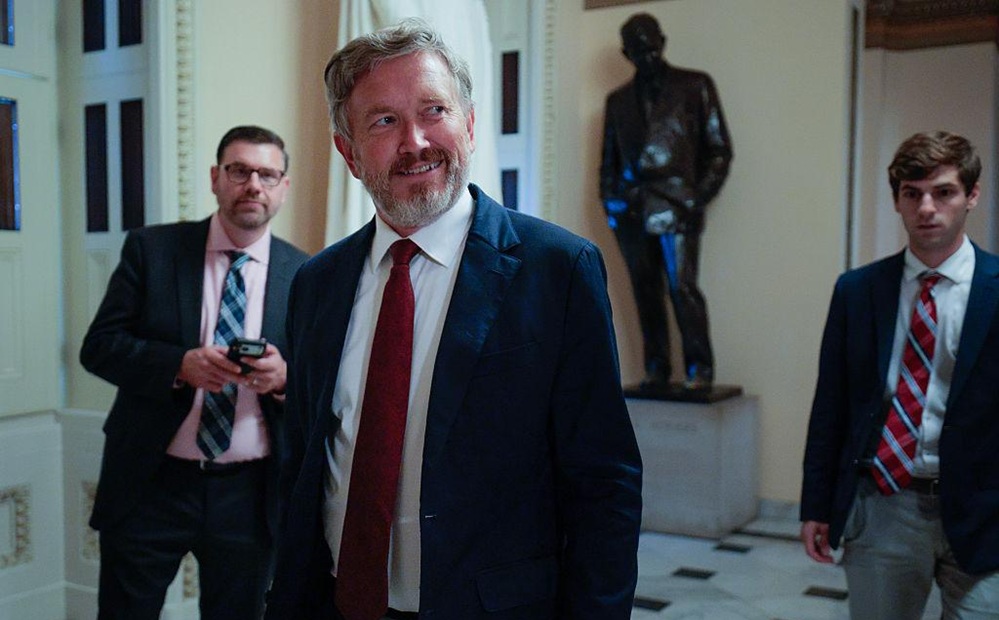
Rep. Thomas Massie, the Republican congressman from Kentucky who filed the impeachment articles against Defense Secretary Pete Hegseth today.

The move comes as the United States remains involved in the conflict with Iran, which began with U.S.-Israeli strikes on Iran on February 28. Massie has repeatedly opposed the war and has also criticized U.S. military support for Israel. The Pentagon rejected the impeachment effort and reaffirmed its support for Hegseth.

“The entire Department is unified behind the Secretary’s vision and will continue working to put our warfighters and America first,” Pentagon press secretary Kingsley Wilson said in a statement. The impeachment effort is unlikely to secure the support needed to remove Hegseth, but Massie’s filing could force House members to take a position on the administration’s military actions.

Massie is not seeking reelection after losing the Republican primary earlier this year to Ed Gallrein, a candidate endorsed by President Donald Trump. His opposition to the Iran war has been a prominent feature of his congressional record. The filing comes amid continuing debate on Capitol Hill over the extent of the president’s authority to conduct military operations without explicit congressional authorization.


Judge blocks Trump name from Kennedy Center

Shibbir Ahmed, WASHINGTON DC: A US federal judge on Tuesday blocked the Kennedy Center board from adding President Donald Trump’s name to the building or its grounds, ruling that such a move would require approval from Congress. US District Judge Christopher Cooper said the board could not circumvent his earlier order by using alternative wording to honor Trump. The ruling came after the Kennedy Center board proposed adding an inscription reading that the building had been “Restored and Renovated By President Donald J. Trump.”

“Simply put,” Cooper wrote, the defendants cannot install memorials for Trump or anyone or anything else at the Kennedy Center without congressional approval. The decision follows Cooper’s May ruling that the Kennedy Center’s name could not be changed without action by Congress. Trump’s name, which had been added to the building’s exterior, was subsequently removed in June.

The Kennedy Center board, which Trump chairs, had voted in August to pursue new signage recognizing his role in the institution’s renovation. The board also considered naming the center’s grounds the “President Donald J. Trump Plaza.” The latest court ruling blocks those efforts.

The legal dispute comes as the Kennedy Center faces financial difficulties and questions over the condition of its aging building. Trump and his allies have argued that extensive repairs are urgently needed, while the administration has warned in court filings that the building could eventually face demolition if major renovations are not carried out.

Trump has pointed to recent damage at the center following severe weather as evidence of safety concerns. In a post on Truth Social on Tuesday, he argued that the building required immediate attention and criticized the court proceedings over its future.

Meanwhile, the Kennedy Center board voted Tuesday to temporarily close the performing arts complex for renovations. The decision followed the court ruling and came amid reports of severe financial pressures facing the institution. The Kennedy Center, officially established as a memorial to former President John F. Kennedy, was created by Congress and opened in 1971. Cooper’s rulings have emphasized that Congress has the authority to determine its name.

The dispute has also affected programming at the venue. A number of artists have canceled or reconsidered appearances following Trump’s takeover of the institution, while reports have pointed to declines in ticket sales and fundraising.

Trump has said his involvement is intended to help secure the center’s finances and fund necessary renovations. The legal battle over the institution’s name and future is expected to continue as the administration considers its options following Cooper’s ruling.


Quader, six others sentenced to death over July uprising

DHAKA: The International Crimes Tribunal-2 (ICT-2) today sentenced Awami League General Secretary and former minister Obaidul Quader and six others to death for crimes against humanity committed during the July-August 2024 mass uprising. A three-member tribunal headed by Justice Nazrul Islam Chowdhury delivered the verdict this afternoon.

The six other convicts are Awami League Joint General Secretary AFM Bahauddin Nasim, former State Minister for Information and Broadcasting Mohammad Ali Arafat, Jubo League Chairman Sheikh Fazle Shams Parash, Jubo League General Secretary Md Mainul Hossain Khan Nikhil, Bangladesh Chhatra League President Md Saddam Hossain and its General Secretary Sheikh Wali Asif Inan.

All seven were tried in absentia and remain at large, according to reports on the verdict. The tribunal also ordered the confiscation of 50 percent of the movable and immovable properties of Quader, Nasim, Arafat, Parash and Nikhil. The proceeds from the sale of the confiscated assets are to be used to provide compensation to those killed and injured during the July-August uprising, through the July Foundation or another statutory institution.

Charges against Quader

According to the prosecution, Quader, as Awami League general secretary and a former cabinet minister, exercised command and control over law enforcement agencies and armed cadres of the Awami League and its affiliated organisations during the suppression of the student-led movement.

The prosecution alleged that he issued instructions to party and student leaders to confront protesters, helped coordinate the mobilisation of armed cadres and was involved in decisions concerning the use of force, curfew measures and restrictions on communications. The prosecution also alleged that the violence during the July-August uprising resulted in more than 1,400 deaths and over 25,000 serious injuries.

Bahauddin Nasim

The tribunal also sentenced AFM Bahauddin Nasim to death. The prosecution accused him of participating in high-level party decision-making concerning the response to the student protests and of helping organise and facilitate measures to suppress the movement.

The prosecution further alleged that Nasim was involved in coordinating the implementation of the government’s crackdown and that statements made by him contributed to the mobilisation of party activists and law enforcement personnel against protesters.

Mohammad Ali Arafat

Former State Minister for Information and Broadcasting Mohammad Ali Arafat was also sentenced to death. The prosecution accused Arafat of involvement in efforts to control media coverage of the violence and suppress reports concerning killings and attacks during the uprising. It also alleged that he participated in decisions concerning the government’s response to the protests and supported the use of force against demonstrators.

Sheikh Fazle Shams Parash

Jubo League Chairman Sheikh Fazle Shams Parash was convicted of crimes against humanity and sentenced to death. According to the prosecution, Parash exercised command responsibility over Jubo League activists mobilised to suppress the student movement. Prosecutors linked the organisation’s cadres to violent incidents in several parts of the country during July and August 2024.

Mainul Hossain Khan Nikhil

Jubo League General Secretary Md Mainul Hossain Khan Nikhil was also handed the death sentence. The prosecution accused Nikhil of mobilising Jubo League activists and participating directly in operations against protesters. It alleged that he was involved in armed attacks in Dhaka and played a role in coordinating Jubo League activities during the uprising.

Saddam Hossain

Bangladesh Chhatra League President Md Saddam Hossain was convicted and sentenced to death for his alleged role in organising and mobilising armed cadres against student protesters. The prosecution alleged that Saddam issued threats against demonstrators and helped organise BCL activists during attacks on Dhaka University and other locations. Prosecutors also linked the organisation’s activities to violence that resulted in deaths and injuries during the uprising.

Sheikh Wali Asif Inan

BCL General Secretary Sheikh Wali Asif Inan was the seventh person sentenced to death. The prosecution accused Inan of receiving operational instructions and funds, mobilising BCL activists and participating in attacks against protesters. It also alleged that he coordinated activities with senior party leaders during the violence.

Trial proceedings

The investigation into the case began in June 2025, and the investigation agency submitted its report to the prosecution in December that year. ICT-2 formally took cognisance of the charges in December 2025 and framed charges in January 2026.

The trial began in February 2026, with 29 prosecution witnesses giving testimony. The prosecution and defence concluded their closing arguments in August, after which the tribunal kept the case awaiting judgment. The defence had rejected the allegations and sought acquittal, according to reports on the proceedings.


US Envoy, BEPZA Chief Discuss Labor Standards

DHAKA — U.S. Ambassador to Bangladesh Brent T. Christensen and Labor Attaché Leena Khan met with Bangladesh Export Processing Zones Authority (BEPZA) Executive Chairman Major General Abul Kalam Mohammad Ziaur Rahman to discuss ways to strengthen Bangladesh-U.S. relations through high labor standards.

The meeting, held in Dhaka on Monday, focused on the importance of maintaining strong labor standards as a foundation for sustainable economic growth, improved working conditions and a stronger business environment in Bangladesh. According to the U.S. Embassy, the discussions highlighted how high labor standards can benefit workers and businesses while contributing to long-term economic growth in both countries.

The meeting also underscored the importance of continued cooperation between Bangladesh and the United States on labor issues as the two countries seek to deepen their broader economic and commercial relationship. High labor standards are increasingly important to Bangladesh’s export-oriented industries, particularly the ready-made garment sector, which remains heavily dependent on access to major international markets.

Improving workplace safety, protecting workers’ rights and ensuring compliance with internationally recognized labor standards can also help strengthen the competitiveness of Bangladeshi businesses and attract greater foreign investment. The discussions between the U.S. delegation and BEPZA leadership come at a time when Bangladesh is seeking to further modernize its export-processing zones and improve the overall investment environment.

BEPZA oversees the country’s export processing zones, which host domestic and foreign-invested companies engaged in export-oriented manufacturing and employ a large workforce. The U.S. side has repeatedly emphasized labor rights and workplace standards as important elements of the broader Bangladesh-U.S. trade and economic relationship. Ambassador Christensen and Labor Attaché Leena Khan’s meeting with the BEPZA executive chairman reflects Washington’s continued engagement with Bangladeshi authorities on labor issues and economic cooperation.

Both sides emphasized the potential for stronger cooperation to create a more favorable environment for workers and businesses while supporting sustainable and mutually beneficial economic growth. The meeting is expected to contribute to ongoing efforts to deepen Bangladesh-U.S. economic ties through improved labor practices, stronger worker protections and a more competitive investment environment.