CNN, MS NOW and Politico Sue Trump Administration Over White House Press Access

Shibbir Ahmed, Washington DC — CNN, MS NOW and Politico have filed a federal lawsuit against President Donald Trump’s administration, challenging the decision to bar their journalists from the White House. The three news organizations filed the lawsuit Monday in the U.S. District Court for the District of Columbia, arguing that the administration’s action violates constitutional protections for freedom of the press. They are seeking an emergency order that would restore their journalists’ access to the White House while the case proceeds.

The dispute began after the White House announced Friday that journalists from CNN, MS NOW and Politico would no longer be allowed on White House grounds. Their reporters were subsequently denied entry and had their press credentials disabled or confiscated. In their legal challenge, the three organizations argue that their access was revoked because the administration objected to their reporting. They also argue that the government acted without adequate notice or due process and violated their First Amendment rights.

President Trump has defended the restrictions, saying the administration is targeting what he describes as “fake news” rather than the free press. The White House has argued that the outlets can continue reporting on the administration even though their access to the White House has been restricted.

The case has also affected the White House press pool. CNN had been scheduled to provide video coverage for the television pool during Trump’s trip to New York for the United Nations General Assembly. The pool subsequently announced that it would not provide replacement coverage after CNN was prevented from carrying out its assignment.

Other major television networks, including ABC, CBS, NBC and Fox, have suspended their participation in the White House video pool in response to the dispute, according to Reuters. The lawsuit now places the dispute over White House press access before a federal court, which could determine whether the administration can exclude the three news organizations under the circumstances at issue.

US, Japan, South Korea Reaffirm North Korea Denuclearization Commitment

Shibbir Ahmed, New York — The United States, Japan and South Korea have reaffirmed their commitment to the complete denuclearization of North Korea while calling for the resumption of dialogue with Pyongyang.

U.S. Secretary of State Marco Rubio, Japanese Foreign Minister Toshimitsu Motegi and South Korean Foreign Minister Cho Hyun met in New York on the sidelines of the United Nations General Assembly High-Level Week. In a joint statement released September 21, the three countries also pledged to strengthen cooperation on regional security, economic resilience and emerging technologies.

The three ministers reiterated their opposition to support that generates revenue for North Korea’s nuclear and ballistic missile programs, in line with relevant UN Security Council resolutions. At the same time, they said the path to dialogue remains open and called on Pyongyang to return to negotiations.

Washington, Tokyo and Seoul also welcomed international efforts to monitor North Korea’s violations and evasion of UN sanctions. They highlighted cooperation against North Korean cyber threats and activities involving North Korean IT workers. The statement also addressed humanitarian issues, including abductees, detainees, unrepatriated prisoners of war and separated families.

Focus on Economic Security

Economic security was another major topic of the trilateral meeting. The three countries said they would work to strengthen free and transparent trade and protect critical supply chains. They agreed to enhance their trilateral Supply Chain Early Warning System and welcomed a new consultation mechanism on economic security.

The countries also discussed energy security, including greater regional cooperation and increased oil stockpiles. They said they would advance implementation of a July 7 trilateral agreement aimed at accelerating small modular reactor deployments while maintaining nuclear safety, security and nonproliferation standards. The three governments further pledged cooperation in artificial intelligence, quantum technology, digital infrastructure, biotechnology and semiconductors.

Taiwan Strait and Regional Security

The United States reiterated its defense commitments to Japan and South Korea, including extended deterrence commitments. The three ministers also stressed the importance of peace and stability across the Taiwan Strait. They called for peaceful resolution of cross-Strait issues and opposed unilateral attempts to change the status quo.

They also reaffirmed support for freedom of navigation and overflight and lawful commerce in the Indo-Pacific and globally, consistent with international law and the UN Convention on the Law of the Sea.

The statement also announced trilateral cooperation with the UN Office on Drugs and Crime to combat organized crime, particularly scam centers in Southeast Asia. The three countries agreed to continue cooperation on maritime security, law enforcement, disaster relief and Arctic issues. The ministers concluded by committing to continue trilateral meetings and strengthen cooperation at regional and global levels.


BNP-Awami League Tensions Escalate in New York, Riot Police Intervene

NEW YORK — Tensions between supporters of Bangladesh’s ruling Bangladesh Nationalist Party (BNP) and the opposition Awami League escalated in New York’s Jackson Heights on Sunday evening, September 20, as rival groups gathered for competing programmes ahead of Prime Minister Tarique Rahman’s visit to the city for the 81st session of the United Nations General Assembly.

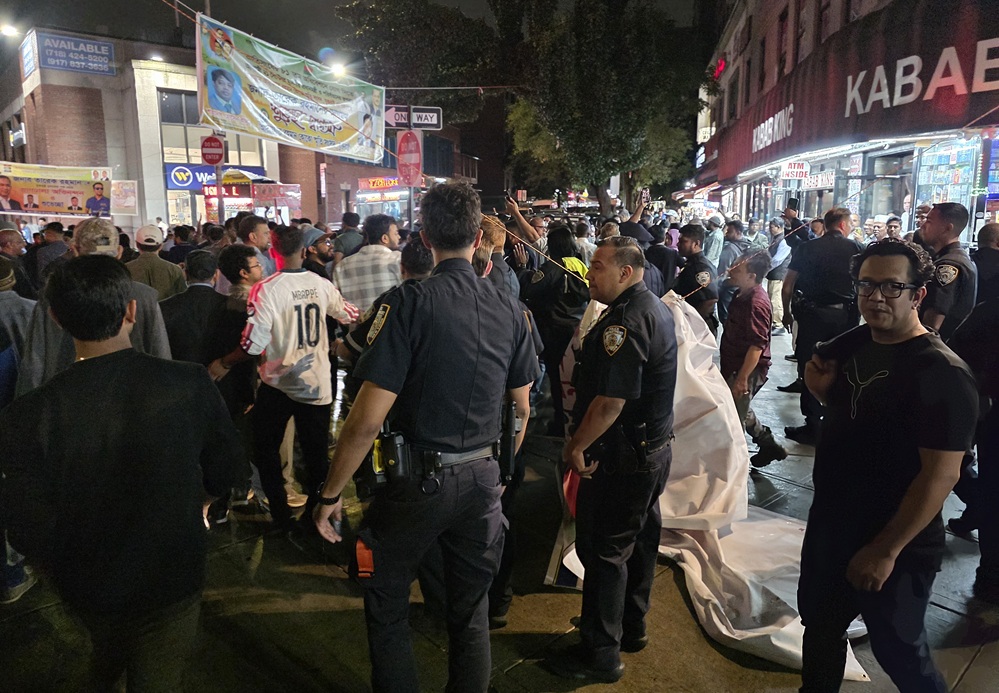
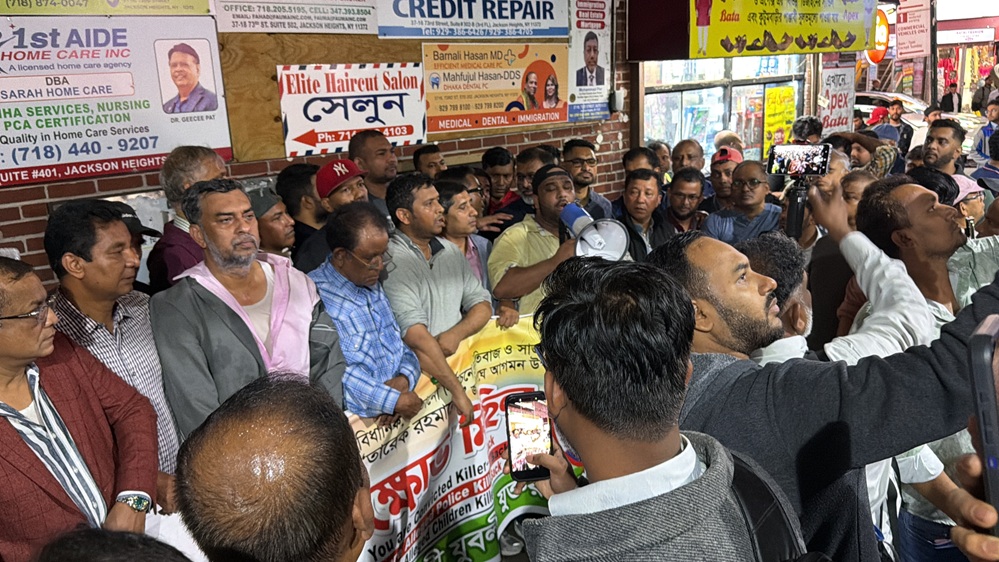
The situation at Diversity Plaza became increasingly tense as supporters of the BNP gathered to welcome Tarique Rahman, while a large group of Awami League activists assembled nearby chanting, “Wherever Tarique goes, resistance will follow.”

The two sides initially exchanged competing slogans before the confrontation reportedly escalated into pushing, shoving and verbal altercations. The BNP alleged that several banners welcoming Tarique Rahman were torn down by Awami League activists, further intensifying tensions.

A section of the Awami League gathering during the tense face-off between Awami League and BNP supporters at Diversity Plaza in Jackson Heights. Photo: Khabor

According to witnesses, several hundred activists from both sides were involved in the confrontation. Multiple teams of the New York Police Department responded to the scene after receiving reports of the escalating situation. More than 50 riot-control officers subsequently moved between the two groups and attempted to keep them separated.

Police eventually intervened more forcefully as the two sides continued their confrontation. The area remained crowded with competing chants, while traffic was temporarily disrupted. Pedestrians moved away from the scene as police worked to prevent the situation from escalating further.

The confrontation comes as Bangladeshi political groups in New York prepare for a series of activities surrounding Tarique Rahman’s visit. BNP supporters have been organizing welcome programmes in Jackson Heights and elsewhere in the city. Recent reporting also confirms that BNP activists gathered in Jackson Heights ahead of the prime minister’s arrival.

Tarique Rahman left Dhaka on September 21 to attend the 81st UN General Assembly. According to Bangladesh Sangbad Sangstha (BSS), he is scheduled to arrive at John F. Kennedy International Airport at about 5:55 p.m. New York time after a stopover in Istanbul. He is scheduled to address the General Assembly on September 24 and depart New York for Dhaka on September 25.

New York police officers remove BNP supporters from the area during the tense confrontation between Awami League and BNP supporters at Diversity Plaza in Jackson Heights. Photo: Khabor

The United Nations’ high-level week for the 81st General Assembly is scheduled for September 22–29, with the general debate taking place from September 22 to 26 and again on September 28.

Meanwhile, Awami League leader Imdad Chowdhury said the party is preparing to mobilize about 1,000 activists at JFK Airport as part of its “Wherever Tarique, Resistance There” programme. He said permission had been obtained from the relevant airport authorities for the gathering.

BNP leader Golam Faruk Shaheen, meanwhile, said hundreds of BNP supporters would gather at JFK Airport to welcome Tarique Rahman. He also said the BNP had obtained the necessary authorization for its programme.

A section of the Awami League gathering during the tense face-off between Awami League and BNP supporters in Jackson Heights. Photo: Khabor

The competing plans are expected to require additional security measures at the airport. Police may establish separate areas and security barriers to keep the two groups at a safe distance from each other.

Security arrangements are also being heightened in New York during the UN General Assembly’s high-level week, when heads of state, government leaders and senior officials from around the world gather at the United Nations headquarters. The UN’s official schedule places the 81st General Assembly’s high-level week from September 22 through September 29.

The latest confrontation in Jackson Heights has raised concerns within the Bangladeshi-American community about the possibility of further tensions during Tarique Rahman’s visit, particularly around the airport and other locations where competing political groups are expected to gather.


Tarique Rahman Leaves for New York for UNGA

DHAKA — Prime Minister Tarique Rahman left Dhaka early Monday for New York to attend the 81st session of the United Nations General Assembly (UNGA), where he is scheduled to deliver his first address to the General Assembly as prime minister on September 24.

A Turkish Airlines flight carrying the prime minister, his wife Dr Zubaida Rahman and members of his entourage departed Hazrat Shahjalal International Airport at around 6:05 a.m. The flight is scheduled to transit through Istanbul before arriving at John F. Kennedy International Airport in New York at about 5:55 p.m. local time.

The prime minister will be received at JFK by Bangladesh’s Permanent Representative to the United Nations in New York Irene Zubaida Khan and Bangladesh Ambassador to the United States Tareq Md Ariful Islam before being escorted to the Hyatt Grand Central New York, where he is scheduled to stay.

His official engagements are set to begin on September 22 with a welcome breakfast hosted by UN Secretary-General António Guterres for heads of state and government. He will subsequently attend the opening of the high-level General Debate and a reception hosted by the U.S. president for heads of state and government and their spouses.

On September 23, Tarique Rahman is scheduled to attend meetings on global inequality and climate action. He will also participate in a side event on the Rohingya crisis, where Bangladesh is expected to seek stronger international cooperation for the early repatriation of forcibly displaced Rohingyas to Myanmar.

Bangladesh is also expected to highlight its position as a climate-vulnerable country, focusing on climate finance, adaptation, technology transfer, loss and damage, and climate justice.

On September 24, the prime minister will deliver his General Assembly address. He is also scheduled to speak at a high-level meeting on the threats posed by rising sea levels and attend Bangladesh-hosted events on maternal and newborn health and midwifery.

According to the Foreign Secretary, the prime minister’s UNGA address will cover Bangladesh’s democratic journey, rule of law and accountability, global peace and security, climate change, sustainable development, economic cooperation, youth and women’s empowerment, education and health, the Rohingya crisis, technology and reform of the multilateral system.

On the sidelines of the General Assembly, Tarique Rahman is scheduled to hold bilateral meetings with the Crown Prince of Kuwait and the prime ministers of Croatia, Bhutan, Thailand, Pakistan and Haiti. Discussions are expected to cover political and economic relations, trade and investment, development cooperation and the Rohingya crisis.

He is also scheduled to meet UN Secretary-General António Guterres, the President of the European Council, the President of the World Bank Group, the UN Special Envoy on Myanmar and the UN high commissioners for refugees and human rights.

As part of the government’s economic diplomacy, the prime minister is scheduled to meet senior representatives of Meta, Wall Street firms and other business organisations to discuss investment, manufacturing, infrastructure, technology, skills development and employment opportunities. Tarique Rahman is scheduled to leave New York for Dhaka on the night of September 25.


Bachelet Withdraws From Race for UN Secretary-General

Shibbir Ahmed, New York — Former Chilean President Michelle Bachelet has withdrawn her candidacy to become the next Secretary-General of the United Nations, narrowing the field to seven candidates in the race to succeed António Guterres. Bachelet, 74, announced her decision in a video posted on Instagram. She said she would continue her international work after ending her campaign for the top UN post.

The two-time president of Chile and former UN High Commissioner for Human Rights had campaigned on issues including multilateralism and international law. Her withdrawal came after a third informal Security Council straw poll in which her support declined significantly.

Bachelet’s decision leaves seven candidates in contention to succeed Guterres, whose second five-year term is scheduled to end on December 31, 2026. The UN Security Council will eventually recommend one candidate to the 193-member General Assembly, which will formally appoint the next Secretary-General. The UN Secretary-General selection process is taking place as world leaders gather in New York for the opening of the high-level phase of the 81st General Assembly session.

Bachelet’s candidacy had initially been jointly nominated by Chile, Brazil and Mexico. Chile later withdrew its nomination in March 2026, while the United Nations subsequently recorded Bachelet as a candidate nominated by Brazil and Mexico. The selection process will continue as the Security Council considers the remaining candidates before sending a recommendation to the General Assembly.


US Expands Social Media Screening for Visa Applicants

Shibbir Ahmed, Washington DC — The U.S. Department of State is expanding its online presence screening program to three additional categories of nonimmigrant visa applicants, requiring certain foreign nationals to make their social media profiles publicly accessible as part of the visa vetting process.

Beginning October 1, 2026, the expanded screening will apply to applicants for I, TN and TD visas, according to a State Department announcement issued September 18. Applicants in these categories will be instructed to set the privacy settings on all of their social media profiles to “public” or “open” to facilitate the review.

The I visa is used by representatives of foreign media, including members of the press, radio, film and print industries who travel temporarily to the United States to work in their profession. TN visas are available to qualifying professionals from Canada and Mexico under the United States-Mexico-Canada Agreement, while TD visas are for eligible dependents of TN visa holders.

The State Department said it uses information from available sources during visa screening to determine whether applicants are admissible to the United States, including whether they may pose national-security or public-safety concerns.

“Every visa adjudication is fundamentally a national security decision,” the department said, emphasizing that applicants must demonstrate their eligibility for the visa category and their intention to comply with the terms of admission.

The latest expansion adds I, TN and TD applicants to a growing list of visa categories already subject to online presence review. The program currently covers several diplomatic and official categories, F and M student visas, H-1B and certain related employment visas, J exchange-visitor visas, K fiancé and dependent visas, Q cultural-exchange visas, R religious-worker visas, and S, T and U categories involving witnesses, informants and victims.

The State Department previously expanded online presence screening in March to additional visa classifications, including H-3, H-4 dependents of H-3 applicants, K-1, K-2, K-3, Q, R-1, R-2, S, T and U visas. H-1B and H-4 applicants were brought under the online-presence review in December 2025.

The department says the screening is part of a broader effort to strengthen visa vetting and identify applicants who may be inadmissible to the United States. The policy applies during the visa adjudication process and does not mean that every applicant whose social-media account is reviewed will be denied a visa.

For foreign journalists, the change is particularly significant because the I visa is specifically designed for eligible representatives of foreign media organizations. The State Department says I-visa holders may engage in informational or educational activities in the United States connected to the news-gathering and reporting functions of their foreign media organization.

The expanded screening comes as the Trump administration continues to tighten immigration and visa-screening procedures. The administration has previously expanded online vetting for students, exchange visitors and certain employment-based visa applicants. The new requirements for I, TN and TD applicants will take effect October 1, 2026.


Trump Announces Greenland Security Deal

Shibbir Ahmed, Washington DC — President Donald Trump has announced a new security agreement involving the United States, Denmark and Greenland that would expand the U.S. military presence on the strategically important Arctic island and give Washington long-term security access. Trump announced the agreement on September 18, describing it as providing the United States with “permanent control” over Greenland’s security and saying it would address Washington’s national security concerns. He also said the United States would begin developing plans for a larger military presence on the island.

The agreement does not transfer Greenland’s sovereignty to the United States. Denmark and Greenland said the arrangement recognizes the sovereignty and territorial integrity of the Kingdom of Denmark as well as the Greenlandic people’s right to self-determination. The governments have also indicated that the agreement must go through the necessary parliamentary procedures before it can take effect.

The precise terms of the agreement have not yet been made public. According to reporting by Reuters, the deal would allow the United States to expand its military presence in Greenland while preventing U.S. adversaries from establishing military bases on the island or making sensitive investments there.

A U.S. State Department official said the agreement guarantees Washington permanent access, basing and overflight rights and is designed to remain in place even if Greenland eventually becomes independent. The official also said the agreement would prevent non-NATO countries from establishing military bases in Greenland.

Trump said the United States would work with Greenland’s population on the development and construction of additional military facilities. The United States already maintains a significant military installation at Pituffik Space Base in northwestern Greenland, formerly known as Thule Air Base. The U.S. has maintained military facilities on the island for decades under a 1951 defense agreement with Denmark.

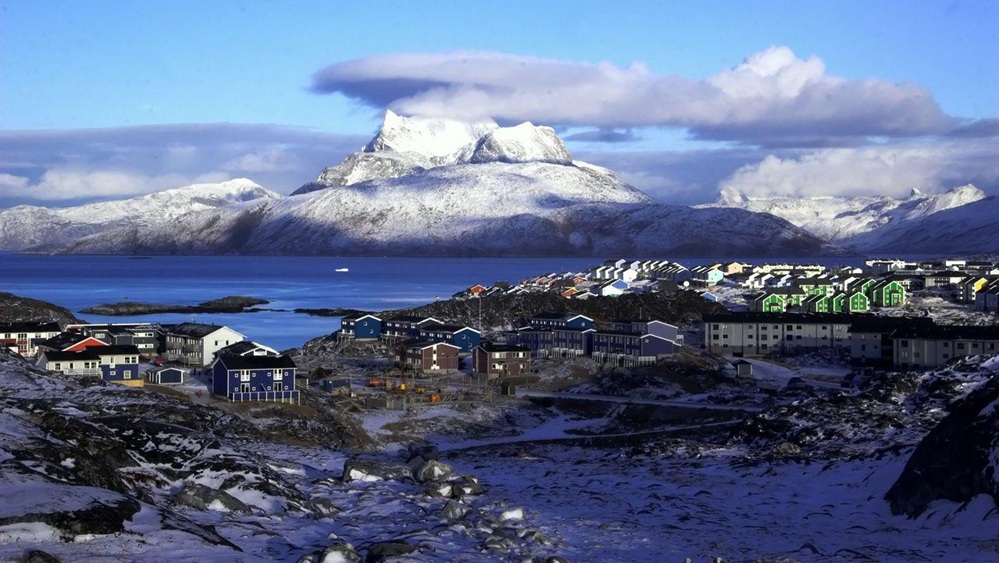
Greenland’s Arctic landscape highlights the island’s strategic importance in the region.

The announcement follows months of tension over Greenland. Trump has repeatedly argued that the island is strategically important to U.S. national security because of its location between North America, Europe and the Arctic region. His earlier push to acquire Greenland generated strong opposition in Denmark and Greenland and created tensions with other NATO allies.

Danish Prime Minister Mette Frederiksen said the agreement would strengthen security in the Arctic and North Atlantic and would be beneficial to NATO and Europe. She also emphasized that the arrangement recognizes Denmark’s sovereignty and Greenland’s right to self-determination.

Greenland’s Prime Minister Jens-Frederik Nielsen also welcomed the agreement, saying it recognizes Greenland’s interests and its role in international cooperation. Greenland is an autonomous territory within the Kingdom of Denmark and has its own government and parliament.

U.S. Secretary of State Marco Rubio said the agreement addresses Washington’s national security concerns and ensures that Greenland remains part of the strategic defense area of North America. NATO also welcomed the announcement, saying greater security and cooperation in the Arctic and North Atlantic would benefit the alliance.

The planned agreement is expected to be signed in New York during the United Nations General Assembly next week, according to the governments involved. It will then face the required parliamentary procedures in Denmark and Greenland.

The agreement represents a shift from Trump’s earlier proposal to acquire Greenland toward a security-focused arrangement that leaves the territory under Danish sovereignty while giving the United States expanded and potentially permanent military access. The full text of the agreement will be important in determining the precise scope of Washington’s rights and obligations under the arrangement.


Why the UN General Assembly Still Matters

Shibbir Ahmed, New York — The United Nations General Assembly remains a central forum for international diplomacy, providing all 193 UN member states with a platform to debate global issues ranging from war and peace to development, climate change and human rights. In an interview with UN News, Richard Gowan, Director of UN and Multilateral Diplomacy at the International Crisis Group, discussed the Assembly’s changing role and its importance in global affairs ahead of the UN General Assembly’s high-level week.

Gowan said the UN’s founders initially expected the Security Council to be the main center of decision-making. However, divisions among the major powers quickly shifted many political discussions toward the General Assembly. During the early years of the UN, the Assembly played a significant role in debates over Palestine and Korea while the Security Council was frequently affected by Cold War divisions.

One major test came in 1956, when the Suez crisis and the Soviet intervention in Hungary unfolded simultaneously. According to Gowan, the General Assembly authorized the first UN peacekeeping operation in response to the Suez crisis, marking an important moment in the Assembly’s role in international crisis management.

A platform for newly independent states

The expansion of UN membership during the 1960s transformed the General Assembly. Newly independent countries used the forum to raise issues including apartheid in South Africa and remaining colonial conflicts.

Gowan said the Assembly became an important platform for countries emerging from colonial rule to make their voices heard internationally. During the 1960s, the Assembly adopted a series of resolutions condemning apartheid, while its debates increasingly reflected the growing influence of countries from what is now commonly called the Global South.

Developing countries also used the Assembly to challenge what they regarded as an unfair international economic system. In 1974, the General Assembly adopted a resolution calling for a new international economic order intended to provide a fairer system for developing countries.

Gowan said the Assembly gave countries emerging from colonialism a major platform to assert themselves on the world stage. He also argued that the international campaign against apartheid contributed to the eventual end of apartheid in South Africa, while acknowledging that efforts to establish a new international economic order did not achieve their intended outcome.

Post-Cold War cooperation

Following the end of the Cold War, diplomats were able to cooperate more closely on strengthening the UN system. Gowan pointed to the creation of the Peacebuilding Commission in 2005 as an example of initiatives developed through cooperation between member states and the UN Secretariat and subsequently approved by the General Assembly.

The global financial crisis of 2008–2009 presented another challenge. Gowan said many UN members expected the organization to respond, while the United States and other major economies instead worked through the G20. At the same time, discussions on environmental protection and efforts to address global environmental challenges gained greater prominence within the UN system.

A voice for smaller countries

Gowan said the General Assembly remains particularly important for small countries and middle powers, which often have fewer opportunities to influence international affairs through smaller diplomatic groupings. He noted that despite frequent discussion about the UN’s future, large numbers of world leaders continue to travel to New York every September to address the General Assembly.

He also emphasized the significance of keeping the Assembly at UN Headquarters in New York, describing the location as an important center for global diplomacy and international media attention.


Khalilur Rahman Puts Trust at Center of UN Presidency

Shibbir Ahmed, New York — United Nations General Assembly President Khalilur Rahman has made restoring trust in the United Nations the central theme of his one-year presidency, saying the organization needs to respond to unmet expectations on peace, development and human rights. Rahman, a senior Bangladeshi diplomat and Bangladesh’s sitting foreign minister, took the gavel as president of the 81st session of the General Assembly. In an interview with UN News, he said the UN faces a “crisis of confidence” and needs a transformation to meet the challenges of the modern world.

Speaking as High-Level Week gets underway, Rahman described the gathering of world leaders as a major expression of the UN General Assembly’s convening power. He said he would closely examine what world leaders say about rebuilding trust in the organization and use their views to guide his presidency.

Rahman said the United Nations was founded in 1945 with the ambition of preventing another global conflict. While he noted that the world has avoided another large-scale global war and that the UN has made progress in development, he said many conflicts have not been prevented and development progress has often been slow.

He also highlighted human rights as an area requiring greater attention, saying the UN spends about four percent of its total spending on human rights. Rahman said work across the UN’s peace and security, development and human rights pillars is needed to rebuild confidence in the organization.

AI poses a new challenge

Rahman identified artificial intelligence as one of the major challenges distinguishing today’s world from the era when the UN was founded. He said AI could accelerate human progress but could also create serious risks. While innovation should continue, he argued that safeguards are needed to ensure the technology serves humanity. He called for governments, developers and users to participate in discussions on the responsible development and use of AI.

Assembly’s role

Responding to criticism that General Assembly resolutions lack the authority of Security Council decisions, Rahman emphasized the Assembly’s ability to bring countries together. He said the Assembly provides heads of government and state with a setting to discuss serious international issues and seek solutions through diplomacy. He also said the Assembly will continue to play a role in establishing international norms and providing broader direction for the international community.

Rohingya crisis

Rahman also reflected on his experience working on the Rohingya crisis, describing it as a grave humanitarian crisis and highlighting the resilience of refugees and their desire to return home. He said the crisis reinforced his belief that violence does not provide a lasting solution and that dialogue and negotiation are necessary to resolve conflicts. Looking toward the end of his presidency, Rahman said he hopes to see progress on UN reform, the organization’s financial sustainability and faster delivery at the local level.


Security Council Meets on United Nations Peacekeeping Operations

Shibbir Ahmed, New York — The United Nations Security Council met on September 18 to discuss the future of United Nations peacekeeping operations amid increasingly complex conflicts and growing challenges facing peace missions around the world. The meeting, the Council’s 10,226th, focused on the changing nature of UN peace operations and the need to ensure that missions remain effective, adaptable and capable of responding to evolving security threats. The meeting was formally listed as “United Nations peacekeeping operations.”

UN Secretary-General António Guterres told the Council that many UN peacekeeping missions are now operating in environments where peace remains elusive. He called for greater emphasis on peacemaking and for peace operations to adapt to the realities of modern conflicts.

The discussion comes as the United Nations undertakes a broader review of the future of all forms of peace operations. The review, led jointly by the Department of Peace Operations and the Department of Political and Peacebuilding Affairs, was submitted to the General Assembly and Security Council in August 2026.

According to the UN, today’s conflicts are increasingly protracted and internationalized, while peace agreements are becoming harder to achieve. Peace missions also face emerging challenges including the increased use of drones, advanced weapons technologies, threats to civilians and civilian infrastructure, and the involvement of a wider range of state and non-state actors.

The United Kingdom said peace operations must remain adaptable, effective and suited to the challenges they face. In a statement to the Council, UK Deputy Permanent Representative Kate Foster said Britain was prepared to work with the United Nations to strengthen the effectiveness of peace operations.

Pakistan’s Permanent Representative to the United Nations, Asim Iftikhar Ahmad, also addressed the Council, highlighting Pakistan’s longstanding contribution to UN peacekeeping. Pakistan has been among the major contributors of troops and personnel to UN peacekeeping missions for decades.

The Council’s discussion comes at a critical time for several UN missions. In Lebanon, for example, the UN Interim Force in Lebanon (UNIFIL) is preparing for a scheduled withdrawal by the end of 2026, with UN officials stressing the importance of a smooth transition and continued coordination with Lebanese authorities and other UN agencies.

The Security Council’s September 18 meeting formed part of its September programme of work, during which members also addressed issues including Sudan, Afghanistan, the Middle East, terrorism and non-proliferation.

The broader debate is expected to continue as UN member states consider how peace operations can become more focused, flexible and responsive while maintaining their mandates to support peace and security.