PM Tarique Rahman Calls for Stronger Trade, Investment Ties with China

DHAKA — Prime Minister Tarique Rahman today called for further expansion of bilateral trade, investment and development cooperation between Bangladesh and China. He made the remarks during a farewell meeting with outgoing Chinese Ambassador Yao Wen at the Prime Minister’s Office.

According to Prime Minister’s Deputy Press Secretary Hasan Shiplu, the meeting discussed a range of issues of mutual interest, including the Rohingya crisis. During the meeting, Yao Wen congratulated Tarique Rahman on his participation in the 81st session of the United Nations General Assembly and his various engagements in New York.

The Chinese ambassador reaffirmed China’s continued support for Bangladesh’s development efforts and expressed hope that bilateral relations between the two countries would be further strengthened. The meeting also underscored the importance of expanding economic engagement between Bangladesh and China, particularly in trade, investment and development cooperation.

State Minister for Foreign Affairs Humaiun Kobir and Chairman of the Bangladesh Investment Development Authority (BIDA) Chowdhury Ashik Mahmud Bin Harun were present at the meeting. Deputy Chief of Mission of the Chinese Embassy Liu Yuyin accompanied the outgoing ambassador.


Bangladesh Bank Expands Card Payments for Foreign Airline Tickets

DHAKA — Bangladesh Bank has expanded the scope of international card payments for air tickets purchased from foreign airlines, allowing eligible transactions to be settled through international acquiring and payment arrangements outside Bangladesh. The Foreign Exchange Policy Department-1 (FEPD-1) introduced the facility through Circular No. 39, expanding the framework established under FE Circular No. 47 issued on November 19, 2025.

Under the revised arrangement, foreign airlines operating in Bangladesh may accept international card payments for air tickets, provided the proceeds are settled through established international acquiring and payment settlement arrangements outside Bangladesh. The facility applies only to foreign airlines. Bangladeshi airlines will continue to follow existing local settlement and domestic acquiring arrangements for international ticket sales originating from Bangladesh.

A key provision of the new arrangement is that eligible air-ticket purchases will not be counted against an individual’s annual travel entitlement. In other words, such purchases will not be deducted from the standard annual foreign-exchange travel quota. Bangladesh Bank has also introduced a post-facto card replenishment mechanism for these transactions. Authorized Dealers (ADs) may replenish an international card after verifying the ticket purchase against the relevant card statement and confirming that the transaction falls within the eligible Merchant Category Codes (MCCs) specified by the central bank.

The foreign airlines covered by the facility are Air India, Cathay Pacific Airways, China Eastern Airlines, China Southern Airlines, Emirates, Flydubai, Gulf Air, Kuwait Airways, Malaysia Airlines, Oman Air, Qatar Airways, Saudi Arabian Airlines (Saudia), Singapore Airlines, SriLankan Airlines, Thai Airways International, Turkish Airlines and Air Arabia.

According to the circular, Authorized Dealers must report all ticket purchases made under the facility through Bangladesh Bank’s Transaction Monitoring (TM) module. The central bank also instructed ADs to continue applying the provisions of FE Circular No. 47 of 2025 that have not been specifically modified by the latest circular. These include applicable documentation, verification and compliance requirements.

Bangladesh Bank further clarified that foreign airlines receiving ticket proceeds through offshore settlement arrangements must include those proceeds when calculating their remittable surplus earnings. Amounts settled outside Bangladesh cannot subsequently be claimed again as part of the airlines’ regular profit remittances.

The necessary adjustment must be made in accordance with the audit requirements set out under Part-B of FEPD-1 Circular No. 08, issued on May 7, 2026. Bangladesh Bank has instructed Authorized Dealers to inform their customers and corporate constituents about the revised facility and ensure compliance with all applicable foreign-exchange regulations.


Cuba Condemns US Pressure, Warns of ‘Law of the Jungle’ at UN

Shibbir Ahmed, New York — Cuba’s Foreign Minister Bruno Eduardo Rodríguez Parrilla has warned that growing military and economic pressure in Latin America and the Caribbean is threatening international law, while accusing the United States of intensifying its longstanding campaign to isolate and weaken Cuba.

Addressing the General Debate of the 81st session of the United Nations General Assembly on Saturday, Rodríguez Parrilla said the international system was facing a rise in what he described as “expansionism, usurpation, plunder” and military and economic aggression.

He argued that fundamental principles of the UN Charter, including the sovereign equality of states, were under increasing pressure. The Cuban foreign minister called for the United Nations to be strengthened and made “more democratic and effective,” with a closer connection to the people it serves.

Cuba accuses US of economic pressure

A major part of Rodríguez Parrilla’s address focused on Cuba’s decades-long confrontation with Washington. He accused the United States of escalating economic pressure on Cuba since January, including what he called an “energy blockade” and efforts to discourage other countries from exporting fuel to the island. According to the Cuban minister, more than 7,000 containers were stranded in ports, including shipments containing food, medicines and medical equipment. He said some of the shipments had already been paid for by Cuban private companies.

Rodríguez Parrilla also accused Washington of putting pressure on foreign investors, restricting tourism and limiting Cuba’s access to financing, technology and international markets. He further criticized US efforts to discourage governments from maintaining arrangements under which Cuban medical professionals provide healthcare overseas.

“The economic warfare is aimed against the people,” Rodríguez Parrilla said, characterizing the alleged impact on Cuban families as deliberate “collective punishment.” He rejected claims that Cuba poses a threat to US national security.

“Cuba is not a threat; the blockade is!” he declared.

Havana says it remains open to dialogue

Despite his criticism of US policy, Rodríguez Parrilla said Cuba remained willing to engage in dialogue with Washington. He said any negotiations should be based on sovereign equality, respect for international law, non-interference in domestic affairs and the absence of preconditions. The Cuban government has maintained for decades that the US economic embargo has imposed significant costs on the country’s economy, while Washington has defended its policies on various political and security grounds.

Cuba outlines changes at home

The foreign minister also highlighted changes Cuba is pursuing in response to its economic and social difficulties. He pointed to a new program adopted by the National People’s Power Assembly that introduces new economic practices, actors and concepts while maintaining Cuba’s constitutional framework and socialist system.

According to Rodríguez Parrilla, the process is intended to address the needs of the Cuban population while pursuing what he described as greater social justice and protecting the country’s sovereignty and right to self-determination.

Warning over militarization in Latin America

Turning to the wider region, Rodríguez Parrilla criticized what he described as attempts at militarization, intervention and domination in Latin America and the Caribbean. He rejected the Monroe Doctrine and referred to the region’s 2014 declaration as a Zone of Peace.

The Cuban foreign minister also expressed solidarity with Small Island Developing States facing the effects of climate change, reiterated Cuba’s support for Nicaragua, backed Puerto Rico’s right to self-determination, and supported calls for reparations to African and Caribbean nations over colonialism and the transatlantic slave trade.

Concluding his address, Rodríguez Parrilla warned that allowing powerful states to impose their will through intimidation and coercion would create an unstable international order. “The law of the jungle cannot be the future of humanity,” he told the General Assembly, urging countries to strengthen the United Nations and preserve its role in international affairs.


Bangladesh repays $699m in foreign debt in July-August

DHAKA – Bangladesh repaid $698.92 million in foreign loans during the first two months of the current fiscal year (FY27), according to the Economic Relations Division (ERD). Of the total debt repayment, $516.04 million was paid as principal and $182.88 million as interest.

The country received $294.56 million in foreign loans and grants in July-August of FY27. The ERD data covers foreign loans and grants received by the government as well as repayments made against previously contracted external loans.

Bangladesh received $750 million in foreign assistance during July-August of FY26. The country also received commitments for $240.39 million in foreign assistance during July-August of FY27.


Jaishankar Warns of ‘Weaponisation of Everything’ at UN

Shibbir Ahmed, New York — Indian External Affairs Minister S. Jaishankar has warned that the world is witnessing the “weaponisation of everything,” with finance, market access, supply chains and technology increasingly being used as tools of pressure. Addressing the General Debate of the 81st United Nations General Assembly in New York on Saturday, Jaishankar said growing conflicts and confrontations were undermining international security, economic progress and development, particularly affecting countries in the Global South.

“What we are actually seeing is a weaponisation of everything,” Jaishankar said, referring to the growing use of economic and technological tools as leverage. He said a mindset of extreme competition was undermining institutions and creating new chokepoints in global trade and cooperation.

According to Jaishankar, the trend extends from finance and market access to supply chains and technology. He said countries were increasingly focused on reducing risks and diversifying their economic relationships, but warned that the overall atmosphere was becoming less conducive to trust and goodwill.

Concerns Over Global Conflicts

Jaishankar also addressed ongoing conflicts in the Gulf, Ukraine and West Asia. He called for restraint, de-escalation and the protection of civilians, while stressing the importance of maintaining the uninterrupted flow of energy and commerce. He particularly condemned attacks on commercial shipping and seafarers in international waterways, saying the loss of Indian and other nationals in such attacks was “simply unacceptable.”

India has also launched a Group of Friends on Safety and Security of Shipping and Seafarers, with 23 other partners, aimed at strengthening international attention to maritime safety. On Ukraine, Jaishankar said India supports efforts to bring the conflict to an end, while reiterating the importance of protecting food and energy supplies. Regarding West Asia, he said India supports a two-state solution as the basis for a durable and lasting peace and called for humanitarian assistance for Palestinians.

Warning Over Global South’s ‘4F Crisis’

Jaishankar said developing countries were facing what he described as a “4F crisis” involving food, fuel, fertiliser and finance. He warned that fertiliser shortages, disruptions to grain movements and other global pressures were increasing the challenges faced by developing nations. He also argued that restrictions on market access and non-market practices were making it harder for countries in the Global South to industrialise. Jaishankar further raised concerns about artificial intelligence, saying technology that was expected to create opportunities could also become a source of anxiety if misused.

Call for a More Representative Global Order

The Indian minister also called for reforms to international institutions, arguing that the global order established after World War II is facing new realities. He said the world is moving toward a more multipolar system and that countries should engage through dialogue and cooperation. He also argued that large sections of humanity should not be excluded from global decision-making.

Jaishankar’s address placed India’s concerns about terrorism, maritime security, economic pressures, technology and global governance within a broader call for greater stability and international cooperation.


Russia Backs India’s Bid for Permanent UN Security Council Seat

Shibbir Ahmed, New York — Russia has backed India’s bid for a permanent seat on the United Nations Security Council, with Foreign Minister Sergey Lavrov calling for greater representation of Asia, Africa and Latin America in the powerful UN body. Speaking during the general debate of the 81st United Nations General Assembly in New York on Saturday, Lavrov said Moscow supports the candidacies of both India and Brazil for permanent membership of the Security Council.

“We are in favour of broadening the representation of Asia, Africa, and Latin America. We support Brazil’s and India’s candidatures for a permanent seat,” Lavrov said, according to reports of his UNGA address. Lavrov also said Russia opposed allocating additional permanent seats to Western countries, specifically mentioning Germany and Japan. He argued that any reform of the Security Council should preserve the prerogatives of its existing permanent members while increasing representation from the Global South.

The Security Council currently has 15 members, including five permanent members — China, France, Russia, the United Kingdom and the United States — which hold veto power. The remaining 10 members are elected for two-year terms. India has for years sought a permanent seat on the Security Council as part of broader efforts to reform the UN’s principal body responsible for international peace and security. India has argued that the Council’s composition should better reflect contemporary geopolitical and economic realities.

Russia’s latest statement adds to recent international support for India’s bid. During the current UNGA session, Mauritius and Portugal also expressed support for India’s candidature, while other countries have called for broader reform of the Security Council. The issue of Security Council reform has gained renewed attention at the 81st UN General Assembly, where countries from the Global South have continued to call for greater representation in the UN’s decision-making institutions.

Russia’s position, however, distinguishes between the countries seeking permanent membership. While Moscow supports India and Brazil, Lavrov opposed additional permanent seats for Germany and Japan, according to reports of his speech. The debate over expansion of the Security Council remains subject to negotiations among UN member states, and Russia’s support for particular candidates does not itself change the Council’s membership.


PM Tarique Rahman Returns Home from New York After UNGA Visit

DHAKA — Prime Minister Tarique Rahman returned home Sunday morning after concluding a five-day visit to New York, where he attended the 81st session of the United Nations General Assembly (UNGA), delivered his maiden address to the General Debate and held a series of high-level bilateral and multilateral meetings. An Emirates flight carrying the prime minister, his wife Dr. Zubaida Rahman and members of his entourage landed at Hazrat Shahjalal International Airport at 8:21 a.m., according to PM’s Deputy Press Secretary Hasan Shiplu.

Local Government, Rural Development and Cooperatives Minister Dr. Abdul Moyeen Khan, Chief Whip Nurul Islam Moni, Prime Minister’s Defence Adviser Brigadier General (retd.) AKM Shamsul Islam, Whip Miah Nuruddin Ahmad Apu, local MP SM Jahangir Hossain, Cabinet Secretary Nasimul Ghani and Prime Minister’s Principal Secretary ABM Abdus Sattar received the prime minister at the airport.

Tarique Rahman left Dhaka on September 21 and reached New York the same day after a stopover in Istanbul. He departed New York on September 25 and travelled through Dubai before returning to Dhaka. During his four working days in New York, the prime minister took part in 30 engagements, including 11 bilateral meetings, eight UNGA-related engagements and 11 institutional meetings. The prime minister and members of his delegation collectively represented Bangladesh at around 80 engagements, according to BSS.

A major highlight of the visit was Tarique Rahman’s first address to the UNGA General Debate on September 24. In his speech, he outlined Bangladesh’s positions on global peace and security, sustainable development, climate change, economic cooperation and humanitarian issues, while calling for conflicts to be resolved through dialogue, diplomacy and cooperation.

The prime minister held bilateral meetings with the leaders of Türkiye, Iran, Pakistan, Croatia, Haiti, Bhutan and Thailand. He also met the vice president of the Maldives, the crown prince of Kuwait, the UAE’s deputy prime minister and foreign minister, the Saudi foreign minister and Sweden’s foreign minister. The discussions covered bilateral relations, trade and investment, economic cooperation, manpower exports, energy security, regional and international issues and other areas of mutual interest.

The Rohingya crisis was another major issue during the visit. Tarique Rahman called for stronger international support for the safe, voluntary and dignified repatriation of Rohingyas to Myanmar and discussed the issue with UN Secretary-General António Guterres, UN Special Envoy on Myanmar Julie Bishop and UN High Commissioner for Refugees Barham Salih.

Climate change and the impact of rising sea levels also featured prominently in the prime minister’s engagements. He called for stronger global action to reduce emissions, greater access to climate finance and technology, and international cooperation to address climate-induced displacement and loss and damage. At a Bangladesh-Sweden-UNFPA high-level event on midwifery, Tarique Rahman outlined his government’s vision of a “Healthy Bangladesh,” with primary healthcare at the centre of health-sector reform. He said the government plans to recruit additional health workers and professional midwives while developing an integrated digital health system.

Economic diplomacy was also a significant part of the visit. At a breakfast meeting with Wall Street representatives hosted by JPMorgan Chase, the prime minister discussed Bangladesh’s economic prospects, investment opportunities and potential partnerships. During the visit, Biman Bangladesh Airlines also signed an agreement with Boeing for the purchase of 11 aircraft as Bangladesh plans to expand its aviation sector and open new international routes.

Tarique Rahman also held meetings with World Bank Group President Ajay Banga, Gates Foundation CEO Mark Suzman, International Peace Institute President and CEO Zeid Ra’ad Al Hussein and UN High Commissioner for Human Rights Volker Türk, among others. On September 22, Tarique Rahman and Dr. Zubaida Rahman attended a welcome breakfast hosted by UN Secretary-General António Guterres for world leaders and their spouses before attending the opening of the UNGA General Debate. They later attended a reception hosted by US President Donald Trump for leaders participating in the General Assembly.

Dr. Zubaida Rahman also took part in several high-level engagements during the visit, including the UN General Assembly’s Platform of Women Leaders, the First Spouses’ Dialogue and a high-level event focusing on maternal and child health and midwifery. The New York visit marked Tarique Rahman’s first participation in the UN General Assembly as prime minister and included a broad programme of diplomatic, economic, humanitarian and multilateral engagements.


New Khulna Divisional Society of New Jersey Launched in Atlantic City

ATLANTIC CITY, N.J. — A new community organization, the Khulna Divisional Society of New Jersey, has been formally launched in Atlantic City to strengthen fraternity, cooperation and mutual support among members of the Khulna Division community living in South Jersey.

Although several district-based organizations are active in South Jersey and Atlantic City, the Khulna Division community had not previously had a dedicated organization of its own. The new initiative was established following a long period of planning and collaborative efforts by senior community members, including Rezaul Islam Khalid, Golam Mostafa, Sheikh Amin, Shahanur Nanna, Altaf Hossain, Md. Hasan, Imtiaz Litu, Tafir and other senior members of the southern Bangladesh community.

The organization began its activities at an event held at Gourmet Restaurant on Atlantic Avenue in Atlantic City at 7 p.m. on September 23. The meeting was chaired by Sheikh Amin, a native of Khulna, while veteran Jessore politician Rezaul Islam Khalid moderated the discussion.

During the meeting, participants emphasized the need for an organization that would promote mutual respect, brotherhood, cooperation and stronger community ties among people from the Khulna Division living in New Jersey. Following the discussion, an ad hoc committee was formed with Sheikh Nasir Khokon as convener and Md. Moniruzzaman as member secretary. Helal Hasan was named joint convener, while Imran Hossain was appointed joint member secretary.

Speakers at the meeting included Md. George, Tanmoy, Oni, Shipul, Imtiaz Litu, Helal Hasan, Imran Hossain, Golam Mostafa, Sheikh Amin, Shahanur Nanna, Altaf Hossain, Moniruzzaman, Sheikh Nasir and Tanmoy, among others. Speakers expressed their support for the new organization and highlighted the importance of maintaining unity, friendship and cooperation among members of the Khulna Division community. The program concluded with remarks from the chair, followed by a dinner for the guests and participants.


Fatikchhari MP Sarwar Alamgir Honored in New York

NEW YORK — Fatikchhari MP Sarwar Alamgir was accorded a reception at Radhuni Restaurant in the Church-McDonald area of New York on Thursday night, September 25. The event was organized at the initiative of Mohammad Hanif, chief adviser and former president of the Chattogram Association of New York. The reception was chaired by Mohammad Hanif and moderated by Md. Ariful Islam, general secretary of the Chattogram Association of New York. Among those attending were New York City Councilwoman Shahana Hanif, former Chattogram Association president Kazi Shakhawat Hossain Azam, current president Abu Taher, and poet and writer Shamsuddin Mahmud of Washington, D.C., along with prominent members of the Bangladeshi-American community.

In his speech as the chief guest, Sarwar Alamgir recalled his longstanding family relationship with Mohammad Hanif and his family. “Hanif bhai has not merely acted like an elder brother; he has always stood by me as my elder brother. I am therefore very happy to be able to visit New York and attend this gathering as his guest first,” Alamgir said. Alamgir also highlighted various initiatives undertaken for the development of Fatikchhari and expressed his determination to take necessary measures to eliminate terrorism and improve law and order in the constituency.

He also thanked Prime Minister Tarique Rahman for nominating him from Fatikchhari.  New York City Councilwoman Shahana Hanif said that although she was born and raised in New York City, her roots are in Fatikchhari.

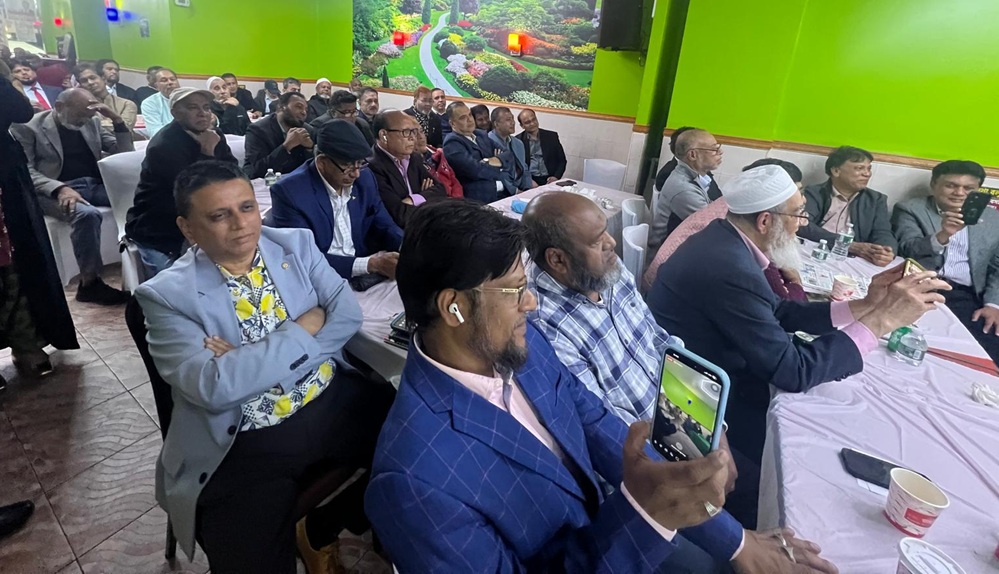
Members of the Bangladeshi-American community attend a reception honoring Fatikchhari MP Sarwar Alamgir in New York on September 25. Photo: KHABOR

“I am a New York City Councilwoman. I was born and raised here, but my roots are in Fatikchhari,” she said. Shahana Hanif expressed her happiness that the people of Fatikchhari have a leader like Sarwar Alamgir. She also expressed hope that Alamgir would provide necessary advice and cooperation to Prime Minister Tarique Rahman not only for the development of Fatikchhari but also for the broader development of Bangladesh.

During the event, poet and writer Shamsuddin Mahmud presented two of his books to Sarwar Alamgir as gifts. The program concluded with guests being served traditional Chattogram-style mezbani cuisine. Recent reporting also identifies Sarwar Alamgir as the MP for Chattogram-2 (Fatikchhari) and confirms that he is currently serving as a lawmaker.


Microsoft Expands Copilot With Coding Tools and Always-On AI Agent

Redmond, Washington — Microsoft has expanded its Copilot artificial intelligence platform with new coding and automation capabilities, including a new coding tool and an always-on AI agent designed to handle tasks on behalf of users.

The company unveiled the new features Friday as it seeks to turn Copilot from a conventional AI chatbot into a broader workplace platform capable of helping users create software, automate tasks and work directly with Microsoft’s productivity applications.

One of the new capabilities, called Code, allows users to create applications, dashboards and other software using natural-language instructions. Microsoft says the feature is based on technology used by GitHub Copilot and is intended to make software development and automation more accessible within organizations.

Microsoft is also introducing Autopilot, an AI agent designed to perform tasks continuously with permissions controlled by users. The company says the agent will have its own identity within an organization’s directory and will operate within defined access controls. The company is integrating Word, Excel and PowerPoint more deeply into Copilot, allowing users to work with those applications without leaving the AI platform.

Microsoft also announced tools designed to give organizations greater visibility into the costs associated with AI usage, an increasingly important issue as companies expand their use of AI agents.

The new capabilities will roll out in stages. Microsoft said Home and Code will gradually become available through its Frontier program, while Autopilot will enter private preview toward the end of September.

Microsoft is competing with other major AI platforms as technology companies increasingly shift from conversational chatbots toward AI agents capable of completing multi-step tasks.