Trump Launches America.gov as Unified Digital Gateway to U.S. Government Services

Shibbir Ahmed, Washington DC — President Donald Trump on Tuesday launched America.gov, a new digital platform designed to provide Americans with a single entry point to federal government information and services, as the administration seeks to simplify how people interact with the U.S. government. The platform was unveiled September 29 in Washington alongside an executive order directing the establishment of America.gov as a unified digital “front door” for Americans seeking federal information and covered online services.

The administration says America.gov uses artificial intelligence and information drawn from government websites to help users find answers and navigate federal services through a conversational interface. The U.S. General Services Administration said America.gov combines information from more than 29,000 government websites with AI-enhanced search technology, allowing users to find information and guidance without having to navigate a fragmented network of individual agency websites.

The executive order says Americans have traditionally been required to search across multiple federal agencies, interpret government terminology, provide the same information repeatedly and verify their identities through different systems. America.gov is intended to change that process by providing a single digital point of entry through which users can communicate in plain language, receive information and, where authorized and technically available, complete federal government transactions.

AI-powered access to federal services

The new platform is designed to allow users to describe what they need rather than determine which federal agency is responsible for providing the service. The GSA said the platform can help users find information about government benefits, passport services, Social Security and other federal needs. The administration’s executive order directs federal agencies to identify qualifying online services and integrate them with America.gov in a secure and privacy-preserving manner.
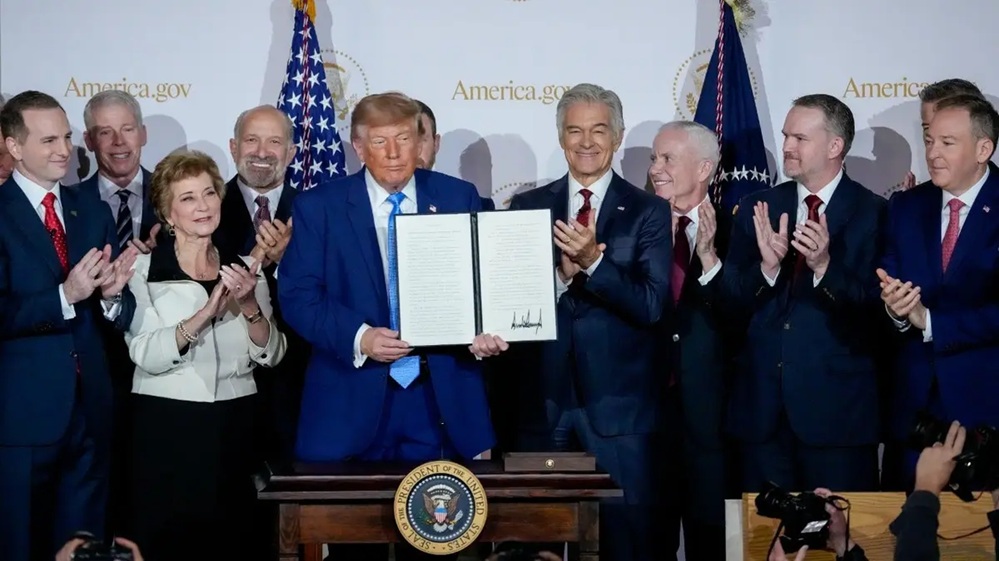
President Donald Trump holds up the executive order establishing America.gov during its launch event in Washington, D.C., on September 29, 2026. Administration officials joined the president at the event. Photo: WH

The order also calls for the integration of Login.gov as the authentication service for America.gov. Under the plan, agencies will continue to maintain control over their own records, systems, statutory responsibilities and decision-making authority. The order specifically states that the unified access system is not intended to create a centralized federal system of records about Americans. Privacy protections are also included in the order, including data minimization, secure authentication, auditable authorization and disclosure practices consistent with federal law.

Passport services among planned features

Secretary of State Marco Rubio said at the launch event that the State Department is partnering with America.gov to overhaul the passport application experience. Rubio announced that, beginning next year, Americans will be able to apply for their first U.S. passport entirely online. Applicants will be able to sign in through Login.gov, use information already held by the government where available, submit a photograph from a phone or other device, make a payment and track the status of the application. Rubio said the administration’s goal is for the vast majority of Americans to be able to apply for a passport or passport card through America.gov by the end of 2027.

Agencies given 90 days for implementation guidance

The executive order directs the Office of Management and Budget to issue implementation guidance to federal agencies within 90 days. Agencies will then be required to identify covered services, integrate those services with America.gov where appropriate and provide usage and performance information to the General Services Administration and OMB. The order defines covered services generally as public-facing federal services that serve more than 100,000 users during a 12-month period and can be accessed or applied for online. The order excludes Internal Revenue Service tax filing services, as well as services provided by the Department of War and elements of the Intelligence Community.

Existing government services will remain available

The administration says America.gov is intended to provide an additional, simplified way to access federal services rather than eliminate existing methods. The executive order specifically preserves existing lawful methods of obtaining government services, including in-person, telephone, mail and agency-specific digital services. That means Americans will not be required to use America.gov as the sole method of interacting with the federal government.

New passport design planned for 2028

Rubio also unveiled the planned design of a new U.S. passport expected in 2028. The redesigned passport features the American eagle and the Great Seal and includes artwork depicting major moments in U.S. history. Rubio said the new passport will visually represent 250 years of American history, with imagery ranging from the Revolutionary era and westward expansion to aviation, the raising of the American flag at Iwo Jima and the Artemis space program. The State Department also plans to change how the passport is packaged and delivered.

America.gov represents broader government technology push

The launch comes as the Trump administration expands its focus on artificial intelligence and digital technology as tools for government services. The new website is currently centered on AI-assisted information access, while additional transaction capabilities are expected to be introduced as federal agencies integrate their services with the platform.

The administration has described America.gov as a fundamental shift toward organizing government services around the needs of citizens rather than around the structure of federal agencies. For Americans, the intended result is a single digital starting point for finding federal information, understanding available services and eventually completing more government transactions online.



US Supreme Court Allows Third-Country Deportations to Continue

Shibbir Ahmed, New York — The U.S. Supreme Court on Tuesday allowed the Trump administration to continue rapidly deporting migrants to third countries while the justices consider the legality of the policy. The court’s 6-3 order temporarily suspended a lower-court requirement that migrants receive an opportunity to challenge their removal before being sent to countries other than their own. The case concerns the administration’s use of third-country deportations, under which migrants may be removed to countries with which they may have little or no connection. The Supreme Court is scheduled to hear full arguments over the policy in December.

The administration has argued that third-country removals are an important immigration-enforcement tool, particularly when migrants’ countries of origin refuse to accept them or when authorities consider them security or criminal threats. Immigration attorneys and other critics of the policy have challenged the practice in court, arguing that migrants can face serious risks if sent to unfamiliar countries without adequate opportunity to contest their removal.

According to Associated Press reporting, the administration has already deported roughly 25,000 people to more than two dozen countries under the policy, with Mexico among the principal destinations. The Supreme Court’s temporary order does not constitute a final ruling on whether the administration’s third-country deportation policy is lawful. The broader legal dispute remains pending before the justices.

The case is part of a wider legal battle over the Trump administration’s immigration policies, including the government’s authority to accelerate removals and limit procedural protections for migrants facing deportation. The December arguments are expected to provide the court with an opportunity to consider the legal requirements surrounding third-country removals and the protections available to people facing deportation.

For migrants currently subject to removal proceedings, Tuesday’s order means the administration can continue the challenged practice while the litigation proceeds. The Supreme Court’s eventual ruling could have broader implications for the government’s authority to deport migrants to countries other than their countries of origin and for the procedural protections available before such removals take place.


UNHCR Funding Crisis Could Leave 8.3 Million Refugees Without Aid

New York — Nearly 8.3 million refugees and forcibly displaced people could lose access to essential assistance this year as the United Nations refugee agency faces a severe funding shortfall, the UNHCR warned Tuesday. The United Nations High Commissioner for Refugees said it is facing a $5.789 billion funding gap for 2026, with humanitarian needs continuing to rise while donor contributions decline.

According to a new UNHCR report cited by Reuters, the agency had received only 32 percent of the $8.505 billion it estimated it would need for 2026 as of July. Funding available to UNHCR fell by 24 percent between 2024 and 2025, contributing to what the agency described as one of the most serious financial crises in its history. UNHCR expects the number of people under its mandate to reach 131.2 million by the end of 2026, up from 129.4 million at the end of last year.

The agency warned that further reductions could affect refugee registration, child-protection programs and services for survivors of gender-based violence. In Chad, where large numbers of refugees have fled violence in neighboring Sudan, approximately 319,000 people face delays in registration, while around 200,000 women and girls could lose access to safe spaces and prevention programs.

Sudan remains one of the world’s largest displacement emergencies. UNHCR said approximately 140,000 refugees and asylum-seekers in Sudan were still unregistered by the middle of the year after registration operations were suspended for several months. The funding crisis is also affecting assistance for people returning to Afghanistan.

UNHCR grants for returning Afghans have been reduced from $375 to $170 per person, while more than one million people have returned to the country this year following forced or voluntary returns from neighboring Iran and Pakistan. The agency has already taken significant cost-cutting measures. Its workforce was reduced by 33 percent in 2025, while offices were closed in 140 locations and operations were discontinued in 15 countries compared with 2024.

UNHCR also warned that an increasing proportion of donor funding is earmarked for specific purposes, limiting the agency’s ability to redirect resources toward emergencies as they arise. The proportion of tightly earmarked donor funding has risen to 51 percent in 2026, compared with 19 percent five years ago, according to the agency.

UNHCR said the consequences of continued underfunding could extend beyond reduced services, potentially weakening refugee protection systems and leaving more displaced people without documentation or access to essential support. The warning comes as global displacement remains near record levels, putting additional pressure on governments and humanitarian organizations already struggling with limited resources.


Developing Nations Demand Greater Voice in Global AI Rules at UN

Shibbir AHmed, New York — Developing countries are calling for a greater role in shaping the global rules governing artificial intelligence, warning that the rapid expansion of AI could deepen existing economic inequalities if decisions about the technology remain concentrated in wealthy nations. The issue emerged prominently during discussions surrounding the 2026 United Nations General Assembly in New York, where leaders and officials from Africa, Asia and Latin America argued that developing countries should not be left simply to adopt technologies and standards designed elsewhere.

Thérèse Kayikwamba Wagner, foreign minister of the Democratic Republic of Congo, said developing countries should have a meaningful role in establishing international standards and norms for artificial intelligence. She warned that technological changes could reproduce longstanding economic inequalities unless countries in the developing world have a voice in determining how AI is governed.

The debate comes as governments and technology companies accelerate the development of increasingly powerful AI systems, while policymakers grapple with questions involving safety, economic disruption, employment, security and access to technology. United Nations Secretary-General António Guterres has compared the challenges posed by artificial intelligence with other major global risks, emphasizing the need for international cooperation and attention to power imbalances.

A UN Security Council discussion on artificial intelligence also brought technology leaders into the conversation. OpenAI CEO Sam Altman and Anthropic CEO Dario Amodei were among those discussing the importance of international cooperation on AI safety. For developing countries, however, the debate extends beyond safety.

Officials from those countries are increasingly focused on access to computing infrastructure, investment, digital skills, data, economic opportunities and participation in the institutions that will establish AI standards. The World Bank and International Monetary Fund have highlighted the potential economic benefits of AI for developing economies, while also warning that unequal access could widen the technological divide.

The stakes are particularly significant in Africa, Asia and Latin America, where governments are seeking to use AI to improve public services, education, health care, agriculture and economic productivity while confronting limited technological infrastructure.

The discussions at the United Nations therefore reflect a broader question about who will shape the next generation of global technology rules. As AI development accelerates, developing countries are pressing for an international framework in which they participate not only as consumers of artificial intelligence but also as decision-makers in determining how the technology is developed, governed and deployed.


Durga Puja Returns to Times Square October 10-11

New York : New York’s iconic Times Square is set to host a vibrant two-day celebration of Mahalaya and Durga Puja on October 10 and 11, bringing together religious rituals, Bengali culture, music and dance in the heart of Manhattan. The celebration, being held at Times Square for the second time, will feature Chandi Path, Gita recitations by children and teenagers, Durga Puja rituals, Anjali, traditional Dhunuchi dance, cultural performances and special concerts featuring popular artists from Bangladesh, India and the United States.

Organizers say the event is intended not only to celebrate the religious significance of Durga Puja but also to showcase Bengali cultural heritage on an international stage and strengthen younger generations’ connection with their cultural roots. Details of the two-day program were announced at a press conference in New York on September 27 attended by organizers, cultural leaders and community representatives.

Two days of religion, music and culture

The press conference was addressed by organization president Shashadhar Howlader, General Secretary Nirupama Saha, adviser and Cultural Association of Bengal (CAB) President Ashok Raksit, New York Bangladesh Hindu Community social worker Nabendu Dey, Vedanta Society President Rina Saha, Adda Academy Director Alpana Guha, and organizing committee officials Anupam Dey, Rohan Rawat and Soma Mukherjee.

Music Sadhana Academy Director Malabika Chatterjee, Nrityanjali Academy Director Chandra Banerjee, and priest Prabash Chakraborty also spoke at the press conference. Opening the press conference, Shashadhar Howlader said preparations were complete for the second Durga Puja celebration at Times Square.

He said one of the main objectives of the event is to preserve and showcase Bengali religious and cultural traditions abroad while helping younger generations maintain a stronger connection with their heritage.

October 10: Chandi Path, Gita recitation, music and dance

The first day, Saturday, October 10, will begin at 11 a.m. with Chandi Path by Satyam Roy Chowdhury. This will be followed by a Gita recitation by Bengali-American children and teenagers who have grown up in New York. The segment will be coordinated by Sutipa Chowdhury. Artists from Sangeet Sadhana Academy, under the direction of Malabika Chatterjee, will then present the opening musical program.

One of the major attractions of the first day will be a large-scale dance presentation featuring more than 60 performers from Nrityanjali Academy, directed by Chandra Banerjee. Artists from BAFA and Adda Academy will also take part in the dance program, bringing together performers from different generations to showcase the diversity of Bengali dance and culture. The musical program will feature popular Bangladesh and New York-based singer Shah Mahbub, while renowned West Bengal singer Meghla Das Gupta will also perform.

October 11: Durga Puja, Anjali and special concert

The second day, Sunday, October 11, will begin with Durga Puja at 10 a.m., followed by Anjali at 3 p.m. The cultural program will continue alongside the religious ceremonies, including a special Dhunuchi dance performance by artists from Nrityanjali Academy.

West Bengal singer Diyasini Roy will perform during the second day’s musical program. Another major attraction will be a special concert by Jojo Mukherjee and his band. General Secretary Nirupama Saha said renowned singer Riddhi Bandyopadhyay will also attend the celebration as a guest artist.

Bringing Bengali heritage to a global audience

Ashok Raksit, adviser to the organization and president of the Cultural Association of Bengal, described the Times Square Durga Puja as an important initiative to bring Bengalis from different parts of the world together. He encouraged Bengali communities in the New York area and beyond to participate in the celebration.

Nabendu Dey of the New York Bangladesh Hindu Community recalled the history of Durga Puja celebrations among Bangladeshi Hindus in New York. He said Bangladeshi Hindus began organizing Durga Puja celebrations in New York in the early 1990s, when many participated in pujas organized by Bengali communities from West Bengal.

Over the years, the scale of Durga Puja celebrations in the diaspora has expanded, he said, adding that the Times Square celebration has brought a new dimension to the tradition. According to Dey, the event has increasingly become an opportunity for Bengalis from different countries to come together in a spirit of community, harmony and celebration.

A focus on the next generation

Organizers say the celebration is particularly aimed at connecting younger Bengali-Americans with their cultural heritage. Through Bengali music, dance, religious traditions and language, the organizers hope to introduce younger generations to the cultural traditions associated with Durga Puja and Mahalaya. They also expect the event to strengthen social and cultural ties among Bengali communities across generations.

A major cultural event in Times Square

Organizers said Asha Group is serving as a partner for this year’s celebration. Nirupama Saha called on media organizations and social media platforms to support the promotion of the event and expressed hope for strong participation from the Bengali community following last year’s celebration.

With religious rituals, traditional performances and artists from Bangladesh, India and the United States, organizers expect the two-day program to create a colorful celebration of Bengali heritage in one of New York City’s most recognizable public spaces. They also hope the Times Square event will help expand international awareness of Bengali culture and the traditions of Durga Puja.


Bangladeshi Diaspora Forum Submits 9-Point Demands to PM Tarique Rahman

Hakikul Islam, New York: A Bangladeshi diaspora organization in the United States has submitted a nine-point set of demands to Prime Minister Tarique Rahman, seeking measures to address issues involving the rights, welfare, property and interests of Bangladeshis living abroad. Leaders of the Bangladeshi Diaspora Forum handed over a memorandum containing the demands to the Consul General of Bangladesh in New York on Tuesday afternoon, September 22, 2026.

The Consul General received the memorandum and said the issues raised by the expatriate community would be communicated to the appropriate authorities, according to the forum. The memorandum was submitted while Prime Minister Tarique Rahman was in New York to attend the 81st session of the United Nations General Assembly. During his visit, he attended the UNGA opening and held a series of high-level meetings and engagements.

We wanted to meet the prime minister directly

Forum convener Fakhrul Alam said the organization had hoped to meet the prime minister personally and present the demands directly. “We wanted to meet Prime Minister Tarique Rahman and present these demands to him directly, but that was not possible,” Alam said. He said the prime minister’s New York visit was relatively brief and that his schedule was largely focused on UN-related engagements.

“We were advised to submit the memorandum to the Consul General. We were told that it would be conveyed to the prime minister,” Alam said. The forum expressed hope that the government would give serious consideration to the issues raised by expatriate Bangladeshis and take steps to address them.

Nine demands of expatriate Bangladeshis

According to the memorandum, the Bangladeshi Diaspora Forum has called for action on the following nine issues:

1. Representation in national affairs: Ensure meaningful participation and representation of expatriate Bangladeshis in the Jatiya Sangsad and in the governance of the country.

2. Direct New York-Dhaka flights: Introduce direct flights between New York and Dhaka, including service on the New York-Dhaka-New York route.

3. Priority services for expatriates: Establish effective mechanisms through which expatriate Bangladeshis can receive priority, respectful and efficient services at government offices, administrative agencies and courts in Bangladesh.

4. Protection of land and property: Protect expatriate Bangladeshis from land-related disputes and alleged land grabbing. The forum specifically called for measures to ensure that land, plots and apartments purchased by expatriates under contractual agreements are properly handed over to their rightful owners.

5. End harassment at Dhaka airport: Take effective measures to prevent harassment of expatriate Bangladeshis at Hazrat Shahjalal International Airport.

6. Reduce complications involving dual citizenship: End what the forum describes as unnecessary harassment and complications faced by Bangladeshis holding dual citizenship.

7. Action against money laundering and illicit transfers: Take action to prevent the alleged diversion of large amounts of money abroad, including funds generated through an economy supported by remittances, and bring those responsible for illegal transfers to justice.

8. Ensure safety during visits to Bangladesh: Guarantee the security of life and property of expatriate Bangladeshis when they travel to their homeland.

9. Protect property and expedite legal cases: Protect expatriates’ residential and other movable and immovable properties in Bangladesh and establish mechanisms for the speedy resolution of related legal cases.

Expatriates make significant contributions to Bangladesh

Fakhrul Alam said millions of Bangladeshis living in the United States and other countries continue to contribute to Bangladesh’s economy and society. He said expatriates contribute not only through remittances but also through investment, business, education, healthcare and humanitarian activities.

“Leaving the country is itself a painful experience,” Alam said, adding that many Bangladeshis living abroad continue to support the country’s economy because of their connection to Bangladesh and their sense of responsibility toward their homeland.

According to the forum, successive governments have spoken about protecting the interests of expatriate Bangladeshis and have made various commitments, but many long-standing concerns remain unresolved.

Focus on citizenship, property and consular services

The forum said expatriate Bangladeshis continue to face difficulties involving citizenship rights, property ownership, voting rights, passports and National Identification Cards (NIDs), consular services and investment in Bangladesh. Forum leaders called for long-term government initiatives to address these issues and urged the government to establish more direct communication channels with Bangladeshis living overseas. They also called for expatriate services to be made more accessible, efficient and technology-driven.

The memorandum was endorsed by advisers and members of the Bangladeshi Diaspora Forum, including Dr. Mohsin Patwari, Dr. Iqbal Chowdhury, Dr. Wadud Bhuiyan, Maf Misbah Uddin, Mohammad Shah Moazzem, Attorney Sheikh Selim, Attorney Moin Chowdhury, Mohammad N. Majumder, Engineer Altaf Chowdhury, Sheikh Shahjahan and Fakhrul Alam, along with other members of the organization. The forum said it expects the government to consider the nine demands and take concrete steps to address the concerns of Bangladeshis living abroad.


Bangladesh Society Rejects Financial Allegations, Says Funds Have Grown to $919,000

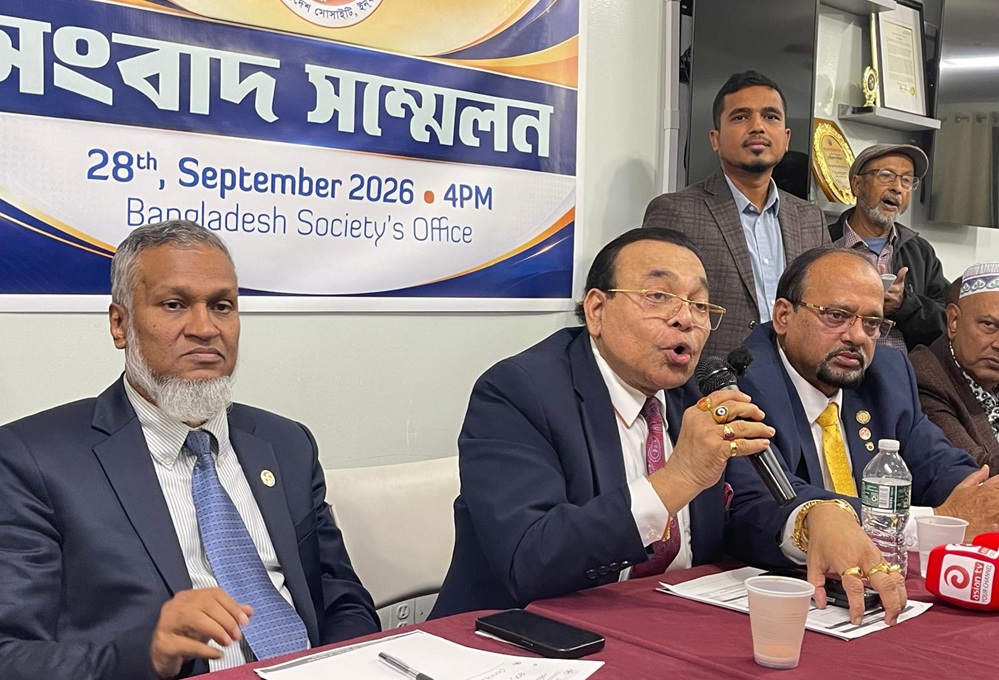
Akbar Haider Kiron, New York: The Bangladesh Society, Inc., one of the largest community organizations representing Bangladeshi Americans in the United States, has rejected recent allegations concerning its financial management, spending and alleged misuse of funds, saying its financial position has significantly improved over the past 20 months. At a press conference on September 28, 2026, the organization’s General Secretary Mohammad Ali presented a written statement addressing the allegations and outlining the society’s current financial position.

Bangladesh Society President Ataur Rahman Selim, Board of Trustees Chairman Shah Newaz, and other leaders and executive committee members were present at the press conference. Following the written statement, Shah Newaz, Ataur Rahman Selim and Mohammad Ali responded to questions from journalists.

Society disputes $725,000 spending allegation

Responding to allegations that the current executive committee had spent or wasted approximately $725,000 over the past 20 months, society leaders rejected the claim as inaccurate. According to figures presented at the press conference, total spending during the period amounted to $521,865, covering regular operating expenses and various programs and activities.

The leaders said the expenditures are supported by relevant documentation, vouchers and bank statements. They also said the organization currently has approximately $919,000 in its bank accounts, arguing that the figure demonstrates a substantial increase in the society’s financial reserves.

According to the organization, the net financial position stood at approximately $116,000 when the current executive committee assumed responsibility.

$200,000 Bangladesh Center deposit returned

The leadership also addressed questions surrounding the proposed purchase of a Bangladesh Center in Jamaica, Queens. According to the society, it had entered into an initial agreement and placed a $200,000 deposit as part of the proposed transaction.

The organization said legal complications involving the property subsequently emerged and the seller failed to meet certain conditions outlined in the agreement. The deal was therefore canceled, the leaders said, adding that the entire $200,000 deposit was returned to the society.

Building violations reduced from $82,000 to $31,000

The society also provided an explanation regarding outstanding building violations and fines inherited from the previous administration. Leaders said the organization had inherited approximately $82,000 in violation-related penalties. A professional firm was subsequently hired to address the matter, resulting in the amount being reduced to approximately $31,000, according to the society. They said legal efforts are continuing to seek a further reduction or waiver of the remaining amount.

$89,000 spent on eight Iftar events

The organization also addressed questions regarding the cost of its Iftar programs. According to the figures presented at the press conference, the society organized eight Iftar events in four locations over the past two years, with total expenses of approximately $89,000.

Bangladesh Society Board of Trustees Chairman Shah Newaz responds to questions from journalists during the September 28 press conference. Photo: KHABOR

However, society leaders said approximately $42,770 of that amount came from sponsors and donations from supporters. Based on those figures, they said the society’s own funds accounted for an average of approximately $5,803.75 per Iftar event.

Officials’ checks described as reimbursements

Questions were also raised about checks issued in the names of society officials. The organization’s leaders said such payments were reimbursements for expenses initially paid out of the officials’ own pockets for urgent organizational purchases or other necessary expenses. They said reimbursement checks were issued only against valid vouchers and supporting documentation.

Membership rises from 18,000 to more than 35,000

The society also highlighted an increase in its registered membership. According to its leadership, the organization had approximately 18,000 registered members when the current executive committee assumed office. The number has since increased to more than 35,000, they said.

Leaders urge verification of information

At the conclusion of the press conference, Bangladesh Society leaders urged journalists and community members to verify information before circulating allegations or claims concerning the organization. They said unverified information could create confusion and division within the Bangladeshi-American community.

The leadership also expressed its intention to strengthen the Bangladesh Society as a unified community platform and to build a more transparent, effective and sustainable organization for future generations.


PM pays courtesy call on President

DHAKA – Prime Minister Tarique Rahman paid a courtesy call on President Mirza Fakhrul Islam Alamgir at the Bangabhaban here this afternoon. Upon the arrival of the Prime Minister at the Bangabhaban at 3 pm, the President welcomed him at the Octagonal and introduced his Military Secretary, Secretary and Press Secretary to the Prime Minister, President’s Press Secretary Md. Sarwar Alam told KHABOR.

During the meeting, the Prime Minister briefed the President on his recent visit to the United States, participation in the UNGA session, sideline meetings with heads of the states, UN high officials, and economic and development partners and appraised him of the government’s overall activities. The President congratulated the Prime Minister on his address at the 81st session of the United Nations General Assembly, describing it as “visionary, resolute and guiding”.

He said the speech reflected Bangladesh’s national interests and aspirations and clearly articulated the country’s positions on major global issues. The President expressed hope that the Prime Minister’s UNGA address, sidelined meetings would further enhance Bangladesh’s dignity and position in the international arena.

“The visit played an important role in further consolidating and strengthening Bangladesh’s position in the international arena, protecting public interests, and expanding bilateral and multilateral relations,” he said.

They also exchanged views on various issues related to national and state interest. The President thanked the Prime Minister for visiting the Bangabhaban. The visit marked the Prime Minister’s first official meeting at the Bangabhaban after President Mirza Fakhrul Islam Alamgir assumed the office.


Large Crowd Joins Muslim Day Parade in New York Despite Heavy Rain

Md. Mashiur Rahman Majumder, New York — Thousands of people gathered along Manhattan’s Madison Avenue on Sunday September 27, 2026 for the Muslim Day Parade, turning out despite heavy rain to celebrate faith, cultural diversity and community unity. Parents accompanied by their children, students, teachers, imams, community leaders and representatives of religious and social organizations took part in the annual event. The strong turnout despite the unfavorable weather highlighted the diversity and community spirit of Muslim New Yorkers.

Held against the backdrop of the 250th anniversary of the United States, this year’s parade carried the theme “United in Faith, Diverse in Culture.” Organizers also promoted the messages “One Ummah, One Nation, Proud Americans” and “Love for All, Hatred for None.”

Participants representing different languages, nationalities and cultural backgrounds joined the procession, reflecting the diverse character of the Muslim American community. Religious and community leaders were joined by Muslim officers of the New York City Police Department (NYPD), members of the Fire Department of the City of New York (FDNY), representatives of Islamic organizations, law enforcement personnel and elected officials.

Despite the persistent rain, the participation of community members helped turn the parade into a major gathering celebrating Muslim American identity and community engagement. Mohammad Razvi, president of the Council of Peoples Organization (COPO) and convener of the parade, thanked participants and everyone involved in organizing the event. He also expressed appreciation to organizers, volunteers, partner organizations and sponsors who worked behind the scenes to make the parade possible.

Razvi said New York’s Muslim community represents unity and peace, adding that the large turnout despite the rain demonstrated the strength of that unity. Students and members of the school community from Elham Academy in Queens also participated in the parade. For the students, the event provided an opportunity to celebrate their faith and heritage while taking part in a broader community gathering. Parents and teachers joined the students and shared the experience with them.

Imam Muhammad Shahidullah, founder of Elham Academy and chief executive officer of Save the People, said Islam is a religion of peace. He highlighted the contributions of Muslim Americans to the United States and said Muslims have played an important role in the country’s education, service, culture and development.

Shahidullah said the Muslim community would continue working alongside people of all ethnicities and faiths to showcase the values of Islam and contribute to the continued progress of the United States. The parade’s organizing committee included Tahir Mustafa Kukigi, Rafiq Mohamed, Ibrahim Ahmed, Ainul Haque, Zilfa Baksh, Ed Powell, Sakibeh Mustafa, Souleymane Konate, Bajah Ruhi, Kenan Taskent, Ahmad Ali, Hafida Torres, Moni Lutfi, Imam Muhammad Shahidullah and Mohammad Razvi.

According to the parade’s promotional materials, participating organizations included COPO, Darul Uloom New York, Save the People, Al-Amin School, Jalalabad Foundation for Children and Youth, Africa Community Services, African Cultures Promotions, Albiana Islamic Cultural Center, Al-Ihsan Academy, Al-Iman School, Al-Mamur School, American Council of Minority Women, Basti, Council of African Imams, Islamic Leadership School, Jamaica Muslim Center and Jamaica Bangladesh Friends Society.

The promotional materials also listed numerous mosques, schools and community organizations, including Al-Madani Mosque, Masjid Al-Hikmah, Masjid Al-Ghaffar, Makki Mosque, Masjid Asri, Miraj Islamic School, Razi School, Yankasa Association of USA, Moroccan Society of New York, Yemeni American Association of New York, Yonkers Islamic Center, Elham for All, New York Imam Council, Islamic Schools Association, Caribbean American Muslim Association and Smile of Life.

The heavy rain did little to dampen participation. Organizers said the parade sent an important message to younger generations: people can take pride in their faith and cultural identity while embracing other communities and contributing to a peaceful and united America.


USMNT Opens 2030 World Cup Campaign with 4-1 Win Over Peru

ORLANDO, Flordia: The United States Men’s National Team (USMNT) opened its road toward the 2030 FIFA World Cup with an emphatic 4-1 victory over Peru on Saturday at a sold-out Inter&Co Stadium in Orlando. The victory marked Mauricio Pochettino’s first match since signing a new contract that keeps him as U.S. head coach through 2030. The match also featured a strong showing from a new generation of American players, with 11 players earning their first senior international cap, including eight teenagers.

Justin Ellis and Julian Hall both scored on their international debuts, while Malik Tillman converted a second-half penalty and Sebastian Berhalter capped the victory with a spectacular long-range goal.

The United States made a fast start when 19-year-old Justin Ellis scored less than four minutes into his senior international debut. Ellis drew a foul on the left side of the field, earning the U.S. a free kick. Gio Reyna delivered the set piece, and Ellis rose inside the penalty area to head the ball toward the far post and give the hosts a 1-0 lead.

The goal was the fastest scored by a U.S. player on his senior debut in the modern era. Ellis also became the first player to score on his USMNT debut in his home state since Brandon Vazquez in 2023.

Peru responded in the 15th minute through veteran striker Gianluca Lapadula. Captain Yoshimar Yotún sent a cross toward the far post, where Lapadula rose above the defense and headed the ball into the opposite corner to make it 1-1. The U.S. continued to create opportunities before halftime, but Peru goalkeeper Pedro Gallese made an important save to deny Malik Tillman from close range.

The match remained level until the 66th minute, when the United States regained the advantage from the penalty spot. Two minutes after entering the match for his international debut, Mathis Albert made a dangerous run into the penalty area and was brought down by a Peruvian defender. The referee awarded a penalty, and Tillman stepped forward to take it.

Tillman calmly sent his right-footed shot into the net to make it 2-1. It was Tillman’s third goal in three consecutive matches for the United States.

The U.S. extended its lead six minutes later. In the 72nd minute, Sebastian Berhalter delivered a dangerous cross toward the far post, and 18-year-old Julian Hall threw himself at the ball and redirected it into the net. Hall, who plays for New York Red Bulls, scored in his first appearance for the senior national team. He also became the first U.S. player since Matko Miljevic in January 2025 to score and record an assist in his senior international debut.

Sebastian Berhalter put the result beyond doubt in the 90th minute with a spectacular strike from outside the penalty area. After receiving the ball from Hall, Berhalter took his chance from roughly 25 yards and fired a powerful shot beyond Gallese’s reach to make it 4-1. It was Berhalter’s third international goal in 19 appearances for the United States.

The statistics reflected the United States’ control of the match. The USMNT enjoyed 70 percent possession, completed 94 percent of its passes and outshot Peru 16-5. The victory also extended the U.S. team’s unbeaten run at its Orlando home venue to eight matches. The game was played before a sellout crowd of 24,228.

The match marked the beginning of a new phase for the U.S. national team following the 2026 FIFA World Cup. Eleven players made their senior international debuts: Mathis Albert, Justin Ellis, Zavier Gozo, Julian Hall, Diego Kochen, Adri Mehmeti, Peyton Miller, Neil Pierre, Brooklyn Raines, Cavan Sullivan and Frankie Westfield. Cavan Sullivan, at 16 years and 363 days, became the fourth-youngest player to make his senior debut for the United States. The youthful lineup included three teenagers from the start: Ellis, Sullivan and defender Peyton Miller.

Pochettino used the Peru match to introduce a number of young players while also giving several established internationals important minutes. The U.S. coach has a new contract extending through 2030, and the Peru match was the first step toward building the squad for the next World Cup cycle.

The United States will play three more matches during the current international window, beginning with Chile on September 29 in St. Louis. The team will then face Mexico on October 3 in Glendale, Arizona, before closing the window against Canada on October 6 in St. Paul, Minnesota.

Final Score:
United States 4-1 Peru

Goals:
4′ — Justin Ellis (USA)
15′ — Gianluca Lapadula (Peru)
66′ — Malik Tillman (USA, penalty)
72′ — Julian Hall (USA)
90′ — Sebastian Berhalter (USA)