Syria Destroys Assad-Era Chemical Weapons as UN Hails First Verified Destruction Since 2014

Shibbir Ahmed, UNITED NATIONS, NY — September 4, 2026: Syria has begun destroying remnants of the chemical weapons programme inherited from the government of former President Bashar al-Assad, marking a major step in the country’s efforts to dismantle its clandestine chemical arsenal under international oversight.

The development was highlighted during a United Nations Security Council briefing on Syria’s chemical weapons programme, where UN officials reported that the Organisation for the Prohibition of Chemical Weapons (OPCW) had verified the destruction of chemical munitions in Syria for the first time since 2014.

UN High Representative for Disarmament Affairs Izumi Nakamitsu told the Council that the verified destruction represented “significant progress” in international efforts to eliminate Syria’s remaining chemical weapons capabilities.

According to UN and Reuters reporting, the destruction includes 42 aerial bombs, along with additional chemical-weapons-related production and storage facilities. The verification represents the first confirmed destruction of Syrian chemical munitions by the OPCW since the international disarmament process began more than a decade ago.

Remnants discovered after Assad’s fall

The latest operation follows the discovery earlier this year of previously undeclared chemical-weapons materials in Syria. In May, an OPCW expert team working with Syrian authorities reported finding previously undeclared chemical munitions, chemical substances, equipment and extensive documentation linked to the former government’s chemical weapons programme.

The OPCW said its investigation found dozens of previously undeclared chemical munitions, including aerial bombs of the same type associated with chemical attacks in Ltamenah in 2017 and Khan Shaykhun in 2017, as well as rockets of a type associated with the 2013 Ghouta chemical attack.

The discovery was significant because the OPCW had repeatedly raised questions about gaps and inconsistencies in Syria’s earlier declarations concerning the full extent of its chemical weapons programme. Following the fall of the Assad government in December 2024, Syria’s new authorities opened the door to renewed international inspections and cooperation with the OPCW.

International verification

The OPCW plays the central technical role in identifying, securing and destroying Syria’s remaining chemical weapons materials, while the issue continues to be addressed by the UN Security Council under its existing mandate.

The OPCW said in July that Syria’s rights and privileges under the Chemical Weapons Convention had been reinstated after the country’s new authorities demonstrated progress in cooperating with the organisation. The decision followed steps including amendments to Syria’s declaration, preparations for facility agreements and plans for verification and destruction activities.

The current process is therefore not simply a Syrian announcement of destruction. The significance lies in the fact that the destruction has been independently verified by the OPCW.

That distinction is crucial in international chemical-weapons disarmament, where verification is intended to establish that declared materials have actually been destroyed and cannot simply be transferred, concealed or reused.

Damascus promises further action

Syria’s representative to the United Nations, Ibrahim Olabi, told the Security Council that the destruction programme was intended to protect Syrians and prevent chemical weapons from falling into the wrong hands. The Syrian government has said it is cooperating with international experts to address the chemical weapons legacy left by the previous government.

The authorities are also preparing legal proceedings involving individuals allegedly connected to the former chemical weapons programme. Reuters reported that Syria is preparing trials involving 18 suspects, including senior figures allegedly connected to the programme.

The move could add an important accountability dimension to the international disarmament effort: not only destroying the remaining weapons and materials, but also investigating responsibility for their development and use.

Concerns over military activity

The Security Council discussion also reflected broader regional tensions. Syria’s UN representative criticized Israeli military actions in Syria, arguing that strikes could complicate chemical-weapons operations and place personnel involved in the destruction process at risk. Türkiye also raised concerns that Israeli military activity could make the disarmament effort more difficult.

Those claims remain part of the broader political dispute surrounding Syria and should be distinguished from the independently verified technical findings concerning chemical-weapons destruction.

A milestone after more than a decade

The latest development represents a significant change from the period when Syria’s chemical weapons programme was the subject of intense international confrontation. Syria joined the Chemical Weapons Convention in 2013, following international pressure after the deadly chemical attack in Ghouta. The OPCW subsequently supervised the removal and destruction of declared chemical weapons, but questions remained about whether Syria had fully disclosed the scope of its programme.
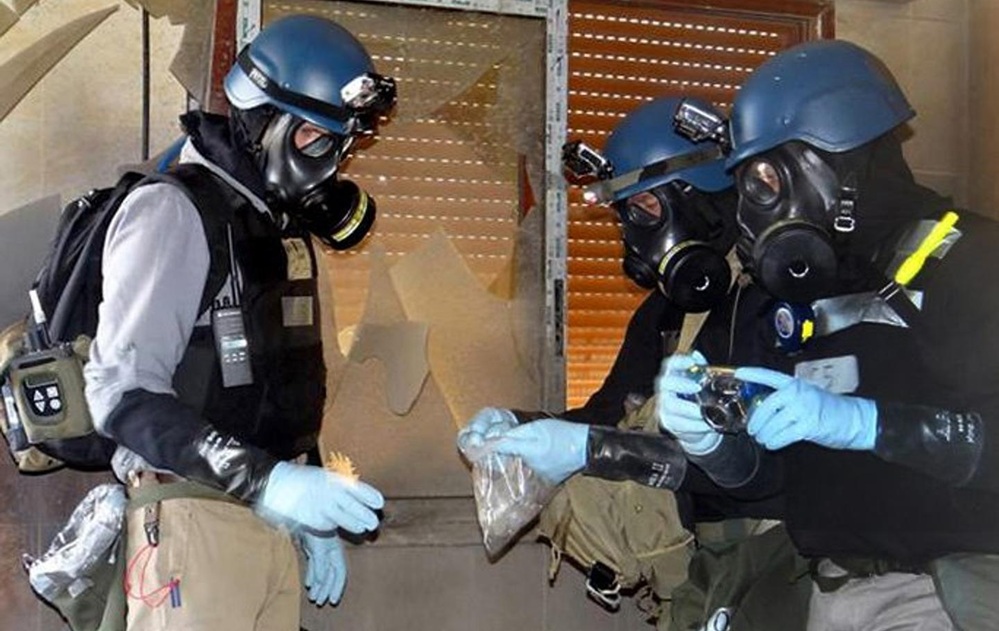
The discovery of previously undeclared materials in 2026 reinforced those concerns. The new Syrian authorities’ cooperation with the OPCW has now created an opportunity for international inspectors to revisit sites, collect documentation, identify undeclared materials and oversee their destruction.

The OPCW said its current work includes efforts to establish a complete and accurate inventory of remnants of the Assad-era programme and ultimately ensure their destruction in accordance with the Chemical Weapons Convention.

UN welcomes progress but warns work remains

The UN briefing made clear that the destruction of 42 aerial bombs and other materials does not mean the Syrian chemical weapons dossier is closed. International inspectors still have work to do to determine the full extent of the former programme, verify Syria’s declarations and oversee the destruction of remaining chemical-weapons-related materials.

The OPCW has previously said that more than 100 locations across Syria were considered potentially relevant to the former chemical weapons programme, with high-priority sites selected for investigation based on information gathered over many years.

For the United Nations and the OPCW, the immediate objective is therefore twofold: complete the inventory and ensure the irreversible destruction of everything that remains. The first verified destruction since 2014 nevertheless represents an important milestone.

After years of international disputes over Syria’s chemical weapons declarations, the combination of renewed Syrian cooperation, OPCW inspections and verified destruction could mark the beginning of a new phase in efforts to permanently eliminate the country’s chemical weapons legacy.

For the Security Council, however, the challenge remains ensuring that the process continues safely, transparently and under international verification until the entire inherited programme is accounted for and eliminated.


Nepal Floods Leave 22,000 Children Without Safe Water, UNICEF Warns

KATHMANDU — At least 22,000 children in Nepal urgently need safe drinking water, sanitation and hygiene assistance more than a week after devastating flash floods swept through the Bhotekoshi-Trishuli river basin, UNICEF said. The floods damaged water-supply systems across affected districts and destroyed or severely damaged toilets and other sanitation facilities, increasing the risk of waterborne and infectious disease outbreaks.

Families displaced by the disaster are also crowded into host households and temporary holding centres, making it increasingly difficult to maintain basic hygiene and access clean water.

“Every parent in these districts is now making the same calculation several times a day,” said Alice Akunga, UNICEF Representative in Nepal, referring to families’ urgent need to determine where they can obtain water and whether it is safe for their children.

UNICEF expands emergency response

UNICEF has already delivered water, sanitation and hygiene supplies for approximately 19,000 people in Rasuwa and Nuwakot, two of the districts hardest hit by the floods. The emergency supplies include more than 3,800 hygiene kits, 3,300 collapsible 10-litre jerrycans, 3,500 buckets, 3,500 one-litre mugs and 4,000 bottles of water-treatment solution. More than 1,000 tarpaulin sheets have also been distributed.

UNICEF teams are working with Nepalese authorities and humanitarian partners on disease surveillance, hygiene awareness and outbreak prevention as the risk of infectious diseases rises.

Schools also heavily affected

The floods have also disrupted children’s education. UNICEF estimates that at least 19 schools have been damaged, including eight that were completely destroyed and another eight that suffered partial destruction. More than 10,000 school-age children are in need of immediate psychosocial support and access to safe learning spaces.

The damage to water infrastructure, homes and schools has left thousands of families facing an uncertain recovery while emergency teams continue providing essential assistance. Humanitarian agencies say restoring access to clean water and sanitation is particularly urgent because prolonged displacement and overcrowded living conditions can accelerate the spread of disease.

The latest warning comes as Nepal continues to recover from one of its most destructive recent flood disasters, with communities across the affected river basin struggling to rebuild homes, infrastructure and essential services. UNICEF said it will continue working with the Nepalese government and partners to provide life-saving water, sanitation, hygiene and child-protection support to affected communities.


Quad Sherpas Meet in New Delhi to Advance Indo-Pacific Cooperation

NEW DELHI — India hosted a meeting of senior officials from the Quad countries in New Delhi on Thursday, with the four nations reviewing ongoing initiatives and discussing ways to strengthen practical cooperation across the Indo-Pacific.

Indian Foreign Secretary Vikram Misri hosted the Quad Sherpas’ Meeting, which was attended by Elly Lawson, Deputy Secretary of the Strategic Planning & Coordination Group at Australia’s Department of Foreign Affairs and Trade; Hiroyuki Namazu, Japan’s Senior Deputy Minister for Foreign Affairs; and Sergio Gor, the U.S. Special Envoy to South and Central Asia and Ambassador to India.

The meeting followed the Quad Foreign Ministers’ Meeting held in New Delhi on May 26, 2026, and focused on implementing the outcomes of that meeting while preparing for the next gathering of Quad foreign ministers.

The Sherpas reviewed progress on a range of ongoing Quad initiatives and explored ways to deepen practical cooperation among Australia, India, Japan and the United States. The officials reiterated their shared commitment to promoting a free and open Indo-Pacific, amid evolving security, economic and geopolitical challenges across the region.

According to the media note, discussions covered several major areas of Quad cooperation, including maritime and transnational security, economic prosperity and security, critical and emerging technologies, and humanitarian assistance and emergency response.

The officials also exchanged views on developments across the Indo-Pacific as well as broader regional and global issues. The meeting placed particular emphasis on translating the Quad’s commitments into concrete and action-oriented initiatives, reflecting the grouping’s increasing focus on practical cooperation rather than solely diplomatic coordination.

The Sherpas reaffirmed the importance of continued consultations among the four countries and said they looked forward to further discussions ahead of the next Quad Foreign Ministers’ Meeting.

The Quad—comprising Australia, India, Japan and the United States—has increasingly focused on cooperation in areas ranging from regional security and maritime awareness to emerging technologies, economic resilience and disaster response. Thursday’s meeting in New Delhi is part of the continuing diplomatic process aimed at coordinating the group’s priorities and advancing initiatives across the Indo-Pacific.


U.S. Imposes New Sanctions on Cuba, Targeting Castro Family, Bank and Energy Sector

Shibbir Ahmed, WASHINGTON, D.C. — The United States imposed new sanctions on Cuba on Thursday, targeting a member of the Castro family, a Cuban state-owned bank and four entities linked to the country’s mining and energy sectors as the Trump administration stepped up pressure on Havana.

The U.S. Department of State said the latest measures target five entities and one individual under President Donald Trump’s Executive Order 14404, which authorizes sanctions against foreign persons determined to meet specified criteria related to repression in Cuba and other threats to U.S. national security and foreign policy.

The administration said the measures are part of a broader effort to disrupt the Cuban government’s financial networks and restrict its ability to obtain resources used to sustain its economic and security apparatus.

Castro Family Member Added to Sanctions List

Among those designated Thursday is Fidel Ernesto Castro Calis, a grandson of former Cuban leader Raúl Castro. According to the State Department, Castro Calis was designated because he is an adult family member of Alejandro Castro Espín, who was previously designated under Executive Order 14404.

Alejandro Castro Espín, the son of Raúl Castro, and his son Raúl Alejandro Castro Calis, the brother of Fidel Ernesto Castro Calis, were designated on June 4, 2026. The latest action expands the administration’s sanctions targeting members of the Castro family and individuals it says are connected to Cuba’s ruling establishment.

Cuban State-Owned Bank Targeted

The United States also designated Banco Exterior de Cuba, a Cuban state-owned bank that specializes in corporate banking, foreign-trade financing and international transactions. The State Department said the bank was sanctioned for operating in or having operated in Cuba’s financial-services sector.

The designation could further complicate Cuba’s access to international financial channels and increase compliance risks for foreign banks and businesses conducting transactions involving the Cuban financial system.

Mining Sector Comes Under Pressure

Two Cuban entities connected to the country’s metals and mining industry were also designated. They are Empresa de Servicios Comandante Rene Ramos Latour (NICAROTEC) and Empresa Importadora y Abastecedora del Niquel (CEXNI).

NICAROTEC is described by the State Department as a Cuban state-owned industrial and technical services company that provides geological and mining support to the country’s nickel industry. CEXNI is a foreign-trade and logistics company that imports and supplies specialized raw materials, machinery and equipment for Cuba’s nickel and cobalt industries. The move puts additional pressure on an important segment of Cuba’s natural-resource economy, particularly its nickel and cobalt operations.

Energy Companies Also Sanctioned

The administration also targeted two companies associated with Cuba’s energy sector. Empresa Importadora de Abastecimiento para el Petroleo (ABAPET) was designated because it is owned, controlled or directed by, or acts on behalf of, Unión Cuba-Petróleo (CUPET), Cuba’s state oil company.

The State Department said ABAPET provides procurement support for CUPET and has imported technological equipment, spare parts, specialized tools and industrial inputs needed to sustain Cuba’s energy sector.

The United States also designated Comercial CUPET S.A., a Cuban state-owned company that represents CUPET in negotiations and joint ventures with foreign companies. The designations could make it more difficult for Cuba’s energy sector to obtain foreign equipment, financing and business partnerships.

Sanctions Block Property and Restrict Transactions

Under Executive Order 14404, property and interests in property belonging to the designated individuals and entities that are located in the United States or under the possession or control of U.S. persons are blocked and must be reported to the Treasury Department’s Office of Foreign Assets Control (OFAC). The order also applies to entities that are owned individually or collectively, directly or indirectly, 50 percent or more by one or more blocked persons.

U.S. persons are generally prohibited from conducting transactions involving property or interests in property of designated or otherwise blocked persons unless the transaction is authorized by an OFAC general or specific license or is otherwise exempt. The restrictions include providing or receiving funds, goods or services involving blocked persons.

Foreign Banks and Companies Face Sanctions Risk

The new measures could also have consequences beyond U.S. companies and citizens. The State Department warned that foreign persons engaging in transactions with individuals or entities designated under Executive Order 14404, or operating in certain identified Cuban sectors, could themselves face sanctions.

The sectors identified under the order include energy, defense and related materiel, metals and mining, financial services and security. The warning is particularly significant for foreign financial institutions, which may face increased sanctions and compliance risks when dealing with Cuban entities subject to U.S. restrictions.

The State Department also cautioned non-U.S. persons against returning blocked assets to sanctioned parties or transferring such assets to another jurisdiction for potential use by a designated target.

Part of Broader Cuba Policy

The latest measures are part of a broader Trump administration policy aimed at increasing pressure on the Cuban government. The United States has maintained a longstanding sanctions and embargo framework against Cuba, including the Cuban Assets Control Regulations (CACR). The new measures add further targeted restrictions to that existing framework rather than creating an entirely new Cuba embargo.

The administration has said its Cuba policy is intended to promote human rights, the rule of law, free markets, private enterprise and democratic governance. In its statement Thursday, the State Department argued that the Cuban people continue to face economic hardship while the Castro family and other regime-linked elites retain control over significant economic resources.

Washington Says Goal Is Behavioral Change

The State Department said the purpose of sanctions is not simply to punish individuals or institutions. “The ultimate goal of sanctions is not to punish, but to bring about a positive change in behavior,” the department said.

The administration says the sanctions are designed to weaken the financial networks and economic structures that support what Washington describes as Cuba’s repressive government. The measures also reflect President Trump’s stated goal of supporting what his administration describes as a “free Cuba.”

Sanctions Expand in 2026

Thursday’s action is the latest in a series of U.S. sanctions targeting Cuban individuals and state-linked institutions during 2026. The Trump administration has increasingly focused its Cuba policy on individuals associated with the country’s ruling structure as well as strategic sectors of the economy, including financial services, energy, mining and other industries.

The September 3 designations further expand that approach by targeting a state-owned bank, companies connected to Cuba’s nickel and cobalt industries, and entities linked to the country’s oil and energy sector. The new measures are expected to increase pressure on Cuba’s ability to access international financial services, obtain industrial equipment and maintain foreign commercial partnerships.

However, the sanctions do not mean that every transaction involving Cuba is prohibited. U.S. sanctions regulations include specific exemptions and licensing provisions for certain activities.

The broader question now is whether the intensified economic pressure will force meaningful changes by the Cuban government—or further deepen the economic difficulties already facing the Cuban population.


UN Security Council Confronts Syria’s Chemical Weapons Legacy as Destruction Begins

Shibbir ahmed, UNITED NATIONS, New York — The United Nations Security Council met Thursday to address Syria’s chemical weapons program, as Damascus begins a major effort to destroy remnants of the arsenal left behind by the former government of Bashar al-Assad.

The meeting comes at a significant moment for Syria’s chemical weapons file. New discoveries made after the fall of Assad’s government have raised fresh questions about the scale of the country’s undeclared chemical weapons program and whether all remaining materials have been identified.

At the same time, Syria has begun destroying chemical weapons materials, marking a potentially important new phase in international efforts to eliminate the country’s chemical weapons legacy. The Organisation for the Prohibition of Chemical Weapons (OPCW) has verified the destruction of chemical munitions in Syria for the first time since 2014.

Security Council Focuses on Syria

The Security Council’s meeting was held under the agenda item concerning the situation in the Middle East, with particular attention to efforts to eliminate Syria’s chemical weapons program. The issue remains highly sensitive because Syria’s chemical weapons program has been linked to some of the most serious allegations of chemical weapons use during the country’s civil war.

The international community has spent years attempting to establish the full scope of Syria’s chemical weapons activities, verify declarations made by the former government and ensure that prohibited materials are destroyed. Thursday’s meeting comes as new evidence and discoveries have reopened questions about what remained hidden.

Syria Begins Destroying Chemical Weapons Remnants

Syria has now begun destroying materials connected to the former government’s chemical weapons program. According to Reuters, the materials were discovered in May 2026 by Syria’s new leadership. The cache included raw materials and munitions similar to those associated with deadly chemical attacks during the civil war.

The OPCW has verified the destruction of chemical munitions, representing the first such verification in Syria since 2014. The development has been welcomed as an important step toward removing a major security threat from Syria and the wider Middle East.

New Discoveries Raise Questions

International investigators have uncovered additional evidence concerning the former Syrian government’s chemical weapons infrastructure. The discoveries include an additional production facility, a previously unidentified chemical associated with nerve agents, unfilled munitions and two storage facilities, according to Reuters.

The findings have reinforced concerns that the former Syrian government’s declarations about its chemical weapons program did not provide the international community with a complete picture. For the United Nations and the OPCW, determining the full extent of the undeclared program remains a major priority.

42 Aerial Bombs Permanently Destroyed

Among the developments reported Thursday, OPCW teams confirmed the permanent destruction of 42 aerial bombs in Syria. The destruction represents a concrete step toward eliminating remaining chemical weapons materials and reducing the possibility that such weapons could fall into the hands of armed groups or be used in future conflicts. The process is expected to require continued international monitoring, verification and cooperation from Syrian authorities.

The Ghouta Legacy

Syria’s chemical weapons issue is inseparable from the devastating history of chemical attacks during the country’s civil war. One of the most notorious incidents occurred in the Ghouta area near Damascus in August 2013, when a sarin attack killed and injured large numbers of civilians. More than a decade later, the victims and survivors continue to demand truth, justice and accountability.

At Thursday’s Security Council meeting, Britain’s Deputy Permanent Representative to the UN, Ambassador Kate Foster, said Syria’s progress should receive international support but stressed that this progress must lead to the complete and verified destruction of the former regime’s chemical weapons program. She also emphasized the need for truth, justice and accountability for victims.

Accountability Remains a Central Issue

Destroying chemical weapons is only one part of the international community’s response. Another major question is accountability for those responsible for developing, maintaining or using chemical weapons.

The OPCW has previously identified Syrian government forces as responsible for several chemical weapons attacks. In January 2026, the organization said its investigations had produced further evidence of systematic use of toxic chemicals as weapons by the former Syrian authorities.

The organization has also said that the fall of the Assad government created an opportunity to uncover the full scope of Syria’s chemical weapons program. Since 2025, the OPCW has expanded its presence in Syria, including inspections, sampling, interviews and the collection of documents relating to the former chemical weapons program.

A New Phase for Syria

The destruction process represents a significant change from the situation that existed under the Assad government. Syria has committed to cooperating with international chemical weapons inspectors and fulfilling its obligations under the Chemical Weapons Convention.

The international community now faces the challenge of ensuring that this cooperation continues and that every remaining chemical weapons facility, stockpile and relevant material is identified and safely destroyed. The process could take considerable time because investigators must not only locate physical materials but also establish whether previous declarations were complete and accurate.

Concerns Beyond Chemical Weapons

The Security Council’s discussions come amid broader questions about Syria’s past weapons activities. The UN has also been examining information concerning undeclared nuclear activities under the former government. Recent findings by the International Atomic Energy Agency have added another layer to international scrutiny of Syria’s former weapons-related programs.

The IAEA has reported evidence consistent with nuclear reactor infrastructure at a site in Deir Az Zor and has said Syria failed to report certain nuclear material, facilities and activities under the Assad government. The combination of chemical weapons discoveries and renewed scrutiny of Syria’s nuclear history has made the country an important focus of international non-proliferation efforts.

Regional Security at Stake

The issue extends beyond Syria’s borders. Syria sits at the heart of a region already affected by multiple conflicts and competing military interests. Any remaining chemical weapons materials could pose a serious threat if acquired by armed groups or transferred outside the country.

For that reason, the United Nations considers the destruction and verification of Syria’s chemical weapons program an important component of regional security. The goal is not simply to remove existing weapons but to ensure that the infrastructure, knowledge and materials necessary to produce such weapons cannot be reconstituted.

International Cooperation Will Be Critical

The success of the process will depend heavily on cooperation between Syria, the United Nations, the OPCW and other international partners. Inspectors will need access to suspected sites, documents and relevant personnel. Syrian authorities will also need to provide information about facilities and materials that may not yet have been identified.

The international community, meanwhile, will have to provide technical expertise and support for the safe destruction of hazardous materials. Thursday’s Security Council meeting therefore represents more than another diplomatic discussion. It comes at a moment when international investigators are gaining access to previously hidden information and Syria is beginning to destroy remnants of its former chemical weapons program.

What Comes Next?

The immediate priority is to identify and destroy all remaining chemical weapons materials and verify that the process is complete. The OPCW and the United Nations will continue monitoring developments, while the Security Council is expected to remain engaged with the issue. The discovery of previously undeclared materials means the process is unlikely to end quickly.

But the destruction of the first newly identified stockpiles provides an important indication that Syria’s chemical weapons file may finally be entering a new phase. For the victims of Syria’s chemical attacks, however, destruction of the weapons is only part of the story.

The international community continues to face the larger challenge of establishing the truth about what happened, identifying those responsible and ensuring that chemical weapons are never again used against civilians. As Britain’s representative told the Security Council on Thursday, chemical weapons have no place in Syria—or anywhere in the world.


Trump Says Europe Should Repay U.S. for Ukraine Military Aid

Shibbir Ahmed, WASHINGTON DC — President Donald Trump said Thursday that the United States intends to seek repayment from European countries for military assistance and ammunition previously provided to Ukraine, opening a new front in his administration’s long-running dispute with European allies over the cost of supporting Kyiv. In a social media post, Trump said European nations should reimburse the United States for military aid that Washington provided to Ukraine and NATO without charging European governments directly.

Trump characterized the amount as involving “hundreds of billions of dollars” and said Europe would have paid for the assistance if it had been asked to do so at the time. The president’s comments represent a significant escalation in his criticism of the financial burden the United States has carried during the Ukraine war.

They also come at a particularly sensitive moment for Washington, as the United States is simultaneously engaged in a major military confrontation with Iran and is confronting concerns about the availability of key weapons and ammunition.

U.S. weapons stocks under pressure

Trump’s demand for repayment comes as his administration is focusing heavily on rebuilding American weapons inventories. In his Thursday statement, Trump criticized reports that U.S. ammunition stockpiles have been significantly depleted. He said the United States is now prioritizing weapons for its own military rather than continuing to sell the same quantities to other countries.

Trump indicated that weapons sales to U.S. allies could resume in the near future, but emphasized that American stockpiles are currently receiving priority. The issue has gained additional urgency because of the ongoing U.S. military campaign against Iran.

Reuters previously reported that the U.S. Army has used a substantial portion of its stockpile of highly accurate, long-range missiles during the Iran conflict, raising questions about America’s ability to respond to another major military contingency.

The combination of the Ukraine war and the Iran conflict has therefore created an unusual strategic challenge for the Pentagon: Washington is supporting partners overseas while simultaneously trying to ensure that its own forces retain sufficient weapons for future operations.

Trump challenges the traditional U.S.-Europe arrangement

Trump has repeatedly argued that European countries should shoulder more of the financial burden for their own security and for assistance to Ukraine. His latest comments go further by suggesting that Europe should retroactively compensate the United States for assistance already delivered. That position could create difficult conversations between Washington and European capitals.

European governments have provided substantial military, financial and humanitarian assistance to Ukraine since Russia’s full-scale invasion in 2022. Europe has also increasingly taken responsibility for purchasing American weapons for Ukraine through mechanisms in which NATO allies finance U.S.-made equipment.

A Congressional spending analysis cited by the Council on Foreign Relations estimates that the United States had made available roughly $195 billion in spending related to the Ukraine war as of March 31, 2026. However, that figure includes a wide range of war-related spending and should not be interpreted as money directly handed to the Ukrainian government.

The distinction is important because much of U.S. Ukraine-related spending has supported American military production, logistics, replacement of U.S. stocks and other activities associated with the war.

Europe has already increased its role

European countries have significantly expanded their own support for Ukraine. The United States under Trump has also supported a system in which NATO allies pay for American weapons that are then provided to Ukraine. Under the Prioritized Ukraine Requirements List, or PURL, European and other NATO countries finance the purchase of U.S. weapons for Kyiv rather than requiring Washington to bear the full cost. The arrangement has allowed Ukraine to obtain advanced American systems while shifting more of the financial responsibility toward European allies.

A British Parliament research briefing published in August noted that the Trump administration had made clear that the United States would not pay for new assistance supplied through the PURL mechanism; NATO allies would finance the purchases. Trump’s latest demand nevertheless suggests that the president believes the existing burden-sharing arrangements do not go far enough.

Ukraine faces continuing pressure

For Ukraine, the development comes at a difficult time. Kyiv remains heavily dependent on Western military assistance, particularly air-defense systems, missiles, ammunition and other advanced weapons needed to defend against Russian attacks. Any reduction in American weapons availability could place additional pressure on European governments to increase their own contributions.

The issue is particularly sensitive for air defense. Ukraine has relied heavily on American-made systems and interceptors, while European governments have struggled to provide enough comparable equipment from their own inventories. The growing European role has therefore become both a financial and strategic necessity.

Trump’s comments linked to Iran war

The timing of Trump’s announcement is significant. The president’s comments came while the United States is engaged in the separate war with Iran, which has created additional demand for American precision-guided weapons. The Iran conflict has raised concerns inside Washington about whether U.S. weapons inventories are sufficient to sustain prolonged operations while simultaneously meeting commitments to allies.

Trump’s message indicates that the administration is responding by putting U.S. military requirements ahead of some foreign sales. That could affect not only Ukraine but also other American allies that depend on U.S.-manufactured weapons. The president said weapons sales to allies would eventually resume, suggesting that the administration views the current restrictions as a temporary measure while American stockpiles are rebuilt.

A new burden-sharing debate

Trump’s demand could also reopen a broader debate over NATO and transatlantic security. For decades, the United States has provided the backbone of NATO’s military capabilities, while European allies have often spent less on defense than Washington. Russia’s invasion of Ukraine dramatically changed that calculation.

European governments have increased defense spending and begun expanding domestic weapons production. But European militaries remain dependent on the United States for several critical capabilities, including strategic airlift, intelligence, missile defense and advanced weapons systems.

A report released Thursday by the European Court of Auditors warned that the European Union still faces major challenges in achieving its goal of defense readiness by 2030, including fragmented national systems, industrial bottlenecks and continued reliance on the United States. The report illustrates why Trump’s pressure on European allies is likely to continue.

Potential impact on NATO

Trump’s demand also raises questions about the future relationship between Washington and European allies. European governments may argue that they have already spent enormous sums supporting Ukraine and strengthening their own militaries. Washington, meanwhile, can point to decades of American spending on NATO’s collective defense and the extensive U.S. military assistance provided to Ukraine.

The disagreement is therefore about more than a single bill. It reflects a fundamental question about how the transatlantic alliance should divide the costs of security in an increasingly dangerous international environment. If European countries are asked to make retroactive payments for American assistance, negotiations could become particularly complicated.

There is also the question of how such payments would be calculated and whether the proposed reimbursement would cover the cost of weapons transferred directly from U.S. stockpiles, the cost of replacing those weapons, or broader U.S. spending related to the war. Trump did not provide a detailed mechanism for calculating or collecting the payments in his Thursday statement.

Russia watches the dispute

The growing disagreement between Washington and Europe is also being closely watched in Moscow. Russia has long sought to weaken Western unity over support for Ukraine and has portrayed the war as evidence of a broader confrontation between Russia and NATO.

Any significant reduction in U.S. support or disagreement among NATO members could therefore have consequences beyond the immediate financial dispute. At the same time, European governments are unlikely to abandon Ukraine simply because Washington is demanding greater financial responsibility.

Instead, Trump’s latest comments could encourage Europe to accelerate efforts to build an independent defense industry and reduce its reliance on American weapons. That process, however, would take years rather than months.

What comes next?

Trump’s announcement is likely to trigger discussions between Washington and European governments over the financial responsibilities associated with Ukraine. The immediate question will be whether European allies accept the principle of retroactive reimbursement or reject the proposal. A second question will be how the dispute affects future American weapons sales.

If U.S. weapons production remains under pressure because of the Iran conflict, European countries could face stronger incentives to finance American weapons directly for Ukraine while simultaneously increasing their own defense production.

For Ukraine, the key concern will be whether American weapons deliveries continue at a level sufficient to meet battlefield requirements. For Europe, the challenge will be balancing continued support for Kyiv with the need to rebuild national military inventories. And for Washington, the administration must balance support for allies with the increasingly urgent requirement to maintain adequate U.S. weapons stocks.

A changing transatlantic relationship

Trump’s latest demand is another sign that the traditional model of American leadership in European security is changing. The president has repeatedly called for NATO allies to spend more and take greater responsibility for their own defense. His demand that Europe reimburse the United States for past Ukraine assistance pushes that argument into new territory.

Whether European governments ultimately agree to Trump’s proposal remains uncertain. But the message from Washington is unmistakable: the Trump administration wants America’s allies to carry a much larger share of the financial burden for military security.

With the Ukraine war continuing, the Iran conflict consuming American weapons and Europe confronting its own defense shortcomings, the dispute over who should pay for Western security is likely to remain one of the most important issues shaping the transatlantic alliance.


Nepal Floods Highlight Urgent Need for Global Climate Action: GCF Chief

Shibbir Ahmed, United Nations, New York: The devastating floods in Nepal and recent wildfires in Europe should serve as a wake-up call for the world to take more urgent action against the growing risks of climate change, said Mafalda Duarte, Executive Director of the Green Climate Fund (GCF).

In an interview with Agence France-Presse (AFP) in Palau, Duarte said climate change was receiving less urgency in global politics than other major crises. While the international community has demonstrated the ability to mobilise large amounts of funding quickly in response to wars, conflicts and other emergencies, climate-related challenges have not received a similar response, she said.

Duarte warned that the world is moving closer to several climate “tipping points”, beyond which reversing environmental damage could become increasingly difficult or even impossible.

“We can mobilise money quickly when we choose to respond to an emergency,” Duarte said, stressing that climate change should be treated with the same sense of urgency.

She cited Nepal’s recent floods, along with heatwaves and wildfires in Europe, as examples of the increasingly widespread impacts of climate change. According to Duarte, climate-related disasters are no longer confined to developing countries. Both developed and developing nations are increasingly facing the consequences of a changing climate.

Growing Concern Over Nepal Disaster

The recent floods and landslides in Nepal’s Himalayan region have caused extensive destruction and raised fresh concerns about the vulnerability of mountain communities to extreme weather events. The disaster occurred in the Himalayan region near the Nepal-China border, with sudden flows of water and large amounts of debris affecting several areas.

Nepal’s Prime Minister Balendra Shah has also described the disaster as a serious warning about the growing risks associated with climate change and called for stronger international action to support countries vulnerable to climate-related disasters.

Experts say rising global temperatures are contributing to changes in Himalayan glaciers, snow cover and other environmental conditions, potentially increasing the risks of floods, landslides and glacier-related disasters. However, determining the precise contribution of climate change to any individual disaster requires further scientific analysis.

Concerns Over Climate Finance

The Green Climate Fund provides financial support to developing countries for climate adaptation, resilience and efforts to reduce greenhouse-gas emissions. According to the BSS/AFP report, the fund has invested about $19 billion across 134 developing countries.

However, concerns remain over the future of international climate finance. The report said the United States withdrew from the fund in January, while Britain halved its contribution in May. Duarte stressed that climate-vulnerable countries need faster and more accessible financing to prepare for and respond to the growing impacts of climate change.

Pacific Region Sees Increased Investment

Duarte is currently in Palau, where leaders of Pacific island nations are attending their annual summit. For many of these small island states, climate change represents a major threat to their security, economies and long-term survival. The Green Climate Fund has increased its investment in the Pacific region significantly. Over the past three years, its investment there has doubled to around $1 billion.

Duarte acknowledged that accessing climate finance remains difficult for many small island nations. She said efforts were under way to streamline the process, with the average approval period now taking about nine months.

Tina Stege, the climate envoy of the Marshall Islands, has also called for faster and more tangible progress on climate finance. She expressed frustration over the limited funding available through the separate United Nations-backed “loss and damage” mechanism, which is intended to help vulnerable developing countries address the impacts of climate-related disasters.

Duarte said there was still time to act on climate change, but the window for effective action was narrowing. She urged governments and the international community to move faster, increase climate financing and work together to address the growing risks posed by a warming planet.


Moyeen Seeks Stronger World Bank Support for Bangladesh Development

DHAKA – LGRD and Cooperatives Minister Dr Abdul Moyeen Khan has expressed hope that the World Bank will further strengthen its support for the country’s sustainable development and improvement of people’s quality of life. He said various government initiatives are underway in important areas such as water supply, sanitation, rural development and addressing the impacts of climate change.

Continued support from development partners is necessary to make these activities more effective and sustainable, he said when World Bank Division Director for Bangladesh and Bhutan Jean Pesme paid a courtesy call on him at his office at the Secretariat today.

Various issues including the World Bank’s support for various ongoing development projects in Bangladesh, water supply and sanitation systems, rural development, climate change and local government sector were discussed.

The minister said the government and development partners need to work in coordination to accelerate and sustain the country’s development activities. He said WB support could play an important role in strengthening the capacity of the local government sector and ensuring quality civic services reach people at their doorsteps.

The minister expressed gratitude for the World Bank’s longstanding support for Bangladesh’s development journey and hoped that the bank would continue its support for the country’s key development initiatives in the future.

During the exchange of views, emphasis was placed on further strengthening the existing cooperation between Bangladesh and the World Bank. LGD Md Shahidul Hassan, senior officials from the ministry and the WB were present at the meeting.


‘1945 World Order No Longer Reflects Reality’: Guterres Calls for UN Reform

Shibbir Ahmed | United Nations, New York — United Nations Secretary-General António Guterres has called for sweeping reforms to global institutions, arguing that the international system must adapt to a rapidly changing, increasingly multipolar world.

Addressing the Shanghai Cooperation Organization (SCO) summit in Bishkek on Tuesday, Guterres said global power relations were changing while many multilateral institutions continued to reflect the geopolitical realities of 1945.

“We must reform our multilateral institutions, including the United Nations and the Bretton Woods system, to reflect today’s realities,” Guterres said, calling for greater representation and influence for developing countries in order to build a fairer global order.

Guterres said the world was becoming increasingly multipolar and argued that the trend should be strengthened.

“Multipolarity is a condition for justice in global governance and international relations,” he said, describing it as a foundation for effective multilateralism and a United Nations that serves all countries without double standards.

The UN chief has repeatedly called for reforms to the Security Council and other international institutions to make them more representative of the current distribution of global power.

His remarks in Bishkek also highlighted four areas for stronger international cooperation: global security, development financing, climate action and governance of artificial intelligence.

Guterres’ call comes amid growing geopolitical tensions, conflicts and disputes over the effectiveness of existing international institutions. His message was clear: as global power shifts, the institutions governing international affairs must change with it.


End Of An Era: Lionel Messi Retires From International Football

BUENOS AIRES — Argentina captain Lionel Messi has officially announced his retirement from international football, bringing a definitive close to a legendary 21-year career with La Albiceleste. The 39-year-old icon shared the emotional news via social media, revealing that he originally penned his farewell letter on July 21—just two days after Argentina’s heartbreaking 1–0 extra-time defeat to Spain in the 2026 FIFA World Cup final. While he initially contemplated making the announcement then, he delayed the public statement following the passing of his father, Jorge Messi, in August.

“After all this time since the final, and after thinking about it a lot, I want to tell everyone that I’m retiring from the national team,” Messi wrote. “It was a decision that hurt—and still hurts deep down—but I understand that the time has come. I’ve given everything I had; I have nothing left to give, and besides, there are some great young players coming up who deserve to be here.”

A Storied Legacy of Redemption and Glory

Messi walks away as a national hero and the heartbeat of modern Argentine football. After years of near-misses and heavy scrutiny early in his career—which famously included a brief, short-lived international retirement in 2016—Messi authored one of the greatest redemption arcs in sports history.

He finishes his international career holding virtually every major record for his country, racking up 125 goals in 207 record-breaking appearances. His major trophy haul includes the 2022 FIFA World Cup, back-to-back Copa América titles in 2021 and 2024, and an Olympic gold medal in 2008.

His crowning achievement came in Qatar in 2022, when he dragged Argentina to global glory, cementing his status alongside Diego Maradona. Even in his final international tournament this past summer, Messi dazzled with eight goals and four assists, guiding the defending champions all the way to the World Cup final before falling narrowly to Spain.

“Now I’ll Be One of You”

In his farewell message, Messi expressed profound gratitude to the fans, his family, and his teammates who shared the journey with him.

“Thank you for all the love during these 20 years. I’m going to miss hearing you from the inside,” Messi said. “Now I’ll be one of you, always supporting from the outside, in the good times and even more in the bad ones. … Thank you, God, for making me Argentine. Vamos Argentina!”

With his international chapter officially closed, Messi will turn his full focus toward his club career with Inter Miami in MLS, leaving the football world to reflect on the departure of one of the greatest artists the sport has ever seen.