Bangladesh Condemns Israeli Settlement Plan in West Bank

DHAKA: Bangladesh has strongly condemned Israel’s plan to advance settlement construction in the E1 area of the occupied West Bank, saying the move violates international law and threatens prospects for a viable two-state solution.

In a statement issued today, Bangladesh’s Ministry of Foreign Affairs said the planned settlement expansion was contrary to international law and relevant United Nations Security Council resolutions.

The ministry said the proposed construction would further undermine the territorial integrity of the occupied Palestinian territory and diminish prospects for the establishment of a viable and sovereign Palestinian state. Bangladesh called on Israel to immediately halt all settlement activities in the occupied Palestinian territory.

Dhaka also reaffirmed its unwavering support for the legitimate and inalienable rights of the Palestinian people, including their right to establish an independent and sovereign State of Palestine based on the pre-1967 borders, with East Jerusalem as its capital.

Bangladesh urged the international community to intensify diplomatic efforts to prevent actions that could undermine Palestinian statehood and to advance a just, comprehensive and lasting peace in the Middle East based on international law and the two-state solution.

“Bangladesh stands in solidarity with the people of Palestine and remains committed to supporting their legitimate aspirations for freedom, dignity, justice and statehood,” the statement said.


Bangladesh Missions Operate Mobile Consular Camps in 63 Countries: Khalilur Rahman

Shibbir Ahmed, UN, New York: Bangladesh’s diplomatic missions in 63 countries are operating mobile consular camps to make essential government services more accessible to Bangladeshi expatriates, Foreign Minister and President of the 81st United Nations General Assembly Dr. Khalilur Rahman has said.

According to Rahman, the initiative is aimed at bringing consular services closer to expatriate Bangladeshis, particularly those living far from the country’s embassies and consulates.

Through mobile consular camps, expatriates can access a range of services without having to travel long distances to diplomatic missions. Depending on the mission and the specific camp, services may include passport-related assistance, document attestation, birth registration, citizenship-related services and other consular facilities.

Bangladesh’s diplomatic missions have been organizing mobile consular camps in different countries for several years. The Bangladesh Embassy in Washington, for example, regularly conducts such outreach programs in different U.S. cities. The embassy has also announced a mobile consular camp in Oklahoma City on September 12 and 13, 2026.

The mobile camps are particularly important for Bangladeshis living outside major metropolitan areas, allowing them to receive government services closer to their communities.

Rahman’s remarks highlight the government’s efforts to expand access to consular services for the country’s large overseas community. By taking services directly to expatriate communities, Bangladesh’s missions are seeking to make consular assistance more accessible and convenient.

The figure of 63 countries is attributed to Rahman’s statement. Bangladesh’s missions are independently documented as conducting mobile consular outreach in several countries, although a publicly available official source confirming the full 63-country figure was not located at the time of publication.


Mastercard-IFC Launch $500 Million Initiative for Emerging Markets

Shibbir Ahmed, NEW YORK: Mastercard and the International Finance Corporation (IFC), a member of the World Bank Group, have launched a $500 million global risk facility aimed at expanding digital financial access in emerging markets.

Announced on September 9, the initiative is designed to help banks, fintech companies and other financial institutions in emerging markets participate more easily in international payment networks. The program will initially focus on emerging markets in Europe and Latin America.

The initiative seeks to reduce financial and risk-related barriers that can prevent local financial institutions from expanding digital payment services. By helping institutions manage international payment-related exposure, the facility is expected to support broader access to secure and modern financial services.

According to the World Bank Group, many banks and fintech companies in emerging markets face difficulties meeting the financial requirements needed to participate in global payment systems. These barriers can leave millions of consumers and small businesses dependent on cash and excluded from the digital economy. The initiative aims to help address that gap by expanding access to digital payments for consumers and businesses, including small enterprises and underserved communities.

According to IFC, the program could support a significant expansion of digital payment activity through participating financial institutions. The initiative is expected to potentially enable around $280 billion in additional digital payment volume, facilitate the issuance of approximately 360 million new cards and bring about 90 million new active users into digital payment systems.

Women are expected to account for a significant share of the new users, with approximately 39 million women potentially gaining access through the initiative. IFC Managing Director Makhtar Diop said expanding digital payments in emerging markets can help create economic opportunities and bring more people and businesses into the formal financial system.

Mastercard said the initiative is intended not only to increase access to financial services but also to strengthen security, trust and resilience across digital payment ecosystems. The program reflects growing efforts to expand financial inclusion in emerging markets, where digital payments are increasing but access to international payment infrastructure remains uneven. By reducing barriers for local financial institutions, Mastercard and IFC aim to help more consumers and businesses participate in the formal digital economy.


Iran Fires 20 Missiles Toward U.S.-Used Base in Jordan

AMMAN/WASHINGTON DC — Iran fired a barrage of ballistic missiles toward a military base in Jordan used by U.S. forces on Wednesday, escalating an already widening confrontation with Washington following the destruction of five Iranian oil tankers by the United States.

Jordanian authorities said their air defenses intercepted 18 of the 20 Iranian missiles launched toward the kingdom. The remaining two missiles fell in unpopulated areas, according to Jordanian officials. A U.S. official said American military personnel in Jordan were accounted for following the attack. There were no immediate reports of U.S. casualties.

Iran said the missile attack was carried out in retaliation for recent U.S. military strikes against Iranian oil tankers. The Islamic Revolutionary Guard Corps has warned that Tehran will intensify its response to further American attacks.

The target was the Muwaffaq Salti Air Base near Al-Azraq in eastern Jordan, a strategically important facility that hosts U.S. military personnel and aircraft. The base has played a significant role in American military operations in the region.

The missile attack was part of a broader escalation on Wednesday. Iran also said it had attacked 10 vessels near the Strait of Hormuz, including oil tankers, after the United States destroyed five Iranian tankers. Washington has disputed Iranian claims that U.S. naval vessels were hit.

The latest exchange marks one of the most significant escalations in the six-month-old U.S.-Iran conflict. The confrontation has increasingly spread beyond Iran and the United States, drawing neighboring countries and international shipping into the crisis.

The Strait of Hormuz remains at the center of the escalation. The strategic waterway is one of the world’s most important routes for oil shipments, and renewed attacks on commercial vessels have raised fears of major disruptions to global energy supplies.

The developments have already shaken international energy markets. Brent crude rose sharply on Wednesday, with prices moving above the $100-a-barrel level amid fears that the fighting could disrupt oil production and shipping in the Gulf.

The United States has said its military operations against Iranian vessels were carried out in response to attacks by Iran’s Revolutionary Guard on an American warship. Iran, meanwhile, has threatened further retaliation and warned that the area of restricted maritime activity around the Strait of Hormuz could be expanded.

The latest missile attack on Jordan raises concerns that the conflict could increasingly involve U.S. military facilities and American allies across the Middle East, increasing the risk of a broader regional war.

With Iran threatening further retaliation and the United States continuing military operations against Iranian targets, governments across the region are closely monitoring the situation for signs of another major escalation.


Oil Prices Break Above $100 as U.S.-Iran Conflict Escalates

Shibbir Ahmed, NEW YORK — Oil prices climbed above $100 a barrel on Wednesday as escalating tensions between the United States and Iran raised fresh concerns about disruptions to global energy supplies and shipping through the strategically vital Strait of Hormuz.

Brent crude, the international benchmark, rose above the $100 mark as investors reacted to the widening confrontation in the Middle East. The surge reflects growing fears that continued military escalation could threaten oil flows through the Strait of Hormuz, a critical route for global energy shipments.

The latest increase came amid heightened tensions following U.S. military action involving Iranian oil tankers and Iran’s subsequent missile attacks toward a U.S.-used military facility in Jordan.

The Strait of Hormuz has become a central focus of the crisis. A prolonged disruption in the waterway could have significant consequences for global oil markets because a substantial share of the world’s petroleum shipments passes through the narrow strategic corridor.

Higher crude prices are also raising concerns about renewed inflationary pressure. A sustained increase in energy costs could push up prices for gasoline, transportation and other goods, potentially complicating efforts by central banks to control inflation.

Financial markets have responded cautiously to the escalation. Investors are closely watching developments between Washington and Tehran for signs that the conflict could expand further or threaten critical energy infrastructure and shipping routes. The rise above $100 a barrel represents a major psychological threshold for global energy markets and underscores the economic risks posed by the widening U.S.-Iran confrontation.

Analysts say oil prices could remain volatile as long as uncertainty persists over the security of shipping through the Strait of Hormuz and the possibility of further military escalation in the region.


IAEA Refers Iran to UN Security Council for First Time in 20 Years

VIENNA— The International Atomic Energy Agency’s Board of Governors on Wednesday referred Iran to the United Nations Security Council for the first time in 20 years, citing Tehran’s failure to cooperate with a long-running investigation into uranium traces discovered at undeclared sites.

The resolution, introduced by the United States, Britain, France and Germany, was approved by the 35-member IAEA Board of Governors with 23 votes in favor. China, Russia and Niger voted against it, while eight countries abstained and one country did not vote.

The decision marks a significant escalation in international pressure on Iran over its nuclear activities. The IAEA has been unable to fully verify Iran’s nuclear material and activities at several sites, particularly following U.S. and Israeli strikes on Iranian nuclear facilities.

Western governments have expressed concern that uranium traces found at previously undeclared locations could indicate that Iran conducted undisclosed nuclear activities in the past. Iran has repeatedly denied seeking nuclear weapons and maintains that its nuclear program is intended for peaceful purposes.

The referral to the Security Council could expose Iran to renewed international pressure, including possible sanctions. However, immediate punitive action by the council is considered difficult because Russia and China, both permanent members of the Security Council, have veto power and have opposed the measure.

Iran strongly rejected the IAEA resolution. Iran’s representative to the agency, Reza Najafi, described the decision as politically motivated and accused the IAEA of undermining its own independence and credibility. Iran has also argued that continuing military operations and attacks on its nuclear facilities have made it impossible for international inspectors to safely access some sites.

The IAEA estimates that Iran had approximately 440.9 kilograms of uranium enriched to 60% purity before the attacks on its nuclear facilities. Uranium enriched to that level is below weapons-grade material, which is generally considered to be about 90%, but is technically much closer to weapons-grade enrichment than the level required for civilian nuclear power.

IAEA officials have stressed that the size of Iran’s enriched-uranium stockpile does not by itself establish that Tehran possesses or is developing a nuclear weapon. The Security Council referral comes amid a broader escalation in tensions between Iran and the United States and Israel, adding a major diplomatic dimension to the ongoing conflict and increasing international scrutiny of Iran’s nuclear program.


Iran Captures U.S. Underwater Drone in Strait of Hormuz

SHibbir Ahmed, WASHINGTON DC — Iran’s Islamic Revolutionary Guard Corps (IRGC) says it has captured a U.S. unmanned underwater vehicle near the entrance to the Strait of Hormuz, in the latest development in the escalating confrontation between Tehran and Washington.

Iranian state media identified the vessel as a Dive-LD, a large autonomous underwater vehicle manufactured by California-based defense company Anduril. The approximately 19-foot (5.8-meter) unmanned submersible is designed for missions including seabed mapping, mine detection, intelligence gathering and inspection of underwater infrastructure. The IRGC described the operation as a complex intelligence and military mission and claimed that Iranian forces had “trapped” one of the most advanced unmanned submarines operated by the United States.

However, the U.S. military gave a significantly different account of the incident. A Pentagon spokesperson acknowledged that a U.S. underwater drone had been lost, but said the vehicle had malfunctioned more than a day earlier while surveying regional waters in support of ongoing operations. According to the Pentagon, the drone was an older model and did not carry classified sonar or radar equipment or collect sensitive data.

Anduril also confirmed the loss of one of its underwater vehicles and emphasized that the Dive-LD was designed to operate in dangerous environments where losing the vehicle was considered a possibility.

Reuters said it could not independently verify Iran’s claim that it had captured the vehicle through a deliberate intelligence operation. The Dive-LD can reportedly operate for up to 10 days and is designed to reach depths of approximately 6,000 meters (19,700 feet). The system is part of the U.S. military’s growing use of autonomous underwater and surface vessels for surveillance, mine detection and other missions without putting American personnel directly at risk.

The incident comes as tensions around the Strait of Hormuz continue to rise. Commercial shipping through the strategic waterway has fallen sharply amid the ongoing U.S.-Iran confrontation, while oil prices have climbed above $100 a barrel amid fears of further disruption to global energy supplies.


Khalilur Rahman Puts UN Reform at Top of Presidency Agenda

Shibbir Ahmed, United Nations, New York: Bangladesh’s Foreign Minister Dr. Khalilur Rahman has assumed the presidency of the 81st session of the United Nations General Assembly, pledging to prioritize dialogue, cooperation, rebuilding trust and meaningful reform of the world body. Speaking to reporters at UN Headquarters in New York on Tuesday ahead of the formal opening of the 81st session, Rahman said the multilateral system is facing unprecedented pressure and a growing deficit of trust.

Against this backdrop, he stressed the importance of finding common ground among countries despite their differences and pursuing solutions through dialogue and cooperation. According to the United Nations, Rahman was elected president of the General Assembly on June 2, 2026, and formally took office on September 8. He will preside over the 193-member General Assembly for the next year. The theme of the 81st session is “Restoring Trust, Managing Transformation: A United Nations That Delivers for All.”

Rahman acknowledged that many international disputes cannot be resolved quickly. However, he said disagreements should not prevent countries from identifying areas of common interest and working together. He said his presidency would remain firmly grounded in the UN Charter and the mandates entrusted to the organization by its member states. He also emphasized that global challenges can be addressed more effectively when countries work collectively and seek solutions through dialogue rather than confrontation.

UN Reform a Key Priority

Meaningful reform of the United Nations will be one of the central priorities of Rahman’s presidency. He said deeper reform is necessary to make the world body more effective and better prepared to respond to the challenges of the future. According to Rahman, public confidence in the United Nations has declined, making it necessary to strengthen the organization not only for the present but also for the generations ahead.

His broader agenda for the 81st session includes peace and security, progress toward the Sustainable Development Goals, climate and environmental protection, human rights, governance of emerging technologies including artificial intelligence, and reform of the United Nations. Rahman also pledged continued support for UN Secretary-General António Guterres’ reform efforts.

Giving Greater Space to Voices Beyond Governments

Rahman also called for greater participation in UN affairs by civil society, the media, academics, industry and innovation communities. Referring to the opening words of the UN Charter, “We the peoples of the United Nations,” he said the organization should not be viewed solely as an institution of member states.

He stressed the need to create greater opportunities for people from different sectors to contribute their views and participate in the work of the United Nations. While “Restoring Trust, Managing Transformation” remains the central theme of his presidency, Rahman said making the United Nations fit for the future would also be a major objective.

Pledge to Keep Rohingya Voices Heard

Responding to a question about how the United Nations can represent stateless populations, particularly the Rohingya, Rahman said the concept of “the peoples of the United Nations” should not be restricted by nationality or legal status.

Drawing on his previous experience as Bangladesh’s High Representative on Rohingya Issues, he said he had witnessed firsthand the suffering of forcibly displaced Rohingyas and their strong desire to return to their homeland.
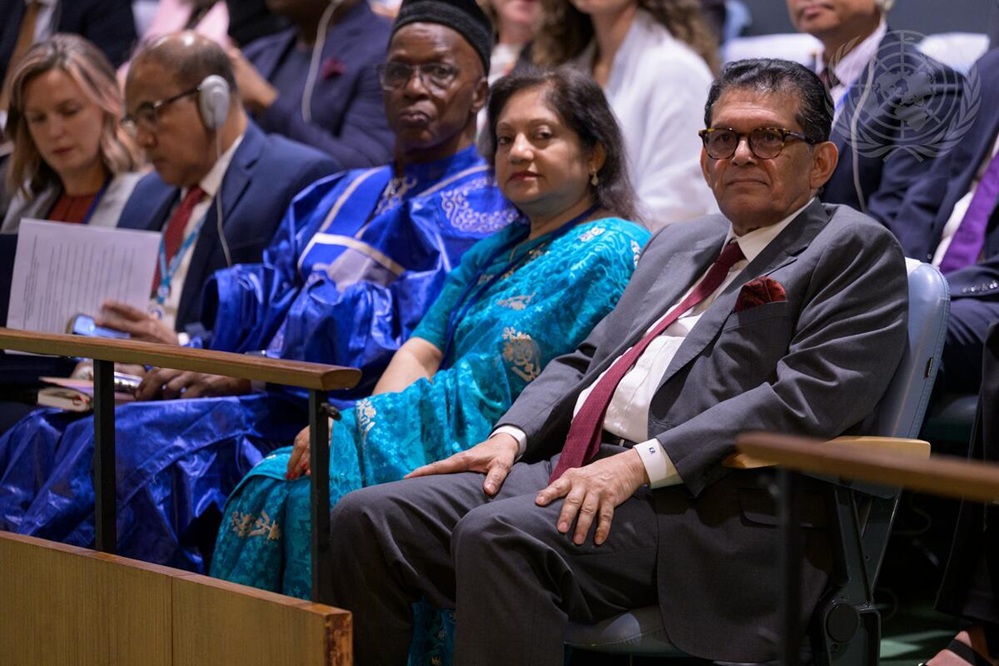
Recalling a visit by UN Secretary-General António Guterres to the Rohingya refugee camps in Bangladesh, Rahman said refugees had repeatedly expressed their desire to return home. He said Bangladesh had helped bring the voices of the Rohingya to the United Nations and pledged to continue raising their concerns during his presidency.

Dialogue During High-Level Week

Rahman described the presence of world leaders at the upcoming high-level week as an important opportunity to promote dialogue and diplomacy. The General Debate of the 81st General Assembly is scheduled to take place from September 22 to 28, bringing together heads of state and government and senior representatives from around the world.

Rahman expressed hope that world leaders would use their addresses to emphasize dialogue and diplomacy as means of resolving conflicts and reaffirm their commitments to development, human well-being and human rights. He said the presidency would review the priorities outlined by world leaders and seek areas that could form the basis of a common agenda.

“I Will Be President for All Countries”

Rahman emphasized that, as president of the General Assembly, he would represent all member states, regardless of whether they supported his election. He also addressed the selection of the next UN secretary-general, saying he would remain faithful to the process established by the UN Charter.

Under the Charter, the Security Council recommends a candidate for secretary-general and the General Assembly makes the appointment. Rahman said he would work closely with member states and the president of the Security Council to facilitate the process and ensure a smooth transition of leadership.
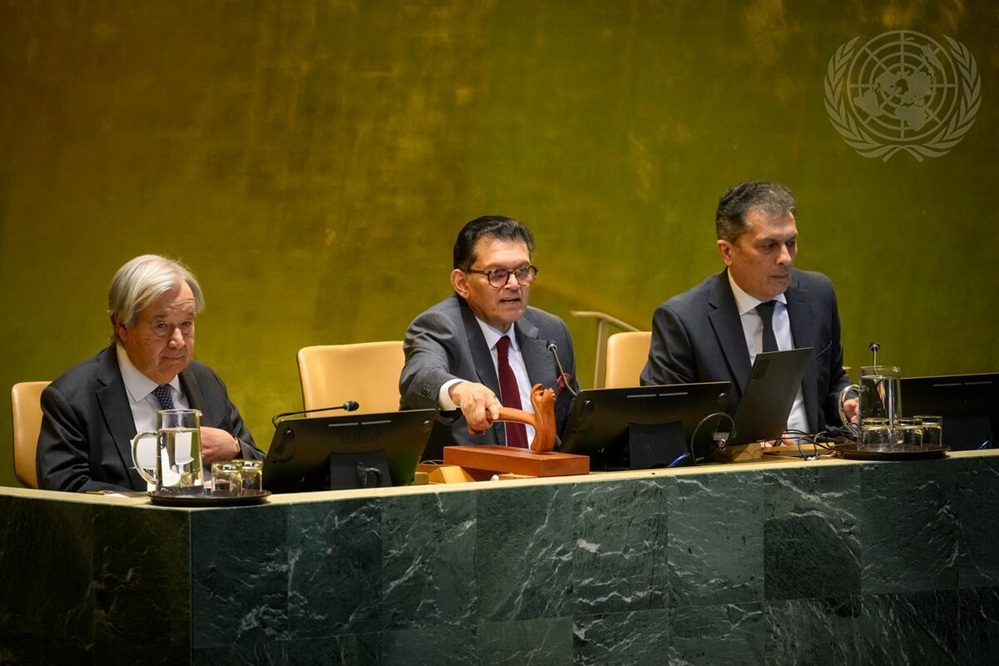
The 80th session of the General Assembly concluded at UN Headquarters on September 8, followed by Rahman’s formal assumption of the presidency of the 81st session. His election marks Bangladesh’s return to the presidency of the General Assembly after four decades. Former Bangladeshi Foreign Minister Humayun Rashid Choudhury presided over the 41st session in 1986-87.

Rahman, who first attended the United Nations as a member of Bangladesh’s delegation in 1985, described his return to the organization four decades later as a remarkable moment, while noting how dramatically the world has changed during the intervening years.

As president of the 81st session, Rahman will seek to promote dialogue in a deeply divided world, rebuild confidence in multilateralism and help make the United Nations more effective in confronting the challenges of the future.


Iran Strikes U.S. Base in Jordan as Hormuz Crisis Deepens

TEHRAN — Iran’s Islamic Revolutionary Guard Corps said Wednesday that it launched a missile attack against a U.S.-linked military base in Jordan, escalating tensions after American forces destroyed five Iranian oil tankers. The latest exchange marks another sharp escalation in the six-month-old U.S.-Iran war, with the conflict increasingly threatening regional security and global energy supplies.

Iran said its missile strike targeted the Al-Azraq air base in Jordan, which hosts U.S. military assets. Iranian state media reported that the operation damaged maintenance and repair facilities, aircraft deployment areas and shelters. Those damage claims could not immediately be independently verified. Jordan’s military said it intercepted 18 ballistic missiles launched from Iran toward the kingdom. No casualties were immediately reported.

The Iranian attack came after U.S. forces destroyed five Iranian oil tankers on Tuesday. The U.S. military said the crews were ordered to abandon the vessels before they were struck. The operation followed an Iranian attack targeting a U.S. Navy warship. Iranian officials had previously warned that American military bases in the region would be targeted if Washington attacked Iranian oil tankers.

Iran has also threatened to target oil tankers operating near U.S.-allied Kuwait and Bahrain. The threats have heightened fears of further disruption to commercial shipping across the Persian Gulf and the Strait of Hormuz.

The strategic waterway has become a major flashpoint in the conflict. Shipping through the Strait of Hormuz has fallen sharply, raising concerns about global oil and gas supplies. Reuters reported Wednesday that only six commodity vessels transited the strait on Tuesday, well below the recent average.

The escalation has also pushed oil prices higher. Brent crude approached $100 a barrel on Wednesday, while U.S. West Texas Intermediate crude traded above $94 a barrel as markets assessed the risk of further supply disruptions.

U.S. Secretary of State Marco Rubio has warned that Washington will continue responding to Iranian attacks. The latest U.S. strikes on Iranian tankers were described by American officials as retaliation for attacks on U.S. naval forces.

Iranian state media also claimed that the Revolutionary Guard had attacked two U.S. destroyers with ballistic missiles. The claim had not been independently confirmed by the U.S. military and should be treated as an Iranian claim.

The latest confrontation comes as both sides remain locked in a wider struggle over control of the Strait of Hormuz, a vital route for global energy shipments. With Iran threatening further attacks on shipping and U.S. forces continuing operations against Iranian assets, concerns are growing that the conflict could expand further across the Middle East and place additional pressure on global energy markets.


Trump Bans Some Canadian Imports as Trade War Escalates

Shibbir Ahmed, Washington DC: President Donald Trump has ordered new restrictions blocking the import of certain Canadian products into the United States, escalating the growing trade dispute between Washington and Ottawa.

Under proclamations issued on September 8, 2026, the United States will prohibit imports of specified Canadian dairy products, alcoholic beverages and motor vehicles, with the new restrictions taking effect September 29. The White House said the measures are intended to respond to what it describes as continued Canadian discrimination against U.S. commerce.

The move comes as Canada has imposed retaliatory tariffs on about $20 billion worth of U.S. goods, with duties ranging from 15% to 50%. The measures mark another major escalation in the trade dispute between the two longtime allies.

The latest U.S. action goes beyond tariffs by completely excluding certain Canadian products from the U.S. market. The White House says that if any part of the import ban is invalidated, the previously imposed 50% tariff would apply instead to the affected products.

The dispute has also widened beyond tariffs. Trump has threatened additional action against Canadian companies, including aircraft manufacturer Bombardier, while Canada has signaled that it intends to diversify its trade relationships and reduce its dependence on the U.S. market.

The escalating measures are raising concerns about the future of the United States-Mexico-Canada Agreement (USMCA) and the economic relationship between the two countries.