U.S. Expands Cuba Sanctions, Targets Military and Nickel Sectors

Shibbir Ahmed, WASHINGTON DC — The United States on Thursday announced new sanctions against eight Cuban entities and three individuals as part of the Trump administration’s broader effort to restrict Cuba’s military capabilities and sources of revenue. The U.S. Department of State said the latest measures target elements of Cuba’s military research and development apparatus as well as entities connected to the country’s nickel and mining sector.

The designations were imposed under Executive Order 14404, issued in May 2026. The order authorizes sanctions against foreign persons involved in specified activities related to Cuba, including operations in the defense, metals and mining, energy, financial-services and security sectors. Four Cuban military enterprises were designated for operating in or having operated in the defense and related-materials sector.

They are the Centro de Investigacion y Desarrollo de Simuladores (SIMPRO), which the State Department says develops and manufactures simulators and training programs for Cuba’s Revolutionary Armed Forces and other government entities; the Centro de Investigacion y Desarrollo Naval (CIDNAV), involved in research programs for the Cuban Revolutionary Navy; the Centro de Investigacion y Desarrollo de Armamento de Infanteria (CIDAI), involved in research related to infantry weapons; and Centro de Investigacion, Desarrollo y Produccion Grito de Baire (GELCOM), which produces electronics and communications equipment.

The United States also sanctioned three senior Cuban military officials associated with those enterprises: Joaquin Francisco Cancio Monteagudo, director general of SIMPRO; Dioglis Pedrera Arguello, director general of CIDNAV; and Julio Hurtado Betancourt, director general of CIDAI.

Four additional entities connected to Cuba’s nickel industry were also designated: SERCONI, CEPRONIQUEL, CEDINIQ and PINARES S.A. The State Department identified them as state-linked organizations involved in technical services, engineering, research and mineral surveying associated with Cuba’s nickel sector.

Under the sanctions, property and interests in property belonging to designated persons that are in the United States or under the possession or control of U.S. persons are blocked. U.S. persons are generally prohibited from engaging in transactions involving blocked property unless authorized or exempt.

The measures also create sanctions risks for certain foreign persons that conduct specified transactions with persons designated under E.O. 14404 or operate in sectors covered by the order. OFAC says E.O. 14404 operates alongside, rather than replacing, the existing Cuban Assets Control Regulations.

The latest action follows several rounds of U.S. sanctions against Cuban entities and officials during 2026. Earlier measures have also targeted Cuba’s financial channels, energy-related entities and resource-exploitation apparatus. The State Department said the ultimate objective of the sanctions is to encourage changes in behavior by the Cuban government.


US Embassy marks Constitution Day at Dhaka University

DHAKA – The US Embassy in Dhaka on Thursday observed US Constitution Day at Dhaka University, highlighting constitutional principles, democratic values and the traditions that have shaped the American constitutional system for more than two centuries.

US Ambassador to Bangladesh Brent T. Christensen joined Law Minister Mohammad Asaduzzaman, Dhaka University Pro-Vice Chancellor (Academic) Professor Abdus Salam, constitutional experts, academics and students at the programme held at the university’s Nabab Nawab Ali Chowdhury Senate Building.

In his remarks, Christensen highlighted the role of continuous debate and the pursuit of consensus in contributing to the resilience of the US Constitution. He also pointed to the Constitution’s emphasis on separation of powers, judicial independence and the ability to adopt amendments. The ambassador said these features have allowed the US constitutional system to evolve over time and have contributed to its influence on democratic systems around the world.

Dhaka University said the programme also featured discussions on constitutional governance, separation of powers, judicial independence, constitutional rights and comparative aspects of the constitutional experiences of Bangladesh and the United States.

Law Minister Asaduzzaman highlighted the historical significance of the US Constitution and its role in institutionalising principles related to democracy, freedom and the rule of law. He also noted the value of comparative academic discussions on issues such as judicial review, fundamental rights and constitutional limitations on state power. The Constitution Day programme included a public ceremony, panel discussion, essay competition, quiz contest and an exhibition titled “American Founders Museum.”

The event was organised as part of activities marking 250 years of American democracy. Constitution Day is observed annually in the United States on September 17, commemorating the signing of the US Constitution in 1787.


U.S. Extends Visa Sanctions on Palestinian Officials

Shibbir Ahmed, WASHINGTON DC — The United States has extended visa sanctions against members of the Palestine Liberation Organization (PLO) and officials of the Palestinian Authority (PA), citing what the State Department described as continued failures to meet commitments made to Washington.

In a September 16 media note, the State Department said it had notified Congress that the PLO and PA had again failed to comply with commitments outlined under the PLO Commitments Compliance Act of 1989 and the Middle East Peace Commitments Act of 2002.

The department accused the two organizations of pursuing actions at international institutions that Washington says contradict previous commitments related to UN Security Council Resolutions 242 and 338. It also cited efforts to pursue the Israeli-Palestinian conflict through international legal institutions, including the International Criminal Court (ICC) and International Court of Justice (ICJ), as well as efforts to obtain unilateral international recognition.

The State Department also cited what it described as continued payments to individuals convicted of terrorism and the glorification of terrorism and terrorists in public statements and educational materials. These are U.S. government allegations and were presented as the basis for the policy.

As a consequence, Washington said it would extend visa restrictions denying entry visas to PLO members and PA officials under Section 604(a)(1) of the Middle East Peace Commitments Act. The State Department said it would continue a standing waiver for personnel notified to the PLO Observer Mission to the United Nations, as in previous determinations.

The announcement comes ahead of the 81st UN General Assembly, when Palestinian representatives are expected to participate in high-level diplomatic meetings in New York. Reuters reported that the restrictions continue measures imposed previously, including the denial of a U.S. visa to Palestinian President Mahmoud Abbas, preventing him from attending the General Assembly in person.

The Palestinian Authority holds observer status at the United Nations rather than full UN membership. The latest U.S. action adds another point of tension to Washington-Palestinian relations as international attention remains focused on the Gaza conflict and efforts toward a broader Israeli-Palestinian political settlement.


DFC Approves $8 Billion in Global Investments

Shibbir Ahmed, WASHINGTON, D.C. — The U.S. International Development Finance Corporation (DFC) Board of Directors has approved more than $8 billion in new investments aimed at expanding U.S. exports, strengthening critical infrastructure and energy security, and supporting American technology and businesses in international markets.

The DFC said the investments include projects in Ukraine, Jordan, Sub-Saharan Africa and emerging markets, with additional support for critical minerals in West Africa. The agency described the package as part of its effort to advance U.S. economic and national security interests.

One major component will support U.S. exports to emerging markets through a counter-guarantee for the International Finance Corporation’s Global Trade Finance Program. The arrangement is designed to help foreign banks expand trade-finance capacity and facilitate purchases of American goods.

In Ukraine, DFC will provide financing to Vodafone Ukraine to strengthen telecommunications infrastructure, including the development of secure and reliable 5G networks. The agency also approved financing for a 200-megawatt/400-megawatt-hour battery energy storage portfolio across six Ukrainian sites. The project, developed by DTEK with technology from U.S.-based Fluence, is designed to improve the stability and resilience of Ukraine’s electricity grid. DFC said the storage system could provide enough power for approximately 600,000 homes for two hours.

In Jordan, DFC approved a loan for the National Carrier Project Company to support construction, operation and maintenance of a seawater desalination plant and water-conveyance system. Political-risk insurance will also be provided for equity investors Meridiam and Suez.

In Sub-Saharan Africa, DFC will make an equity investment in WIOCC Group to expand digital infrastructure across the continent. WIOCC operates telecommunications, data-center and fiber-network infrastructure spanning 30 African countries, according to DFC.

DFC is also supporting a critical-minerals project in West Africa. The agency said some additional transactions remain confidential because of commercial sensitivities and may require further steps, including congressional notification, before they can be formally committed and closed.


China Warns U.S. Space Weapons Could Fuel Arms Race

BEIJING — China has urged the United States to halt its military buildup in outer space, warning that the deployment of weapons in orbit could trigger a global arms race and increase strategic tensions.

The warning followed comments from U.S. officials acknowledging that the United States has weapons deployed in orbit. U.S. Air Force Secretary Troy Meink said the weapons are intended to help defend against hostile actions involving space. Chinese Foreign Ministry spokesperson Guo Jiakun said Beijing opposes the weaponization of outer space and called on Washington to stop expanding its military capabilities there.

“China stands for peaceful use of outer space and keeping it safe, and opposes any arms race in outer space,” Guo said at a Foreign Ministry briefing on September 15. He urged the United States to maintain global strategic stability through concrete actions.

Chinese state media and military analysts have also warned that the expansion of U.S. military capabilities in orbit could encourage other countries to develop counter-space weapons, potentially creating a cycle of competition and increasing the risk of conflict in space.

The issue highlights growing international concerns over the military use of space. Russia has separately called for efforts to prevent an arms race in outer space, arguing that a legally binding agreement could help restrict offensive weapons in orbit.

The United States and China are already competing across several strategic areas, including advanced technology, artificial intelligence and military capabilities. The latest dispute adds space security to the growing list of issues affecting relations between the two powers.


U.S. Pays $725 Million to UN, Keeps Voting Rights

Shibbir Ahmed, New York — The United States has paid $725 million to the United Nations, reducing its outstanding financial obligations to the world body and ensuring that Washington retains its voting rights in the UN General Assembly. The payment comes just days before world leaders are due to gather in New York for the annual General Assembly session.

The United Nations said the United States transferred $725 million for the organization’s regular budget on Tuesday. Washington also paid an additional $102 million toward UN peacekeeping operations on Friday. Despite the latest payments, the United States still owes approximately $1.312 billion to the UN regular budget, according to UN spokesperson Farhan Haq.

The payment also removes the immediate risk that the United States could lose its voting rights under Article 19 of the UN Charter. The provision says a member state can lose its vote in the General Assembly when its arrears reach or exceed the amount of contributions due for the preceding two full years, although the General Assembly can grant an exception in certain circumstances.

The United States is the largest contributor to the UN budget, but the Trump administration has criticized the organization and reduced or delayed funding to various UN agencies. Washington has also pushed for reforms and cost reductions across the UN system.

The latest payment comes as the United Nations faces continuing financial pressure and implements its “UN80” reform and cost-cutting initiative. China, the UN’s second-largest contributor, paid $641.4 million toward its regular budget contribution earlier this month, according to UN figures cited by Reuters. The U.S. payment means Washington will retain its vote as the 2026 UN General Assembly prepares to convene in New York next week, while the broader dispute over U.S. funding and UN reforms remains unresolved.


Bangladesh RMG Exports to US Jump 25.65%

DHAKA — Bangladesh’s readymade garment (RMG) exports to the United States surged 25.65 percent year-on-year in August, marking the highest monthly growth recorded in the US market, according to data from the Export Promotion Bureau (EPB). Bangladesh exported more than $817 million worth of garments to the US in August of the 2026-27 fiscal year, compared with $650.34 million during the same month a year earlier.

During July-August of FY2026-27, Bangladesh’s RMG exports to the US reached $1.61 billion, registering an 11.42 percent increase from the corresponding period of FY2025-26. The average monthly RMG export to the US during the first two months of the current fiscal year stood at $806.46 million, compared with an average of $645.38 million in FY2025-26. The strong performance was largely driven by the sharp increase recorded in August.

The United States remains Bangladesh’s largest single market for RMG exports. In FY2025-26, Bangladesh exported around $9.04 billion in merchandise to the US, up 4.09 percent from the previous fiscal year. Of that amount, approximately $7.74 billion came from RMG products, while non-garment exports accounted for about $1.30 billion.

Bangladesh’s non-RMG exports to the US include leather and leather goods, jute products, home textiles, agricultural and processed food products, plastics and melamine products, pharmaceuticals, footwear, textiles and yarn, and light engineering products.

US market offers further growth opportunities

Apparel industry leaders say Bangladesh has significant room to expand its presence in the US market, particularly through product diversification and increased production of higher-value garments. Mohammad Fazlul Hoque, an apparel entrepreneur and administrator of the Federation of Bangladesh Chambers of Commerce and Industry (FBCCI), said the August increase was partly linked to the deadline for placing orders for winter apparel.

“Despite various global crises, Bangladeshi entrepreneurs have an inherent capacity to compete,” he said, adding that exporters are receiving better orders from US buyers for the coming months. Hoque said greater product diversification could help Bangladesh substantially increase exports to the US.

Fazle Shamim Ehsan, executive president of the Bangladesh Knitwear Manufacturers and Exporters Association (BKMEA) and managing director of Fatullah Apparels Ltd, said changing global conditions have created opportunities for Bangladeshi exporters. He stressed that reliable energy supplies and policy continuity would be important for fully utilizing those opportunities.

Mahmududdin Rubel, CEO of Bangladesh Apparel Voice, described the current pace of RMG exports to the US as encouraging. He estimated that if the current trend continues over the next 12 months, Bangladesh’s RMG export earnings from the US could reach $9 billion in FY2026-27. He also emphasized the importance of product diversification, higher value addition and improved quality to strengthen Bangladesh’s position in the US apparel market.

Focus shifts to export diversification

Alongside garments, Bangladesh is seeking to expand exports of leather, jute, home textiles, agricultural and processed food products, pharmaceuticals, plastics and light engineering goods to the US. The Commerce Ministry has identified pharmaceuticals, leather and leather products, agricultural goods, light engineering and information and communication technology as priority sectors for expanding trade with the United States.

Bangladesh earned around $48 billion from total merchandise exports in FY2025-26, with the United States accounting for approximately $9.04 billion, making it the country’s largest single export destination.

The sharp growth in RMG exports during the opening months of FY2026-27 has renewed attention on Bangladesh’s potential to expand its share of the US apparel market while diversifying its overall export base.


US Plans $2.8 Billion Munitions Sale to Israel

Shibbir Ahmed, WASHINGTON DC: The Trump administration is planning to sell Israel a $2.8 billion package of munitions, including tens of thousands of 2,000-pound bombs, according to a U.S. official familiar with the proposed sale. The package would include 20,000 MK-84 bombs and 20,000 BLU-117 bombs, both weighing 2,000 pounds, according to the official.

The proposed sale has been informally communicated to congressional committees that review major U.S. arms transfers, but the deal has not yet been publicly announced by the State Department. The Israeli Embassy in Washington also had not publicly commented on the proposal as of Tuesday.

The planned weapons transfer comes as the United States continues its military and security partnership with Israel amid ongoing conflicts and heightened tensions across the Middle East.

Israel has used similar heavy munitions in its military operations in Gaza and Lebanon. Their use in densely populated areas has drawn scrutiny from human rights experts because of the potential for significant civilian casualties.

The proposed sale also comes amid debate in the United States over Washington’s military support for Israel. Reuters reported that a 2026 public opinion poll found an increasing share of Americans believe U.S. support for Israel has gone too far, with the shift particularly pronounced among Democrats.

The proposed $2.8 billion package would represent a significant addition to Israel’s stock of heavy U.S.-made munitions. However, the plan remains subject to the U.S. arms-sale process and congressional review.

The proposal comes as the wider Middle East remains under heightened military tension following the U.S.-Israeli conflict with Iran earlier this year and continuing violence in the region.


US Senate blocks major cryptocurrency bill

Shibbir Ahmed, WASHINGTON DC: The U.S. Senate on Tuesday blocked legislation that would establish a comprehensive federal regulatory framework for cryptocurrencies, dealing a major setback to the digital-asset industry and Republican lawmakers who had championed the bill. The Clarity Act failed to secure the 60 votes needed to advance, with senators voting 49-50 on the procedural measure, according to the Associated Press.

The legislation was designed to provide clearer rules for the $2.3 trillion U.S. cryptocurrency market, including defining regulatory responsibilities and establishing greater legal certainty for digital-asset companies. Crypto industry groups had strongly backed the measure and spent hundreds of millions of dollars lobbying for its passage.

Democrats opposed advancing the bill without stronger restrictions concerning President Donald Trump and his family’s financial interests in cryptocurrency. Trump and his family have significant business interests in the sector, including World Liberty Financial and a cryptocurrency meme coin.

Republicans had revised the legislation in an effort to address those concerns. The revised version included provisions giving state attorneys general greater enforcement authority and requiring public officials with significant interests in crypto-related companies to divest those interests or place them in blind trusts. Democrats argued that the changes did not go far enough.

The bill also faced concerns from the banking industry over provisions involving stablecoins, which allow certain digital tokens to maintain a value linked to traditional currencies. Banking groups warned that stablecoin rewards could encourage customers to move deposits away from banks and potentially affect lending.

The Senate’s action represents a significant setback for the cryptocurrency industry’s effort to secure its first comprehensive federal regulatory framework. Reuters reported that the legislation now faces limited prospects for revival in the near term, particularly with Congress approaching the November midterm elections and a recess.

Financial markets reacted to the Senate vote. Bitcoin fell about 4% to around $75,908, while shares of cryptocurrency companies Coinbase and Circle each declined roughly 9%, according to Reuters.

The Securities and Exchange Commission and Commodity Futures Trading Commission have meanwhile continued developing cryptocurrency-related rules, but industry participants have argued that legislation from Congress is needed to provide a more permanent regulatory framework.


Republican lawmaker seeks Hegseth impeachment over Iran war

Shibbir Ahmed, WASHINGTON DC: Republican Rep. Thomas Massie on Tuesday filed articles of impeachment against Defense Secretary Pete Hegseth, accusing him of conducting military action against Iran without congressional authorization.

Massie, a Kentucky Republican and outspoken critic of the U.S. war in Iran, filed the impeachment resolution as a privileged measure, meaning the House is required to take it up within two legislative days.

The lawmaker’s resolution accuses Hegseth of abusing his office by carrying out hostilities against Iran without a declaration of war or specific authorization from Congress. Massie has argued that the administration’s continued military operations violate Congress’s constitutional authority over decisions to initiate war.

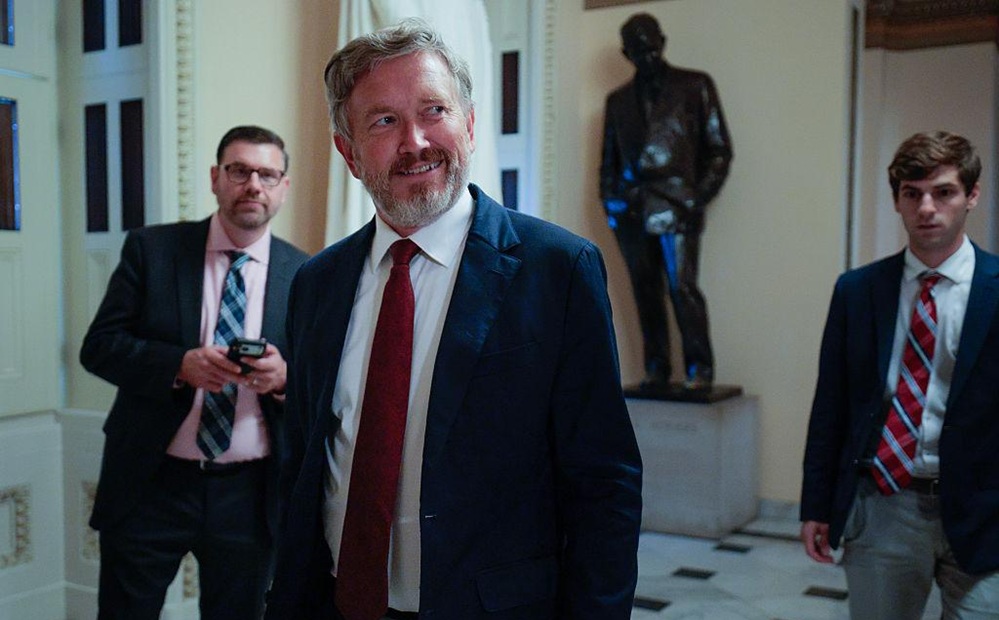
Rep. Thomas Massie, the Republican congressman from Kentucky who filed the impeachment articles against Defense Secretary Pete Hegseth today.

The move comes as the United States remains involved in the conflict with Iran, which began with U.S.-Israeli strikes on Iran on February 28. Massie has repeatedly opposed the war and has also criticized U.S. military support for Israel. The Pentagon rejected the impeachment effort and reaffirmed its support for Hegseth.

“The entire Department is unified behind the Secretary’s vision and will continue working to put our warfighters and America first,” Pentagon press secretary Kingsley Wilson said in a statement. The impeachment effort is unlikely to secure the support needed to remove Hegseth, but Massie’s filing could force House members to take a position on the administration’s military actions.

Massie is not seeking reelection after losing the Republican primary earlier this year to Ed Gallrein, a candidate endorsed by President Donald Trump. His opposition to the Iran war has been a prominent feature of his congressional record. The filing comes amid continuing debate on Capitol Hill over the extent of the president’s authority to conduct military operations without explicit congressional authorization.