Tarique Rahman Leaves for New York for UNGA

DHAKA — Prime Minister Tarique Rahman left Dhaka early Monday for New York to attend the 81st session of the United Nations General Assembly (UNGA), where he is scheduled to deliver his first address to the General Assembly as prime minister on September 24.

A Turkish Airlines flight carrying the prime minister, his wife Dr Zubaida Rahman and members of his entourage departed Hazrat Shahjalal International Airport at around 6:05 a.m. The flight is scheduled to transit through Istanbul before arriving at John F. Kennedy International Airport in New York at about 5:55 p.m. local time.

The prime minister will be received at JFK by Bangladesh’s Permanent Representative to the United Nations in New York Irene Zubaida Khan and Bangladesh Ambassador to the United States Tareq Md Ariful Islam before being escorted to the Hyatt Grand Central New York, where he is scheduled to stay.

His official engagements are set to begin on September 22 with a welcome breakfast hosted by UN Secretary-General António Guterres for heads of state and government. He will subsequently attend the opening of the high-level General Debate and a reception hosted by the U.S. president for heads of state and government and their spouses.

On September 23, Tarique Rahman is scheduled to attend meetings on global inequality and climate action. He will also participate in a side event on the Rohingya crisis, where Bangladesh is expected to seek stronger international cooperation for the early repatriation of forcibly displaced Rohingyas to Myanmar.

Bangladesh is also expected to highlight its position as a climate-vulnerable country, focusing on climate finance, adaptation, technology transfer, loss and damage, and climate justice.

On September 24, the prime minister will deliver his General Assembly address. He is also scheduled to speak at a high-level meeting on the threats posed by rising sea levels and attend Bangladesh-hosted events on maternal and newborn health and midwifery.

According to the Foreign Secretary, the prime minister’s UNGA address will cover Bangladesh’s democratic journey, rule of law and accountability, global peace and security, climate change, sustainable development, economic cooperation, youth and women’s empowerment, education and health, the Rohingya crisis, technology and reform of the multilateral system.

On the sidelines of the General Assembly, Tarique Rahman is scheduled to hold bilateral meetings with the Crown Prince of Kuwait and the prime ministers of Croatia, Bhutan, Thailand, Pakistan and Haiti. Discussions are expected to cover political and economic relations, trade and investment, development cooperation and the Rohingya crisis.

He is also scheduled to meet UN Secretary-General António Guterres, the President of the European Council, the President of the World Bank Group, the UN Special Envoy on Myanmar and the UN high commissioners for refugees and human rights.

As part of the government’s economic diplomacy, the prime minister is scheduled to meet senior representatives of Meta, Wall Street firms and other business organisations to discuss investment, manufacturing, infrastructure, technology, skills development and employment opportunities. Tarique Rahman is scheduled to leave New York for Dhaka on the night of September 25.




US Expands Social Media Screening for Visa Applicants

Shibbir Ahmed, Washington DC — The U.S. Department of State is expanding its online presence screening program to three additional categories of nonimmigrant visa applicants, requiring certain foreign nationals to make their social media profiles publicly accessible as part of the visa vetting process.

Beginning October 1, 2026, the expanded screening will apply to applicants for I, TN and TD visas, according to a State Department announcement issued September 18. Applicants in these categories will be instructed to set the privacy settings on all of their social media profiles to “public” or “open” to facilitate the review.

The I visa is used by representatives of foreign media, including members of the press, radio, film and print industries who travel temporarily to the United States to work in their profession. TN visas are available to qualifying professionals from Canada and Mexico under the United States-Mexico-Canada Agreement, while TD visas are for eligible dependents of TN visa holders.

The State Department said it uses information from available sources during visa screening to determine whether applicants are admissible to the United States, including whether they may pose national-security or public-safety concerns.

“Every visa adjudication is fundamentally a national security decision,” the department said, emphasizing that applicants must demonstrate their eligibility for the visa category and their intention to comply with the terms of admission.

The latest expansion adds I, TN and TD applicants to a growing list of visa categories already subject to online presence review. The program currently covers several diplomatic and official categories, F and M student visas, H-1B and certain related employment visas, J exchange-visitor visas, K fiancé and dependent visas, Q cultural-exchange visas, R religious-worker visas, and S, T and U categories involving witnesses, informants and victims.

The State Department previously expanded online presence screening in March to additional visa classifications, including H-3, H-4 dependents of H-3 applicants, K-1, K-2, K-3, Q, R-1, R-2, S, T and U visas. H-1B and H-4 applicants were brought under the online-presence review in December 2025.

The department says the screening is part of a broader effort to strengthen visa vetting and identify applicants who may be inadmissible to the United States. The policy applies during the visa adjudication process and does not mean that every applicant whose social-media account is reviewed will be denied a visa.

For foreign journalists, the change is particularly significant because the I visa is specifically designed for eligible representatives of foreign media organizations. The State Department says I-visa holders may engage in informational or educational activities in the United States connected to the news-gathering and reporting functions of their foreign media organization.

The expanded screening comes as the Trump administration continues to tighten immigration and visa-screening procedures. The administration has previously expanded online vetting for students, exchange visitors and certain employment-based visa applicants. The new requirements for I, TN and TD applicants will take effect October 1, 2026.


Trump Announces Greenland Security Deal

Shibbir Ahmed, Washington DC — President Donald Trump has announced a new security agreement involving the United States, Denmark and Greenland that would expand the U.S. military presence on the strategically important Arctic island and give Washington long-term security access. Trump announced the agreement on September 18, describing it as providing the United States with “permanent control” over Greenland’s security and saying it would address Washington’s national security concerns. He also said the United States would begin developing plans for a larger military presence on the island.

The agreement does not transfer Greenland’s sovereignty to the United States. Denmark and Greenland said the arrangement recognizes the sovereignty and territorial integrity of the Kingdom of Denmark as well as the Greenlandic people’s right to self-determination. The governments have also indicated that the agreement must go through the necessary parliamentary procedures before it can take effect.

The precise terms of the agreement have not yet been made public. According to reporting by Reuters, the deal would allow the United States to expand its military presence in Greenland while preventing U.S. adversaries from establishing military bases on the island or making sensitive investments there.

A U.S. State Department official said the agreement guarantees Washington permanent access, basing and overflight rights and is designed to remain in place even if Greenland eventually becomes independent. The official also said the agreement would prevent non-NATO countries from establishing military bases in Greenland.

Trump said the United States would work with Greenland’s population on the development and construction of additional military facilities. The United States already maintains a significant military installation at Pituffik Space Base in northwestern Greenland, formerly known as Thule Air Base. The U.S. has maintained military facilities on the island for decades under a 1951 defense agreement with Denmark.

Greenland’s Arctic landscape highlights the island’s strategic importance in the region.

The announcement follows months of tension over Greenland. Trump has repeatedly argued that the island is strategically important to U.S. national security because of its location between North America, Europe and the Arctic region. His earlier push to acquire Greenland generated strong opposition in Denmark and Greenland and created tensions with other NATO allies.

Danish Prime Minister Mette Frederiksen said the agreement would strengthen security in the Arctic and North Atlantic and would be beneficial to NATO and Europe. She also emphasized that the arrangement recognizes Denmark’s sovereignty and Greenland’s right to self-determination.

Greenland’s Prime Minister Jens-Frederik Nielsen also welcomed the agreement, saying it recognizes Greenland’s interests and its role in international cooperation. Greenland is an autonomous territory within the Kingdom of Denmark and has its own government and parliament.

U.S. Secretary of State Marco Rubio said the agreement addresses Washington’s national security concerns and ensures that Greenland remains part of the strategic defense area of North America. NATO also welcomed the announcement, saying greater security and cooperation in the Arctic and North Atlantic would benefit the alliance.

The planned agreement is expected to be signed in New York during the United Nations General Assembly next week, according to the governments involved. It will then face the required parliamentary procedures in Denmark and Greenland.

The agreement represents a shift from Trump’s earlier proposal to acquire Greenland toward a security-focused arrangement that leaves the territory under Danish sovereignty while giving the United States expanded and potentially permanent military access. The full text of the agreement will be important in determining the precise scope of Washington’s rights and obligations under the arrangement.


US-China Talks in New York Target AI, Trade and Critical Minerals

Shibbir Ahmed, New York — The United States and China opened high-level economic talks in New York on Sunday, with artificial intelligence, trade, tariffs and critical minerals on the agenda as Washington and Beijing prepare for a summit between President Donald Trump and Chinese President Xi Jinping later this week.

U.S. Treasury Secretary Scott Bessent and Chinese Vice Premier He Lifeng are meeting at JPMorgan Chase’s headquarters in Manhattan, alongside U.S. Trade Representative Jamieson Greer. The talks were scheduled to begin at about 10:30 a.m. ET and were expected to continue throughout the day. The discussions are intended to prepare potential agreements and reduce outstanding differences ahead of the Trump-Xi summit scheduled for Sept. 24 in Washington.

Trade truce and tariffs

A central issue is the status of the current U.S.-China trade truce, which is scheduled to expire on Nov. 10. Officials are expected to discuss tariffs on non-strategic goods, market access and China’s commitments to increase purchases of U.S. agricultural products. Issues left unresolved from Trump’s May meeting with Xi in Beijing are also expected to remain part of the negotiations. The talks come as both countries seek to manage a trade relationship that has significant implications for global markets and supply chains.

Critical minerals and rare-earth supplies

Critical minerals and Chinese rare-earth magnets are another major issue in the New York discussions. The United States has raised concerns about the flow of rare-earth magnets and other critical materials needed for advanced manufacturing and technology industries. Rare earths are particularly important to the production of components used in electronics and advanced semiconductor technologies. Washington is seeking greater reliability in these supply chains as the two countries negotiate broader economic arrangements.

AI takes center stage

Artificial intelligence is emerging as a new area of U.S.-China economic and strategic competition. Bessent said the discussions are expected to cover both open-weight and closed-weight AI models. Open-weight systems make key elements of an AI model available to users, allowing them to download and modify the technology for specific applications.

U.S. officials are also interested in potential safeguards, or “guard rails,” to address shared risks associated with increasingly powerful AI systems. Reuters reported that the talks come amid concerns about security breaches involving AI models.

The United States and China are among the world’s leading developers and users of advanced artificial intelligence, making cooperation and competition over the technology an increasingly important part of their broader relationship.

Ahead of Trump-Xi summit

The New York meetings are taking place just days before Trump and Xi are scheduled to meet in Washington. Several issues from previous negotiations remain unresolved, including tariffs, agricultural purchases, rare-earth supplies and technology-related concerns. Reuters reported that analysts expect the two sides to focus on limited steps that could help prevent further escalation rather than seeking an immediate comprehensive agreement.

The outcome of the New York discussions could therefore help shape the agenda for the leaders’ upcoming meeting, while providing an indication of whether Washington and Beijing can maintain their current trade truce and expand cooperation in selected areas. The talks are also taking place as New York prepares to host world leaders for the United Nations General Assembly’s high-level week, bringing increased diplomatic activity to the city.


Sheikh Hasina to Address US Awami League Press Meet Sept. 24

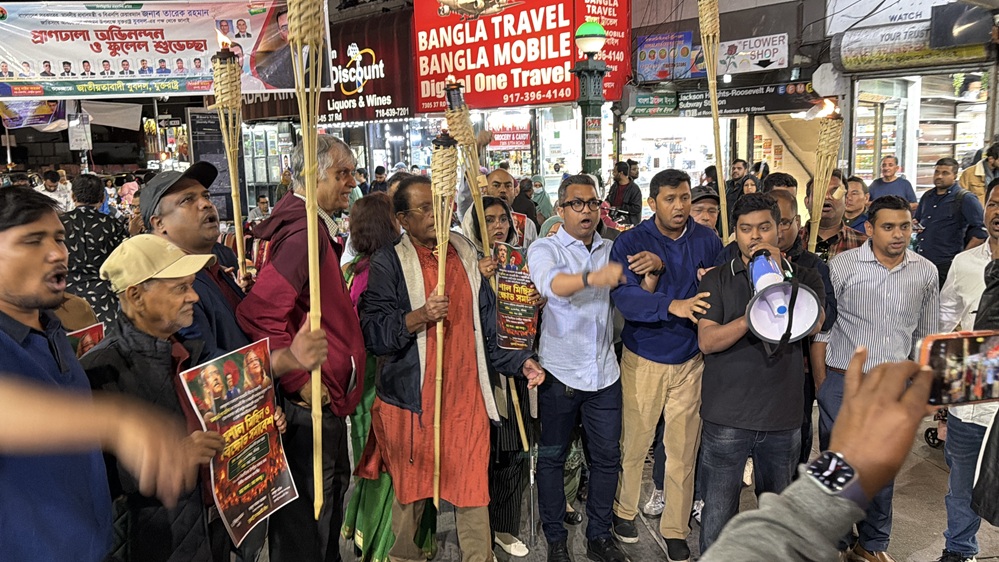
New York — The US Awami League is scheduled to hold a press conference in New York at 8 p.m. on September 24, with Bangladesh Awami League President and former Prime Minister Sheikh Hasina expected to participate as the chief guest, according to the organization. The announcement was made by US Awami League President Dr. Siddiqur Rahman during a torchlight procession and protest rally organized by the party at Diversity Plaza in Jackson Heights, New York, on Saturday, September 19.

According to Dr. Siddiqur Rahman, Sheikh Hasina will deliver what the organization described as a guideline-setting address on the future of Bangladesh. He also said she would make an important decision concerning her planned return to Bangladesh in December. Sheikh Hasina said in a Reuters interview published in July that she planned to return to Bangladesh in December, despite facing legal proceedings and a death sentence. She has been living in India since leaving Bangladesh in August 2024.

Torchlight rally in Jackson Heights

The September 19 rally brought together leaders and activists from the US Awami League and its affiliated organizations, including the Jubo League, Sramik League, Swechchhasebak League, Mohila Awami League and Chhatra League. Participants chanted slogans including “Go back, go back, Tarique, Tarique” and “Step down, step down, Tarique, Tarique” during the procession and rally.

The program was chaired by US Awami League President Dr. Siddiqur Rahman and moderated by the organization’s General Secretary Abdus Samad Azad. According to the organizers, the protest was held in response to court verdicts involving Sheikh Hasina and leaders of the Awami League and its affiliated organizations, the situation surrounding the lockdown in Dhaka, and the planned visit of BNP Chairman and Prime Minister Tarique Rahman to the United States.

Addressing the gathering, Dr. Siddiqur Rahman said the US Awami League would organize protest and resistance programs wherever Tarique Rahman is present between September 21 and 25. He also called on Awami League supporters living in the United States to participate in programs organized by the US Awami League.

Sheikh Hasina’s planned December return

Sheikh Hasina has publicly said she intends to return to Bangladesh in December. In an interview with Reuters published in July, she said she planned to return from India despite the legal consequences she could face. In August, she again said she intended to return to Bangladesh and that the exact date would be announced when the time was appropriate, while indicating that she wanted the return to take place in December.

The issue has gained renewed attention following recent court proceedings involving former Awami League officials. On September 15, a Bangladesh tribunal sentenced seven former aides of Sheikh Hasina to death in absentia in cases connected to the 2024 crackdown, according to Al Jazeera. The report said the defendants were convicted of crimes including murder and inciting killings.

Political activity intensifies in New York

Tarique Rahman’s visit to New York for the 81st session of the United Nations General Assembly has prompted increased political activity among Bangladeshis in the United States.

The US Awami League leadership said it has planned a series of demonstrations, protests and other programs in New York and elsewhere in the United States throughout the period of Tarique Rahman’s stay for the UN General Assembly. According to party leaders, Awami League supporters from different US states and other countries have begun arriving in the United States to participate in the planned programs.

The BNP’s US organization has also been holding programs ahead of Tarique Rahman’s visit, including a “Meet the Press” event in New York, where the party called on expatriate Bangladeshis to support its activities surrounding the prime minister’s UNGA visit.

With competing political groups preparing separate programs around the UN General Assembly, the period is expected to bring increased political activity within the Bangladeshi-American community in New York.

The US Awami League says Sheikh Hasina’s September 24 address will focus on Bangladesh’s future and will include an announcement concerning her planned return to the country. The details of that announcement remain to be seen.


Trump to Personally Welcome Xi in Washington

Shibbir Ahmed, Washington DC — U.S. President Donald Trump is set to personally welcome Chinese President Xi Jinping at Joint Base Andrews when Xi arrives in the Washington area next week for a high-profile state visit, in a rare protocol gesture by a U.S. president.

Xi is expected to arrive on Wednesday, September 23, ahead of talks with Trump at the White House on September 24. Trump’s decision to greet Xi at the airport marks a departure from the usual practice of receiving visiting foreign leaders at the White House.

The visit will include a formal arrival ceremony at the White House, a military review in the Rose Garden and a state dinner hosted by Trump and First Lady Melania Trump. Senior U.S. officials said a number of leading technology executives are expected to attend the dinner.

Trade, rare-earth supplies and artificial intelligence are expected to be among the major issues discussed by the two leaders. The summit comes as Washington and Beijing continue efforts to manage tensions over trade and technology while seeking greater stability in their bilateral relationship.

The upcoming meeting will be the second face-to-face encounter between Trump and Xi this year, following Trump’s visit to Beijing in May. Chinese Vice Premier He Lifeng is also scheduled to hold preparatory economic and trade talks with U.S. officials ahead of the summit.


UN Chief Deeply Regrets US Visa Denial to Mahmoud Abbas

Shibbir Ahmed, New York: United Nations Secretary-General António Guterres has expressed “deep regret” over the United States’ decision to deny a visa to Palestinian Authority President Mahmoud Abbas for the second consecutive year, preventing him from attending the upcoming UN General Assembly in person. UN spokesperson Stéphane Dujarric said Friday that Guterres was concerned about the impact of the decision on the ability of the State of Palestine to participate fully in the work of the United Nations.

“The full participation of all delegations in the work of the Organization is essential to its proper functioning,” Dujarric said in a statement. The U.S. State Department announced that visas would not be issued to Abbas and other Palestinian officials seeking to attend the high-level UN General Assembly session, which begins in New York on Tuesday. Members of the Palestinian mission to the United Nations will continue to participate.

Guterres has urged the United States, as the host country, to ensure that visas are issued to members of all delegations in accordance with its obligations. Dujarric said the secretary-general would continue engaging with U.S. authorities on the issue.

Abbas to Address UNGA Virtually

The U.S. decision marks the second consecutive year that Abbas has been unable to attend the General Assembly in person. Last year, he addressed the gathering by video after the Trump administration denied visas to members of the Palestinian delegation. On Thursday, the UN General Assembly voted 152-3 to allow Abbas to address this year’s high-level debate virtually. The United States, Israel and Paraguay voted against the measure, while four countries abstained.

US Cites Palestinian Policies

Washington has defended the visa restrictions by citing what it describes as the Palestinian Authority’s failure to meet commitments related to peace efforts and reforms. The U.S. State Department has also cited Palestinian efforts to pursue the Israeli-Palestinian conflict through international institutions, including the International Criminal Court (ICC) and the International Court of Justice (ICJ). Washington has argued that such moves seek to bypass negotiations through international legal and diplomatic mechanisms.

The United States and Israel have also criticized the Palestinian Authority’s former policy of providing payments to families of imprisoned or killed Palestinians, including individuals accused of carrying out attacks against Israelis. The Palestinian Authority has since reformed the system, saying assistance would be based on families’ financial needs rather than political affiliation or prisoner status.

Continuing Tensions Over Palestinian Representation

The visa dispute comes amid continuing tensions over Palestinian representation at the United Nations and the broader Israeli-Palestinian conflict. The United States has opposed efforts to internationalize the conflict through international courts and has also disagreed with the position of the majority of UN member states that recognized Palestine at the United Nations last year. According to AFP, 142 UN member states recognized a Palestinian state in 2025.

Despite the visa restrictions, Palestinian diplomats accredited to the United Nations will continue to represent the State of Palestine at UN meetings, while Abbas is expected to address the General Assembly remotely. Guterres has maintained that the participation of all delegations is important to the functioning of the United Nations and said he would continue discussions with Washington over the issue.


Russia and China Veto US-Backed Iran Sanctions Monitoring Resolution

Shibbir Ahmed, New York — Russia and China on Thursday vetoed a U.S.-drafted United Nations Security Council resolution that sought to extend the mandate of a panel of experts monitoring international sanctions on Iran. The resolution received 11 votes in favor, while Pakistan and Somalia abstained. The Russian and Chinese vetoes blocked its adoption.

The proposed resolution would have extended the mandate of the independent panel of experts for another year. The panel was established to monitor implementation of sanctions imposed on Iran and report possible violations to the 15-member Security Council.

The vote comes amid a wider dispute over the legal status of UN sanctions on Iran. Western countries, including Britain, France and Germany, triggered the “snapback” mechanism under the 2015 Iran nuclear agreement in 2025, arguing that Tehran had violated its nuclear commitments. The move resulted in the reimposition of UN sanctions.

Russia and China reject the Western interpretation and argue that the UN sanctions had expired when Security Council Resolution 2231 reached its scheduled end date in October 2025. Russian Ambassador Vassily Nebenzia said the U.S.-backed resolution lacked a legal basis and urged the parties to resolve the nuclear dispute through political and diplomatic means.

The United States criticized the vetoes, saying the absence of an independent panel would create a gap in monitoring sanctions violations. U.S. Deputy Ambassador Jennifer Locetta said the panel provided impartial, evidence-based reporting on potential violations.

France and other Western members also criticized the veto, while stressing that the veto does not itself remove the sanctions that they consider to remain in force. The dispute has also left the Security Council divided over how to monitor Iran’s nuclear-related activities and enforce sanctions. The UN sanctions include measures affecting Iranian assets, arms-related transactions and ballistic-missile activities.

The latest vote highlights continuing divisions among the permanent members of the Security Council over Iran’s nuclear program, the validity of the sanctions and the role of international monitoring.


UN Experts Cite Possible US War Crimes in Iran

GENEVA — United Nations-backed human rights experts said Thursday they found “reasonable grounds” to believe that the United States committed war crimes in two military strikes in Iran, including an attack on a school that killed more than 150 people. The findings come from the Independent International Fact-Finding Mission on Iran, which investigated the conduct of the United States during the war that began in February, as well as human rights violations allegedly committed by Iranian authorities. The mission’s report is due to be presented to the UN Human Rights Council in Geneva.

The experts said they found reasonable grounds to believe U.S. forces were responsible for a February 28 strike on the Shajareh Tayyebeh Primary School in Minab, southern Iran. Iranian officials said more than 150 people were killed, including about 120 schoolchildren.

According to the mission, the school was a clearly identifiable civilian facility and investigators found no evidence that it was being used for military purposes. The experts concluded that the attack was indiscriminate and caused civilian deaths and damage to civilian infrastructure, amounting to a war crime under international law.

The mission also examined a strike on a sports center in Lamerd. Investigators said the attack damaged nearby residential buildings and a school and killed or injured 22 civilians. They concluded that the strike was indiscriminate and therefore constituted a war crime.

U.S. Central Command said in March that American forces did not conduct strikes in Lamerd on the day in question. U.S. officials have also previously said that American military operations are carried out in accordance with the law of armed conflict.

The report also addressed Iran’s response to nationwide anti-government protests that began in late December. The experts said Iranian authorities carried out a widespread and systematic attack against civilians, including unlawful killings, torture, arbitrary detention and enforced disappearances, which they characterized as crimes against humanity.

The fact-finding mission is an investigative body rather than a court and cannot initiate criminal proceedings. Its findings, however, can be used in future investigations or proceedings before national courts or international tribunals. The United States and Iran have previously rejected allegations of wrongdoing, and the two governments did not immediately respond to requests for comment on the latest findings.


U.S. Sanctions Iranian Digital Asset Network Over Sanctions Evasion

Shibbir Ahmed, Washington DC — The United States has imposed new sanctions on an Iranian digital asset network accused of helping the Iranian regime evade sanctions and move funds through cryptocurrency. The U.S. Department of the Treasury’s Office of Foreign Assets Control (OFAC) announced the measures on September 17 as part of Operation Economic Outcast, a broader U.S. campaign targeting Iran’s financial networks and sources of revenue.

The sanctions target BitBank, an Iranian digital asset exchange controlled by Iranian financier Babak Zanjani, along with its developer, Pishtaz Simorgh Electronic Trade Company. Three individuals associated with Zanjani—Hossein Ali Zaker Hossein, Mohammad Mahdi Zaker Hossein, and Seyed Adel Heidari—were also designated.

According to the Treasury Department, the targeted entities and individuals form part of an Iranian digital asset-based sanctions-evasion infrastructure. U.S. officials said BitBank has been used to transfer payments received by the Iranian regime and that the broader network was involved in laundering funds and transferring hundreds of millions of dollars in Bitcoin to Iran’s Islamic Revolutionary Guard Corps (IRGC).

Treasury Secretary Scott Bessent said the action demonstrates that cryptocurrency-based financing linked to the Iranian regime remains within the reach of U.S. sanctions authorities.

The latest measures were issued under Executive Order 13902, which authorizes sanctions targeting certain sectors of Iran’s economy, including its digital asset sector. Treasury said the expanded use of the authority is intended to disrupt Iran’s efforts to use digital assets to circumvent U.S. sanctions.

The action is part of Operation Economic Outcast, launched by the Treasury Department on August 24, 2026. The campaign focuses on financial networks, facilitators and channels that U.S. authorities say Iran uses to generate revenue, evade sanctions and finance activities linked to the regime.

Treasury has warned that entities involved in money laundering or sanctions evasion on behalf of Iran could face restrictions on access to the U.S. financial system. The department has also increased the potential exposure to secondary sanctions for foreign entities that continue certain business dealings with Iran.

The latest action follows a series of U.S. sanctions targeting Iranian financial and economic networks, including measures against foreign banks and other entities accused of facilitating Iran’s access to international financial channels.