Trump Reportedly Rejects Iran’s Proposal to Reopen Strait of Hormuz

Washington DC — U.S. President Donald Trump has reportedly rejected an Iranian proposal aimed at reopening the Strait of Hormuz within seven days and ending fighting across the region, according to a report by The Wall Street Journal cited by Reuters.

Iran has been seeking an agreement that would reopen the strategically important waterway and establish a pause in the wider regional conflict. Tehran said the proposal was transmitted to the United States through Qatari mediators.

Iranian Foreign Minister Abbas Araqchi said the plan would trigger a seven-day countdown to reopening the strait if Washington agreed to the terms. Tehran has also called for the lifting of U.S. restrictions affecting Iranian ports, the release of frozen Iranian funds and the removal of oil sanctions.

However, The Wall Street Journal reported that Trump had rejected the proposal. Reuters said it could not immediately independently confirm the report, and Iran was still awaiting an official U.S. response.

The uncertainty comes as the Strait of Hormuz remains central to the international economic consequences of the conflict. The waterway is a critical route for global energy shipments, and prolonged disruption has contributed to concerns about oil supplies and shipping costs.

Iran has said it is prepared to discuss broader issues after hostilities are paused, but Tehran has ruled out concessions on several aspects of its nuclear program. The latest developments leave the diplomatic initiative in an uncertain position as Washington considers its response and regional tensions continue.


US, China Agree to $30 Billion Tariff Cut and AI Dialogue

Washington DC — The United States and China have agreed to a reciprocal tariff-reduction arrangement covering about $30 billion in trade, while also establishing a new dialogue on artificial intelligence, according to China’s Foreign Ministry and reporting by Reuters.

The agreement was reached during Chinese President Xi Jinping’s visit to the United States and his meeting with U.S. President Donald Trump. The two sides described the discussions as part of broader efforts to manage trade disputes and maintain communication between the world’s two largest economies.

Under the arrangement, the United States and China will reduce tariffs affecting certain goods, with the agreement reportedly covering about $30 billion in reciprocal trade. U.S. Trade Representative Jamieson Greer separately said Washington and Beijing had reached understandings concerning several categories of goods, including agricultural products, medical devices and consumer goods. Further details are expected to be released by U.S. officials.

The two countries also agreed to establish a new channel for discussions on artificial intelligence. The mechanism is intended to improve communication between Washington and Beijing over AI-related issues, including incidents that could have broader security implications. The AI component comes as both countries compete for technological leadership while attempting to manage concerns over the security implications of rapidly advancing artificial intelligence.

The latest trade understanding follows years of escalating economic tensions between Washington and Beijing. Previous tariff measures had pushed duties on some goods to exceptionally high levels before the two sides moved toward a temporary reduction and broader negotiations. The new agreement does not resolve all U.S.-China trade disputes, but it creates additional areas for negotiation and communication between the two governments.


Landau Calls for Shift From Aid to Investment in U.S. Economic Diplomacy

Shibbir Ahmed, New York — U.S. Deputy Secretary of State Christopher Landau has called for a stronger focus on trade and private investment as a long-term alternative to traditional foreign aid, saying economic diplomacy should play a central role in strengthening relationships between countries. Speaking at a Trade Over Aid Deals Showcase on September 25, Landau said economic and commercial issues had for decades taken a back seat in diplomacy, which he argued had too often focused primarily on political, military and security matters.

‘Economic and commercial issues should be treated as a core element of diplomacy’, Landau said, arguing that governments have a responsibility to create prosperity, economic opportunities and jobs for their people. Landau said economic projects can create lasting relationships that survive changes in government. While acknowledging that aid programs can help countries remain afloat, he argued that long-term economic projects can provide more sustainable value by generating investment, infrastructure, employment and economic growth.

He also emphasized that foreign investment does not necessarily mean a loss of national sovereignty. According to Landau, governments should establish clear terms and conditions for investments so that both investors and host countries understand their respective obligations and potential returns.

‘Investment is an engine of growth’, Landau said, urging governments and businesses to view foreign capital as an opportunity to expand economic activity rather than as a threat to sovereignty. He described investment relationships as potentially “win-win” arrangements, saying capital inflows can support infrastructure, jobs and economic growth while also strengthening political and commercial ties between countries.

U.S. private sector at the center

Landau said one of his priorities as deputy secretary is to improve communication between the U.S. government and American companies seeking investment opportunities overseas. He noted that during trips around the world, he frequently hears foreign governments asking why American companies are absent from projects where businesses from other countries have submitted bids.

Landau said he had previously focused largely on American companies directly operating overseas, including construction, infrastructure, oil and mining firms. He said he now sees a greater role for U.S. financial capital, particularly from New York City, which he described as the world’s financial capital.

‘There are trillions of dollars here that can be deployed around the world,’ Landau said, arguing that attracting capital providers could help connect foreign investment opportunities with American operating companies. He said he recently met with major capital providers to discuss why they were not investing in certain countries and what obstacles were preventing greater U.S. participation.

Calls for a more coordinated U.S. approach

Landau also acknowledged concerns from private investors about the fragmented nature of the U.S. government’s economic engagement overseas. He said investors sometimes want the U.S. government to have a financial stake or other involvement in projects to reduce risks associated with political changes in foreign countries.

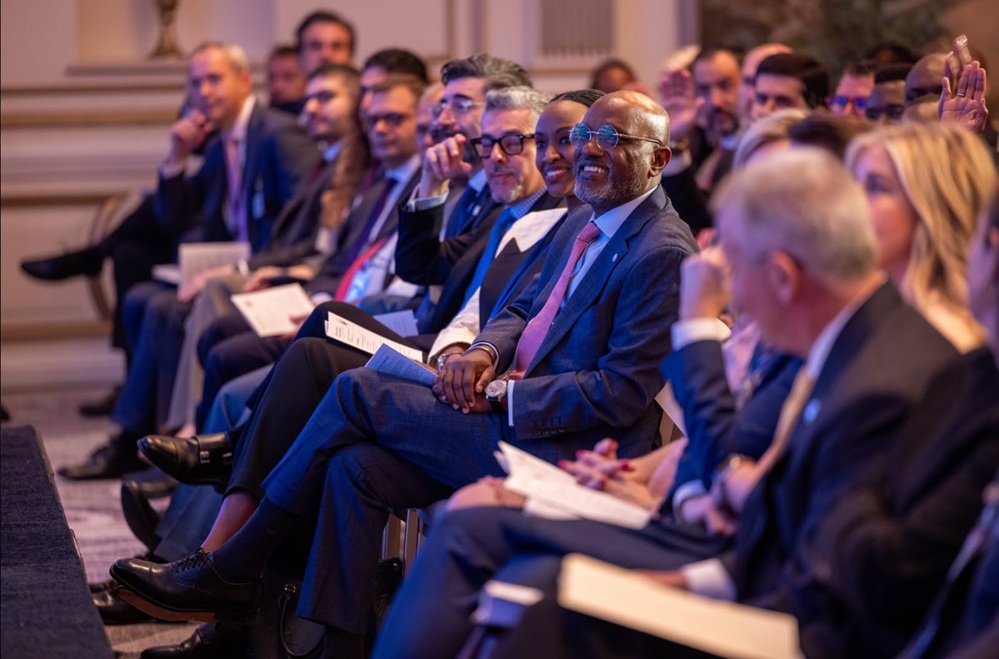
Government officials, private-sector representatives and international participants attend the “Trade Over Aid Deals Showcase” as U.S. officials discuss expanding trade and investment opportunities.

Landau said he wants the State Department, Commerce Department, Export-Import Bank, Development Finance Corporation and Millennium Challenge Corporation to work more closely together and make the U.S. government a more accessible “one-stop shop” for businesses seeking to invest overseas.

He cited the Pacific Islands as one region where he believes greater investment opportunities exist. Landau said he had organized a business summit and investment roundtable in Honolulu in February with Pacific Island leaders and U.S. private-sector representatives to identify sectors where investment could be expanded.

Landau said the U.S. government’s role is to improve communication between governments, businesses and investors and help identify opportunities for private capital. Concluding his remarks, Landau reaffirmed his commitment to expanding the global role of American businesses and called for what he described as an “unprecedented golden era for the American private sector around the world.”


Bangladesh-U.S. Relations Gain New Momentum: Bethany Morrison

Shibbir Ahmed, New York: Bangladesh-U.S. relations are currently on a positive trajectory, with Washington highlighting recent progress in trade, aviation and civilian nuclear cooperation as important developments in bilateral ties. Bethany Morrison, Deputy Assistant Secretary for South and Central Asian Affairs at the U.S. Department of State, made the remarks during a briefing on South Asia at the New York Foreign Press Center on Thursday.

“We are also in a good place with Bangladesh,” Morrison said, pointing to recent high-level engagement and expanding cooperation between the two countries.

Bangladesh Foreign Minister Meets President Trump

Morrison noted that Bangladesh’s foreign minister had the opportunity to meet with U.S. President Donald Trump earlier this week. She described the meeting as an important example of high-level engagement between Washington and Dhaka.

Highlighting recent trade cooperation, Morrison also referred to a major commercial agreement involving Boeing. She said President Trump had also posted about the development on his Truth Social account on Thursday morning.

Civilian Nuclear Cooperation

Morrison also said Bangladesh and the United States are preparing to sign a memorandum of understanding (MoU) on civilian nuclear cooperation. According to Morrison, the MoU is expected to be signed on Friday with the participation of a U.S. undersecretary. The proposed agreement could open another area of cooperation between the two countries, particularly in the peaceful use of nuclear technology and related civilian applications.

U.S. Sees Greater Engagement in South Asia

Morrison described the recent high-level contacts and agreements with Bangladesh as part of broader progress in U.S.-Bangladesh relations. Speaking about Washington’s wider policy toward South Asia, she said the Trump administration is placing greater importance on the region than in the past.

She indicated that the United States expects further progress in its relations with Bangladesh and other South Asian countries in the coming days. Journalists from Bangladesh, India, Nepal, South Korea, the United States and other countries attended the briefing at the New York Foreign Press Center.


U.S. Says Decisions on Awami League and Sheikh Hasina Are Bangladesh’s to Make

Shibbir Ahmed, New York – The United States has said it has taken no position on lifting restrictions on Bangladesh’s Awami League or on allowing former Prime Minister Sheikh Hasina to return to Bangladesh and participate in the country’s political process. Washington has also not taken an official position on the judicial proceedings against Sheikh Hasina, a senior U.S. State Department official said during an on-background briefing on South Asia at the New York Foreign Press Center on Thursday.

Asked whether the United States supports lifting restrictions on the Awami League and allowing Sheikh Hasina to return to Bangladesh and participate in politics, the official said Washington does not want to take sides in Bangladesh’s domestic political affairs.

The official said the United States is working with Bangladesh’s elected government and wants to strengthen bilateral relations with the aim of helping build a stronger, safer and more prosperous Bangladesh. Asked whether the decision to lift restrictions on the Awami League was ultimately a matter for the United States, the official replied that it was “a decision for the government of Bangladesh.”

No official U.S. position on Sheikh Hasina’s trial

The issue of Sheikh Hasina’s trial and possible return to Bangladesh was also raised by journalist Lovlu Ansar. He asked about the U.S. position on the verdict against Hasina by a Bangladeshi court, her reported desire to return to the country and her request for an opportunity to challenge proceedings conducted in her absence.

In response, the U.S. official said Washington has not taken an official position on the matter. The official described the issue as an important point of disagreement in India-Bangladesh relations and said the United States hopes India and Bangladesh will resolve the matter through discussions between the two countries.

The official also said Washington has not taken a specific position on what should be done regarding Sheikh Hasina. The United States, the official added, wants to see improved relations between India and Bangladesh and encourages both countries to strengthen their bilateral ties.

U.S. responds to questions about AQIS in Bangladesh

The briefing also touched on concerns regarding the activities of Al-Qaeda in the Indian Subcontinent (AQIS). Journalist Lovlu Ansar referred to a report by the UN Security Council sanctions monitoring team that raised concerns about AQIS attempting to establish small clandestine terrorist cells in several countries, including Bangladesh. Asked about Bangladesh’s response and the U.S. position on the issue, the official said he was not familiar with the details of the specific report.

However, he described Al-Qaeda as a terrorist organization and said the United States would work with countries on counterterrorism efforts. The official declined to comment specifically on the report because he had not reviewed its details.

U.S. does not want Bangladesh to choose sides

The official was also asked about Bangladesh’s efforts to maintain relations with the United States, India and China. He said Washington does not want Bangladesh to be forced to choose one side over another. At the same time, he said Bangladesh should make careful decisions regarding sensitive sectors, including critical infrastructure and telecommunications. The United States, he said, wants to help Bangladesh protect its sovereignty and systems while providing alternatives in strategically sensitive areas.

“We’re not saying you have to choose between this or that. We want to provide alternatives for these countries, particularly in their sensitive sectors,” the official said.

U.S. monitoring Imran Khan’s situation

The briefing also included a question about former Pakistani Prime Minister Imran Khan. The U.S. official said Washington is closely monitoring developments surrounding Khan’s legal cases and health situation. However, the official said U.S. involvement in the matter remains primarily limited to monitoring developments.


Biman Bangladesh Airlines Orders 11 More Boeing Aircraft in New York

Shibbir Ahmed, New York — Biman Bangladesh Airlines has ordered 11 additional Boeing aircraft as Bangladesh’s national flag carrier moves to expand and modernize its fleet. Boeing and Biman announced the agreement Wednesday in New York on the sidelines of the 81st session of the United Nations General Assembly. The order comprises five Boeing 787-10 Dreamliners and six Boeing 737-8 aircraft, according to Boeing.

The latest purchase follows Biman’s order for 14 Boeing aircraft announced in April, bringing the airline’s planned Boeing acquisitions to 25 aircraft this year. The April order included eight 787-10s, two 787-9s and four 737-8s. Reuters reported the April deal at approximately $3.7 billion based on list prices.

Signing ceremony in New York

The agreement was signed between Biman Bangladesh Airlines and Boeing during a ceremony in New York. Rumee A. Hossain, chairman of Biman Bangladesh Airlines, and Brad McMullen, Boeing senior vice president of Commercial Sales and Marketing, represented the two organizations at the signing ceremony. Boeing’s official photograph shows Hossain and McMullen in the front row of the ceremony.

The signing was attended by senior Bangladeshi and U.S. officials, reflecting the broader economic and trade context surrounding the aircraft purchase. Among those present were M. Rashiduzzaman Millat, Bangladesh Minister of Civil Aviation and Tourism; Humaiun Kobir, State Minister of Foreign Affairs; Chowdhury Ashik Mahmud Bin Harun, chairman of the Invest Bangladesh Authority; Madhi Amin, Advisor to the Prime Minister; U.S. Secretary of Commerce Howard Lutnick; and U.S. Deputy Secretary of State Christopher Landau.

Also pictured at the ceremony were William Kimmitt, Under Secretary of Commerce for International Trade; Brendan Nelson, Boeing Global senior vice president; Stephanie Pope, Boeing Commercial Airplanes president and CEO; S. Paul Kapur, Assistant Secretary of State for South and Central Asian Affairs; Kaanthi Bhuvanagiri, Boeing sales director for India and South Asia; and Paul Righi, Boeing vice president of Commercial Sales and Marketing for Eurasia, India and South Asia.

Fleet modernization and network expansion

Biman Chairman Rumee A. Hossain described the supplemental agreement as part of the airline’s ongoing fleet-renewal and network-expansion program. “Today’s supplemental agreement is an important step in Biman’s ongoing fleet renewal and network expansion,” Hossain said, adding that the order responds to specific requirements in the airline’s fleet plan. Hossain said Biman aims to develop its network and capabilities to meet the connectivity needs of passengers in Bangladesh, the country’s expatriate community, businesses and the tourism sector.

Boeing said the additional aircraft will strengthen Biman’s existing Boeing fleet. The 737-8 will provide additional range and capacity for the airline’s single-aisle network, while the 787-10 will add capacity alongside Biman’s existing 787-8 and 787-9 aircraft. Boeing also said the 787 Dreamliner and 737 MAX families provide approximately 20% to 25% greater fuel efficiency compared with the aircraft they replace, supporting Biman’s fleet-modernization strategy.

Boeing welcomes additional Biman order

Brad McMullen, Boeing’s senior vice president of Commercial Sales and Marketing, said the additional order reflects Biman’s approach to fleet renewal and capacity growth. “Biman’s follow-on order reflects its strategic approach to fleet renewal and capacity growth, and underscores the strength of our long-standing partnership,” McMullen said. He said the additional 787 Dreamliner and 737 MAX aircraft will provide the efficiency and versatility Biman needs as Bangladesh’s international aviation market grows.

Broader Bangladesh-U.S. trade context

The aircraft purchase comes as Bangladesh seeks to strengthen economic and trade ties with the United States. Reuters reported that the latest Boeing purchase expands Biman’s planned orders to 25 aircraft as Dhaka seeks to increase imports from the United States and address a trade imbalance of roughly $6 billion. Reuters also reported that the aircraft order is part of broader efforts to reduce pressure related to U.S. tariffs on Bangladeshi exports.

However, the aircraft agreement itself is a commercial purchase between Biman Bangladesh Airlines and Boeing, rather than a government-to-government contract between Bangladesh and the United States. Government officials attended and celebrated the signing, but Boeing and Biman are the parties to the aircraft purchase.

Biman’s Boeing fleet

Biman currently operates Boeing 787, 777 and 737 Next-Generation aircraft across its international network, serving destinations in the Middle East, South and Southeast Asia and Europe. With the latest order, Biman’s planned Boeing purchases announced in 2026 total 25 aircraft, comprising both wide-body Dreamliners and 737 MAX aircraft. The carrier says the fleet expansion is intended to support modernization, increase capacity and strengthen its international network.


U.S. State Department Launches Online Portal to Report Visa Fraud

Shibbir Ahmed, Washington DC – The U.S. Department of State has launched an online tip portal allowing members of the public to report suspected fraud and misuse involving U.S. visas. According to the State Department, information provided by members of the public has helped authorities identify suspected visa fraud. The new online system is intended to provide a convenient channel for submitting information for review and possible law-enforcement action.

The department said visa fraud can involve falsified documents or travel plans, sham marriages, shell companies, fabricated employment offers, and schemes involving birth tourism, among other activities. Authorities can take action that may include visa revocation and referral of suspected fraud for further investigation.

The State Department also warns that knowingly providing false or misleading information in an effort to obtain a U.S. visa can result in serious immigration consequences. Under U.S. immigration law, willful misrepresentation of a material fact or fraud can result in permanent visa ineligibility in certain circumstances.

Members of the public who have information about suspected U.S. visa or passport fraud can report it through the State Department’s official fraud-reporting resources. The department advises people to provide as much relevant information as possible so reports can be properly assessed.


Biman to Sign Deal for 11 More Boeing Aircraft

Shibbir Ahmed, New York: Biman Bangladesh Airlines is set to sign an agreement in New York to purchase 11 additional commercial aircraft from U.S. aircraft manufacturer Boeing. The agreement is scheduled to be signed Wednesday on the sidelines of Prime Minister Tarique Rahman’s visit to New York for the 81st session of the United Nations General Assembly.

U.S. Ambassador to Bangladesh Brent T. Christensen welcomed the deal. In a social media post, he congratulated Boeing and Biman Bangladesh Airlines, describing the purchase of 11 additional commercial aircraft as another mutually beneficial achievement for U.S.-Bangladesh relations.

Christensen also said he was looking forward to witnessing the signing ceremony in New York. The new agreement for 11 aircraft is in addition to a $3.7 billion deal signed with Boeing on April 30. Under that agreement, Biman Bangladesh Airlines agreed to purchase 14 aircraft, including eight Boeing 787-10 Dreamliners, two Boeing 787-9s and four Boeing 737-8s.

With the additional 11 aircraft, Biman’s planned purchases from Boeing will rise to 25 aircraft. However, the specific models, total purchase price, financing arrangements and delivery schedule for the additional 11 aircraft have not yet been disclosed.

The purchase is part of Biman Bangladesh Airlines’ plans to expand and modernize its fleet. At the same time, Biman is considering a separate proposal to purchase 10 Airbus aircraft. The additional aircraft are expected to support the airline’s fleet expansion and meet growing demand in the aviation sector. The new aircraft are also intended to help Biman expand its international network and enhance passenger services.


US Announces New Visa Restrictions Targeting Birth Tourism

Shibbir Ahmed, Washington DC — U.S. Secretary of State Marco Rubio has announced a new visa restriction policy targeting individuals who knowingly engage in or facilitate commercial “birth tourism” to the United States. Under the policy, announced September 23, the State Department said it will use Section 212(a)(3)(C) of the Immigration and Nationality Act to restrict visa issuance to people involved in commercial birth-tourism operations. The policy specifically targets owners, operators and managers of birth-tourism networks, visa “fixers” who coach applicants to commit fraud, foreign medical providers who knowingly facilitate such travel, and others who knowingly support or enable the practice.

Rubio said foreign commercial birth-tourism networks have exploited the U.S. immigration system by charging large sums of money to arrange births in the United States for the purpose of obtaining U.S. citizenship for children. The statement also accused some networks of coaching foreign nationals to provide false information on visa applications and of facilitating fraudulent use of Medicaid.

“The Trump Administration is using every tool at our disposal to defend the integrity of U.S. citizenship, protect American public benefits and U.S. taxpayers from exploitation, and safeguard our national security,” Rubio said in the statement.

The State Department has already prohibited birth tourism as a permissible purpose for a U.S. visitor visa. Its current visitor-visa guidance defines birth tourism as travel to the United States primarily to give birth so that the child obtains U.S. citizenship, and states that such travel is not permissible on a visitor visa.

The department previously introduced specific rules addressing birth tourism in 2020. Under those rules, consular officers were directed to deny B-visa applications when they had reason to believe an applicant’s primary purpose for traveling to the United States was to give birth in order to obtain U.S. citizenship for the child.

The newly announced policy goes beyond the individual seeking to travel for birth tourism by specifically targeting people and organizations that facilitate or profit from the practice. According to Rubio’s statement, certain family members of individuals covered by the restrictions may also be subject to the new visa restrictions.

The announcement comes as the State Department has continued to expand visa screening and vetting measures. On September 18, the department announced that, effective October 1, online-presence review would be expanded to additional nonimmigrant visa categories, saying the screening process is intended to identify applicants who may be inadmissible or who fail to establish eligibility for the visa requested.

The new birth-tourism policy is being implemented under existing provisions of U.S. immigration law rather than through a change to the statutory citizenship rules themselves. The announcement specifically concerns visa restrictions on people involved in or facilitating commercial birth tourism.


Trump Signs Greenland Security Agreement With Denmark and Greenland

Shibbir Ahmed, New York — President Donald Trump on Tuesday signed a new security agreement with Denmark and Greenland aimed at strengthening defense cooperation in the Arctic, during the 81st United Nations General Assembly in New York.

Danish Prime Minister Mette Frederiksen and Greenlandic Prime Minister Jens-Frederik Nielsen joined Trump for the signing ceremony. Secretary of State Marco Rubio was also present as the agreement was signed.

The agreement amends and supplements the existing 1951 U.S.-Denmark defense agreement concerning Greenland. It reaffirms the parties’ defense cooperation and provides for expanded U.S. military access and activities in Greenland.

Under the agreement, the United States will be allowed to modernize and expand activities at Pituffik Space Base and establish additional defense areas at Narsarsuaq and Mestersvig, subject to arrangements between the parties. The agreement also provides a framework for establishing additional defense areas in Greenland through consultations and mutual agreement.

The agreement gives U.S. forces specified rights of access and movement in Greenland, including access by land, air and sea between defense areas. It also establishes provisions concerning U.S. aircraft and public vessels operating in Greenland and its territorial waters.

The three parties also agreed to strengthen cooperation on Arctic security, including through greater NATO engagement, planning, military presence, exercises and intelligence gathering.

The agreement includes provisions restricting non-NATO states from establishing military installations or maintaining a persistent military presence in Greenland unless otherwise agreed by the parties. It also contains restrictions related to certain foreign investments and activities considered potential threats to national security or public order.

The document reaffirms the sovereignty and territorial integrity of the Kingdom of Denmark and recognizes the right of the people of Greenland to self-determination under international law. It also states that the agreement has no end date and can be amended only by mutual consent under the existing defense framework.

The White House described the agreement as a major step in strengthening U.S. security interests in the Arctic. The signing took place as world leaders gathered in New York for the 81st session of the United Nations General Assembly.

The agreement was signed in New York on September 22, 2026, in English, Danish and Greenlandic. It will enter into force after the required parliamentary procedures in Denmark and Greenland are completed and the United States receives the necessary diplomatic notification.