Pentagon to Cut 20% of General and Admiral Positions: Hegseth
Shibbir Ahmed, Washington DC — U.S. Defense Secretary Pete Hegseth is set to announce a major restructuring of the U.S. military’s senior leadership, with the Pentagon planning to reduce the number of positions reserved for generals and admirals by 20%. The announcement is part of Hegseth’s broader effort to restructure the military’s senior ranks and reduce what the administration views as unnecessary layers of leadership. The planned reduction doubles the 10% cut ordered last year.
Hegseth is expected to outline the changes during his “State of the Force” address at Marine Corps Base Quantico in Virginia on Wednesday. Pentagon officials say the reduction will apply across the military services and is expected to be completed by January 1, 2027.
According to reporting based on Pentagon officials, the plan concerns positions for one- to four-star generals and admirals. Some positions are expected to be eliminated, while others could be downgraded so they can be filled by officers at lower ranks.
The Pentagon’s latest move follows Hegseth’s May 2025 directive ordering reductions in senior military positions. That directive included a minimum 20% reduction in active-duty four-star positions, a minimum 20% reduction in National Guard general officers and an additional 10% reduction through changes to the military’s unified command structure.
The latest plan would bring the overall reduction in general and flag officer positions to 20%, according to Pentagon officials cited by AP. The military currently has roughly 800 such positions, meaning the changes could affect about 170 positions.
The restructuring comes as the Pentagon continues to review the organization and priorities of the U.S. armed forces. Hegseth has argued that reducing senior-level bureaucracy will allow the military to focus more resources and attention on operational readiness. The plan is expected to be implemented across the Army, Navy, Air Force and the broader joint military structure.
Trump Launches America.gov as Unified Digital Gateway to U.S. Government Services
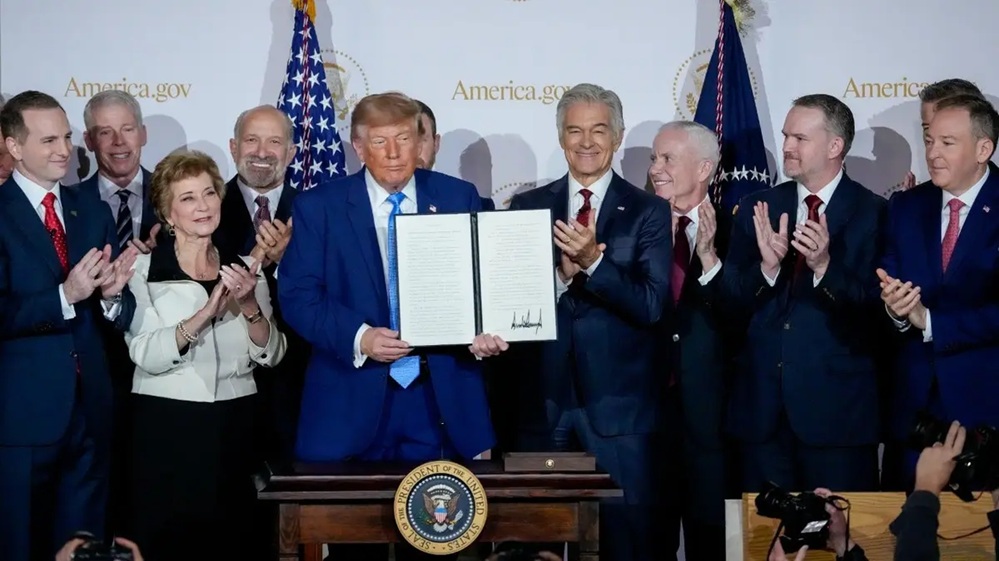
Shibbir Ahmed, Washington DC — President Donald Trump on Tuesday launched America.gov, a new digital platform designed to provide Americans with a single entry point to federal government information and services, as the administration seeks to simplify how people interact with the U.S. government. The platform was unveiled September 29 in Washington alongside an executive order directing the establishment of America.gov as a unified digital “front door” for Americans seeking federal information and covered online services.
The administration says America.gov uses artificial intelligence and information drawn from government websites to help users find answers and navigate federal services through a conversational interface. The U.S. General Services Administration said America.gov combines information from more than 29,000 government websites with AI-enhanced search technology, allowing users to find information and guidance without having to navigate a fragmented network of individual agency websites.
The executive order says Americans have traditionally been required to search across multiple federal agencies, interpret government terminology, provide the same information repeatedly and verify their identities through different systems. America.gov is intended to change that process by providing a single digital point of entry through which users can communicate in plain language, receive information and, where authorized and technically available, complete federal government transactions.
AI-powered access to federal services
The new platform is designed to allow users to describe what they need rather than determine which federal agency is responsible for providing the service. The GSA said the platform can help users find information about government benefits, passport services, Social Security and other federal needs. The administration’s executive order directs federal agencies to identify qualifying online services and integrate them with America.gov in a secure and privacy-preserving manner.
President Donald Trump holds up the executive order establishing America.gov during its launch event in Washington, D.C., on September 29, 2026. Administration officials joined the president at the event. Photo: WH
The order also calls for the integration of Login.gov as the authentication service for America.gov. Under the plan, agencies will continue to maintain control over their own records, systems, statutory responsibilities and decision-making authority. The order specifically states that the unified access system is not intended to create a centralized federal system of records about Americans. Privacy protections are also included in the order, including data minimization, secure authentication, auditable authorization and disclosure practices consistent with federal law.
Passport services among planned features
Secretary of State Marco Rubio said at the launch event that the State Department is partnering with America.gov to overhaul the passport application experience. Rubio announced that, beginning next year, Americans will be able to apply for their first U.S. passport entirely online. Applicants will be able to sign in through Login.gov, use information already held by the government where available, submit a photograph from a phone or other device, make a payment and track the status of the application. Rubio said the administration’s goal is for the vast majority of Americans to be able to apply for a passport or passport card through America.gov by the end of 2027.
Agencies given 90 days for implementation guidance
The executive order directs the Office of Management and Budget to issue implementation guidance to federal agencies within 90 days. Agencies will then be required to identify covered services, integrate those services with America.gov where appropriate and provide usage and performance information to the General Services Administration and OMB. The order defines covered services generally as public-facing federal services that serve more than 100,000 users during a 12-month period and can be accessed or applied for online. The order excludes Internal Revenue Service tax filing services, as well as services provided by the Department of War and elements of the Intelligence Community.
Existing government services will remain available
The administration says America.gov is intended to provide an additional, simplified way to access federal services rather than eliminate existing methods. The executive order specifically preserves existing lawful methods of obtaining government services, including in-person, telephone, mail and agency-specific digital services. That means Americans will not be required to use America.gov as the sole method of interacting with the federal government.
New passport design planned for 2028
Rubio also unveiled the planned design of a new U.S. passport expected in 2028. The redesigned passport features the American eagle and the Great Seal and includes artwork depicting major moments in U.S. history. Rubio said the new passport will visually represent 250 years of American history, with imagery ranging from the Revolutionary era and westward expansion to aviation, the raising of the American flag at Iwo Jima and the Artemis space program. The State Department also plans to change how the passport is packaged and delivered.
America.gov represents broader government technology push
The launch comes as the Trump administration expands its focus on artificial intelligence and digital technology as tools for government services. The new website is currently centered on AI-assisted information access, while additional transaction capabilities are expected to be introduced as federal agencies integrate their services with the platform.
The administration has described America.gov as a fundamental shift toward organizing government services around the needs of citizens rather than around the structure of federal agencies. For Americans, the intended result is a single digital starting point for finding federal information, understanding available services and eventually completing more government transactions online.
US Supreme Court Allows Third-Country Deportations to Continue
Shibbir Ahmed, New York — The U.S. Supreme Court on Tuesday allowed the Trump administration to continue rapidly deporting migrants to third countries while the justices consider the legality of the policy. The court’s 6-3 order temporarily suspended a lower-court requirement that migrants receive an opportunity to challenge their removal before being sent to countries other than their own. The case concerns the administration’s use of third-country deportations, under which migrants may be removed to countries with which they may have little or no connection. The Supreme Court is scheduled to hear full arguments over the policy in December.
The administration has argued that third-country removals are an important immigration-enforcement tool, particularly when migrants’ countries of origin refuse to accept them or when authorities consider them security or criminal threats. Immigration attorneys and other critics of the policy have challenged the practice in court, arguing that migrants can face serious risks if sent to unfamiliar countries without adequate opportunity to contest their removal.
According to Associated Press reporting, the administration has already deported roughly 25,000 people to more than two dozen countries under the policy, with Mexico among the principal destinations. The Supreme Court’s temporary order does not constitute a final ruling on whether the administration’s third-country deportation policy is lawful. The broader legal dispute remains pending before the justices.
The case is part of a wider legal battle over the Trump administration’s immigration policies, including the government’s authority to accelerate removals and limit procedural protections for migrants facing deportation. The December arguments are expected to provide the court with an opportunity to consider the legal requirements surrounding third-country removals and the protections available to people facing deportation.
For migrants currently subject to removal proceedings, Tuesday’s order means the administration can continue the challenged practice while the litigation proceeds. The Supreme Court’s eventual ruling could have broader implications for the government’s authority to deport migrants to countries other than their countries of origin and for the procedural protections available before such removals take place.
US Imposes Visa Restrictions Over Corruption
Shibbir Ahmed, Washington DC — The United States has announced new visa restrictions on foreign nationals accused by the Trump administration of undermining democratically elected governments through corruption or narcotrafficking in the Western Hemisphere. The U.S. Department of State said the new policy applies under Section 212(a)(3)(C) of the Immigration and Nationality Act and can also affect the immediate family members of targeted individuals. The provision allows the United States to restrict entry when an individual’s presence or proposed activities could have potentially serious adverse consequences for U.S. foreign policy.
The State Department said the policy follows commitments made at the Doral Summit and reaffirmed in the Shield of the Americas leaders’ statement issued September 22. The administration said the United States would coordinate sanctions, designations and financial measures against individuals involved in activities that threaten security, the rule of law and democratic governance.
Initial visa-restriction actions were announced for nationals of Bolivia, Colombia, Ecuador and Peru.
In Bolivia, the State Department said it had taken steps to impose restrictions on 12 nationals and their families, including prosecutors, judges, a former justice minister, a police colonel, a former customs official and a private businessman. Existing U.S. visas for the named individuals were revoked, according to the department. Nine additional Bolivian nationals who do not currently hold U.S. visas were also made generally ineligible to receive visas, along with their families.
In Colombia, the United States said it revoked the visas of businessman Euclides Antonio Torres Romero and Senator Martha Isabel Peralta Epieyu and imposed corresponding restrictions on their families. The State Department identified Torres Romero as a businessman whose conglomerate operates mainly in the energy, traffic-signal and public-lighting sectors. Peralta Epieyu is affiliated with Colombia’s Historic Pact and the Alternative Indigenous and Social Movement, according to the department.
The State Department said two Ecuadorian nationals were also targeted under the new policy, with their visas revoked. The individuals were not identified in the announcement.
In Peru, the department said it revoked the existing U.S. visa of Juan Carlos Nunez Matos, a judge of the First Circuit Constitutional Court in Lima, and imposed restrictions on his family.
Separately, the State Department publicly designated Bolivia’s Attorney General Roger Mariaca under Section 7031(c) of the National Security, Department of State, and Related Programs Appropriations Act for fiscal year 2026.
The department alleged that Mariaca was involved in significant corruption and had abused his public positions by soliciting and accepting bribes to facilitate narcotrafficking and helping violent criminals evade justice. The State Department said the designation makes Mariaca and his immediate family members generally ineligible for entry into the United States.
The allegations against Mariaca are claims made by the U.S. government in announcing the designation.
Section 7031(c) allows the Secretary of State to publicly or privately designate foreign officials and their immediate family members when the Secretary has credible information indicating involvement in significant corruption or gross violations of human rights.
The State Department said the new visa restriction policy provides the United States with a mechanism to act as evidence develops and to coordinate measures with partner governments.
The administration said the measures are intended to support democratic governance, security and the rule of law across the Western Hemisphere while targeting corruption and narcotrafficking.
U.S. Announces New Visa Restrictions Over Child Abduction Cases
Shibbir Ahmed, Washington, DC — The Trump administration announced a new visa restriction policy Monday aimed at pressuring foreign officials to help resolve international parental child abduction cases involving children taken across international borders.
The policy targets foreign government officials, judges, judicial administrators, law enforcement officials and others who are determined to be responsible for, or complicit in, intentionally obstructing the prompt resolution of international parental child abduction cases.
Under the new policy, the United States may restrict visa issuance to individuals who intentionally fail to implement or comply with laws, policies or court orders intended to resolve such cases and facilitate the return of children to their country of habitual residence. The restrictions may also apply to the immediate family members of targeted individuals. The State Department said the policy provides the department with an additional accountability tool to encourage countries to meet their obligations and cooperate in resolving cases.
“The Department proactively works to prevent abductions and facilitate the quick and safe return of abducted children to their country of habitual residence,” the department said in its announcement.
The administration said the policy is intended to strengthen U.S. efforts to protect American children abducted across international borders and reunite them with their parents. The State Department also said the measures are intended to promote accountability when countries fail to meet their obligations under international law. The new visa restrictions are being implemented pursuant to Section 212(a)(3)(C) of the Immigration and Nationality Act.
The department emphasized that the United States remains committed to protecting the safety and well-being of American children involved in international parental child abduction cases.
UN General Assembly 2026: Leaders Discuss Global Crises, AI
Shibbir AHmed, New York — World leaders and senior officials are continuing high-level diplomatic discussions at the 81st United Nations General Assembly in New York, with conflicts, artificial intelligence, climate change, development and international cooperation remaining central issues.
The General Assembly’s high-level week, which runs through September 28, has brought together leaders and representatives from across the world to address major global challenges and debate the future of multilateral cooperation.
The General Debate is scheduled to continue on September 28, following several days of speeches and diplomatic meetings focused on international security, regional conflicts, economic development and emerging global challenges.
Artificial intelligence has emerged as an important issue during this year’s UN discussions. Secretary-General António Guterres has called for stronger international governance of AI and warned that technological developments are moving faster than existing global institutions can respond.
The UN has also placed conflicts and international diplomacy at the center of the General Assembly agenda as governments seek diplomatic approaches to ongoing crises, including tensions in the Middle East. The UN General Assembly’s 81st session is being chaired by Bangladesh’s Khalilur Rahman. The session’s theme is “Restoring trust, managing transformation: A United Nations that delivers for all.”
A major UN meeting taking place today, September 28, is commemorating the 25th anniversary of the adoption of the Durban Declaration and Programme of Action, which focuses on combating racism, racial discrimination, xenophobia and related intolerance.
The high-level week has also included meetings on climate action, sea-level rise and pandemic preparedness, reflecting the broad range of issues being addressed by the international community.
As the high-level portion of the General Assembly concludes, diplomatic attention remains focused on how governments can address conflicts, technological risks and other global challenges through international cooperation.
Nor’easter Hits U.S. Northeast, Flooding Coastal Areas
NEW YORK — A powerful nor’easter continued to batter the U.S. Northeast on Sunday, bringing coastal flooding, strong winds, heavy rain and power outages from New Jersey through New England. The slow-moving storm pounded coastal communities for a second consecutive day, with tidal surges flooding low-lying neighborhoods in New Jersey while strong winds brought down trees and utility poles on New York’s Long Island.
Some areas of New Jersey received more than 4 inches of rain since Friday. The combination of heavy rainfall and rising ocean water produced significant flooding in several coastal communities, with some residents reporting water entering homes and businesses.
More than 100,000 customers across the Northeast and Mid-Atlantic were without power at times Sunday, while numerous flights were canceled or delayed. Boston Logan International Airport reported more than 250 cancellations by late Sunday morning as strong winds affected the region.
The National Weather Service said the storm was gradually weakening but warned that tidal flooding could continue through additional high-tide cycles. Local officials in New Jersey and New York also warned that another high tide could bring further flooding Monday.
The storm also generated dangerous surf and coastal erosion concerns along the Atlantic shoreline. Forecasters expected the remaining heavy rain to affect parts of New England and the Mid-Atlantic as the system moved through the region. The nor’easter’s impact has brought renewed concerns for vulnerable coastal communities still dealing with the effects of repeated flooding and severe weather events.
Cuba Condemns US Pressure, Warns of ‘Law of the Jungle’ at UN
Shibbir Ahmed, New York — Cuba’s Foreign Minister Bruno Eduardo Rodríguez Parrilla has warned that growing military and economic pressure in Latin America and the Caribbean is threatening international law, while accusing the United States of intensifying its longstanding campaign to isolate and weaken Cuba.
Addressing the General Debate of the 81st session of the United Nations General Assembly on Saturday, Rodríguez Parrilla said the international system was facing a rise in what he described as “expansionism, usurpation, plunder” and military and economic aggression.
He argued that fundamental principles of the UN Charter, including the sovereign equality of states, were under increasing pressure. The Cuban foreign minister called for the United Nations to be strengthened and made “more democratic and effective,” with a closer connection to the people it serves.
Cuba accuses US of economic pressure
A major part of Rodríguez Parrilla’s address focused on Cuba’s decades-long confrontation with Washington. He accused the United States of escalating economic pressure on Cuba since January, including what he called an “energy blockade” and efforts to discourage other countries from exporting fuel to the island. According to the Cuban minister, more than 7,000 containers were stranded in ports, including shipments containing food, medicines and medical equipment. He said some of the shipments had already been paid for by Cuban private companies.
Rodríguez Parrilla also accused Washington of putting pressure on foreign investors, restricting tourism and limiting Cuba’s access to financing, technology and international markets. He further criticized US efforts to discourage governments from maintaining arrangements under which Cuban medical professionals provide healthcare overseas.
“The economic warfare is aimed against the people,” Rodríguez Parrilla said, characterizing the alleged impact on Cuban families as deliberate “collective punishment.” He rejected claims that Cuba poses a threat to US national security.
“Cuba is not a threat; the blockade is!” he declared.
Havana says it remains open to dialogue
Despite his criticism of US policy, Rodríguez Parrilla said Cuba remained willing to engage in dialogue with Washington. He said any negotiations should be based on sovereign equality, respect for international law, non-interference in domestic affairs and the absence of preconditions. The Cuban government has maintained for decades that the US economic embargo has imposed significant costs on the country’s economy, while Washington has defended its policies on various political and security grounds.
Cuba outlines changes at home
The foreign minister also highlighted changes Cuba is pursuing in response to its economic and social difficulties. He pointed to a new program adopted by the National People’s Power Assembly that introduces new economic practices, actors and concepts while maintaining Cuba’s constitutional framework and socialist system.
According to Rodríguez Parrilla, the process is intended to address the needs of the Cuban population while pursuing what he described as greater social justice and protecting the country’s sovereignty and right to self-determination.
Warning over militarization in Latin America
Turning to the wider region, Rodríguez Parrilla criticized what he described as attempts at militarization, intervention and domination in Latin America and the Caribbean. He rejected the Monroe Doctrine and referred to the region’s 2014 declaration as a Zone of Peace.
The Cuban foreign minister also expressed solidarity with Small Island Developing States facing the effects of climate change, reiterated Cuba’s support for Nicaragua, backed Puerto Rico’s right to self-determination, and supported calls for reparations to African and Caribbean nations over colonialism and the transatlantic slave trade.
Concluding his address, Rodríguez Parrilla warned that allowing powerful states to impose their will through intimidation and coercion would create an unstable international order. “The law of the jungle cannot be the future of humanity,” he told the General Assembly, urging countries to strengthen the United Nations and preserve its role in international affairs.
Trump Reportedly Rejects Iran’s Proposal to Reopen Strait of Hormuz
Washington DC — U.S. President Donald Trump has reportedly rejected an Iranian proposal aimed at reopening the Strait of Hormuz within seven days and ending fighting across the region, according to a report by The Wall Street Journal cited by Reuters.
Iran has been seeking an agreement that would reopen the strategically important waterway and establish a pause in the wider regional conflict. Tehran said the proposal was transmitted to the United States through Qatari mediators.
Iranian Foreign Minister Abbas Araqchi said the plan would trigger a seven-day countdown to reopening the strait if Washington agreed to the terms. Tehran has also called for the lifting of U.S. restrictions affecting Iranian ports, the release of frozen Iranian funds and the removal of oil sanctions.
However, The Wall Street Journal reported that Trump had rejected the proposal. Reuters said it could not immediately independently confirm the report, and Iran was still awaiting an official U.S. response.
The uncertainty comes as the Strait of Hormuz remains central to the international economic consequences of the conflict. The waterway is a critical route for global energy shipments, and prolonged disruption has contributed to concerns about oil supplies and shipping costs.
Iran has said it is prepared to discuss broader issues after hostilities are paused, but Tehran has ruled out concessions on several aspects of its nuclear program. The latest developments leave the diplomatic initiative in an uncertain position as Washington considers its response and regional tensions continue.
US, China Agree to $30 Billion Tariff Cut and AI Dialogue
Washington DC — The United States and China have agreed to a reciprocal tariff-reduction arrangement covering about $30 billion in trade, while also establishing a new dialogue on artificial intelligence, according to China’s Foreign Ministry and reporting by Reuters.
The agreement was reached during Chinese President Xi Jinping’s visit to the United States and his meeting with U.S. President Donald Trump. The two sides described the discussions as part of broader efforts to manage trade disputes and maintain communication between the world’s two largest economies.
Under the arrangement, the United States and China will reduce tariffs affecting certain goods, with the agreement reportedly covering about $30 billion in reciprocal trade. U.S. Trade Representative Jamieson Greer separately said Washington and Beijing had reached understandings concerning several categories of goods, including agricultural products, medical devices and consumer goods. Further details are expected to be released by U.S. officials.
The two countries also agreed to establish a new channel for discussions on artificial intelligence. The mechanism is intended to improve communication between Washington and Beijing over AI-related issues, including incidents that could have broader security implications. The AI component comes as both countries compete for technological leadership while attempting to manage concerns over the security implications of rapidly advancing artificial intelligence.
The latest trade understanding follows years of escalating economic tensions between Washington and Beijing. Previous tariff measures had pushed duties on some goods to exceptionally high levels before the two sides moved toward a temporary reduction and broader negotiations. The new agreement does not resolve all U.S.-China trade disputes, but it creates additional areas for negotiation and communication between the two governments.