PM Tarique Rahman Returns Home from New York After UNGA Visit

DHAKA — Prime Minister Tarique Rahman returned home Sunday morning after concluding a five-day visit to New York, where he attended the 81st session of the United Nations General Assembly (UNGA), delivered his maiden address to the General Debate and held a series of high-level bilateral and multilateral meetings. An Emirates flight carrying the prime minister, his wife Dr. Zubaida Rahman and members of his entourage landed at Hazrat Shahjalal International Airport at 8:21 a.m., according to PM’s Deputy Press Secretary Hasan Shiplu.

Local Government, Rural Development and Cooperatives Minister Dr. Abdul Moyeen Khan, Chief Whip Nurul Islam Moni, Prime Minister’s Defence Adviser Brigadier General (retd.) AKM Shamsul Islam, Whip Miah Nuruddin Ahmad Apu, local MP SM Jahangir Hossain, Cabinet Secretary Nasimul Ghani and Prime Minister’s Principal Secretary ABM Abdus Sattar received the prime minister at the airport.

Tarique Rahman left Dhaka on September 21 and reached New York the same day after a stopover in Istanbul. He departed New York on September 25 and travelled through Dubai before returning to Dhaka. During his four working days in New York, the prime minister took part in 30 engagements, including 11 bilateral meetings, eight UNGA-related engagements and 11 institutional meetings. The prime minister and members of his delegation collectively represented Bangladesh at around 80 engagements, according to BSS.

A major highlight of the visit was Tarique Rahman’s first address to the UNGA General Debate on September 24. In his speech, he outlined Bangladesh’s positions on global peace and security, sustainable development, climate change, economic cooperation and humanitarian issues, while calling for conflicts to be resolved through dialogue, diplomacy and cooperation.

The prime minister held bilateral meetings with the leaders of Türkiye, Iran, Pakistan, Croatia, Haiti, Bhutan and Thailand. He also met the vice president of the Maldives, the crown prince of Kuwait, the UAE’s deputy prime minister and foreign minister, the Saudi foreign minister and Sweden’s foreign minister. The discussions covered bilateral relations, trade and investment, economic cooperation, manpower exports, energy security, regional and international issues and other areas of mutual interest.

The Rohingya crisis was another major issue during the visit. Tarique Rahman called for stronger international support for the safe, voluntary and dignified repatriation of Rohingyas to Myanmar and discussed the issue with UN Secretary-General António Guterres, UN Special Envoy on Myanmar Julie Bishop and UN High Commissioner for Refugees Barham Salih.

Climate change and the impact of rising sea levels also featured prominently in the prime minister’s engagements. He called for stronger global action to reduce emissions, greater access to climate finance and technology, and international cooperation to address climate-induced displacement and loss and damage. At a Bangladesh-Sweden-UNFPA high-level event on midwifery, Tarique Rahman outlined his government’s vision of a “Healthy Bangladesh,” with primary healthcare at the centre of health-sector reform. He said the government plans to recruit additional health workers and professional midwives while developing an integrated digital health system.

Economic diplomacy was also a significant part of the visit. At a breakfast meeting with Wall Street representatives hosted by JPMorgan Chase, the prime minister discussed Bangladesh’s economic prospects, investment opportunities and potential partnerships. During the visit, Biman Bangladesh Airlines also signed an agreement with Boeing for the purchase of 11 aircraft as Bangladesh plans to expand its aviation sector and open new international routes.

Tarique Rahman also held meetings with World Bank Group President Ajay Banga, Gates Foundation CEO Mark Suzman, International Peace Institute President and CEO Zeid Ra’ad Al Hussein and UN High Commissioner for Human Rights Volker Türk, among others. On September 22, Tarique Rahman and Dr. Zubaida Rahman attended a welcome breakfast hosted by UN Secretary-General António Guterres for world leaders and their spouses before attending the opening of the UNGA General Debate. They later attended a reception hosted by US President Donald Trump for leaders participating in the General Assembly.

Dr. Zubaida Rahman also took part in several high-level engagements during the visit, including the UN General Assembly’s Platform of Women Leaders, the First Spouses’ Dialogue and a high-level event focusing on maternal and child health and midwifery. The New York visit marked Tarique Rahman’s first participation in the UN General Assembly as prime minister and included a broad programme of diplomatic, economic, humanitarian and multilateral engagements.


Iran Proposes Seven-Day Plan to Reopen Strait of Hormuz

Shibbir Ahmed, New York — Iran has proposed a plan that could reopen the strategically important Strait of Hormuz within seven days and pause fighting across the region, Iranian officials said during the United Nations General Assembly in New York.

Iranian Foreign Minister Abbas Araqchi said the proposal was transmitted to the United States through Qatari mediators. Under the proposal, a seven-day countdown would begin once Washington agrees to the terms, potentially leading to the reopening of the strategic waterway and a halt to hostilities. The Strait of Hormuz is one of the world’s most important energy-shipping routes, making its continued disruption a major concern for global oil markets and international trade.

Iran’s proposal reportedly calls for the United States to lift its blockade on Iranian ports, release frozen Iranian funds and waive oil sanctions. Tehran has also indicated that broader negotiations could follow once fighting is halted.

Iranian officials have said they are not prepared to make concessions on their nuclear program as part of the proposal. Tehran maintains that it retains rights related to uranium enrichment and has rejected demands that it surrender highly enriched uranium.

The initiative comes amid continuing military tensions across the Middle East. The disruption of oil shipments through the Strait of Hormuz has added pressure to global energy markets and raised concerns about alternative shipping routes.

Iran has also discussed safe shipping arrangements in the strait with Saudi Arabia, according to Iranian officials. The United States has not formally accepted Iran’s proposal, leaving the status of the initiative uncertain.


PM leaves New York for home after attending UNGA session

New York – Prime Minister Tarique Rahman today left New York for home after winding up a five-day visit packed with high-level engagements, including his maiden address to the General Debate of the 81st United Nations General Assembly where he placed Bangladesh’s aspirations and priorities before the global community.

“An Emirates flight carrying the Prime Minister, his wife Dr Zubaida Rahman and members of his entourage departed John F Kennedy International Airport at 11:30pm (New York time) for Dhaka via Dubai,” Prime Minister’s Press Secretary Saleh Shibly told KHABOR.

The flight is scheduled to reach Dubai at 8:00pm on September 26 and depart for Dhaka at 2:00am on September 27. The Prime Minister is scheduled to arrive at Hazrat Shahjalal International Airport at 8:40am the same day.

During the visit, he presented Bangladesh’s positions on global peace and security, climate change, sustainable development, humanitarian issues, economic cooperation and the Rohingya crisis.

In his UNGA address on September 24, the Prime Minister reaffirmed Bangladesh’s support for UN initiatives aimed at establishing global humanity and world peace, calling for conflicts to be resolved through dialogue, diplomacy and mutual cooperation.

He also pledged to establish a prosperous, self-reliant and welfare-oriented democratic Bangladesh by ensuring political and economic empowerment of the people and equal opportunities for all, while outlining the government’s 3-R strategy of Recovery, Restoration and Reconstruction.

On the Rohingya crisis, he said safe and dignified repatriation to their homeland is the only solution to the prolonged crisis and sought stronger international support for creating conditions conducive to their voluntary return.

During the visit, the Prime Minister discussed the crisis separately with UN Secretary-General’s Special Envoy on Myanmar Julie Bishop and UN High Commissioner for Refugees Barham Salih.

The Prime Minister also met Turkish President Recep Tayyip Erdogan, with the two leaders discussing ways to expand Bangladesh-Türkiye trade and investment and diversify cooperation in economic sectors, while underscoring the importance of coordination on regional and international issues.

In separate meetings with Bhutanese Prime Minister Dasho Tshering Tobgay and Maldives Vice-President Uz Hussain Mohamed Latheef, Tarique Rahman discussed strengthening existing friendly relations and exploring new areas of bilateral, regional and international cooperation. At a meeting with World Bank Group President Ajay Banga, they discussed Bangladesh’s development priorities, economic progress, strengthening World Bank cooperation and exploring new areas of partnership.

The Prime Minister also held a meeting with Haitian Prime Minister Alix Didier Fils-Aimé, discussing bilateral relations, mutual interests and regional and international cooperation.

On September 22, Tarique Rahman and his wife joined a welcome breakfast hosted by UN Secretary-General Antonio Guterres for world leaders and their spouses before attending the opening of the 81st UNGA General Debate. In the evening, they attended a reception hosted by the US President for leaders joining the General Assembly.

On September 23, the Prime Minister held a breakfast meeting with representatives of the Gates Foundation, Visa Foundation, Rockefeller Foundation, International Rescue Committee and Rotary International, where Bangladesh’s perspectives on humanitarian challenges, international cooperation, climate change, sustainable development and economic partnership were highlighted.
He also met Gates Foundation CEO Mark Suzman and discussed public health, child healthcare, vaccination, affordable vaccines, preventive healthcare and health-system modernisation.

The Prime Minister also addressed the high-level meeting on “Climate Action and the Just Transition”, calling for collective global action to build a safer and more sustainable future for the next generation, including deeper emission cuts and predictable climate finance for climate-vulnerable countries.

A bilateral meeting with Croatian Prime Minister Andrej Plenkovic focused on expanding trade and investment, economic partnership, skilled manpower, education and technology, as well as greater coordination at multilateral forums.

The visit also featured economic diplomacy, including the signing of an agreement by Biman Bangladesh Airlines with Boeing to purchase 11 aircraft as Bangladesh seeks to expand its aviation sector and open new international routes.

On September 24, before his UNGA address, the Prime Minister delivered opening remarks at a high-level meeting on the existential threat posed by sea-level rise, calling for faster and deeper global emission cuts, predictable and accessible adaptation finance, wider access to climate-smart technologies and stronger international cooperation.

He also held a bilateral meeting with Pakistani Prime Minister Muhammad Shehbaz Sharif, with the two premiers discussing bilateral relations, regional and international situations and potential areas of cooperation.

At a Bangladesh-Sweden-UNFPA high-level event on midwifery, Tarique Rahman outlined his vision of a “Healthy Bangladesh”, placing primary healthcare at the centre of health reform.

He said the government plans to recruit 100,000 additional health workers, including 80,000 women, and 25,000 professional midwives, while developing an integrated digital health system.

The Prime Minister also held a bilateral meeting with UN Secretary-General Antonio Guterres, who expressed gratitude for Bangladesh’s role in sheltering the Rohingyas and contributing troops to UN peacekeeping operations, while praising Bangladesh’s role in climate resilience and multilateral affairs.

Tarique Rahman also met Thai Prime Minister Anutin Charnvirakul before delivering his UNGA address and later attended a dinner hosted in his honour by Bangladesh’s Permanent Representative to the UN.

On the final day of his New York visit, the Prime Minister attended a breakfast meeting with Wall Street representatives hosted by JPMorgan at its Manhattan Headquarters and held a bilateral meeting with Kuwait’s Crown Prince Sheikh Sabah Khaled Al-Hamad Al-Sabah.


Landau Calls for Shift From Aid to Investment in U.S. Economic Diplomacy

Shibbir Ahmed, New York — U.S. Deputy Secretary of State Christopher Landau has called for a stronger focus on trade and private investment as a long-term alternative to traditional foreign aid, saying economic diplomacy should play a central role in strengthening relationships between countries. Speaking at a Trade Over Aid Deals Showcase on September 25, Landau said economic and commercial issues had for decades taken a back seat in diplomacy, which he argued had too often focused primarily on political, military and security matters.

‘Economic and commercial issues should be treated as a core element of diplomacy’, Landau said, arguing that governments have a responsibility to create prosperity, economic opportunities and jobs for their people. Landau said economic projects can create lasting relationships that survive changes in government. While acknowledging that aid programs can help countries remain afloat, he argued that long-term economic projects can provide more sustainable value by generating investment, infrastructure, employment and economic growth.

He also emphasized that foreign investment does not necessarily mean a loss of national sovereignty. According to Landau, governments should establish clear terms and conditions for investments so that both investors and host countries understand their respective obligations and potential returns.

‘Investment is an engine of growth’, Landau said, urging governments and businesses to view foreign capital as an opportunity to expand economic activity rather than as a threat to sovereignty. He described investment relationships as potentially “win-win” arrangements, saying capital inflows can support infrastructure, jobs and economic growth while also strengthening political and commercial ties between countries.

U.S. private sector at the center

Landau said one of his priorities as deputy secretary is to improve communication between the U.S. government and American companies seeking investment opportunities overseas. He noted that during trips around the world, he frequently hears foreign governments asking why American companies are absent from projects where businesses from other countries have submitted bids.

Landau said he had previously focused largely on American companies directly operating overseas, including construction, infrastructure, oil and mining firms. He said he now sees a greater role for U.S. financial capital, particularly from New York City, which he described as the world’s financial capital.

‘There are trillions of dollars here that can be deployed around the world,’ Landau said, arguing that attracting capital providers could help connect foreign investment opportunities with American operating companies. He said he recently met with major capital providers to discuss why they were not investing in certain countries and what obstacles were preventing greater U.S. participation.

Calls for a more coordinated U.S. approach

Landau also acknowledged concerns from private investors about the fragmented nature of the U.S. government’s economic engagement overseas. He said investors sometimes want the U.S. government to have a financial stake or other involvement in projects to reduce risks associated with political changes in foreign countries.

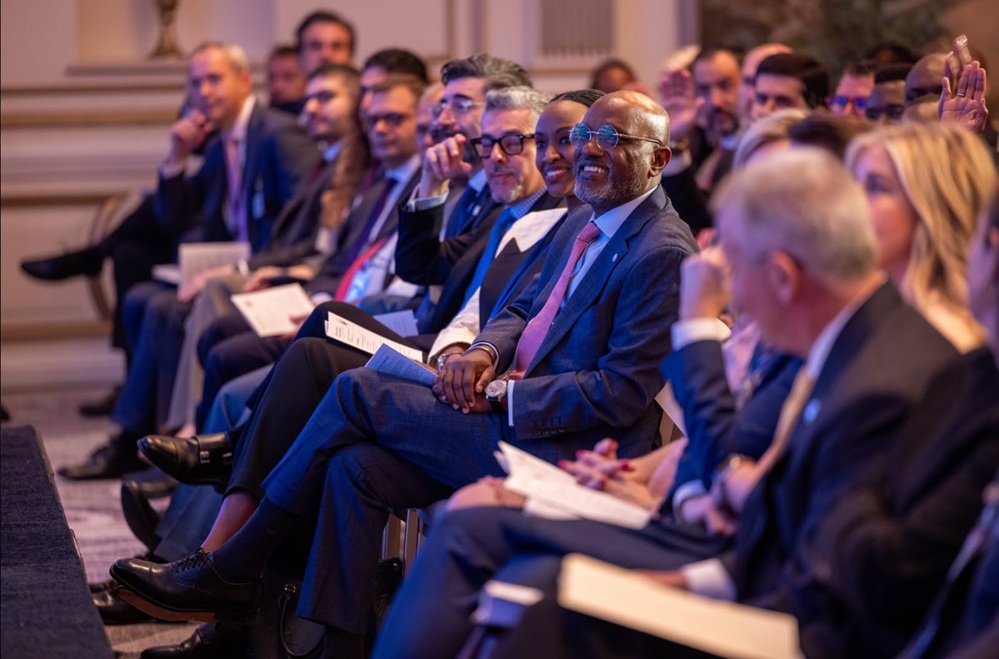
Government officials, private-sector representatives and international participants attend the “Trade Over Aid Deals Showcase” as U.S. officials discuss expanding trade and investment opportunities.

Landau said he wants the State Department, Commerce Department, Export-Import Bank, Development Finance Corporation and Millennium Challenge Corporation to work more closely together and make the U.S. government a more accessible “one-stop shop” for businesses seeking to invest overseas.

He cited the Pacific Islands as one region where he believes greater investment opportunities exist. Landau said he had organized a business summit and investment roundtable in Honolulu in February with Pacific Island leaders and U.S. private-sector representatives to identify sectors where investment could be expanded.

Landau said the U.S. government’s role is to improve communication between governments, businesses and investors and help identify opportunities for private capital. Concluding his remarks, Landau reaffirmed his commitment to expanding the global role of American businesses and called for what he described as an “unprecedented golden era for the American private sector around the world.”


Bangladesh-U.S. Relations Gain New Momentum: Bethany Morrison

Shibbir Ahmed, New York: Bangladesh-U.S. relations are currently on a positive trajectory, with Washington highlighting recent progress in trade, aviation and civilian nuclear cooperation as important developments in bilateral ties. Bethany Morrison, Deputy Assistant Secretary for South and Central Asian Affairs at the U.S. Department of State, made the remarks during a briefing on South Asia at the New York Foreign Press Center on Thursday.

“We are also in a good place with Bangladesh,” Morrison said, pointing to recent high-level engagement and expanding cooperation between the two countries.

Bangladesh Foreign Minister Meets President Trump

Morrison noted that Bangladesh’s foreign minister had the opportunity to meet with U.S. President Donald Trump earlier this week. She described the meeting as an important example of high-level engagement between Washington and Dhaka.

Highlighting recent trade cooperation, Morrison also referred to a major commercial agreement involving Boeing. She said President Trump had also posted about the development on his Truth Social account on Thursday morning.

Civilian Nuclear Cooperation

Morrison also said Bangladesh and the United States are preparing to sign a memorandum of understanding (MoU) on civilian nuclear cooperation. According to Morrison, the MoU is expected to be signed on Friday with the participation of a U.S. undersecretary. The proposed agreement could open another area of cooperation between the two countries, particularly in the peaceful use of nuclear technology and related civilian applications.

U.S. Sees Greater Engagement in South Asia

Morrison described the recent high-level contacts and agreements with Bangladesh as part of broader progress in U.S.-Bangladesh relations. Speaking about Washington’s wider policy toward South Asia, she said the Trump administration is placing greater importance on the region than in the past.

She indicated that the United States expects further progress in its relations with Bangladesh and other South Asian countries in the coming days. Journalists from Bangladesh, India, Nepal, South Korea, the United States and other countries attended the briefing at the New York Foreign Press Center.


Bangladesh redesigning primary healthcare system with a focus on prevention: Zubaida

Shibbir Ahmed, New York – Ziaur Rahman Foundation Vice-President and eminent physician Dr Zubaida Rahman on Thursday said Bangladesh is redesigning its primary healthcare system around prevention, early identification and continuity of care, with a stronger frontline workforce and professional midwives at the centre of the transformation.

“Our vision of a Healthy Bangladesh is to move from a treatment-centred system to one that emphasises prevention, early identification and continuity of care, with services closer to people’s homes,” she said.

Addressing a high-level side event titled “From Commitment to Action: Integrating Midwifery into Primary Health Care to End Preventable Maternal and Newborn Deaths” at United Nations Headquarters in New York, Zubaida outlined Bangladesh’s ongoing and planned initiatives to transform its Primary Health Care (PHC) system.

Bangladesh, she said, is working towards an integrated PHC network extending to rural unions and urban wards, supported by a stronger frontline workforce and digital health services.

“Women and children are at the centre of this transformation,” she said.

Zubaida said recruitment of 25,000 professional midwives has already begun, stressing that the initiative is aimed not merely at increasing their number but at integrating them into multidisciplinary PHC teams.

“Our objective is not simply to increase their numbers. We want to integrate them into multidisciplinary PHC teams and provide continuity of care from preconception and pregnancy through childbirth, postnatal and newborn care,” she said. The PHC model presented at the discussion places midwives at the centre of the maternal healthcare journey and seeks to move Bangladesh’s health system from fragmented services towards an integrated and accountable platform, she said.

The platform will connect households and communities with primary healthcare facilities and, when necessary, with secondary, tertiary and specialised care through a functioning referral system, Zubaida said. She said midwife-led PHC could advance three priorities for Bangladesh: better access, stronger financial protection and better value in healthcare.

“It can bring essential care closer to women, reduce unnecessary interventions and out-of-pocket expenditure, and ensure respectful care at the right place and at the right time,” she said. Zubaida said Bangladesh’s approach reflects its broader effort to put people at the centre of development and build a modern health system around prevention, dignity and access. The vision, she said, is to ensure that women receive continuous care throughout the maternal journey rather than accessing fragmented services at different stages.

“Every woman should have access to a skilled professional midwife as part of her PHC team, close to where she lives,” she said, outlining the ambition that guided the discussion. Zubaida said the approach is also intended to provide a model for countries to learn from one another while developing solutions suited to their respective health systems.

“Professional midwives save lives. Our task now is to build health systems that enable them to do so effectively, equitably and sustainably,” she said. Bangladesh looks forward to continuing its engagement with governments, UN agencies, development partners and the global health community to turn the dialogue into practical action, she said.

The discussion brought together health ministers and senior representatives from Sierra Leone, Nepal, Thailand, Indonesia, the Philippines and other countries, along with UN agencies, development partners, professional organisations, civil society representatives and members of the global health community. The event was organised in partnership with the Government of Sweden and the United Nations Population Fund (UNFPA).


Primary healthcare at heart of vision for ‘Healthy Bangladesh’: PM

Shibbir Ahmed, New York – Prime Minister Tarique Rahman on Thursday said his government wants to build a “Healthy Bangladesh” where healthcare begins at home and in the community, placing primary healthcare at the centre of the country’s health reform agenda with particular emphasis on women and children.

“My government is transforming our health system, guided by a simple principle: ‘Prevention is better than cure.’ We want to build a Healthy Bangladesh, where healthcare begins in the home and community,” he said.

The Prime Minister made the remarks while opening a high-level side event titled “From Commitment to Action: Integrating Midwifery into Primary Health Care to End Preventable Maternal and Newborn Deaths” at United Nations Headquarters in New York.

Bangladesh co-hosted the event with Sweden in partnership with the United Nations Population Fund (UNFPA) on the sidelines of the 81st session of the United Nations General Assembly. The event focused on integrating professional midwifery into primary healthcare to improve maternal and newborn care and reduce preventable deaths.

Tarique Rahman outlined plans to strengthen community-based primary healthcare and expand the role of professional midwives as members of multidisciplinary primary healthcare teams.

He said his government intends to recruit 100,000 additional health workers, 80 percent of whom will be women, to connect families with the health system, identify health risks at an early stage and facilitate timely care.

“One professional has a particularly important role in this continuum: the midwife,” he said.

“A professional midwife can become a woman’s trusted health professional from preconception through the postnatal period,” he added.

The Prime Minister said the government has decided to recruit 25,000 professional midwives across Bangladesh and that the process has already begun. He said the midwives would provide essential reproductive healthcare, support antenatal care, promote safe and respectful childbirth, identify complications early and facilitate referrals. They would also support mothers and newborns through breastfeeding, immunisation and healthy childhood development, he said.

Tarique Rahman said Bangladesh had built an important foundation for professional midwifery, including through professional midwifery education, stronger regulation and deployment of midwives at district, sub-district and union-level facilities.

“We now have more than 11,000 licensed midwives, with the objective of reaching 25,000 by 2030,” he said. He also acknowledged the contribution of Sweden and UNFPA to the development of professional midwifery in Bangladesh.

With UNFPA’s cooperation, Bangladesh has expanded midwifery-led care across 22 districts, where skilled midwives have supported more than 154,000 births and managed critical maternal cases, he said.

“These are not merely statistics. They represent mothers returning home safely, and newborns beginning life with hope,” the Prime Minister said. He also outlined the government’s plan to develop an integrated digital health ecosystem under which every citizen would have a Health Card linked to a digital health record and electronic referral system.

“For a woman in rural Bangladesh, her care can be registered close to home, her visits tracked, and her risk factors recorded. If referred to a higher-level hospital, the necessary information should travel with her,” he said.

The Prime Minister said the government’s vision for women’s health extends beyond pregnancy and childbirth and covers women’s health throughout the life course. This includes adolescent health, reproductive health and family planning, as well as prevention and early detection of cervical and breast cancers, he said. “Midwifery must therefore be part of a broader platform for women’s health within Primary Health Care,” Tarique Rahman said. He stressed that the next phase of the initiative should be driven by national ownership and sustainable domestic investment.

“As we open today’s discussion, I leave you with one ambition: Every woman should have access to a skilled professional midwife as part of her Primary Health Care team, close to where she lives,” he said.

“For Bangladesh, this means deploying midwives nationwide, strengthening community health services and referral pathways, and connecting citizens through a modern digital health system,” he added.

“Together, these steps will help us build a healthy, thriving Bangladesh. And this is how we move from commitment to action,” the Prime Minister said.

The event brought together ministers, UN agencies, development partners and health experts to discuss ways of translating commitments on midwifery and primary healthcare into sustainable investments and stronger health systems. UNFPA described the integration of midwifery into primary healthcare as a key strategy for expanding equitable, high-quality and dignified maternal and newborn care.


ADB approves $200m for Dhaka power upgrade

Dhaka: The Asian Development Bank (ADB) has approved a $200 million loan to help Bangladesh modernise and strengthen its electricity distribution network in fast-growing industrial and urban areas around Dhaka. The project aims to improve the reliability, efficiency and resilience of electricity supply for businesses and households, according to an ADB statement yesterday.

Under the Power Distribution Network Enhancement Project, the Bangladesh Rural Electrification Board (BREB) will upgrade distribution infrastructure across 13 Palli Bidyut Samities serving rapidly growing industrial and urban areas around the capital. The project will install 1,150 megavolt-amperes (MVA) of new transformer capacity across 52 substations and increase the capacity of 12 existing substations by 115 MVA.

It will also construct or upgrade more than 2,600 kilometres of overhead and underground distribution lines and install insulated conductors to improve network reliability, efficiency and safety. Another 900 fault locator sets will be deployed to speed up fault detection and service restoration. The project will also build river-crossing transmission structures and switching stations to modernise system operations.

“This project will help future-proof the power system in key growth corridors around Dhaka through advanced technologies, stronger infrastructure, and enhanced resilience measures,” said ADB Country Director for Bangladesh Qingfeng Zhang.

The ADB loan is part of a broader financing package for the project. The government will provide about $108 million in cofinancing, while BREB will contribute about $141 million. The Republic of Korea’s e-Asia and Knowledge Partnership Fund will provide a $1 million technical assistance grant.


PM to present Bangladesh’s vision, people’s aspirations at UNGA

Shibbir Ahmed, New York – Prime Minister Tarique Rahman will present Bangladesh’s vision for the future, national interests and aspirations of its people at the global forum of the United Nations General Assembly, with a focus on ensuring inclusive development, said PMO Spokesperson Mahdi Amin.

“Carrying the patriotism, emotions, sentiments and aspirations of the people, Prime Minister Tarique Rahman will present before the global community what Bangladesh’s vision for the future should be, how the country’s interests can be safeguarded and how inclusive development can be ensured,” he said.

Mahdi Amin made the remarks at a press conference in the lobby of the Hyatt Grand Central New York hotel at 9:00pm local time today after the premier arrived in New York to attend the UN General Assembly. He said the prime minister has arrived in New York on a historic visit as the head of a representative government elected by the people’s vote after a long time.

Referring to the historical context, he said, “Shaheed President Ziaur Rahman and Begum Khaleda Zia had presented Bangladesh’s position, vision and plans before the global community. As part of that historical continuity, their son, Prime Minister Tarique Rahman, will likewise uphold the spirit of patriotism and present Bangladesh’s interests and rights on the global stage.”

Mahdi Amin said the prime minister will deliver his address at the UN General Assembly on Thursday. Describing the prime minister’s visit as a very brief one, the spokesperson said he was moving away from the usual practice of lengthy foreign visits and would stay in New York for only a short period.

“Excluding the two days spent on travel, he will stay in New York for only four working days and will attend a number of bilateral and multilateral meetings,” he said. Regarding the size of the delegation, Mahdi Amin said the prime minister had completely broken away from the traditional practice and arrived with a small delegation for the brief visit.

“Officially, there are only 35 people here. Besides them, there are only essential media, security and personal staff. Prime Minister’s wife Dr Zubaida Rahman is also accompanying him,” he said. Informing that the prime minister’s official engagements will begin Tuesday, he said he would attend the opening session at the UN Headquarters at 9:00am, where heads of state and government of different countries will be present.

Earlier in the morning, he will attend a “Welcome Breakfast Reception” hosted at the invitation of the UN Secretary-General. PM’s Press Secretary AAM Saleh Shibly, Additional Press Secretary Atikur Rahman Ruman and Bangladesh’s Deputy Permanent Representative to the United Nations A K M Wahiduzzaman were also present at the press conference.


Biman Bangladesh Airlines Orders 11 More Boeing Aircraft in New York

Shibbir Ahmed, New York — Biman Bangladesh Airlines has ordered 11 additional Boeing aircraft as Bangladesh’s national flag carrier moves to expand and modernize its fleet. Boeing and Biman announced the agreement Wednesday in New York on the sidelines of the 81st session of the United Nations General Assembly. The order comprises five Boeing 787-10 Dreamliners and six Boeing 737-8 aircraft, according to Boeing.

The latest purchase follows Biman’s order for 14 Boeing aircraft announced in April, bringing the airline’s planned Boeing acquisitions to 25 aircraft this year. The April order included eight 787-10s, two 787-9s and four 737-8s. Reuters reported the April deal at approximately $3.7 billion based on list prices.

Signing ceremony in New York

The agreement was signed between Biman Bangladesh Airlines and Boeing during a ceremony in New York. Rumee A. Hossain, chairman of Biman Bangladesh Airlines, and Brad McMullen, Boeing senior vice president of Commercial Sales and Marketing, represented the two organizations at the signing ceremony. Boeing’s official photograph shows Hossain and McMullen in the front row of the ceremony.

The signing was attended by senior Bangladeshi and U.S. officials, reflecting the broader economic and trade context surrounding the aircraft purchase. Among those present were M. Rashiduzzaman Millat, Bangladesh Minister of Civil Aviation and Tourism; Humaiun Kobir, State Minister of Foreign Affairs; Chowdhury Ashik Mahmud Bin Harun, chairman of the Invest Bangladesh Authority; Madhi Amin, Advisor to the Prime Minister; U.S. Secretary of Commerce Howard Lutnick; and U.S. Deputy Secretary of State Christopher Landau.

Also pictured at the ceremony were William Kimmitt, Under Secretary of Commerce for International Trade; Brendan Nelson, Boeing Global senior vice president; Stephanie Pope, Boeing Commercial Airplanes president and CEO; S. Paul Kapur, Assistant Secretary of State for South and Central Asian Affairs; Kaanthi Bhuvanagiri, Boeing sales director for India and South Asia; and Paul Righi, Boeing vice president of Commercial Sales and Marketing for Eurasia, India and South Asia.

Fleet modernization and network expansion

Biman Chairman Rumee A. Hossain described the supplemental agreement as part of the airline’s ongoing fleet-renewal and network-expansion program. “Today’s supplemental agreement is an important step in Biman’s ongoing fleet renewal and network expansion,” Hossain said, adding that the order responds to specific requirements in the airline’s fleet plan. Hossain said Biman aims to develop its network and capabilities to meet the connectivity needs of passengers in Bangladesh, the country’s expatriate community, businesses and the tourism sector.

Boeing said the additional aircraft will strengthen Biman’s existing Boeing fleet. The 737-8 will provide additional range and capacity for the airline’s single-aisle network, while the 787-10 will add capacity alongside Biman’s existing 787-8 and 787-9 aircraft. Boeing also said the 787 Dreamliner and 737 MAX families provide approximately 20% to 25% greater fuel efficiency compared with the aircraft they replace, supporting Biman’s fleet-modernization strategy.

Boeing welcomes additional Biman order

Brad McMullen, Boeing’s senior vice president of Commercial Sales and Marketing, said the additional order reflects Biman’s approach to fleet renewal and capacity growth. “Biman’s follow-on order reflects its strategic approach to fleet renewal and capacity growth, and underscores the strength of our long-standing partnership,” McMullen said. He said the additional 787 Dreamliner and 737 MAX aircraft will provide the efficiency and versatility Biman needs as Bangladesh’s international aviation market grows.

Broader Bangladesh-U.S. trade context

The aircraft purchase comes as Bangladesh seeks to strengthen economic and trade ties with the United States. Reuters reported that the latest Boeing purchase expands Biman’s planned orders to 25 aircraft as Dhaka seeks to increase imports from the United States and address a trade imbalance of roughly $6 billion. Reuters also reported that the aircraft order is part of broader efforts to reduce pressure related to U.S. tariffs on Bangladeshi exports.

However, the aircraft agreement itself is a commercial purchase between Biman Bangladesh Airlines and Boeing, rather than a government-to-government contract between Bangladesh and the United States. Government officials attended and celebrated the signing, but Boeing and Biman are the parties to the aircraft purchase.

Biman’s Boeing fleet

Biman currently operates Boeing 787, 777 and 737 Next-Generation aircraft across its international network, serving destinations in the Middle East, South and Southeast Asia and Europe. With the latest order, Biman’s planned Boeing purchases announced in 2026 total 25 aircraft, comprising both wide-body Dreamliners and 737 MAX aircraft. The carrier says the fleet expansion is intended to support modernization, increase capacity and strengthen its international network.