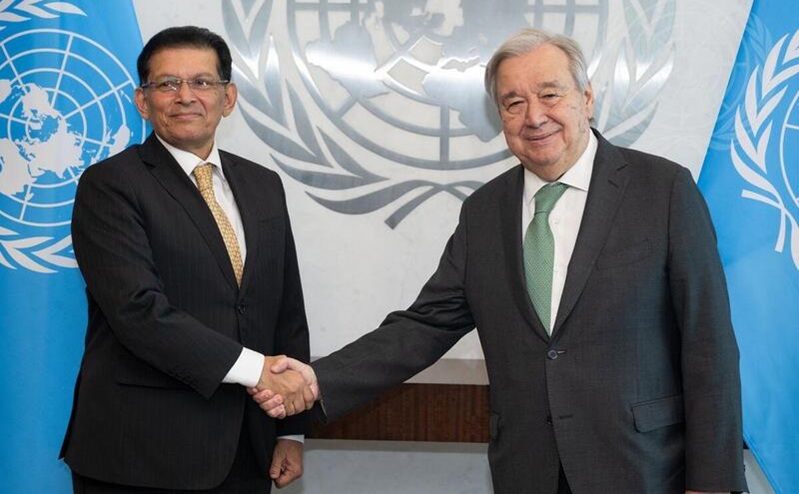
Jacobson: US doesn’t support any party, expects fair polls in Bangladesh

US Chargé d’Affaires in Dhaka Tracey Ann Jacobson on Monday said the US does not support any particular party, politician, or election outcome, as it expects fair elections in an atmosphere of peace and security early next year.

“The US embassy or the US government does not support any particular party, but we do meet political parties to understand their platforms and their goals. We do not support any particular politician, but we do meet politicians to understand their goals, and we do not support any particular outcome. That is for the people of Bangladesh to decide, and we wish you all the best in doing it,” she said.

The US envoy made the remarks while talking to reporters after a meeting with Chief Election Commissioner A M M Nasir Uddin at Nirbachan Bhaban in the capital.

Tracey Ann Jacobson said she came to the EC with some of her colleagues to listen and to learn and understand, as there are so many rumours and conspiracy theories out there.

Noting that she wants to be very clear what the US government position is, the envoy said the US supports the interim government led by Professor Yunus and the Central Election Commission in charting a pathway to free and fair elections early next year.

“We hope those elections will happen in an atmosphere of peace and security, and we hope they will lead to a successful democratic government that will represent the aspirations and dreams of the Bangladeshi people,” she said.

Jacobson led a three-member delegation from the US Embassy to the meeting. Two other delegation members are David Moo (political chief at the embassy) and Firoze Ahmed (political specialist).


Bangladeshis lose 5.5 years of life to world’s most polluted air

DHAKA: Air pollution shortens the average Bangladeshi’s life by 5.5 years, making it the world’s most affected country, latest data shows, as the government vows to act by the year’s end.

According to last week’s Air Quality Life Index report by the University of Chicago’s Energy Policy Institute, “air pollution is the greatest external threat to life expectancy” in Bangladesh, which is currently “the world’s most polluted country.”

All of Bangladesh’s 166.8 million people live in areas where the yearly average level of fine particulate pollution exceeds both the World Health Organization’s guideline of 5 micrograms per cubic meter of air and the country’s national limit of 35 micrograms. In places like the capital, Dhaka, the concentration was above 76 micrograms.

“The average Bangladeshi resident could live 5.5 years longer if particulate pollution met the World Health Organization (WHO) guideline,” the report says. In Dhaka, the impact of toxic air is particularly severe, slashing the average life expectancy by 6.9 years.

The report also shows that the air quality is quickly worsening despite the government’s attempts to address the problem.

“It’s very concerning for us. I doubt if there are any other countries in the world that witnessed such a grave situation,” said Dr. Ahmad Kamruzzaman Majumder, professor at the Department of Environmental Science at Stamford University in Dhaka.

“Air pollution has reached such a severe level here that no research is needed to identify it, as one can see it with the naked eye.”

Smog is an everyday reality for residents of Bangladeshi cities, as it shrouds them almost every morning. But what is more dangerous is the pollution that the eye cannot see: particulate matter, PM2.5 — tiny airborne particles less than 2.5 micrometers wide that can penetrate deep into the lungs and bloodstream.

PM2.5 levels in Bangladesh have been on a sharp rise since the late 1990s. The only time they dropped was during the coronavirus pandemic in 2022, but that trend did not last.

“In last year’s AQLI report, our average life expectancy was reduced by 4.8 years, and this year it’s reported as 5.5 years,” Majumder said.

“The situation is very alarming. It shows that the state has failed to ensure a safe environment for the protection of its people. Bangladesh didn’t reject this report, which means the Bangladeshi government also agrees with the findings of this report. The state can’t evade the responsibility here.”

As the main sources of pollution, he listed increasing use of fossil fuels and fumes from brick kilns, which burn coal or wood to fire bricks.

“Every year, an additional 100,000 vehicles hit the streets of Dhaka. Many of these vehicles operate without proper fitness checks, contributing significantly to air pollution,” he said.

“Transboundary air pollution from neighboring countries is also affecting us. The lack of proper waste management, including open burning, is also a big factor.”

In response to the latest air pollution report, the government vows to step up its efforts by the year’s end, although the task is not easy, with Dr. Ziaul Huq, director of air quality management at the Department of Environment, admitting that “every source of air pollution” exists in Bangladesh’s environment.

“We are trying to withdraw the vehicles without fitness checks from the streets, but we are yet to see any success in this sector,” he told the News.

“Big industries that are responsible for air pollution, we will bring them under constant monitoring. A device will be installed at their factory furnace, and our officials will continuously monitor the emission results centrally. If any deviation is found, we will intervene immediately. This work will begin within the next two months under the ‘Bangladesh Clean Air’ project.”

While not all sources of pollution can be controlled, some, until now, have not been properly addressed.

“In the case of Dhaka, transboundary pollution is responsible for 30 percent to 35 percent of air pollution. This situation is beyond our control. From October to April, 35 percent of air pollution in Dhaka comes from outside the country,” he said.

“Thirty-nine percent of Dhaka’s air pollution is caused by the burning of waste and firewood. We couldn’t address this issue properly. Our efforts are there.”


Times Square shooting leaves 3 hurt, suspect in custody

Three people were shot and wounded in New York’s Times Square, the New York Police Department said on Saturday (9 August). The people – an 18-year-old female, 19 19-year-old male, and a 65-year-old male – are in a stable condition in hospital, an NYPD spokesperson said. A 17-year-old male is in custody, the NYPD added. The police also recovered a firearm.

The shooting took place at around 1:20am ET (0520 GMT) and followed a verbal altercation with one of the victims, the NYPD added. It said it was not known at this time whether the shooter or the victims knew each other. Mass shootings are relatively common in the United States, where guns are widely available.

The incident at one of New York’s most iconic tourist spots comes after July’s high-profile shooting in a Manhattan office tower, which left four people dead, including a senior Blackstone executive and an NYPD officer.

New York experienced record-low shooting incidents and victims in the first seven months of this year, and in July, according to a statement published by the city’s police department on 4 August. Crime is a key electoral issue for America’s largest city, which is set to hold mayoral elections in November.


Bangladesh women climb 24 places in FIFA ranking

Bangladesh have achieved their biggest-ever leap in the FIFA Women’s World Ranking, climbing 24 places to reach 104th, up from 128th. This dramatic rise follows their historic qualification for the AFC Women’s Asian Cup 2026 — the first time Bangladesh have reached the continental finals.

In the latest rankings released by FIFA, the Bengal Tigresses earned 1179.87 points — the highest gain among all nations in this cycle, with a net increase of +80.51 points. The improvement reflects the team’s consistent performances, especially against higher-ranked opponents, during the Asian Cup qualifiers held in Yangon, Myanmar.

Coached by Englishman Peter Butler, Bangladesh emerged as group champions, defeating host nation Myanmar (ranked 55th at the time), Bahrain (ranked 36 places higher), and Turkmenistan. The team maintained a perfect winning record throughout the campaign, showcasing tactical discipline, defensive strength, and attacking flair.

With this boost, Bangladesh are now ranked 19th among AFC (Asian Football Confederation) nations. Within the South Asian Football Federation (SAFF), they are now third, only behind India (63rd) and Nepal (87th) — a significant milestone that highlights their growing stature in regional football.

The qualifiers marked a turning point for Bangladesh women’s football, with the team demonstrating resilience and a growing maturity on the international stage.

Their rise in the rankings signals a strong step forward for South Asian women’s football and sets high expectations for their Asian Cup debut.

Meanwhile, Spain — runners-up in the recent UEFA Women’s Euro — have reclaimed the top position in the global standings, pushing the United States down to second. However, Bangladesh’s 24-place climb remains the most remarkable gain in this update.

With momentum on their side, the Tigresses now look ahead to making a bold statement in the 2026 AFC Women’s Asian Cup.


Final voter list to be published on 31 August: EC

The Election Commission (EC) will publish the final voter list for the upcoming national elections on 31 August. Prior to that, a draft version will be released on 10 August, said a press release issued today (4 August) signed by EC Secretariat Director (Public Relations) Md Shariful Alam.

According to the release, the supplementary voter list — comprising newly registered voters born on or before 1 January 2007 and added to the database by 30 June 2025 — will also be made public on 10 August. This list will include updates such as the removal of deceased voters.

Following the release of the supplementary list, applications for the inclusion of eligible voters, deletion of names of deceased or ineligible individuals, transfer of voter records, and correction of any errors must be submitted by 21 August. The final voter list, incorporating all verified changes, will then be published on 31 August, said the Election Commission.


Gunman kills four including Bangladeshi immigrant police officer

A gunman with mental health issues opened fire in a central Manhattan skyscraper on Monday, killing four people including a policeman before apparently taking his own life, officials said. Mayor Eric Adams said the fallen police officer was a 36-year-old immigrant from Bangladesh.

Two other males and a female died and another man remained in a critical condition, officials said without giving any preliminary motive for the shootings.

An NFL employee was stable after being ‘seriously injured’ in the attack, ESPN reported, quoting an internal memo from league commissioner Roger Goodell. A fifth victim was in critical condition after being shot, Eric Adams told a late-night press briefing at a nearby hospital.

The gunman was caught on surveillance footage leaving a black BMW and carrying an M-4 rifle, police commissioner Jessica Tisch told the news conference.

On entering the building, he immediately opened fire on a police officer before ‘spraying the lobby’ with bullets, she said.

The gunman then took an elevator to the 33rd floor of Rudin Management, which owns the building, and continued his spree before apparently shooting himself. He was later discovered by officers next to his weapon.

The office tower block at 345 Park Avenue — home to the National Football League, hedge fund giant Blackstone, and auditor KPMG — was apparently targeted by the gunman, who is believed to have acted alone, Tisch said.

The police commissioner identified the shooter as Shane Tamura from Las Vegas and said a revolver, ammunition and magazines were found in his vehicle.

Tamura had a history of mental health issues, she said.

The incident began around 6:00pm (2200 GMT) when reports of gunfire prompted hundreds of police to swarm a busy office district on Park Avenue, an area popular with tourists and businesspeople.

A worker from a nearby office building wept as she left the area after a local lockdown was lifted. Another office worker described the gunman going floor-to-floor as staff prepared to leave for the day.

‘We lost four souls to another act of senseless violence,’ the city’s mayor said, excluding the shooter, who died by an apparently self-inflicted gunshot. CNN and NBC cited unnamed officials as saying the shooter had a grievance with the NFL and its handling of CTE, a brain condition linked to head trauma.

The gunman had a note in his pocket saying he suffered from CTE, the news channels said, quoting a source with knowledge of the investigation. Office worker Shad Sakib said that he was packing his things to leave work when a public address announcement warned him and his colleagues to shelter in place.

‘Everyone was confused with like, ‘wait, what’s going on?’ And then someone finally realised that it’s online, that someone walked in with a machine gun,’ the witness said.

‘He walked right into a building right next door. We saw the photo of him walking through the same area that I walked through to get lunch here.

‘You would think it won’t happen to you, and then it does.’

Another witness, a woman who declined to give her name as she left the vicinity of the shooting, said: ‘I was in the building. He went floor by floor.’

A second woman wept as she left the scene.

There have been 254 mass shootings in the United States this year including Monday’s incident in New York, according to the Gun Violence Archive — which defines a mass shooting as four or more people shot.


39 Bangladeshis deported from US arrive in Dhaka

A total of 39 Bangladeshi nationals, including one woman, were deported from the United States and arrived in Dhaka today (2 August). They were flown back on a special military aircraft (C-17), which landed at 6:45am at the Hazrat Shahjalal International Airport in Dhaka, an officer of the Immigration Department of the Special Branch (SB) of police confirmed to The Business Standard.

Upon their arrival, the returnees were provided with transportation assistance by Brac, while food support was arranged by the expatriates’ welfare desk, Brac Migration Programme said in a press release. Several of the deportees alleged that they were kept in handcuffs throughout the long flight from the US.

“We are not criminals. We simply sought asylum. But we were treated like dangerous prisoners,” said one of the returnees.

Commenting on the deportation, Shariful Hasan, associate director of Brac Migration Programme and Youth Platform, said, “From what we have learned, most of them had sold their homes or taken heavy loans to finance the journey — some spending as much as Tk30 to Tk40 lakh — trying to reach the US in an irregular approach through Mexico or various South American countries.”

Upon reaching the US, they applied for asylum, but their applications were rejected by the courts and immigration authorities, Shariful said, adding that the US administration later decided to deport them.


Silent procession in Dhaka condemns assault on democracy, vilification of Tarique

A silent procession of professionals was held in Dhaka on Friday, protesting attempts to undermine the country’s democratic environment and tarnish the image of Tarique Rahman, hailed as a symbol of youth pride.

The procession, organised by the Bangladesh United Professionals Council, began from the Jatiya Press Club and marched through Kadamful Fountain, Topkhana Road and Purana Paltan before returning to the Press Club.

It was led by Professor Dr AZM Zahid Hossain, convener of the council, and journalist Kader Gani Chowdhury, its member secretary.

Speaking during the event, Dr Zahid said democracy in the country is under threat from “conspirators operating from the shadows.”

“These elements are the main obstacle to restoring democratic governance,” he added.

Kader Gani Chowdhury said the people of Bangladesh have been struggling for nearly two decades to reclaim their voting rights, yet that right remains elusive.

He alleged that “agents of fascism” still hold influential positions within the administration and called for their removal.

Gani also demanded the repeal of all repressive laws, including the Cyber Security Act, and an end to what he described as the “politics of character assassination” and conspiracy against national leaders.

A wide range of professionals and prominent citizens took part in the procession.

Among them were Bangladesh Open University Vice-Chancellor Professor Dr ABM Obaidul Islam, senior lawyer Subrata Chowdhury, National University Pro-VC Professor Dr Lutfur Rahman, corporate leader Syed Alamgir, and educationists, physicians, engineers, agriculturists and journalists.


Gopalganj violence: 3 cases filed against 1,329 people, 90 more arrested

At least three cases, including two with the Gopalganj sadar police station and the other with the Kashiani police station, were filed against 1,329 people between Thursday night and Friday over allegations of attacking police and vandalising their vehicles and felling trees to create obstructions on Wednesday centering the National Citizen Party rally. The death toll from the violence in Gopalganj over NCP rally on Wednesday reached five as a rickshaw puller hit by bullet died while undergoing treatment at Dhaka Medical College Hospital early Friday.

The government, meanwhile, extended the curfew over Gopalganj district till 6:00am on Saturday and it might be extended further while the joint forces arrested 90 more people since Thursday night. The Wednesday violence in Gopalganj erupted as security forces personnel and Awami League and its banned student body Bangladesh Chhatra league members got locked into clashes after the latter attacked NCP leaders in their motorcade.

The interim government on May 12 banned all activities of the Awami League and its affiliated, allied, and like-minded organisations until the completion of the trials involving them at the International Crimes Tribunal. Ramjan Munshi, 32, a resident of Thana Para, Gopalganj town, son of Akbar Munshi, died at about 1:45am on Friday, according to DMCH officials.

Asked about the death in a gunshot injury, DMCH director Brigadier General Md Asaduzzaman acknowledged the death but did not provide details. According to DMCH officials, Ramjan Munshi was admitted to the DMCH at about 4:30pm on Thursday. They said that the body was sent to the DMCH morgue for autopsy. While talking to New Age in front of the morgue, the victim’s brother Hira Munshi said that his brother received a bullet injury in the chest at Chowrangi Mor on Wednesday.

‘We first got him admitted to Gopalganj Sadar Hospital and later shifted him to Dhaka Medical College,’ he said.

According to police, two cases were filed with the Gopalganj sadar police station but none of them were filed in connection with the killing of five people. Gopalganj sadar police station inspector for investigation Abdullah Al Mamun told New Age that a case was filed under the Anti-Terrorism Act 2009 on Thursday night against 575 people, including 75 named for beating police members with the intention to kill and vandalising a police vehicle at Ulpur under sadar upazila, on Wednesday.

‘Police filed another case with the sadar police station on Friday against 404 people, including 54 named persons under the Anti-Terrorism Act 2009,’ the inspector added.

Gopalganj district assistant superintendent of police for Muksudpur Circle Md Abdul Based said that Kashiani police sub-inspector Alimul Huda Jony filed a case against 300-350 people, both named and unnamed, on the allegation of obstructing the highway near Sampan Highway Restaurant by felling trees on the road. He, however, also said that they had arrested 90 people, including 66 in Muksudpur and 24 in Kashiani area, over the Wednesday violence since Thursday night.

‘We will continue our drive to arrest the accused,’ he added.

Earlier, the joint forces arrested 25 people and the number of arrestees rose to 115 so far. The Inter Services Public Relation directorate in a statement on Thursday said that the Bangladesh Army was compelled to use force at one point in self defence in Gopalganj on Wednesday as attackers threw a huge number of crude bombs and brick bats at them.

At about 7:30pm on Wednesday, a group of unruly people took away the bodies of the deceased from the Gopalganj District Hospital. They prevented doctors from carrying out autopsy of the bodies, said the chief adviser’s press wing on Thursday.

In the Wednesday violence in Gopalganj, a police vehicle was torched, upazila nirbahi officer was attacked, cocktails were exploded, brick bats were hurled, and the NCP rally venue and motorcade were attacked.

The police fired rubber bullets, hurled sound grenades, and lobbed tear gas shells while members of the Bangladesh Army opened fire in the air to disperse Awami League activists and to save the NCP leaders.


Data from PHQ presents a grim picture of violent crimes

A recent spate of violent crimes across the country has raised serious concerns about the effectiveness of law enforcement, nearly a year into the interim government’s tenure. Data from the Police Headquarters (PHQ) presents a grim picture of violent crimes, including murder, mugging, robbery, extortion, and mob violence, in the first six months of 2025.

Moreover, many of these incidents were caught on camera and widely shared on social media, fuelling fear and insecurity among the public. Inspector General of Police Mohammad Baharul Alam admitted that the police are yet to regain their control following last year’s traumatic political upheaval.

“You may say we haven’t been 100 percent successful. Maybe not even 50 percent. The situation is widespread … we must find ways to deal with it,” he told yesterday.

Experts warned that the situation may worsen if the government fails to take prompt and effective measures to tackle it. According to PHQ, 1,336 cases of dacoity and robbery were reported across the country in the first six months of this year.

During the same period, police recorded 1,930 murder cases, though over 400 of them were filed over incidents that took place in previous years. Crimes against women and children also remained a serious concern. From January to June this year, 11,008 cases related to the repression of women and children were filed.

In addition, 515 kidnapping cases were reported in the same period, indicating a growing threat to personal security. Mob violence remained a disturbing trend. At least 89 people were killed in mob attacks between January and June this year, including 45 in Dhaka alone, according to rights group Ain o Salish Kendra. Such incidents have continued despite repeated warnings from law enforcement officials and government advisers.

One such case is the recent brutal killing of scrap metal trader Lal Chand alias Sohag in the capital’s Mitford area on Wednesday, a video of which went viral on social media, sparking public outrage. Many criticised how such a barbaric assault could occur in broad daylight and in full view of bystanders, without any intervention.

Meanwhile, a group of armed men attacked a business establishment in the capital’s Pallabi on Friday, allegedly for not getting Tk 5 crore in extortion money. Also on Friday, unidentified assailants severed tendons and shot dead a former Jubo Dal leader in front of his house in Khulna city.

The same day, a 75-year-old khatib of a local mosque was hacked with a machete after Juma prayers in Chandpur. On Friday morning, muggers in the capital’s Shyamoli area not only snatched valuables from a man but also took his shirt and shoes.

Just a day before, police recovered the body of a man bearing multiple hack wounds, with his hands cuffed behind his back and legs tied with a scarf, from a roadside in the capital’s Mirpur-11 area.Such killings have lately hogged the headlines.

Apart from these, mugging incidents, some taking place in broad daylight, have also rattled people’s confidence in the country’s law and order. These incidents kept occurring even as the army remains deployed across the country with magistracy powers to assist in maintaining law and order. IGP Baharul Alam yesterday said the authorities are yet a find a way to make the force fully operational.

“Our main challenge is making the force 100 percent effective after such a traumatic experience [last year],” he said at an event in Gendaria.

“I’m still not satisfied [with the situation]. We’re still in the process [of regaining control],” he said, adding that operations and arrests of known criminals are ongoing.

On political ties to crimes, he said the expulsion of accused individuals from political organisations is a welcome sign. Meanwhile, Home Affairs Adviser Lt Gen (retd) Jahangir Alam Chowdhury defended law enforcers. “If police were inactive, arrests wouldn’t have happened in last two days,” he said, referring to the Mitford murder.

“There may have been some delays in action, but we acted after verifying information,” he said, urging people to contact police instead of taking law into their own hands.

Meanwhile, Rapid Action Battalion Director General AKM Shahidur Rahman said the elite force is focused on regaining public trust following criticism during last year’s political unrest. “Gaining public trust is the main task,” he said at a press briefing in Karwan Bazar.

Omar Faruk, a professor at the Department of Criminology and Police Science at Mawlana Bhashani Science and Technology University, said prolonged political misuse of the police has deeply damaged the institution.

“For 15 years, police have been used politically. That damage is hard to reverse,” he told. “Police still don’t behave like they should in a democratic country.”

He added, “I have spoken to several officers. They believe the police are going through a crisis period, and once it’s over, the situation will be under control, gradually.” However, he said the government has to arrange training or counselling programmes to help officers adapt to the situation. He also said curated efforts are needed to rebuild the trust between the force and the people.