Republican lawmaker seeks Hegseth impeachment over Iran war

Shibbir Ahmed, WASHINGTON DC: Republican Rep. Thomas Massie on Tuesday filed articles of impeachment against Defense Secretary Pete Hegseth, accusing him of conducting military action against Iran without congressional authorization.

Massie, a Kentucky Republican and outspoken critic of the U.S. war in Iran, filed the impeachment resolution as a privileged measure, meaning the House is required to take it up within two legislative days.

The lawmaker’s resolution accuses Hegseth of abusing his office by carrying out hostilities against Iran without a declaration of war or specific authorization from Congress. Massie has argued that the administration’s continued military operations violate Congress’s constitutional authority over decisions to initiate war.

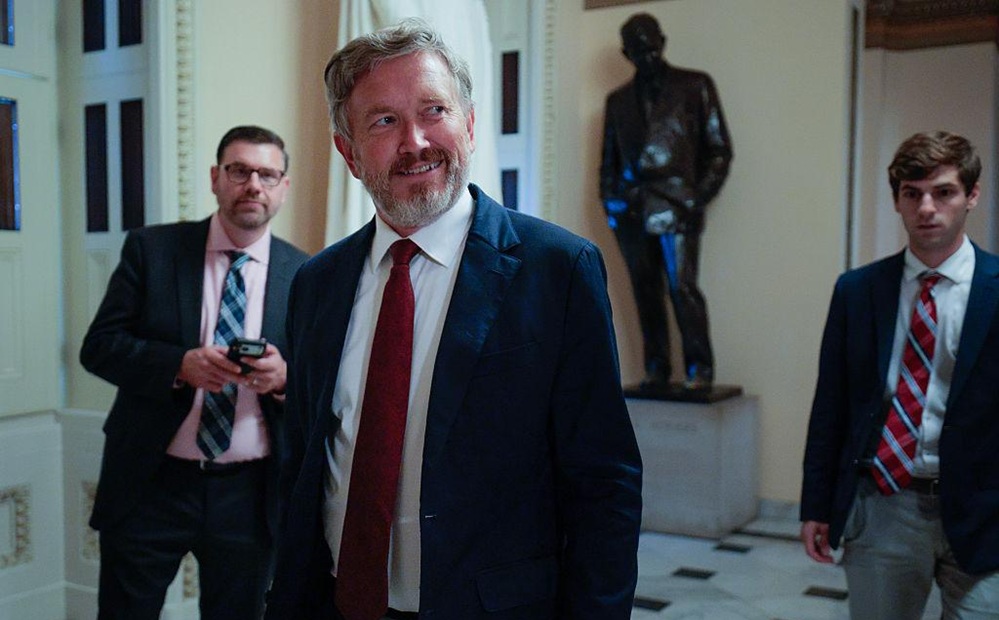
Rep. Thomas Massie, the Republican congressman from Kentucky who filed the impeachment articles against Defense Secretary Pete Hegseth today.

The move comes as the United States remains involved in the conflict with Iran, which began with U.S.-Israeli strikes on Iran on February 28. Massie has repeatedly opposed the war and has also criticized U.S. military support for Israel. The Pentagon rejected the impeachment effort and reaffirmed its support for Hegseth.

“The entire Department is unified behind the Secretary’s vision and will continue working to put our warfighters and America first,” Pentagon press secretary Kingsley Wilson said in a statement. The impeachment effort is unlikely to secure the support needed to remove Hegseth, but Massie’s filing could force House members to take a position on the administration’s military actions.

Massie is not seeking reelection after losing the Republican primary earlier this year to Ed Gallrein, a candidate endorsed by President Donald Trump. His opposition to the Iran war has been a prominent feature of his congressional record. The filing comes amid continuing debate on Capitol Hill over the extent of the president’s authority to conduct military operations without explicit congressional authorization.


Judge blocks Trump name from Kennedy Center

Shibbir Ahmed, WASHINGTON DC: A US federal judge on Tuesday blocked the Kennedy Center board from adding President Donald Trump’s name to the building or its grounds, ruling that such a move would require approval from Congress. US District Judge Christopher Cooper said the board could not circumvent his earlier order by using alternative wording to honor Trump. The ruling came after the Kennedy Center board proposed adding an inscription reading that the building had been “Restored and Renovated By President Donald J. Trump.”

“Simply put,” Cooper wrote, the defendants cannot install memorials for Trump or anyone or anything else at the Kennedy Center without congressional approval. The decision follows Cooper’s May ruling that the Kennedy Center’s name could not be changed without action by Congress. Trump’s name, which had been added to the building’s exterior, was subsequently removed in June.

The Kennedy Center board, which Trump chairs, had voted in August to pursue new signage recognizing his role in the institution’s renovation. The board also considered naming the center’s grounds the “President Donald J. Trump Plaza.” The latest court ruling blocks those efforts.

The legal dispute comes as the Kennedy Center faces financial difficulties and questions over the condition of its aging building. Trump and his allies have argued that extensive repairs are urgently needed, while the administration has warned in court filings that the building could eventually face demolition if major renovations are not carried out.

Trump has pointed to recent damage at the center following severe weather as evidence of safety concerns. In a post on Truth Social on Tuesday, he argued that the building required immediate attention and criticized the court proceedings over its future.

Meanwhile, the Kennedy Center board voted Tuesday to temporarily close the performing arts complex for renovations. The decision followed the court ruling and came amid reports of severe financial pressures facing the institution. The Kennedy Center, officially established as a memorial to former President John F. Kennedy, was created by Congress and opened in 1971. Cooper’s rulings have emphasized that Congress has the authority to determine its name.

The dispute has also affected programming at the venue. A number of artists have canceled or reconsidered appearances following Trump’s takeover of the institution, while reports have pointed to declines in ticket sales and fundraising.

Trump has said his involvement is intended to help secure the center’s finances and fund necessary renovations. The legal battle over the institution’s name and future is expected to continue as the administration considers its options following Cooper’s ruling.


Dhaka, Beijing Discuss Economic Corridor

DHAKA – Bangladesh and China today discussed cooperation on the Bangladesh-China-Myanmar Economic Corridor alongside a wide range of bilateral areas, including infrastructure, energy, human-resource development and economic cooperation.

The issues came up when Chinese Ambassador to Bangladesh Yao Wen paid a courtesy call on State Minister for Foreign Affairs Shama Obaed Islam, MP, at her office here, according to a foreign ministry press release.

During the meeting, the two sides exchanged views on areas of mutual interest and cooperation, particularly the Bangladesh-China-Myanmar Economic Corridor, the Chinese Economic Zone and development of Mongla Port.

They also discussed the proposed 1,000-bed hospital in Rangpur, education and human-resource development, people-to-people exchanges, energy cooperation, including renewable energy, and women’s empowerment.

Shama recalled Prime Minister Tarique Rahman’s successful visit to China and appreciated Beijing’s continued support for Bangladesh’s development, particularly in infrastructure, human development and capacity building.

Ambassador Yao reaffirmed China’s commitment to Bangladesh as a trusted partner and friend and highlighted the significant progress made in bilateral relations in recent years. During the meeting, the Chinese envoy also invited the state minister to visit China at a mutually convenient time, leading a delegation of women entrepreneurs from Bangladesh. Shama welcomed the invitation and expressed appreciation for the initiative.


US Sanctions Russian VTB Bank Over Iran Sanctions Evasion

Shibbir Ahmed, New York — The United States has imposed new sanctions on Russia’s VTB Bank, accusing the major financial institution of helping Iran evade U.S. sanctions and establishing correspondent banking relationships with sanctioned Iranian banks. The U.S. Department of the Treasury’s Office of Foreign Assets Control (OFAC) announced the action on September 14 under the administration’s Operation Economic Outcast, a campaign aimed at disrupting the Iranian regime’s financial networks and sources of revenue.

“Under Operation Economic Outcast, Treasury will continue to target and disrupt those who provide material, technological, or financial support that allows the Iranian regime to sustain its terrorist enterprise,” Treasury Secretary Scott Bessent said. Bessent added that the United States would continue identifying, exposing and isolating individuals and institutions that support the Iranian regime.

VTB Accused of Expanding Ties With Iran

According to the Treasury Department, VTB Bank, one of Russia’s largest financial institutions, has expanded its banking presence in Iran in recent years as Moscow and Tehran have sought to deepen economic and trade ties.

U.S. authorities said VTB established correspondent banking relationships with Iranian financial institutions already under sanctions and began taking additional steps to expand its presence in Tehran in January 2025.

The Treasury Department also accused the bank of helping establish a settlement mechanism using Iranian rials and Russian rubles through correspondent accounts, with the aim of facilitating bilateral trade. U.S. officials further alleged that VTB took steps to move billions of dollars in frozen Iranian assets.

Operation Economic Outcast

The Treasury Department announced Operation Economic Outcast on August 24, describing the campaign as an effort to sever the remaining economic lifelines supporting the Iranian regime. The operation focuses on financial networks involved in oil smuggling, sanctions evasion and the financing of Iran’s security apparatus, terrorist proxies and other affiliated networks.

Washington has warned foreign financial institutions that continuing significant business with sanctioned Iranian entities could expose them to secondary sanctions and potentially restrict their access to the U.S. financial system. The Treasury Department said it is also working with partners in the European Union, the United Kingdom and Gulf countries to target financial channels connected to Iran.

VTB Already Under U.S. Sanctions

The latest action is not the first time VTB Bank has been targeted by the United States. OFAC previously designated VTB in January 2025 under sanctions authorities targeting Russia’s financial sector. The bank was also sanctioned in February 2022 over its ties to the Russian government and its operations in Russia’s financial services sector. The new designation adds Iran-related sanctions exposure to the bank’s existing restrictions.

Assets Blocked

Under the latest action, all property and interests in property belonging to VTB Bank that are located in the United States or held by U.S. persons are blocked and must be reported to OFAC. U.S. persons are generally prohibited from conducting transactions involving the blocked property unless authorized by OFAC or covered by an applicable exemption. The restrictions also extend to entities that are owned, directly or indirectly, 50% or more by one or more blocked persons.

Foreign financial institutions engaging in certain significant transactions involving designated entities may also face the risk of secondary sanctions, including restrictions on their ability to maintain correspondent or payable-through accounts in the United States.

The Treasury Department said the latest action sends a broader warning to foreign banks and businesses that facilitate Iran’s efforts to circumvent U.S. sanctions. Washington is expected to continue targeting financial institutions and other entities that it says provide Iran with access to international financial networks.


U.S. Judge Blocks Trump Mail-Ballot Restrictions Again

Shibbir Ahmed, Washington, D.C. — A second federal judge has blocked the Trump administration from implementing new restrictions on mail-in voting, delivering another legal setback to the administration as the 2026 midterm elections approach.

U.S. District Judge Carl Nichols in Washington issued a preliminary injunction blocking new U.S. Postal Service rules that would impose stricter requirements on mail-in ballots. His ruling follows a similar decision by Boston-based U.S. District Judge Indira Talwani, who also blocked the rules.

The disputed regulations would require states to provide voter eligibility information to the Postal Service and comply with new ballot-envelope requirements, including unique barcodes. The administration says the measures are intended to strengthen election security and ensure that mail ballots are properly verified.

Opponents argue that the federal government does not have the authority to impose such requirements on state-run elections and warn that the changes could prevent otherwise eligible voters from casting valid ballots.

Judge Nichols, a Trump appointee, concluded that the Postal Service had exceeded its authority and that implementing the rules could make it harder for some voters to participate in elections.

The legal battle comes as states begin preparing to distribute mail ballots for the November midterm elections. The Trump administration has already asked the U.S. Supreme Court to intervene in the broader dispute and overturn an earlier order blocking the rules.

The Supreme Court’s eventual decision could determine whether the administration’s proposed mail-voting restrictions take effect before the midterms. The case has become part of a broader national fight over federal authority, voting access and election administration.

All 50 states allow some form of voting by mail, although the rules and availability vary from state to state. With the midterm elections approaching, the outcome of the court battle could have significant consequences for voters and election officials across the country.


Nearly 86,000 Flee Yemen Fighting: UN

Shibbir Ahmed, New York — Nearly 86,000 people have fled their homes in Yemen as fighting between government forces and Iran-backed Houthi rebels intensifies, the United Nations said, citing displacement figures from the International Organization for Migration (IOM).

IOM said 85,818 people had been displaced by the renewed fighting, including 82,164 since the beginning of September alone. The latest wave of displacement has followed intensified hostilities along Yemen’s western coast and in parts of Taiz and Al-Hodeidah. Taiz has emerged as one of the areas hardest hit by the renewed fighting, with about 9,280 households—nearly 56,000 people—displaced, according to IOM figures.

The escalation comes as the Houthis advance along Yemen’s Red Sea coast, raising fears of a wider conflict and further civilian displacement. The Iran-backed group has made gains in areas near the strategic port of Mocha and the Bab el-Mandeb Strait.

The Bab el-Mandeb connects the Red Sea with the Gulf of Aden and is one of the world’s most important maritime routes. Any prolonged disruption in the area could affect international shipping, global trade and energy supplies.

The humanitarian crisis is also spilling beyond Yemen’s borders. More than 2,000 Yemenis fleeing the violence have reached Djibouti by sea, according to IOM. The crossings add another layer of danger for people already displaced by the conflict.

IOM Director General Amy Pope warned that behind the displacement figures are families who have repeatedly lost their homes and livelihoods. Many people fleeing the latest violence are crossing the sea with little more than what they can carry because they have few remaining options for safety.

Yemen has endured more than a decade of conflict since the Houthis seized the capital, Sanaa, in 2014. A UN-brokered truce in 2022 brought a period of relative calm and largely halted major fighting, but it expired after six months without producing a lasting political settlement.

The renewed offensive has raised fears that Yemen could once again descend into prolonged large-scale warfare. Humanitarian agencies have warned that continued fighting and repeated displacement will put additional pressure on families already struggling with poverty, food insecurity and limited access to basic services.

With tens of thousands of people newly displaced and thousands more crossing the sea to Djibouti, the latest escalation threatens to deepen one of the world’s longest-running humanitarian crises.


Middle East War Threatens Global Oil Supplies as Attacks Intensify

Shibbir Ahmed, NEW YORK — The escalating war in the Middle East is threatening to deepen disruptions to global oil supplies as fresh attacks target shipping and energy infrastructure in Saudi Arabia and around the strategically vital Strait of Hormuz.

A vessel was struck by a projectile while transiting the Strait of Hormuz on Sunday, forcing its crew to evacuate after a fire broke out, according to the British maritime security agency UKMTO. An Iranian commercial vessel was also hit off Iran’s coast, killing one person and injuring four others, further raising concerns about the safety of commercial shipping in the region.

The latest incidents came after Saudi Arabia shut down its major East-West oil pipeline following a drone attack. The pipeline, which normally carries millions of barrels of crude per day to the Red Sea, has served as a critical alternative route while shipping through the Strait of Hormuz has been heavily disrupted.

Reuters reported Sunday that the pipeline outage could threaten as much as 4% of global oil supply if it is not restored within days. Saudi Arabia has not provided a detailed timeline for repairs, while traders and oil buyers have offered varying estimates for how long the disruption could last.

The supply concerns are being compounded by growing instability around another major maritime chokepoint, the Bab el-Mandeb Strait. Iran-aligned Houthi forces in Yemen have advanced along the Red Sea coast, increasing the risk of further disruption to oil and commercial shipping routes.

Global oil markets have already reacted sharply to the worsening situation. Brent crude has moved above $100 a barrel, while fuel prices have climbed as traders assess the possibility of prolonged disruptions to supplies from the Middle East. Reuters reported that U.S. diesel prices have also reached record levels.

The International Energy Agency has warned that global oil supply could decline by about 5.7 million barrels per day, or 6%, in 2026 because of the continuing conflict and disruptions in the Gulf. Saudi oil production has also fallen sharply from earlier levels.

The developments have raised fears that a prolonged conflict could push energy prices even higher, increasing transportation and production costs and adding to inflationary pressures around the world.

Diplomatic efforts to ease the crisis are continuing, but negotiations involving Iran and Gulf states over safe navigation through the Strait of Hormuz have faced delays. Iran has indicated that reopening the waterway would require concessions from the United States.

With both the Strait of Hormuz and Bab el-Mandeb facing heightened security risks, global energy markets are increasingly vulnerable to further attacks. Any prolonged disruption at both routes could have consequences well beyond the Middle East, affecting fuel prices, shipping costs, inflation and economic growth worldwide.


Trump Says He’ll Consider Releasing More 9/11 Records

Shibbir Ahmed, Washington DC — U.S. President Donald Trump said Sunday he would consider a request from relatives of victims of the September 11, 2001, terrorist attacks to release additional government records related to the attacks, including documents that could shed further light on possible Saudi connections.

Speaking to reporters in Ireland before returning to the United States, Trump was asked about calls from 9/11 victims’ families for the release of additional records. “I’m going to look at it when I get back,” Trump said.

The renewed push comes just days after the United States marked the 25th anniversary of the September 11 attacks, which killed nearly 3,000 people in New York, at the Pentagon and in Pennsylvania.

Families of 9/11 victims have for years sought the release of additional records they believe could help clarify whether individuals linked to Saudi Arabia provided assistance to some of the hijackers. Fifteen of the 19 hijackers were Saudi nationals.

Terry Strada, whose husband was killed in the attacks, has been among those pressing the Trump administration to release more information. During a 25th-anniversary remembrance ceremony, she urged Trump to stop protecting Saudi Arabia and provide families and survivors with greater transparency.

Saudi Arabia has consistently denied involvement in the attacks. The issue has nevertheless remained the subject of years of investigation and legal action by victims’ families.

Trump’s comments do not amount to a commitment to release the records, but they could reopen a long-running debate over the remaining classified material surrounding the September 11 attacks.

The Public Interest Declassification Board has also been advocating for the release of additional historically significant 9/11 records. The board said earlier this month that it was pursuing the potential declassification of high-priority records associated with the 9/11 Commission, including material related to intelligence assessments before the attacks.

For families who have spent a quarter-century seeking answers, Trump’s statement represents a potentially significant development in their long-running effort to obtain additional information about what U.S. officials knew before September 11 and whether individuals connected to the attacks received assistance from foreign actors.


UN Chief Calls for Peace in Gaza, Ukraine and Sudan

Shibbir Ahmed, UN, New York: United Nations Secretary-General António Guterres has called for peace and an end to conflicts from Gaza and the wider Middle East to Ukraine and Sudan, warning that the world urgently needs greater international cooperation to address escalating crises.

Speaking at the BRICS Summit in New Delhi on Sunday, Guterres said conflicts around the world continue to cause immense suffering and instability, underscoring the need for countries to work together to promote peace and resolve disputes through diplomacy.

He highlighted the devastating humanitarian situation in Gaza and other conflict zones, while also pointing to the wars in Ukraine and Sudan as major challenges facing the international community. Guterres said the international community must not allow ongoing conflicts to become normalized and stressed the importance of collective efforts to achieve lasting peace.

His remarks came as world leaders gathered for the BRICS Summit, where global security, economic cooperation and major international crises were among the key issues under discussion. The UN chief has repeatedly called for an immediate end to violence in conflict zones and urged world powers to strengthen diplomatic efforts to protect civilians and uphold international law.


Adani Resumes 1,046.73 MW Power Supply to Bangladesh

DHAKA: Adani Power has resumed operation of both units of its power plant in India and is now supplying 1,046.73 megawatts (MW) of electricity to Bangladesh’s national grid. “We have finally brought both units of the power plant back into operation today after resolving the technical faults, and generation is being increased gradually,” a company official said. Power generation from Unit-2 of Adani Power’s Godda plant in Jharkhand resumed today following repairs to a mechanical fault.

According to the latest information from Adani Power, electricity supply to Bangladesh resumed after the fault was repaired, with 1,046.73 MW connected to the national grid at around 2pm. Unit-2 had remained out of operation since midnight Thursday due to the technical problem.

Earlier, electricity supply from the Adani plant resumed when the 800-MW Unit-1 was connected to the national grid at 12:04pm, said Mohammad Jahurul Islam, a member of the Bangladesh Power Development Board (BPDB). Bangladesh imports electricity from Adani Power under a 25-year power purchase agreement signed in 2017 to procure 1,600 MW from its coal-fired power plant in Godda.

Data from the Power Grid Company of Bangladesh (PGCB) showed that Adani Power had been supplying around 800-1,000 MW of electricity to Bangladesh since mid-August. The Godda plant consists of two 800-MW units and supplies electricity exclusively to Bangladesh under a long-term agreement with the BPDB.According to the BPDB, Bangladesh’s electricity demand stands at around 15,520 MW during the daytime peak period, while demand rises to approximately 16,920 MW during the evening peak.

An energy expert said the country’s power situation is improving following the resumption of electricity supplies from Adani Power. He said the government is also working to restore the power situation to normal and reduce load shedding across the country.